Tom Cruise in Mission: Impossible – Dead ReckoningImage via Paramount
Tom Cruise is aiming to have a massive year in 2026, as he stars in his first original movie in almost 10 years with Digger, which hails from director Alejandro G. Iñárittu. Most experts predict that Cruise will receive an Oscar nomination for his performance in the film, and were he to win, it would certainly be one of the biggest moments in movie history given his contributions to the industry in the last 40+ years. It’s now been four years since Cruise played a role other than Ethan Hunt when he starred as Captain Pete Mitchell in Top Gun: Maverick, which is one of the most successful movies of all time. The last few years he’s been focused on closing out the Mission: Impossible franchise with a pair of the best action movies ever.
The final chapter in the Mission: Impossible saga unfolded over two films, Dead Reckoning and The Final Reckoning, which are both streaming on Paramount Plus for all subscribers. While The Final Reckoning has found homes on other streaming platforms like Prime Video and even Amazon MGM+, Dead Reckoning has also been streaming on Netflix for a few months now. However, earlier this week, Netflix announced that the second-to-last Mission: Impossible movie is being removed from the platform on August 24. Fans who want to check out the last Mission: Impossible movie still streaming on Netflix have only two weeks to do so before it will only be available to watch on Paramount Plus. There’s no word yet on if the film will move to another service like Hulu or HBO once it is no longer streaming on Netflix.
Advertisement
Advertisement
Collider Exclusive · Action Hero Quiz Which Action Hero Would Be Your Perfect Partner? Rambo · James Bond · Indiana Jones · John McClane · Ethan Hunt
Five legends. Five completely different ways of getting out alive — with style, with muscle, with charm, with luck, or with a plan so intricate it probably shouldn’t work. Ten questions will reveal which action hero was built to have your back.
🎖️Rambo
🍸James Bond
🏺Indiana Jones
Advertisement
🔧John McClane
🎭Ethan Hunt
Advertisement
01
You’re dropped into a dangerous situation with no warning. What do you need most from a partner? The first few seconds tell you everything about who belongs beside you.
Advertisement
02
You have to get somewhere dangerous, fast. How do you travel? How you get there is half the mission.
Advertisement
03
You’re pinned down and outnumbered. What does your ideal partner do? This is when you find out what someone is really made of.
Advertisement
04
The mission is paused. You have one evening to decompress. What does your partner suggest? Who someone is when the pressure drops is who they actually are.
Advertisement
05
How do you prefer your partner to communicate mid-mission? Good communication is the difference between partners and a liability.
Advertisement
06
Your enemy is powerful, well-resourced, and has the upper hand. How should your partner approach them? The approach to the enemy defines the partnership.
Advertisement
07
Things go badly wrong and you’re captured. What do you trust your partner to do? Who someone is when you need them most is the only thing that matters.
Advertisement
08
What does your ideal partner bring to the table that you couldn’t replace? A great partner fills the gap you didn’t know you had.
Advertisement
09
Every partnership has a cost. Which of these can you live with? No one comes without baggage. The question is whether you can carry it together.
Advertisement
10
It’s the final moment. Everything is on the line. What do you need from your partner right now? The last question is the most honest one.
Advertisement
Your Partner Has Been Assigned Your Perfect Partner Is…
Your answers have pointed to one action hero above all others. This is the person built to have your back — for better or considerably, spectacularly worse.
Advertisement
Rambo
Your partner doesn’t talk much, doesn’t need to, and will have assessed every threat in your immediate environment before you’ve finished your first sentence. John Rambo is not a man of plans or politics — he is a force of nature shaped by survival, loyalty, and a capacity for endurance that goes beyond anything training can produce. He will not leave you behind. He has never left anyone behind who deserved to come home. What you get with Rambo is the most capable, most quietly ferocious partner imaginable — one who has been through things that would have broken anyone else, and who chose to keep going anyway. You’ll never need to ask if he has your back. You’ll just know.
James Bond
Advertisement
Your partner will arrive perfectly dressed, perfectly briefed, and with a cover story so convincing it’ll take you a moment to remember what’s actually true. James Bond is the most professionally dangerous person in any room he enters — and the most disarmingly charming, which is the point. He operates in a world of layers, where nothing is what it appears and every advantage is used without apology. You’ll never be bored. You’ll occasionally be furious. But when it matters — when the mission is genuinely on the line and the margin for error has collapsed to nothing — Bond is exactly the partner you want. He has survived things that have no business being survivable. He does it with style. That is not nothing.
Indiana Jones
Your partner will know the history, the language, the cultural context, and exactly why the thing everyone else is ignoring is actually the most important thing in the room. Indiana Jones is brilliant, reckless, and occasionally impossible — but he is also one of the most resourceful, most genuinely knowledgeable partners you could find yourself beside. He approaches every situation with a scholar’s eye and a brawler’s instinct, which is an unusual combination and a remarkably effective one. He hates snakes and gets personally attached to objects of historical significance, both of which will slow you down at least once. It doesn’t matter. What Indy brings is irreplaceable — and the adventures you’ll have together will be the kind people write books about. Assuming you survive them.
Advertisement
John McClane
Your partner was not supposed to be here. He does not have the right equipment, the right information, or anything approaching the right odds. He has a sarcastic remark and an absolute refusal to accept that the situation is as bad as it looks. John McClane is the greatest accidental hero in the history of action cinema — a man whose superpower is stubbornness, whose contingency plan is improvisation, and whose capacity to absorb punishment and keep moving would be alarming if it weren’t so useful. He will complain the entire time. He will make it significantly more chaotic than it needed to be. And he will absolutely, unconditionally, without question come through when it counts. Yippee-ki-yay.
Advertisement
Ethan Hunt
Your partner has already run seventeen scenarios by the time you’ve finished reading the briefing, and the plan he’s settled on involves at least two things that should be physically impossible. Ethan Hunt operates at the absolute edge of human capability — technically, physically, and intellectually — and he brings the same relentless precision to protecting his partners that he brings to dismantling organisations that shouldn’t exist. He is not easy to know and he will never fully tell you everything. But he will carry the weight of the mission so completely, so absolutely, that your job is simply to trust him — and the remarkable thing is that trusting him always turns out to be the right call. The mission will be impossible. He will complete it anyway.
Advertisement
Is Tom Cruise Making Another ‘Mission: Impossible’ Movie?
There has been no announcement yet on if Tom Cruise plans to make another Mission: Impossible movie, but with the last film being titled The Final Reckoning, it doesn’t exactly seem likely that another franchise entry is in the cards. The ending of the last Mission: Impossible movie certainly led audiences to believe the franchise has reached a natural end, but it wouldn’t be that shocking to see Cruise resurrect one of his most beloved characters. Some fans have also pointed to other big stars, like Michael B. Jordan, as a perfect candidate to take over the Mission: Impossible franchise.
Advertisement
Check out Mission: Impossible — Dead Reckoning on Netflix before it’s removed on August 24, and stay tuned to Collider for more streaming updates.
The fractured doll in the likeness of Lee Harker as a child in LonglegsImage via Neon
The success of Obsession and Backrooms this year will likely alter the filmmaking landscape as we know it, with studios doubling down on projects aimed at younger audiences and betting big on ambitious filmmakers. The two movies were released in close proximity to each other, creating a sort of “Barbenheimer” effect for Gen Z horror and grossing a combined total of around $900 million worldwide. However, the seeds for the films’ success were sown very recently. In the months leading up to Obsession and Backrooms, a worrying number of franchise horror movies underperformed at the box office while standalone originals such as Weapons broke out. One of the biggest original horror hits during this time is now streaming on Hulu, while a sequel remains in active development.
The movie in question was released theatrically in 2024, and it emerged as an instant hit thanks to a viral marketing campaign. The pre-release buzz for the movie revolved around a mysterious central performance by Nicolas Cage, which reportedly terrified his co-star Maika Monroe during one scene, causing her heart rate to spike. The studio, Neon, used this tidbit to market the movie, much like how Paramount publicized the original Paranormal Activity by releasing a trailer focusing on the audience’s reaction to the movie’s biggest scares. In the movie, Monroe plays an FBI investigator with supernatural abilities who tracks down a demonic serial killer played by Cage.
Advertisement
Advertisement
Collider Exclusive · Horror Survival Quiz Which Horror Villain Do You Have the Best Chance of Surviving? Jason Voorhees · Michael Myers · Freddy Krueger · Pennywise · Chucky
Five killers. Five completely different ways to die — if you’re not smart enough, fast enough, or self-aware enough to avoid it. Only one of them is the villain your particular set of instincts gives you a fighting chance against. Eight questions will figure out which one.
🏕️Jason
🔪Michael
💤Freddy
Advertisement
🎈Pennywise
🪆Chucky
Advertisement
01
Something feels wrong. You can’t explain it — you just know. What do you do? First instincts are the difference between the survivor and the first act casualty.
Advertisement
02
Where are you most likely to find yourself when things go wrong? Setting is everything in horror. Where you are determines which rules apply.
Advertisement
03
What is your most reliable survival asset? Every survivor has a quality the villain didn’t account for. What’s yours?
Advertisement
04
What kind of fear is hardest for you to fight through? Knowing your weakness is the first step to not dying because of it.
Advertisement
05
You’re with a group when things start going wrong. What’s your role? Horror movies are brutally clear about who survives group situations and who doesn’t.
Advertisement
06
What’s the horror movie mistake you’re most likely to make? Honest self-assessment is a survival skill. Denial is not.
Advertisement
07
What’s your best weapon against something that can’t be stopped by conventional means? Every horror villain has a weakness. The survivors are always the ones who find it.
Advertisement
08
It’s the final scene. You’re the last one standing. How did you make it? The final survivor always has a reason. What’s yours?
Advertisement
Your Survival Odds Have Been Calculated Your Best Chance Is Against…
Your instincts, your strengths, and your particular way of thinking under pressure point to one villain you actually have a fighting chance against. Everyone else — good luck.
Advertisement
Camp Crystal Lake · Friday the 13th
Jason Voorhees
Jason is relentless, but he is also predictable — and that is the gap you would exploit.
Advertisement
He moves in straight lines toward his target. He doesn’t strategise, doesn’t adapt, doesn’t outsmart. He simply pursues.
Your ability to keep moving, use the environment, and resist the panic that freezes most victims gives you a genuine edge.
The Crystal Lake survivors were always the ones who stopped running in circles and started thinking about terrain, water, and distance.
You think like that. Which means Jason, for all his indestructibility, would face someone who simply refused to be where he expected.
Haddonfield, Illinois · Halloween
Michael Myers
Michael watches before he moves. He is patient, methodical, and almost impossible to detect — until it’s too late for anyone who isn’t paying close enough attention.
Advertisement
But you are paying attention. You notice the shape in the window, the car parked slightly wrong, the silence where there should be sound.
Michael’s power lies in the invisibility of ordinary suburbia — the fact that nothing ever looks wrong until it already is.
Your spatial awareness and instinct to map every room, every exit, and every shadow before you need them is precisely the quality Laurie Strode had.
You are not a victim waiting to happen. You are someone who already suspects something is wrong — and acts on it.
Elm Street · A Nightmare on Elm Street
Freddy Krueger
Freddy wins by getting inside your head — using your own fears, your own memories, your own subconscious as weapons against you. That strategy requires a target who can be destabilised.
Advertisement
You are harder to destabilise than most. You’ve faced uncomfortable truths about yourself and you haven’t looked away.
The survivors on Elm Street were always the ones who understood what was happening and chose to face it rather than flee from it.
Freddy’s greatest weakness is that his power evaporates in the presence of someone who refuses to give him the fear he feeds on.
Your psychological resilience — the ability to stay grounded when reality itself becomes unreliable — is exactly the quality that keeps you alive here.
Derry, Maine · It
Pennywise
Pennywise is ancient, shapeshifting, and feeds on terror — but it has one critical vulnerability: it cannot function against someone who genuinely stops being afraid of it.
Advertisement
The Losers Club didn’t survive because they were braver than everyone else. They survived because they faced their fears together, and faced them honestly.
You ask the questions others avoid. You look directly at what frightens you rather than turning away.
That directness — the refusal to let fear fester in the dark — is Pennywise’s worst nightmare.
It chose the wrong target when it chose you. You are exactly the kind of person whose fear tastes like nothing at all.
Chicago · Child’s Play
Chucky
Chucky’s greatest advantage is that nobody takes him seriously until it’s already too late. He exploits the gap between how something looks and what it actually is.
Advertisement
You don’t have that gap. You take threats seriously regardless of how they present — and you never make the mistake of underestimating something because of its size or appearance.
Chucky relies on surprise, on the delay between recognition and response. You close that delay faster than almost anyone.
Your instinct to treat every unfamiliar thing with appropriate scepticism — rather than dismissing it because it seems absurd — is the exact quality that keeps you breathing.
Against Chucky, not laughing is already winning. You are very good at not laughing.
Advertisement
The Horror Hit Is Getting a Sequel
By now you’ve probably guessed that we’re talking about Longlegs, which emerged as a blockbuster with around $130 million at the global box office against a reported budget of under $10 million. The movie was directed by Osgood Perkins, who served as one of the executive producers on Backrooms, along with James Wan and Shawn Levy. Longlegs received positive reviews and is now sitting at a “Certified Fresh” 85% score on the aggregator website Rotten Tomatoes. The site’s consensus reads, “Saturated in disquieting mood while leveraging a nightmarishly gonzo performance by Nicolas Cage, Longlegs is a satanic horror that effectively instills panic.” A follow-up film with both Cage and Perkins returning will be released by Paramount.
While Longlegs is trending on the Apple TV Store in Bolivia and Ecuador, you can watch it on Hulu in the United States. Stay tuned to Collider for more updates.
Whenever people talk about prestige television shows, they usually focus on long-running, network landmarks like Grey’s Anatomy or cultural phenomena like Breaking Bad. What are generally overlooked are the shorter shows that are often better than the multi-season hits that dominate pop culture. Several miniseries of the 21st century have proven that sometimes less is more and redefined how we look at television shows.
In their limited runtime, well-made miniseries work like well-written short stories with tight pacing, assured conclusions (or intriguing cliffhangers), and no filler episodes. From TV classics like Tinker Tailor Soldier Spy to acclaimed modern gems like Ripley, these series are easily some of the greatest television shows of all time, and they’re all utterly satisfying despite being just a few episodes long. With that in mind, here’s our selection of some of the greatest series available to stream with eight episodes or fewer.
Advertisement
1
‘Chernobyl’ (2019)
Jared Harris as Valery Legasov leaning against a wall in Chernobyl (2019).Image via HBO
Craig Mazin’s critically acclaimed television drama Chernobyl dramatizes the titular nuclear disaster in Ukraine in 1986, which destroyed the entire industrial town and has affected human and natural life in the area for generations. The HBO series focuses on the events leading up to the disaster, the people who were involved, and how the first responders dealt with the aftermath. Jared Harris, Stellan Skarsgård, Emily Watson, Paul Ritter, Jessie Buckley, and Barry Keoghan portray various real-life personalities associated with the incident.
Released in 2019, Chernobyl was a very unique show at the time with its tightly paced five-episode narrative, standing out among multi-season hits. While the lines between facts and fiction often get blurred, the narrative successfully translates scientific realities and brutal tragedy into atmospheric horror and psychological dread. Through its powerful performances, architectural accuracy, and masterful cinematography, the historical miniseries masterpiece captures the intensity and graveness of the decades-old tragedy in its limited runtime like no other.
Advertisement
2
‘Generation Kill’ (2008)
Jon Huertas, Alexander Skarsgård, and Lee Tergesen as soldiers with weapons in a town in Generation Kill.Image via HBO
A classic war TV series created by David Simon and Ed Burns, based on war journalist Evan Wright’s non-fiction book, Generation Kill dramatizes Wright’s experiences as a reporter during the 2003 U.S. Invasion of Iraq. The series sees Wright, portrayed by Lee Tergesen, becoming an embedded reporter in the United States Marine Corps 1st Reconnaissance Battalion, facing various challenges alongside the Marines on their way to Baghdad in the first phase of the war. Other real-life figures are played by Alexander Skarsgård, James Ransone, Jon Huertas, Marc Menchaca, and Stark Sands.
Gripping and tense, Generation Kill is a clever deconstruction of the chaotic reality that unfolded during the invasion and is considered to be one of the most accurate depictions of the war. At the time of its release, the series was one of those rare shows without any genre or TV clichés, lauded for its raw realism, which leaves a lasting impression on the viewer. Generation Kill has since become a genre landmark like Band of Brothers and ranks among the greatest war shows made in the 2000s.
Advertisement
3
‘Pluto’ (2023)
Image via Netflix
Directed by Toshio Kawaguchi, Pluto is an anime series adaptation of Naoki Urasawa and Takashi Nagasaki’s manga, Pluto: Urasawa X Tezuka, in turn inspired by the legendary manga series, Astro Boy. Set in a neo-futuristic world where humans and robots cohabit on a delicate balance of existence, the show follows a string of gruesome murders, with robot detective Gesicht of Europol investigating and finding himself entangled in a mind-boggling, sinister conspiracy that could forever destroy the world of humans and robots. The Japanese voice cast features Shinshū Fuji, Hiroki Yasumoto, Koichi Yamadera, Yoko Hikasa, and Minori Suzuki as main characters.
The original manga successfully expands the iconic universe of Astro Boy to greater heights, and Netflix’s series adaptation of Pluto breathes life into that masterful world-building. With its complex themes and remarkable character evolution, the anime series raises critical questions about human beings and the unique experience of being human. Exceptionally thoughtful and beautifully designed, Pluto thrills, intrigues, and delights with stunning art and haunting music that captivates you in every minute of its eight episodes.
Advertisement
Collider Exclusive · TV Medicine Quiz Which Fictional Hospital Would You Work Best In? The Pitt · ER · Grey’s Anatomy · House · Scrubs
Advertisement
Five hospitals. Five completely different ways medicine goes sideways on television — brutal, chaotic, romantic, brilliant, and ridiculous. Only one of them is the ward your instincts were built for. Eight questions will figure out exactly where you belong.
🚨The Pitt
🏥ER
💉Grey’s
🔬House
Advertisement
🩺Scrubs
Advertisement
01
A critical patient comes through the door. What’s your first instinct? Medicine under pressure reveals who you actually are.
Advertisement
02
Why did you go into medicine in the first place? The honest answer says more about you than the one you’d give in an interview.
Advertisement
03
What do you actually want from the people you work with? Who you want beside you under pressure is who you are.
Advertisement
04
You lose a patient you fought hard to save. How do you carry it? Every doctor who’s worked a long shift has had to answer this question.
Advertisement
05
How would your colleagues describe the way you work? Your reputation on the floor is usually more accurate than your self-image.
Advertisement
06
How do you feel about hospital protocol and procedure? Every institution has rules. What you do with them is a choice.
Advertisement
07
What does this job cost you personally? Nobody works in medicine without paying a price. What’s yours?
Advertisement
08
At the end of a long shift, what keeps you coming back? The answer to this question is the most honest thing about you.
Advertisement
Your Assignment Has Been Made You Belong In…
Your answers have pointed to one fictional hospital above all others. This is the ward your instincts, your temperament, and your particular brand of dysfunction were built for.
Advertisement
Pittsburgh Trauma Medical Center
The Pitt
You are built for the most unsparing version of emergency medicine television has ever shown — one that puts you inside a single fifteen-hour shift and doesn’t let you look away.
You need your work to be real, not romanticised — meaning over drama, honesty over aesthetics.
You find purpose inside the work itself, not in the chaos surrounding it.
You’ve made peace with the fact that this job takes from you constantly, and gives back in ways that are harder to name.
Pittsburgh Trauma Medical Center demands exactly that kind of person — and you would not want to be anywhere else.
Advertisement
County General Hospital, Chicago
ER
You are the person who keeps the whole floor running — not the most brilliant in the room, but possibly the most essential.
You show up, do the work, absorb the losses, and come back the next day without needing the job to be anything other than what it is.
You care about patients as individual human beings, not as cases to solve or dramas to live through.
You believe in the system even when it fails you — and you understand that emergency medicine is about holding the line just long enough.
ER is television about endurance. You have it.
Advertisement
Grey Sloan Memorial Hospital, Seattle
Grey’s Anatomy
You came to medicine with your whole self — your ambition, your emotions, your relationships, your history — and you have never quite managed to leave any of it at the door.
You feel things fully and form deep attachments to the people you work with.
Your personal and professional lives are permanently, chaotically entangled — and that entanglement drives both your greatest disasters and your most remarkable saves.
You understand that extraordinary medicine often happens at the intersection of clinical skill and profound human connection.
It’s messy at Grey Sloan. You would not have it any other way.
Advertisement
Princeton-Plainsboro Teaching Hospital, NJ
House
You are drawn to the problem above everything else — the symptom that doesn’t fit, the diagnosis hiding underneath the obvious one.
You’re not primarily motivated by the patient as a person — though you are capable of caring, even if you’d deny it.
You work best when the stakes are highest and the standard answer is wrong.
Princeton-Plainsboro exists to house one extraordinary, impossible mind — and everyone around that mind is there because they’re smart enough to keep up.
The only way forward here is to think harder than everyone else in the room. That is exactly what you do.
Advertisement
Sacred Heart Hospital, California
Scrubs
You understand that medicine is tragic and absurd in almost equal measure — and that the only sane response is to hold both of those things at the same time.
You are warm, self-aware, and funnier than most people in your field.
You use humour to get through terrible moments — and at Sacred Heart, that’s not a flaw, it’s a survival strategy.
You lean on the people around you and let them lean back. The laughter and the grief are genuinely inseparable here.
Scrubs is a show about learning to become someone worthy of the job. You are still very much in the middle of that process — which is exactly right.
Advertisement
4
‘Tinker Tailor Soldier Spy’ (1979)
Alec Guinness as George Smiley in Tinker Tailor Soldier SpyImage via BBC
Advertisement
Among all of John le Carré’s novels adapted for television, the BBC’s Tinker Tailor Soldier Spy remains one of the finest. Directed by John Irvin, the series follows MI6 spymaster George Smiley, played by Alec Guinness, who is brought back from retirement to run an internal investigation inside the British Secret Service to identify a Russian double agent among the high-ranking senior agents. The series also stars Michael Jayston, Anthony Bate, George Sewell, Ian Bannen, and Patrick Stewart.
While the 2011 film adaptation of Tinker Tailor Soldier Spy is more popular among modern-day fans, the 1979 miniseries is a masterpiece of spy television. The series has been praised for its utmost faithfulness to the original novel and Guinness’s perfect portrayal of the grizzled British spy. The seven-episode BBC show is also notable for reflecting its contemporary realities and authentic sentiments during the height of the Cold War, bringing more artistic depth and psychological weight to the narrative.
5
‘Devs’ (2020)
Nick Offerman as Forest in Devs Image via FX
Advertisement
In his first television project, Alex Garland brings his sci-fi storytelling mastery to Devs, a thriller miniseries centered on an experimental quantum computing company called Amaya, where Lily, a software engineer, investigates the sudden death of her boyfriend. As Lily dives into the inner workings of the company and its CEO, Forest, she discovers a game-changing technology that raises life-altering questions of morality, ethics, and existentialism. Sonoya Mizuno stars as Lily and Nick Offerman as Forest, with Allison Pill, Zach Greiner, Carl Glusman, Cailee Spaeny, Stephen McKinley Henderson, and more in supporting roles.
An intellectual, ambitious, and visually distinct show, Devs was a stand-out sci-fi show of its time. Though it ran alongside similar high-concept shows like Westworld and Dark, Devs became unique with its niche concept, which brilliantly merges themes of quantum physics, determinism, and tech cultism in a tight narrative without ever missing out on any element. Mind-bending and inventive, Devs moves like a dream, despite its deliberate pace, captivating the audience in its imaginative story and hypnotic visuals.
6
‘Ripley’ (2024)
Andrew Scott as Tom Ripley leaning on a chair in Episode 5 of Netflix’s Ripley.Image via Netflix
Advertisement
Steven Zaillian’s second-ever television show (after The Night Of), Netflix’s Ripley is a neo-noir psychological thriller miniseries adapted from Patricia Highsmith’s popular crime novel, The Talented Mr. Ripley. It tells the story of the titular conman, Tom Ripley, who travels from New York to Italy to convince wealthy heir Dickie Greenleaf to return home to America. But when Tom meets Dickie, he develops a dangerous psychosexual obsession with him, with deadly consequences. Andrew Scott leads the cast as Tom Ripley, with Johnny Flynn, Dakota Fanning, Eliot Sumner, Margherita Buy, and Maurizio Lombardi playing other main characters.
Presented through rich black-and-white cinematography, with Hitchcockian motifs and elements of Giallo cinema, Ripley is a visual feast that delights in every frame. Zaillian puts a very stylish spin on Highsmith’s popular antagonist and turns the vintage crime fiction into an opulent contemporary masterpiece. Driven by invested performances by its main cast, headlined by Andrew Scott’s chilling antagonist, Ripley is undoubtedly one of the most perfect shows Netflix has ever produced.
7
‘Angels in America’ (2003)
Image via HBO
Advertisement
Created by Mike Nichols and based on Tony Kushner’s Pulitzer Prize-winning play Angels in America: A Gay Fantasia on National Themes, Angels in America revolves around various characters living in 1985 New York City, whose lives and stories intersect through common themes of mental health, emotional struggles, and AIDs. Featuring a mix of fictional and historical characters and powerful symbolism, the six-episode series centers on Prior Walter (Justin Kirk), a gay man suffering from AIDS who is visited by an angel. The series also stars Meryl Streep, Patrick Wilson, Mary-Louise Parker, Emma Thompson, Jeffrey Wright, and more, with Al Pacino in his first major TV role.
Originally released as a TV movie, Angels in America became the most-watched cable film of its time and has since remained an HBO landmark, every episode of which is masterfully made. Set against the backdrop of the radically changing American social and political landscape of the ’80s, the series explores grave themes in the most artistic and aesthetic way possible, delivered through remarkable A-list performances. The series has since been critically praised for its depiction of AIDS, and it became the first of only three programs in Emmy history to sweep every major eligible category and all four acting categories.
8
‘A Very English Scandal’ (2018)
Advertisement
Created and written by Russell T. Davies and based on John Preston’s non-fiction crime novel, A Very English Scandal is a three-part British historical drama series fictionalizing the infamous Thorpe Affair of 1976-1979, in which Member of Parliament and Leader of the Liberal Party Jeremy Thorpe was accused of conspiring to murder his alleged former lover, Norman Josiffe aka Norman Scott. The BBC series follows 18 years of events leading up to the affair becoming a public scandal. Hugh Grant and Ben Whishaw star as Thorpe and Norman, respectively, with Alex Jennings, Patricia Hodge, Monica Dolan, Paul Hilton, and Jonathan Hyde in notable roles.
A Very English Scandal is a gripping political drama that gives a shocking look into British politics and society of the time and engrosses the audience with its clever writing and cruel humor. Hugh Grant delivers a refreshing performance as the deeply conflicted politician, as does Ben Whishaw as his unstable ex-lover. A sophisticated and stylish satire, the BBC series has earned critical acclaim for revisiting the dark real-life case with sharp writing and masterful acting.
“August 4 was going to be a really hard day for me. It was going to be my 14th wedding anniversary. The first one after finding out about my husband’s diabolical betrayal,” Jen, 35, wrote via Instagram on Saturday, August 8. “So I threw a party for all my work friends. So many people showed up! They loved on me so hard and I told them EVERYTHING.”
Jen announced her split from Brian after nearly 14 years of marriage in June and later accused him of living “a double life with a woman who was 56 years old.” (Brian has not responded to Jen’s accusations.)
On Saturday, the Birth Vibes: Stories and Strategies for an Empowered Birth author shared photos from a “Jendependence” party on what would have been her 14th wedding anniversary on Tuesday, August 4. In one photo, Jen flips the double middle finger to a blazing fire that is burning her former bedsheets.
Influencer Jen Hamilton seemingly shared a glimpse of a text conversation with estranged husband Brian Hamilton following their split. “I truly hope you take advantage of every resource that has been given to you,” Jen, 35, appeared to write to Brian, as seen in a screenshot she shared in an Instagram video on Wednesday, July […]
“I burned the bedsheets which held years of my own personal repression and the lies he told. He cannot hurt me anymore,” she insisted. “Boooo to cheating on your loving and faithful wife with a grandma. No offense to grandmas. She just is one.”
Advertisement
Jen mentioned that she is discovering new ways of reframing what has been a very traumatic few months.
“I am getting to the point now that I’m grateful for what this has brought me,” she concluded Saturday’s post. “Because now I get to create my own future instead of living in the knowing that things would never get better for me. I’m so grateful for my friends. And for that night. Happy Jendependence to me.”
Late last month, Jen admitted that there may still be aspects of Brian’s alleged “double life” that she’s not aware of.
“Me, now? Me, big, strong girl. Okay? Me, independent girl. Me, ‘don’t need no man’ girl. Me, ‘get out of bad relationship’ girl. But I feel like I need to get out ahead of something,” Jen joked on July 29. “If anything comes out about other things this guy’s done in my marriage, just listen. Me, now? Me, big, strong girl. Me, independent girl. Me, back then? Me, insecure girl. Me, desperate girl.”
Advertisement
Jen HamiltonCourtesy Instagram / Jen Hamilton
She added, “Yes, he had a double life with a woman who was 56 years old. Yes, I should have left him way earlier — giving myself grace. I am so fortunate to have the means and resources to leave a bad relationship. There are so many women who are unable to do so, whether from finances, resources, etc.”
Influencer Jen Hamilton is in her carefree era amid her divorce from husband Brian Hamilton. Jen, 37, took to Instagram on Sunday, July 26, to share a mirror selfie in which she showed off her sexy ensemble for a night out: a certifiable black high-neck “revenge” top with sheer patterned sleeves, paired with high-waisted jeans, […]
“One thing that I love to do is take something terrible that is happening and turn it into something good for other people,” Jen explained to her followers on July 23. “What I recognized through this process is that I am so fortunate to be able to get out of a situation that I didn’t need to be in because I have the resources to do so. So many women do not have that.”
There’s no denying that crime movies are wildly entertaining, but they don’t even come close to a great crime novel. The biggest advantage these books have over the screen is that they can place readers in uncertain situations and immerse them in paranoia. A moment that might last a few seconds in a film can become an entire page of doubt. Readers don’t just watch someone solve the mystery.
They actively piece together the evidence, forming theories, and realizing how easy it is to be misled in stressful situations. In fact, crime novelists created the rules of the genre long before filmmakers brought them to life on the screen. To prove that, here are the best crime books of all time that have had a lasting impact on the genre.
Advertisement
10
‘The Moonstone’ (1868)
Image via Tinsley Brothers
Wilkie Collins’s The Moonstone is a defining crime novel because of how many familiar conventions it established before they became the norm. The story begins when a sacred yellow diamond is stolen during a British military campaign in India. Years later, the soldier who stole it leaves the jewel to his niece, Rachel Verinder, as a gift for her eighteenth birthday. Rachel proudly wears the diamond during a celebration at her family’s country estate, but by the following morning, it has vanished from her bedroom. The crime seems impossible, and that’s when eccentric Scotland Yard detective Sergeant Cuff enters the picture. He begins questioning and testing everyone present at the scene, and as he does, the case becomes increasingly complicated, especially when the suspicion falls on Rachel herself.
The Moonstone features a country-house crime, an inside job, incompetent local policemen and several red herrings, elements that would later become essential to detective fiction. The increasingly complex story is also told through several narrators, each offering a different version of events, so the audience never knows who to trust. The Moonstone may move more slowly than a modern crime thriller, but it created the blueprint that generations of crime writers are still following.
Advertisement
9
‘Red Harvest’ (1929)
Image via Alfred A. Knopf
Red Harvest by Dashiell Hammett follows an unnamed investigator known only as the Continental Op, who is summoned to the Montana mining town of Personville by newspaper publisher Donald Willsson. The locals call the town “Poisonville,” and the nickname fits since the police are corrupt, rival gangsters control the streets, and wealthy industrialist Elihu Willsson has helped create the very criminal empire he now wants removed. Before the Op can even meet Donald, though, his client is brutally murdered in an alley. Op solves the crime and accepts a second assignment from Elihu to clean up the city and destroy the gangs controlling it. Now, the way Op chooses to do so is by lying and leaking information and convincing the town’s criminals to turn against each other. This leads to a sharp rise in tension, where the investigator becomes responsible for almost as much chaos as the people he was hired to eliminate.
Red Harvest unfolds with an ambiguity that practically defines the thriller genre now. Instead of separating the detective from the criminal world, the story places Op directly in the corruption to show how his judgment is affected by it. There is no clear path to victory in this town where every institution has been compromised, and that’s what makes Red Harvest so intriguing till the very last page. The novel made crime fiction grittier and introduced a world where justice and violence operated as two sides of the same coin.
Advertisement
8
‘The Silence of the Lambs’ (1988)
Image via St. Martin’s Press
Thomas Harris’ The Silence of the Lambs is one of the most influential and recognizable thriller stories of all time, and for good reason. The novel follows FBI trainee Clarice Starling, who is unexpectedly sent to interview imprisoned psychiatrist and cannibalistic serial killer Hannibal Lecter. Jack Crawford, the head of the FBI’s Behavioral Science Unit, hopes Lecter may have information that will help the team capture Buffalo Bill, a serial killer who kidnaps women and tortures them in unimaginable ways. Now, Lecter immediately recognises that Clarice is being used to draw information out of him, so he turns every conversation into an exchange. He offers cryptic clues about Buffalo Bill, but only when Clarice reveals something personal in return.
Their interviews become the novel’s greatest source of tension because Lecter never needs to raise his voice or leave his cell to feel dangerous. On the other hand, Clarice is inexperienced and working within an institution dominated by older men. She knows that one mistake could destroy her career. However, even then, Harris never reduces her to a helpless victim. Her intelligence, empathy, and determination allow her to recognize connections that more experienced investigators overlook. The novel shifts between all these storylines and uses the smallest of details to lay the foundation for the next big reveal. Hannibal Lecter may be the character everyone remembers, but the heart of the story belongs to Clarice till the very end.
Advertisement
7
‘The Black Echo’ (1992)
The Black Echo 1992 book coverImage via Little, Brown and Company
Michael Connelly’s The Black Echo — one of the best books of the ’90s — introduces Harry Bosch, an LAPD homicide detective and Vietnam veteran whose sincerity to his job has made him unpopular within his own department. The story begins when a body is discovered inside a drainage pipe near the Mulholland Dam. The routine overdose becomes personal when Bosch identifies the victim as Billy Meadows, a fellow “tunnel rat” who served beside him during the war. Bosch soon finds evidence connecting Meadows’ death to a major bank robbery where the criminals entered a vault through underground tunnels. Now, the case falls under federal jurisdiction, and the detective is forced to work with the FBI, particularly agent Eleanor Wish.
Their investigation moves between Los Angeles streets, veterans’ halfway houses, bank vaults, and the tunnels beneath the city, while internal affairs detectives follow Bosch and treat him with the same suspicion as the criminals. The tunnel connection adds another layer of depth to the mystery, and Bosch’s experience underground helps him understand how the robbers operate. At the same time, though, it forces him to confront memories he has spent years trying to forget. The Black Echo is complex without ever losing its momentum, and Connelly builds this world one precise detail at a time. The story’s early-1990s technology may now seem dated, but the investigation itself remains sharp because it relies on pure human instinct over anything else.
Advertisement
6
‘The Lincoln Lawyer’ (2005)
Image via Little, Brown/ Orion
The Lincoln Lawyer is another Connelly masterpiece on the list. The story follows Los Angeles criminal defence attorney Mickey Haller, an attorney who runs his practice from the back seat of a chauffeured Lincoln Town Car. His clients are usually drug dealers, gang members, prostitutes, and anyone else able to pay his fee. After working inside the justice system for years, Haller is convinced that trials are not really about truth, but about negotiation, manipulation, and finding the weakness that can break the opposing case apart. He seems to have found the perfect client when wealthy Beverly Hills real-estate agent Louis Roulet is accused of brutally attacking a woman he met at a bar. Roulet has money, no serious criminal record, and he insists that he was set up. At the same time, inconsistencies in the victim’s account give Haller several possible ways to create reasonable doubt. However, things take a turn when evidence begins connecting Roulet to an earlier crime involving one of Haller’s former clients, which forces the attorney to confront the possibility that his own legal strategy may have helped place an innocent man in prison.
This moral conflict is what essentially drives The Lincoln Lawyer and gives the audience a reason to keep turning the page. Connelly grounds the story in the practical details of criminal defence, yet the human element of the story is always at the center. The Lincoln Lawyer became the first entry in the long-running Mickey Haller series and transformed the courtroom into a psychological battle where there is no clear right answer.
Advertisement
Collider Exclusive · Oscar Best Picture Quiz Which Oscar Best Picture Is Your Perfect Movie? Parasite · Everything Everywhere · Oppenheimer · Birdman · No Country
Advertisement
Five Oscar Best Picture winners. Five completely different visions of what cinema can be — and what it can do to you. One of them is the film that was made for the way your mind works. Ten questions will figure out which one.
🪜Parasite
🌀Everything Everywhere
☢️Oppenheimer
🐦Birdman
Advertisement
🪙No Country for Old Men
Advertisement
01
What kind of film experience do you actually want? The best movies don’t just entertain — they leave something behind.
Advertisement
02
Which idea grabs you most in a film? Great films are driven by a central obsession. What’s yours?
Advertisement
03
How do you like your story told? Form is content. The way a story is shaped changes what it means.
Advertisement
04
What makes a truly great antagonist? The opposition defines the protagonist. What kind of opposition fascinates you?
Advertisement
05
What do you want from a film’s ending? The final note is the one that lingers. What do you want it to sound like?
Advertisement
06
Which setting pulls you in most? Where a film takes place shapes everything — mood, stakes, what’s even possible.
Advertisement
07
What cinematic craft impresses you most? Every great film has a signature — a technical or artistic element that makes it unmistakable.
Advertisement
08
What kind of main character do you root for? The protagonist is the lens. Who you choose to follow says something about you.
Advertisement
09
How do you feel about a film that takes its time? Pace is a choice. Some films sprint; others let tension accumulate slowly, deliberately.
Advertisement
10
What do you want to feel walking out of the cinema? The best films leave a mark. What kind of mark do you want?
Advertisement
The Academy Has Decided Your Perfect Film Is…
Your answers have pointed to one Oscar Best Picture winner above all others. This is the film that was made for the way your mind works.
Advertisement
Parasite
You are drawn to films that operate on multiple levels simultaneously — that begin in one genre and quietly, brilliantly migrate into another. Bong Joon-ho’s Parasite is a film about class, desire, and the architecture of inequality that manages to be darkly funny, deeply suspenseful, and genuinely shocking across a single extraordinary running time. Your instinct is for cinema that hides its true intentions until the moment it’s ready to reveal them. Parasite is exactly that — a film that rewards close attention and punishes assumptions, right up to its devastating final image.
Advertisement
Everything Everywhere All at Once
You want it all — and this film gives you all of it. The Daniels’ Everything Everywhere All at Once is one of the most maximalist films ever made: action comedy, multiverse sci-fi, family drama, existential crisis, and a genuinely earned emotional core that sneaks up on you amid the chaos. You are someone who responds to ambition, who doesn’t want cinema to choose between being entertaining and being meaningful. This film refuses that choice entirely. It is overwhelming by design, and its overwhelming nature is precisely the point — because the feeling of being crushed by infinite possibility is exactly what it’s about.
Advertisement
Oppenheimer
You are drawn to cinema on a grand scale — films that understand history not as a backdrop but as a force, and that place their characters inside that force and watch what happens. Christopher Nolan’s Oppenheimer is a film about the terrifying gap between what we can do and what we should do, told with the full weight of one of the most consequential moments in human history behind it. You want your films to feel important without feeling self-important — to earn their ambition through sheer craft and the gravity of their subject. Oppenheimer does exactly that. It is enormous, complicated, and refuses easy comfort.
Advertisement
Birdman
You are drawn to films that foreground their own construction — that make the how of the filmmaking part of the what it’s about. Alejandro González Iñárritu’s Birdman, shot to appear as a single continuous take, is cinema examining itself through the cracked mirror of a fading actor’s ego. You respond to formal daring, to the feeling that a film is doing something that probably shouldn’t be possible. Michael Keaton’s performance and Emmanuel Lubezki’s restless camera create something genuinely unlike anything else — a film that is simultaneously about creativity, relevance, self-destruction, and the impossibility of ever truly knowing if your work means anything at all.
Advertisement
No Country for Old Men
You are drawn to cinema that trusts silence, that refuses to explain itself, and that treats dread as a form of meaning. The Coen Brothers’ No Country for Old Men is a film about the arrival of a new kind of evil — implacable, arbitrary, and utterly indifferent to the moral frameworks we use to make sense of the world. It is one of the most formally controlled films ever made, and its controlled restraint is what makes it so terrifying. You want your films to haunt you, not comfort you. You are not interested in resolution if resolution would be dishonest. No Country for Old Men is honest in a way that most cinema never dares to be.
Advertisement
5
‘The Big Sleep’ (1939)
Image via Penguin
Advertisement
Raymond Chandler’s The Big Sleep begins with a fairly simple blackmail case that gradually expands into something much darker. The story follows private investigator Philip Marlowe, who is hired by the wealthy General Sternwood to deal with a blackmailer targeting his younger daughter, Carmen. The seemingly straightforward case quickly pulls Marlowe into a much larger web of pornography, gambling, blackmail, disappearance, and murder. Soon enough, Marlowe discovers that nearly everyone connected to the Sternwood family is hiding something. Things get even more complicated as people disappear and Marlowe has to deal with corrupt businessmen, wealthy socialites, and gangsters.
The Big Sleep doesn’t unfold like an organized puzzle, with every loose end neatly tied up. The confusion in the narrative is intentional, because it’s meant to reflect this messed-up world Marlowe has entered. The protagonist’s voice is one of the most compelling things about the novel, since his bitter humor and sharp observations are the key to uncovering what is actually happening. The plot is almost secondary to the story’s atmosphere and compelling characters. Marlowe’s real challenge is holding onto his sense of right and wrong while moving through a city where nearly everyone has compromised theirs. Humphrey Bogart eventually brings Marlowe to life in the acclaimed 1946 film.
4
‘The Hound of the Baskervilles’ (1901)
The first edition cover of Arthur Conan Doyle’s The Hound of the BaskervillesImage via George Newnes Ltd
Advertisement
Arthur Conan Doyle’s The Hound of the Baskervilles is a classic crime mystery for the ages. The story begins when Dr. James Mortimer visits Sherlock Holmes with the story of an old family curse. According to legend, generations of the Baskerville family have been haunted by a monstrous supernatural hound. When Sir Charles Baskerville is found dead on the grounds of his Devon estate with an expression of terror on his face, Mortimer discovers enormous paw prints near the body. Now, as Sir Henry Baskerville prepares to claim the estate, he fears the curse may be ready to strike again. Holmes initially dismisses the legend as superstition, but things take a turn when Sir Henry receives an anonymous warning to stay away from the moor. That’s when Holmes and Watson have to determine whether someone is using the legend to hide a very real crime.
The mystery itself is compelling, but the atmosphere is what makes the novel unforgettable. Most of the story takes place around Baskerville Hall and the isolated moors of Devon, where thick fog, dangerous marshes, distant howling, and empty landscapes make the supernatural explanation feel extremely possible. Even though Holmes trusts logic, Doyle places the reader in an environment where things don’t always make sense. The novel also makes excellent use of Dr. Watson since he spends much of the case investigating alone. Readers discover the mystery beside him, never knowing whether to trust reason or fear. The Hound of the Baskervilles was the third of Arthur Conan Doyle’s four Sherlock Holmes novels and remains one of Holmes’ most compelling cases to this day.
3
‘In the Woods’ (2007)
Four images of tree branches rotated into a mismatched collage on the book cover of In the Woods by Tana French.Image via Penguin Books
Advertisement
In the Woods by Tana French begins in 1984, when three children enter the woods near the Irish town of Knocknaree, but only one returns. Adam Ryan is found covered in blood and unable to remember what happened to his two friends. Twenty years later, Adam calls himself Rob and has become a detective in Dublin’s Murder Squad. When a young girl is found dead in those same woods, Rob is assigned to the case alongside his partner and closest friend, Cassie Maddox. The connection between the two incidents instantly makes the investigation feel personal, and the story gradually explores what the case does to Rob. He has spent most of his life distancing himself from his childhood and burying the memories he cannot understand. Returning to Knocknaree begins to weaken that carefully constructed identity.
What makes things really interesting is that Rob is an extremely unreliable narrator. His memory has lapses, and his judgement becomes increasingly emotional as he tries to hide his connection to the woods from his superiors and Cassie. In the Woods really explores how childhood fears shape people, and everything in Knocknaree turns into a symbol of Rob’s past. In the Woods is a memorable crime-mystery book because it doesn’t just focus on two heinous crimes, but also the very man at the center of it all.
2
‘The Maltese Falcon’ (1930)
The book cover for The Maltese FalconImage via Alfred A. Knopf
Advertisement
The Maltese Falcon is another Hammett title that deserves to be on this list. The story begins when a mysterious woman hires private detective Sam Spade and his partner to follow a man she claims has run away with her sister. However, the next morning, Spade’s partner is found dead, and so is the man they were following. That prompts the police to suspect that Spade may be involved in the case. The detective then realizes that his client has lied about almost everything and that several dangerous people are searching for a valuable black statuette known as the Maltese Falcon. This sets up a pretty entertaining mystery, but the novel’s real tension comes from trying to understand Spade as a person.
The readers judge Spade in the same way the other characters do. He constantly negotiates with criminals, withholds information from the police, and appears willing to work for whoever offers him the best deal. Even when he seems to have chosen a side, his next decision can completely change the power dynamics. Spade’s unpredictability makes him one of crime fiction’s defining antiheroes. He may lie and manipulate, but there are certain lines even he refuses to cross, and the novel gradually reveals those limits as the story progresses. The Maltese Falcon helped popularise hard-boiled detective fiction and established the model for the morally ambiguous private investigator who would later become a staple for the genre.
1
‘The Long Goodbye’ (1953)
The Long Goodbye book coverImage via Vintage Crime/Black Lizard
Advertisement
The Long Goodbye by Raymond Chandler follows private investigator Philip Marlowe, who meets Terry Lennox, a troubled man with a scarred face, a wealthy but unhappy wife, and a serious drinking problem. Marlowe helps him without asking for anything in return, and the two develop an unusual friendship over occasional drinks. When Lennox later appears at Marlowe’s home asking for a ride to Mexico, Marlowe agrees, even though he suspects his friend is running from something serious. Soon afterward, Lennox’s wife is found dead, and Lennox is blamed for the crime. The case is closed almost immediately, but Marlowe just cannot accept the convenient explanation. His investigation eventually connects him to Roger Wade, a successful novelist whose career and marriage are being destroyed by alcoholism. Although the two cases initially appear separate, Chandler gradually brings them together without allowing the mystery to overpower the characters.
The Long Goodbye feels a lot more personal compared to Chandler’s earlier novels. The connection between Marlowe and Lennox lays the foundation for the narrative, and this loyalty also humanizes Marlowe more than ever before. The author uses the investigation to criticise how money and power can control popular opinion, which adds another layer of nuance to the already intriguing mystery. The neo-noir adaptation of The Long Goodbye is worth watching for readers who enjoyed the 1953 novek.
Artificial intelligence is one of those science fiction tropes that’s been used for so many years that, by this point, you’re almost surprised when you watch a film and it isn’t a malevolent threat. It’s gone from science-fiction fantasy to everyday reality in remarkably little time and, at a time when our lives are affected by AI almost every second, audiences are rediscovering one film that explored its possibilities long before the conversation became mainstream.
Ex Machinawas one of the most unsettling movies about the prospects of artificial intelligence when it was released in 2015, and it follows the young programmer Caleb Smith (Domhnall Gleeson), who wins the chance to spend a week with his company’s brilliant but reclusive CEO, Nathan Bateman (Oscar Isaac). There, things start to get weird, as the synopsis offers:
“Upon his arrival, Caleb learns that Nathan has chosen him to be the human component in a Turing Test—charging him with evaluating the capabilities, and ultimately the consciousness, of Nathan’s latest experiment in artificial intelligence. That experiment is Ava (Alicia Vikander), a breathtaking A.I. whose emotional intelligence proves more sophisticated––and more deceptive––than the two men could have imagined.”
Advertisement
Written and directed by Alex Garland in his directorial debut, the film also features Sonoya Mizuno (House of the Dragon) as Kyoko, and Corey Johnson (The Righteous Gemstones) as Jay.
Advertisement
Collider Exclusive · Sci-Fi Personality Quiz Which Sci-Fi Hero Are You Most Like? Paul Atreides · Captain Kirk · Princess Leia · Ellen Ripley · Max Rockatansky
Five iconic heroes. Five completely different ways of facing an impossible universe. One of them shares your instincts, your values, and your particular way of refusing to back down. Eight questions will tell you which one.
🏜️Paul Atreides
🖖Capt. Kirk
Advertisement
✊Princess Leia
🔦Ellen Ripley
🔥Max Rockatansky
Advertisement
01
How do you lead when the stakes couldn’t be higher? The way you lead under pressure is the most honest thing about you.
Advertisement
02
What is your greatest strength in a crisis? The quality that keeps you alive when everything else fails.
Advertisement
03
What is the thing you’d sacrifice everything else for? Your deepest motivation is your truest compass.
Advertisement
04
How do you relate to the people around you? Who you are to others under pressure is who you really are.
Advertisement
05
You’re facing a threat that no one else believes is real. What do you do? How you respond when you’re the only one who sees it defines everything.
Advertisement
06
What has your heroism cost you personally? Every hero pays. The question is what — and whether they’d pay it again.
Advertisement
07
How do you feel about the rules of the world you’re in? Every hero has a relationship with the system. What’s yours?
Advertisement
08
When everything is on the line, what keeps you going? The answer is the most honest thing about you.
Advertisement
Your Hero Has Been Identified Your Sci-Fi Hero Is…
Your answers point to the iconic sci-fi hero who shares your instincts, your values, and your particular way of facing the impossible.
Advertisement
Arrakis · Dune
Paul Atreides
Advertisement
You carry a weight most people would crumble under — the knowledge of what you’re capable of, and the burden of what you might have to become.
You see further ahead than others and you plan accordingly, even when the vision frightens you.
You are driven by loyalty to your people and a sense of destiny you didn’t ask for but can’t escape.
Paul Atreides is not simply a hero — he is someone who understands the cost of power and chooses to bear it anyway.
That gravity, that willingness to carry what others won’t, is exactly you.
USS Enterprise · Star Trek
Captain Kirk
Advertisement
You lead with instinct, warmth, and an absolute refusal to accept a no-win scenario — because you’ve always believed there’s a third option nobody else has thought of yet.
You take the mission seriously without ever taking yourself too seriously.
Your crew would follow you anywhere, not because you demand it, but because you’ve earned it.
Kirk’s genius isn’t tactical — it’s human. He reads people, bends rules with purpose, and wills outcomes into existence through sheer conviction.
That combination of warmth, audacity, and relentless optimism is unmistakably yours.
The Rebellion · Star Wars
Princess Leia
Advertisement
You are the kind of person who holds the line when everyone else is losing faith — not because you’re fearless, but because giving up simply isn’t something you’re capable of.
You lead through conviction. Your voice carries because your belief is unshakeable.
You gave up everything ordinary the moment you chose the cause, and you’ve never looked back.
Leia is not a supporting character in her own story — she is the moral centre of the entire rebellion.
That same fierce, principled, unbreakable core is what defines you.
The Nostromo · Alien
Ellen Ripley
Advertisement
You are not reckless, not grandiose, and not particularly interested in being anyone’s hero — you just refuse to stop when it matters.
You see threats clearly, you document the truth even when no one listens, and when the time comes you handle it yourself.
Ripley’s heroism is earned, not performed. She doesn’t have a speech — she has a flamethrower and a plan.
You share her composure under the worst possible pressure, and her refusal to pretend the monster isn’t there.
When it counts, you don’t flinch. That’s everything.
The Wasteland · Mad Max
Max Rockatansky
Advertisement
You have been through fire that would break most people — and what came out the other side is something the world underestimates at its peril.
You don’t ask for help, don’t need validation, and don’t wait for anyone to tell you the rules no longer apply.
Your loyalty, when it finally arrives, is absolute — but it’s earned in silence and tested in action, not in words.
Max is not a nihilist. He is someone who lost everything and found, against his will, that he still has something worth protecting.
That bruised, stubborn, ultimately human core is exactly yours.
Critics adored the film, and it boasts a superb 92% critics score and 86% audience score on Rotten Tomatoes. It also won the Academy Award for Best Visual Effects, famously defeating Mad Max: Fury Road,while earning a nomination for Best Original Screenplay. Now, it’s widely considered one of the defining AI movies in modern cinema and some may argue that it will end up being Garland’s magnum opus when all is said and done.
Ex Machina is available to purchase on Prime Video, Apple TV and more.
Russell Crowe in The Pope’s ExorcistImage via Sony Pictures Releasing
Russell Crowe has had an uneven run at the box office in the last few years, ever since he stopped headlining big-budget studio projects. His last tentpole was Noah, the controversial biblical epic directed by Darren Aronofsky, which grossed $360 million worldwide in 2014. Since then, Crowe has played either cameos or supporting parts in major movies such as Thor: Love and Thunder and Kraven the Hunter. His starring roles have mostly been restricted to offbeat genre movies such as the stalker thrillerUnhinged and more recently, the action movie The Get Out. Last year, Crowe made a bid for an Oscar with the period drama Nuremberg, which grossed a healthy $70 million against a reported budget of under $10 million.
Nuremberg nearly emerged as Crowe’s biggest hit as a leading man since Noah. But this title is still held by Crowe’s 2023 horror hit that grossed $77 million worldwide against a reported budget of $18 million. The movie is now streaming in the United States on HBO Max, but it’ll be removed from the service soon. The movie’s attention-grabbing title and premise were based on a real-life personality: Father Gabriele Amorth. He was best known as the official exorcist of the Vatican, a man who conducted thousands of exorcisms in his career and was the subject of a documentary directed by William Friedkin.
Advertisement
Advertisement
Collider Exclusive · Horror Survival Quiz Which Horror Villain Do You Have the Best Chance of Surviving? Jason Voorhees · Michael Myers · Freddy Krueger · Pennywise · Chucky
Five killers. Five completely different ways to die — if you’re not smart enough, fast enough, or self-aware enough to avoid it. Only one of them is the villain your particular set of instincts gives you a fighting chance against. Eight questions will figure out which one.
🏕️Jason
🔪Michael
💤Freddy
Advertisement
🎈Pennywise
🪆Chucky
Advertisement
01
Something feels wrong. You can’t explain it — you just know. What do you do? First instincts are the difference between the survivor and the first act casualty.
Advertisement
02
Where are you most likely to find yourself when things go wrong? Setting is everything in horror. Where you are determines which rules apply.
Advertisement
03
What is your most reliable survival asset? Every survivor has a quality the villain didn’t account for. What’s yours?
Advertisement
04
What kind of fear is hardest for you to fight through? Knowing your weakness is the first step to not dying because of it.
Advertisement
05
You’re with a group when things start going wrong. What’s your role? Horror movies are brutally clear about who survives group situations and who doesn’t.
Advertisement
06
What’s the horror movie mistake you’re most likely to make? Honest self-assessment is a survival skill. Denial is not.
Advertisement
07
What’s your best weapon against something that can’t be stopped by conventional means? Every horror villain has a weakness. The survivors are always the ones who find it.
Advertisement
08
It’s the final scene. You’re the last one standing. How did you make it? The final survivor always has a reason. What’s yours?
Advertisement
Your Survival Odds Have Been Calculated Your Best Chance Is Against…
Your instincts, your strengths, and your particular way of thinking under pressure point to one villain you actually have a fighting chance against. Everyone else — good luck.
Advertisement
Camp Crystal Lake · Friday the 13th
Jason Voorhees
Jason is relentless, but he is also predictable — and that is the gap you would exploit.
Advertisement
He moves in straight lines toward his target. He doesn’t strategise, doesn’t adapt, doesn’t outsmart. He simply pursues.
Your ability to keep moving, use the environment, and resist the panic that freezes most victims gives you a genuine edge.
The Crystal Lake survivors were always the ones who stopped running in circles and started thinking about terrain, water, and distance.
You think like that. Which means Jason, for all his indestructibility, would face someone who simply refused to be where he expected.
Haddonfield, Illinois · Halloween
Michael Myers
Michael watches before he moves. He is patient, methodical, and almost impossible to detect — until it’s too late for anyone who isn’t paying close enough attention.
Advertisement
But you are paying attention. You notice the shape in the window, the car parked slightly wrong, the silence where there should be sound.
Michael’s power lies in the invisibility of ordinary suburbia — the fact that nothing ever looks wrong until it already is.
Your spatial awareness and instinct to map every room, every exit, and every shadow before you need them is precisely the quality Laurie Strode had.
You are not a victim waiting to happen. You are someone who already suspects something is wrong — and acts on it.
Elm Street · A Nightmare on Elm Street
Freddy Krueger
Freddy wins by getting inside your head — using your own fears, your own memories, your own subconscious as weapons against you. That strategy requires a target who can be destabilised.
Advertisement
You are harder to destabilise than most. You’ve faced uncomfortable truths about yourself and you haven’t looked away.
The survivors on Elm Street were always the ones who understood what was happening and chose to face it rather than flee from it.
Freddy’s greatest weakness is that his power evaporates in the presence of someone who refuses to give him the fear he feeds on.
Your psychological resilience — the ability to stay grounded when reality itself becomes unreliable — is exactly the quality that keeps you alive here.
Derry, Maine · It
Pennywise
Pennywise is ancient, shapeshifting, and feeds on terror — but it has one critical vulnerability: it cannot function against someone who genuinely stops being afraid of it.
Advertisement
The Losers Club didn’t survive because they were braver than everyone else. They survived because they faced their fears together, and faced them honestly.
You ask the questions others avoid. You look directly at what frightens you rather than turning away.
That directness — the refusal to let fear fester in the dark — is Pennywise’s worst nightmare.
It chose the wrong target when it chose you. You are exactly the kind of person whose fear tastes like nothing at all.
Chicago · Child’s Play
Chucky
Chucky’s greatest advantage is that nobody takes him seriously until it’s already too late. He exploits the gap between how something looks and what it actually is.
Advertisement
You don’t have that gap. You take threats seriously regardless of how they present — and you never make the mistake of underestimating something because of its size or appearance.
Chucky relies on surprise, on the delay between recognition and response. You close that delay faster than almost anyone.
Your instinct to treat every unfamiliar thing with appropriate scepticism — rather than dismissing it because it seems absurd — is the exact quality that keeps you breathing.
Against Chucky, not laughing is already winning. You are very good at not laughing.
Advertisement
Here’s How Long You Have Left to Watch Russell Crowe’s Movie on HBO Max
The movie we’re talking about, of course, is The Pope’s Exorcist. Directed by Julius Avery, the film received mixed reviews. It’s now sitting at a 50% score on the aggregator website Rotten Tomatoes, where the consensus reads, “Dominus Crowe! The Pope’s Exorcist is standard-issue holy horror in most respects, but its star’s sanctified performance will be the answer to some viewers’ prayers.” The film’s audience score of 80% has helped turn it into something of an ironic cult hit in the years since its release. Perhaps encouraged by this response, Sony announced that Crowe would return for a sequel, but the follow-up hasn’t materialized yet. You can watch The Pope’s Exorcist on HBO Max until August 12. Stay tuned to Collider for more updates.
Us Weekly has affiliate partnerships. We receive compensation when you click on a link and make a purchase. Learn more!
If you’ve been binge-watching Ransom Canyon like Us, chances are you’ve found yourself admiring more than just the sweeping Texas scenery. Minka Kelly‘s effortlessly chic wardrobe has become a character in its own right, and one standout look — a flattering white eyelet sundress that perfectly captures the show’s romantic Western aesthetic — has fans eager to recreate her style.
Kelly’s slimming eyelet dress is actually an Amazon find (yes, really!), and it’s on sale for just $29 right now. With its breezy cotton fabric, feminine eyelet embroidery and figure-flattering silhouette, it’s the kind of timeless summer staple you’ll reach for long after the credits roll.
Advertisement
Get the Ebossy Eyelet-Embroidered Slip Dress for $29 (originally $40) at Amazon! Please note, prices are accurate as of the publishing date but are subject to change.
Whether you’re headed to a backyard barbecue, a beach getaway or an alfresco brunch, this airy maxi dress strikes the perfect balance between laid-back and elevated. Crafted from 100% cotton with a breathable lining, it features delicate crochet eyelet embroidery, a tiered skirt and a flattering V-neckline that feels effortlessly romantic.
Ransom Canyon knows how to bring the drama, but if I’m being honest, a major reason the Netflix show’s worth watching is for the fashion. Minka Kelly, who plays Quinn O’Grady on the series, has been known to rock some seriously cute country-chic fits. Still, it’s her ‘ranch wife’ dresses that are exceptionally chic and […]
Shoppers say the pick delivers on style and quality. One reviewer raved, “Beautiful dress! Perfect! Very well made,” while another couldn’t believe how luxe it looked, writing, “Looks exactly like an Isabel Marant dress. It’s insane — the fit, the material — I’m obsessed.”
The dress has a high-waisted silhouette that gently skims the body before flowing into a breezy ankle-length hem, creating the same elongated effect that made Quinn O’Grady’s (Kelly’s character) Ransom Canyon look so memorable. Spaghetti straps, a racerback design and an open-back finish add just the right amount of charm. Embroidered eyelet accents give the dress a timeless, heirloom-inspired feel, too.
Dress it up with wedges and gold jewelry or keep it casual with sandals and a woven tote. If you’re looking to channel Kelly’s effortless, ranch-meets-romance aesthetic without splurging on designer labels, this flattering Amazon dress checks every box.
Please note, prices are accurate as of the publishing date but are subject to change.
Looking for something else? Explore more from Ebossy here and more dresses here! Don’t forget to check out all of Amazon’s Daily Deals for more great finds!
Meghan Markle and Prince Harry stepped out on a date night to attend a star-studded fundraiser in Canada.
The Duchess of Sussex, 45, offered a peek behind the scenes via Instagram at the royal couple’s attendance at the 40th anniversary celebrations for composer David Foster’s charitable foundation in Victoria, British Columbia, Canada, on Friday, August 8.
Meghan simply captioned her look back at the gala with emojis of a Canadian flag and a red heart.
Per People, Meghan wore a black Greta Constantin gown, paired with her late mother-in-law Princess Diana’s diamond and sapphire earrings. Prince Harry, 41, opted for a chic black and white tuxedo, complete with a traditional bowtie.
Advertisement
Alongside a selfie shot at the event, Meghan shared behind-the-scenes video footage of the pair making their royal entrance. The footage showed Harry and Meghan stopping to speak with members of a bagpipe and drum band who were playing at the gala before heading into the ballroom.
Once inside, Meghan and Harry potentially hobnobbed with A-list guests including Foster, 76, and his wife Katharine McPhee, Bill Gates, Maroon 5 frontman Adam Levine and Nickelback singer Chad Kroeger, among others. The Times Colonist reported that there were four separate donations of $1 million each during the event, as well as several more of at least $100,000. (Per the outlet, more than $14.5 million was earned during the fundraiser.)
In March, the David Foster Foundation announced it was hosting a 40th anniversary weekend of events in August to “bring together friends, supporters, artists, and families for an extraordinary celebration of four decades of life-changing impact.”
“From elegant gala experiences and unforgettable musical performances to the beauty of the iconic Inner Harbour, every moment has been thoughtfully designed to celebrate the legacy we have built together — and the countless lives forever changed because of it,” Foster announced via the group’s website.
It may not be an official royal tour, but Meghan Markle and Prince Harry’s visit to Australia has definitely created a lot of buzz — particularly around Meghan’s fashion choices. True to her signature quiet‑luxury style, the Duchess relied on chic, minimalist pieces from top designers for her public visits. One of the most talked‑about […]
The singer-songwriter created the David Foster Foundation in 1986 to provide financial support for children in need of life-saving organ transplants.
Meghan and Harry are fresh off the prince’s homecoming trip to the U.K. in July where their family visited Althorp House, the Spencer family estate where Princess Diana grew up.
Advertisement
Thank You!
You have successfully subscribed.
Buckingham Palace also confirmed to The Times of London on July 10 that King Charles III and Queen Camillahosted Harry and his family for lunch at Highgrove House in Gloucestershire, England. This was the first in-person visit Charles had with Harry and Meghan’s children — Prince Archie, 7, and Princess Lilibet, 5— in four years.
Meghan Markle wears plenty of high-end items, but her knit sweaters take rich mom to a whole new level. The only downside? Her exact designs tend to cost between $300-$1,000 (if not more), which isn’t exactly ideal. Still, we had to get the look; in the process, we discovered 13 sweaters that channel her exact […]
The Duke of Sussex capped off a whirlwind return to the U.K. with an event to celebrate the one-year countdown to the 2027 Invictus Games in Birmingham, England.
Less than one week after returning to the U.S., Harry wore a sleek black suit during a rare solo red carpet appearance to attend the TIME100 Most Influential People in Sports gala in New York City on July 16. He was honored during the ceremony for his work with the Invictus Games.
A Golden Age masterpiece starring two of the most popular male actors of the era is about to leave HBO Max, leaving fans of Pre-Code classics with very little time to check it out. The movie has had a deep and lasting influence on the gangster genre, and it’s safe to say that Martin Scorsese would have been a different filmmaker were it not for his fascination with films of this kind. In fact, in a 1990 interview with the Los Angeles Times, Scorsese said, “everything from this genre properly comes from the inspiration” of two movies, the one we’re talking about, and The Public Enemy.
Incidentally, both movies were released in the same year, 1931, which makes them 95 years old. Public Enemy was headlined by arguably the greatest star of the gangster genre, James Cagney. Scorsese deconstructed these early Warner Bros. gangster movies in his own films, such as Goodfellas and Mean Streets, not to mention the relatively recent The Irishman. The movie that’s currently streaming on HBO Max, on the other hand, starred Edward G. Robinson and Douglas Fairbanks Jr. It was produced during the Great Depression and tells a classic story of a street-level thug who climbs to the top of a crime syndicate.
Advertisement
Collider Exclusive · Taylor Sheridan Universe Quiz Which Taylor Sheridan Show Do You Belong In? Yellowstone · Landman · Tulsa King · Mayor of Kingstown
Advertisement
Four worlds. All of them brutal, complicated, and built on power, loyalty, and the price of survival. Taylor Sheridan doesn’t write heroes — he writes people who do what they have to do and live with the cost. Ten questions will reveal which one of his worlds you were made for.
🤠Yellowstone
🛢️Landman
👑Tulsa King
⚖️Mayor of Kingstown
Advertisement
01
Advertisement
Where does your power come from? In Sheridan’s world, everyone has leverage. The question is what kind.
02
Advertisement
Who do you put first, no matter what? Loyalty in Sheridan’s universe is always absolute — and always costly.
03
Advertisement
Someone crosses a line. How do you respond? Every Sheridan protagonist has a line. What matters is what happens after it’s crossed.
04
Advertisement
Where do you feel most in your element? Sheridan’s worlds are as much about place as they are about people.
05
Advertisement
How do you feel about operating in the grey? Nobody in a Sheridan show has clean hands. The question is how they carry the dirt.
06
Advertisement
What are you actually fighting to hold onto? Every Sheridan character is fighting a war. The real question is what they’re defending.
07
Advertisement
How do you lead? Authority in Sheridan’s world is never given — it’s established, maintained, and constantly tested.
08
Advertisement
Someone new arrives and tries to change how things work. Your reaction? Every Sheridan show has an outsider disrupting an established order. Sometimes that outsider is you.
09
Advertisement
What has your position cost you? Nobody gets to where these characters are without paying for it. The bill is always personal.
10
Advertisement
When it’s over, what do you want people to say? Sheridan’s characters all know the ending is coming. The question is what they leave behind.
Sheridan Has Spoken You Belong In…
Advertisement
The show that claimed the most of your answers is the world you were built for. If two tied, both are shown — you’re complicated enough to straddle two Sheridan universes.
🤠 Yellowstone
Advertisement
🛢️ Landman
👑 Tulsa King
⚖️ Mayor of Kingstown
Advertisement
You are a Dutton — or you might as well be. You understand that some things are worth protecting at any cost, and that the modern world’s indifference to history, to land, to legacy, is not something you’re willing to accept quietly. You lead from the front, you carry your family’s weight without complaint, and when someone threatens what’s yours, you don’t escalate — you finish it. You’re not cruel. But you are absolute. In Yellowstone’s world, that combination of ferocity and loyalty doesn’t make you a villain. It makes you the only thing standing between everything that matters and everyone who wants to take it.
You thrive in the chaos of high-stakes negotiation, where the money is enormous, the margins are thin, and the wrong word in the wrong room can cost everyone everything. You’re a fixer — the person called when a situation is already on fire and needs someone with the nerve to walk into it. West Texas oil country rewards exactly what you are: sharp, adaptable, unsentimental, and absolutely clear-eyed about what people want and what they’ll do to get it. You’re not naive enough to think this world is fair. You’re smart enough to be the one deciding who it’s fair to.
Advertisement
You are a Dwight Manfredi — someone who has served their time, paid their dues, and arrived somewhere unexpected with nothing but their reputation and their wits. You adapt without losing yourself. You build loyalty through respect rather than fear, though you’re not above reminding people that the two aren’t mutually exclusive. Tulsa King is for people who are still standing when everyone assumed they’d be finished — who find, in an unfamiliar place, that they’re more capable than the world gave them credit for. You don’t need a throne. You build one, wherever you happen to land.
You carry the weight of a system that is broken by design, and you do it anyway — because someone has to, and because you’re the only one positioned to do it without the whole thing collapsing. Mike McLusky’s world is for people who are comfortable operating where there are no good options, only less catastrophic ones. You speak every language: law enforcement, criminal, political, human. That fluency makes you invaluable and it makes you a target. You’ve made your peace with both. Mayor of Kingstown belongs to people who understand that keeping the peace is not the same as being at peace — and who do the job regardless.
Advertisement
Advertisement
Here’s How Long You Have Left to Watch the Crime Classic on HBO Max
We’re talking, of course, about Little Caesar. The movie was directed by Mervyn LeRoy and released in January 1931. It entered the public domain in January this year, meaning that even if you aren’t able to catch it on HBO Max in time, you can legally watch it for free wherever it’s available. This includes Wikipedia. Little Caesar grossed more than $750,000 at the box office and is now regarded as a classic. It holds a 96% score on the aggregator website Rotten Tomatoes, where the consensus reads, “Little Caesar achieves epic stature thanks to Edward G. Robinson’s volcanic charisma, forging a template for the big-screen mobster archetype that’s yet to be surpassed.”
Watch Little Caesar before it leaves HBO Max at the end of August. Stay tuned to Collider for more updates.
Keith Urban is reportedly not heartbroken over Nicole Kidman’s apparent new romance following the end of their 19-year marriage. Although reports suggested the country singer was “devastated” after Kidman was linked to millionaire private equity businessman Michael Reinstein, insiders now claim her decision to move on has brought Urban a sense of relief. According to a source, Keith Urban had been unhappy for some time and was ultimately the person who chose to end the marriage.
5AdMedia / MEGA
Kidman and Urban would have celebrated their 20th wedding anniversary in June. Instead, the former couple entered the milestone year separately after ending their relationship in late 2025. Kidman was later photographed in Portofino, Italy, with Reinstein. The pair reportedly met at a pre-Oscars party earlier this year, months after Kidman and Urban finalized their divorce.
Despite speculation that seeing his former wife with another man had been difficult for Urban, a source told the Daily Mail that he had already grown tired of the high-profile lifestyle surrounding their marriage.
“Keith’s been unhappy for a long time,” the insider claimed. “He didn’t want to be on another red carpet or have a staff full of people and be forced to wear designer [clothes]. He doesn’t care about any of that. That’s not who he is, and he’s been dealing with it for a long time.”
The source continued, “He just wants to make music and play music. The rest was all very complicated and outside of his comfort zone.”
Advertisement
Nicole Kidman Previously Admitted Her Husband Needed Space
Urban’s reported desire for a quieter life was not entirely hidden during the marriage. The musician occasionally avoided high-profile appearances, including skipping the red carpet at the Country Music Association Awards last year.
Kidman also acknowledged his need for solitude during a 2020 interview with Marie Claire. “At times, he just needs to escape with his guitar,” she told the publication. “Sometimes I’ll find him in his closet playing guitar. That’s when I know we really need to give him space.”
Kidman’s work as an actress and producer created an especially demanding schedule. Over the past three years, she appeared in 12 television and film productions while producing nine. Urban, meanwhile, released one album, completed a Las Vegas residency and spent much of 2025 touring internationally.
Their schedules sometimes kept them apart during significant family moments. Kidman was reportedly unable to attend Urban’s father’s funeral in 2015 because she was filming in England. Urban had attended her father’s memorial the previous year and performed “Amazing Grace.”
Keith Urban’s Interviews Sparked Questions Before The Split
Shortly after that appearance, several of Urban’s interviews attracted attention because of his reactions to questions involving Kidman. In fact, he abruptly left a remote radio interview after being asked about Kidman filming intimate scenes in “A Family Affair” with Zac Efron.
“What does Keith Urban think when he sees his beautiful wife with beautiful younger men like Zac Efron having these beautiful love scenes on TV and radio?” a host asked during a “Wall of Truth” segment on “Hayley & Max in the Morning.”
Advertisement
Following a period of silence, a producer confirmed that Urban had disconnected from the Zoom interview. “I think his team hung up on us because they didn’t want us to ask that question,” the producer said. “I knew that would happen. He doesn’t like talking about his wife.”
Nicole Kidman’s New Romance Is Reportedly A ‘Relief’ For Her Ex
A Daily Mail insider claimed Kidman has privately been the angrier party since the marriage ended. According to the source, her relationship with Reinstein may “be a relief for [Urban]” because she could now “ease up a little.”
The insider also alleged that disagreements over access to their daughters had been especially difficult. As of a few months ago, the source claimed Kidman was “holding the kids over his head.”
“She’s the one that’s mad at him. He is not getting to see his kids as much as he wants,” the insider alleged. “It’s basically an ‘if you want to see them come back home’ kinda thing.”
Under their reported parenting arrangement, Kidman has daughters Sunday and Faith for 306 days of the year. Urban is scheduled to spend every other weekend and alternating holidays with them.
Advertisement
Keith Urban Reportedly Could Not Picture Nicole Kidman In His Future
Despite Kidman’s enormous impact on Urban’s life, the source claimed his decision to leave came after he was encouraged to imagine his future. “He left her,” the insider said. “His decision came after he was asked, ‘When you see yourself in ten years do you see Nicole in that picture?’ And he clearly didn’t.”
According to the source, Urban ultimately wanted a life far removed from red carpets, extensive staff and Hollywood obligations. “He’s a simple guy that just wants a house in Nashville and a house on the beach,” the insider concluded.
Neither Kidman nor Urban has responded directly to the latest claims.


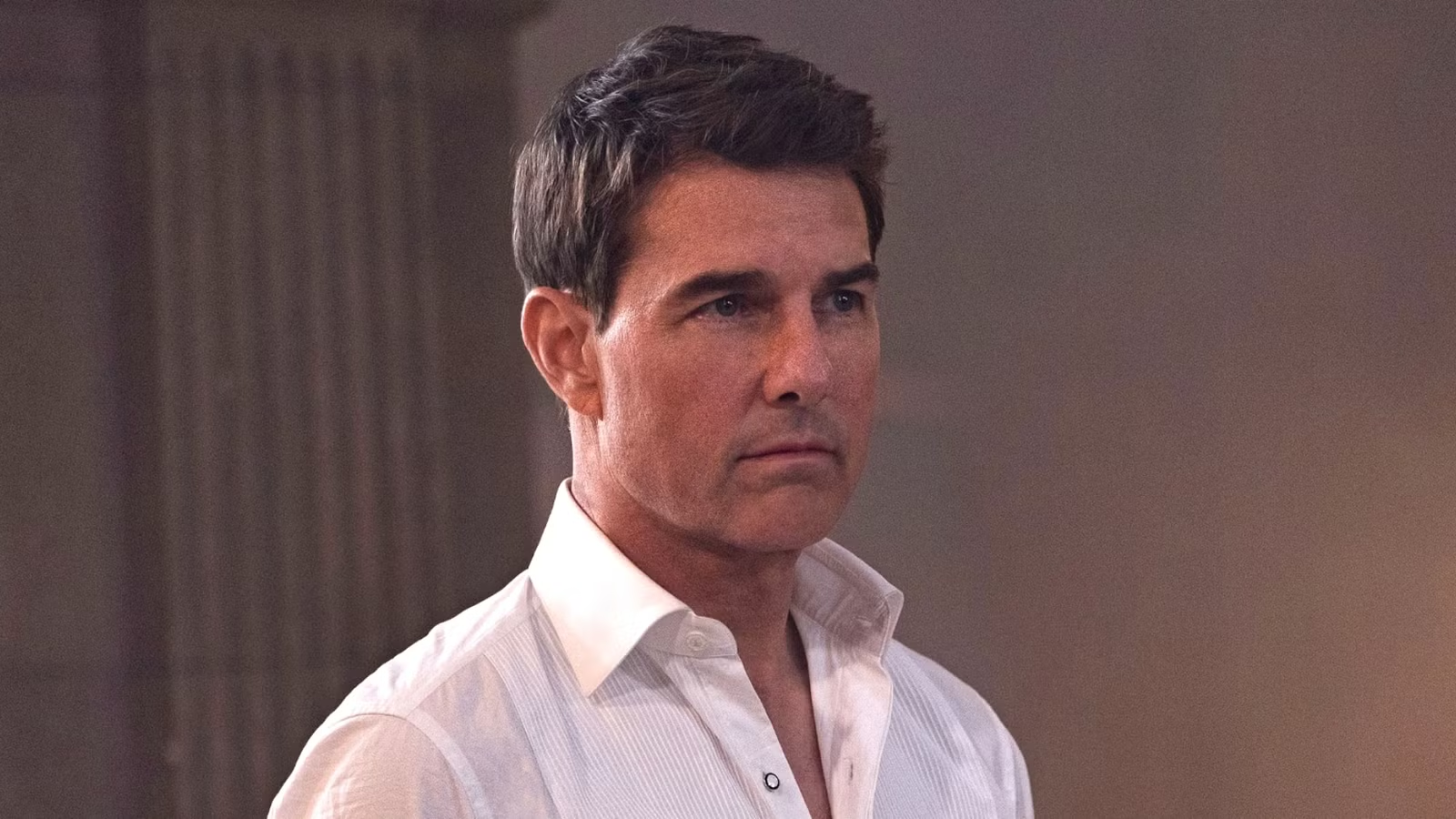






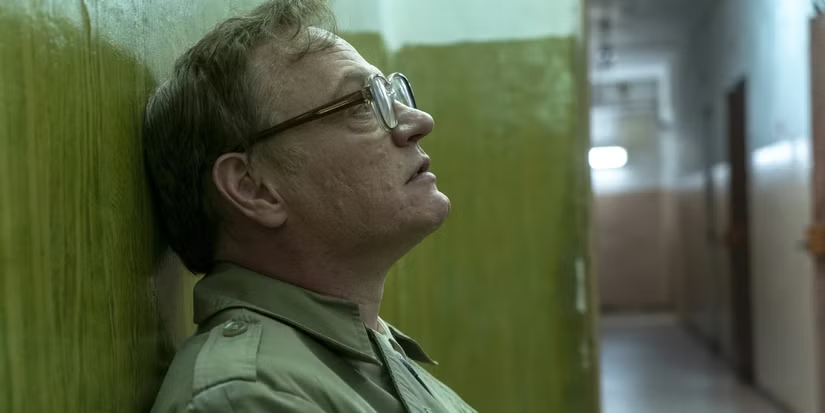







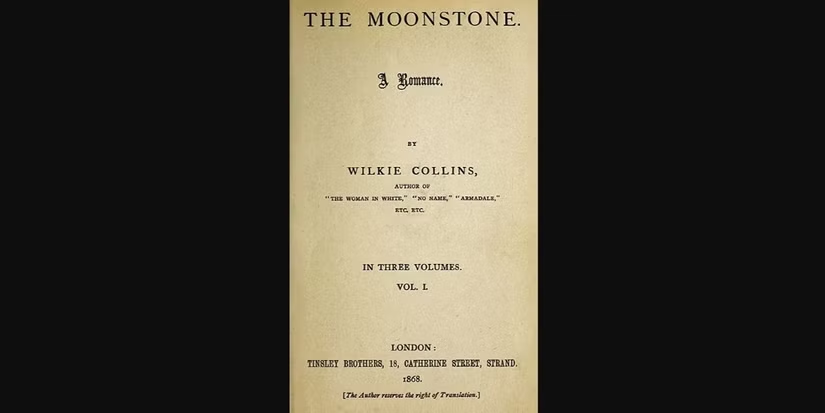




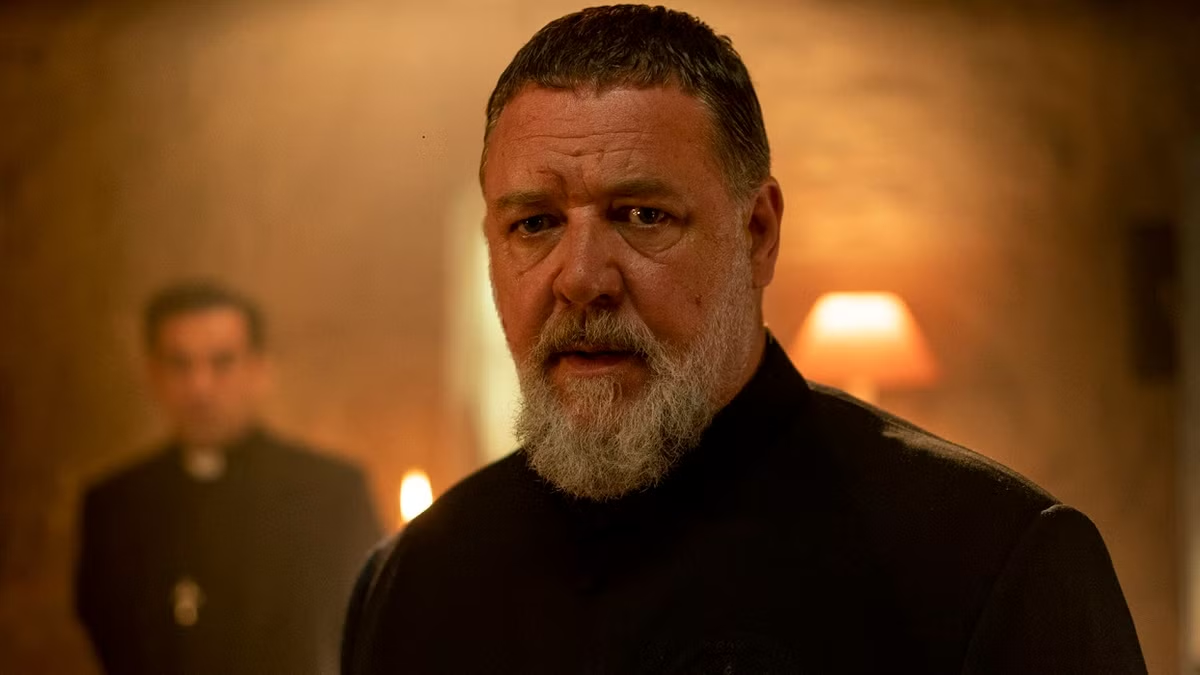




















































You must be logged in to post a comment Login