



Of all the side-effects of weight-loss jabs, this might just be the strangest one yet: Welcome to the rise of ‘Ozempic feet’.
For some, the weight loss of dropping down a dress size also sees them develop painful foot conditions.
Jatender Chaggar, senior foot health practitioner at the Foot-Map clinic, says he’s seen a 4 per cent increase in ‘patients experiencing rapid “foot fat” loss due to GLP-1 weight-loss medications’.
The fat loss on the sole of the foot is like an inflatable being slowly let down, resulting in more pressure on the ball and toes.
Although there is no strong evidence that GLP-1 medications directly cause foot problems, the physical changes associated with major weight loss, including reduction of naturally cushioning fat pads, changes in muscle mass, gait and pressure distribution, may result in stress and pain on certain areas of the foot.
So if you’ve lost weight on the jabs and are struggling in your mules this summer, that might be why.
‘Ozempic feet’ are surprisingly common; fat loss on the sole of the foot causes more pressure on the ball and toes, meaning walking in heels can be especially painful for those suffering it
This loss of padding can also be exacerbated by hormonal shifts in menopause and reduced collagen from ageing. Leading podiatrist and brand founder Margaret Dabbs warns: ‘As we age, the fat pads in our feet can migrate and become thinner and GLP-1s may potentially reduce soft tissue support further. This natural cushioning normally helps absorb impact when walking and supports the foot structure.’
Which is why many of us – particularly when wearing high heels – find it more tiring being on our feet as we get older.
So, what is the best way to ease Mounjaro or Meno Foot without resigning yourself to a life of slippers? Here’s what our experts advise…
Dabbs says, ‘There is not just one cause of heel or metatarsal pain [a burning or tingling on the ball of the foot] and your first point of call should be to book a podiatrist appointment for a full diagnostic assessment (available from £85 at margaretdabbs.co.uk).’

Leading podiatrist and brand founder Margaret Dabbs says the natural cushioning in our feet becomes thinner with ageing, but custom shoe inserts or foot creams can help
Moulded orthotics, custom-made shoe inserts to support the foot and provide shock absorption, are also worth investing in (assessments from £90, prescription orthotics from £400).
‘The plantar fat pads act as shock absorbers,’ says Dr Manav Bawa, Medical Director of Time Clinic. ‘So when that cushioning reduces, patients may experience increased pressure in the heel and forefoot, tenderness on hard surfaces, or a sensation that their feet tire more quickly.
‘In some cases, it can even unmask or worsen underlying issues such as metatarsalgia [pain on the ball of the foot] or plantar fasciitis [stabbing pain on the bottom of the heel linked to repetitive strain].’
Dermal filler, such as Juvéderm, can replace cushioning. Often known as a ‘Loub Job’ – a phrase inspired by Christian Louboutin heels – filler is placed into the heel and ball of the foot to improve shock absorption (from £400). The results can last 6-12 months with maintenance treatments once or twice a year.
Filler in the feet must be administered conservatively by an injector with strong anatomical knowledge, says aesthetician Dr Sophie Shotter, ‘Because the tissues are thinner and there are important blood vessels and structures that can be at risk if product is placed incorrectly.’ She adds: ‘It’s also important to understand that addressing volume loss doesn’t change the underlying cause, so maintaining stable weight and wearing supportive footwear is just as important.’
Chaggar, whose clinic is linked to Altimus sportswear in Kensington, recommends trainers such as Asics Metaspeed or Asics Kayano (£180, altimusoutdoor.com).
To ease ‘Ozempic feet’, Dabbs recommends foot exercises twice a day. These reduce stiffness, improve circulation, maintain joint flexibility and strength. Try ten reps for each foot, which only takes three to five minutes.

Foot exercises, including using a resistance band, can reduce stiffness and increase strength
‘Skin on our feet is 15 times thicker than other parts of the body, which is why foot lotion is advised,’ says Dabbs.
‘Applying with a short massage helps circulation, bringing nutrients to the area and relieving muscle tension.’
Pedicurist Bastien Gonzalez (pedicure £145, mandarinoriental.com) says fat pads can be plumped with massage.
Try Margaret Dabbs Miracle Foot Cream (£24, margaretdabbs.co.uk), The Body Shop Peppermint Invigorating Foot Cream (£12, thebodyshop.com) and Reverence de Bastien Le Baum (£95, niche-beauty.com).
‘When fat pads thin out, the nerves on top of the foot become hypersensitive,’ points out Chaggar.
‘Switch to seamless, moisture-wicking socks to reduce friction and prevent the burning sensations (paresthesia) often triggered by fabric rubbing against the skin.’
Try Bamboo Ankle Socks from Panda Food (£18.71, pandafood.co.uk).

Former Harry Potter child star Jessie Cave has spoken about turning to OnlyFans after her acting career slowed down.
The 39-year-old played Lavender Brown in the Harry Potter films as a teenager and went on to land roles in Call the Midwife and on the West End.
But the mother-of-four has now detailed how work started to slow down last year and she didn’t know where to turn.
In a new interview, Cave said she couldn’t afford to do a new degree and couldn’t get a job in a supermarket, because of childcare costs and fears of customers ‘shouting Harry Potter spells’ at her.
Describing it as a ‘point of complete desperation,’ Cave told The Times she had a ‘breakdown’.
In March 2025, she joined the mostly-explicit content sharing platform OnlyFans, with a viral first post that got her 3,500 subscribers.


Cave posts fully clothed ‘hair content’, in which she brushes her hair, which falls to her pelvis, while dressed as characters including Lavender Brown.
‘I thought I’d make five grand, be on it for a few months and it would buy me time to work out what we’re going to do,’ she told the publication. ‘But it’s now been over a year and a half and it’s genuinely saved our lives.’
She added: ‘My rule is the hair is the main character. That’s how I justify it. It’s literally about hair: the texture of hair. The fetish. It’s very, very niche.’
Cave said her subscribers pay $6 a month, with additional revenue coming from paid-for messages. She said that in one day, she made £15,000 and that in one year, she’s earned more than during her entire acting career.
Before scoring the Harry Potter role, Jessie Cave acted in the CBBC drama Summerhill in early 2008.
She landed Lavender Brown through an open casting call, beating 7,000 other girls for the Harry Potter and the Half-Blood Prince part.
Cave has continued to notch several IMDb credits in the years since, including in Industry, Am I Being Unreasonable? and Black Mirror.
Her longest-running roles have been in the TV shows Buffering, an ITV sitcom created by and starring Iain Stirling, and the Sky sitcom Trollied, about a fictional supermarket’s staff.

Earlier this year, she underwent breast enlargement surgery, which she said her subscribers paid for and something she did in part because her hair ‘can only do so much’.
While Cave does not do explicit content, she said she does routinely get asked to do ‘gross stuff’ on the platform, which she admitted gets to her.
The actress also told the publication she suspects she will only have a limited time on the platform, given that performing explicit content is a line she will not cross.
However, said that she anticipates more artists will sign up to OnlyFans in the future. Kate Nash and Lily Allen have both previously admitted to turning to the platform to subsidise their music careers.
MORE: Outraged Harry Potter fans force diversion of £430,000,000 energy project
MORE: Lego Harry Potter The Ministry of Magic set includes its own tube stop
MORE: Seagull returns lost £10 note to staff member on Harry Potter train
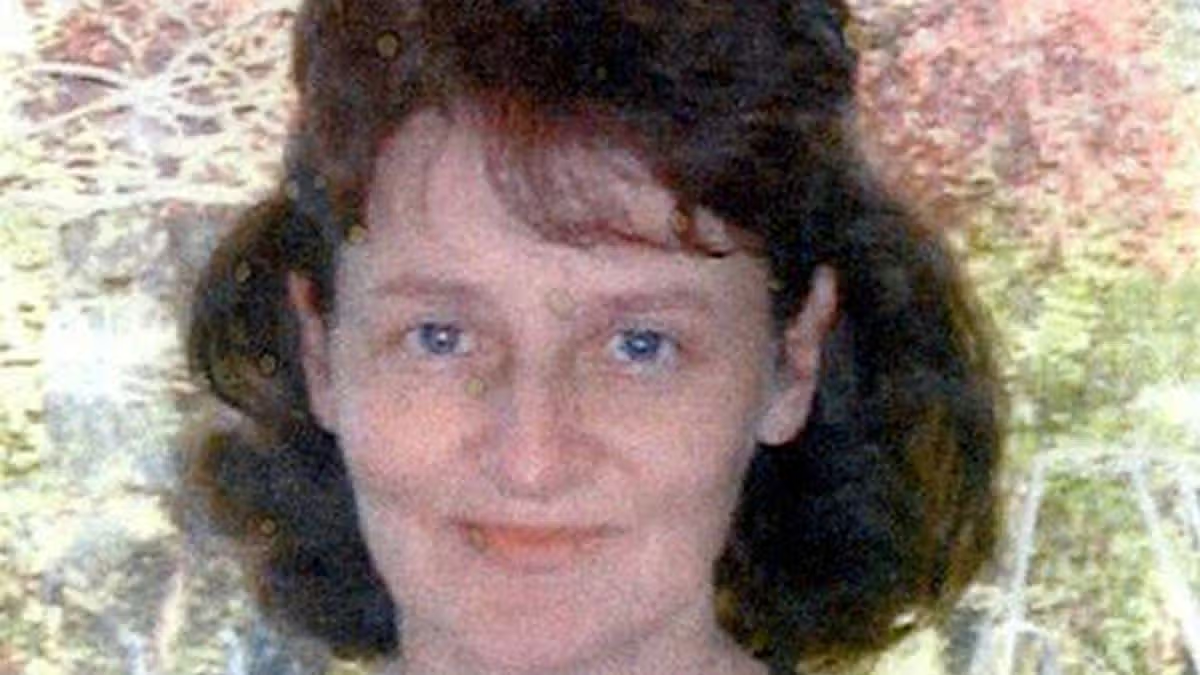
The daughter of a murder victim will urge the High Court this week not to release the killer from prison until he reveals where her mum’s body has been hidden.
Mum-of-four Linda Razzell, 41, vanished without trace on her way to work in Swindon, in May 2002 and was last seen parking her car. Her estranged husband Glyn Razzell, now 67, was arrested when traces of her blood were found in the car he was using. He was convicted of murder and sentenced to life with a minimum tariff of 16 years.
Now, the eldest of their four children, Cat, 38, will tell a High Court hearing that her father is not safe to be released. She believes Razzell “still clearly poses a risk to the public” and “demonstrates continuing cruelty” to his children by not telling them where he hid their mum’s body.
In a statement on behalf of the family she said: “We still do not know where our mother’s body is. Our father continues to deny he killed her, has done nothing to address his abusive behaviour, and refuses to tell us what he did with her remains.
“We do not believe a convicted murderer should progress through the prison system while denying the offence, showing no remorse, and withholding the only information that could bring our family any measure of peace or closure.”
She adds: “I don’t have a wish for my dad to die in prison. This is about giving us information that we need and it’s about us, as a society, saying ‘this is unacceptable and there will be repercussions’. Because, currently, failing to disclose a body doesn’t carry meaningful or effective consequences.”
Following their mother’s murder, the four children, all under 14, were lovingly raised by close members of Linda’s family.
Linda and Razzell, originally from Somerset, had been in the middle of divorce proceedings when she went missing. She had visited a local bank with a court order to freeze his bank accounts the week before she vanished.
At first he made a public appeal for her return, before being arrested and charged with her murder.He was found guilty after a trial and sentenced to life in prison, with a minimum term of 16 years, which expired in 2019.
Razzell applied for parole and was refused three times – including in 2021 when he became the first prisoner to be denied parole under Helen’s Law.
Helen’s Law made it a legal requirement for parole judges to consider non-disclosure by a killer of a body’s remains. It was established after a long campaign by Marie McCourt – mother of missing murder victim Helen, who was killed in 1988.
But on the fourth hearing in January 2026, the Parole Board decided to release him, ruling: “…the panel was satisfied that imprisonment was no longer necessary for the protection of the public.”
However, this decision will now be reviewed by the High Court for a second judicial check, after the Secretary of State for Justice used the new parole referral power, established in December last year. It is a discretionary power that can only be used if it is believed that release would undermine public confidence in the Parole Board. This is the first time a referral has resulted in a High Court hearing.
Cat and other family members will attend the two-day hearing in person to read their Victim Impact Statements. Until now, they have endured their grief in private. But finding themselves in the ‘last chance saloon’ has compelled them to speak out.
Cat said: “Having to do this publicly, just in the hopes of getting some kind of justice is very difficult. But I don’t believe the Parole Board has properly taken into consideration the spirit of Helen’s Law in deciding to grant parole to a man who has done nothing to help his victims grieve the whole time he has been detained?’
“It’s a case of ‘You killed your wife. You took away four children’s mother, you’re not going to say what you did. Here’s 16 years, we’ll keep you in prison for a further five or so, and then you’re free to go.’ That’s not alright, is it?
“There is no evidence that my father is any less dangerous now than on the day he committed that crime. So why is it that he is eligible for parole and he’s been provisionally granted it? That’s something that I think represents a real failure.”
Linda, she said, experienced abuse that was physical, emotional and financial after the couple separated. “When you’re 12 years old, you don’t really understand the fullness of what’s happening in this adult scenario that’s really toxic. But what I could understand is that my dad was hurting my mum.
“Twice, she took my dad to court for assault – but he was acquitted, leaving him free to kill her in the ultimate act of control.”
The family were stunned that the Parole Board recommended release – while acknowledging that Razzell has information about where and how his wife’s remains were disposed of which he has not disclosed, had used significant violence against her on several occasions and could reduce the family’s pain ‘in a moment’ by saying what he did after the murder.
Campaigner Marie McCourt, now 83, is also urging the decision to be reversed. In a statement issued by the family, she said: “I was appalled to learn of the decision and urged ministers to challenge it. My daughter’s killer was released, just before Helen’s Law was adopted, despite hiding her body. It almost destroyed me.
“Human rights laws ruled out No Body No Parole that I had originally fought for. I was advised that a legal requirement to consider non-disclosure was the next best thing – and, once in place, could be tightened. Over six years, I have called for set questions to be asked of killers in hearings and the involvement of an independent forensic psychologist – but to no avail.”
Marie is now calling on Westminster to follow the lead of Northern Ireland which is introducing a ‘stronger’ version of Helen’s Law where hiding a body will result in a longer sentence.
Cat told how they have not been able to grieve properly, explaining: “It is a ritual – both to honour who that person was and for the living to remember the dead. Taking that away takes away a piece of the humanity of the person that died and the ability to grieve for the people that remain. And to do that to your own kids… I just can’t fathom how someone can live with the guilt.
“It might have been really difficult and extremely painful to know what happened at the time but it might have meant less suffering in the long term. Because I couldn’t properly grieve, I couldn’t properly think about what happened for a really long time until I was much older.
“The continuing impact of the decision not to tell us what happened has meant that my family’s suffering has been just extended. So aside from the need to lay somebody to rest, which is just fundamental, there’s also this greater harm that continues to ripple out.”
Prior to the time of abuse which left Linda ‘a frightened, anxious’ person, Cat has fond memories of her ‘amazing’ mum. She said: “I remember her being just an amazing, amazing, mother – thinking always of other people, being generous with her time and money. She was a fantastic cook and really emotionally intelligent.
“She understood what it was like to lose a parent. She lost her own mum when she was eight and, I think, wanted to show us how much she loved us. And that’s abundantly clear in the fact that, we’ve worked hard to make successes of our lives, despite the challenges. I think there’s no greater testament to her.”

The summer window continues to ramp up as the likes of Arsenal, Manchester United, Chelsea, Liverpool and Tottenham work on deals to improve their squads. The Gunners are on the lookout for attacking targets, and could reignite their interest in Julian Alvarez, amid interest in Bradley Barcola and lliman Ndiaye, while Ezri Konsa and Tottenham captain Cristian Romero are of interest in defence.

Maresca’s team will be out soon, so let’s see how it differs from the XI that he used in training. That was: Donnarumma, Nunes, Dias, Reis, Gvardiol, Kovacic, Reijnders, Foden, Savinho, Semenyo, Marmoush
They were working meticulously and it feels like Maresca will want to see what he saw yesterday on the ball. That is a strong team that wouldn’t look out of place starting the Community Shield given the absences City have got.

ALBUQUERQUE, N.M. (AP) — On opening day at the Iowa Tribe of Oklahoma’s new Harrah’s-branded casino, the tribe’s chairman watched customers pack the gambling floor while a queue of cars spilled out of the parking lot.
“We couldn’t let them in because we were so full,” Chairman Jacob Keyes said. “That’s a direct impact from the Harrah’s name.”
But a vacancy in Washington is preventing the tribe’s partnership with the gambling giant from moving beyond branding. Plans for Harrah’s parent company to take over day-to-day management of the casino in Chandler, Oklahoma, stalled after it opened in April, because no one is at the helm of the federal commission that oversees tribal gambling.
The last chairperson of the National Indian Gaming Commission stepped down from the role in January. President Donald Trump has not nominated anyone to fill the vacancy. Absent a chair, the commission is unable to perform some key responsibilities, like enforcing legal and safety violations, approving new tribal gambling laws and certifying management agreements between tribes and casino operators.
Industry leaders say the agency’s inertia risks delaying business deals, weakening oversight and leaving tribes without a key advocate in Washington as they grapple with an emerging threat posed by online prediction markets.
“At this crucial time, the (National Indian Gaming Commission) is operating with one arm tied behind its back,” said Jonodev Chaudhuri, a former NIGC chair from 2013 to 2019 and a citizen of the Muscogee (Creek) Nation. “That’s a very precarious position for tribes and Indian gaming.”
There’s a lot at stake for tribes that rely heavily on casino revenue to fund healthcare, housing, education and other vital services. Tribal gambling brought in a record $46 billion in 2025, nearly triple the annual casino revenue of gambling powerhouse Nevada.
With its Harrah’s contract stuck in limbo, the Iowa Tribe’s small government staff finds itself managing the 175,000-square-foot (16,258 square-meter) casino, a mammoth task it had intended to outsource.
“It’s discouraging. We’re paying a fee and not getting the full value,” Keyes said.
The decision to outsource management was strategic: Harrah’s branding would bring in more business than existing staff could accommodate. Instead, staff has to balance management with other priorities like preparing tribal budgets and overseeing social programs, Keyes said.
The three-member gaming commission was formed in 1988 to regulate casino-style gambling and promote economic development on tribal lands. Some 250 tribal governments across 29 states now operate 545 gambling facilities, the commission said.
Under federal law, its enforcement powers are vested solely in the chairperson. Industry leaders say its inability to cite casinos for violating federal law or force the emergency closure of unsafe facilities is particularly troubling.
In a typical year, the commission issues several citations to tribes for operating casinos on unauthorized lands, failing to submit required financial statements, misusing revenues and other violations. The commission’s last enforcement action was issued on Jan. 12 — the same day acting chairperson Sharon Avery’s term expired. She remains on the commission.
The commission declined an interview request and said in an emailed statement that tribal officials and its field staff provide “excellent regulation” amid the leadership gap. But Steven Light, an expert in tribal gambling law at the University of Nevada, Las Vegas, said the lack of enforcement power could discourage investment in tribal gambling and slow business growth.
“Markets function best when there’s stability and certainty around processes and rules,” Light said.
The commission vacancy comes as the popularity of online prediction markets like Kalshi and Polymarket explodes. Tribal leaders fear those platforms, which allow users to wager on the outcome of virtually any event, could violate their sovereignty and take a bite out of gambling revenue.
“Every dollar generated by Indian gaming goes to fund healthcare for our people, education for our children, housing for our elders,” said David Bean, chairman of the Indian Gaming Association and a citizen of the Puyallup Tribe.
At least eight tribes have sued prediction market platforms, alleging they accept bets from tribal lands and in states where tribes have exclusive gambling rights in violation of the Indian Gaming Regulatory Act, which the gaming commission is tasked with enforcing.
Prediction markets argue their users are engaging in futures trading, not gambling, and dispute claims that they are circumventing regulation.
The commission chairperson typically serves as an advocate for the tribal gambling industry in Washington, according to former commissioners and staffers. Yet it’s been conspicuously silent while the federal government weighs how to regulate prediction markets, said Joe Valandra, the commission’s chief of staff from 2005 to 2007 and a citizen of the Rosebud Sioux Tribe.
James Siva, who leads the California Nations Indian Gaming Association and is vice chairman of the Morongo Band of Mission Indians, said the Trump administration’s support of and business ties to the prediction markets industry could explain why it hasn’t filled the vacancy.
“These things are happening in conjunction with each other,” Siva said in April at a news conference with the Indian Gaming Association. “It is not a coincidence by any means.”
The commission’s last Senate-confirmed chairperson termed out under former President Joe Biden without a successor in place.
A White House spokesperson called the commission a “valued board” but did not say when a new nomination will be made.
In April, Trump appointed Assistant Secretary for Indian Affairs Billy Kirkland, a citizen of the Navajo Nation, to the commission. That’s raised questions about potential executive branch influence over an agency designed to be independent.
“This crosses that threshold in an uncomfortable way,” said Shannon O’Loughlin, the commission’s chief of staff from 2015 to 2017 and a citizen of the Choctaw Nation of Oklahoma.
Keyes said a crucial opportunity to develop his tribe’s economy hangs in the balance. He doesn’t see the commission vacancy as partisan play.
“I don’t want to sound like sour grapes, but when have Native American issues ever been prioritized by the federal government?” he said.

At a time when the debate over migration is drawing a great deal of heat, Spain has stood out in Europe for its liberal stance. Six months ago, the government of Pedro Sánchez opened up a pathway to legal residency for hundreds of thousands of undocumented migrants. So, when tens of thousands of migrants crossed from Morocco into the tiny Spanish enclave of Ceuta on July 30, the uproar was not confined to Spain.
This came days after Spain’s supreme court had ruled that migrants stopped at sea while trying to reach Ceuta or Melilla, another Spanish enclave on the coast of Africa, could not simply be returned from whence they came. While many commentators blamed this ruling for the sudden dash for Ceuta, more than 95% of the migrants who entered on July 30 have since returned to Morocco via the land border.
Nonetheless, the events of July 30 stirred up a hornets’ nest in Spain, where the Sanchez government, which has a minority of seats in the Spanish parliament, is under severe pressure from conservative and far-right parties. Spain’s far-right Vox party, led by Santiago Abascal, has been running hot on the subject ever since.
As Deniz Torcu, an expert in globalisation at Spain’s IE university, notes, the footage of migrants surging past, or swimming around, barriers into Ceuta immediately changed the tone of the migration debate in Spain – and elsewhere in Europe. “The optics are a gift for Europe’s far right, and they know precisely what to do with it. They can lose every argument about the real numbers and still come out ahead, because their aim is to make the story of a welcoming Spain look foolish.”
À lire aussi :
How the Ceuta border crossing incident immediately played into the hands of Spain’s far right
Spain has held Melilla and Ceuta since the 15th and 16th centuries respectively, despite being pushed out of the rest of north Africa over the years. Francisco Franco launched the Spanish civil war from Ceuta in 1936, having flown there from the Canary Islands where he was Spain’s military commander.
The two enclaves remain an open sore in relations between Spain and Morocco, explains Parvati Nair, a professor of Hispanic, cultural and migration studies at Queen Mary University of London. And the events of July 30 will not have made things any easier – Ceuta’s authorities have already accused its neighbour of deliberately loosening border controls on its side, something Morocco denies.
Nair charts the controversial history of Ceuta and Melilla as colonial hangovers which now play a key – and contested – role in the enforcement of Europe’s southern border.
À lire aussi :
Ceuta and Melilla: how the colonial legacies of these cities have shaped migration in the region
This role, and the ability of the European Union generally to control its borders, are now the subject of intense debate for the EU’s 27 member states. An emergency video conference was held on August 4, prompted by a letter signed by 22 members including Italy, Germany, Poland, Hungary, the Czech Republic and Denmark, which made a number of claims about shortcomings in EU border controls.
One was that domestic policies of countries such as Spain acted as “pull factors” for irregular migrants. Another was that the movement of such migrants through EU countries is being facilitated by the Schengen agreement, which provides for free movement of people through member countries. Karla Zeravcic and Marco Mauer, researchers at the European University Institute, point to problems with these assumptions as they relate to EU law.
À lire aussi :
Ceuta migrant crossings: are calls for stronger border controls from 22 member states in line with EU law?
The UN has reported that in the 300 days since the ceasefire in Gaza came into force last October, at least 300 children have been killed. It’s a shocking statistic which gives urgency to the latest roadmap to peace unveiled by the US president, Donald Trump, at the end of July.
But that deal now looks to be dead in the water after Israel’s prime minister, Benjamin Netanyahu, said his country would not withdraw its troops from the Palestinian enclave until Hamas is completely disarmed. Hamas has already said it will not disarm until Israel withdraws its military. So it’s stalemate – once again.
This was not unexpected, writes Julie Norman, whose book Gaza: The Dream and the Nightmare – co-authored with American political scientist Maia Carter Hallward – charts the enclave’s history and chronicles the devastation of the past three years of war. Norman has just returned from a month of fieldwork in the West Bank, where settler violence and land seizures are spiralling.
Julie M Norman
She believes that events in Gaza and the West Bank are “inextricably linked” – and that the likelihood of any peace deal in Gaza is far outweighed by the very real prospect of out-and-out conflict in the other, much larger Palestinian territory.
À lire aussi :
How Israeli conduct in the West Bank could derail Donald Trump’s latest peace plan for Gaza
In March 2023, the International Criminal Court issued an arrest warrant for Vladimir Putin and the Russian president’s commissioner for children’s rights, for the crime of unlawful deportation of children from occupied areas of Ukraine into the Russian Federation.
Now, a disturbing report prepared for the Organization for Security and Co-operation in Europe has revealed the forcible indoctrination and militarisation of these children, and also children in Russian-occupied parts of Ukraine.
The report’s authors, Stefan Wolff, Elīna Šteinerte and Hervé Ascensio, found detailed and distressing evidence of children being force-fed propaganda and given military-style training in schools which were deliberately preparing them to fight against their own country. This, they stress, is a crime under the Geneva Convention.
It was revealed at the end of June that Donald Trump made US$2.2 billion (£1.63 billion) in the first year of his second presidential term. Much of this reportedly came through his investments in cryptocurrency, including the $TRUMP meme coin he launched days before his inauguration, which has since lost much of its value.
The revelations prompted much discussion about the rights and wrongs of a president doing business while in office. Historian Benjamin Quail, of Queen’s University Belfast, gives us a rundown of the financial fortunes of previous inhabitants of the White House, and finds that while it’s not unusual for a president to make a fortune after leaving office, Trump’s amassing of such a fortune as president is without precedent.
À lire aussi :
Donald Trump has made US$2.2 billion in his second term. How does that stack up against other US presidents?
“
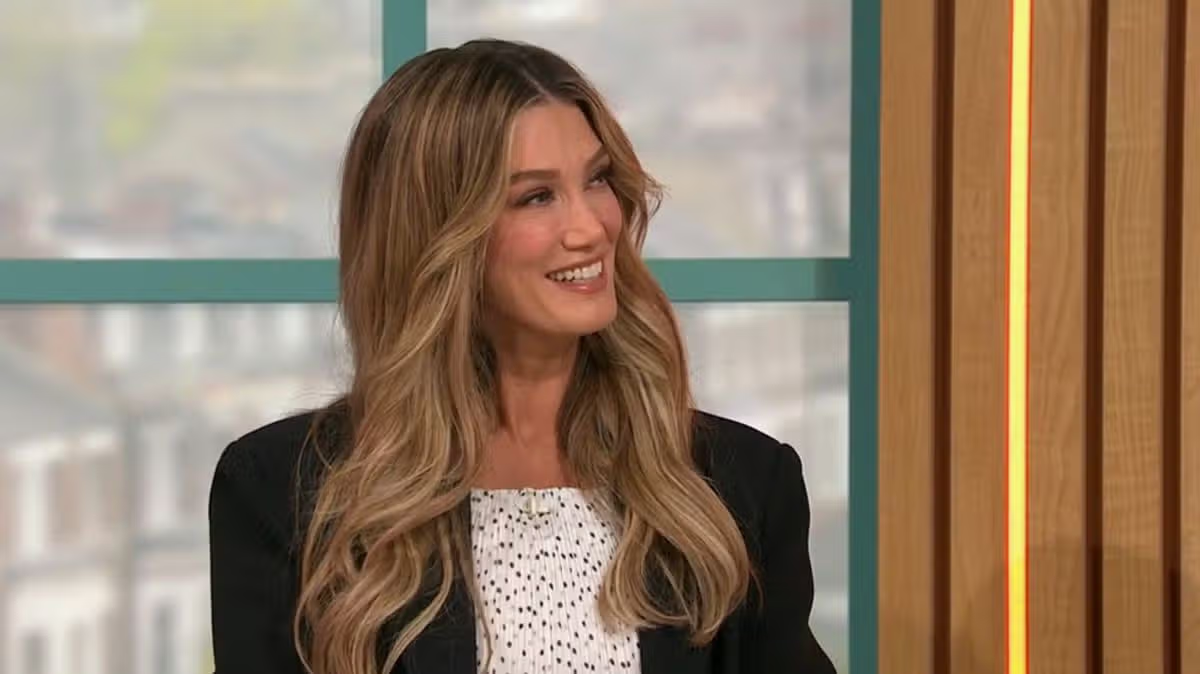
Delta Goodrem is set to star on the new series of Strictly Come Dancing, which is expected to kick off next month.
The Australian singer-songwriter, 41, will be taking to the ballroom in hopes of lifting the all-important glitterball trophy, although she doesn’t yet have a professional dance partner.
Appearing on the latest episode of Sunday Brunch (August 9), Delta joined hosts Tim Lovejoy and chef Simon Rimmer alongside guests JB Gill, Tracy Ann Oberman, Nick Helm, and Holly Humberstone.
After opening the Channel 4 show, the conversation quickly turned to Delta’s fast-approaching appearance on Strictly as former contestants, JB and Simon, shared their experiences of taking part in the competition.
Despite the competition starting in a matter of weeks, celebrity contestants haven’t yet been partnered up with a professional dancer, though Delta confirmed the process is due to take place within the coming week.
Tim asked, “When did you find out who your dancer is?”. She replied, “No, I think in a couple of weeks, so it’s still like a week or so away when we start the process. I’m excited, nervous, all those kinds of things.”
Tim added, “Simon loved it, JB you loved it as well,” as JB chimed in, “Oh, you’re going to have such a good time. Honestly, it’s so good, really fun. I’m sure everyone you’re going to be going up against will be brilliant.”
Simon then called the first day of rehearsals terrifying, and told Delta and JB, “Basically, you see all the pro dancers being pro dancers, and you can both dance, I couldn’t, and I’m thinking, ‘what am I doing here’.”
When asked if she thinks she will win Strictly, Delta added: “Oh look, I am going to go in and give my very best that I possibly can. I have no expectations or awareness of what level of dancing.”
Returning to the dance floor later this year as Strictly professionals are Dianne Buswell, Julian Caillon, Amy Dowden, Katya Jones, Neil Jones, Nikita Kuzmin, Jowita Przystał, Johannes Radebe, Aljaž Škorjanec, Alexis Warr, Kai Widdrington, Nancy Xu, Carlos Gu, Lauren Oakley, and Vito Coppola.
In addition to the returning dancers, brand-new professional dancers will join the line-up in 2026, Aleksandra Isaeva, Cristian Priori, Lethabo Monametsi, Maddie Ingoldsby and Mark Karmalita.
Delta Goodrem is one of Australia’s most accomplished and enduring artists, with a career spanning multiple fields, including as a singer-songwriter, actress, philanthropist, and entrepreneur.
Speaking about joining the show, Delta said: “I’ve been incredibly honoured to perform on many different stages throughout my career – from TV, theatre, film sets, to touring my own shows around the world.
“There is, however, one stage I’ve never stepped onto, and that is the ballroom floor! I’m absolutely thrilled to be joining Strictly and can’t wait to get started!”
Joining Delta in this year’s line-up for Strictly Come Dancing is:
With more names yet to be announced for the show…
Sunday Brunch airs every Sunday at 10am on Channel 4
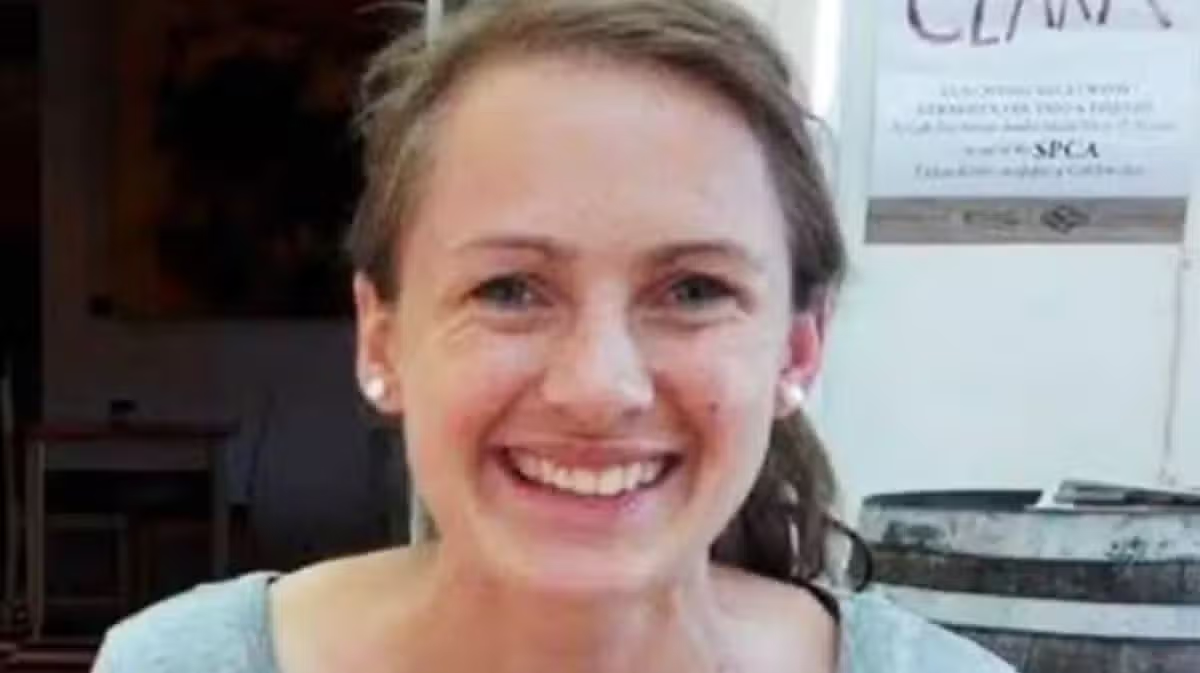
The test results to establish how a Scottish aid worker died, after her body was found in a suitcase in Greece, could be delayed for another month.
Elisabeth-Jane Ross, 38, known as Lisa, was found dead by a homeless man in a derelict building in the Kypseli area of Athens on Saturday, July 18, after travelling there from Edinburgh on June 26. Sharif Ahmadzai, 26, has since appeared in court in the Greek capital on suspicion of killing the aid worker, along with weapons offences and robbery charges.
Local police said they were fast-tracking tests as a priority. However, spokesperson Konstantina Dimoglidou has said that the results could take “at least another month”, according to the BBC.
The coroner’s report initially cited an undetermined cause of death, as the body showed no signs of external trauma. Then “asphyxiation was listed as the probable cause of death” following a more detailed investigation, autopsy and post-mortem examination.
On Thursday, Ahmadzai – a professional boxer from Afghanistan – arrived at the Court of First Instance in Athens where he was detained on illegal weapons possession charges and a charge of homicide with intent. Ahmadzai’s lawyer Christos Erdos confirmed his client did not speak during Thursday’s hearing.
He did not submit a plea in relation to any of the three charges he faces. It is understood he denies murder and claims he found Lisa already dead on the bathroom floor.
Ahmadzai was remanded in custody until his trial, which could take up to 18 months.
The court complex is located on the city’s Evelpidon Street, a short walk from the derelict building where the charity worker’s body was found. Floral tributes have been placed on the ground next to the structure, with one card containing the words “Elisabeth-Jane Ross. Rest in peace” written in Greek.
Police said the suspect was detained for questioning after investigators reviewed surveillance camera footage recorded nearby. After allegedly killing Ms Ross, Ahmadzai is accused of sending a series of messages from her phone to her friends and family before switching off the device.
He is then said to have bought another phone and texted her friends in Athens, including his wife, impersonating an unnamed jihadist saying he had killed the Scot because of her religion, Greek newspapers Proto Thema and Ta Nea reported. The newspapers said his wife, a US citizen named Alaina Hall, told the police she suspected her husband’s involvement in the killing when she woke up to find he was not in their apartment and tracked his phone to where Ms Ross was staying.
Ahmadzai’s lawyer has also claimed that his “have been violated”. In a statement released to the media, Paraschis-Erdas and Associates said that a the leak of “information and documents” amounted to the violation.
The firm claimed that there were “no injuries whatsoever“ and that “there was a complete absence of any obvious cause of death”.
The statement continued: “His approach toward the prosecutorial and investigating authorities was therefore not one of refusal to cooperate, but rather one of reservation, so that he could provide a full statement once the case file had been completed with the above essential documents.
“These documents had not been sought by the pre-trial investigating authorities. The sole objective is to establish the substantive truth, for the benefit of both sides.”
Ms Ross is believed to have died a number of days before she was found, during which time temperatures reached 36C. Authorities were able to identify her using fingerprints.
Her family paid tribute days after she was identified. A statement read: “Lisa will always be remembered by us as kind, principled and selfless.
“Her integrity was absolute, and she dedicated her life to helping others in need. We are in deep pain, and we ask for time and privacy as we come to terms with our loss.”
The Foreign and Commonwealth Office said: “Our thoughts are with Elisabeth’s family during this difficult time. We are providing consular support and are in contact with the local authorities.”
A Police Scotland spokesperson said: “We are aware of the death of a Scottish woman in Athens and are liaising with authorities in Greece. Officers are providing support to her family in Scotland.”
Get more Daily Record exclusives by signing up for free to Google’s preferred sources. Click HERE.

The Met Office expects temperatures to rise from Monday (August 9) and reach 30C by Tuesday and 31C on Wednesday.
Clear skies are expected on Tuesday and Wednesday turning to clouds and highs of 23C-26C at the end of next week.
It comes as a yellow heat health alert was issued for York on Saturday until Tuesday.
The UK Health Security Agency (UKHSA) issued the heat alert and warned the latest high temperatures could put extra pressure on the NHS, with more vulnerable people likely to require medical treatment.
Read next:
Mike Silverstone, the Met Office’s deputy chief forecaster, said rising temperatures mean a “fairly widespread heatwave is likely across large parts of England and Wales, with hot conditions developing in places”.
“The heat is expected to peak for much of England, Wales, Northern Ireland and Scotland on Wednesday, with up to 34C possible in parts of central and southern England and southeast Wales. East Anglia and south-east England, however, could see temperatures even higher on Thursday.
“Humidity levels are also expected to increase through the week, which may make conditions feel more uncomfortable, particularly overnight.”
The hot weather comes after last month was confirmed to be the driest July for England and Wales since records began in 1836, according to provisional figures released by the Met Office.
Nineteen counties across England recorded effectively no rainfall – 1mm or less – across the whole of the month, Met Office figures show.




Zack Polanski: an incitement to murder Nigel Farage?


Frugal Friday’s Workwear Report: Cap-Sleeve Pointelle Crewneck Sweater


Weekend Open Thread: Mattifying Sunscreen


DTCR: Deleveraging And A Hedge Fund Collapse Point To A Possible AI Bottom


XRP Ledger urges node upgrade after manifest flood


Jordan Coyle & Cordiamo take Laya Arena Stakes at RDS


Can Astrology Help Find Gold and Silver Trends? A Financial Astrology Guide


US Tech Stocks See Largest 5-Week Inflow in History: Can Nasdaq Break Its Downtrend?

US stocks: Dow closes at record on Mideast optimism; SpaceX, AMD drag Nasdaq


Reform UK And Greens Sink To Lowest Favourability Ratings To Date


Nvidia Stock Climbs 2.5% as Chip Sector Rally Builds Ahead of AMD Earnings, Nvidia’s Own Report Looms


Polymarket targets $20 billion valuation as competition heats up in prediction market sector


OpenAI teases Astra, its next major AI model, after it solves 10 long-standing math problems


OpenAI, Anthropic AI agents targeted real people and systems in cyber tests


Supply chain issues impact Ingredion


#crypto #cryptocurrency #cryptonews #cuet2026 #ceuta


Myspace owners announce plans to relaunch the once-popular platform


Crypto.com Partners with UFC for UFC 331 Event

CLARITY Act Senate Vote Locked In, But 60-Vote Hurdle Looms Large


Huge SPINS!! (for me) #slots #casino #gambling #money #jackpot



You must be logged in to post a comment Login