

Entertainment
Only 5 Fantasy Movies From the 2010s Can Be Considered True Masterpieces

Every decade is home to some fantastic films, and one of the greatest genres that fans have been enjoying for centuries is fantasy. The sense of adventure paired with the mystical worlds, fascinating creatures, and overall feeling of wonder is unrivaled. The best part of the genre is that it can be so many different things, from epic high fantasy films like The Lord of the Rings trilogy to a more grounded movie that bends realism into fantasy, such as Life of Pi. Whatever fans want, this genre can provide.
Out of all the decades, the 2010s are one of the most peculiar when it comes to fantasy films, providing a mix of animation, high fantasy, and altered fantasy. There may be a lot of great movies, such as A Monster Calls, but there are only a handful of masterpieces. That is why this list will determine the only five fantasy movie masterpieces from the 2010s based on originality, story, influence, staying power, themes, directing, acting, fan opinion, critical acclaim, and overall quality. The status of masterpiece is a title few movies achieve, but these five films wear it proudly.
‘How to Train Your Dragon’ (2010)

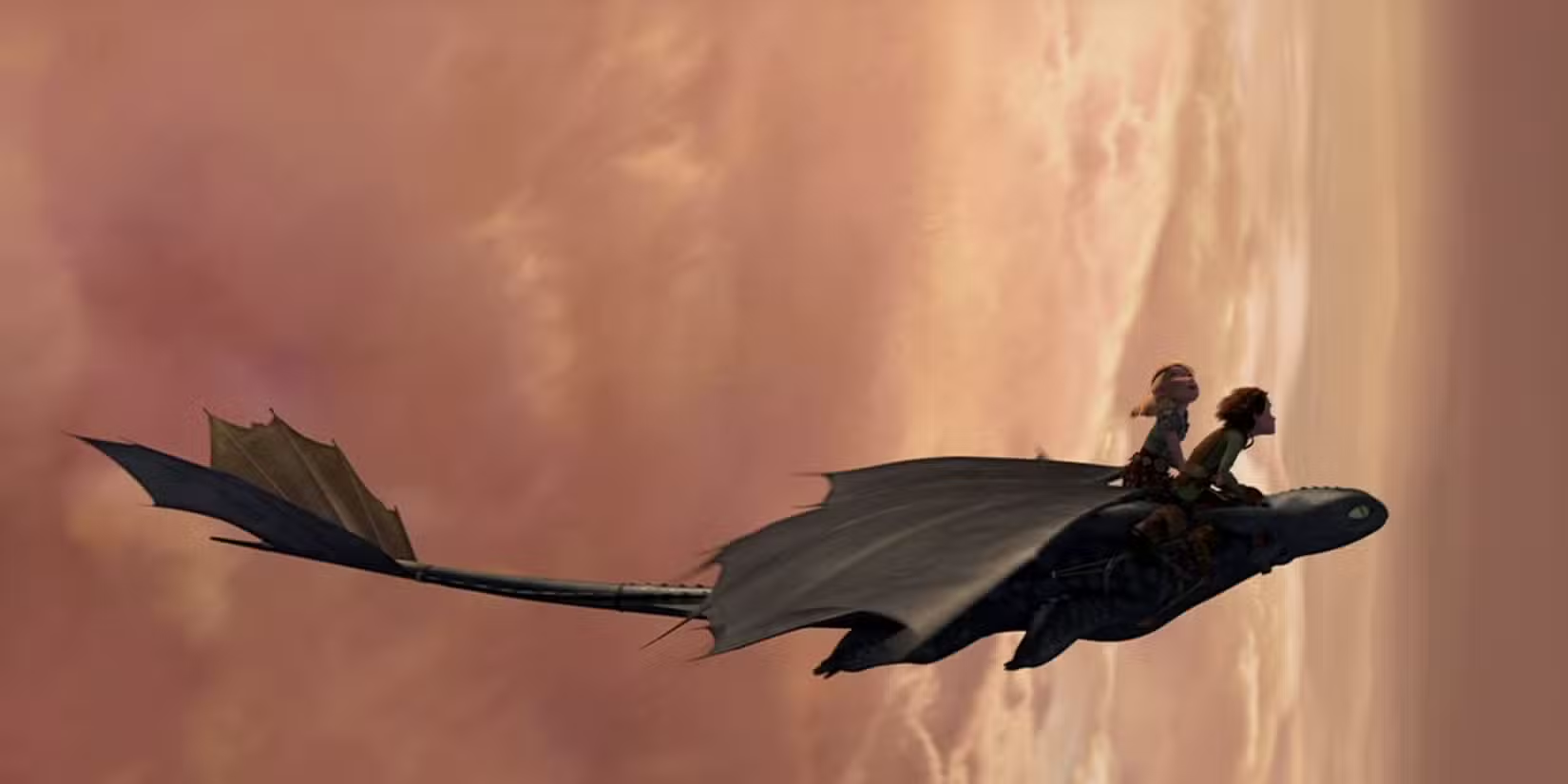
Live-action remakes are here to stay, unfortunately, creating soulless rehashes of beloved animated classics. One of the most recent adaptations is How to Train Your Dragon, and even though it was almost entirely one-to-one, the original is still far better. The village of Berk is home to some of the strongest Vikings in the land, but they have been at odds with dragons for as long as time. It is a rite of passage to slay a dragon, but the Chief’s son, Hiccup (Jay Baruchel), is against the murder of these creatures, leading to a rough relationship with his father. After finding a rare dragon, Hiccup decides to befriend it, leading to the realization that humans and dragons can coexist. However, he is going to have a lot tougher time trying to convince the people of Berk.
DreamWorks used to be known for its pop-culture gags that, while relevant at the time, didn’t always age well. However, How to Train Your Dragon moved away from this, instead delivering a family movie that aged perfectly. The flight scenes were absolutely gorgeous, using revolutionary technology to create a kinetic sense of action that was both beautiful and exhilarating. Technical craftsmanship aside, this movie also features a classic story with emotional weight. The characters are endearing, the humor is funny, and the scale is magnificent, all coming together to make How to Train Your Dragon an iconic staple of the 2010s and a universally beloved animated film.
‘Midnight in Paris’ (2011)

Woody Allen is a controversial figure, but no matter what fans think of him, they have to at least acknowledge his proficiency in filmmaking, specifically in the romance genre. One of his best modern works is Midnight in Paris, which blends his usual style of romance and comedy with a little fantasy spice. Gil Pender (Owen Wilson) is a Hollywood screenwriter and aspiring novelist, but he and his fiancée (Rachel McAdams) are in a tough spot. Vacationing in Paris, Gil takes to wandering the streets alone at night, only to find himself transported back in time to the 1920s. Here, he meets icons like Ernest Hemingway (Corey Stoll) and F. Scott Fitzgerald (Tom Hiddleston), who may help solve his problems.
Midnight in Paris is a forgotten fantasy film, but that doesn’t take away its status as a masterpiece; it just means more fans need to rediscover this flawless movie. Magic and fantasy go hand in hand, but where most films use them for spectacle and mysticism, Midnight in Paris uses them as a precise storytelling tool to explore the philosophical nature of the film and its themes. This profound touch creates a distinct fantasy masterpiece that is much different than the other movies on this list, but this separation further proves its genius. By deconstructing the Golden Fallacy, Midnight in Paris creates a psychological evolution of its protagonist that is grounded and bittersweet.
‘The Tale of the Princess Kaguya’ (2013)

Anime is one of the biggest media as of late, and it also contains some of the greatest fantasy films, mostly from the acclaimed animation studio, Studio Ghibli. However, out of their impressive catalogue, the only fantasy masterpiece of the 2010s they have is The Tale of the Princess Kaguya. Based on a 10th-century Japanese folktale, it follows the titular princess born from a bamboo shoot. Now forced to live in luxury with a restrictive life, she must choose a suitor to spend the rest of her life with. However, Kaguya only wants to be free and live a normal human life.
The Tale of the Princess Kaguya doesn’t use the whimsical narrative style as other Studio Ghibli films do, but rather adopts a tragic and somber story. This timeless tale works perfectly with this modern adaptation because it uses a sketch-like watercolor style that mimics the sumi-e style, creating a visual masterclass with one of the most engaging art styles in animation. The narrative reflects its themes in the art, thus providing a beautiful contrast that highlights the excellence of The Tale of Princess Kaguya. The technical innovation, when paired with its emotional story, creates an unforgettable movie that might be Studio Ghibli’s best.
‘Kubo and the Two Strings’ (2016)
This list features a good amount of animated films, which is only natural since the fantasy genre works best in this creative and ambitious medium. How to Train Your Dragon is a Western animation, and The Tale of the Princess Kaguya is an anime film, so Kubo and the Two Strings perfectly rounds out this trifecta as a stop-motion masterpiece. When the titular character accidentally summons an evil spirit, he must travel around ancient Japan in search of his father’s spirit, hoping to defeat the Moon God.
When done right, stop-motion is one of the most visually stunning mediums ever, and Kubo and the Two Strings is the height of the genre. Putting together intricate characters, creations, and one of the largest set pieces with a giant skeleton, this movie builds an immersive world that is a spectacle to witness. Furthermore, the painterly woodblock aesthetic makes Kubo and the Two Strings feel more authentic, accentuating the style and themes. By blending CGI with its puppets, Kubo and the Two Strings becomes one of the greatest fantasy adventure films, not to mention its profound themes of grief and memory that create a daring and captivating masterpiece.
‘The Shape of Water’ (2017)

Guillermo del Toro is a cinematic mastermind, creating some of the most unique, bizarre, and creative fantasy films that have all become cult classics. However, the one that won him the Oscar was The Shape of Water. Set in the 1960s, it follows a mute cleaner at a government facility, who discovers the secret they have been harboring: a mutated fish-man creature from the Amazon. Instead of being afraid, Elisa (Sally Hawkins) is fascinated by the monster and forms an unlikely bond with it, eventually orchestrating an escape when it doesn’t have much time left.
The Shape of Water might not be for everyone, but its distinct atmosphere and unique story make for a touching tale that uses del Toro’s signature style in its favor. Here, the renowned director flipped the classic Monster Movie formula into an endearing romance that was fresh, daring, and bold. The Shape of Water cemented itself as one of the best modern fantasy movies because it blends genres so masterfully, mixing spy thriller in the Cold War era with monster madness, romance, and fairy tale. It may not be a traditional fantasy movie, but that is exactly why it is a masterpiece from the 2010s that will be remembered forever.

Continue Reading
Some movies are just purely horrifying. Since the dawn of cinema, horror has been at the forefront of entertainment, delivering some of the most spectacular and terrifying films in history. They captivate audiences, sending a shiver down their spines at how thrilling and creepy they can be.
Yes, the horror genre is full of some truly frightening movies, but which ones stand out as the most chilling? The following entries are top contenders for the scariest of all time. They’re iconic and unquestionably disturbing stories that have endured throughout the decade, continuing to scare viewers and filling them with unimaginable terror. They have retained their ability to scare and are as effective today as when they first came out. From James Wong‘s Final Destination to William Friedkin‘s The Exorcist, here are the scariest movies from horror cinema.
30
‘Final Destination’ (2000)

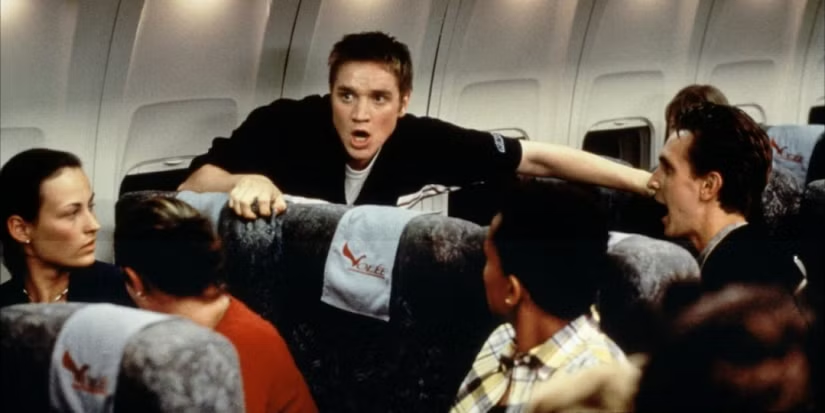
From director James Wong, the 2000 horror thriller Final Destination is a paranoia-inducing modern classic that made audiences everywhere afraid of their surroundings. It begs the ultimate horrifying question: how can you escape something that’s after you if it is literally death itself? For high schooler Alex Browning (Deven Sawa), that question is on his mind. After having an ominous premonition of a plane disaster, he narrowly avoids the tragedy along with a lucky few. But when the survivors slowly die in gruesome freak accidents, Alex suspects the real personification of the Grim Reaper is reclaiming the lives that were never meant to get off that plane.
Final Destination is a hair-raising thrill ride full of epic suspense, unexpected scares, and plenty of shockingly gory kills. It keeps viewers on edge with its chilling premise and a fantastic horror villain in the form of Death, who is unstoppable, unavoidable, and always comes back. This film shows some horror that can’t be outrun, and that’s the scariest kind of horror this is. While not exactly a perfect film, Final Destination has scared the wits out of audiences for generations since the early 2000s, even spawning one of the most successful and long-running franchises still going strong today.
29
‘Rosemary’s Baby’ (1968)

One of the most effective slow-burning mystery thrillers of all time, Roman Polanski‘s 1968 masterpiece Rosemary’s Baby is a timeless film that can still creep under your skin. Mia Farrow commands the screen, giving one of the most solid horror performances of the 20th century as Rosemary Woodhouse, a soon-to-be mother, slowly unraveling as her difficult pregnancy, coupled with her apartment tenants’ strange behaviors, causes her to believe sinister forces are trying to take away her unborn child.
This is a masterclass in set-up and payoff, featuring a perfect escalation of terror that ultimately leads to a horrifying yet satisfying conclusion, which has since become a standout in the horror genre. Rosemary’s Baby is effective at giving the audience an unsettling mystery to follow. It knows how to slowly scare you with its mounting suspense and subtle moments of dread. Truly, it’s a timeless terror that doesn’t lose its ability to freak viewers out.
28
‘The Blair Witch Project’ (1999)

1999 was a cruel year for horror; the genre was changed forever with the release of The Blair Witch Project, the supernatural thriller that birthed the booming found-footage craze. It’s revolutionary for its time, as viral marketing and word of mouth truly amplified the hype, making audiences at the time genuinely feel like the horror they were about to see was real. It documents three amateur film students as they encounter something terrifying while searching for a local witch legend in the woods of Maryland.
Today, the buzz surrounding The Blair Witch Project‘s marketing has since died down, but the terror still lives on. The hand-held technique, coupled with the raw, realistic dialogue and acting, still makes it feel that it has some connection to real life. It’s also a masterclass in dread, as the slow build-up to the three characters’ haunting doom feels prevalent throughout the runtime. While some find The Blair Witch Project polarizing, as either you love it or hate it, there’s no denying its success and influence changed the horror landscape, and it remains eerily realistic even today.
27
‘Saw’ (2004)

In 2004, audiences were dared to play a game, and the horror world was changed forever. James Wan, the legend behind some of modern horror’s most chilling masterpieces, delivered Saw, a psychologically twisted, shockingly gory, and nail-bitingly suspenseful mystery thriller that later came to define early 2000s horror cinema. Leigh Wannell and Cary Elwes star in this dark tale of survival as two men, who’ve each done terrible things in the past, wake in a dirty, locked bathroom and soon realize they’re unwilling participants in a game of life-or-death against the mysterious Jigsaw (Tobin Bell) serial killer.
It’s a spine-chilling, iconic shocker, featuring some of the scariest plot twists in recent movie history. Saw ushered in a new age of horror at the turn of the 21st century, with its gritty tone and graphic violence, reinvigorating the splatter subgenre. It takes you on an intense mystery as you follow along with the two men as they discover why they are there and just who the Jigsaw killer really is. By the frightening finale, you’ll be left completely frozen in terror. And this effect still persists even after rewatches.
26
‘The Descent’ (2005)

Highly regarded as one of the most claustrophobic horror movies in history, Neil Marshall‘s The Descent is a film guaranteed to leave some viewers sleeping with the lights on. It follows a group of friends as they descend into an uncharted cave system in the Apalachian Mountains. But, after a sudden cave collapse, they soon realize they’re not alone in the dark.
The Descent is honestly too hard to watch at times, as the extreme violence and gory effects, coupled with the uncomfortably cramped setting and psychological tone, make it a truly nightmarish experience. It’s an intense survival tale that gets more bloody, horrific, and mind-bendingly twisted as the story progresses.
25
‘The Shining’ (1980)

From the brilliant mind of one of the all-time greatest filmmakers of the 20th century, Stanley Kubrick, comes his eerie adaptation of horror novelist Stephen King‘s The Shining. Hailed as horror royalty, it’s a chilling, slow-burning horror masterpiece full of dread and mounting tension. Featuring two magnificent performances by Jack Nicholson and Selly Duvall, it follows a struggling writer as he slowly succumbs to madness and turns on his family after being influenced by the sinister ghosts of a desolate mountain resort.
This thought-provoking psychological masterpiece has become an essential part of horror and pop culture. It’s a perfect example of suspense and tension building used to enhance the horror elements of the story. It’s also incredibly ambiguous, leaving unanswered questions about whether it’s more psychological or supernatural. Though King has had some hard words about the changes and ambiguity of this story, this version of The Shining is undeniably frightening and complex. There are so many moments that have audiences gasping and coming back for more.
24
‘The Omen’ (1976)

The ultimate creepy kid movie, the late Richard Donner‘s The Omen, is a terrifying supernatural horror thriller that came to define the genre in the 1970s. A paranoia-inducing tale with shocking twists and intense dread, it sees Academy Award-winner Gregory Peck in a heartbreaking role as an American Ambassador who slowly uncovers a devastating secret that he’s being used to raise the devil’s son to take over the world.
It’s a nail-biting thriller with mounting suspense and unending dread. There’s a lingering sense of doom throughout this story, and it keeps rising with every scene and every shocking death. Coupled with a compelling and undeniably frightening supporting performance by the then-young Harvey Stephens as the sinister son of satin, Damien Thorn, The Omen is a creepy classic that continues to leave shivers down audiences’ spines.
23
‘The Silence of the Lambs’ (1991)

As the only horror film to win Best Picture, and one of only three films to win the big five at the Academy Awards, The Silence of the Lambs is an undeniable masterpiece that deserves all of its acclaim. Directed by the late Jonathan Demme, this fascinating crime thriller features two powerhouse performances by Jodie Foster and Sir Anthony Hopkins in a thrilling mystery that follows an FBI trainee as she plays an intense game of wits with a brilliant convicted murderer to help her locate another serial killer.
With hair-raising suspense and grisly violence, The Silence of the Lambs is quite intense and shocking, one of the most edge-of-your-seat horror movies of all time. Sir Anthony Hopkins intimidates viewers with his Oscar-winning performance as the cunning and ruthless Dr. Hannibal Lecter. Every second of his screen time is tense, and he seems to control every moment, despite the fact that he spends most of the time behind bars. There’s a great feeling of terror in this masterpiece, and it hasn’t diminished in the years since its release. It’s only gotten more compelling and terrifying.
22
‘When Evil Lurks’ (2023)

One of the most unbelievably terrifying films in recent memory, Demián Rugna‘s unusually disturbing supernatural thriller When Evil Lurks is a devastating watch that gets more shocking and unflinching with every second. It follows two farming brothers in Argentina as they accidentally ignite a terrible series of events after they unsuccessfully try to dispose of a bloated, demonically possessed body.
This brings new levels of demonic terror. When Evil Lurks never lets up in intensity and dread. It’s often cited as being mean-spirited and bleak, featuring a plot that seriously has no chance of a triumphant finale for the main characters. The deaths are nightmare-inducing, and there are moments here that are unbelievable and striking enough to evoke a sense of absolute terror. There’s nothing else quite like it.
21
‘Psycho’ (1960)

A highly influential masterpiece, the late Sir Alfred Hitchcock‘s greatest contribution to horror, Psycho, is truly a necessary watch for fans of the genre. A prime example of brilliant tension and psychological terror, it follows a shocking crime as a thieving woman checks into an isolated motel in the California desert, owned and operated by a timid young man who’s not as harmless as he appears to be.
Psycho is scary in many ways, from its incredible suspense to thrilling mystery to even Anthony Perkins‘ career-defining performance as the deeply disturbed Norman Bates. It’s an unforgettable, hair-raising classic that’s only gotten better and more terrifying with age. And, of course, it is remembered the most by audiences for Psycho‘s iconic shower scene, which is one of the most significant moments in cinematic history.
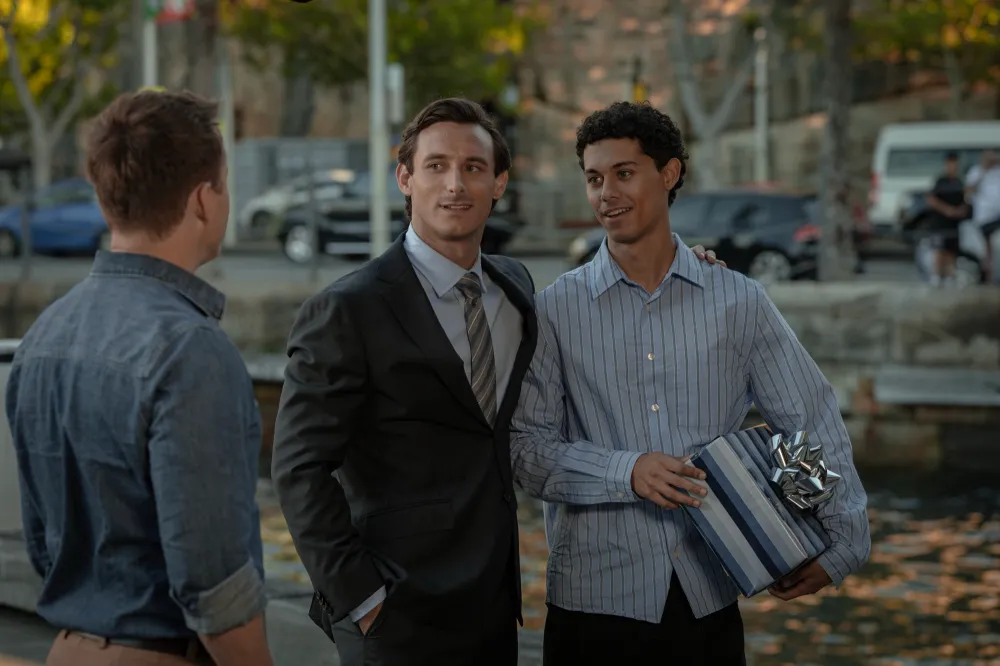
NCIS: Sydney season 3 ended with one case seemingly closing and another up in the air — literally — but it’s the possible romance between Mackey and JD that has fans talking.
Warning: Spoilers below from NCIS: Sydney season 3, episodes 19 and 20.
During the two-part season 3 finale, which aired on Tuesday, May 12, fans watched as Special Agent Michelle Mackey (Olivia Swann) took down The Collective’s lead man, Lee Meyers (Angus Sampson), before corrupt government official US Drug Czar John Callaghan fled Australia with the drug dealer’s intel.
“She gets the last word with Meyers. So I think in Mackey’s world, that’s a success,” Swann, 33, exclusively told Us Weekly of the two-part conclusion that resulted in Meyers being back in custody. “We do leave a little kind of cliffhanger for things to come, which is always exciting.”
Swann noted that the cliffhanger has a lot to do with Callaghan escaping on a private plane after he orchestrated a prisoner switch — Meyers for Mackey’s ex and the father of her child, Ryan Brady (Ryan Panizza) — that gets messy. The good news? Mackey planted her cellphone on the plane before jumping off with Ryan in her arms.
“I think her decision to do that is, again, a very kind of maverick rogue move,” Swann explained. “And I feel like it was just done in the spur of the moment kind of thing.”
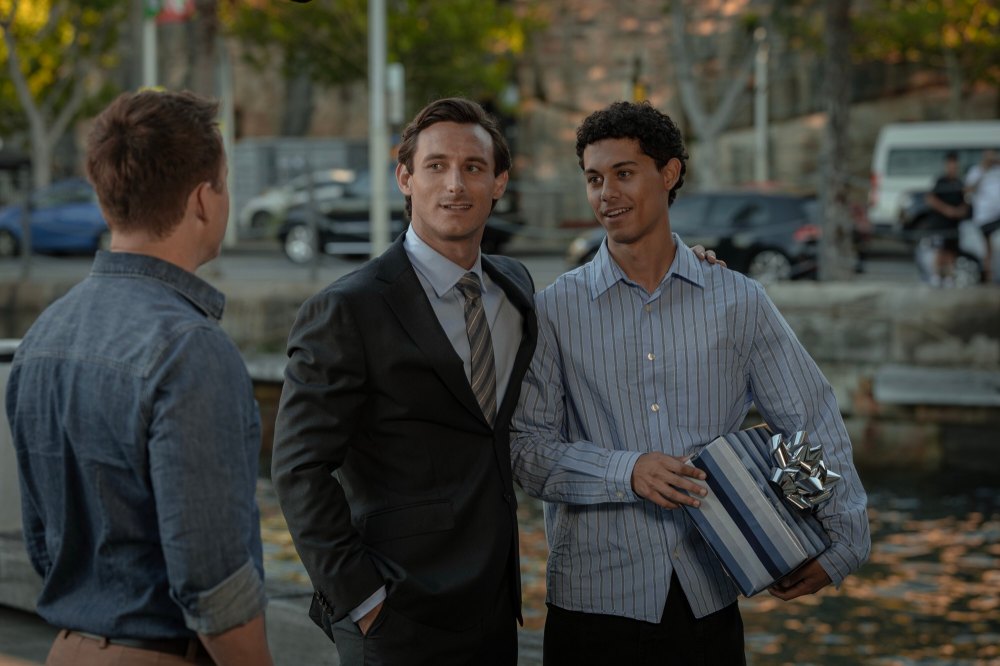
Ryan Panizza as Ryan Brady and Noah Eid as Trey Mackey. Daniel Asher Smith/Paramount+
The actress added that Mackey “teasing JD” by playing coy with what happened to her phone is “just so very Mackey” and a story line that “will be something that hopefully we see” when season 4 premieres in 2027.
While the action comes first on NCIS: Sydney, Swann teased that Mackey’s undeniable chemistry with Jim “JD” Dempsey (Todd Lasance), which is evident during the finale, will be touched upon next season as well. (During Mackey’s son Trey’s 18th birthday bash, she tells JD, he’s a “catch” and they exchange a cheeky look.)
“We are really focusing more on character connections and really building those this season,” Swann confirmed to Us. “So, that very much centers around Mackey and JD. Take with that what you will.”
She pointed out that viewers saw “ a lot more closeness between the two of them” during season 3, including seeing their “trust constantly growing” and their bond “deepening.”
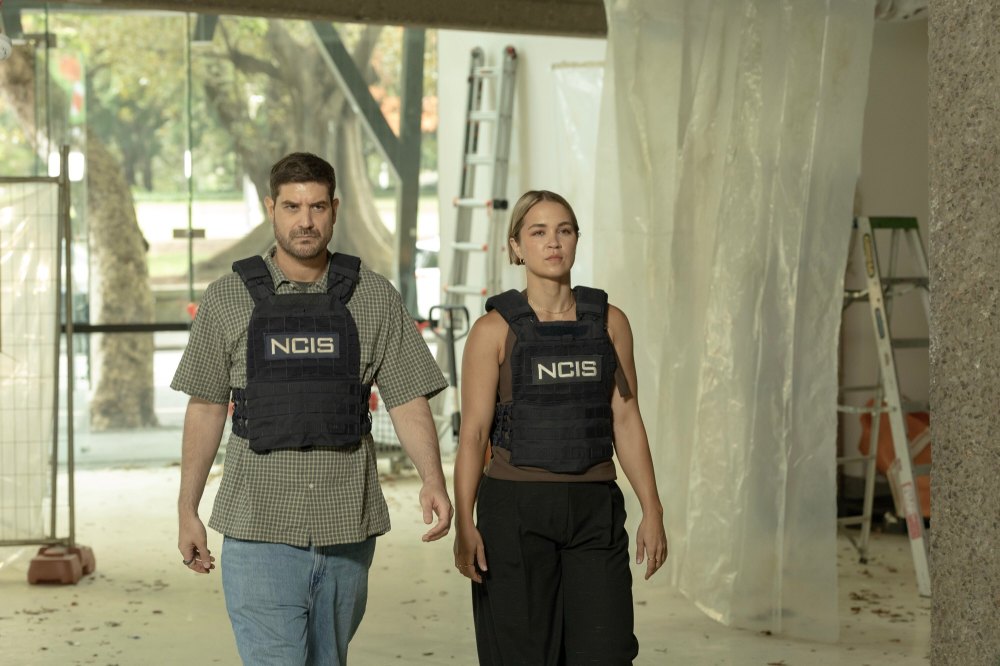
Claude Jabbour as Travis ‘Trigger’ Riggs and Tuuli Narkle as AFP Liaison Officer Constable Evie Cooper. Daniel Asher Smith/Paramount+
“I’m looking forward to seeing where that goes in [season] 4,” Swann confessed, teasing that if Mackey and JD become a couple they “maybe would be surprised at how much their protection level would shift.”
She explained, “I think a lot of what they have is very unspoken and kind of subconscious with each other. If that were to shift into something more overt, I think they’d kind of be taken by surprise at how kind of big and deep the feelings might be.”


Swann also noted that the dynamic between teammates Evie Cooper (Tuuli Narkle) and Travis “Trigger” Riggs (Claude Jabbour) will be a big plot point next season after Trigger told Evie — and no one else — that he accepted another job, which opened up the possibility of a budding romance.
“It is interesting to understand a little bit more of Evie’s psyche to do with Trigger leaving for work, and how that affects her moving forward,” Swann said, confirming that fans will “see a little shift” in how Evie “operates” and in her “bravado” if in fact Trigger does leave the team as their resident bomb guru.
Season 4 of NCIS: Sydney will premiere on CBS sometime in 2027 as part of the network’s midseason lineup.
Entertainment
‘The Punisher: One Last Kill’s Unrelentingly Action-Packed Hour of Television Marks the End of an Era
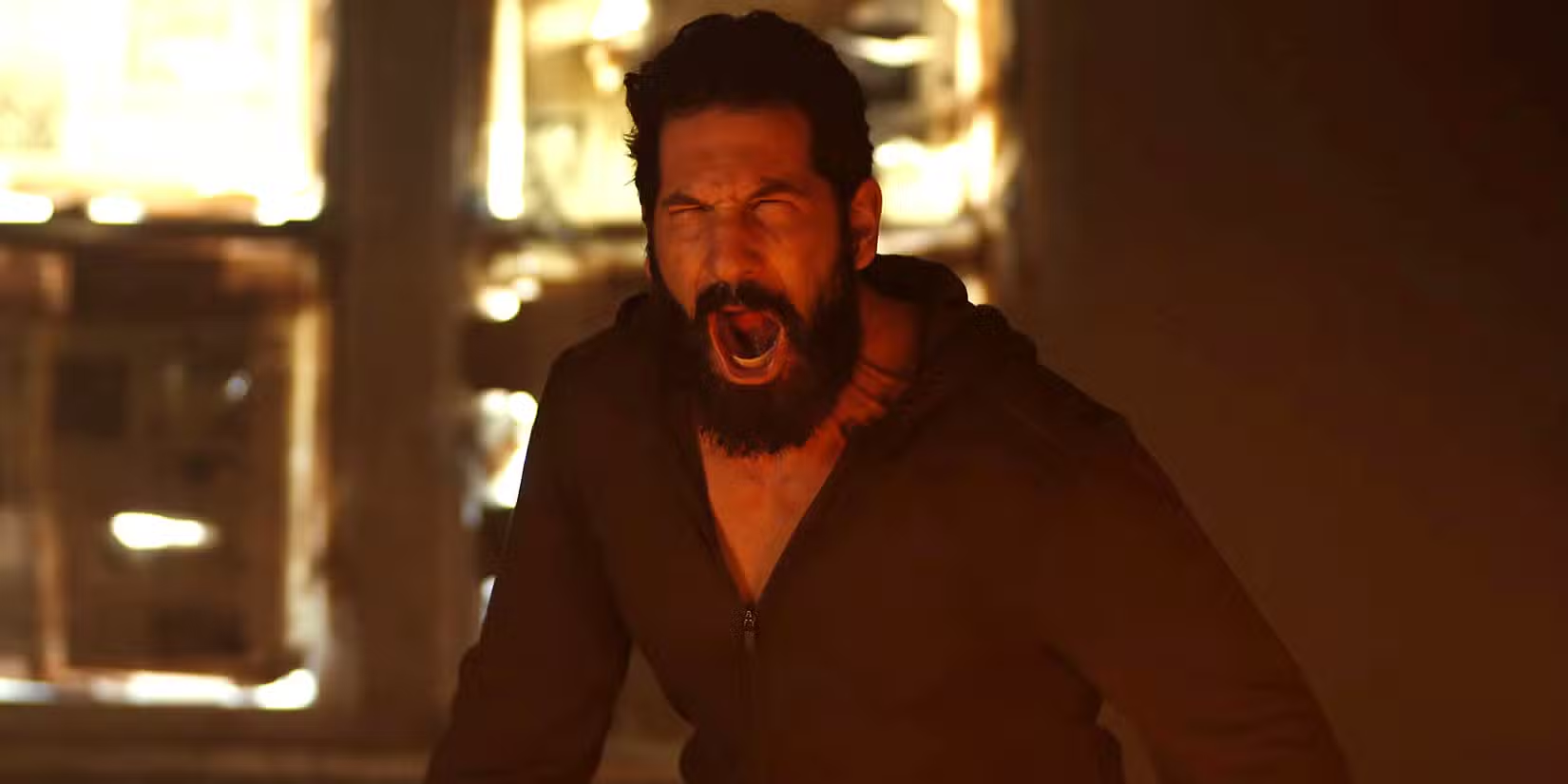
The last time we saw Frank Castle (Jon Bernthal) was at the end of Season 1 of Daredevil: Born Again, where the anti-hero was locked in one of Wilson Fisk’s (Vincent D’Onofrio) cages, but with the return of Season 2 this year, the Punisher was curiously missing from the lineup of heroes protecting New York. Now, after The Punisher: One Last Kill, we know where he’s been the entire time. In a violent and action-packed hour of television, Marvel gives us an intimate look into where Frank has been since the cage. While the special covers a lot of ground, it also dives deep into Frank’s psyche, something fans haven’t witnessed since the end of the original Netflix Punisher series.
‘The Punisher: One Last Kill’ Shows Frank Castle at His Lowest Point
One thing that becomes immediately obvious in One Last Kill is that this is the darkest version of Frank Castle we’ve ever seen. Gone is the snarky, gruff brawler that trades quips with Daredevil (Charlie Cox); this is Frank at his lowest. He’s spent the last few months killing every member of the Gnucci crime family, the last people responsible for the deaths of his family. The streak of vengeance has done a number on his psyche. He’s not only hallucinating the ghosts of his comrades, like Curtis (Jason R. Moore), but also his wife and children.
As a man on a mission, Frank is completely checked out of everything around him. His actions against the Gnucci family have thrown New York into chaos, especially in the neighborhood of Little Sicily, where crime runs rampant. People are getting beaten up, robbed, and even killed without a second thought, but it’s all going over Frank’s head. It’s a stark contrast to Matt Murdock, who can’t help but help everyone around him, even when he’s not able to, and shows the different headspaces of the two characters. It’s not until Frank is literally forced to act that he finally picks up a weapon and becomes the Punisher again.
‘The Punisher: One Last Kill’ Needs To Close the Book on Frank Castle’s Trauma

One Last Kill once again focuses on Frank’s trauma and specifically the loss of his family. Director Renaldo Marcus Green penned the script with Bernthal, and the two have left no room for subtlety when it comes to Frank’s character. Unfortunately, by this point, it’s very familiar ground. It proves that the series needs to let Frank grow beyond his trauma. It’s beginning to make him feel one-note, and the special essentially knocks you over the head to remind you that this is a man in a bad mental state.
The problem here is that this has been Frank’s storyline since we first met him in Daredevil Season 2 over 10 years ago. Since then, we’ve seen him reconcile his past with his present in various ways, but One Last Kill needs to be the last time it’s revisited. Clocking in at under an hour, One Last Kill itself feels very much like a standalone episode or a one-shot comic rather than a true special, like it could be tacked onto Daredevil: Born Again if the season had been longer. Half of the episode is pure action while the other half is pure angst, giving the viewer little time to actually feel settled. It also feels like a bit of a reset for Frank, but as he’s had several of these for his character by now, we can really only hope the change is permanent this time.
Disney+ Goes Full Monty on Violence with ‘The Punisher: One Last Kill’

If Disney+ has been getting flak for making their shows too sanitized, that fear has been officially assuaged (if Fisk crushing a head with his bare hands didn’t do it for you). One Last Kill is unrelentingly vicious when it comes to violence. Within the first ten minutes, we watch an unhoused man get beaten up while his dog is tossed into oncoming traffic. The violence of the special is stomach-churning, especially when there’s no Frank to come in and save the day.
When Frank is confronted by Ma (Judith Light), the matriarch of the Gnucci family, he is finally knocked back into focus. And when Frank goes full throttle, it feels like he’s as invincible as Luke Cage (Mike Colter). Bernthal adds a good amount of grunting and struggling, but at this point, the number of injuries Frank has sustained while continuing to keep fighting is superhuman. At one point, he falls from a roof down to the ground and manages to get up and walk away like it’s nothing. He gets stabbed, slashed, shot, and punched, all while inflicting lethal violence on whoever dares to charge at him.

“Frank Is in My Bones”: Jon Bernthal Confirms He Is Co-Writing ‘The Punisher’ Special
Jon Bernthal makes his writing debut with a new Punisher project, finally telling Frank Castle’s story his way. Discover what’s coming.
As was the issue with the first season of Daredevil: Born Again, this once again feels a bit like Disney overcompensating. Showing sequences of Frank killing mercenaries, almost like a video game, while Hatebreed‘s “I Will Be Heard” blasts, feels a little too on the nose. It’s an impressive bit of violence, showing how creative Frank can be at killing people, but it eats up almost the entire half of the episode, oftentimes becoming redundant.
‘The Punisher: One Last Kill’ Still Wins When It Comes to Character

What saves One Last Kill from being too one-note is, of course, Bernthal’s acting. Green splices in memories of Frank’s kids and his wife Maria (Kelli Barrett) to show us just which demons continue to haunt him, but it’s the quiet scenes he has alone that are the most tragic. His loneliness is suffocating, turning him into a hermit, one who can’t escape the ghosts of his past and doesn’t seem to want to. While these scenes, along with the ones of Curtis and his fellow marines, can feel almost oppressively sad, there is one moment that becomes a turning point for Frank.
Deborah Ann Woll appears near the halfway mark as Karen Page, her presence shaking some sense back into Frank and offering a reprieve from his extremely dour mood. Although it’s short, it acts as a transitional scene between the two halves of the episode as well as Frank’s past and his future. By the end of the special, the stage has been set for Frank’s appearance in Spider-Man: Brand New Day, while also bringing in potential regulars for Frank’s own story, including Light’s Ma and Andre Royo‘s Dre, a local storekeeper who shares some strong moments with Frank.
Ultimately, it’s clear that what makes The Punisher work is still the star at the center of it. Bernthal has a very lived-in approach to Frank, one that manages to make his depressing scenes feel somewhat fresh despite retreading the same ground. As much as Cox has perfected the different sides of Matt Murdock, Bernthal has really honed in on what makes Frank tick, and his presence alone makes One Last Kill worth watching.
The Punisher: One Last Kill is now streaming on Disney+.

- Release Date
-
May 12, 2026
- Runtime
-
60 Minutes
- Director
-
Reinaldo Marcus Green
- Writers
-
Reinaldo Marcus Green, Ross Andru, Jon Bernthal, Gerry Conway, John Romita Sr.
- Franchise(s)
-
The Punisher
Pros & Cons
- Jon Bernthal has perfected playing Frank Castle and it’s never been more obvious.
- The action in One Last Kill is at its peak, even if it can be too violent at times.
- Judith Light and Deborah Ann Woll make great short appearances that propel the story forward.
- One Last Kill feels more like just a standalone episode rather than a special feature.
- The special retreads familiar ground with storylines that have already been thoroughly explored.
Nicole Scherzinger has mixed emotions about the Pussycat Dolls being forced to cancel all but one date on the U.S. leg of their PCD Forever Tour.
“Nicole is disappointed,” a source exclusively tells Us Weekly. “She was really excited to get back out there with Ashley [Roberts] and Kimberly [Wyatt] to celebrate a new era, but now she feels they didn’t get a chance to showcase what they can do.”
The insider acknowledges that the recently reunited girl group had been “too ambitious” in planning their first tour since 2009’s Doll Domination, resulting in low ticket sales.
“They went from not touring for over 15 years to booking big arenas like Madison Square Garden with only one new song to back it,” the source points out, referencing the Pussycat Dolls’ comeback single, “Club Song,” which they released in March but have yet to perform. “They overestimated the demand.”
From nostalgic reunions to buzzy new headliners and possible farewells, this summer’s concert calendar is stacked with what are sure to be must-see tours. Below, Us Weekly rounds up 10 superstar acts — including pop princess Ariana Grande, global heartthrob Harry Styles and generation-defying party starter Bruno Mars — who are hitting the road with […]
Scherzinger’s disappointment has not gotten in the way of rehearsals for the only remaining American show at the OutLoud Music Festival in West Hollywood on June 6. The frontwoman, 47, posted a video via Instagram on Tuesday, May 12, of herself, Roberts, 44, and Wyatt, also 44, running through choreography for the Pride Week performance before they launch their international tour in September.
“Nicole is trying to look on the bright side because the Dolls are still proceeding with their European dates, which she’s beyond excited about, but it’s hard not to feel defeated,” the insider tells Us. “She’s been through this before. Her solo album Her Name Is Nicole was shelved [in 2007], the Dolls also had to cancel their last reunion tour [in 2020] and she has a ton of other music that she never got to put out. It’s been a tough road for Nicole despite her other successes, but she’s grateful for the continuous love from across the pond.”
While the Pussycat Dolls have called off 32 shows, they believe fan videos from the remaining 21 dates could drum up interest for a second chance in America.
“Nicole is hopeful the Dolls can figure out something else in the U.S. after people see the show they’re putting together for Europe, which is going to be very special,” the insider teases.
Us Weekly has reached out to Scherzinger’s rep for comment.

Nicole Scherzinger has finally settled her legal battle with Pussycat Dolls founder Robin Antin over a planned reunion tour that fell apart, Us Weekly can exclusively report. On Tuesday, October 28, Scherzinger, 47, informed the court that the lawsuit filed by Antin, 64, and the countersuit she filed against Antin are being dismissed. The move […]
The Pussycat Dolls — who rose to fame in the mid-aughts with hits including “Don’t Cha,” “Buttons” and “When I Grow Up” — announced in March that they were reuniting and going on tour. However, earlier this month, they released a statement announcing their “difficult and heartbreaking” decision to scrap concerts in the U.S. and Canada after “taking an honest look” at sales.
The girl group’s reunion has been mired in controversy from the start. After Scherzinger, Roberts and Wyatt revealed they were getting back together as a trio, former Dolls Carmit Bachar and Jessica Sutta publicly called them out for not including all five members.
“I was not contacted regarding the group’s decision to move forward, and I learned of these plans at the same time as the public,” Bachar, 51, claimed via Instagram. “Given my history with the brand, having been part of its foundation long before its commercial debut and instrumental in the connections that led to the record deal… I would have appreciated direct communication.”
Meanwhile, Sutta, 43, described herself as a “liability” on the “Maverick Approach” podcast because she is a friend and vocal supporter of President Donald Trump‘s health secretary, Robert F. Kennedy Jr.
“I align with Bobby Kennedy, which is aligning with MAGA,” Sutta added.
The anticipation for Avengers: Doomsday is feverish, to say the least, and the MCU is reaping all the benefits. The franchise has regained prominence, with all the talk of its demise that has dominated the conversation for months taking a back seat to unabashed optimism. The films that make up the franchise have seen a resurgence in streaming, and even the weakest of the Avengers films benefited. And racing up to the top, as it should be, is the MCU’s best, the one that started it all 18 years ago: Iron Man.
Why ‘Iron Man’ Became the MCU’s First Great Movie
By rights, a film about a lesser-known superhero outside comic circles, played by an actor who had only started to rebuild the career that he had utterly destroyed through addiction, directed by Jon Favreau, then best known for Elf, shouldn’t have been a hit. The superhero genre had largely squandered the momentum created by Sam Raimi‘s Spider-Man and his genre-redefining Spider-Man from 2002, with the likes of Catwoman and Spider-Man 3 effectively bleeding it dry. Yet it did succeed, wildly, to the tune of $585 million plus.
So what was it about Iron Man that drew people to the film back then? Like Spider-Man before it, Iron Man represents a true reinvention of the superhero genre, lending it the gravitas Raimi brought to Spider-Man but with a stark realism that keeps it grounded. Favreau kept it fun, adventurous, dramatic, straightforward, and insular, teasing a bigger world without succumbing to a full reveal. Then there was the casting of Robert Downey Jr., a gamble that paid off in spades.
With Tony Stark/Iron Man in that second tier, there were literally no preconceived notions of what the character should be: no inescapable shadow of Christopher Reeve; no years of comic-book lore in the public consciousness, where everyone knows the story of Peter Parker and the radioactive spider verbatim. Downey Jr. was already reinventing himself for moviegoers, and as such was free to craft the perfect marriage of character and actor, becoming truly inseparable from his creation. And the way he was effortlessly able to take Stark from an arrogant, careless charmer to a (somewhat) humbled, morally-stricken charmer was, in a word, stunning.
How ‘Iron Man’ Became an MCU Comfort Movie
But why is the film drawing in viewers now, 18 years later? The reasons above play a part in it, as true now as they were then, but there’s more to it. The simplest explanation is that fans are marathoning MCU content before Avengers: Doomsday hits. That 18-year span would place Iron Man right in the heart of a new generation, too, where those who grew up with the film are now at an age where they’re showing it to their own children.
That tracks, given that the film doesn’t require homework going in. Straightforward, one doesn’t need to have watched countless hours of streaming content just to know what’s going on in Iron Man. It represents a simpler time for the MCU, a sense that it was building towards something important, as opposed to now, where such a high bar has been set that anything less than Avengers: Endgame is a disappointment and a step backwards.
The Superhero Movie That Started a Billion-Dollar Franchise Proves It’s Still One of the Best
Robert Downey Jr. returns to the MCU this year.
There could be another, more psychological rationale for Iron Man‘s recent streaming success: the concept of the “comfort movie.” During times of turmoil, of which current events certainly qualify, people face difficult decisions, life changes, and an almost relentless outpouring of negative news from almost every direction. All these things work to overload our cognitive abilities, our working memory, and, as silly as it may sound, watching a new movie requires a lot of mental work that only adds to the problem. First, you have to find a movie that you might be interested in, no guarantees, then you need to know the characters, track the storyline, and leave enough room for plot twists.
But as Psychology Today notes, “there’s no guesswork, cliffhangers, or stressful anticipation when watching an old favorite — which makes it easier for our tired, overloaded brains to process.” What fills that role better than Iron Man? It’s a classic good vs. evil film; there’s no guesswork, and there aren’t multiple timelines and thousands of hours of content to know to enjoy it. It’s easy to like Downey Jr., easy to dislike Jeff Bridges‘ Obadiah Stone, and it’s easy to fall into the childlike thrill of seeing that first successful test flight again. But whatever the reason, Iron Man hits the heights once again, 18 years later, it just seems right.
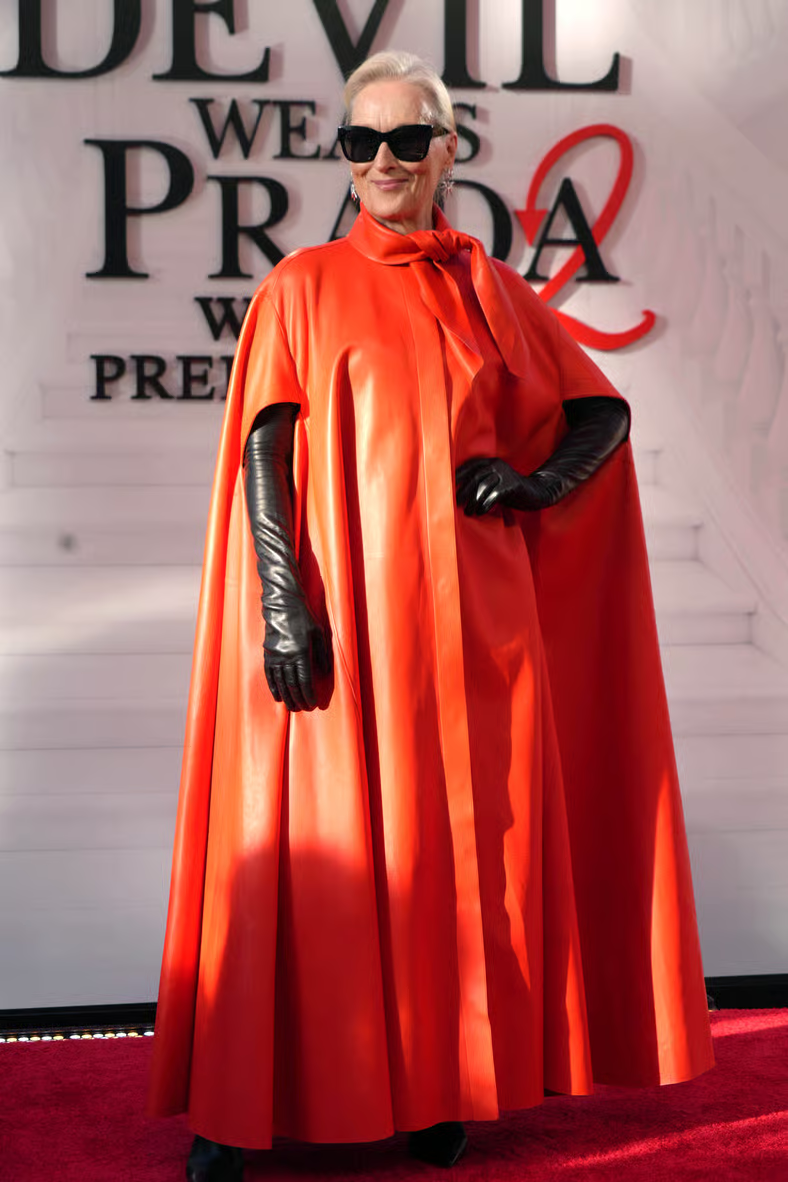
Meryl Streep has spent decades being treated as untouchable in Hollywood, but the internet is suddenly asking a question many movie fans never thought they would hear: has the Oscar icon actually made that many great films in recent years?
A viral debate over Streep’s modern filmography exploded online after social media users began revisiting some of her biggest flops, divisive performances, and critically panned projects.
Even with “The Devil Wears Prada 2” dominating theaters, the actress is now facing renewed scrutiny over whether her legendary status still matches her recent work.
Meryl Streep found herself at the center of social media discourse after a viral post declared her the greatest actor of the century.
Although the list was later revealed to have been generated by AI, it still sparked intense online debate about Streep’s work over the last 25 years.
One viral X post questioned whether the actress has actually delivered many memorable films since 2000.
“I’ll give you three chances to name a good Meryl Streep movie since 2000 and I’ll be shocked if you can get to two,” one user wrote.
Political journalist David Weigel added fuel to the conversation by criticizing several of her more recent projects and even calling some of them “Streepslop.”
Critics online pointed toward films like “Lions for Lambs,” which struggled with reviewers and currently holds a low Rotten Tomatoes score.
Others revisited “The Prom,” the Ryan Murphy musical comedy that failed to recreate the success of Streep’s “Mamma Mia!” era despite featuring stars like Nicole Kidman and James Corden.
Streep’s Box Office Misses Are Being Revisited

As the online discussion intensified, several of Meryl Streep’s lesser-loved films began resurfacing across social media.
Her musical drama “Ricki and the Flash” was once again criticized for failing to leave much of a cultural impact despite pairing Streep with her real-life daughter Mamie Gummer.
The pair had also previously appeared together in 2007’s “Evening,” which received harsh reviews for what critics described as overly slow storytelling and “labored dialogue.”
Romantic comedies like “Prime” and “It’s Complicated” also became part of the discussion. While “It’s Complicated” still earned impressive box office numbers, many viewers revisiting the film now remain divided about its long-term appeal.
Other titles receiving renewed criticism included “The Laundromat,” “The Giver,” “Rendition,” and “Dark Matter.”
Even some of Streep’s award-recognized work hasn’t escaped scrutiny. Her Netflix satire “Don’t Look Up” divided audiences despite becoming a streaming sensation during the pandemic.
Meanwhile, “The Iron Lady,” which earned the 79-year-old another Oscar win for portraying Margaret Thatcher, still holds mixed reviews more than a decade later.
“Meryl Streep’s performance as The Iron Lady is reliably perfect, but it’s mired in bland, self-important storytelling,” Rotten Tomatoes’ consensus reads per the Daily Mail.
Meryl Streep’s New York Times Snub Still Divides Critics

One of the biggest moments reigniting criticism around Streep’s career happened years earlier when The New York Times excluded her from its list of the greatest actors of the 21st century.
The omission shocked many film fans, especially considering Streep’s decades of acclaim and record-breaking Oscar nominations.
Instead, the list highlighted performers including Isabelle Huppert, Nicole Kidman, Denzel Washington, Keanu Reeves, and Daniel Day-Lewis.
After backlash erupted, critics Manohla Dargis and A.O. Scott defended the decision publicly.
“Meryl Streep has given some very fine performances in the past 20 years, but she’s also given some not very good ones that are showy and overdone,” Scott explained.
He specifically pointed to “August: Osage County” and “The Iron Lady” while arguing her recent work reflected a “mixed record.”
Dargis also dismissed arguments centered around Streep’s long awards history. “People keep yelling at us about how many Oscar nominations Streep has, as if that’s a metric Tony and I ever paid attention to,” she said.
Dargis continued, “This is not a list of people who have been nominated for Oscars; this is our list of people we really, really respect and love.”
Streep Still Has Several Modern Classics Under Her Belt

Despite the growing criticism, Meryl Streep’s supporters have been quick to point out that her post-2000 career still includes several celebrated films.
Her performance in Charlie Kaufman’s “Adaptation” remains widely praised, and the film was later recognized by both The New York Times and the British Film Institute as one of the century’s best films.
She followed that success with “The Hours,” which was eventually selected for preservation in the United States National Film Registry.
The Hollywood star also earned back-to-back Oscar nominations for “Doubt” and “Julie & Julia,” while simultaneously dominating theaters with the hugely successful “Mamma Mia!” franchise.
Later, she impressed critics again in Steven Spielberg’s “The Post,” portraying a journalist navigating the Pentagon Papers scandal. Now, Streep is once again sitting atop the box office thanks to “The Devil Wears Prada 2.”
The sequel has already grossed more than $433 million worldwide against a $100 million budget and is projected to climb even higher.
Reports also claim that Streep negotiated lucrative box office bonuses that could add another $20 million to her paycheck on top of her $12.5 million upfront salary.
Meryl Streep Shows No Signs Of Slowing Down In Hollywood

Even as debate around her legacy grows louder online, Streep appears completely unfazed by the criticism. At 76, the actress still has a packed slate of upcoming projects that could easily reshape the conversation yet again.
She is currently attached to play legendary singer-songwriter Joni Mitchell in Cameron Crowe’s upcoming biopic, a role already generating early Oscar buzz.
Streep is also set to appear alongside Sigourney Weaver in the thriller “Useful Idiots” and will lend her voice to Greta Gerwig’s ambitious Netflix reboot of “The Chronicles of Narnia.”
The actress herself has long seemed uninterested in arguments about whether she is Hollywood’s greatest performer.“I don’t think of myself as the greatest anything—cook, housekeeper, actor, or developer of material. I don’t think there’s the best of anything,” she told ABC News in 2010.
Adventure movies often feel old-fashioned, but the best ones don’t feel old-fashioned in bad/detrimental ways. It’s more to do with stories about adventure having always been appealing and entertaining for hopefully obvious reasons, so there are plenty of iconic ones that have existed long before cinema was ever a thing (take The Odyssey, arguably… though, yeah, that one’s being made into a high-budget film in 2026).
Some of the best adventure movies of the past four decades have felt old-fashioned in good ways, and then a few have excelled in other regards, while feeling debatably a little more modern. There are a range of them below, but they all share a couple of things in common: they’re pretty much perfect, and they all belong either wholly, or in part, to the adventure genre.
10
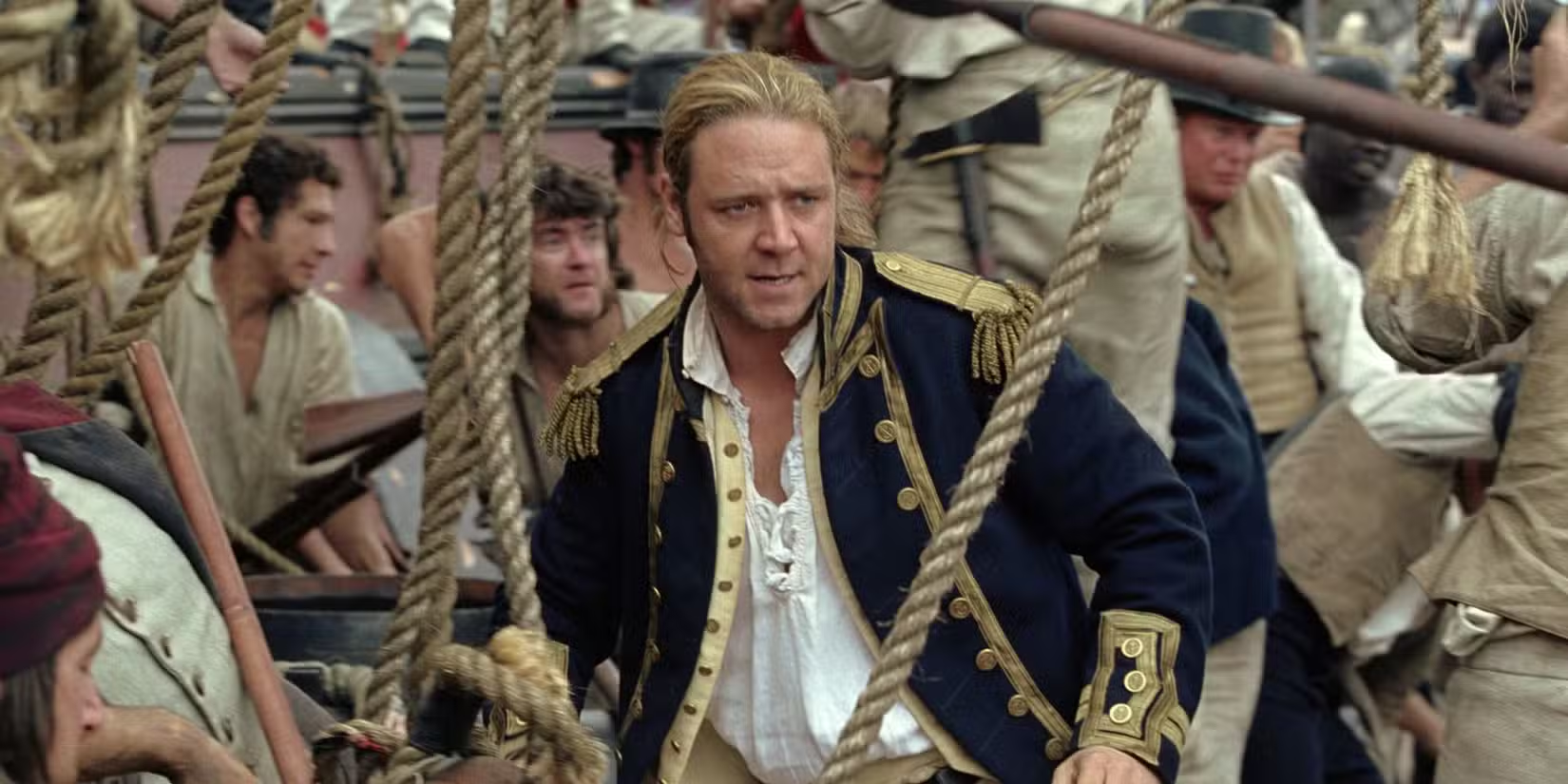
‘Master and Commander: The Far Side of the World’ (2003)

It might not have been as successful or as widely-seen as other war movies considered to be among the best of all time, but Master and Commander: The Far Side of the World debatably should’ve been. It’s remarkable, as both a war and adventure movie, being set during the Napoleonic Wars and mostly centering on the captain of a warship being driven to pursue another ship following a disastrous attack.
Master and Commander: The Far Side of the World is kind of a chase movie, and one with a commitment to both realism and good old-fashioned spectacle/entertainment at the same time, somehow. It’s juggling a lot all at once, and manages to keep all those balls in the air the whole time, so to speak, being one of the best movies of the past couple of decades (or so) that deserved at least one sequel, but never got any.
9
‘Until the End of the World’ (1991)

This is the most obscure and underrated movie that’s going to be mentioned here, and it is admittedly quite a commitment if you want to appreciate it, but Until the End of the World is worth the effort. The theatrical cut was an already lengthy 179 minutes, yet you do have to watch the director’s cut of Until the End of the World instead, and that one’s almost two hours longer.
Since it goes for a bit under five hours, it manages to feel particularly expansive and globe-trotting in nature, even by the standards of the adventure genre, since it’s basically a road trip movie that spans different continents, and has its characters go around much of the world. On top of that, Until the End of the World is also forward-thinking (and maybe even prophetic) as a work of science fiction, all the while boasting one of the most impressive soundtracks in cinema history, too.
8
‘The Mission’ (1986)

There are a few different genres tackled throughout The Mission, so it’s not “just” an adventure movie, but the same can be said for other movies that were written by Robert Bolt (his best-known screenplay is – and probably always will be – Lawrence of Arabia). Both its main characters do undertake a journey deep into the jungles of South America, though, one of them wanting to build a mission, and the other later traveling to that mission to seek redemption.
After all that, The Mission starts to feel almost like a war movie, or at least a historical action movie, maybe a little in line with something like The Last of the Mohicans. There’s also music in The Mission that’s well worth highlighting, though instead of being a soundtrack like with Until the End of the World, it comes in the form of one of the very best scores the great Ennio Morricone ever composed.
7
‘Avatar’ (2009)

You can liken James Cameron’s work to the cinematic equivalent of great pop music. It’s easy to look down on both, because such blockbusters and such popular music look kind of easy to make, or at least there’s a sense that those behind such things might be lazy compared to those who make more complex and challenging stuff, and yet there’s such a challenge when it comes to actually delivering truly crowd-pleasing entertainment.
Cameron can do so in a seemingly effortless way, and Avatar might not demonstrate that as much as Titanic, but Titanic’s not really an adventure film, so Avatar is the Cameron film that feels most worth shouting out here. It goes to some wild and visually spectacular places, and it’s still a pretty undeniable technical achievement all these years later, which isn’t something that can be said about many movies from the 2000s that featured so much computer-generated animation.
6
‘The Princess Bride’ (1987)

No exaggeration: The Princess Bride really does have one of the best screenplays of all time, and then it’s also great in all the other ways that a movie needs to be great if it wants to be considered a masterpiece, which The Princess Bride well and truly is. It’s a fantasy/adventure/romance/comedy movie all at once, and is technically a story within a story that celebrates and gently parodies fairy tales simultaneously.
Before, Master and Commander: The Far Side of the World was mentioned as a movie that did a great job of juggling various things/genres at once, but The Princess Bride arguably balances even more, and does so within a briefer runtime, too. It’s one of those rare films that truly has something to offer for everyone, regardless of one’s age or general outlook on life (be it cynical or optimistic/romantic).
5
‘Mad Max: Fury Road’ (2015)
It’s such an obvious pick, alongside a trilogy of fantasy/adventure movies that are going to be outlined in a bit, but Mad Max: Fury Road deserves to be here, since it’s very hard to fault as an action/sci-fi/adventure movie. The adventure here is a dark and particularly desperate one, though, since like the other movies in the Mad Max series (besides the first, which is more dystopian), Fury Road is a post-apocalyptic film.
Much of it’s one extended chase sequence, plus a few scenes that are more focused on character development and non-action stuff sprinkled throughout… though never so many that the film stops feeling relentlessly energetic. So much has already been written and said about how thrilling and non-stop Mad Max: Fury Road feels, and so much more will probably continue to be written as the years go on, and this film continues to age well (in all likelihood… it’ll be surprising if it doesn’t hold up 10, 20, or even 50 years from now).
4
‘Spider-Man: Into the Spider-Verse’ (2018)

Spider-Man: Into the Spider-Verse is one of the best animated movies of all time, and it also happens to be a sci-fi/adventure/action movie (plus some other genres, probably), so here it is. It’s all about different universes colliding, and various Spider-people having to band together to take on something that threatens all the universes, and then it’s also an origin story for Miles Morales at the same time.
And origin stories already felt a bit played-out and a little too everywhere, in 2018, yet this movie found a way to do that whole kind of narrative in an enjoyable and sometimes quite surprising way. It’s hard to say whether it’s the very best Spider-Man movie, when Spider-Man 2 (2004) also exists, but it’s more of an adventure film than that one, and it has to be admired for finding new things to do with one of the more ubiquitous superheroes in the movie world.
3
‘Princess Mononoke’ (1997)

There’s an argument to be made that most of Hayao Miyazaki’s movies come pretty close to being perfect, with Princess Mononoke being especially so. It’s the best of a great bunch, in other words, and is simultaneously a fantasy movie, an adventure film, and an allegorical one about humanity and its relationship/conflict with the natural world, as much of the premise here concerns the people of an industrial town warring with beings living in a nearby forest.
Since it’s directed by Miyazaki and produced by Studio Ghibli, Princess Mononoke is stunning throughout, on a visual front.
Obviously, since it’s directed by Miyazaki and produced by Studio Ghibli, Princess Mononoke is stunning throughout, on a visual front, and proves similarly enthralling as far as the aural side of things is concerned, too (since it might well be the best-composed score of Joe Hisaishi’s). You can’t really go wrong with anything here, so this being considered an all-timer however you want to define or classify it feels fitting.
2
‘Jurassic Park’ (1993)
The Jurassic Park series has just kept on trucking, post-1993, and is now technically the Jurassic World series (probably/maybe?), but it’s unlikely that anything will ever top the original. This is almost as good as sci-fi/adventure movies get, being about a group of people visiting a theme park featuring dinosaurs that have been brought to life through science before the park officially opens, but then pretty much everything goes wrong.
Once they’re on the island, the film stays there as well, which might make it a little different from a globe-trotting sort of adventure movie, but it fits within the genre because there’s an element of adventuring inherent to the premise, what with people going to that island and all. It’s got some fierce competition for the title of “best Steven Spielberg adventure movie,” seeing as Raiders of the Lost Ark exists, though that one’s more than 40 years old, so Jurassic Park wins out – and gets included – here.
1
‘The Lord of the Rings’ (2001–2003)

You could put any of the movies in The Lord of the Rings trilogy here, or you can put the trilogy as a whole, including it as one big three-part film, and either way, placement in the top spot’s earned. This is maybe the greatest achievement in blockbuster filmmaking of the century so far, and it’s a monumental epic that does justice to J.R.R. Tolkien’s novel of the same name, even if it’s not 100% faithful, as an adaptation.
It gets the basics across and then some, and it makes the story work well in a different format, which might’ve seemed like too challenging a task until it was actually pulled off by Peter Jackson and co. Sorry to be a bit predictable, by celebrating this particular trilogy here, at the end of all lists, but it really is that good, and all the praise that’s been thrown its way over the past 20+ years has been more than well-earned.
:max_bytes(150000):strip_icc():format(jpeg)/vanna-white-wheel-of-fortune-myrtle-golf-051226-51407bdb5c7c47698158967e1a5e90e9.jpg)
The game show icon and avid golfer turned out for the Myrtle Beach Classic Pro-Am on May 6, alongside actors Kurt Russell and Jennie Garth.
:max_bytes(150000):strip_icc():format(jpeg)/The-Sheep-Detectives-Cast-List-051226-70082f0ff18a45feba1a73c0871ac17e.jpg)
Julia Louis-Dreyfus, Bella Ramsey, and Bryan Cranston are among those voicing the fluffy investigators.
It’s agreed upon by most film fans that the ‘70s were the greatest decade in film history, which is why they are often referred to as the “New Hollywood” era. It was after a series of significant box office disappointments in the 1960s that studios began to give more creative control to directors, many of whom were young, and fresh out of film school. Since this rising crop of filmmakers tended to cite international cinema as an influence on their work, the definition of what a “Hollywood” film was transformed dramatically.
It’s incredible to look back at the films of 1976 because so many of them have had a lasting impact on popular culture, and still are perceived to be a significant influence on the cinema of 2026. It was a robust year filled with classics in nearly every genre.
10
‘Carrie’ (1976)

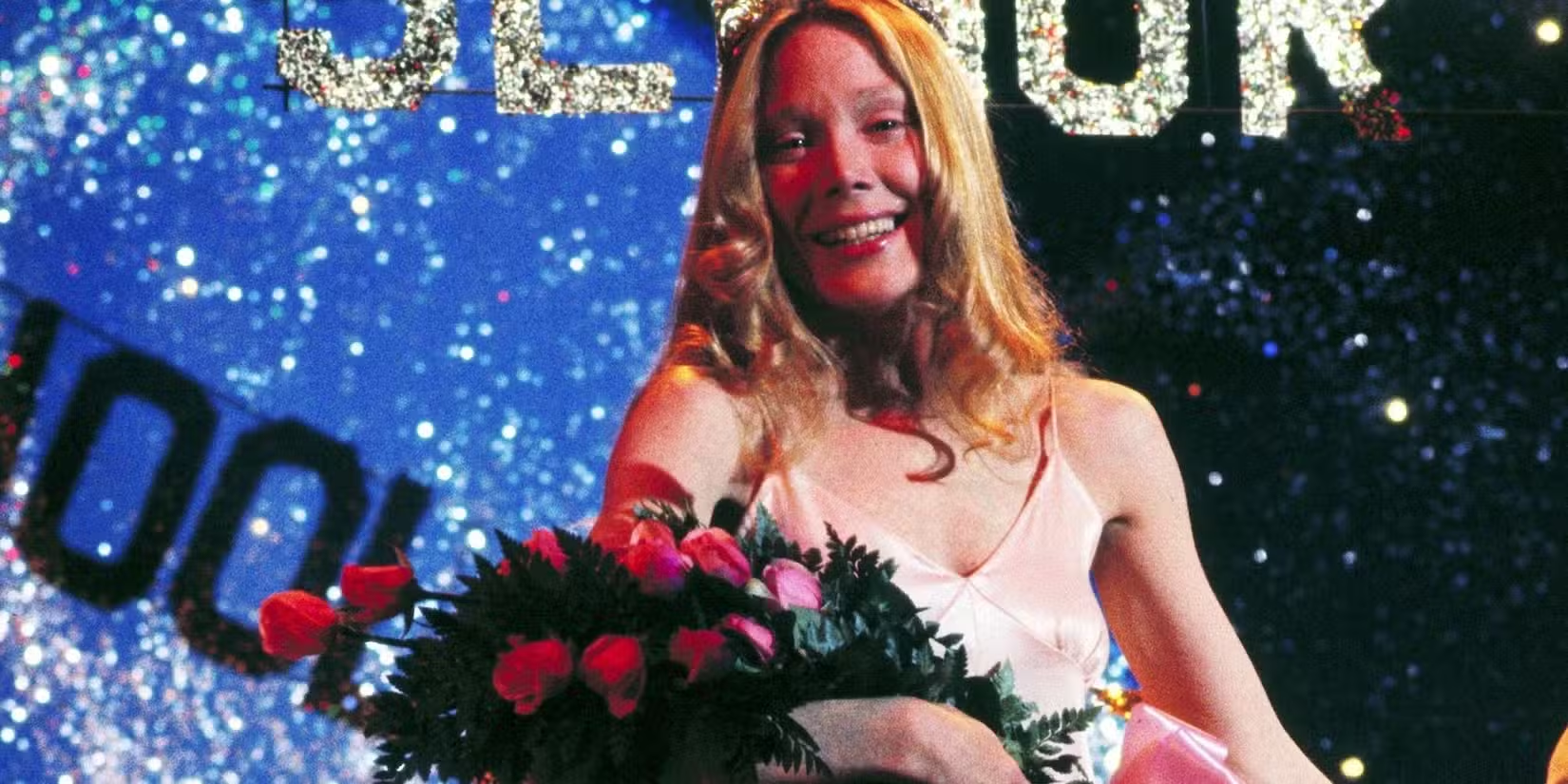
Carrie was the first adaptation ever of a Stephen King novel, and it remains one of the best. What made King’s story so good was that it was a haunting horror story that also presented itself as a coming-of-age tale with a relatable protagonist, and Carrie featured a standout performance by Sissy Spacek that launched one of the most significant stars of the next decade.
Carrie was also a major film for director Brian De Palma, who had his first major success after making a few smaller titles earlier in the decade. De Palma was often cited as being a “modern Alfred Hitchcock” because of the way that he used suspense and intrigue, and Carrie showed how he was willing to tear down taboos when it came to graphic content, thanks to the film’s horrific, bloody ending scene at the school dance.
9
‘The Killing of a Chinese Bookie’ (1976)

The Killing of a Chinese Bookie was a very unique film for director John Cassavetes, as for the most part he had made smaller arthouse dramas, many of which starred his partner, Gena Rowlands. Comparatively, The Killing of a Chinese Bookie was an anxiety-inducing crime thriller that became a masterclass in escalation, as Cassavetes was able to dig deep within the criminal underworld to tell a story of regret and retaliation.
The Killing of a Chinese Bookie came out only a few years after The Godfather, and proved once again that the crime genre was malleable to tell many different types of stories that could be considered “elevated.” While the original cut of the film released in theaters is a masterpiece, Cassavetes also released a director’s cut (that is widely available on streaming) that is much closer to his original vision.
8
‘Mikey and Nicky’ (1976)

Mikey and Nicky was the third film directed by Elaine May, a filmmaker who sadly didn’t receive as many opportunities as she deserved. Although May had a famously intense production process that required fine-tuning and countless takes, the results were all masterpieces, as Mikey and Nicky is one of the best films ever made about male friendship and the impossibility of paying off debts.
May was able to get a great performance out of Cassavetes, who proved that he was capable of completely transforming for a role, even if it was for a film that he did not personally direct. That being said, the true scene-stealer of Mikey and Nicky is the late great Peter Falk, who was able to give a performance so charming, amusing, haunting, and tragic all at once that it makes the film even thoriner upon rewatch.
7
‘Marathon Man’ (1976)

Marathon Man was a truly unique spy thriller that was based on a very popular book, yet still managed to be just as popular. Although Dustin Hoffman was already one of the most respected actors of his generation, he stepped outside of his comfort zone to play a university student that goes on the run after his brother (Roy Scheider) is killed trying to prevent a powerful Nazi (Laurence Olivier) from gaining a powerful treasure.
Olivier was a shocking choice to play the main villain, as he was a more classical British actor who was best known for his work in the adaptations of William Shakespeare and other classic novelists. Nonetheless, Olivier succeeded in giving a transformative and terrifying performance, which was made all the more scary thanks to one of the most realistic torture scenes ever captured on film.
6
‘Rocky’ (1976)

Rocky isn’t just the greatest inspirational sports film of all-time, but the classic that basically redefined the genre and has inspired countless imitators. Although it inspired a terrific franchise that is still going strong to this day, the original Rocky is almost underrated at this point for what a thoughtful, grounded character drama it is, as director John Avildsen avoided some of the more outlandish feats of spectacle that became more prominent in the sequels.
Sylvester Stallone is a movie star with a mixed track record when it comes to hits and misses, but he wrote the original screenplay for Rocky and clearly poured all of his efforts and companion into the story of the ultimate underdog. Stallone has now become a massive action star with many franchises to his name, but Rocky is still the film and performance that he will always be best known for.
5
‘The Outlaw Josey Wales’ (1976)

The Outlaw Josey Wales was a significant achievement for Clint Eastwood, who was quickly proving that he was just as good at directing Westerns as he was at starring in them. Although Eastwood has succeeded in making a smaller, grittier Western thriller just three years prior with High Plains Drifter, The Outlaw Josey Wales was a true war epic that was far more expansive in terms of scope.
The Outlaw Josey Wales showed how brave Eastwood was willing to be when casting himself, as it was far from the type of egocentric role that many other actors-turned-directors would take. He cast himself to play a truly violent, often scary anti-hero, and was able to explore the complex ethical ramifications of the situation by creating a flawed protagonist. Few better films have ever been made about the aftermath of the American Civil War.
4
‘Assault on Precinct 13’ (1976)

Assault on Precinct 13 was a true step up from director John Carpenter, whose previous film Dark Star had really only been a slightly more polished student project that was aimed at satirizing science fiction space operas. Assault on Precinct 13 may have looked on its surface to be another traditional cop thriller, but Carpenter had a trick up his sleeve; he was deeply indebted to the Western cinema of Howard Hawks, as Assault on Precinct 13 served as a loose remake of Rio Bravo that changed the setting from the Wild West to a contemporary police station.
Assault on Precinct 13 featured incredible shootout and fight scenes, even though it was released long before the “action genre” took off in the wake of Die Hard. It’s one of Carpenter’s toughest movies, and is often remembered for its particularly gritty opening scene.
3
‘Network’ (1976)

Network is the rare film from 1976 that remains just as relevant today and it did during its initial theatrical release, as it explored the idea of media sensationalism and overconsumption in a way that resonates even more deeply in the era of the Internet. Although the line “I’m mad as hell and I’m not going to take it anymore” is what the film might be best remembered for, Network has countless amazing pieces of dialogue, as it is one of the best screenplays ever written.
Network has a truly incredible lineup of the most acclaimed actors who were starring in all the best films of the ‘70s, with Peter Finch becoming one of the few stars to win a posthumous Academy Award for Best Actor. Although he was one of the few cast members that wasn’t nominated for an Oscar, Robert Duvall also gives one of his best performances in Network.
2
‘All the President’s Men’ (1976)

All the President’s Men is one of the most important political films ever made because it tackled the controversies surrounding the “Watergate” scandal in the administration of President Richard Nixon only a few years after they transpired. Robert Redford and Dustin Hoffman gave some of their greatest performances ever as Woodward and Bernstein, respectively, the duo of reporters whose report led Nixon to become the first President of the United States in history to resign from office.
All the President’s Men is still cited as being one of the most accurate and important films about the journalistic process, as it examined aspects of an investigation that must be followed in order for the reporters to make their proclamations with absolute certainty. It’s also a great piece of entertainment, as Alan Pakula was a director who could take important stories and make them very engaging for general audiences.
1
‘Taxi Driver’ (1976)

Taxi Driver was a groundbreaking film for Martin Scorsese because it crafted one of cinema’s most defining anti-heroes in Travis Bickle, the unusual main character played by Robert De Niro in one of his greatest performances ever. Bickle was meant to reflect the disillusionment of a generation of Vietnam War veterans who discovered that the country was in shambles, and turned to the underworld as a means of reaching self-actualization.
Taxi Driver is a magnetic thriller because it’s intense to see whether Bickle will lose his mind completely, or if his ethics will come through so that he can do the right thing, even if he only does it inadvertently. Although Scorsese and De Niro had previously worked with one another on the 1973 film Mean Streets, Taxi Driver marked the true inception of one of the greatest director-actor collaborations of all-time.


Tech37 seconds ago
Alphabet’s Isomorphic Labs raises $2.1bn in Series B funding

NewsBeat3 minutes ago
Iran war’s full impact on US grocery prices may take months to appear

Business4 minutes ago
Top 5 Gainers Lead Rally as Commodities Surge on May 13

NewsBeat2 months ago
Manchester United reach agreement with Casemiro over contract clause amid transfer speculation

Politics1 month ago
US brings back mandatory military draft registration

NewsBeat1 month ago
Steven Gerrard disagrees with Gary Neville over ‘shock’ Chelsea and Arsenal claim | Football


-
 Crypto World5 days ago
HarrisX Poll Found 52% of Registered Voters Support the CLARITY Act
-

 Fashion5 days ago
Weekend Open Thread: Marianne Dress
-

 Crypto World6 days ago
Upbit adds B3 Korean won pair as Base token gains Korea access
-
 NewsBeat6 days ago
NCP car park operator enters administration putting 340 UK sites at risk of closure
-

 Fashion2 days ago
Coffee Break: Travel Steam Iron
-

 Fashion2 days ago
What to Know Before Buying a Curling Wand or Curling Iron
-

 Tech3 days ago
Auto Enthusiast Carves Functional Two-Stroke Engine from Solid Metal
-

 Politics1 day ago
What to expect when you’re expecting a budget
-
 Business4 days ago
Ignore market noise, India’s long-term story intact, say D-Street bulls Ramesh Damani and Sunil Singhania
-

 Politics4 days ago
Politics Home Article | Starmer Enters The Danger Zone
-

 Crypto World7 days ago
BlackRock CEO Larry Fink Discusses a New Asset Class
-

 Tech2 days ago
GM Agrees To Pay $12.75 Million To Settle California Lawsuit Over Misuse Of Customers’ Driving Data
-
 Sports7 days ago
NBA playoff winners and losers: Austin Reaves is not loving Lakers vs. Thunder matchup, but Chet Holmgren is
-

 Entertainment6 days ago
Sarah Paulson Called Out For Met Gala ‘Hypocrisy’
-

 Entertainment6 days ago
General Hospital: Ric & Ava Bombshell – Ric’s Massive Secret Exposed!
-

 Politics6 days ago
Simon Cowell Says He Was ‘Horrible’ To Susan Boyle During BGT Audition
-

 Crypto World6 days ago
Robinhood says Wall Street is building onchain
-
 Sports6 days ago
UEFA Champions League final schedule, teams, venue, live time and streaming | Football News
-

 Entertainment7 days ago
Bold and Beautiful Early Spoilers May 11-15: Steffy Revolted & Liam Overjoyed!
-
 Entertainment6 days ago
Why David Letterman Called CBS ‘Lying Weasels’
You must be logged in to post a comment Login