

Crypto World
SoftBank’s Quarterly Earnings Surge 300% Thanks to OpenAI Stake Valuation


Key Takeaways
- SoftBank’s fourth-quarter net income reached $11.6 billion, representing a three-fold increase year-over-year
- A $45 billion valuation increase in its OpenAI holdings fueled the profit surge
- The company’s OpenAI stake was valued at $79.6 billion at the end of March
- Total OpenAI investment stands at $34.6 billion, with commitments exceeding $60 billion
- S&P Global Ratings downgraded SoftBank’s outlook to “negative” citing debt levels and portfolio concentration risks
SoftBank Group announced net income of 1.83 trillion yen (approximately $11.6 billion) for the quarter that concluded on March 31, 2026. This figure represents a substantial increase compared to the 517 billion yen profit recorded during the corresponding quarter of the previous year.
The performance significantly exceeded Wall Street expectations, with analysts having projected earnings of 295.2 billion yen, based on Bloomberg’s consensus estimates.
The dramatic earnings increase was primarily attributed to a 3.043 trillion yen investment gain recorded during the quarter. The majority of these gains originated from the Vision Fund, SoftBank’s primary investment arm.
The standout performer in the portfolio was OpenAI, the artificial intelligence company responsible for developing ChatGPT. As of March 31, SoftBank’s ownership position in OpenAI reached a valuation of $79.6 billion, marking a cumulative gain of $45 billion on the investment.
To date, SoftBank has deployed $34.6 billion into OpenAI. The Japanese conglomerate has pledged to invest over $60 billion in aggregate, which would secure approximately 13% equity ownership in the AI pioneer.
During February, OpenAI completed a funding round that assigned the company an $890 billion valuation. A subsequent financing round in March, which SoftBank co-led, valued the startup at $852 billion.
The Vision Fund alone recorded gains of approximately $20 billion during the three-month period from January through March, with OpenAI accounting for nearly the entire amount.
Significant Losses Beyond OpenAI Holdings
However, SoftBank’s investment portfolio showed mixed results elsewhere. The company experienced losses across multiple other holdings, including positions in Coupang, DiDi Global, and Klarna.
When excluding Vision Fund performance and accounting for currency fluctuations and operational expenses, SoftBank recorded an investment income deficit of 472.1 billion yen for the complete fiscal year.
Financing expenses during the fourth quarter climbed to 229.4 billion yen, compared with 148.9 billion yen in the prior-year period, demonstrating the increased borrowing costs associated with financing its artificial intelligence investments.
The company maintains $17.5 billion in outstanding obligations from a $40 billion bridge financing facility utilized to fund its OpenAI investment.
Credit Rating Concerns Intensify
To finance its aggressive OpenAI investment strategy, SoftBank has been divesting stakes in portfolio companies. The firm liquidated positions in Nvidia and T-Mobile, generating proceeds of 218.1 billion yen from these asset sales throughout the fiscal year.
S&P Global Ratings adjusted its outlook on SoftBank from “stable” to “negative” in March. The ratings agency expressed concerns that SoftBank’s asset quality and financial flexibility would likely decline due to its substantial OpenAI capital commitment.
According to S&P, SoftBank could mitigate these risks through additional asset monetization.
For the complete fiscal year, SoftBank reported net income of 5 trillion yen. Both the Vision Fund and its telecommunications business segment served as primary profit contributors.
Chief Executive Officer Masayoshi Son has positioned artificial intelligence as the central pillar of SoftBank’s long-term strategic vision. OpenAI continues to face intensifying competition from technology giants including Google and emerging players like Anthropic.




Disclosure: This article does not represent investment advice. The content and materials featured on this page are for educational purposes only.
AJC Mining expands access to Bitcoin cloud mining with simplified online hash rate contracts.
Summary
- AJC Mining offers Bitcoin cloud mining contracts without hardware, maintenance, or setup requirements.
- AJC Mining provides mining calculators, flexible plans, and daily settlement tools for users.
- Built for beginners and experienced users, AJC Mining simplifies access to online mining participation.
The cryptocurrency market is once again attracting global attention. XRP-related headlines have highlighted a major shift in the digital asset industry: traditional financial institutions are increasing their exposure to blockchain-based assets, real-world tokenization is expanding into new markets such as Japan, and on-chain financial products are becoming more relevant to institutional investors.
These developments send a powerful signal to the global market: cryptocurrency is no longer only a speculative trend. It is becoming part of the broader financial infrastructure. As institutional capital continues to flow into digital assets, the long-term value foundation of the crypto market, especially Bitcoin, is becoming stronger.
For everyday investors, this creates an important question: how can they participate in the growth of the crypto industry without directly facing the extreme volatility of buying and selling coins in the spot market?
One practical answer is Bitcoin cloud mining.
Why Bitcoin cloud mining is becoming popular
Traditional cryptocurrency mining often requires expensive mining machines, technical knowledge, a stable electricity supply, cooling systems, and ongoing maintenance. For most individual users, building and managing a physical mining setup is costly and complicated.
Bitcoin cloud mining provides a more accessible alternative. Instead of buying mining hardware, users lease computing power, also known as hash rate, from remote mining facilities. This allows users to participate in Bitcoin production through an online platform without personally managing machines or infrastructure.
AJC Mining is designed to make this process easier for users who want to enter the mining industry with a lower barrier. By offering cloud-based mining contracts, AJC Mining allows users to access mining opportunities through a simple online dashboard.
Is cloud mining profitable?
One of the most searched questions in the industry is: Is cloud mining profitable?
The answer depends on several important factors, including the Bitcoin price, network mining difficulty, contract cost, platform service fees, and the amount of hash rate purchased. Since market conditions can change, users should always calculate potential earnings before selecting a mining plan.
This is why a mining profit calculator is an important tool for anyone considering cloud mining. By entering the contract cost, estimated Hash Rate, contract duration, and current market conditions, users can better understand possible daily and monthly mining income.
AJC Mining encourages users to evaluate plans carefully and choose contracts based on their own budget, risk tolerance, and long-term goals.
Why choose AJC Mining for cryptocurrency mining?
When searching for the best cloud mining platforms, users should pay attention to transparency, contract flexibility, payout rules, platform reputation, and ease of use.
AJC Mining focuses on providing a user-friendly cloud mining experience for both beginners and experienced crypto users. The platform offers cloud mining contracts that allow users to participate in Bitcoin mining without purchasing hardware, managing electricity costs, or dealing with technical maintenance.
Key advantages of AJC Mining include:
- Accessible Bitcoin cloud mining contracts
- Simple registration and account setup
- Daily earnings settlement according to contract terms
- Flexible contract options for different budgets
- Beginner-friendly platform interface
- Trial opportunities through free cloud mining rewards
- Tools such as a mining profit calculator to help users estimate potential returns
How to join AJC Mining?
The process for joining AJC Mining is relatively simple, making it ideal for new users with no prior mining experience.
Step 1: Register an account
Users can register an account via the official AJC Mining website. Upon successful registration, new users will receive a $15 reward.
(Click here to register now and claim a reward.)
Step 2: Select a cloud mining contract
The platform offers a variety of short-term and long-term cloud mining contracts for users to choose from. Users can make their selection based on their personal budget, desired contract duration, and profit objectives.
Step 3: Activate the contract
Once a contract has been selected, the system will automatically deploy the cloud-based computing power and settle earnings on a daily basis, in accordance with the terms of the contract.
AJC Mining cloud mining contract reference
| Contract Name | price | Daily Profit | Number of Days | Principal + Total Return |
| New User Experience Contract | $100 | $4 | 2 Days | $100 + $8 |
| Avalon Miner A15 | $500 | $6.25 | 5 Days | $500 + $31.25 |
| Litecoin Miner L9 | $1000 | $13 | 10 Days | $1000 + $130 |
| Bitcoin Miner S21 XP Imm | $5000 | $70 | 25 Days | $5000 + $1750 |
| Bitcoin Miner S21e XP Hyd | $10000 | $150 | 35 Days | $10000 + $5250 |
| ANTSPACE HW5 | $50000 | $900 | 45 Days | $50000 + $40500 |
The aforementioned contracts represent the various computing power plans offered by the platform. Users may select a cloud mining strategy that best suits their individual needs. AJC Mining emphasizes fixed terms, daily settlements, and automated operations, aiming to provide users with a more convenient cloud mining experience.
(Click here to view more cloud mining contracts.)
Free cloud mining: A smart way to start
For many new users, free cloud mining is the easiest way to understand how cloud mining works. Some platforms provide a small amount of free Hash Rate or registration bonus so users can test the system before purchasing a paid contract.
AJC Mining offers new users a registration reward, allowing them to experience the platform and learn how cloud mining contracts, daily settlements, and mining dashboards work.
However, free rewards should mainly be viewed as an educational starting point. Users who want to pursue more meaningful mining income may consider selecting a paid contract after reviewing the platform, calculating potential returns, and understanding the risks involved.
How to select the best cloud mining platforms
The growth of the crypto market has attracted many cloud mining providers, but not all platforms offer the same level of service. Before choosing a provider, users should compare several important factors.
First, a reliable cloud mining platform should clearly explain how its contracts work, including Hash Rate allocation, contract duration, payout rules, and possible fees. Second, the platform should provide tools that help users make informed decisions, such as a mining profit calculator. Third, users should review the platform’s reputation, support service, and operating history.
AJC Mining aims to position itself among the best cloud mining platforms by offering accessible cloud mining contracts, daily settlement mechanisms, and an easy-to-use experience for users interested in Bitcoin mining.
Hash rate: The core of Bitcoin cloud mining
In cryptocurrency mining, hash rate refers to the computing power used to process Bitcoin mining calculations. In general, a higher Hash Rate means more mining power is being contributed to the network.
For cloud mining users, Hash Rate is the key resource purchased through a contract. Instead of owning physical mining machines, users lease Hash Rate from the platform. This allows them to participate in Bitcoin mining without managing equipment.
When comparing cloud mining contracts, users should pay attention to the amount of Hash Rate included, the contract price, the duration, and the estimated payout. These factors directly affect potential mining performance.
AJC Mining and the future of Bitcoin cloud mining
As institutional adoption of digital assets continues to grow, Bitcoin remains one of the most important assets in the cryptocurrency market. While buying Bitcoin directly can expose users to price volatility, Bitcoin cloud mining offers another way to participate in the crypto economy.
AJC Mining provides an accessible path for users who want to explore Bitcoin mining without hardware investment. Through cloud-based Hash Rate contracts, daily settlement, and beginner-friendly tools, AJC Mining helps users enter the mining industry more conveniently.
For users asking “Is cloud mining profitable?”, the best approach is to calculate carefully, compare contract options, and start with a plan that matches their budget. A mining profit calculator can help users estimate potential returns before activating a contract.
Conclusion
The global crypto market is entering a new stage. From institutional XRP adoption to real-world tokenization and on-chain financial applications, blockchain technology is becoming more connected with traditional finance.
In this environment, Bitcoin cloud mining is attracting more attention as a practical way to participate in cryptocurrency mining without purchasing hardware. AJC Mining offers users a simple and accessible platform to lease hash rate, explore free cloud mining, use a mining profit calculator, and choose from flexible mining contracts.
For users searching for the best cloud mining platforms, AJC Mining provides a beginner-friendly option for entering the Bitcoin mining market.
Start the cloud mining journey with AJC Mining today and explore a more accessible way to participate in the future of digital assets.
For more information, visit the official website and download the mobile app.
Disclosure: This content is provided by a third party. Neither crypto.news nor the author of this article endorses any product mentioned on this page. Users should conduct their own research before taking any action related to the company.
The CPI announcement in the US yesterday showcased increasing inflation likely due to the war against Iran, and BTC dipped to under $80,000, but it managed to rebound almost immediately.
Binance Coin has surpassed XRP once again in terms of market cap after a 2.5% increase, while DOGE has solidified its spot in the top 10 alts following a 2% increase.
BTC Rebounds After CPI
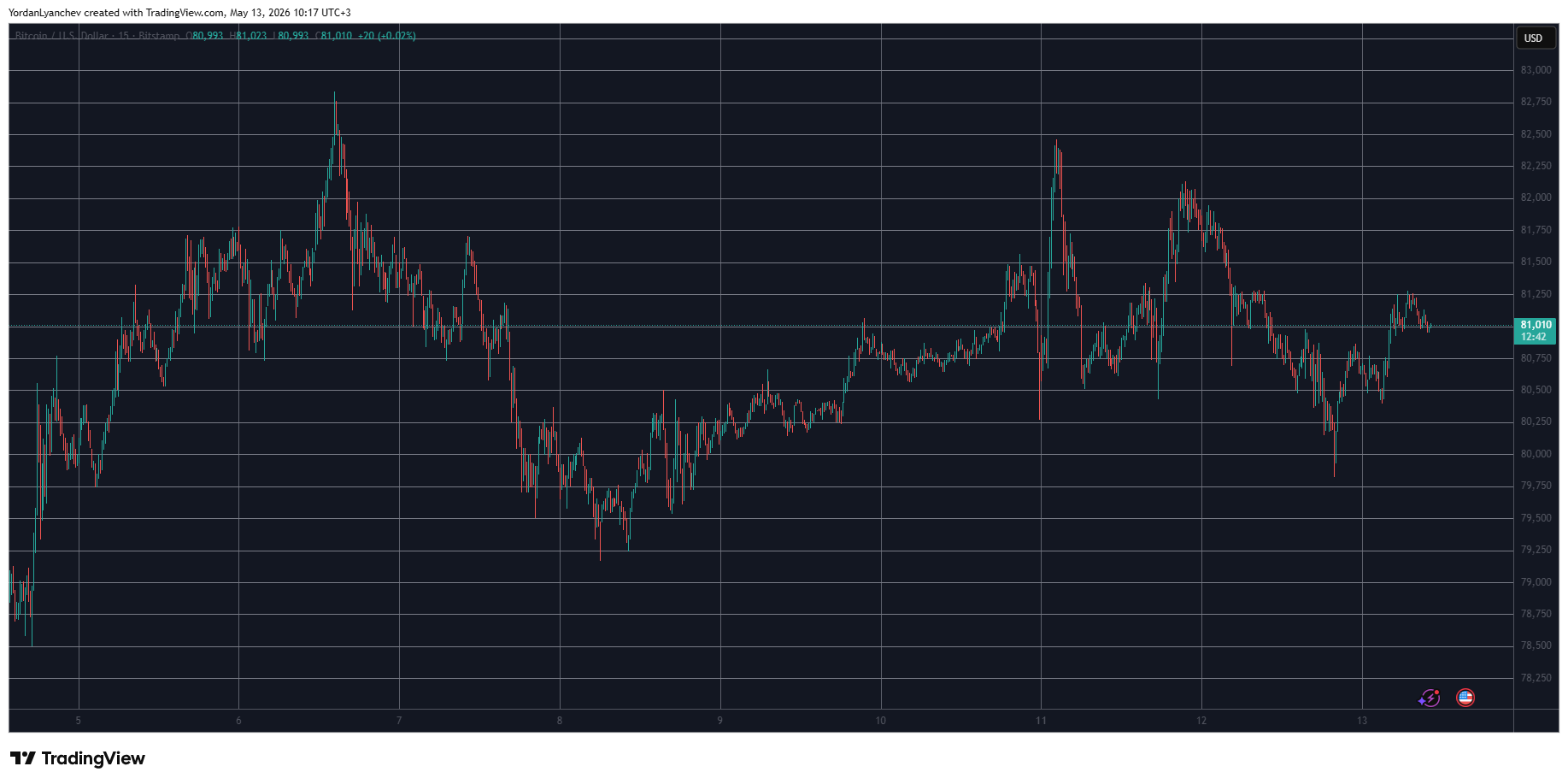
The primary cryptocurrency peaked at almost $83,000 last Wednesday before the subsequent rejection pushed it south to $79,100 by Friday. The gradual recovery began after that bounce off, and BTC reclaimed the $80,000 tag during the weekend.
More volatility ensued on Monday morning as the legacy financial markets opened. The cryptocurrency first dipped to $80,250 from $81,500 before it rocketed to $82,500 after reports that Iran had sent another peace proposal to the US. However, the POTUS quickly rejected it, and BTC crashed by $2,000 in minutes.
It tried another breakout on Tuesday, but it was stopped again at $82,000. The CPI numbers announced yesterday confirmed that inflation has been increasing, and BTC slipped a few hours after they went live to under $80,000. Nevertheless, it reacted well and now sits at around $81,000.
Its market capitalization remains sideways at around $1.620 trillion, while its dominance over the alts is still well above 58% on CG.
BNB Flips XRP
The battle for the fourth spot in terms of market cap continues, and Binance’s native token has emerged on top in the past 12 hours or so. BNB is up by 2.5%, which has helped it surpass XRP as the latter has remained sideways. HYPE, CC, BCH, TAO, and SUI are slightly in the red daily, while DOGE trades above $0.11 after another 2% daily increase.
Today’s most substantial gainer is NEAR, rocketing by almost 6% to $1.64. STABLE follows suit, while WLFI and TRUMP are also in the green as the POTUS went to China to meet with Xi Jinping.
In contrast, VVV has plummeted by over 17% daily to under $15. ONDO, TON, and PENGU are deep in the red as well.
The total crypto market cap has remained at around $2.780 trillion.

The post BTC Recovers From CPI-Induced Dip, Viral Token Plunges by 17% Daily: Market Watch appeared first on CryptoPotato.
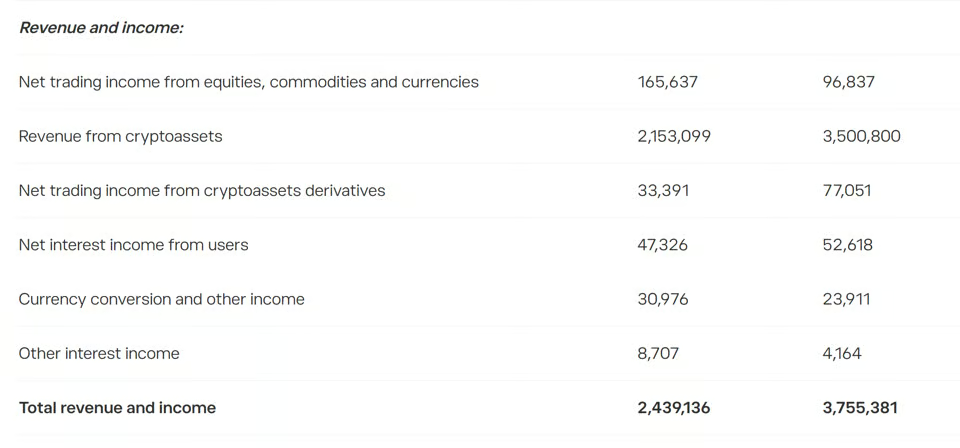
EToro reported first-quarter net income of $82 million, up 37% from a year earlier, as a surge in commodities trading offset weaker crypto activity.
Net income rose 37% year-over-year to $82 million, compared to $60 million in Q1 2025, the company announced Tuesday. Adjusted EBITDA (earnings before interest, taxes, depreciation and amortization) climbed 35% to $109 million, from $80 million a year earlier, while net contribution grew 19% to $258 million.
The upbeat results were driven largely by commodities trading, which accounted for roughly 60% of trading commissions in the quarter, with volumes up nearly fourfold year-over-year. The company also expanded its equities offering, adding Japanese stocks to bring its exchange coverage to 26 and activated its BitLicense to launch crypto trading in New York.

Net revenue and income. Source: EToro
Funded accounts grew 12% to 4.02 million, while assets under administration rose 15% to $17 billion. The company held $1.3 billion in cash, cash equivalents and short-term investments as of March 31.
Related: Deutsche Börse invests $200 million in Kraken parent Payward
Crypto trading volumes tumble
Despite the surge in commodities trading, crypto volumes took a hit. April data released alongside the earnings showed crypto trade volumes fell 32% year-over-year to two million trades, while the invested amount per trade dropped 22% to $207.
On the product side, eToro launched an AI-powered Agent Portfolios feature and deepened its partnership with xAI, embedding Grok 4.2-powered market sentiment into Tori, its AI investing agent.

EToro shares dip. Source: Yahoo! Finance
The company also closed its acquisition of Zengo, a self-custodial crypto wallet provider, on April 30, a move CEO Yoni Assia said advances eToro’s strategy of bridging traditional finance with on-chain infrastructure.
Assets under administration climbed further to $18.7 billion in April, up 19% year-over-year, while total money transfers for the month hit $1.4 billion, up 53%.
Related: Block Inc rises 8% as Q1 gives ‘earnings surprise’ despite Bitcoin dip
Crypto exchanges see lower trading volumes
As Cointelegraph reported, Coinbase posted a net loss of $394.1 million in Q1, its second straight quarterly loss, swinging from a $65.6 million profit a year earlier.
Revenue came in at $1.41 billion, missing analyst estimates of $1.5 billion, as transaction revenue slumped 40% and subscription and services revenue fell 13.5% year-over-year. Total crypto market cap and trading volume were both down more than 20% quarter-over-quarter.
Magazine: Guide to the top and emerging global crypto hubs — Mid-2026
Crypto World
Bitcoin Price Prediction: Coiling at $81,000 as the CLARITY Act Vote Approaches: Will Tomorrow’s Senate Decision Trigger a Rally to $90,000?
Bitcoin is holding near $81,200, as traders brace for a Senate Banking Committee markup vote on the Digital Asset Market Clarity Act scheduled for May 14 at 10:30 AM EST, fueling bullish price predictions.
The move reclaims a level that briefly cracked lower on Friday, and the catalyst sitting directly ahead could determine whether this rally has legs.
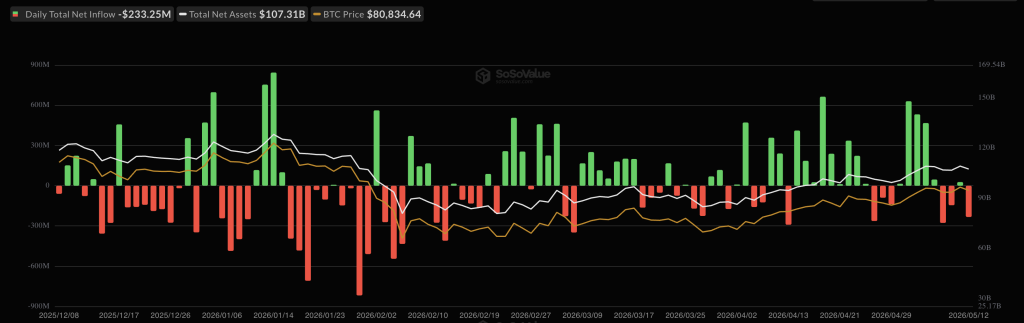
Seven consecutive weeks of ETF inflows totaling $3.43 billion have supported the recovery from February’s $63,000 low, but the legislative outcome is the swing variable few are pricing with confidence.
H.R. 3633, which passed the House on July 17, 2025, by a 294–134 bipartisan vote, would grant the CFTC exclusive authority over spot markets for decentralized digital commodities while keeping SEC oversight over investment contracts.
A May 11 compromise between Senators Thom Tillis (R-NC) and Angela Alsobrooks (D-MD) resolved key industry concerns, permitting activity-based rewards like staking while banning bank-style yields – earning Coinbase’s public support.
Senate Banking Chairman Tim Scott confirmed the committee is, in his words, “in the red zone.” Prediction markets now put passage odds at 60%.
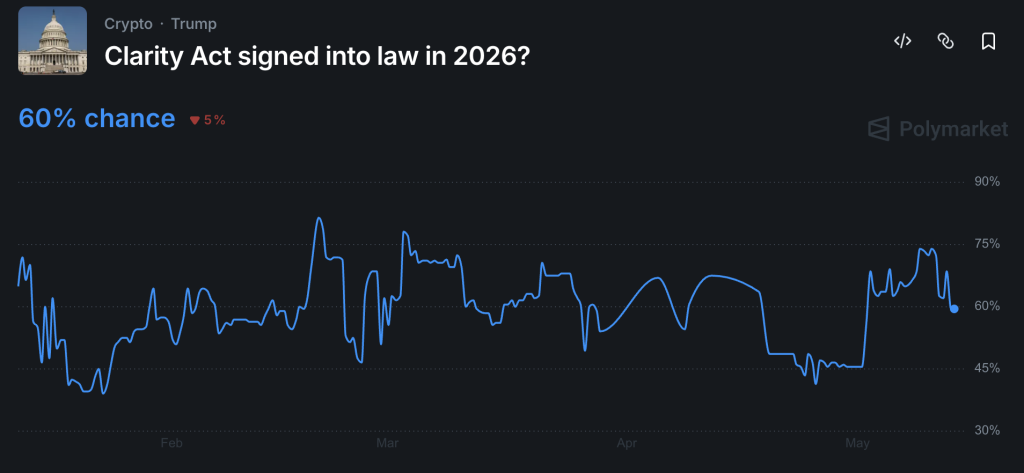
Institutional positioning reinforces the macro bid. UBS disclosed a holding of 6.31 million MicroStrategy shares worth $1.12 billion, an indirect bet on MSTR’s 818,334 BTC treasury.
Strong U.S. jobs data (115,000 payrolls added) and a single-day ETF inflow of $630 million on May 1 are keeping spot demand elevated heading into the vote.
The legislative backdrop has shifted materially since Q1, the question is whether the Senate delivers before the market moves past it.
Bitcoin Price Prediction: Can Bitcoin Price Hit $85,000 Before the Clarity Act Vote?
Bitcoin’s technical structure is constructive but not clean.
Price is consolidating above $80,000, now acting as immediate support, with resistance sitting at $82,800, a level that rejected price earlier this week.
A clean close above it opens the path toward $85,000, the next meaningful ceiling flagged by on-chain analysts.
Momentum leans bullish. Miners offloaded roughly 3,400 BTC, and the sell pressure failed to dent the uptrend. Demand absorption is healthy. 7 straight weeks of ETF inflows are providing a structural floor that did not exist during the Q1 drawdown.
The CLARITY Act committee vote is the catalyst heading into May 14.
Bipartisan support advances the vote and price gaps above $82,800, targeting $85,000 to $87,000 within days. If the vote proceeds but faces amendments or delay, price chops between $79,500 and $82,800 with ETF inflows holding the floor.
Democrats’ blocking of ethics provisions stalls the vote entirely, $80,000 gets tested, and a daily close below $79,200 invalidates the near-term bullish structure.
Inflation data and Fed commentary are secondary risks sitting behind the legislative outcome. The current consolidation pattern resembles pre-breakout coiling. Whether that comparison holds depends entirely on what comes out of Thursday’s vote. the usual caveats. Watch the May 14 close, not just the vote headline.
Smart Money Prefers New Layer 2 Called Bitcoin Hyper And Here is Why
Bitcoin at $80,000-plus validates the macro thesis, but at this market cap, the asymmetric return window for BTC itself is structurally narrower than it was at $30,000.
Traders seeking leverage on the Bitcoin ecosystem without the reduced upside of large-cap exposure are increasingly looking at infrastructure plays built directly on the network. (That’s not a contrarian take, it’s just math.)
Bitcoin Hyper (HYPER) is one project attracting early attention in this context. It positions itself as the first Bitcoin Layer 2 integrating the Solana Virtual Machine – delivering sub-second finality and low-cost smart contract execution while remaining anchored to Bitcoin’s security layer via a Decentralized Canonical Bridge. The pitch is programmability without abandoning Bitcoin’s trust model.
The presale has raised $32,676,096.88 at a current price of $0.01368, with staking rewards available at launch.
Key features include extremely low-latency Layer 2 processing, SVM integration for DeFi-grade smart contracts, and native BTC transfer infrastructure.
The post Bitcoin Price Prediction: Coiling at $81,000 as the CLARITY Act Vote Approaches: Will Tomorrow’s Senate Decision Trigger a Rally to $90,000? appeared first on Cryptonews.
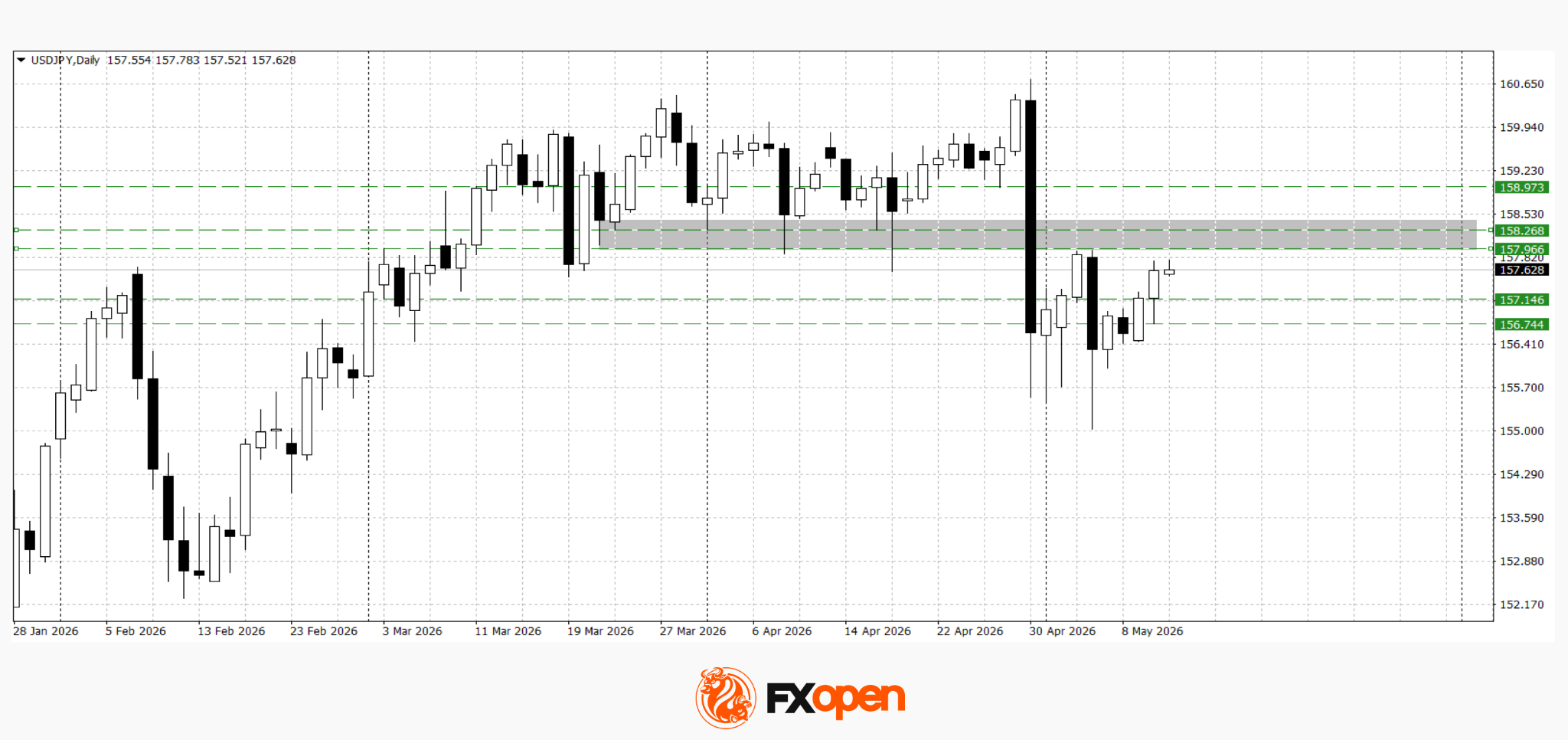
The US dollar strengthened following the release of stronger-than-expected inflation data, which reinforced expectations that the Federal Reserve will maintain a restrictive monetary policy stance. US consumer prices rose to their highest levels since May 2023, renewing concerns over persistent inflationary pressure. This pushed Treasury yields higher and supported demand for the dollar. Additional support came from renewed speculation among some market participants that the Fed could still consider further tightening.
Despite the stronger dollar, the continuation of the upward move remains uncertain. Following the sharp rally, both USD/JPY and USD/CAD tested important resistance levels, but the market has so far failed to secure a sustained break above them. This suggests that investors remain cautious and that the latest bullish impulse has yet to be fully confirmed.
USD/JPY
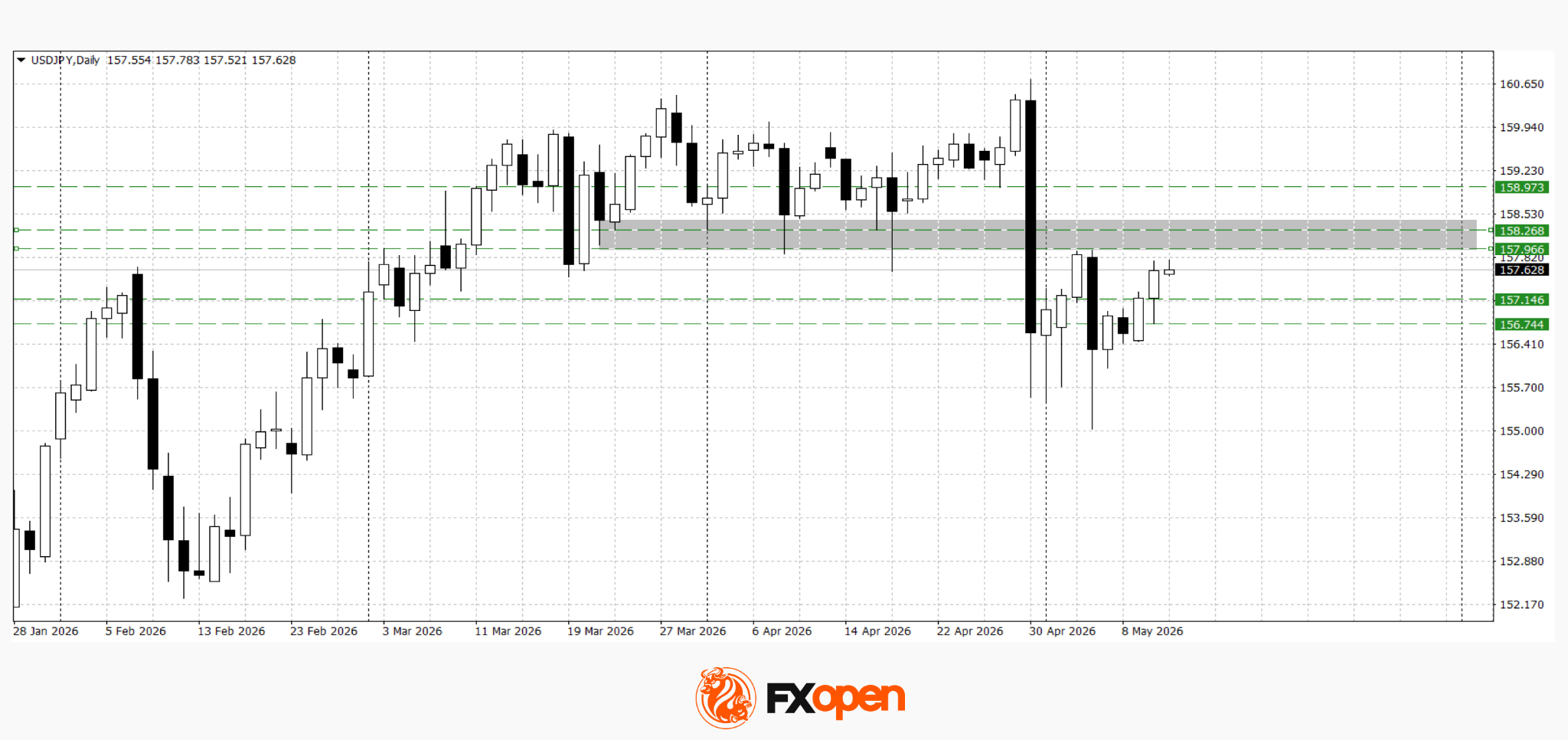
USD/JPY advanced on the back of accelerating inflation and rising US bond yields, but the pair failed to hold above the key resistance area between 158.00 and 158.20. Technical analysis points to a possible retest of recent support levels around 157.20–156.70. If the pair manages to break above 158.20 during the coming sessions, a move towards 159.00 may follow.
Key Events For USD/JPY:
- today at 13:00 (GMT+3): OPEC monthly report
- today at 15:30 (GMT+3): US Producer Price Index (PPI)
- today at 18:00 (GMT+3): Cleveland Fed CPI index (US)
USD/CAD
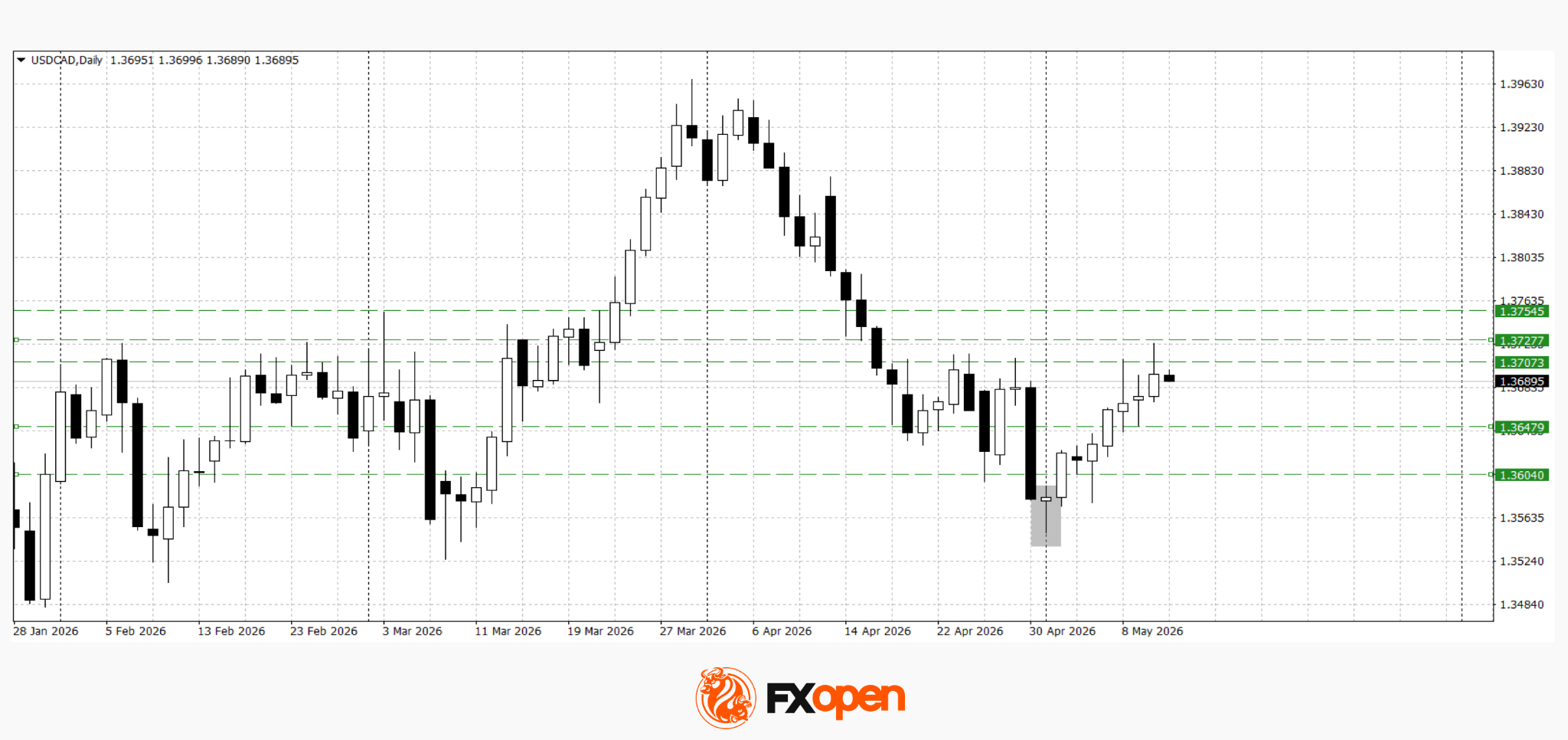
USD/CAD continues to reflect the bullish hammer pattern formed on the daily timeframe on 1 May. However, yesterday’s upward move lost momentum near the important resistance area between 1.3700 and 1.3730. If buyers manage to establish the price above these levels in the coming sessions, the pair could advance towards 1.3750. Otherwise, a decline towards 1.3600–1.3650 remains possible.
Key Events For USD/CAD:
- today at 17:30 (GMT+3): US crude oil inventories
- today at 18:00 (GMT+3): Thomson Reuters/Ipsos Primary Consumer Sentiment Index (PCSI) in Canada
- today at 18:30 (GMT+3): speech by Boston Fed President Susan M. Collins
Overall, stronger inflation data has supported the dollar and strengthened expectations of tighter Fed policy. However, the inability of USD/JPY and USD/CAD to break decisively above resistance levels points to ongoing market uncertainty. If inflationary pressure remains elevated, the dollar’s advance could continue, while a weaker market reaction to upcoming data may result in both pairs returning to previous ranges and entering a corrective phase. Market response to further inflation and production data will be crucial in confirming the current trend.
Trade over 50 forex markets 24 hours a day with FXOpen. Take advantage of low commissions, deep liquidity, and spreads from 0.0 pips (additional fees may apply). Open your FXOpen account now or learn more about trading forex with FXOpen.
This article represents the opinion of the Companies operating under the FXOpen brand only. It is not to be construed as an offer, solicitation, or recommendation with respect to products and services provided by the Companies operating under the FXOpen brand, nor is it to be considered financial advice.

The first US spot ETF tracking Hyperliquid’s HYPE token started trading on Nasdaq on May 12, 2026.
The fund, ticker $THYP, comes from 21Shares and pulled in $1.8 million in trading volume and about $1.2 million in net inflows by the end of the first day.
21Shares Launches First Spot Hyperliquid ETF
21Shares announced the launch of THYP in posts published yesterday, describing the fund as physically backed by HYPE tokens and capable of staking a portion of its holdings. According to the issuer, the ETF carries a 0.30% management fee, which it calls the lowest fee for a Hyperliquid ETF as of May 12.
Bloomberg analyst James Seyffart tracked the launch throughout the trading session. About two and a half hours after markets opened, he said that THYP had already reached roughly $750,000 in trading volume. NovaDius Wealth president Nate Geraci also noted that there was a leveraged 2x version of it.
Later in the day, Seyffart described the final $1.8 million figure as “a very solid day” for a new ETF launch, while adding that it was “nothing too crazy.” For comparison, when Bitwise’s Solana staking ETF (BSOL) launched in October 2025, it recorded $56 million in first-day volume, the best ETF debut of that year.
More recently, Morgan Stanley’s Bitcoin ETF (MSBT) pulled in $34 million on its first day back in April 2026, putting THYP’s $1.8 million in a different territory entirely, although the fund is tracking a significantly smaller and less widely held asset.
Risk Warning
The ETF gives traditional investors exposure to Hyperliquid’s HYPE token through brokerage accounts without directly holding the asset. Still, 21Shares included repeated warnings in its prospectus and promotional material that THYP is not a direct investment in HYPE and carries heightened volatility risks.
The firm also noted that staking introduces risks tied to validator performance, including potential slashing penalties and lock-up periods.
The wave of altcoin ETF activity that THYP is part of follows a notably warmer period for crypto fund flows, which saw Bitcoin ETFs attracting close to $2 billion in April 2026, snapping a multi-month run of net outflows and turning the year-to-date flow picture positive.
HYPE was trading near $40 at the time of writing, down about 2% in the last 24 hours and roughly 9% over the past week. It’s currently about 32% below its all-time high of $59.30, which it reached in September 2025.
The post 21Shares Hyperliquid ETF Debuts With $1.8M in Trading Volume appeared first on CryptoPotato.

[PRESS RELEASE – Singapore, Singapore, May 13th, 2026]
LBank, a leading global cryptocurrency exchange, has officially announced explosive growth in its TradFi business. LBank TradFi’s average daily trading volume has surpassed $2.5 billion, representing a 25% increase compared to March this year. This strong growth not only reflects the continued release of global demand for multi-asset trading but also further highlights LBank’s leading expansion pace and structural advantages in the convergence of crypto assets and traditional finance.
LBank TradFi now provides comprehensive coverage across core asset classes in global traditional financial markets, including stocks, 24H stocks, metals, commodities, and indices, with a total of 117 trading pairs forming a well-structured multi-asset trading matrix. The platform spans a wide range of underlying assets such as gold, silver, crude oil, agricultural products, major global indices, and leading US equities, offering users diversified cross-market trading opportunities and further strengthening its one-stop TradFi trading experience.
Precious metals continue to play a dominant role within LBank TradFi, serving as the primary driver of trading activity across the platform. According to the latest data, the top five traded assets are GOLD, XAUT, SILVER, XTI, and PAXG, with gold-related instruments maintaining a leading position in overall market activity and liquidity flow.
Notably, LBank TradFi has demonstrated significant structural liquidity depth across multiple asset classes. According to CoinGlass data, XBR, US2000, VIXINDEX, and SOYBEAN all rank No.1 in open interest across centralized exchanges, further validating LBank’s deep liquidity advantage and strong market capacity in TradFi assets.
“LBank TradFi’s rapid growth validates that our long-term investment in the convergence of traditional finance and digital assets is gradually delivering structural results,” said Eric He, LBank Community Angel Officer & Risk Control Advisor. “What we are building is not merely a trading product, but a global multi-asset trading infrastructure with deep liquidity, extensive asset coverage, and a highly efficient execution system.”
As global demand for diversified asset allocation continues to accelerate, LBank TradFi is progressively building a comprehensive trading infrastructure system. Through efficient liquidity aggregation and asset connectivity capabilities, it further bridges the trading boundaries between digital assets and traditional financial markets, driving the evolution of multi-asset trading from a fragmented structure toward an integrated framework, while enhancing unified global price discovery and capital allocation efficiency.
Moving forward, LBank will continue to expand the breadth of its TradFi asset coverage and deepen its cross-market connectivity capabilities, further strengthening liquidity aggregation and execution efficiency across global markets. This ongoing development will reinforce LBank’s role as a key multi-asset trading infrastructure and liquidity hub in the global financial ecosystem.
About LBank
Founded in 2015, LBank is a leading global cryptocurrency exchange serving over 20 million registered users in 160 countries and regions. With a daily trading volume exceeding $10.5 billion and 10 years of safety with zero security incidents, LBank is dedicated to providing a comprehensive and user-friendly trading experience. Through innovative trading solutions, the platform has enabled users to achieve average returns of over 130% on newly listed assets.
LBank has listed over 300 mainstream coins and more than 50 high-potential gems. Ranked No. 1 in 100x Gems, Highest Gains, and Meme Share, LBank leads the market with the fastest altcoin listings, unmatched liquidity, and industry-first trading guarantees, making it the go-to platform for crypto investors worldwide.
Users Can Follow LBank for Updates:
Website: https://www.lbank.com/
Twitter: https://twitter.com/LBank_Exchange
Telegram: https://t.me/LBank_en
Instagram: https://www.instagram.com/lbank_exchange
LinkedIn: https://www.linkedin.com/company/lbank
The post LBank Reports $2.5 Billion Daily TradFi Trading Volume, Up 25% Since March appeared first on CryptoPotato.
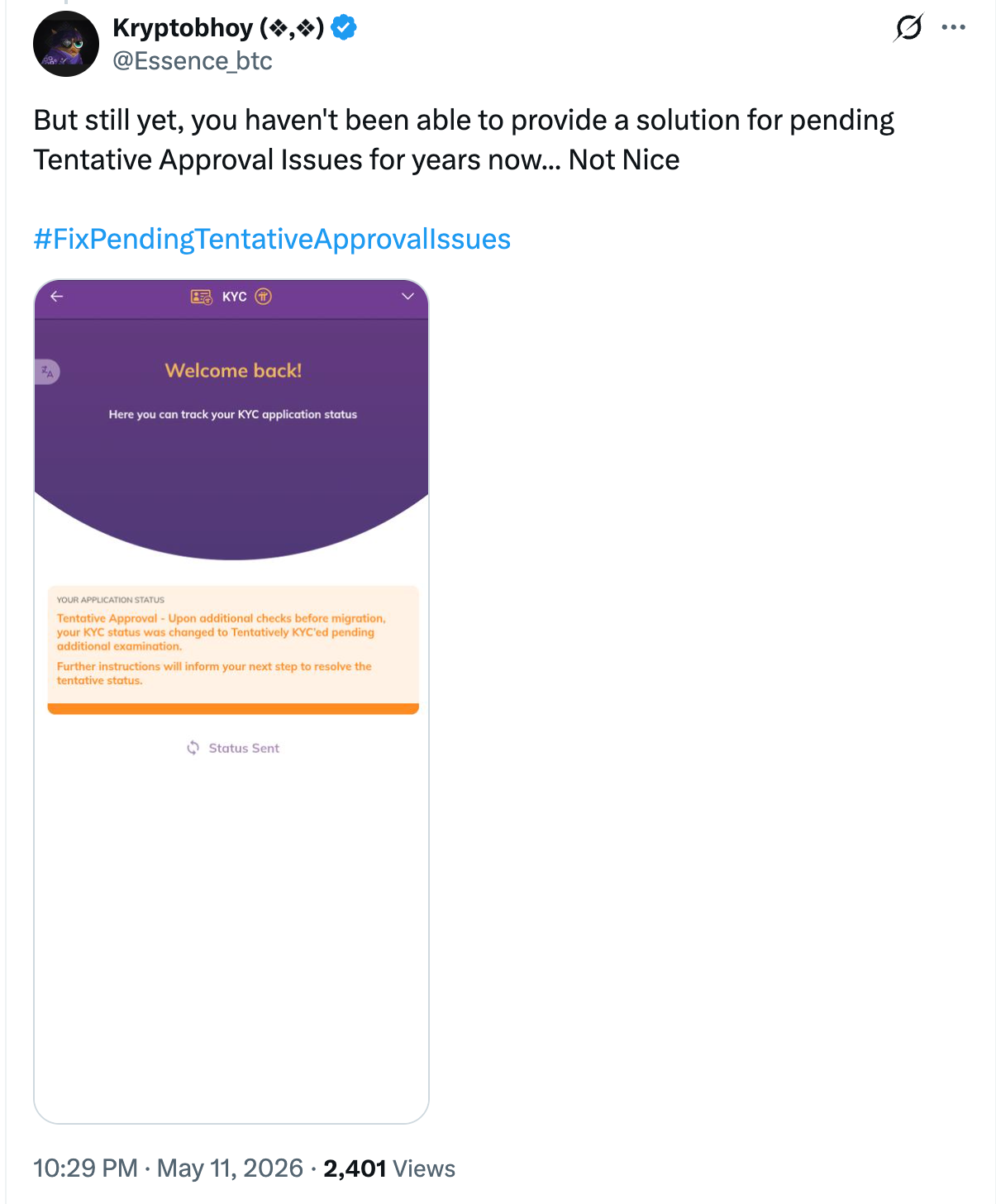
Pi Network’s April 2026 progress update revealed that the network has now surpassed 18.1 million fully verified users and completed over 16.72 million mainnet migrations.
According to the update, April alone saw more than 100,000 KYC approvals and 30,000 mainnet migrations.
Follow us on X to get the latest news as it happens
Pi Network’s KYC Update Triggers Pioneer Backlash
The latest figures come after the Pi Core Team explained that its in-app Know Your Customer (KYC) system combines human reviewers with AI-powered fraud detection.
The network stated that over 1 million individuals have collectively processed around 526 million verification tasks, helping confirm nearly 18 million unique identities.
Each application reportedly undergoes roughly 30 separate verification checks before approval, in an effort to reduce the number of duplicate or fraudulent accounts.
Nonetheless, Pioneers flooded the announcement with complaints. Commenters said tentative approvals had remained pending for extended periods.
“The @PiCoreTeam promised a decentralized revolution, but for millions of Pioneers, the only thing ‘decentralized’ is the hope of passing KYC. It’s been 7 years down the line with no hope in sight,” one user wrote.

Pi Core Team Responds to Pioneer Concerns on KYC
Nonetheless, the Pi Core Team told BeInCrypto that Pi’s KYC review process is intentionally conservative. The team said effective KYC should not allow every account to pass easily, which is exactly the intent of running a strong KYC process in the first place.
They added that if applications were approved without sufficient verification, it would:
• Duplicate accounts could migrate to Mainnet, harming the ecosystem
• Rewards and participation would become distorted, creating unfairness
• Applications and services would not be able to rely on user authenticity, diluting this Pi resource.
“Maintaining a verified, one-person-per-account structure ensures that Pi Network remains fair, secure, and usable. Since Pi rolled out a system process upgrade in October 2025, more than 3.36 million Pioneers have moved from Tentative to fully approved KYC,” the team said.
The team mentioned that resolving user concerns remains “a priority.” The outlined three steps that Pioneers who remain in Tentative status can take:
• Complete any available liveness checks in the Pi app
• Ensure all submitted information is accurate and clear
• Continue actively mining, which may trigger the system process checks
Pi explained that stuck Pioneers fall into different corner cases, each requiring a custom technical fix before that group can be unblocked.
“Overall, having a ‘Tentative KYC’ status does not mean rejection. It means additional verification is required before final approval. The Tentative KYC status helps ensure the integrity of the network by cautiously allowing as many real human Pioneers as possible to pass KYC, while catching and preventing as many fake and bot accounts as possible,” PCT told BeInCrypto.
Pi Coin (PI) Faces Headwinds in May
Meanwhile, amid growing user complaints, Pi Network is also facing pressure on the price front. While many altcoins have rallied with double digits in May, Pi Coin has lagged.
Its price has declined 2.6% so far this month. PI traded at $0.17 at press time, up 1.3% over the past day.

Still, a potential catalyst sits days away. Pi Network has set May 15 as the deadline for mainnet nodes to complete the Protocol 23 upgrade. Previously, Protocol 22 lifted PI nearly 9% before the rally faded.
Whether Protocol 23 produces durable price action remains to be seen. About 174.2 million PI tokens will enter circulation over the next 30 days, which could weigh on any rally.
Subscribe to our YouTube channel to watch leaders and journalists provide expert insights
The post Pi Network Shares KYC Update But Community Backlash Floods In appeared first on BeInCrypto.
Crypto World
Trump Just Flew to China With Elon Musk, Larry Fink, and Jensen Huang: Is a Trade Deal News About to Send Bitcoin to $90,000?

Bitcoin price climbed to a 24-hour high of $81,000 as Trump-China trade news pushed BTC toward its most structurally significant resistance in months.
The question now is whether the geopolitical narrative has enough legs to carry BTC through $90,000, or whether the move is front-running an outcome that hasn’t materialized yet.

What Is the Trump-China Trade Driving Bitcoin Toward $90k?
President Donald Trump’s state visit to China, the first U.S. presidential trip to the country in nearly a decade, landed with immediate market impact.
Trump boarded Air Force One with a delegation of over a dozen U.S. executives, including Tesla’s Elon Musk, Apple’s Tim Cook, BlackRock’s Larry Fink, and, confirmed as a last-minute addition on May 13, Nvidia CEO Jensen Huang.
Markets are pricing in a specific scenario: a framework agreement between Trump and Xi Jinping that eases tariffs on semiconductors and electronics, tariffs that peaked at 60% on Chinese goods in late 2025, alongside potential deals on rare earths and aviation.
US Treasury Secretary Scott Bessent began preparatory talks with Chinese officials in South Korea ahead of the summit, with meetings scheduled with Chinese Vice Premier He Lifeng on Wednesday. Successful outcomes could stabilize global supply chains and directly reduce one of the key macro headwinds suppressing risk appetite.
Bitwise strategist Juan Leon framed the stakes precisely, stating that “reduced tariff risks could unlock $1 trillion in sidelined capital for crypto.”
Near-term, if the Trump-Xi summit produces even a preliminary trade framework by May 15, Bitcoin’s path to $88,000–$90,000 opens quickly.
If talks stall, the unwinding of the Trump trade could be sharp. BTC already dipped to $79,832 when US CPI came in hot at 3.8%, demonstrating how quickly macro data can cut through geopolitical optimism
Can Bitcoin (BTC) Break $90,000 Upon the News?
Bitcoin price is trading above $81,000 after printing a session high of $81,248, recovering from a $79,832 low set earlier when CPI data disappointed.
The first meaningful resistance cluster sits at $82,500 to $83,500, a zone that has capped multiple recovery attempts over the past 2 weeks.
Above that, $88,000 to $90,000 is the decisive range. The 200-day SMA sits in that vicinity, and $90,000 has become a magnet for stop orders and institutional limit sells.
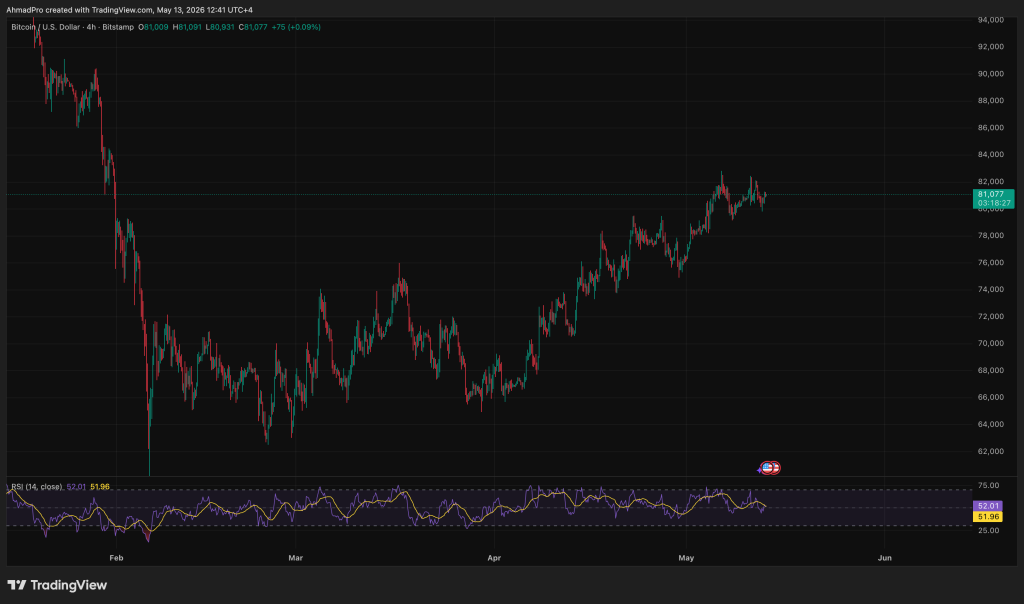
Clearing $90,000 on above-average volume opens the door to $93,000 to $95,000, the range where BTC traded post-election in November 2024. The SMA-50 at $84,500 needs to flip to support before a clean $90,000 test becomes structurally sound rather than just a spike.
On the downside, $79,500 to $80,000 is the line that must hold. A daily close below $79,500 breaks the current higher-low structure and reopens the $75,000 to $76,000 support band.
The bull structure is intact above $80,000, but not yet confirmed as a trend resumption. That confirmation requires a clean close above $84,500.
2 external variables are in play this week. Kevin Warsh’s expected confirmation as Fed Chair and the CLARITY Act markup are scheduled for Thursday. Both are net positive for BTC if they land clean. Both could introduce volatility that resets the setup if they do not.
The chart needs a daily close above $84,500. Everything else is noise until that print.
The post Trump Just Flew to China With Elon Musk, Larry Fink, and Jensen Huang: Is a Trade Deal News About to Send Bitcoin to $90,000? appeared first on Cryptonews.


The Ethereum Foundation unveiled Clear Signing, an open standard that makes transaction approvals human-readable. The release targets blind signing, a flaw the foundation said has fueled billions in user losses.
Built around ERC-7730, the framework lets wallets display plain-language descriptions of each transaction before users approve it. The Ethereum Foundation’s One Trillion Dollar Security Initiative will steward the underlying infrastructure as a credibly neutral host.
Why Blind Signing Has Become a Costly Default
In many crypto exploits, the final step is not a software bug but a user approving a transaction. The Foundation’s announcement framed that approval gap as the core problem. Even after phishing or infrastructure compromise begins a breach, the last action typically falls to the wallet holder. Clear Signing aims to make that defense hold.
Approvals today often appear in low-level machine code that requires technical expertise to interpret. Some users rely on a separate device to double-check transaction details when the application could be compromised. The foundation cited the Bybit incident among recent cases where signed transactions drained user wallets.
How Clear Signing Works
ERC-7730 introduces a shared format that turns transaction data into clear, human-readable descriptions. Instead of being stored on-chain, these descriptions are kept in a decentralized off-chain registry and distributed to wallets.
Another standard, ERC-8176, allows independent auditors to verify and cryptographically confirm that these descriptions are accurate. Based on these verifications, wallets can decide which sources they trust.
Because the system works off-chain, existing apps don’t need to change their smart contracts to support Clear Signing. The Ethereum Foundation says this approach fits into its broader plan to improve privacy and security across the network.
Wallet providers will ultimately choose which descriptor sources to display, relying on reputation and audit attestations.
Multi-Party Push as Institutions Expand Ethereum Exposure
Ledger originated ERC-7730. The working group now spans MetaMask, Trezor, Fireblocks, WalletConnect, Cyfrin, Sourcify, and Zama, alongside independent contributors. Rust and TypeScript libraries funded by the 1TS program are hosted on clearsigning.org.
The release lands as institutions expand their Ethereum footprint, including JPMorgan’s recent launch of JLTXX, a tokenized treasury product. Vitalik Buterin has previously flagged transaction transparency as a critical blind spot for the network’s next phase of adoption.
Developers said the project remains active. Contributors are expanding wallet compatibility, audit tooling, and adoption across decentralized applications. Whether issuers, custodians, and wallet vendors converge on shared descriptors will determine how quickly Clear Signing becomes the default across DeFi and institutional flows.
The post Ethereum Foundation Launches Clear Signing Standard to End Blind Wallet Approvals appeared first on BeInCrypto.

PCOS Is Now PMOS: Name Change, Reason, Symptoms Explained

How to watch PGA online

Strike ballot opens for 600 Bee Network bus drivers

Manchester United reach agreement with Casemiro over contract clause amid transfer speculation

US brings back mandatory military draft registration

Steven Gerrard disagrees with Gary Neville over ‘shock’ Chelsea and Arsenal claim | Football


-
 Crypto World5 days ago
HarrisX Poll Found 52% of Registered Voters Support the CLARITY Act
-

 Fashion5 days ago
Weekend Open Thread: Marianne Dress
-

 Crypto World6 days ago
Upbit adds B3 Korean won pair as Base token gains Korea access
-
 NewsBeat6 days ago
NCP car park operator enters administration putting 340 UK sites at risk of closure
-

 Fashion2 days ago
Coffee Break: Travel Steam Iron
-

 Fashion2 days ago
What to Know Before Buying a Curling Wand or Curling Iron
-

 Tech3 days ago
Auto Enthusiast Carves Functional Two-Stroke Engine from Solid Metal
-

 Politics2 days ago
What to expect when you’re expecting a budget
-
 Business4 days ago
Ignore market noise, India’s long-term story intact, say D-Street bulls Ramesh Damani and Sunil Singhania
-

 Politics4 days ago
Politics Home Article | Starmer Enters The Danger Zone
-

 Crypto World7 days ago
BlackRock CEO Larry Fink Discusses a New Asset Class
-

 Tech2 days ago
GM Agrees To Pay $12.75 Million To Settle California Lawsuit Over Misuse Of Customers’ Driving Data
-
 Sports7 days ago
NBA playoff winners and losers: Austin Reaves is not loving Lakers vs. Thunder matchup, but Chet Holmgren is
-

 Entertainment6 days ago
Sarah Paulson Called Out For Met Gala ‘Hypocrisy’
-

 Entertainment6 days ago
General Hospital: Ric & Ava Bombshell – Ric’s Massive Secret Exposed!
-

 Politics6 days ago
Simon Cowell Says He Was ‘Horrible’ To Susan Boyle During BGT Audition
-

 Crypto World6 days ago
Robinhood says Wall Street is building onchain
-

 Sports6 days ago
UEFA Champions League final schedule, teams, venue, live time and streaming | Football News
-

 Entertainment7 days ago
Bold and Beautiful Early Spoilers May 11-15: Steffy Revolted & Liam Overjoyed!
-

 Entertainment6 days ago
Why David Letterman Called CBS ‘Lying Weasels’
You must be logged in to post a comment Login