Entertainment
Through the Lens of Loss: Artist Katherine Hubbard’s Five-Year Portrait of a Mother Fading

For five years, two vintage Polaroid cameras stood permanently rigged inside a rambling, dilapidated apartment in Germantown, Philadelphia. They were not props or set dressing. They were witnesses. Behind them was artist Katherine Hubbard, and in front of them, again and again, was her mother, Antonette Berger — a woman whose mind was slowly slipping away from her, and whose defiant, theatrical spirit refused to go quietly.
The result, a body of work titled The Great Room and collected in the book One Fifty One, is now on view as part of Hubbard’s solo exhibition at Studio Voltaire in London. It is, by any measure, an unusual entry in the entertainment and art world’s autumn calendar — not a celebrity memoir or a splashy biopic, but an intimate, unflinching record of illness, intimacy and the strange intrusions of caregiving, told through a family’s most private rooms.
Hubbard’s story begins, as so many pandemic-era stories do, with a nagging unease that took time to name. In 2020, visiting her mother in Philadelphia after Covid restrictions eased, Hubbard began to sense that something in Berger’s behaviour had shifted. “It was impossible at the time to say what I was noticing, but something was off,” she has said. The eventual diagnosis was LATE — limbic-predominant age-related TDP-43 encephalopathy, a condition that mimics Alzheimer’s but progresses more slowly, eroding memory and daily function over a longer, more agonising arc.
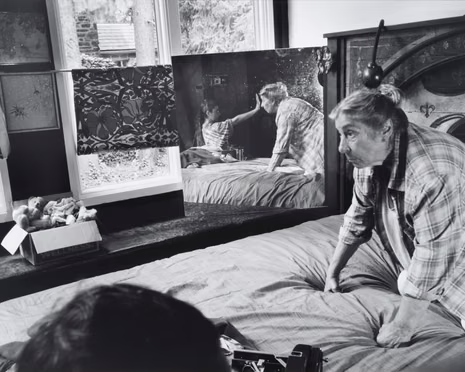

What followed was, in Hubbard’s words, a “painful, drawn-out and confusing process,” followed by grief. Thrust into the role of what she calls “a caretaker under duress,” she responded not by looking away but by looking harder — setting up her cameras in her mother’s apartment and refusing to take them down.
The apartment itself is no ordinary backdrop. Berger owned and rented out the sprawling, maze-like building for four decades, and it functioned for years as something like a neighbourhood hub — tenants dropping by, complaints about broken pipes, a constant hum of people. It stood in sharp contrast to the “more modest” house where Hubbard actually grew up, and its grandiose, crumbling scale gives The Great Room — a title borrowed from Berger’s own name for the apartment’s main living space — its startling visual drama.
Some of the images verge on the theatrical in the most literal sense. At one point, Hubbard built her mother a makeshift stage out of a set of rotting 1960s mirrored doors she found abandoned in the garage, mounting them on stands so Berger could wheel them around the room. Mirrors recur throughout the series, and Hubbard describes them as a deliberate strategy: a way to insert herself into the frame alongside her mother rather than observe from a safe distance. “It’s a way of never leaving my mum alone in the image, to project myself into the image,” she explains. “If I’m in the image there with her, it changes some of the authority and power dynamics of the camera.”
That refusal to simply document from outside — to instead share the frame, the vulnerability, even at one point posing nude and covered in Vaseline to make body prints with her mother — gives the work an emotional charge rarely seen in photography about illness. These are not clinical or pitying images. Berger, described by her daughter as “incredibly headstrong, eccentric, and difficult,” often commands the frame with an unexpected authority, bathed in the kind of majestic light more commonly associated with portraiture of the powerful than the ailing.
Hubbard is candid about the limits of the camera in the face of a disease that erases the very thing photography claims to capture. “The camera fails us in so many ways,” she says, “and the absurdity with dementia is that I was constantly making lots of images of things that can’t be shown in an image. But I make images because of how they feel, not how they look.” It’s a striking admission from an artist whose work depends on the visual, and it reframes the entire project: not as an attempt to preserve her mother’s likeness before it’s gone, but as an attempt to hold onto a feeling — presence, tenderness, the strange choreography of care — that resists straightforward depiction.
As the years passed, mother and daughter moved through daily domestic rituals together in the apartment, eventually beginning the slow, sorrowful work of packing it up so Berger could move into a care facility. Hubbard describes a turning point in the process when the camera itself seemed to disappear from their awareness. “Something wonderful happened at some point where we both stopped thinking about the cameras, and we stopped seeing ourselves as an image — the cameras were just present, and the time to make photographs created interruptions into an otherwise brutal, demanding time.”
That sentence perhaps best captures what makes The Great Room resonate beyond the art world into something more universally recognisable: the way ritual — even one as unusual as a standing photo session — can become a lifeline amid the exhausting, disorienting work of caring for a parent whose mind is receding. In an entertainment landscape often dominated by spectacle, Hubbard’s exhibition offers something quieter and more enduring: a daughter’s attempt to keep making pictures of a person who is, in her words, “completely her own person,” for as long as that person remains reachable through a lens.
The Great Room and related installations are on show as part of Katherine Hubbard’s solo exhibition at Studio Voltaire in London, alongside the publication of her book One Fifty One.
You must be logged in to post a comment Login