
Crypto World
Revolut drops Tether USDT as MiCA rules force major crypto shift



Revolut has confirmed it will remove Tether’s USDT from eligible European accounts after new European Union crypto rules took effect under the Markets in Crypto-Assets (MiCA) framework.
Summary
- Revolut will delist USDT for eligible European users under the EU’s MiCA regulations.
- Users can buy USDT until July 6 and withdraw or sell holdings until Aug. 31.
- Tether also recently froze 131 TRON wallets after new U.S. sanctions targeted ISIS-K-linked addresses.
According to an email sent by Revolut to affected customers, the fintech company will phase out support for USDT over the next two months, giving users until Aug. 31 to sell, withdraw, or transfer their holdings before the stablecoin is removed from eligible accounts.
Revolut has set a phased deadline for USDT holders
Revolut said customers will continue to be able to buy USDT until July 6. Beginning July 30, the platform will stop accepting new USDT deposits, while users will still be allowed to sell their tokens or transfer them to supported external crypto wallets until Aug. 31.
The company told customers to review their USDT holdings before Aug. 31 at 12:00 PM GMT because, after that deadline, the stablecoin will no longer be supported in eligible Revolut accounts. Under Revolut’s crypto delisting policy, any remaining USDT balance will be automatically converted into the account’s base currency using the market price of USDT at the time the delisting takes effect.
Revolut also clarified that the restrictions apply only to notified users. The company said the changes will not affect access to USDT in jurisdictions where the stablecoin continues to be supported.
MiCA requirements continue to reshape stablecoin access
Revolut linked the decision to the European Union’s MiCA framework, which now requires stablecoin issuers and crypto service providers operating in the bloc to comply with licensing, reserve, disclosure, and supervisory rules.
crypto.news previously reported that USDT has not received authorization under MiCA. Tether Chief Executive Officer Paolo Ardoino argued that the framework was not designed for the world’s largest stablecoin because of its reserve-related requirements. Ardoino previously said those rules raised concerns about reserve composition, liquidity management, and redemption risks for issuers.
Following the July 1 implementation of MiCA enforcement measures, Revolut joins other crypto platforms that have restricted access to USDT for European customers because the token lacks MiCA authorization.
The regulatory pressure comes as Tether continues to face increased scrutiny in other areas. As crypto.news reported earlier, the company recently froze USDT balances held in 131 wallets on the TRON blockchain after the U.S. Treasury’s Office of Foreign Assets Control updated sanctions tied to ISIS-K.
Notably, OFAC added 134 cryptocurrency wallet identifiers to its sanctions list on July 1, including 131 TRON addresses and three Monero addresses linked to ISIS-K.
The sanctions update identified the wallets as belonging to the Islamic State Khorasan Province, the Afghanistan and Pakistan branch of the Islamic State, which had already been designated as a terrorist organization before the additional wallet identifiers were published.
While the sanctions action is unrelated to MiCA, it highlights Tether’s ability to freeze tokens in response to regulatory and law enforcement actions. At the same time, Revolut’s delisting decision illustrates how new European crypto rules are affecting the availability of stablecoins that have not secured authorization under the bloc’s regulatory framework.



Galaxy Research Vice President Lucas Tcheyan said on Aug. 7 that Ethereum and Solana are confronting a similar policy question: how much token issuance is needed to pay for network security, and when does that security budget become more costly than useful? The debate is moving through proposal processes on both networks, but neither blockchain has approved an inflation change.
Summary
- Ethereum’s tapered issuance proposal is now EIP-8363, after editors reassigned its initially reported proposal number.
- EIP-8363 would burn rising validator rewards and remove issuance incentives near a 50% staking ratio.
- Solana’s SIMD-0550 would double annual disinflation to 30%, cutting projected emissions by 18.9 million SOL.
- Solana governance requires two-thirds support from decisive stake after proposals complete an eleven-epoch voting process.
- Galaxy says both networks are reassessing security budgets, with no final inflation changes approved yet.
One important update concerns Ethereum’s proposal number. Galaxy initially referred to the Tapered Issuance Burn proposal as EIP-8361. Ethereum’s EIP editors later assigned it EIP-8363 because EIP-8361 had already been allocated elsewhere. The EIP-8363 pull request remained open as of Aug. 9, and an editor requested changes on Aug. 6.
Ethereum proposal would taper rewards as more ETH is staked
EIP-8363 would burn a growing share of consensus layer validator rewards as Ethereum’s staking ratio rises. The burn fraction would reach 100% around a 50% staking ratio, removing new issuance as an incentive for additional staking beyond that level. The authors propose an 18 month transition because applying the full mechanism immediately would sharply reduce validator returns.
Galaxy estimated that, with roughly one third of ETH staked, consensus layer yield would fall from about 2.6% to 1.2% under the full design. MEV and priority fees would remain outside the proposed burn. Those figures describe a modeled outcome, not an approved change to Ethereum’s monetary policy.
The Aug. 6 All Core Developers Consensus agenda listed Tapered Issuance Burn among proposals being considered for Hegotá. The agenda explicitly said the meeting was not a decision to include or schedule those proposals. No network vote or activation date has been set.
Meanwhile, SharpLink CEO Joseph Chalom opposed the issuance change, arguing lower staking returns could make ETH less attractive to institutions and raise financing costs in DeFi. Those outcomes remain forecasts. As crypto.news previously reported, supporters instead argue Ethereum may be paying more issuance than necessary as staked ETH rises.
Solana proposals target emissions and transaction burns
Solana is considering two separate changes. SIMD-0550 would double annual disinflation from 15% to 30% while keeping the terminal inflation floor at 1.5%. The technical proposal was merged into Solana’s improvement document repository on July 23 with Review status, but that does not activate the change.
SGP-0002 asks validators and delegators whether Solana should pursue the faster schedule. Its authors estimate the change would bring the terminal rate forward from about 5.7 years to 2.8 years and produce roughly 18.9 million fewer SOL in emissions over six years. The “18.9 million SOL” reduction is a projection, not a guaranteed change in supply.
SGP-0003 addresses fees. It backs SIMD-0553, which would add an inclusion fee and a resource based fee tied to transaction resource use, with the resource component burned in full. Galaxy cited estimates that daily burns could rise from roughly 650 SOL to between 7,500 and 9,000 SOL under recent network conditions.
However, the burn estimate is already being refined. On Aug. 9, SIMD-0553 author cavemanloverboy said he had been told earlier estimates were “misleading” and published optimistic and pessimistic bounds using the previous month’s traffic. He also noted that contract optimization and other behavioral changes could reduce future burns, meaning the eventual level cannot be treated as fixed.
Solana governance still stands between proposals and activation
Galaxy said SGP-0002 and SGP-0003 each secured support from at least 15% of active stake, enough to advance under Solana’s new onchain governance process. Under the official governance rules, reaching that threshold starts an 11 epoch sequence: seven epochs for discussion, one for a stake snapshot and three for voting.
A proposal passes only if For votes represent at least 66.67% of decisive stake, meaning For plus Against votes. Abstentions are excluded, and there is no separate quorum requirement. Even a successful SGP is a directional mandate rather than automatic code activation; the associated SIMD still needs development and feature gate deployment.
The process follows Solana’s earlier difficulty in changing inflation. SIMD-0228 failed in March 2025 despite 61.39% support because it did not reach the required two thirds approval level. More recently, Solana introduced its SGP framework to separate stake weighted policy signals from technical SIMD review.
What happens next for Ethereum and Solana inflation
Ethereum developers will continue reviewing EIP-8363 and deciding whether it should progress toward Hegotá. The proposal remains an open pull request, and the Aug. 6 developer meeting treated it only as a candidate for further consideration. Any adoption would require more review, agreement on upgrade inclusion and client implementation.
Solana’s path is tied to its governance clock. SGP-0002 and SGP-0003 must complete discussion, stake snapshot and voting stages before either direction is accepted. Technical activation would follow separately. For now, the proposals alter expectations about future ETH and SOL supply rather than either network’s current issuance rules.
Galaxy’s broader view is that both communities are reassessing the price they pay for security as their networks mature. The firm argues lower issuance may improve scarcity at the margin, but demand for blockspace and applications remains the stronger long term driver of token value. With no final decision, any repricing of future supply remains dependent on proposals still under debate.
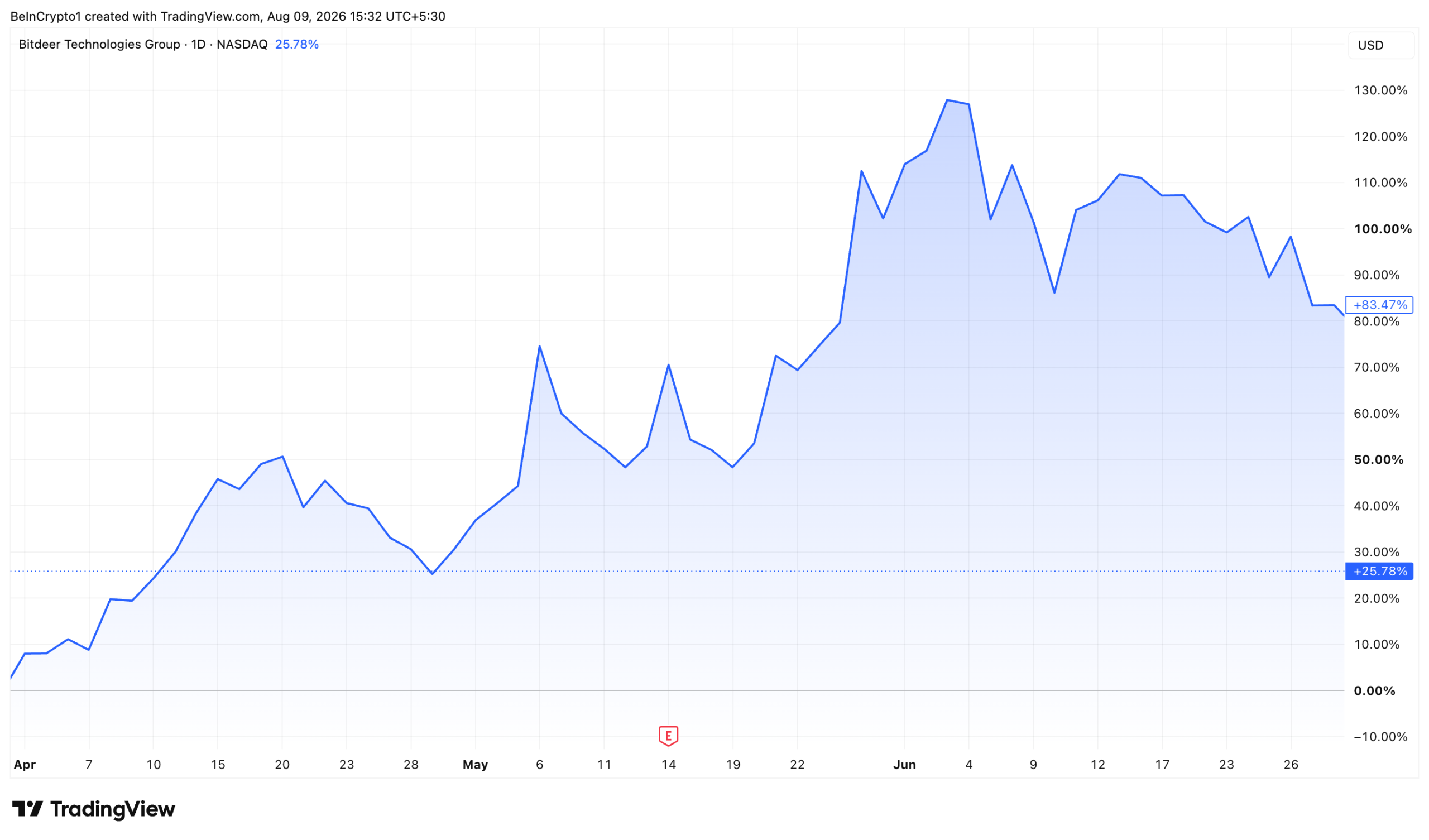
Three crypto companies, Bitdeer (BTDR), Forward Industries (FWDI), and Bit Digital (BTBT), report quarterly earnings this week, each coming off a quarter deep in the red.
The three prints span exposure to major tokens, including Bitcoin (BTC), Solana (SOL), and Ethereum (ETH). All three assets fell last quarter, likely driving heavy paper losses. Now the earnings will show how deep the damage ran.
1. Bitdeer (BTDR)
Bitdeer opens the week on Monday. It will report its second-quarter 2026 results before the US market opens on Monday, August 10, at around 7:00 a.m. ET
In the first quarter, Bitdeer reported a $159.5 million net loss, pressured by weaker cryptocurrency prices. Revenue, however, rose to $188.9 million, while adjusted EBITDA remained positive at $14.4 million.
The second-quarter results come amid a strong period for Bitdeer shares. BTDR gained roughly 83% during Q2, significantly outperforming Bitcoin, which fell 14.08% over the same period.

The company’s mining output also surged. June production reached 990 BTC, up 388% year-over-year. Moreover, Bitdeer has continued to expand its AI infrastructure push.
In June, its subsidiary signed a colocation lease for its Tydal AI data center in Norway. It also broke ground on an Alberta facility.
Follow us on X to get the latest news as it happens
2. Forward Industries (FWDI)
Forward Industries will report its fiscal third-quarter results on Wednesday. In fiscal Q2, the company posted a $283.1 million net loss, largely due to Solana-related write-downs. Revenue more than quadrupled year-over-year to $13.0 million.
Forward previously disclosed that it acquired more than 500,000 SOL during fiscal Q3 at an average price of about $79 per token, lifting its Solana treasury to 7.55 million SOL. The purchases helped fuel a rally in the company’s stock.
Despite that boost, Forward was the only decliner among the three stocks during the quarter, falling about 5% between April and June. The decline was smaller than Solana’s roughly 11.4% drop.

3. Bit Digital (BTBT)
Bit Digital closes the week on Thursday before the open. The Ethereum treasury firm reported a net loss of $146.7 million last quarter as Ethereum’s price downturn cut deep. A $121.1 million hit on digital assets drove most of the damage.
Revenue fell 13.6% to $27.9 million, and the firm held about 155,444 ETH. The stock still recovered. Bit Digital rose about 37% in the second quarter, diverging from ETH’s 25.3% dip.

Together, the three reports test one question. Each firm holds tokens that fell last quarter, and the earnings will show how deeply those drawdowns cut into results.
Subscribe to our YouTube channel to watch leaders and journalists provide expert insights
The post 3 Crypto Earnings to Watch This Week After Q1 Losses appeared first on BeInCrypto.

Brazil’s central bank is introducing a new anti-fraud rule for cryptocurrency transfers, requiring regulated virtual asset service providers (VASPs) to temporarily “hold” certain outbound payments. The measure is designed to slow down potentially fraudulent flows that take advantage of cross-border speed and the complexities of self-custody transfers.
According to a statement from the Banco Central do Brasil (BCB), the rules will apply to funds received above $10,000—either in a single transaction or based on a customer’s total transactions over a day—when those funds are sent to foreign platforms or to customers’ self-custody wallets. The precautionary hold can last up to 24 hours, and providers will also need to hold other transfers that require additional review under their risk-management systems.
Key takeaways
- Brazil’s central bank (BCB) will require up to 24-hour precautionary holds on certain VASP transfers tied to fraud prevention.
- The rule targets transfers involving funds received above $10,000, measured by single transactions or daily aggregates.
- Holds must also cover other transfers flagged for extra scrutiny under a provider’s existing risk policies.
- The requirement takes effect Jan. 1, 2027, with VASPs required to disclose holds to customers and keep detailed records.
24-hour holds for high-value cross-border and self-custody transfers
The BCB says the framework applies when VASPs receive funds over the $10,000 threshold and then transfer them to either overseas providers or wallets held directly by customers. The central bank’s approach is effectively threshold-based: it covers not only one-off large transactions but also cases where multiple smaller moves add up to more than $10,000 in a day for the same customer.
Beyond the headline threshold, the rules also extend to “other transfers requiring further scrutiny” according to each provider’s risk-management policies. That language matters because it gives regulators flexibility to capture additional suspicious patterns even when transfers fall below the $10,000 number, as long as the provider’s compliance framework would normally treat them as higher risk.
When VASPs can release transfers early
A key operational detail is that the hold is not necessarily an automatic full 24-hour delay in every case. The BCB’s statement indicates that a VASP can complete its assessment and release a transfer before the 24 hours expire, as long as it follows parameters set out by the central bank.
Separately, VASPs will be expected to notify customers that a hold has been applied and to document relevant compliance activity. The BCB also requires providers to keep records related to fraud incidents, attempted fraud, and the corrective actions they take. For traders and users, the practical implication is that transfers to foreign platforms or self-custody wallets may become more variable in settlement timing—especially around higher-value or risk-flagged transactions—even if a provider ultimately clears the transfer quickly.
Brazil’s shift reflects a broader anti-scam push
Brazil’s central bank move comes as regulators globally respond to crypto scams that are enabled by fast settlement and the borderless nature of digital assets. The BCB’s approach mirrors a growing trend: slowing down or gating withdrawals and outbound transfers long enough to detect fraud patterns.
Earlier this year, Japan’s Financial Services Agency and National Police Agency asked crypto exchanges to restrict withdrawals in certain circumstances after users deposit fiat currency or buy digital assets. The Japanese authorities outlined expectations that exchanges require customers to pre-register withdrawal addresses, impose a waiting period for newly added addresses, and adopt additional measures such as customer-specific withdrawal limits and stronger monitoring. They also pointed to security practices including phishing-resistant multifactor authentication and checks to ensure the name of a bank remitter matches the account holder of the crypto transaction.
However, the Japan steps are not binding, and exchanges retain flexibility over how they implement restrictions based on their operations and exposure to misuse. Brazil’s plan, by contrast, is framed as an explicit central-bank requirement with a clear effective date and compliance obligations.
What to watch as the rules approach 2027
With the BCB rules scheduled to begin on Jan. 1, 2027, VASPs operating in Brazil will need to ensure their transfer monitoring systems can reliably identify the threshold conditions—particularly the “single transaction or daily total” logic tied to inbound funds above $10,000. They also need workflows for customer notification and for maintaining compliance records on fraud-related events and responses.
For users, the biggest day-to-day impact is likely to be around transfer timing and the need for clarity from providers when outbound moves are paused for review. For investors and market participants, these kinds of rules can affect how quickly capital moves through on-ramps, custody, and exchanges—potentially changing risk pricing, liquidity expectations, and the practical usability of cross-border or self-custody transfers during periods of heightened scam activity.
The next question for Brazil’s crypto market is how strongly providers will apply holds under the broader “risk-management” portion of the framework, and whether central bank guidance will specify further operational parameters that determine when transfers can be released early. Those details will likely shape how disruptive compliance becomes in practice—and how effectively it deters fraud without unduly burdening legitimate users.


Bitcoin’s BIP-110-enforcing branch stalled at block 961,633 on Sunday after producing only two blocks, while the non-enforcing chain advanced to 961,721, widening the gap to 88 blocks.
According to the BIP-110 monitor, updated at 10:19 am UTC, the branch’s latest block had been mined about 12 hours earlier. Ocean records show that a pseudonymous mining group called Roughnecks produced the branch’s first two blocks using Ocean’s Decentralized Alternative Templates for Universal Mining (DATUM) mining protocol.
The divergence began after BIP-110 entered mandatory signaling at block 961,632 on Saturday. Only 51 of the preceding 2,016 blocks, or 2.53%, signaled support. During this window, BIP-110 nodes reject blocks that do not signal through version bit 4, while ordinary Bitcoin nodes accept both signaling and non-signaling blocks.
Under the proposal, mandatory signaling continues through block 963,647. The enforcing branch must mine through the remainder of the 2,016-block adjustment period before its difficulty can adjust, making progress slow without substantially more hashpower.
BIP-110 has faced opposition from prominent Bitcoin advocates. Strategy executive chairman Michael Saylor said he shared the proposal’s objectives but argued that its approach threatened Bitcoin’s neutral rules and consensus.
Blockstream CEO Adam Back warned that the consensus-level change could damage Bitcoin’s credibility and potentially make certain unspent transaction outputs unspendable.
Related: Bitcoin nodes running BIP-110 crosses 2% as spam wars heat up
A company with staff in four or five countries and customers in over twenty has a payments problem its bank was never built to solve. It can be messy, with factors like wire transfers clearing in several days, or maybe the correspondent bank taking a cut at every hop.
Or a contractor in Buenos Aires, Singapore, or Lagos often waiting much longer for payment (often more than the work itself took). Stablecoins do provide an advantage by changing some of those routes, but they are not necessarily perfect.
That’s why this guide covers some of the best payment platforms a business can sign up for today, what each charges, where each can send money, and who regulates it.
We looked at published pricing, regulatory standing, the currencies and countries each platform reaches, and whether a business can verify any of it without booking a sales call. That last test separated the field more than expected. Several established names publish nothing beyond a contact form, and we have marked every case where that is true.
Best Payment Platforms for Global Businesses: A Quick Rundown
.cp-only-mobile{display:none}
@media(max-width:720px){
.cp .table .price .cp-only-mobile{display:inline;font-weight:600;margin-right:.25rem}
}
| Name | Features | Rating |
|---|---|---|
|
||
|
||
|
||
|
||
|


The five, and the job each one is for, quickly summarized:
-
- Performa, for crypto payouts and OTC conversion
- BVNK, for enterprise stablecoin infrastructure
- NOWPayments, for low-cost acceptance and mass payouts
- BitPay, for merchants who want a published fee schedule
- Request Finance, for crypto invoicing and payroll
Performa: Best for Crypto Payroll and OTC Conversion

Performa
- Simplified bulk contractor payments
- Converts crypto-fiat via vetted OTC partners
- Built-in compliance and KYB checks
- Both custodial and self-custodial wallets supported
- Features undergoing tiered rollouts
- Waitlist restrictions apply for some tools
Performa runs payment infrastructure for companies that hold digital assets and need to move them in both directions.
The platform allows businesses to accept payments through links and invoices, send bulk payouts from a CSV file, convert between crypto and fiat through vetted OTC partners, and monitor the wallets from one treasury dashboard.
With payroll, a finance team can just upload a contractor list and settle it in a single run, which strips out the per-transfer bank charges that make small international payments uneconomic.
Onboarding runs in two tiers, with simplified verification allowing the opening of a basic account, while the full KYB lifts the limits and offers more benefits. Moreover, custodial and self-custodial wallets are both supported, so a company that wants to hold its own keys can.
Performa Fees and Coverage
In a nutshell:
- Assets: more than 50 cryptocurrencies, including USDT, USDC, BTC, ETH, SOL, TRX and BNB
- Published rate: 0.1% on Smart FX auto-conversion, the only fee disclosed publicly
- Everything else: quoted per account, with custom terms for high-volume clients
- Company-stated reach: payouts to more than 170 countries, local withdrawals in more than 140
- Verification: KYB required to lift account limits
Pros and Cons of Performa
Pros:
- Payroll, acceptance, OTC and treasury monitoring in one account
- Non-custodial option, uncommon among payout platforms
- CSV bulk payouts suit contractor-heavy teams
- Built-in compliance, with KYB and AML checks
- Global off-ramp
Cons:
- The platform is going through tiered public rollouts, so it has some waitlist restrictions for its features
BVNK: Best Enterprise Stablecoin Infrastructure
- Unmatched regulatory footprint across UK/EU/US
- Supports major marketplaces & payroll providers
- Fast fiat conversion & API access
- Mastercard ownership ensures balance-sheet stability
- No self-serve signup available
- Pricing is not publicly disclosed
- Virtual accounts require a financial license
BVNK is a London-based company that accepts stablecoins, holds balances, converts to fiat, and also offers an API.
It moves around $30 billion a year across more than 200 markets. Mastercard even bought it earlier in 2026, in a $1.5 billion deal, plus up to $300 million tied to performance milestones, and it completed on August 3, ahead of the December timetable set at signing.
It was one of the largest stablecoin acquisitions on record. Coinbase had been in talks at around $2 billion some months before.
Its regulatory footprint runs deeper than anything else, with more than 40 licenses and registrations across the UK, the EU and the US, including an electronic money institution authorization from the Financial Conduct Authority.
BVNK Fees and Coverage
Enterprise terms throughout, with one significant restriction:
- Pricing: not published, quoted per client
- Scale: around $30B a year moved across 200+ markets
- Regulatory: 40-plus licenses, UK and Malta EMIs, EU CASP registrations, US money transmitter licenses
- Products: stablecoin acceptance, payouts, wallets, virtual accounts, embedded flows
- Virtual accounts: available only to customers that are themselves licensed financial services providers
- Ownership: Mastercard, acquisition completed 3 August 2026
Pros and Cons of BVNK
Pros:
- Regulatory coverage: no other platform here comes close to matching
- Built for volume, with payroll providers and marketplaces among its clients
- Mastercard ownership brings settlement reach and balance-sheet certainty
Cons:
- No published pricing and no self-serve signup
- Virtual accounts require you to hold a financial license yourself, which excludes most businesses
NOWPayments: Best for Low Fees and Broad Asset Coverage
- Accepts high-risk business sectors
- Processed $10B since 2019
- Non-custodial direct wallet settlement
- Easy one-time deposit addresses
- Three separate network fees per payment
- No published payment license or regulator
- FX conversion doubles service fee to 1%
NOWPayments is a crypto payment gateway launched by ChangeNOW in 2019. It accepts more than 300 cryptocurrencies and 75 fiat currencies, and settles them to a wallet the merchant controls.
Payments route through a one-time deposit address, convert if the merchant wants a different asset, and pay out automatically to the merchant’s own wallet. An optional Custody product pools funds inside the platform instead, so a merchant withdraws once rather than paying a network fee on every payment.
Mass payouts run up to 1,000 transactions at a time, which covers contractor payroll alongside refunds and affiliate payments.
The service fee is 0.5% on a mono-currency payment, where the customer sends and the merchant receives the same coin. It rises to 1% when the payment converts between coins, and sits at 1% when a fixed exchange rate or the fee-paid-by-user option is switched on.
Network fees sit on top of that. The company’s own documentation counts three of them per payment: one paid by the customer, two taken from the deposit.
NOWPayments Fees and Coverage
In a nutshell:
- Service fee: 0.5% mono-currency, 1% multi-currency, 1% with fixed rate or fee-paid-by-user
- Network fees: three per payment, flat amounts set by the blockchain
- Assets: 300+ cryptocurrencies and 75+ fiat currencies, including USDT, USDC, DAI, PYUSD and FDUSD
- Mass payouts: up to 1,000 transactions in a single batch
- Company-stated volume: $10 billion processed since 2019, 30 million transactions a month
Pros and Cons of NOWPayments
Pros:
- 0.5% on mono-currency payments, among the lowest published service fees in the sector
- Funds settle to a wallet the merchant controls, with pooled custody available as an option
- Accepts business types most processors refuse, including iGaming, casinos and adult platforms
Cons
- Three network fees per payment put the real cost above the 0.5% headline
- The site publishes an AML and KYC policy but names no payments license or regulator
- Converting between coins, or fixing the rate, doubles the service fee to 1%
BitPay: Best for Transparent Merchant Pricing
- NYDFS virtual currency license
- Predictable volume-tiered pricing
- Converts to 7 major fiat currencies
- Supports major coins like BTC, ETH, USDC
- 2% baseline fee is high for small merchants
- Limited to 7 fiat settlement currencies
- Lacks payroll and treasury features
BitPay has processed crypto payments since 2011, and is one of the largest payment service providers and digital wallet applications. New York’s Department of Financial Services licenses BitPay for virtual currency business activity under NMLS ID 1496848.
The supported asset list is broad, covering BTC, BCH, ETH, XRP, LTC, DOGE, USDC, DAI and EURC among others. Fiat settlement is narrower, at seven currencies including the US dollar, the euro and the British pound.
Moreover, a merchant can take fiat, crypto, or a split of the two, with fiat arriving daily in a bank account. They usually pay 2% plus 25 cents below $500,000, 1.5% plus 25 cents between $500,000 and $999,999, and 1% plus 25 cents from $1 million upward.
BitPay Fees and Coverage
In a nutshell again:
- Processing: 2% + 25c below $500K, 1.5% + 25c to $999K, 1% + 25c from $1M
- Settlement: daily, in fiat, crypto, or a combination
- Fiat currencies: seven, including the US dollar, the euro and the British pound
- Licensing: NYDFS virtual currency license, NMLS ID 1496848
- No monthly fee and no stated minimum
Pros and Cons of BitPay
Pros:
- A published fee schedule, which makes the cost possible to budget
- Volume tiers reward growth without a renegotiation
- Fourteen years of operating history behind a US state license
Cons:
- 2% is expensive for a small merchant besides stablecoin-native rails
- Seven fiat settlement currencies constrain a genuinely global business
- Weighted toward accepting payments, with little for payroll or treasury
Revolut Business: Best Business Account With Crypto Exposure
- Regulated deposit protection for business
- Buy, hold, and sell 220+ crypto assets
- Cold storage treasury protection
- Clear subscription plan limits
- Cannot send or receive crypto directly
- Bars funds originating from crypto trading
- High exchange markups beyond plan caps
Revolut is the largest payment processor in Europe, allowing multi-currency balances, local account details, cards, expenses, bulk payments and API access, across markets including the UK, the US, the EEA, Singapore, Australia and the UAE.
Crypto sits beside all of that as an investable asset. A business can buy, hold and sell more than 220 tokens inside the Business app, with the majority of funds in cold storage and permissions governing which team members can trade.
Read the boundary carefully, because it defines what Revolut is for. The company states that a business “can’t receive cryptocurrencies from other accounts” and “can’t send cryptocurrencies from your Revolut Business account”.
Funds that originated in crypto dealing or trading are barred from the account under its terms. The crypto here is treasury exposure, and the payments still travel on bank rails.
Revolut Business Fees and Coverage
Published in a legal fee schedule, which few platforms here manage:
UK plans: Basic £10 a month, Grow £35 or £360 a year, Scale £125 or £1,080 a year, Enterprise custom
- Crypto: 220+ tokens to buy, hold and sell, with no external send or receive
- Custody: majority of funds in cold storage, and no individual wallet for the business
- Banking: Revolut Bank UK Ltd, PRA-authorised, Financial Services Register number 981170
- EU crypto services run through a CySEC-licensed CASP entity under MiCA
Pros and Cons of Revolut Business
Pros:
- A fully licensed bank since March 2026, carrying deposit protection no crypto platform here offers
- Plan fees, allowances and limits published in the terms rather than quoted on a call
- Crypto exposure and everyday business banking behind one login
Cons:
- Crypto cannot be sent or received, which rules it out as a payment rail
- The terms bar funds originating in crypto dealing or trading, excluding many crypto businesses outright
- Currency exchange allowances are capped per plan, with conversions above them charged a markup
How to Choose a Payment Platform for a Global Business
Let’s try to quickly summarize what you need from the get go:
Step 1: Choose a provider based on what you need: collecting payments, making payouts, holding balances, and currency conversion. Few providers excel at all four.
Step 2: Look beyond the advertised fees: Include transaction, payout, subscription, and FX costs, and compare the exchange rate to the mid-market rate, as FX spreads are often the biggest hidden expense.
Step 3: Check how recipients are paid: Confirm they can receive local currency in a local bank account if needed, and whether bank transfers or stablecoin payouts are the better option for your markets.
Step 4: Ask about settlement times in real-world conditions, including weekends, holidays, and compliance reviews (not just the best-case scenario).
Step 5: Verify the provider’s regulatory status. Registration, licensing, and banking offer different levels of oversight and protection, so confirm what applies and request the licence number.
Step 6: Finally, make sure your business is supported. It might sound obvious, but many providers restrict crypto-related activities, so check the terms before integrating.
Risks and What to Watch
Many factors to watch out when considering using a payment platform, including but not limited to:
Stablecoin issuer risk
Because a dollar in USDC is a claim on Circle’s reserves, a dollar in USDT is a claim on Tether’s, and neither one is a bank deposit with insurance behind it.
Concentration
Which compounds the risks. Two issuers dominate business stablecoin flows, so trouble at either would reach every platform in this guide except (except the ones that don’t accept stablecoins like Wise).
Self custody
Another important aspect is custody
Find out whether the platform holds your keys or you do… and what happens to your balance if the company fails.
Crypto payments do not reverse: That shields a merchant from chargeback fraud while leaving a buyer without recourse, which shapes the kind of business that can sensibly accept them.
Regulation: Licensing regimes for digital asset payments differ sharply between Singapore, the EU and the US, and a platform available in one market this year may not be in another next year.
FAQ
What Is the Cheapest Way to Pay Contractors Abroad?
It depends on the destination. For SEPA and other well-served corridors, a mid-market-rate transfer through Wise usually costs less than a stablecoin payout once conversion at both ends is counted.
For markets with slow banking or restricted dollar access, a USDC or USDT payout is normally cheaper and lands far faster.
Does a Global Business Need a Crypto Payment Platform?
Only where crypto solves a problem it has. A company whose customers pay by card and whose staff sit in well-banked countries gains very little. A company paying contributors across fifteen countries, or one whose customers want to settle in stablecoins, gains a great deal.
How Are Stablecoin Payouts Treated for Accounting?
As payments in property in most jurisdictions, which means a transaction can create a gain or loss between receipt and spending. This is why platforms producing audit-grade records, Request Finance among them, matter more than their feature lists suggest. Take local advice before running payroll this way.
What Happens if a Stablecoin Loses Its Peg Mid-Payment?
The recipient ends up with less value than the sender intended. Platforms that settle merchants in fiat, absorb that risk in exchange for their fee. Platforms paying out in stablecoins pass it to the recipient, which is why the contract should say who carries it.
{
“@context”: “https://schema.org”,
“@type”: “FAQPage”,
“mainEntity”: [
{
“@type”: “Question”,
“name”: “What Is the Cheapest Way to Pay Contractors Abroad?”,
“acceptedAnswer”: {
“@type”: “Answer”,
“text”: “It depends on the destination. For SEPA and other well-served corridors, a mid-market-rate transfer through Wise usually costs less than a stablecoin payout once conversion at both ends is counted. For markets with slow banking or restricted dollar access, a USDC or USDT payout is normally cheaper and lands far faster.”
}
},
{
“@type”: “Question”,
“name”: “Does a Global Business Need a Crypto Payment Platform?”,
“acceptedAnswer”: {
“@type”: “Answer”,
“text”: “Only where crypto solves a problem it has. A company whose customers pay by card and whose staff sit in well-banked countries gains very little. A company paying contributors across fifteen countries, or one whose customers want to settle in stablecoins, gains a great deal.”
}
},
{
“@type”: “Question”,
“name”: “How Are Stablecoin Payouts Treated for Accounting?”,
“acceptedAnswer”: {
“@type”: “Answer”,
“text”: “As payments in property in most jurisdictions, which means a transaction can create a gain or loss between receipt and spending. This is why platforms producing audit-grade records, Request Finance among them, matter more than their feature lists suggest. Take local advice before running payroll this way.”
}
},
{
“@type”: “Question”,
“name”: “What Happens if a Stablecoin Loses Its Peg Mid-Payment?”,
“acceptedAnswer”: {
“@type”: “Answer”,
“text”: “The recipient ends up with less value than the sender intended. Platforms that settle merchants in fiat, absorb that risk in exchange for their fee. Platforms paying out in stablecoins pass it to the recipient, which is why the contract should say who carries it.”
}
}
]
}
The post 5 Best Payment Platforms for Global Businesses in 2026 appeared first on CryptoPotato.


Texas Governor Greg Abbott has outlined five key disclosures data centers must reveal to connect to the state grid.
The move comes amid growing public backlash over the rapid expansion of data centers, with state officials seeking greater transparency into how much electricity and water these facilities will require.
What Abbott Wants Data Centers to Disclose
This month, Abbott ordered a pause on data center approvals. The governor directed the Public Utility Commission of Texas (PUCT) and the Electric Reliability Council of Texas (ERCOT) to audit all data centers advancing through ERCOT’s interconnection process. Any center that fails state requirements will be denied a grid connection.
The requirements focus on five areas: public funding, power use, water consumption, community impact, and ownership. Companies must reveal any taxpayer-funded incentives they receive.
They must detail projected power demand and on-site generation plans. They must also identify water sources, reuse methods, and community measures such as noise and traffic controls.
Follow us on X to get the latest news as it happens
The scale is large. ERCOT is weighing more than 474 gigawatts of connection requests, over five times the state’s record peak demand. Data centers make up roughly 90% of those requests.
“Any project that fails to comply with the requirements set forth by the PUCT and ERCOT, and by state law, must be denied connection to the Texas grid. Simply put, Texans must come first,” Abbott said.
New York’s Freeze Signals a Wider Backlash
Texas is not alone. New York enacted the first statewide moratorium on new hyperscale data centers in July.
The pushback is spreading across the country. About a dozen states have proposed data center bans, according to CNN.
Public opposition is also rising. A recent Gallup poll found that 71% of Americans oppose having a data center built in their local area. Separately, a Reuters/Ipsos survey found that 57% would oppose a data center being built in their community.
Subscribe to our YouTube channel to watch leaders and journalists provide expert insights
The post Texas Has 5 New Rules for Data Centers as AI Backlash Grows appeared first on BeInCrypto.

Brazil’s central bank has approved new rules that require virtual asset service providers (VASPs) to temporarily freeze certain crypto transfers before sending funds to foreign platforms or self-custody wallets. The precautionary hold is designed to give firms time to review suspected fraud and suspected illicit behavior.
According to a note published by the Banco Central do Brasil (BCB) on Friday, the requirement takes effect on Jan. 1, 2027 and will apply to transfers where the amount received by a customer exceeds $10,000, either as a single transaction or based on the customer’s total activity in a day. In addition to that threshold, VASPs must also place holds on other transfers flagged for enhanced scrutiny under their risk-management systems.
Key takeaways
- Brazil’s BCB will require VASPs to implement precautionary holds of up to 24 hours on certain outbound virtual asset transfers.
- The initial trigger is $10,000 in value received, measured per transaction or aggregated across daily customer activity.
- Holds also cover transfers marked for review under a provider’s existing risk-management policies.
- VASPs must inform customers about holds and maintain records of fraud incidents and remediation steps.
- Japan’s earlier anti-scam measures exist, but they are non-binding—a key difference from Brazil’s approach.
How the 24-hour hold will work
Under the BCB’s framework, VASPs must apply precautionary holds to certain transfers once the underlying conditions are met. The central bank’s statement specifies that the rules cover funds received above $10,000, either in a single transaction or through the accumulation of transactions over the course of a day.
The BCB also requires providers to place holds on additional transfers that need further evaluation under their own risk policies. In other words, the $10,000 threshold is not the only gate: the central bank expects VASPs to treat certain flagged activity more cautiously, even if the threshold is not the only factor.
Providers will be allowed to complete their assessment and release a transfer before the 24-hour window ends, as long as they follow parameters set out by the BCB. That gives firms flexibility in cases where they can quickly clear the transfer after review.
Operational duties for VASPs
The BCB’s note makes clear that the hold mechanism comes with compliance obligations. VASPs must:
- Notify customers when a transfer is subject to a hold.
- Keep records of fraud incidents, attempted fraud, and the corrective actions taken in response.
These requirements matter for users and firms alike because they effectively formalize what providers must do when suspicious cross-border activity is detected. For traders and businesses relying on fast settlement, the policy introduces a potential delay on outbound transfers routed to foreign venues or self-custody addresses when the relevant conditions apply.
Why this is being tightened now
The central bank’s move reflects a broader shift among regulators as they confront scams that leverage the speed and global reach of digital assets. Crypto transfers can settle quickly across borders, which can help legitimate users—but it also creates opportunities for criminals to move funds before counterparties can intervene.
Brazil’s rules are part of a larger international pattern where regulators seek to slow down or add friction at key stages of the transfer process, particularly when money is leaving regulated custody environments for higher-risk destinations such as self-custody wallets.
That context is especially important for investors and service providers: while blockchain activity is transparent, reversing losses is often difficult. Measures like precautionary holds aim to reduce the chance that funds are sent to the wrong addresses in the first place.
Comparisons: Japan’s withdrawal delays and Europe’s scam warnings
Brazil’s action follows similar anti-scam developments elsewhere. In Japan, the Financial Services Agency and the National Police Agency asked crypto exchanges to restrict withdrawals after customers deposit fiat or buy digital assets. As reported earlier by Cointelegraph, Japanese authorities urged exchanges to implement controls such as requiring customers to preregister withdrawal addresses and applying a waiting period before newly added addresses can be used.
Other safeguards discussed in Japan include customer-specific withdrawal limits, stronger monitoring, phishing-resistant multifactor authentication, and checks intended to confirm that a bank remitter’s name matches the crypto account holder.
However, the Japanese measures are not binding. Exchanges can decide how to implement protections based on their own operations and exposure to misuse, which stands in contrast to Brazil’s regulatory timing and threshold-based structure.
In Europe, regulators have also highlighted risks tied to impersonation and fraud. Earlier coverage from Cointelegraph noted warnings about criminals impersonating watchdogs and crypto firms, including instances involving fake websites and the misuse of identity and logos in falsified documents. While those reports focus more on deception surrounding licensed providers, they point to the same underlying issue: scammers adapt quickly to user demand, especially when people are looking for regulated access points.
What to watch next
With Brazil’s hold rules scheduled to begin on Jan. 1, 2027, VASPs will likely adjust transfer flows, customer communications, and fraud-review processes well before the effective date. Users sending large transfers to foreign services or self-custody wallets should watch how providers interpret the $10,000 trigger and what criteria they use to classify additional transfers as “requiring further scrutiny.”


Grayscale Head of Research says the crypto industry can keep moving forward even if the CLARITY Act, the bill that would set US rules for digital asset markets, fails to pass this year.
Zach Pandl said full passage looks unlikely in 2026, given the crowded Senate calendar and election-year politics.
Crypto Ran 17 Years Before the CLARITY Act
Pandl noted that digital assets operated for roughly 17 years without comprehensive US market structure rules. Progress, he said, can continue through regulators rather than Congress.
“CLARITY not passing won’t have an immediate impact on the functioning of major blockchains, the demand for Bitcoin as a store of value, or on the growth of stablecoin payments,” he said.
He expects the Securities and Exchange Commission (SEC) and other regulators to fill gaps through rulemaking, particularly around tokenized securities. He pointed to the regulators interpretative guidance on the application of Federal securities laws to crypto assets, calling it a “big step forward for the industry.”
Pandl also credited the Trump-era policy for aiding the sector. He cited new institutional custody rules, improved access to banking, clearer staking policies, and growth in crypto exchange-traded products (ETPs).
“Crypto will move forward without CLARITY, supported by expected rulemaking by the SEC and other regulators,” Pandl added.
Follow us on X to get the latest news as it happens
Grayscale Warns Activity Could Move Abroad
Nonetheless, without clear rules at home, the executive cautioned that a growing share of new investment and developer activity could drift to overseas markets. He framed the delay as a missed opportunity rather than a crisis for domestic crypto markets.
“The lack of comprehensive market structure legislation could hold back new investment activity in the United States,” he wrote.
Meanwhile, Senate Majority Leader John Thune filed cloture on the motion to proceed, setting up a floor vote after lawmakers return on September 15.
Even so, the bill still lacks the support to advance, and analysts have flagged several Senate roadblocks that could sink a possible September vote.
Subscribe to our YouTube channel to watch leaders and journalists provide expert insights
The post Can Crypto Advance Without the CLARITY Act? Grayscale Says Yes appeared first on BeInCrypto.
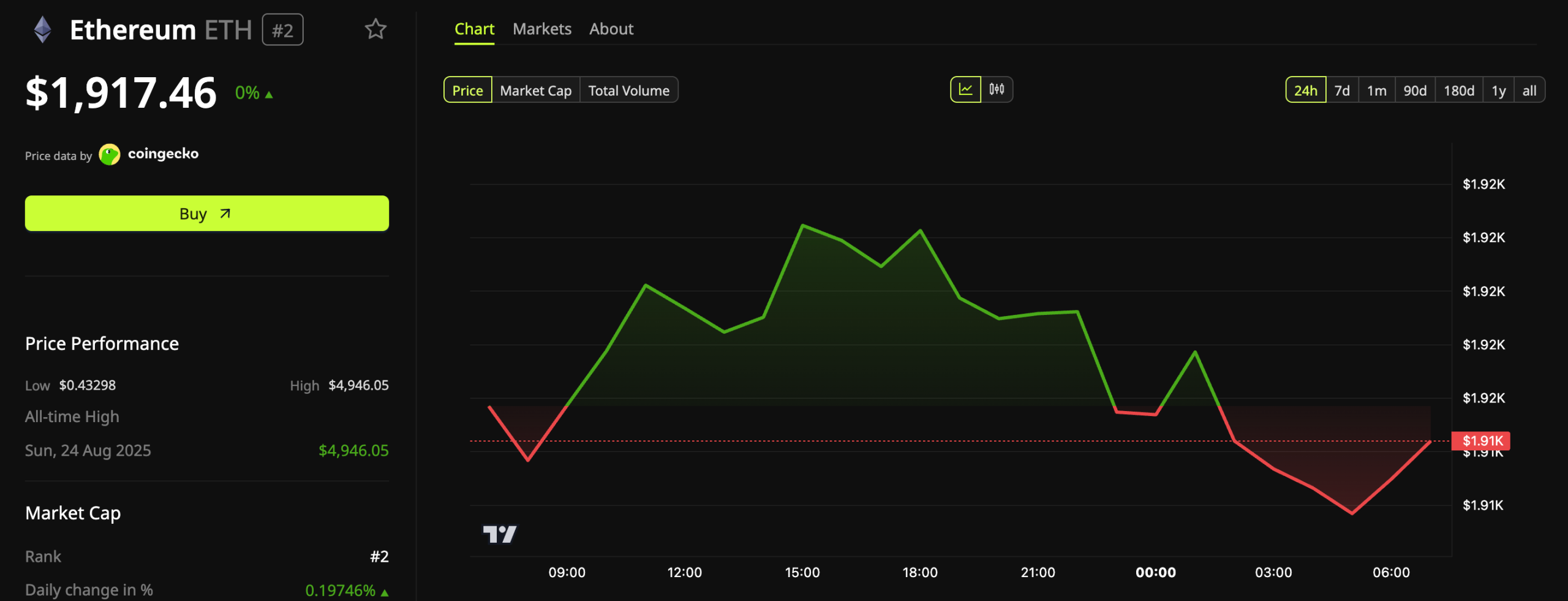
Ethereum (ETH) is tightening from several directions at once, with coins leaving exchanges, staking absorbing supply, and stablecoin liquidity rotating onto its rails. Yet, the price sits still near $1,900.
The setup has drawn attention from onchain analysts. The read points to a market quietly repositioning, while the chart shows little.

Supply Squeeze Building Beneath a Flat Ethereum Price Chart
Ethereum balances held on exchanges have fallen through 2026. CryptoQuant data shows aggregate exchange reserves down to 15.12 million ETH, from 16.86 million in January.
That marks a decline of roughly 1.74 million ETH, close to 10% of the balances available to sell.

At the same time, large-holder movement, measured through top-10 inflow and outflow volumes, is running below recent averages.
Staking has climbed above 34% of the circulating supply. In addition, validator exit queue sits near zero. Thus, holders are choosing to keep it staked rather than sell.
Exchange-traded funds are removing supply as well. Spot ETH funds drew about $482 million over the four weeks to August 7, with the final week alone adding roughly $245 million. Cumulative net inflows now sit near $11.46 billion, according to SoSo Value data.
New smart contract deployments have also risen sharply. The result is a widening gap between shrinking available supply and expanding onchain usage.
Independent data reinforces the picture. Analyst Tanaka noted weekly transaction activity above 20 million, near historical highs.
An analyst noted that similar conditions, where exchange liquidity thins as network activity builds, have led to sharper price moves in the past once demand picks a direction. He cautioned that the pattern provides no timing signal on its own.
Where the Dollars Are Moving
The liquidity side tells a parallel story. CryptoOnchain highlighted that over the past 14 days, total stablecoin netflows to Binance averaged around $87 million per day, but the composition shifted sharply.
Tether (USDT) on Tron (TRX) has drained fast. Binance’s Tron-based USDT reserves fell from about $1.4 billion to $709 million in roughly two weeks.
Ethereum-based stablecoins moved the other way. USDT on Ethereum saw weekly netflows rise 210%, while USD Coin (USDC) inflows climbed 114% over the same period.
The signal is not capital leaving the market. It is capital choosing which network to sit on, with market makers favoring deeper liquidity on Ethereum.
“Large holders and market makers may be shifting collateral away from Tron and toward Ethereum, potentially reflecting a preference for deeper DeFi liquidity, broader Ethereum-based market infrastructure, or positioning ahead of Ethereum-centric volatility,” the post read.
The Trigger Has Not Fired
ETF inflows have been steady in the past few weeks, yet they have not moved the price. That points to offsetting supply reaching the market, or to conviction too thin to force a breakout.
At the same time, spot buying on US venues remains weak. The Coinbase Premium Index, which tracks US spot strength relative to offshore venues, has held negative since early May and sits near -0.069.

Meanwhile, analyst Michaël van de Poppe described the price picture as unchanged, with ETH stuck between $1,800 and $2,000 and volatility near multi-year lows. A clean break above $2,000, he suggested, could open a stronger move.
Whether that break comes depends on demand firming, which the data does not yet show. The setup can also persist, as a tighter supply alone does not force a move.
Subscribe to our YouTube channel to watch leaders and journalists provide expert insights
The post Ethereum Price Risk: Fewer Coins to Sell and More Dollars in Position appeared first on BeInCrypto.


Brazil’s central bank has ordered virtual asset service providers to hold certain crypto transfers for up to 24 hours from Jan. 1, 2027, adding a new anti-fraud layer to the country’s expanding digital asset rulebook.
Summary
- Brazil will require 24-hour holds on qualifying crypto transfers above $10,000 beginning January 1, 2027.
- Transfers to overseas crypto providers and self-custody wallets fall within the central bank’s new safeguards.
- Providers may release transfers early after completing risk reviews under parameters established by Brazil’s regulator.
- Virtual asset providers must notify customers and maintain records covering fraud attempts and corrective actions.
- Brazil’s latest rule follows broader 2026 measures covering licensing capital audits and cross-border crypto activity.
Banco Central do Brasil published Resolution BCB No. 584 on Aug. 7, covering transfers above $10,000 destined for foreign crypto providers or self-custody wallets.
The threshold applies either to one transaction or a customer’s combined transactions during the same day. Smaller transfers can also face additional review when a provider’s risk policies identify reasons for closer scrutiny. The central bank said the measure responds to growing use of virtual assets, including stablecoins, to move proceeds from financial fraud quickly, sometimes beyond Brazil or into wallets controlled directly by users.
Brazil crypto transfers will face new checks
Under the central bank’s new anti fraud rules, a covered provider must retain the assets for 24 hours before proceeding with qualifying transfers. However, the measure is precautionary rather than a permanent freeze. A provider can complete its risk review and release the transfer before the full period ends when the conditions established by the regulator are met.
Providers must also tell customers when a transfer is being held. In addition, institutions must maintain records of fraud incidents, attempted fraud and the corrective measures taken. These requirements extend Brazil’s existing payment fraud controls to virtual asset services and give providers more time to review transactions that could otherwise settle rapidly.
The 24-hour hold joins a wider 2027 crypto rulebook
The transfer rule is one part of a broader regulatory expansion. In July, the BCB classified virtual asset service providers under its prudential framework and said they would begin following capital, risk management and disclosure requirements from Jan. 1, 2027. They must also enter the more demanding Segment 4 supervisory category by June 30, 2028, regardless of size.
In related coverage of Brazil’s capital rules, the framework builds on earlier licensing, customer asset segregation and compliance requirements. Separately, as previously reported, the central bank has restricted the use of virtual assets to settle payments inside regulated cross-border electronic foreign exchange channels.
The tighter oversight also follows fresh scrutiny of Brazil’s stablecoin market. The International Monetary Fund’s July Financial System Stability Assessment found that Brazilian crypto activity, particularly involving U.S. dollar pegged stablecoins, has grown rapidly since 2017. It said cross-border crypto flows have been rising faster than traditional capital flows and nominal GDP.
What happens before the January 2027 deadline
Crypto providers now have less than five months to adapt transaction monitoring, customer notification and record keeping systems before Resolution 584 takes effect. Firms will also need processes capable of calculating the $10,000 threshold across multiple transactions made by the same customer during a single day.
Meanwhile, the Jan. 1 deadline will bring several regulatory changes into force at once. Besides the new transfer controls, providers will begin operating under additional prudential requirements covering capital and risk management. The overlap means Brazil is moving beyond basic crypto licensing toward ongoing supervision of how regulated providers manage assets, transfers and financial risks.
For customers, the new rule does not create a general 24-hour delay on every crypto withdrawal. It targets qualifying transfers to overseas providers and self-custody wallets, along with other transactions selected for additional risk assessment. Providers may also release reviewed transactions early, making the eventual waiting time dependent on the circumstances of each transfer.

BMW’s Cheaper iX3 Reportedly Coming to America in March 2027 With Two New Entry-Level EV Options, Report Says

Woman and five-month-old baby are killed after boat overturns near Statue of Liberty as desperate mission to save a dozen passengers is launched

Woman Arrested After Allegedly Attacking YG Building With Golf Club Amid Blackpink Anniversary Backlash


-

 Politics7 days ago
Zack Polanski: an incitement to murder Nigel Farage?
-

 Fashion2 days ago
Frugal Friday’s Workwear Report: Cap-Sleeve Pointelle Crewneck Sweater
-

 Fashion2 days ago
Weekend Open Thread: Mattifying Sunscreen
-

 Business6 days ago
DTCR: Deleveraging And A Hedge Fund Collapse Point To A Possible AI Bottom
-

 Crypto World7 days ago
XRP Ledger urges node upgrade after manifest flood
-

 Sports3 days ago
Jordan Coyle & Cordiamo take Laya Arena Stakes at RDS
-

 News Videos1 day ago
Can Astrology Help Find Gold and Silver Trends? A Financial Astrology Guide
-

 Crypto World6 days ago
US Tech Stocks See Largest 5-Week Inflow in History: Can Nasdaq Break Its Downtrend?
-
 Business4 days ago
US stocks: Dow closes at record on Mideast optimism; SpaceX, AMD drag Nasdaq
-

 Politics3 days ago
Reform UK And Greens Sink To Lowest Favourability Ratings To Date
-

 Business5 days ago
Nvidia Stock Climbs 2.5% as Chip Sector Rally Builds Ahead of AMD Earnings, Nvidia’s Own Report Looms
-

 Tech7 days ago
OpenAI teases Astra, its next major AI model, after it solves 10 long-standing math problems
-

 Crypto World5 days ago
Polymarket targets $20 billion valuation as competition heats up in prediction market sector
-

 Tech4 days ago
OpenAI, Anthropic AI agents targeted real people and systems in cyber tests
-

 Business4 days ago
Supply chain issues impact Ingredion
-

 News Videos6 days ago
#crypto #cryptocurrency #cryptonews #cuet2026 #ceuta
-

 Business6 days ago
Myspace owners announce plans to relaunch the once-popular platform
-

 News Videos6 days ago
Crypto.com Partners with UFC for UFC 331 Event
-
 Crypto World5 days ago
CLARITY Act Senate Vote Locked In, But 60-Vote Hurdle Looms Large
-

 News Videos6 days ago
Huge SPINS!! (for me) #slots #casino #gambling #money #jackpot
You must be logged in to post a comment Login