While much of his career has been on screen, Ben Shephard has kept his marriage to his wife, Annie Perks, largely out of the spotlight.
The pair met as students at the University of Birmingham, where the This Morning star studied dance, drama and theatre arts, while Annie studied philosophy and headed the Philosophy & Epistemology Society.
After embarking on their blossoming romance in 1995, the two eventually got married in 2004.
Although they have made red carpet appearances together, the couple maintain a private life with their two sons, Sam and Jack.
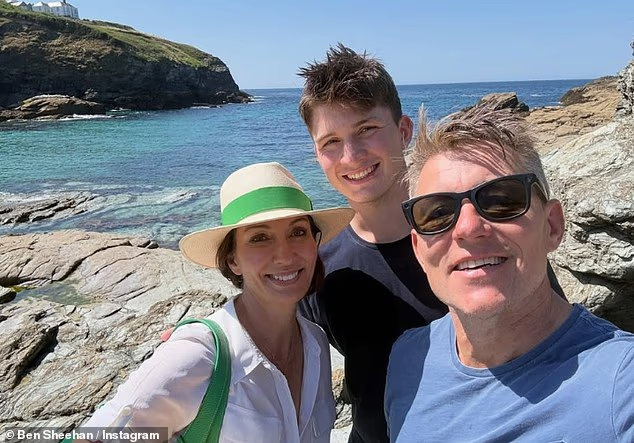
But earlier this week, Ben gave a very rare glimpse into his family as they enjoyed a trip down to Cornwall.
Taking to Instagram, the presenter shared a series of photos from his week down the British coastline to celebrate his Auntie Jan’s retirement.
Inside Ben Shephard’s private life with wife Annie as he shares a very rare glimpse into their family holiday in Cornwall
Earlier this week, Ben gave a very rare glimpse into his family as they enjoyed a trip down to the British coastline
In one snap, he posed for a beaming selfie with Annie and their son Sam, before sharing a series of sweet family moments, including a stunning family lunch at Paul Ainsworth’s restaurant and a walk along the coast.
Alongside the snaps, Ben wrote: ‘One week like this! Family, sunshine + Cornwall❤️
‘We had a wonderful celebration of my Auntie Jan’s retirement from her musical endeavors at 85 with an amazing lunch @stenodoc which under @paulainsw6rth and his wife Emma is just as stunning as the view it overlooks.
‘Honestly, we can’t recommend it enough it’s stunning!! Port Isaac and Port Gaverne couldn’t have looked more inviting and charming and I even squeezed some golf @stenodocholf with mates – as weeks go not sure they get much better!’
The rare family snaps come just months after Ben revealed that he and Annie live ‘separate lives’.
Explaining their differing attitudes towards spending time together, Ben told the Daily Mail: ‘Annie is much more solitary than me.
‘She’s much happier in her own company. Half the time she’s like, “I need a bit of space. Can you leave me alone for five seconds, please?”‘
He continued: ‘We do live quite separate lives.’
Taking to Instagram, the This Morning presenter shared a series of photos of his family celebrating his Auntie Jan’s retirement
Alongside the snaps, Ben wrote: ‘One week like this! Family, sunshine + Cornwall❤️’
Ben and Annie met as students at the University of Birmingham (pictured during their younger days)
‘I’m off working, she has her job, which is garden and interior design. If I’ve got spare time I want to do something physical.’
You can read the full Daily Mail interview here.
After the pair tied the knot over two decades ago, they made Richmond, London, their home, before selling the property last year.
During their marriage, Ben and Annie welcomed their two sons before purchasing their dream home for a reported £2.95million.
However, the family of four have since offloaded the property, which was said to have sold for £5.3million and purchased a Grade II home for £3.5million.
While she keeps out of the public eye, Annie has an impressive career of her own in the media.
She runs an interiors website called The House Edit, and in recent years, she’s also qualified as a garden designer.
Before she became a mum, she had built a career writing for fashion and interior magazines, working for the likes of House & Garden, Glamour, Elle Deco, Elle and Red.
On her website, Annie writes: ‘For the last 15 years I’ve been raising our boys, knocking down and remodelling houses, building gardens out of mud-pits and running interiors projects.
‘I’ve studied hard and taken excellent courses, so I’ve learned both the theory of design and I’ve also learned the hard way, by creating from the ground up, wellies on and spade in hand.
Ben and Annie married in 2004 in Salcombe, Devon
They went on to welcome two sons, Sam and Jack
Ben said of his sons: ‘Jack’s working as a teaching assistant before travelling. Sam’s studying maths at university and having a ball’
‘After a few mistakes and a few more successes, my friends started to ask for help with their own interiors and gardens.’
Currently, she helps people ‘create stylish, meaningful interiors and gardens that tell their story’.
Ben and Annie are currently preparing for the ‘imminent’ moment that they become ’empty-nesters’.
Their son Jack is working as a teaching assistant before going off travelling, and their eldest child, Sam, is currently studying maths at university.
Ben revealed that Jack has funded his travels by himself.
Speaking on the White Wine Question Time podcast, he told former Loose Women anchor Kate Thornton: ‘He worked really hard for his A-Levels, then worked really hard as a teaching assistant, got some money together to be able to fund his trip.
‘He’s learned how to budget, clean his clothes and make sure he’s fed and watered and all those sorts of things.
‘I did that to varying degrees when I was 19. We do miss him and Annie misses him dearly, but it’s just such an exciting time. I’m jealous they’ve got so much ahead.’
Not having young children to care for has allowed Ben to prioritise his personal health.
His physical transformation in recent years also coincided with his milestone 50th birthday last year, which inspired the broadcaster to become the fittest he’s ever been.
He often shares updates on his social media from his workout regime, including workouts with his sons.
Ben told Men’s Health that he gets very competitive when it comes to proving to Sam and Jack that he can keep up with his sons.
Given Ben’s priority on health and fitness, he previously told the publication that his ‘wife does most of the cooking’.
As he noted: ‘And I’m turning around saying, “I’ve got to have enough protein”.’
However, Ben added, they share an unconventional ‘agreement’ to strike the perfect balance.
He added: ‘We came up with an agreement, I’d get what I needed during the day, so I could enjoy our dinners together.
‘You can leave stuff out that you don’t necessarily want, but we still want to share that moment in the evening.’
Ben gushed over Annie earlier this year: ‘This amazing influence who created the home for our boys to become who they are and certainly made me better at being a dad’
With their kids no longer at home, the Tipping Point host said that they’re working on finding activities that they can enjoy together.
He told the Daily Mail: ‘It’s about finding things that work for both of us – but as I say, that feels really exciting.’
Ben was eager to emphasise that, despite their differences, Annie remains the ‘most important factor in our lives as a family’.
He said: ‘This amazing influence who created the home for our boys to become who they are and certainly made me better at being a dad.’
In March, Ben marked his 22nd anniversary with Annie by sharing a rare photo of ‘the best thing to ever happen to me’.
He reminisced about their relationship as he shared a selfie of the couple from the early days of their romance.
‘So 22 yrs ago today @mrsannieshephard said “oh go on then” and that was that!’ he gushed in the caption.
‘It might have taken me 9 yrs to realise it and to ask her to marry me but she’s still the best thing to happen to me,’ he continued before joking about his other great love – West Ham legend Mark Noble.




















































You must be logged in to post a comment Login