

Andy Burnham was today considering imposing a ban on disposable barbecues amid the risk of further wildfires as Britain braces for one of its hottest days on record.
The Prime Minister will chair an emergency Cobra committee this afternoon as the sixth heatwave of the year builds with 33C forecast today and up to 38C tomorrow.
Mr Burnham will meet with ministers, officials and agencies and revealed on a trip to Stevenage this morning that single-use grills could be banned to help prevent fires. It comes eight days after the Government said it was not planning to introduce such a ban.
Rail operators have warned against non-essential travel with several having already cancelled services as passengers were told to brace for major disruption.
East Midlands Railway and Chiltern Railways both told customers to ‘only travel if essential’ tomorrow; while reduced services were confirmed by c2c, CrossCountry, Great Western Railway, Northern, Transport for Wales and West Midlands Railway.
The Met Office has issued a rare 15-hour amber ‘extreme heat’ warning for southern and central England from 9am tomorrow – only its second such alert in four years.
The whole of England has also been put under an amber heat health alert by the UK Health Security Agency (UKHSA) until Friday night, which warns of a ‘rise in deaths’.
A 38C high tomorrow would make it Britain’s joint fifth hottest day on record – tying with that same temperature in Norfolk on June 26, which is the current 2026 high.
It comes as a firefighter union chief warned Britain faces a ‘national emergency’ amid ongoing wildfires, with the country on course for its hottest summer on record.
Some 45million people across England are now in drought-stricken areas, and 27million customers are under hosepipe bans as rivers and reservoirs run low.
Parts of southern England including Hampshire and West Sussex have now gone 60 days without rainfall, and there are no downpours in the immediate forecast.
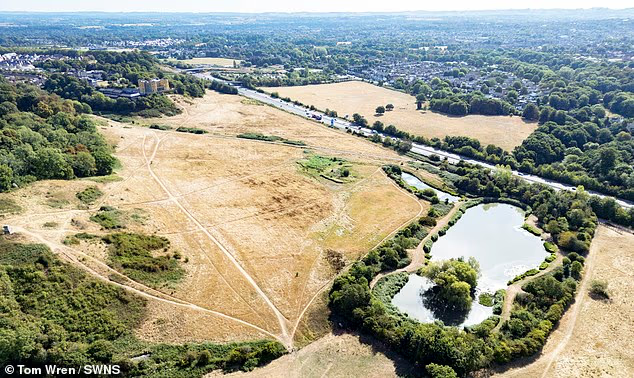
Stoke Park in Bristol is pictured today after being left with parched grass by the dry weather

People walk across the parched grass at Primrose Hill in north London this morning

People collect bottled water at a distribution centre in Loughton, Essex, today after burst water mains left more than 10,000 homes and businesses with no water or low water pressure

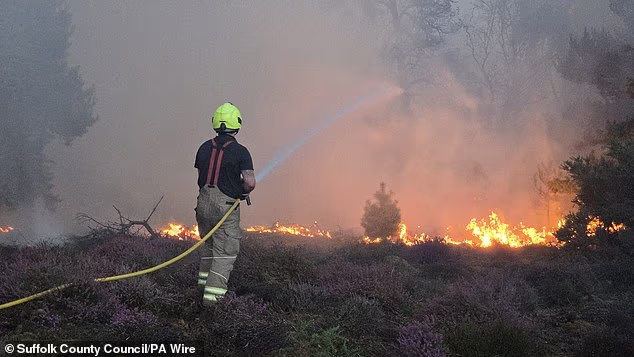
Firefighters try to deal with a big blaze in Eton near Windsor in Berkshire this morning

Allotments in Basingstoke, Hampshire, today as parts of the UK are set to bake in 38C heat

Parliament Square in London today during the drought which has hit 71 per cent of England

Crosland Heath Golf Club in Huddersfield has dry grass on the fairway and a lush putting green

Cows feed in a parched field near the village of East Meon in Hampshire this morning


Speaking about the possible barbecue ban, Mr Burnham said: ‘There is obviously a significant problem of wildfires in the south. The New Forest fire is a great concern; we have seen them in northern areas as well as Suffolk recently.’
He added: ‘This is a message for the public as well, because the wildfires I mentioned, many of them have been created by disposable barbecues.’
Mr Burnham continued: ‘I do believe we need to get the message out loud and clear. People should not be using those barbecues outside at this moment in time.
‘I don’t know yet what the remedy is, but I do want to leave the meeting today with a loud and clear message that we do want people to take the greatest possible care when they are out in the countryside, both in terms of cigarettes, but also those temporary barbecues that we know are causing risk of fires.’
It comes after a Government spokesperson had insisted on August 4: ‘There are no plans to introduce a blanket ban on disposable barbecues.’
Most major UK supermarkets suspended sales of disposable barbecues in recent weeks, which is understood to have been in line with voluntary guidance from the National Fire Chiefs Council (NFCC).
| 1 | 40.3C | July 19, 2022 | Coningsby, Lincolnshire |
| 2 | 38.7C | July 25, 2019 | Cambridge |
| 3 | 38.5C | August 10, 2003 | Faversham, Kent |
| 4 | 38.2C | July 18, 2022 | Pitsford, Northamptonshire |
| 5 | 38.0C | June 26, 2026 | Lingwood, Norfolk |
| 6 | 37.8C | July 31, 2020 | London Heathrow |
| 7 | 37.1C | August 3, 1990 | Cheltenham, Gloucestershire |
| 8= | 36.7C | August 9, 1911 | Raunds, Northamptonshire |
| 8= | 36.7C | July 1, 2015 | London Heathrow |
| 8= | 36.7C | June 25, 2026 | Merryfield, Somerset |
Jon Pearce, the Labour MP for High Peak in Derbyshire, also wrote to retail giants last week asking them to stop selling single-use grills for the rest of the summer. He said he expected the Government to act before next summer and would continue campaigning for a ban.
Ministers from the Department for Environment, Food and Rural Affairs (Defra), Home Office and Department for Health will attend today’s Cobra meeting.
The Environment Agency will also be present at the discussions – the second Cobra meeting this year on heatwaves after another during similar weather in June.
A Downing Street spokesperson said the Government understood firefighters, farmers and NHS staff were all facing challenges connected to the weather.
The Government urged the public to pay attention to warnings, and advised people to drink plenty of fluids and check in on family, friends and neighbours who may be at high risk.
A No 10 spokesperson said: ‘The Prime Minister will chair a meeting of COBR – the government emergency committee – this afternoon on the UK’s ongoing response to extreme heat, wildfires and drought.
‘We know how challenging this summer is proving, particularly for firefighters tackling wildfires, farmers working in drought conditions, and NHS staff in busy A&E units.
‘We will continue to take the action needed to keep communities safe, protect water supplies and safeguard the environment.’
Met Office chief forecaster Chris Bulmer said: ‘While the peak heat will be more short-lived than recent heatwaves, temperatures widely into the mid-30s Celsius on Thursday brings the potential for impacts for some, which is why a Met Office warning has been issued.
‘High pressure is now becoming dominant and temperatures will build day by day.

Prime Minister Andy Burnham said in Stevenage today that single-use grills could be banned

Dry grass at Blackheath in south-east London yesterday with Canary Wharf in the distance

The cracked and parched earth of Stew Pond at Epsom Common in Surrey yesterday
‘Southerly and south-easterly winds will also tap into the hot conditions over Europe which helps develop this further notable heat in what has been a hot and dry summer so far for many in the south of the UK.’
Meanwhile Steve Wright, general secretary of the Fire Brigades Union (FBU), warned the UK faces a national emergency ‘right now’ with fires across the country.
Firefighters have responded to 966 wildfires across England and Wales this year, including 185 in the first 10 days of August alone, while July was the busiest month on record for wildfires with 458 incidents, the NFCC said.
Crews from Hampshire and Isle of Wight Fire and Rescue Service have battled a fire in the New Forest, which started after a van caught fire on the A31 near Ringwood on Sunday.
The area hit by the blaze is protected heathland and home to a number of rare species, according to the New Forest National Park Authority.
Mr Wright told Times Radio: ‘In many parts of the country, firefighters do not have the new modern equipment to deal with these.
‘They do not have the new modern personal protective equipment, the lightweight fire kit that we wear, the right helmets, lightweight helmets, breathable uniforms to make sure they’re better protected, their health is protected when they’re out dealing with these incidents for hours and hours on end.’
The Government said it had announced £97million in new funding to upgrade national firefighting capabilities, including off-road vehicles and specialist equipment.
The Liberal Democrats and Green Party both welcomed the Cobra meeting being convened but called for further action.
Green Party leader Zack Polanski said: ‘What we urgently need is concrete action.
‘That must include taxing fossil fuel giants to pay for firefighting helicopters, a cool space in every community, and a maximum working temperature.’
Lib Dem environment spokesperson Pippa Heylings said: ‘Emergency meetings alone will not put out fires or protect our communities – we urgently need a national strategy to make the UK climate-ready.
‘Extreme weather warnings, widespread water shortages and wildfires raging across our countryside are a stark reminder that the climate crisis is gripping the country, yet the Government is moving at a snail’s pace, waiting until the fifth heatwave this summer to act.’
Rick Parfett, WWF’s head of climate policy, said: ‘Convening a Cobra meeting underlines that extreme heat, drought and wildfires are no longer distant risks. They are immediate threats affecting communities across the UK today.
‘As climate change drives more frequent and extreme weather, the Government must focus not only on emergency response but also on tackling their root cause. Licencing the Rosebank and Jackdaw oil and gas fields would lock in future emissions that will strain our NHS, emergency services and communities even further.
‘The UK must roll out clean energy across the UK to cut bills, drive local growth, and ensure our buildings and farms are fit for future temperature rises. Nature is our best ally in tackling climate change as well as its impacts like extreme heat and flooding. That means restoring and protecting nature now, so it is more resilient to the climate extremes we know are coming.’
Nearly three quarters of England and the whole of Wales are in drought, after a record dry July and very dry start to August has combined with high temperatures to put pressure on water resources.
Southern Water has applied for a rare non-essential use ban drought order, which, if imposed, would mean businesses must stop using water for activities such as cleaning cars and filling non-domestic swimming pools.


Met Office satellite views show the transformed landscape from May (left) to Monday (right)
In its application, the firm said an ‘exceptional’ shortage of rain in the South East ‘demonstrates a clear threat to supplies within the Hampshire Southampton West (HSW) water resource zone, as well as the Isle of Wight (IOW)’.
It added that 165,000 people in the Southampton West supply area could ‘soon be significantly affected by a restricted water supply’.
The application will now be considered by Environment Secretary Angela Eagle, with a decision expected as soon as possible.
A non-essential use ban has not been imposed for 20 years, with the last one granted to Sutton and East Surrey Water in May 2006.
Elsewhere, water stations opened in Ilford, east London, and Chigwell, Essex, after burst water mains left more than 10,000 homes and businesses with no water or low water pressure.
Thames Water said the affected areas were: E10, E11, E17, E18, E4, IG10, IG2, IG4, IG5, IG6, IG7, IG8, IG9 and RM4.
A spokesman for the utility company said: ‘Our teams continue to work in the extreme heat to fix the multiple broken pipes in the area. We’re sorry to those who are still affected.
‘Whilst progress is being made, it’s taking longer than normal to fix the broken pipes as often excavations are needing to be extended.
‘We’re still working on the repairs at both Chigwell Road and Daisy Road, and extra teams are in the area to carry on the work. We’ll be working 24/7 until things are back to normal.
‘To enable the repair, some currently not affected may notice they lose their supply for a short period. Once completed, this will mean a larger area’s water will begin to flow again.’
Record-breaking heatwaves in May and June led to the deaths of more than 2,800 people, while parts of the country were hit with further heatwaves last month as England and Wales endured their driest July since records began in 1836.
A fifth heatwave of the year was declared early last week.
Provisional statistics from the Met Office show that the mean temperature for the summer so far, from June 1, stands at 16.48C – which is 1.88C above the 1991 to 2020 average.
To equal the 16.12C in 2025, the UK’s warmest summer on record, the rest of August would only need to be 0.21C below the long-term average, and any warmer than this would establish a new record for the country, the Met Office said.
And for England and Wales, which have seen temperatures more than 2C above average so far this summer, it is even more likely that June to August 2026 will be record-breaking.
The Environment Agency said 71.3 per cent of England is now experiencing ‘flash drought’, as a dry start to August followed the country’s driest July on record.


Flash drought is one which develops very quickly because of a combination of very low rainfall and high temperatures.
East Midlands Railway said that regional services between Sheffield and Liverpool will be suspended today and tomorrow.
Regional services between Nottingham and Worksop and Nottingham and Leicester will also be suspended from noon tomorrow.
Philippa Cresswell from the operator said: ‘The hot weather means we’ll need to make some temporary changes to our services to keep the railway operating safely.
‘If you do need to travel and the journey is essential, we’d recommend travelling before midday and checking your journey before setting off.
‘We appreciate these changes may inconvenience some customers and we’d like to thank everyone for their patience and understanding while we work to keep people moving safely.’
Health Secretary Yvette Cooper said: ‘There are heat health alerts in place again this week – this means temperatures are set to rise significantly, and people should take extra care.
‘Keep an eye on elderly relatives, neighbours and loved ones, or anyone who might really be feeling the heat, just as we would during a cold spell in winter.

The UK Health Security Agency (UKHSA) has issued amber heat health alerts across England


A UK heatwave is official when a location records at least three consecutive days of daily maximum temperatures which meet or exceed a specified threshold – which varies by region
| Area | Mean temperature (June 1 to August 10, 2026) | Difference from summer average | Current warmest summer on record |
|---|---|---|---|
| UK | 16.48C | +1.88C | 16.12C (2025) |
| England | 18.19C | +2.46C | 17.44C (2025) |
| Wales | 16.80C | +2.17C | 16.09C (2025) |
‘I want to thank NHS staff who are once again stepping up to cope with the extra pressures that hot weather brings.
‘Extreme heat can be dangerous, so staying aware of warnings and alerts in place can make a real difference.’
There are also warnings older people are more at risk from the extreme heat – with Age UK’s charity director Caroline Abrahams saying that as people age, their bodies find it harder to adapt to extremes of heat and cold.
She added that most homes in the UK were not designed to cope with extreme heat, so it is important to keep them as cool as possible.
Keeping curtains and windows closed during the hottest part of the day and opening windows overnight when temperatures fall can help.
Farmers have warned of a ‘brutal harvest’ for crops and a lack of feed for livestock, and there have been warnings of food price inflation shocks later in the year.
The Food and Drink Federation said ‘fruit, vegetable and grain supply’ are being hit by the heatwaves, with these crop shortages then set to feed into supermarket prices.
Economists from the trade group suggested that this will put upward pressure on food inflation going into 2027.
The drought has even revealed the remains of a lost village which was demolished and flooded in the 1970s to create the Rutland Water reservoir in the East Midlands.
Stonework and the outlines of buildings in Nether Hambleton can now be seen because of the low water levels.
Separately, a report warned the UK’s treasured historic green spaces are under increasing threat from climate extremes.
The National Lottery Heritage Fund and Historic England warn that historic parks, gardens and cemeteries are vulnerable to damage from harsher, more widespread drought, intense rainfall, more severe storms and pests which can thrive in warmer conditions.
These impacts are said to be affecting all aspects of these heritage landscapes, from trees and plant collections to paths, terraces and lakes.
Stay away from Dunwich Heath amid ongoing fire risk, warns National Trust
The National Trust has warned people to stay away from Dunwich Heath until the area has been assessed following a devastating wildfire, amid a risk of further flare-ups.
More than 100 hectares of heathland habitat have been destroyed by fire at the Suffolk reserve since it took hold almost two weeks ago, the conservation charity said.
The fire service said on Monday that the fire has been stood down as a major incident but crews remain on scene damping down the affected area and monitoring for hotspots.
Coastal winds are stirring up ash and debris, rabbit burrows and warrens have retained significant heat and trees with burnt root systems are vulnerable to collapse, the National Trust said.
Parts of the landscape have been left unrecognisable, making it harder to navigate, and fires spread along cliffs putting their stability at risk and making the beach below unsafe.
Russell Clement, general manager for the National Trust, praised all of Suffolk’s 35 fire stations, the 18 fire services from around the country and others who ‘worked tirelessly to tackle this fire’.

The aftermath of the wildfire at the National Trust site Dunwich Heath in Suffolk

More than 100 hectares of heathland habitat have been destroyed by fire at the reserve
The National Trust said there are still parts of the fire ground that they have not yet been able to access to map and record hazards.
Work to assess the full site is under way and is likely to take some weeks, the charity said.
Mr Clement said: ‘Right now… the best way people can help is by staying away from the reserve.
‘We know how important Dunwich Heath is to the local community and visitors alike, but we need to ensure it is safe before anyone returns.’
Unexploded ordnance dating back to Operation Kruschen during the Second World War has been exposed by the fire, the National Trust said.
While specialist teams have already made some discoveries safe, there could be more.
‘We very much look forward to welcoming visitors back to Dunwich Heath, when it is safe to do so,’ said Mr Clement.

Coastal winds are stirring up ash and debris at Dunwich Heath in Suffolk

The fire has been stood down as a major incident but crews remain on scene
‘With no rain forecast and continued hot weather, there remains the risk of further flare-ups in the days and weeks ahead, which will require the fire service back on site.
‘In the meantime, Dunwich village remains open and we’d encourage people to support the local businesses, which are such an important part of the community.’
While Dunwich Heath remains closed, supporters can follow updates through the National Trust’s website and social media channels.
A fundraising appeal launched by the National Trust to help support Dunwich Heath’s recovery has raised more than £600,000.
The National Trust is also asking people to sign a petition calling on Government to make climate resilience a national mission, invest in nature to reduce environmental risks and support Fire and Rescue Services with the funding needed to prepare and respond to wildfires.




















































You must be logged in to post a comment Login