Connect with us

NewsBeat

Are summer holidays good for children? It’s time researchers asked them

Published

on

Are summer holidays good for children? It’s time researchers asked them

When academic research has explored the impact of school summer holidays, it has often focused on the costs to parents and to children’s learning and health.

The childcare juggle, the costs of summer holiday activities and the potential impact of losses in learning or more sedentary behaviour by children in the holidays do have a real impact on families.

But research on the summer break often does not reflect how children and young people feel about school holidays. Children’s rights to both education and health, laid out within the UN Convention of the Rights of the Child, are widely known. There is perhaps less awareness that these UN rights also include children’s right to leisure, as our research has explored. Academically, we know very little about how children and young people experience school holidays as leisure time.

Our research set out how children and young people are often seen as in a process of “becoming”, and that their leisure is viewed as an extension of this: it should have a purpose in developing them as future healthy, educated citizens. Even play is seen not as an activity in itself but as a way to learn skills or increase physical health.

Advertisement

But if we see children as already “being”, not just “becoming”, then we can appreciate that their leisure time could also be the chance to rest and simply do what they want.

Holiday downsides

Undoubtedly, managing school breaks can be challenging for working parents. It is estimated that weekly holiday childcare ranges from £180 in Scotland to £224 in Wales, with a UK average of £191.

Beyond childcare, there has been increasing attention paid to the other costs of the school holiday. Children need to be fed and entertained over these breaks. In the context of a cost-of-living crisis, prices quickly add up.

The most significant political attention has been on holiday hunger: the food insecurity faced by families during breaks from school when free school meals cannot be accessed. Under pressure from charities and footballer Marcus Rashford, local authorities in England, Wales and Scotland have moved to provide food, vouchers or cash payments to families to ensure children do not go hungry during the holidays.

Advertisement

Research has raised concerns about learning loss over the summer break, particularly for poorer children. The focus of these studies has tended to be on literacy and numeracy, discounting other opportunities for development.

Concerns have also been raised about the impact of school holidays on children’s wellbeing. There is some evidence that during school holidays children are less physically active, more likely to gain weight, more sedentary, more likely to experience poor mental health and are a greater risk of harm.

Given these issues, it’s no wonder that questions have been raised over whether a term structure that is over 150 years old is still fit for purpose today.

The Welsh Government launched a consultation in 2023 on whether to shorten the summer break and redistribute holidays more evenly across the school year. Responses were divided and ultimately no changes were taken forward.

Advertisement

In the US, some jurisdictions have experimented with a more balanced school calendar with the long summer break (of up to 13 weeks) redistributed to shorter breaks spread more evenly throughout the year. Researchers examining the impact of this change have found mixed impacts on learning loss.

But it’s also important to consider how children feel about the summer holidays.

What do children think?

One of us (Susie Smillie) has worked with young people aged between ten and 18 to understand their experiences of school holiday leisure and its impact on wellbeing. This research found that school holidays were an important break from school work, but also, for some, from difficult relationships with teachers and peers.

School holidays were important to young people because they provided an opportunity for them to direct their own time. “You need to have a break, this is what…the holiday’s about,” a 15-year-old said.

Advertisement
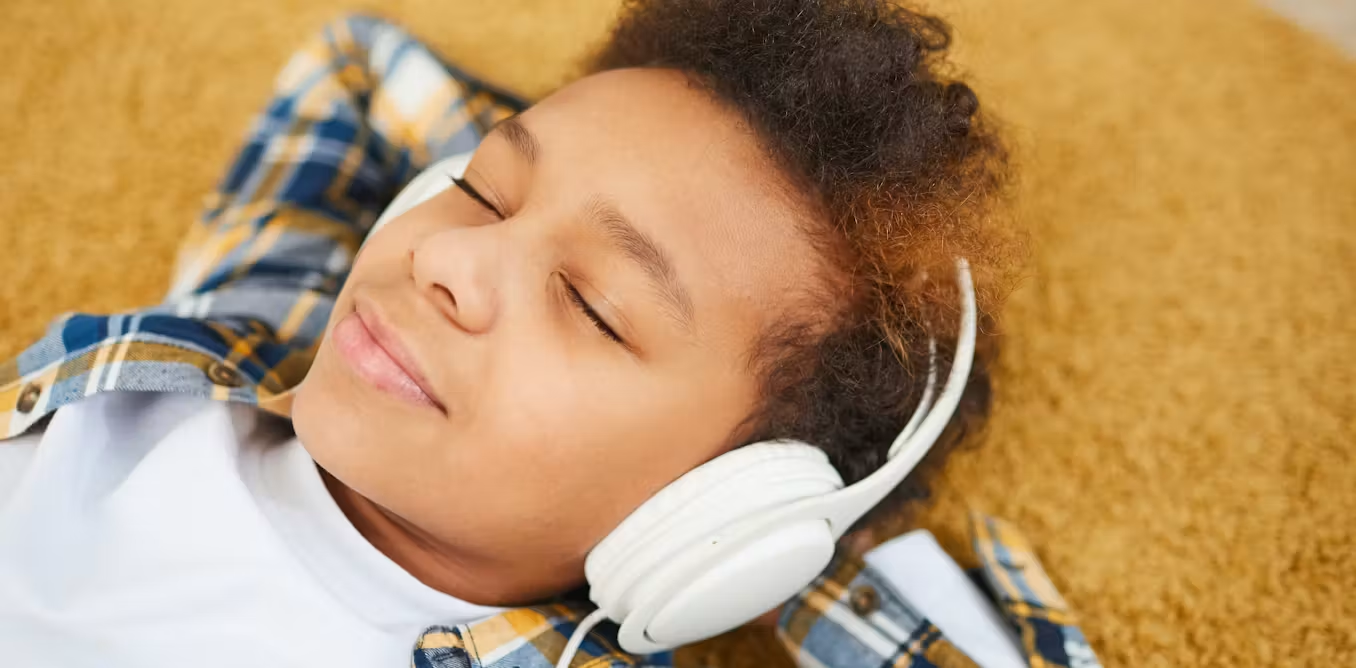
Free time in the holidays can allow young people to develop their own interests.
Maria Moroz/Shutterstock

They chose a broad range of activities beyond the sedentary screen time stereotype. These choices, often supported by trusted adults, was hugely valued, and allowed young people to experience enjoyment “being” in their present leisure choices rather than focusing on “becoming” for the future. “During holidays I’ll learn a lot more about stuff that I enjoy and I find interesting or stuff and that’s even helpful compared to in school, and it’s not like a stressful thing,” one said.

Local organisations were identified as an important asset in supporting young people too. In these spaces young people had the opportunity to participate in enjoyable activities. They also discussed being treated with respect, being involved in organisational decision making and developing their leadership skills.

These findings reinforce the point that while school holidays may see core curricular subjects like literacy and numeracy take a back seat for a few weeks, they provide opportunities for children and young people to flourish in other areas of their lives. This is just as important for their long-term wellbeing.

We are still learning about the impact of school holidays on families, particularly families from a diverse range of backgrounds. Very little is known about disabled children and young people’s experiences of these time periods, as well as children facing various socioeconomic challenges and care-experienced young people. Children, young people and their families from a variety of backgrounds must be at the centre of future research and policy decisions on school holiday experiences.

Advertisement

Source link

Continue Reading
Click to comment

You must be logged in to post a comment Login

Leave a Reply

NewsBeat

Huw Edwards criticised for entering Eisteddfod competition

Published

on

Wales Online

‘It is far too soon for him to try to redeem himself’

Huw Edwards has been criticised after he revealed he entered a competition at Wales’ largest cultural festival. Writing on his Substack, the disgraced BBC newsreader said he had entered a poem at the National Eisteddfod centred on his relationship with his father.

Actress and survivor of child sexual abuse Sera Cracroft said it would have been “catastrophic” if he had won. Mr Edwards’ attempt fell far short of winning the competition, with his poem placed in the third rank of entries, according to Newyddion S4C.

Mr Edwards claimed he knew there was “no way” he was going to win the competition, and described the poem as a “tribute” to his father, intended to correct the “poisonous narrative encouraged by the press” about their relationship.

Advertisement

In 2024 Mr Edwards pleaded guilty to three counts of making indecent images of children. Some of the images Mr Edwards accessed were the most serious category A type, depicting children as young as seven to nine.

He was given a six-month prison sentence, suspended for two years, and placed on the sex offenders’ register for seven years.

On Sunday Mr Edwards published a post on his Substack blog stating he had “attempted to write a poem” for the first time in his life having “drawn inspiration” from the National Eisteddfod.

BBC-produced Newyddion S4C said had it received confirmation that Mr Edwards’ poem, written under the pseudonym Y Gelyn (The Enemy), had been officially entered.

Advertisement

The National Eisteddfod said it has a process in place which ensures nobody, including the judges, knows beforehand who has competed.

Actress Ms Cracroft, best-known for her role in long-running Welsh soap opera Pobol y Cwm, was highly critical of the former newsreader’s latest publication.

“Had he won, the image of him being crowned in front of the nation is hurtful to survivors,” she said. “Huw has said he is receiving mental health support and to be completely honest, I don’t think it’s working for him.

“I’m very, very disappointed that he’s done that so soon after being convicted of creating paedophilia online. Some of the images were in the worst category possible.” She added it was “far too soon for him to try and redeem himself.”

Advertisement

In June Mr Edwards said he had returned to journalism by launching his own Substack. In the opening paragraph of his introduction to the platform the 64-year-old said he would be “tentatively” offering some commentary and analysis on events.

The former newsreader said he knew there would be some people who wouldn’t want to read his work but said he was “attempting to rebuild some kind of worthwhile life”.

In one of his most recent posts, titled ‘On Hatred’, he spoke about the hate he receives. He said he felt “abhorrence” towards the offences he committed and admitted to, and stated he was “not a child rapist”. He said his “crime was to click on files sent to me by someone else”.

In response to S4C and the BBC’s request for comment, the National Eisteddfod said: “We have a process in place which ensures nobody, including the judges, knows beforehand who has competed. After each Eisteddfod we have a period of appraisal to ensure our processes are appropriate – this year will be no exception.”

Advertisement

Mr Edwards said: “The poem was a tribute to my father. Nothing more or less than that. There was no way on earth I was going to win the competition and I knew that. The poisonous narrative encouraged by the press two years ago needed correcting.”

Addressing Cracroft’s criticisms, he added: “This wasn’t a poem for the sickeningly self-righteous Welsh speakers – Sera amongst them – who take advantage of every opportunity to speak unthinkingly on every subject under the sun.

“She and her type are far too willing to ignore the damaging effects of mental ill health. In that, they are loyal to the heritage of London’s tabloid papers.”

Get daily breaking news updates on your phone by joining our WhatsApp community here. We occasionally treat members to special offers, promotions and ads from us and our partners. See our Privacy Notice

Advertisement

Source link

Continue Reading

NewsBeat

Cabinet minister defends ‘Bunk Off Burnham’ as PM heads abroad for a holiday just TWO WEEKS into his premiership… leaving Louise Haigh as minister in charge

Published

on

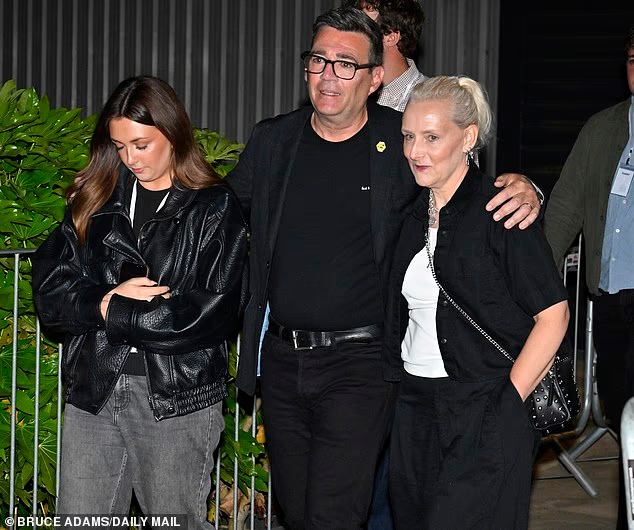
Andy Burnham, pictured with his wife Marie-France van Heel and daughter Rosie in June, is taking a holiday with his family after just two weeks as Prime Minister

A top Cabinet minister today defended Andy Burnham for taking a holiday after just two weeks as Prime Minister.

Mr Burnham, who only entered office on 20 July, is taking a break from his day-to-day duties to travel abroad with his family for a long-planned trip.

He is not expected to appear publicly this week, but Downing Street insisted he will still be working and is prepared to travel back to the UK if required.

Reform UK has accused Mr Burnham of ‘bunking off’ while even Labour insiders questioned the PM’s decision to go away.

Advertisement

But Alex Norris, the Justice Secretary, this morning backed Mr Burnham over his choice to take a holiday and insisted the PM would be ‘in constant contact’ with his office.

‘The Prime Minister is having a few days away with his family,’ he told Sky News. ‘You know, he will be in constant contact with his office.’

‘I mean, I might gently say that I’ve spoken to him virtually every day since I joined the Cabinet, and I suspect that won’t change.

‘These last couple of weeks I’m really proud of the work we’ve been doing on the cost of living, on social care, on homelessness, on defence. And that work is happening at pace and will continue to do so.’

Advertisement

Andy Burnham, pictured with his wife Marie-France van Heel and daughter Rosie in June, is taking a holiday with his family after just two weeks as Prime Minister

Alex Norris, the Justice Secretary, backed Mr Burnham over his decision to take a holiday and insisted the PM would be 'in constant contact' with his office

Alex Norris, the Justice Secretary, backed Mr Burnham over his decision to take a holiday and insisted the PM would be ‘in constant contact’ with his office

In Mr Burnham’s absence, Mr Norris was left to field questions about the Government’s decision to still allow the killers of PC Andrew Harper to be eligible for early release from jail.

Advertisement

The Justice Secretary acknowledged that the decision had ‘created harm’ but said the alternative was seeing prisons cease to function.

Some 5,000 people are expected to be released early under sentencing changes, down from 6,000 after the PM exempted rapists and child sex offenders as part of the scheme to tackle overcrowding in jails.

But two of PC Harper’s killers, Jessie Cole and Albert Bowers, remain eligible for early release after their 2020 convictions for manslaughter despite an outcry from the officer’s family that prompted a review of the early release plans.

PC Harper sustained fatal injuries while responding to a quad bike theft in Sulhamstead, Berkshire, in August 2019.

Advertisement

Until recently, both close friends and staff of Mr Burnham claimed the PM had cancelled plans to join his family on holiday, with this replaced by a tour of Britain to meet voters towards the end of August.

As recently as July 25, Downing Street told the Mail that Mr Burnham would not be heading off for a break after becoming Prime Minister.

But on Monday No10 confirmed he would be travelling abroad to spend time with his family, after making a blizzard of spending pledges on bus fares and energy bills that could cost up to £96billion during his first two weeks in charge.

Downing Street published an official portrait of Mr Burnham on Tuesday as he took a holiday from No10

Downing Street published an official portrait of Mr Burnham on Tuesday as he took a holiday from No10

Advertisement
Mr Burnham, who only entered No10 on 20 July, is taking a break from his day-to-day duties to travel abroad for a long-planned trip

Mr Burnham, who only entered No10 on 20 July, is taking a break from his day-to-day duties to travel abroad for a long-planned trip

While Mr Burnham is on holiday, his de-facto deputy Louise Haigh, the First Secretary of State and Chancellor of the Duchy of Lancaster, will be the most senior minister in Westminster

While Mr Burnham is on holiday, his de-facto deputy Louise Haigh, the First Secretary of State and Chancellor of the Duchy of Lancaster, will be the most senior minister in Westminster

Reform UK chairman Lee Anderson said: ‘Two weeks into the job and Andy Burnham has already had enough.’

‘After dropping a number of unfunded commitments and overseeing over 2,000 illegal migrants breaking into our country he’s bunked off for a jolly abroad.

Advertisement

‘This isn’t a PM that’s serious about leading.’

And a Labour source told the Mail: ‘Talk about easy mode. A week’s holiday? Because he’s had a difficult summer? Because he had to fight a by-election?’

The source said that Keir Starmer ‘barely went on holiday’, adding that when he did ‘he would just sit there with a bottle of rosé and talk through work over the phone. It was inspiring.’

The former PM cancelled a planned holiday in August 2024 – about six weeks after entering No10 – due to the riots that erupted after three young girls were murdered in Southport. He eventually went on a family holiday in Madeira at the end of December 2024.

Advertisement

When Sir Keir was away, Downing Street insisted that he remained in charge, rather than handing over power to the then deputy prime minister, Angela Rayner.

While Mr Burnham is on holiday, his de-facto deputy Louise Haigh, the First Secretary of State and Chancellor of the Duchy of Lancaster, will be the most senior minister in Westminster.

It is understood that convicted fraudster Ms Haigh will be working this week as normal, however, No 10 insisted that she will not be taking day-to-day decisions in Mr Burnham’s absence.

The PM’s spokesman said: ‘The Government continues to operate as normal with [the] PM remaining in contact with officials, holding meetings and receiving regular updates on government business.’

Advertisement

There were no further details on where Mr Burnham will go on holiday as prime ministerial holiday destinations are not usually confirmed by Downing Street.

Source link

Continue Reading

NewsBeat

Transfer news LIVE: Guimaraes to Arsenal FC done deal, Vinicius offer; new Man Utd target; Liverpool, Chelsea latest

Published

on

Transfer news LIVE: Guimaraes to Arsenal FC done deal, Vinicius offer; new Man Utd target; Liverpool, Chelsea latest

The summer window continues to hot up as Arsenal work on a huge double deal for Bruno Guimaraes and Vinicius Junior, while the likes of Manchester United, Chelsea, Liverpool and Tottenham continue talks to bolster their squads. The Gunners have seen a first official bid for the Newcastle captain rejected, and are said to have agreed personal terms on a club-record contract for the Real Madrid star.

Source link

Continue Reading

NewsBeat

Hundreds of people in England died before doctors diagnosed their tuberculosis

Published

on

Hundreds of people in England have died before doctors diagnosed their tuberculosis

Dave, a retired dockworker, has smoked since his teens. When he develops a persistent cough, he dismisses it as “just a smoker’s cough”.

Then he loses weight, develops fevers and wakes at night drenched in sweat. After several courses of antibiotics, he continues to deteriorate and is admitted to hospital.

Doctors find emphysema, a smoking-related condition in which damaged air sacs make breathing difficult. A chest X-ray also shows a white patch in his lung, raising concerns about cancer. A sample of sputum, the mucus coughed up from the lungs, is sent for further testing.

Dave dies before the laboratory identifies tuberculosis (TB).

Advertisement

Dave is fictional, but his story shows how easily TB can be missed when its symptoms resemble those of other illnesses. In a 2026 study, colleagues and I found that 574 people in England were diagnosed with TB only after death between 2010 and 2022. That is almost one person every week.

The people who died represented 0.8% of all TB diagnoses, but nearly one in five deaths recorded among people with TB. The data could not establish whether TB caused or contributed to each death.

TB is the world’s leading cause of death

TB is a bacterial infection that usually affects the lungs and spreads through the air. It remains the world’s leading cause of death from a single infectious organism. In 2024, an estimated 10.7 million people developed TB and 1.23 million died. Global progress has recovered from setbacks during the COVID pandemic, but remains too slow.

England cannot eliminate TB without international progress. In 2024, more than four in five people diagnosed in England were born outside the UK. This is sometimes presented simply as a migration issue. It instead reflects global inequalities in prevention, diagnosis and treatment.

Advertisement

TB also affects UK-born people and remains closely associated with poverty. Rates in England’s most deprived areas are more than five times those in its least deprived.

Homelessness, imprisonment, smoking and harmful alcohol or drug use can increase exposure, weaken the body’s defences or make healthcare harder to access. These factors all contribute to active TB disease.

England is close to losing its status as a low-incidence country, defined by the World Health Organization as fewer than ten cases per 100,000 people. Its rate reached 9.4 per 100,000 in 2024, following the largest annual increase since 1971.

Advertisement

Early diagnosis is vital. Globally, about one in five people who develop TB are not diagnosed, officially reported or treated. Many of these “missed millions” die. In England, the median interval between symptoms beginning and diagnosis of lung TB was 72 days in 2024.

During that delay, an infectious person may transmit TB while their illness worsens. Delays can also disrupt family and working life and create avoidable, sometimes catastrophic costs for people with TB, their households and health services.

The most extreme delay

A national study examined the most extreme delay: TB confirmed only after death. This meant a sample had been collected while the person was alive, but the result arrived later.

TB bacteria grow slowly, so traditional laboratory cultures can take several weeks. Rapid molecular tests, which detect the bacteria’s genetic material, can sometimes provide results much sooner, but doctors must first suspect TB.

Advertisement

The likelihood of diagnosis after death rose sharply with age. It was also higher among men, UK-born people, people with recorded harmful drug or alcohol use, those with TB outside the lungs and those diagnosed outside London.

Older UK-born people may have encountered TB during childhood, when infection was more common. The immune system can contain the bacteria for decades without symptoms. This is called latent TB infection. It can later become active, particularly when immunity weakens because of age, illness or medicines.

Smoking damages the lungs’ defences and increases TB risk. An older man with a cough and weight loss may therefore be investigated for cancer or chronic lung disease before TB is considered. Previous BCG vaccination – the childhood vaccine that was once routinely offered in the UK to protect against tuberculosis – does not rule it out. The vaccine protects young children against severe disease, but does not reliably prevent TB in adults.

TB outside the lungs can affect the lymph nodes, bones, bowel, kidneys, brain or other organs. Diagnosis may require scans or tissue samples. It is generally much less infectious than lung or throat TB, although people can have both forms.

Advertisement

People outside London were more likely to receive a diagnosis after death. Doctors in London may encounter TB more often and have better access to specialist services. Differences in reporting may also contribute. Our findings probably underestimate the problem because some people may die without being tested.

A diagnosis made only after death should be treated as an important patient-safety warning. TB deaths are not currently defined as a formal NHS “never event”, a term reserved for a small number of wholly preventable incidents. Based on our study findings, we recommend that each post-mortem TB diagnosis should prompt a review of symptoms, tests and referral decisions.

Public awareness also matters. A persistent cough, fever, drenching night sweats or unexplained weight loss deserves medical attention, regardless of age or birthplace. Healthcare professionals must consider TB even when cancer, pneumonia or chronic lung disease initially appears more likely.

Prevention must extend beyond detecting active TB disease. England offers some recent migrants testing for latent TB, but only 17% of those eligible were tested in 2024. Strategies should also consider historical exposure among older UK-born people.

Advertisement

England can learn from countries with much greater TB burdens. Lessons include reaching people at higher risk of being missed, such as the homeless, the poor and the socially excluded; reducing stigma; and making services easier to access.

Dave’s fictional laboratory result arrived too late. The next person with an overlooked cough should receive theirs while treatment can still help.

Source link

Advertisement
Continue Reading

NewsBeat

Discover the benefits of a stocks and shares ISA with HSBC UK

Published

on

Discover the benefits of a stocks and shares ISA with HSBC UK

Investing can be a great way to make your money work harder in 2026. Although it’s important to remember that investments can go up and down.

One of the most tax-efficient ways to invest is through an ISA, where any returns earned are exempt from UK income and capital gains tax. And a stocks and shares ISA (Individual Savings Account) is an account that you can use for your investments.

Tax rules can change, and benefits depend on your individual circumstances, However, in the current financial year most UK adults can contribute up to £20,000 across ISAs (subject to eligibility criteria and ISA rules, such as age and residency). With the new tax year now here, it’s a great time to explore your options.

Keep reading for everything you need to know about the benefits of a stocks and shares ISA with HSBC UK.

Advertisement

HSBC UK

What is a stocks and shares ISA?

A stocks and shares ISA lets you invest in assets such as funds or shares and any returns are free from UK income and capital gains tax. HSBC UK offers stocks and shares ISA products that are already used by 300,000 people.

There are risks as there is no guarantee when it comes to investment returns and you could lose money. That is why financial advisers typically recommend investing for long-term goals of over five to 10 years before making withdrawals, as this gives you a better chance of making up losses. That means a stocks and shares ISA may be more beneficial for bigger money milestones such as a mortgage deposit, for your children or grandchildren or to put towards your retirement.

Advertisement

While this product is best suited to medium to long-term investment goals, it’s also worth knowing that you can still sell your investments at any time – meaning the money will usually be back in your account within four business days.

<p></p>

HSBC UK

Opening a stocks and shares ISA with HSBC UK

You can open a stocks and shares ISA with HSBC UK in three simple steps. Check your eligibility, choose what you’d like to invest in and then open the stocks and shares ISA.

Wondering about the eligibility requirements? To open a stocks and shares ISA with HSBC UK, you must be a UK resident for tax purposes and at least 18 years of age. You can’t already be signed up to another HSBC UK or First Direct stocks and shares ISA covering the current tax year. However, you could still have subscribed to a cash ISA with HSBC UK within this timeframe. Finally, you can’t have already exceeded your £20,000 ISA limit for the current tax year.

Advertisement

To get started, you will need to have an HSBC UK current account. After this, you can begin your investment journey with just £50.

When it comes to choosing what you’d like to invest in, one option is choosing an HSBC Global Strategy Portfolio that’s already made. Each portfolio has a different level of risk, contains a mix of global investments and is managed on your behalf. Or, you can choose your own investments, or choose from a wide range of funds and shares. Fees will apply.

After you’ve decided which option you’d like to invest in, you can open up your HSBC UK stocks and shares ISA. And, don’t forget, it’ll be free from UK income tax and capital gains tax, too.

Source link

Advertisement
Continue Reading

NewsBeat

Your UK property rights explained if neighbour builds extension too close

Published

on

Daily Record

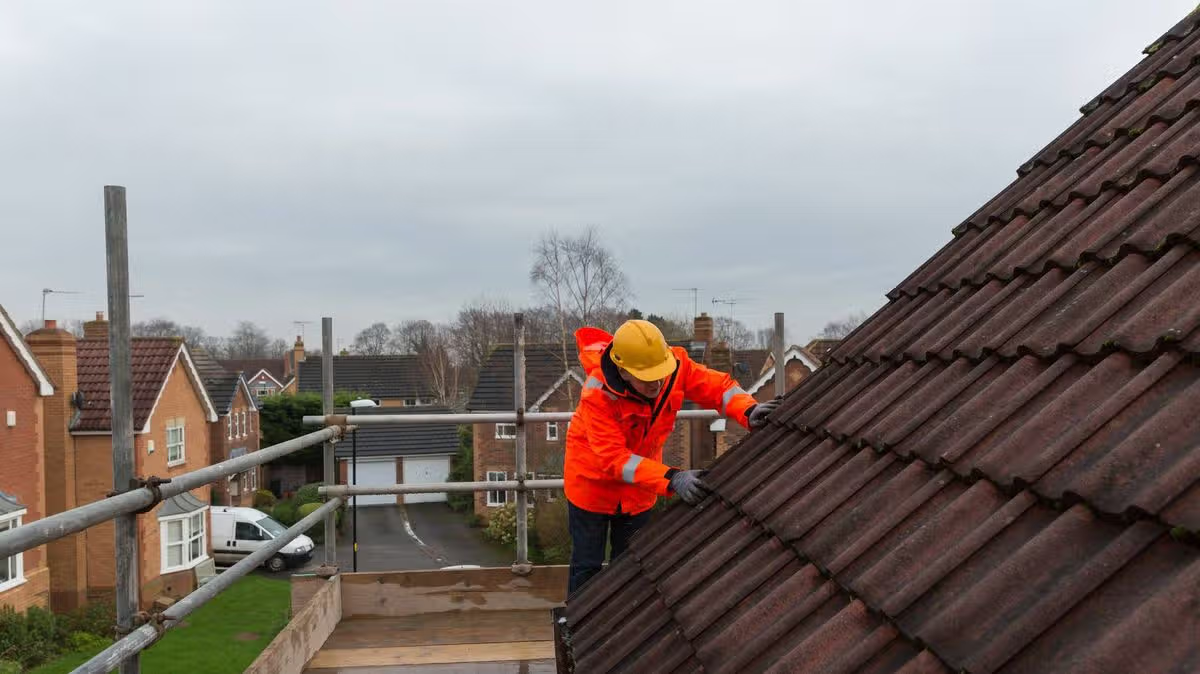
If your neighbour is building an extension too close to your property boundary, you have specific legal rights

Home extensions are a popular choice for homeowners looking to expand their living space. Yet these projects can frequently spark disagreements with neighbours, especially over how close the new build can be to the property line.

Advertisement

Under UK law, a neighbour has the right to construct right up to the boundary of your property, but they’re prohibited from crossing it, building over it, or allowing roof features such as guttering to overhang it. If an extension appears too near, your entitlements will hinge on boundary restrictions, planning rules, and party wall legislation.

There’s no universal minimum distance requirement for every property for a neighbour’s extension work. The requirements differ based on the extension type, its height, the effect on neighbouring properties, and whether it qualifies under permitted development or needs planning approval.

What are the rules on building near boundaries?

With Permitted Development Rights or Planning Permission, construction can take place as close as 50mm from your neighbour’s boundary, typically at no additional expense. However, if you wish to build directly on the boundary itself, a Party Wall Agreement becomes necessary, which usually demands your neighbour’s approval and may also require a surveyor’s involvement, particularly if your proposals impact any shared walls or structures, reports Wales Online.

Under permitted development regulations (which remain largely uniform across England and Wales for these particular measurements), an extension may be built near a boundary. However, if any part of it lies within two metres of the boundary line, the highest point of the eaves must not exceed three metres.

Advertisement

A single-storey rear extension has a maximum height restriction of four metres. Property owners typically have the right to build up to their property boundary. Under the Party Wall Act 1996, a neighbour may extend their structure right up to the boundary or even upon it, provided they adhere to the correct legal procedures. This usually involves serving a Party Wall Notice on the adjacent property owner at least two months prior to commencing any works.

If the extension involves excavation within three to six metres of your property, depending on the depth of the new foundations, you must receive notification. Should you object to the notice, both parties must appoint a surveyor to produce a “Party Wall Award,” which sets out how the works should proceed to reduce damage and disruption.

When constructing an extension, many homeowners seek to build as near to the edge as feasible to maximise space. Nevertheless, building regulations and local planning requirements usually establish a minimum setback distance.

Advertisement

In many locations, regulations stipulate a minimum distance of one metre between an extension’s edge and the boundary line. This requirement is primarily designed for fire prevention, stopping flames from spreading easily between properties, while also ensuring access for ongoing maintenance work.

What protections exist for light and privacy?

Among the most important legal safeguards for neighbours is the “Right to Light.” Should a new extension substantially diminish the natural light coming through your windows (particularly if you’ve benefited from that light for two decades or longer), you could have legitimate grounds for legal action.

This represents a civil issue distinct from planning consent. Even when a neighbour has secured council approval, they cannot lawfully breach your established right to light.

Privacy represents another key consideration. Planning authorities typically guard against “overlooking” by limiting windows on side walls or mandating the installation of obscured glazing. Should you believe an extension would compromise your privacy or cast excessive shadow over your garden, these concerns should be voiced during the planning submission stage.

Advertisement

When is professional guidance necessary?

If you’re worried about a neighbour’s construction proposals, the initial approach should be a direct conversation with them. Should that prove unproductive, seeking advice from a Party Wall surveyor or a solicitor who specialises in property law would be sensible.

Taking action promptly is vital. It’s far simpler to modify plans before building work commences than to pursue an injunction or compensation once the brickwork is already in place.

Source link

Advertisement
Continue Reading

NewsBeat

Sick TikTok clips show delivery drivers pushed off bikes in Glasgow attacks

Published

on

Daily Record

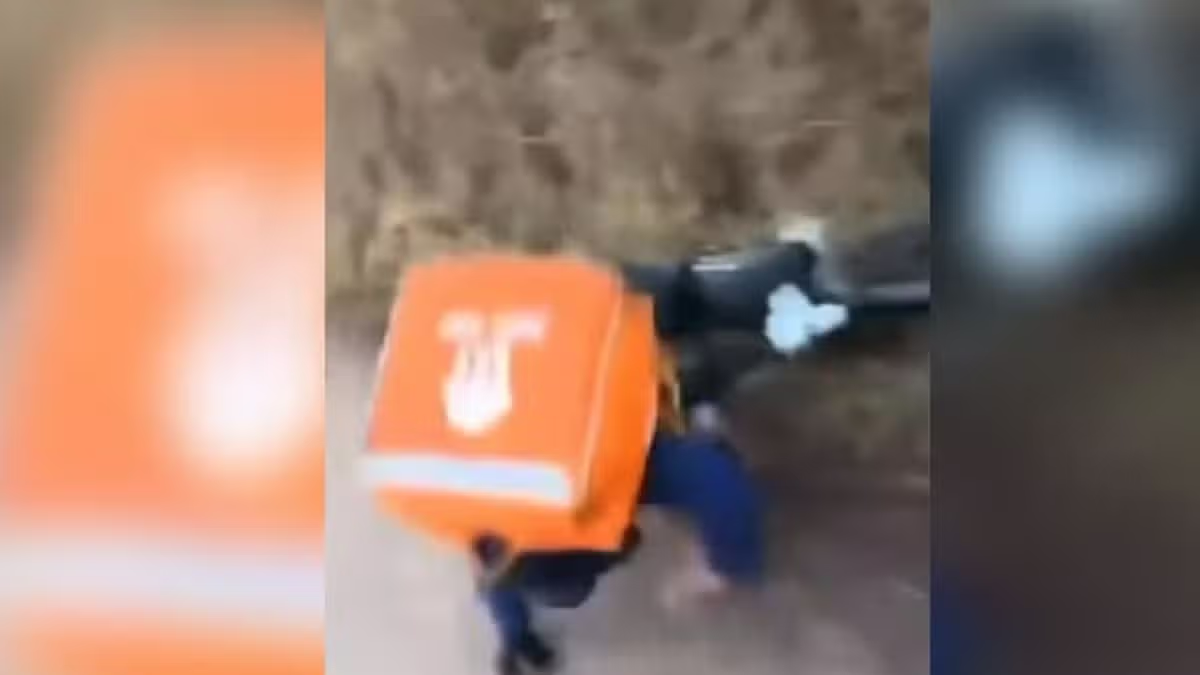
Footage shows several workers being approached by an individual who attacks them before leaving them on the ground.

Delivery drivers are being pushed off their bikes in sickening clips shared on TikTok. Multiple incidents, which appear to be in Glasgow, show delivery drivers being shoved off their bikes while innocently trying doing their jobs.

Footage shows a number of workers being approached by an individual who attacks them before leaving them on the ground. Glasgow Live reports the clips, filmed in various locations across the city, have been going viral.

The comments section is also flooded with vile remarks, including “more please” and “good man”. However the motivation for the ongoing attacks has not yet been made clear.

Advertisement

The clips emerge after our sister title told of Muhammad Jawad Yaqoob’s heartbreaking story. The delivery driver was attacked by a racist mob following an anti-immigration protest on Saturday, July 25.

The delivery driver has lived and legally worked in Glasgow for three years since moving from Kashmir. After arriving looking for a better future with his wife Hajra, they are now “scared to go outside”.

He told Glasgow Live: “They abused and harassed me, and you can see in the video they hit me with a traffic cone… I went home, and then I saw the video is viral on different pages, and I was very scared.

“I’m very upset, I’m not going outside. Some people are not good in Scotland.

“I’ve lived here for three years, I know Scottish people are very nice people, but this happening insulted me. I am Asian. My [skin] colour is brown. But we are human beings. I paid my visa fee.”

Police Scotland has been approached for comment.

Advertisement

Get more Daily Record exclusives by signing up for free to Google’s preferred sources. Click HERE

Source link

Continue Reading

NewsBeat

Police update after person dies in Cambridgeshire house fire

Published

on

Cambridgeshire Live

Police have confirmed some details about the person who died

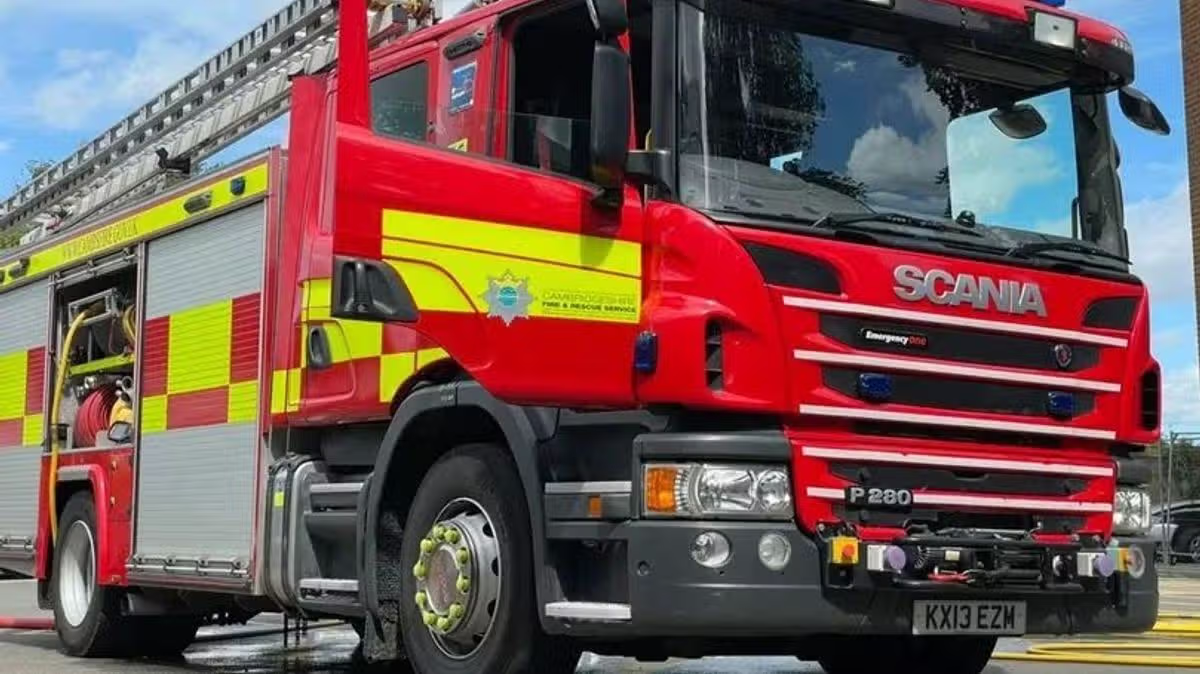
Police have provided an update after a fatal house fire. Emergency services were called to a house fire in Eagles Lane, Little Downham, at around 6pm on Friday (July 31).

Advertisement

A person was confirmed dead at the scene. Cambridgeshire Police have confirmed the casualty was a woman aged in her 60s.

A police spokesperson said: “There have been no arrests and the fire is believed to be non-suspicious.”

A Cambridgeshire Fire and Rescue Service spokesperson added: “Wearing breathing apparatus, firefighters used a hose reel to extinguish the fire and cleared the smoke using a positive pressure ventilation fan.

“Sadly, a casualty died at the scene. Crews returned to their stations by 8.15pm. The cause of the fire was accidental.”

Advertisement

Do you want more of the latest Cambridgeshire news as it comes in from across the county? Sign up to our dedicated newsletter to make sure you never miss a big story from Cambridge or anywhere else in the county. You can also sign up to our dedicated Traffic and Crime newsletters for the latest updates on the topics you are most interested in.

Source link

Continue Reading

NewsBeat

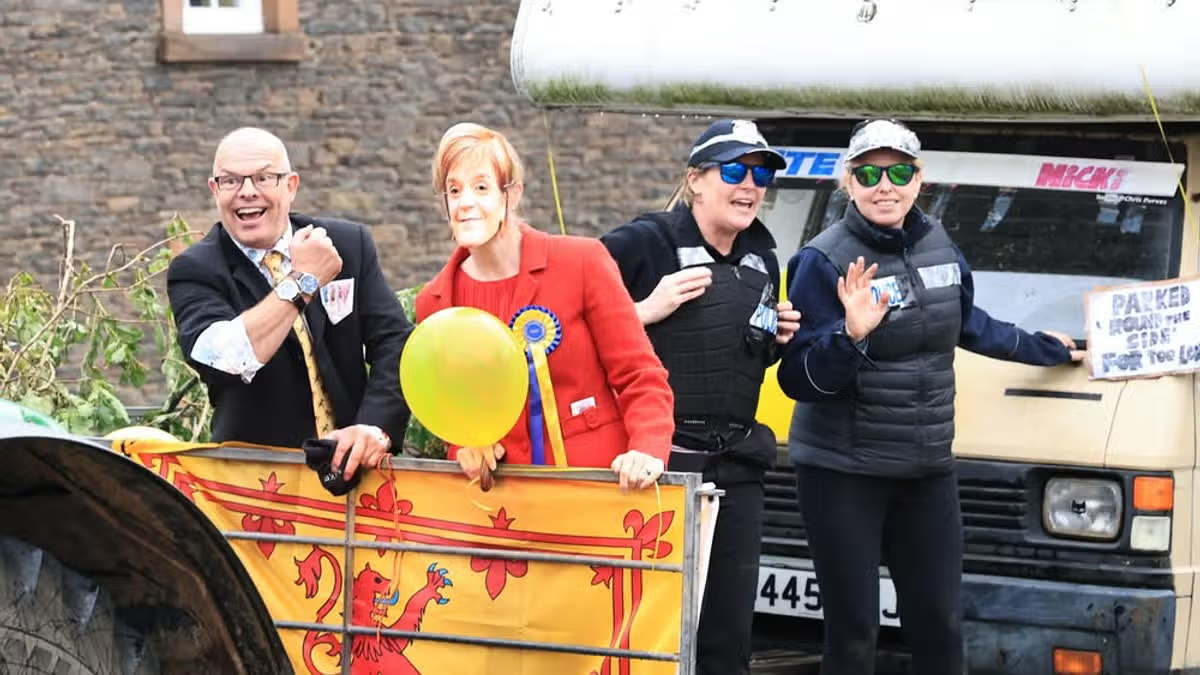
Nicola Sturgeon and Peter Murrell mocked by campervan float at historic Scots festival

Published

on

Daily Record

A banner attached to the campervan towed through Lauder said it offered “eye tests” while another joked the vehicle had been “parked round the side”.

Nicola Sturgeon and Peter Murrell have been mocked by a campervan float at an historic Scots festival.

A motorhome was towed through Lauder last week as part of the Borders town’s annual Common Riding, complete with two locals dressed as the former first minister and her estranged husband.

A banner attached to the vehicle joked: “New campervan eye test here – approved alternative to the Barnard Castle eye test“, while another sign quipped the vehicle had previously been “parked round the side”.

Advertisement

The local dressed as Murrell was pictured showing off watches on his wrist, while two other participants on the float posed as police officers.

But despite the cheeky float grabbing attention from the gathered crowds and pictures being shared widely on social media, it only claimed third prize in the vehicle category of the festival’s annual fancy dress competition.

One of the organisers told the Record the float was “just a bit of fun to make people laugh” and insisted it was not meant as a political statement.

A campervan purchased by Murrell was one of the central pieces of evidence against the disgraced former SNP chief executive, who was jailed for five years after pleading guilty to embezzlement in May.

Advertisement

It followed a lengthy police investigation – Operation Branchform – into SNP finances.

The luxury motorhome was was bought by Murrell using £124,000 of cash he stole from the Nationalists.

Murrell, 61, pled guilty at the High Court in Edinburgh to embezzling more than £400,000 from his employers. He used the ill-gotten cash to buy a string of luxury goods, including cars, cosmetics, jewellery, gardening equipment and fountain pens.

Advertisement

The best-known of Murrell’s many purchases was the Niesmann and Bischoff motorhome in October 2020. It was bought in Dunfermline and later sat outside Murrell’s mother’s home in the Fife town.

The Record first reported how the campervan was supposedly earmarked for the SNP Holyrood election campaign in 2021 but was never deployed after Covid restrictions were lifted.

But the prosecution cast doubt on that explanation and said there was no evidence the vehicle was ever intended for political purposes.

Sturgeon has repeatedly denied all knowledge of her estranged husband’s offending. She claimed she was first made aware of the motorhome’s existence in 2023 after the home she shared with Murrell was searched by police.

Advertisement

Officers also searched the Fife home of Sturgeon’s mother-in-law and impounded the campervan on the same day.

The former SNP leader previously claimed in an interview she had never “consciously” saw the campervan as it was parked “round the side” of her mother-in-law’s house.

The fancy dress competition is one of several events that take place in a week of festivities in Lauderdale each year, the climax being a band of horse riders making a circuit of the boundaries of the Borders town.

Source link

Advertisement
Continue Reading

NewsBeat

AI-generated fashion models: innovation, illusion or a step too far?

Published

on

AI-generated fashion models: innovation, illusion or a step too far?
StreetOnCamara_Comeback/Shutterstock

Fashion has always sold aspiration. Long before artificial intelligence (AI), it relied on carefully constructed images of beauty through styling, lighting, makeup and, more recently, digital retouching.

While consumers may have understood that these images do not reflect everyday reality, they continued to engage with them. They followed fashion trends and they bought the products being advertised.

The industry is now moving beyond enhancing images of real people, however. It is beginning to generate the people themselves.

AI-generated fashion models and digital twins (virtual replicas of real models) are becoming increasingly common. Brands like Balmain, Levi’s and H&M have experimented with the technology, arguing that it offers new opportunities to increase diversity, improve efficiency and reduce costs.

Advertisement

But despite consumers’ familiarity with edited and idealised imagery, these developments have sparked a much stronger backlash. So, why does creating a model with AI feel fundamentally different from editing a photograph of a real person?

As a researcher in digital consumer psychology, I have become increasingly interested in this question. And a pattern is beginning to emerge. Consumers appear less concerned about whether an image is perfect than whether there is a real person behind it.

From retouching to creation

AI-generated models represent an important change because they move beyond alteration and into creation. Rather than modifying an existing person, brands can now generate entirely synthetic individuals. And they can create digital versions of real models that can appear in campaigns without ever stepping in front of a camera.

Supporters argue that this technology offers some advantages. AI models can be produced quickly, adapted for different markets and used across multiple campaigns.

Advertisement

They can also be designed to represent a wider range of ages, body types and appearances than those traditionally featured in fashion advertising. So, in theory at least, this could help address some of the long-standing criticisms directed at the industry.

But consumer reactions to AI-generated models have been mixed. Some research suggests that synthetic models may reduce harmful social comparisons. Because consumers know they are not real people, they may be less likely to compare their own bodies with them. Other studies have found that AI-generated imagery can increase feelings of envy and reinforce unrealistic appearance standards.

These contradictory findings highlight a broader issue. Consumers have become accustomed to artificiality in advertising, but they often react differently when that artificiality becomes explicit.

Part of the explanation may lie in how people understand authenticity. Fashion images have never been entirely “real”, but they have traditionally been connected to real people. Consumers may recognise that a photograph has been heavily edited while still believing that a human being exists behind the image.
AI-generated models disrupt that relationship.

Advertisement

Authenticity

Research suggests consumers’ responses to AI are shaped not simply by appearance, but by perceptions of humanness and authenticity. Brands increasingly rely on authentic storytelling, making that distinction especially important in fashion marketing.

Although synthetic models can be designed to look diverse, they do not possess the life and experience of a human being. They can’t speak about navigating life in a larger body, overcoming barriers as a disabled person or experiencing discrimination as a member of a marginalised community. They can simulate appearance, but they cannot replicate personal history.

As a result, authenticity may depend less on what a model looks like and more on whether consumers perceive them as genuinely human. This helps explain why some consumers remain sceptical of AI-generated models even when they support greater representation in advertising.

This debate extends beyond consumers too. Models, photographers, stylists and other creative professionals have raised concerns about the effects of AI on employment across the industry. Those concerns are understandable. AI-generated content can often be produced more quickly and cheaply than traditional campaigns.

Advertisement

Fashion has played a powerful role in shaping ideas about beauty, identity and aspiration. AI-generated models may offer opportunities to challenge some of the industry’s limitations, but they also risk creating new forms of distance between brands and consumers.

In my view, the most responsible path forward is one in which AI enhances opportunities rather than replacing people. Used thoughtfully, it could help expand representation and support more inclusive forms of marketing. Used carelessly, it could simply create a new generation of unattainable ideals.

The Conversation

Hannah Marriott does not work for, consult, own shares in or receive funding from any company or organisation that would benefit from this article, and has disclosed no relevant affiliations beyond their academic appointment.

Source link

Advertisement
Continue Reading

Trending

Copyright © 2025