Connect with us

NewsBeat

Argentina president Javier Milei ramps up Falklands pressure as he announces new oil sanctions – but still Andy Burnham says nothing

Published

on

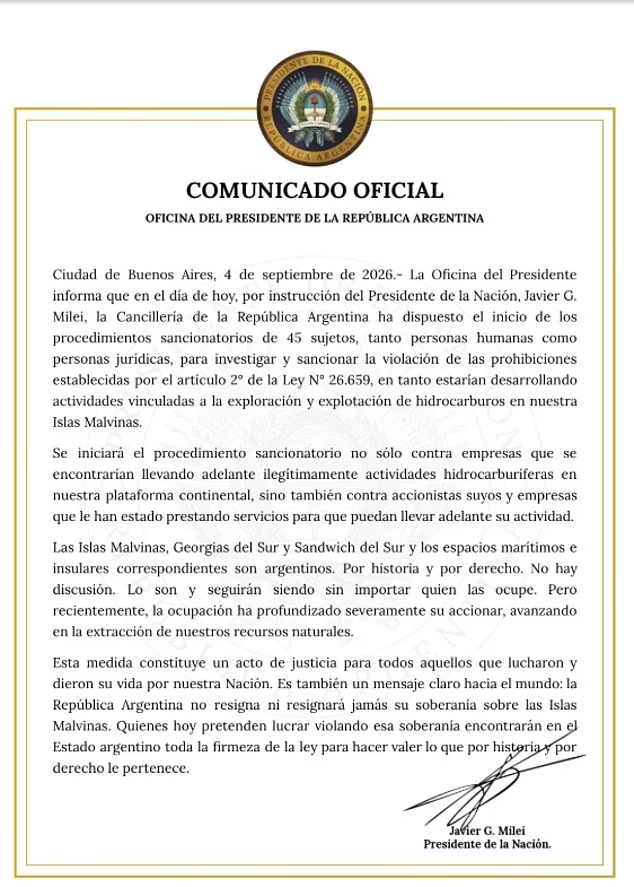
Argentina has moved to enforce a crackdown on oil exploration around the Falkland Islands, launching sanction proceedings against 45 people and companies

Argentina has moved to enforce a crackdown on oil exploration around the Falkland Islands, launching sanction proceedings against 45 people and companies.

President Javier Milei’s office announced the new move on Saturday morning in a post on X, a day after he vowed tougher action against companies operating in the British overseas territory and reiterated the country’s claim on the area.

But Prime Minister Andy Burnham has yet to say anything about the escalating rhetoric from Argentina’s president.

Downing Street has instead responded on his behalf, insisting the UK’s position on the islands is ‘unwavering’ and saying Burnham ‘fully supports the wishes of the islanders to remain a British overseas territory’.

Advertisement

Burnham has come under growing pressure to personally respond, with Reform UK accusing the Prime Minister of being ‘too weak’ to stand up to Argentina over the Falklands.

The Argentinian government said proceedings could also be brought against shareholders and companies providing services to firms involved in the oil projects.

The announcement did not identify those facing proceedings.

At the heart of the row are vast oil reserves which could deliver a £4billion windfall for the Falkland Islands.

Advertisement

The Sea Lion field, 150 miles north of Port Stanley, is estimated to contain around 900 million barrels of oil, with production expected to begin in 2028.

Argentina has moved to enforce a crackdown on oil exploration around the Falkland Islands, launching sanction proceedings against 45 people and companies

President Javier Milei's office announced the new move on Saturday morning in a post on X, a day after he vowed tougher action against companies operating in the British overseas territory and reiterated the country's claim on the area

President Javier Milei’s office announced the new move on Saturday morning in a post on X, a day after he vowed tougher action against companies operating in the British overseas territory and reiterated the country’s claim on the area

Advertisement

Argentina claims the islands and their surrounding waters as its own and says the oil cannot be extracted without its permission.

Advertisement

The project could generate £4billion for the Falklands over 35 years, transforming the islands’ economy.

In a national address on Friday, Mr Milei demanded a Hong Kong-style handover of the Falklands to Argentina as part of what he called a ‘consensus solution’.

He reiterated the country’s claim on the islands and said he would introduce sanctions on any oil companies working in the area. 

The Argentine president insisted his countrymen ‘do not believe in war’ and would not ‘start yelling like savages’ about the contentious archipelago. 

Advertisement

Renewed tensions over the British overseas territory came after US President Donald Trump hinted the US would not help the UK in a future Falklands conflict.

Following Mr Milei’s address, Foreign Secretary Ed Miliband said in a post on X: ‘The UK’s position on the Falkland Islands is unwavering.

‘The Islands are British and will remain so because that is the overwhelming position of the Islanders.

‘Their right of self-determination is paramount, grounded in international law and we will resolutely uphold it.’

Advertisement

Defence Secretary Wes Streeting said the UK’s commitment to the Falklands was ‘absolute and unshakeable’.

Downing Street suggested there would be no UK diplomatic response to Mr Milei’s threats, with the UK seeking to bolster ties with the country.

In a 2013 referendum, the Falkland Islanders voted overwhelmingly to remain a British overseas territory, with 99.8% voting in favour and just three votes against.

Although the US is formally neutral, Washington provided support for Britain’s campaign to retake the islands after the Argentinian invasion in 1982.

Advertisement

It sparked the Falklands War which saw 255 British service deaths in just over 70 bloody days. It also led to the deaths of 655 Argentinians and three Falkland Islanders.

In his speech, Mr Milei said: ‘Our role and relevance as a country in the world has changed dramatically.

‘The Falklands are our future – we need to recover these islands which are nationally relevant. There is no other path forward.’

He said he would sign decrees to introduce sanctions against any companies working on oil production in the area.

Advertisement

And he declared the Sea Lion oilfield, owned by an Israeli and a British firm where production is expected to begin in 2028, a ‘clear and present danger’ to the country’s claims.

‘If we do not act swiftly in a few months, they will have the material capacity to access the oil that lies underneath our sea. Something that has never happened before,’ he said.

British-based oil exploration company Rockhopper, which is working with Navitas on the oilfield near the islands, said it did not expect developments by the Argentinian government to have a ‘material effect’ on the project.

A No 10 spokeswoman said the UK supports the right of the Falkland Islanders to develop their natural resources for their own economic benefit, and ‘this is an integral part of their right to self-determination’.

Advertisement

The Argentinian leader announced plans to boost its defence resources with a new naval base in Tierre del Fuego in the south of the country.

Mr Milei said the US was ‘assessing their historical position in regard to the Falklands’.

Asked whether there would be a diplomatic response to his threats, the Downing Street spokeswoman said the UK continues ‘to have a diplomatic relationship with Argentina, and from our perspective we want to continue to strengthen that’.

The US president on Thursday suggested he would not back the UK in a fight over the territory, pointing to the lack of support for his war in Iran.

Advertisement

No 10 declined to comment on Mr Trump’s remarks, saying they were ‘a matter for the US president’.

This is a breaking news story, more to follow. 

Source link

Advertisement
Continue Reading
Click to comment

You must be logged in to post a comment Login

Leave a Reply

NewsBeat

‘I re-watched West Brom 1-0 Man United – Mike Dean doesn’t blow his whistle for 19 minutes’

Published

on

Manchester Evening News

Former referee Mike Dean controversially claimed he used to play “mini games” while officiating matches – and footage from an old Manchester United fixture raises some very uncomfortable questions

There are few things more likely to send football fans into a conspiracy theory spiral than a referee admitting he used to play games with himself during Premier League matches – and Mike Dean has now given them plenty to work with.

Advertisement

The former Premier League referee caused a storm this week after appearing on Jamie Vardy’s Having a Party podcast and revealing that he and fellow officials would set themselves little challenges while refereeing.

One was seeing how long they could stay in the centre circle. Another was seeing how long they could go without blowing the whistle.

Dean claimed he had managed to go 20 to 25 minutes without blowing his whistle “a few times” during his top-flight career, adding that it was something they did “for a laugh.” Unsurprisingly, though, his comments weren’t particularly well received by football fans, many of whom have accused Dean of compromising the integrity of matches.

To investigate, MEN went back and watched the full footage of one particular Premier League match – and it’s difficult not to raise an eyebrow. The game in question was West Brom’s 1-0 victory over Manchester United at The Hawthorns on March 6, 2016.

It was hardly an obscure game in Dean’s career. United were downed by Salomon Rondon’s goal, Juan Mata was sent off before half time, and Louis van Gaal’s side suffered a damaging defeat in their pursuit of Champions League football.

It was also a game in which Dean did something rather unusual. He didn’t blow his whistle once during the opening 19 minutes.

That, in itself, is not evidence of wrongdoing. Referees are not required to blow their whistles a certain number of times during a match. Games can flow, players can stay on their feet, and officials can quite reasonably allow contact that falls below their threshold for a foul.

And, importantly, none of the incidents in those opening 19 minutes can reasonably be described as an outrageous, stonewall foul that Dean inexplicably ignored. But there were several moments when you would ordinarily expect a Premier League referee to intervene.

There were around half a dozen challenges or incidents, which, while hardly career-defining refereeing blunders, looked like the sort of infringements that would normally result in a free kick. But Dean waved play on. Again. And again. And again.

There was another particularly odd incident involving Anthony Martial and Craig Dawson. Martial clattered into the back of the West Brom defender, but with the ball falling to his team-mate Stephane Sessegnon, Dean signalled for advantage.

That advantage, however, was short-lived. Sessegnon was immediately dispossessed, yet instead of pulling play back for the foul on Dawson, Dean simply waved play on.

It was another moment where, having chosen not to blow his whistle, the referee appeared content to let the game continue regardless of what happened next.

On the stroke of 19 minutes, Dean finally blew for a foul. It was unavoidable, since Daley Blind had raised a boot close to Saido Berahino’s face. In fairness to the official, it was the first stone wall foul of the game – but what followed was a little bizarre.

Having swallowed his whistle for a quarter of the match, he suddenly started blowing it with wild, frantic regularity, penalising players for the most innocuous, softest offences imaginable. This does not prove he was playing his alleged “mini game,” but it is an awfully uncomfortable coincidence.

What happened next was equally eyebrow-raising. Juan Mata, not exactly known for his aggressive streak, was sent off. First, the Spaniard was booked on 23 minutes for preventing a quickly-taken free kick, before being shown a second yellow just two minutes later for a mistimed challenge.

Neither decision looked particularly controversial when viewed in isolation. The first booking was justified, with Mata deliberately stopping West Brom from restarting play quickly, while the second challenge was reckless enough to warrant a second yellow.

Advertisement

Yet the red card became another part of the story because it came just minutes after Dean had finally started blowing his whistle.

And that is precisely why this match is worth revisiting now. Not because it proves that Dean cheated. It doesn’t. Not because every decision he made in the opening 19 minutes was wrong. It wasn’t. And certainly not because Manchester United were somehow robbed of victory by a referee determined to set himself a personal record. There is no evidence for that.

What the footage does show is a referee who went an unusually long time without awarding a single free kick – followed by a marked increase in whistle-blowing once he finally did.

After his comments this week went viral, Dean attempted to draw a line under the controversy. In a statement posted on Instagram, he insisted that throughout his 25-year career, he had always applied the Laws of the Game to the best of his ability.

He explained that his refereeing philosophy was to allow matches to flow and operate with a high threshold for contact – something he said players liked. And he made clear that whenever he saw a foul that required action, he would give it.

“At no stage was it my intention to question, criticise or undermine the integrity of refereeing in this country,” the 58-year-old wrote. “I have always respected the profession and the responsibility that comes with being a referee.”

Perhaps the simplest explanation is also the most innocent one. Dean was joking. He was trying to entertain Vardy and his audience, embellishing an old refereeing anecdote and never allowing a personal challenge to influence his decisions on the pitch.

Advertisement

That would certainly explain why some people who know him believe he was simply playing to the room. But there is an obvious problem with that defence.

Dean didn’t merely say referees joked about how long they could go without blowing their whistles. He said he did it himself in Premier League matches, and claimed to have gone 20 to 25 minutes without blowing on several occasions.

Now one of those occasions appears to have been found. Nineteen minutes. Manchester United. Half a dozen challenges that might ordinarily have prompted a whistle. Then, suddenly, the whistle starts going.

Maybe it’s a coincidence. Maybe Dean was having a laugh. Maybe his famously high threshold for contact simply meant the opening 19 minutes were exactly what he says they were: a game allowed to flow.

Advertisement

But if Dean really was telling the truth about his little refereeing games, this is exactly the sort of footage you would expect people to go searching for. And having watched it back, it certainly does not make his original claim look any less extraordinary.

Source link

Continue Reading

NewsBeat

Dover protest LIVE as ‘hundreds of men in black balaclavas’ block ferry port

Published

on

Manchester Evening News

Paul King, the Reform UK councillor for Dover West, said he has been told the demonstration is a “stop the boats protest”.

He wrote on Facebook: “Avoid the port area, large number of men have blocked the A20. I’ve been told it’s a stop the boats protest speaking to local women, they felt frightened by such a large group of men walking up the street.

“We don’t condone causing public disturbance by protest. But it’s a very good example of what is happening daily with the boats coming in.”

Advertisement

Source link

Continue Reading

NewsBeat

Power cut left Bury and Bolton residents without electricity

Published

on

Power cut left Bury and Bolton residents without electricity

People living in parts of Radcliffe and Ainsworth have woken up to find their power is out.

According to Greater Manchester electricity distribution network operator, SP Electricity North West, 70 homes have been affected.

Engineers have been sent to fix the problem, and a team is currently on the wa

Advertisement

A fault with an underground cable is being blamed. It is estimated that power will not be restored to those homes affected until around 2pm.

The fault was reported just after 8am

One resident, who contacted The Bury Times, said: “I woke up to grab a coffee to find the electricity was off yet again! Now according to the website it won’t be on until 2pm.

“What is it with the electricity in Ainsworth, I don’t know how long it’s been off! It’s just so annoying as we seem to experience a power cut so often.”

Advertisement

Source link

Continue Reading

NewsBeat

Loneliest house in the world on isolated island where your only neighbour is the ocean

Published

on

Daily Mirror

This island has been the subject of a lot of rumours

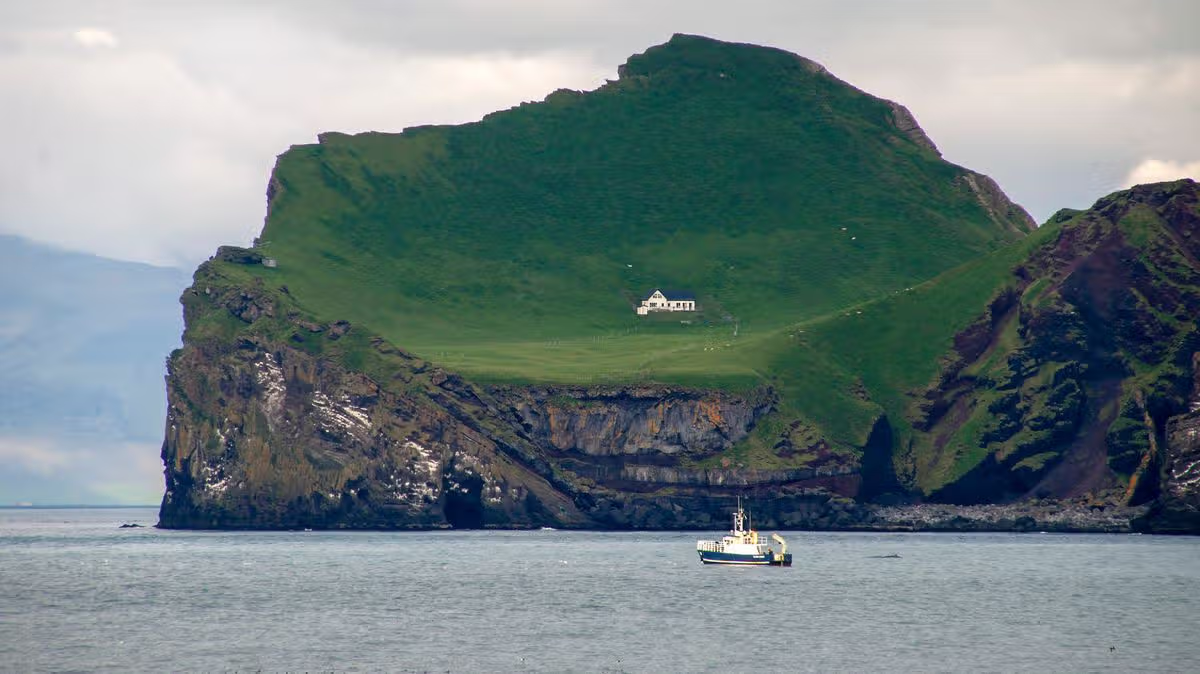
You’ve likely seen the photograph at one point or another – a lone house, tucked inside a great sloping hillside on an abandoned island. Behind the house, an expanse of lush green hillside rises to the sky, and in front of it the grass falls away to the ocean below.

Advertisement

It’s the subject of plenty of urban myths, from zombie bunkers to being Björk’s home – but the real truth is the house is not a house at all. The building sits on the island of Elliðaey, the northernmost island in the Vestmannaeyjar archipelago.

This group of islands is located about five miles south of Iceland’s mainland.

The lone building is actually a hunting lodge, built in 1953 by the Elliðaey Hunting Association.

There is a second building on the island, but this is used as a storage hut, the island has no permanent population, except for the large number of puffins which call the island home.

Advertisement

There have been several rumours about the lodge.

One was that it was built by an unnamed eccentric billionaire to escape a zombie apocalypse, another was that it was constructed as a place to isolate during Covid.

A third rumour, which was a little more realistic, was that it was home to Björk, the famous Icelandic singer.

This started way back in 2000 when The Miami Herald reported that Björk had been granted the exclusive use of the uninhabited island because she had done so much for the country.

However, this was a mistake. In fact, the reporting was about a different island, also called Elliðaey (Ellidaey) in the west of Iceland.

According to the Irish Examiner, the singer rejected the offer as she didn’t want the island to become a tourist attraction.

Now, tourists are not permitted on the island without the express permission of the owners, but plenty of boats pass it by and offer a spectacular view of the isolated island.

Advertisement

Source link

Continue Reading

NewsBeat

Hundreds of balaclava-clad protesters blockade Dover ‘in anti-migrant demonstration’ – as P&O warn holiday-makers of delays and police move in

Published

on

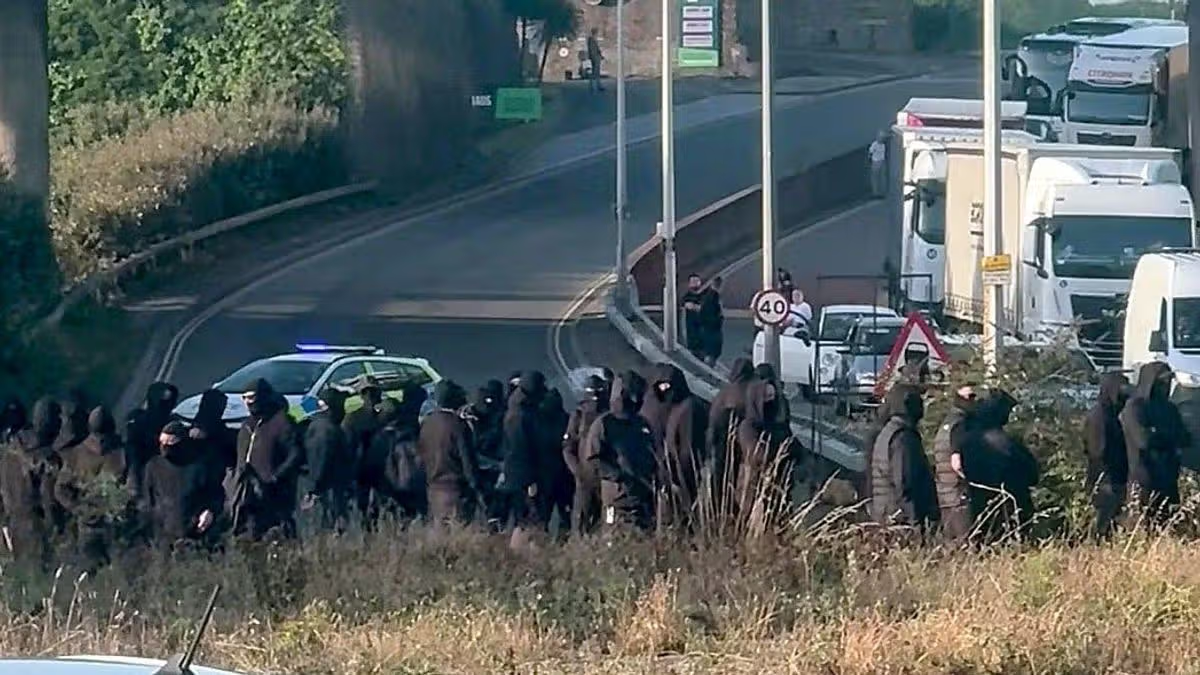
Balaclava-clad protesters have blocked roads leading to the Port of Dover in a suspected anti-migrant demonstration, sparking warnings of delays for holidaymakers

Hundreds of balaclava-clad protesters have blocked roads leading to the Port of Dover in a suspected anti-migrant demonstration, sparking warnings of delays for holidaymakers.

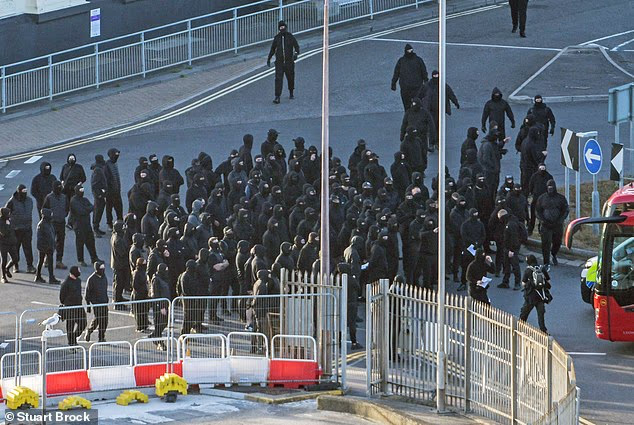
The group, dressed largely in black with their faces obscured, gathered around the ferry terminal on Saturday morning and blocked traffic in and out of the port.

One witness visiting the area said police appeared to be heavily outnumbered as hundreds of protesters descended on the town. 

Kent Police said officers were dealing with an ongoing ‘public order incident’ and were ‘engaging with protesters’.

Advertisement

The protesters are thought to be members of Patriot Platform, a far-right group demonstrating against migrants crossing the Channel in small boats.

P&O Ferries warned passengers of disruption and said those who missed their scheduled crossing would be put on the next available sailing.

Videos and pictures shared online show scores of protesters standing in roads around the port, many wearing black clothing and balaclavas.

A man filming a livestream of the protest declared that ‘something is happening’ as he observed the crowds gathering in Dover.

Advertisement

‘We have hundreds of men, English men, and they seem to be dressed head to toe in black, with black balaclavas, black everything from head to toe,’ he said.

‘There’s going to be waves upon waves. I’m led to believe Dover is going to have a problem today.’ 

Balaclava-clad protesters have blocked roads leading to the Port of Dover in a suspected anti-migrant demonstration, sparking warnings of delays for holidaymakers

Advertisement
A large group dressed in black and with their faces obscured gathered around the ferry terminal on Saturday morning, blocking traffic in and out of the port

A large group dressed in black and with their faces obscured gathered around the ferry terminal on Saturday morning, blocking traffic in and out of the port

Kent Police said officers were dealing with an ongoing 'public order incident' and were 'engaging with protesters'

Kent Police said officers were dealing with an ongoing ‘public order incident’ and were ‘engaging with protesters’

There is speculation online that as many as 300 people are involved, although this has not been confirmed. 

Patriot Platform was launched in June by Danny Thomas, an associate of Tommy Robinson.

Advertisement

Thomas has described the organisation as a ‘resistance’ movement and claimed tens of thousands of people have signed up.

He has also promoted increasingly confrontational rhetoric, calling for supporters to take ‘direct action’ and put ‘boots on the ground’. 

Mike Tapp, the Labour MP for Dover and Deal, criticised what he described as ‘idiots coming to to cause disruption’.

In a post on Facebook, he said: ‘Park run cancelled and port access disrupted.

Advertisement

‘I am fed up with idiots coming to Dover to cause disruption. I bet if you asked any one of those ‘protesters’ they wouldn’t know small boat crossing are down by 40% and we are working hard to fix the mess. 

‘Go home, enjoy your weekend/get a job.’

Commuter Nathan Ditchburn said the group arrived at around 6.45am.

He told KentOnline: ‘I would say there are around 300 men, maybe more.

Advertisement

‘They have blocked off every entrance and exit of the Dover port area, and Jubilee Way is blocked as well.

The protesters are thought to be members of Patriot Platform, a far-right group demonstrating against migrants crossing the Channel in small boats

The protesters are thought to be members of Patriot Platform, a far-right group demonstrating against migrants crossing the Channel in small boats

P&O Ferries warned passengers of disruption and said those who missed their scheduled crossing would be put on the next available sailing

P&O Ferries warned passengers of disruption and said those who missed their scheduled crossing would be put on the next available sailing

The protesters are thought to be members of Patriot Platform, a far-right group launched in June by Danny Thomas (pictured), an associate of Tommy Robinson

The protesters are thought to be members of Patriot Platform, a far-right group launched in June by Danny Thomas (pictured), an associate of Tommy Robinson

Advertisement

‘It will be causing huge delays for the ferries today.’

The Port of Dover confirmed in a statement on X that the disruption is affecting ‘all routes’ in and out, as well as around the town.

It said: ‘The Port of Dover can confirm that there is an ongoing public order incident happening around the town of Dover.

Advertisement

‘This is affecting all routes in and out the port and the town. We are in contact with Kent Police to understand the situation.

‘This situation is impacting our local community and our customers, so of course we are hoping for a swift resolution.’

In a statement on X, Kent Police said: ‘We are aware of a protest currently taking place at the Port of Dover. Officers are in attendance and engaging with protesters.’

Shipping company DFDS said: ‘We are aware of the current traffic disruption affecting access to the port.

Advertisement

‘Rest assured we will accommodate you onto the next departure once you arrive.’

 Reform UK councillor John Baker, for Kent County Council, said he believes it is a ‘stop the boats’ protest.

A man visiting the area said he looked out of the window of the hotel where he was staying at 7 am this morning and saw people walking ‘all covered in black’. 

A clip shared by him shows large groups of people standing in the middle of roads. 

Advertisement

He said: ‘Nothing can get in or out of Dover. The police are vastly outnumbered.

‘They have not made clear why they are doing this protest.

‘People in Dover are saying it’s about immigration, which seems a reasonable conclusion, but it’s not for me to say.’

He added that the protesters are ‘not making threats to anybody’ and that his understanding is that they are keeping silent.

Advertisement

‘People are going to get very frustrated because they are missing their ferries and it’s going to cause a backlog’, he said.

This is a breaking news story, more to follow. 
Source link

Advertisement
Continue Reading

NewsBeat

Tour of Britain fourth stage – road closures and restrictions

Published

on

Tour of Britain fourth stage - road closures and restrictions

The fourth stage of the Tour of Britain will pass through Easingwold, Boroughbridge and Ripon, in a route that extends from Helmsley to Leyburn today (Saturday, September 5).

North Yorkshire Council has scheduled a series of fixed and rolling road closures, as well as parking restrictions, to allow the cyclists safe passage.


RECOMMENDED READING:


Today’s stage presents one of the toughest and most decisive tests of the race – with cyclists reaching elevations of 8,756ft (2.669m).

Advertisement

Starting at 11am in Helmsley, the race will thread down to Coxwold and Easingwold, Boroughbridge and then Ripon Racecourse before entering the Yorkshire Dales National Park.

The map of the Stage Four route from Helmsley to LeyburnThe map of the Stage Four route from Helmsley to Leyburn (Image: Tour of Britain)

Riders are expected to finish the race at 3.20pm today.

Roads will be closed in Easingwold from 11am till 12pm, with the Tour of Britain expected to pass between 11.36 am to 11.41am.

In Boroughbridge, roads will close from 11.30am to 12.30pm for the cyclists arrival scheduled from 11.59am to 12.09pm.

Advertisement

The event will arrive at Ripon Racecourse sometime between 12.09pm to 12.21pm, and Ripon Studley Road from 12.12pm to 12.25pm.

Both areas’ roads will be under road restrictions from 11.40am to 12.40pm.

A spokesperson for North Yorkshire Council said: “Parking restrictions will be in place across the race route to make sure the event is safe – restrictions will be marked with yellow cones and will be in place from 8pm on Friday 4 September until the last race vehicle has passed (about an hour after the estimated time of race arrival).

“Temporary road closures will be in place but these are known as rolling road closures.

Advertisement

“This means the roads are only restricted for when necessary.

“As with previous events, we will be working with emergency service partners to make sure that they are able to deliver services as needed on the race day.”

“Cyclists pass at speed so please stand well back from the road, keep pets on a lead, keep flags, phones and cameras out of the carriageway.”

Advertisement

Source link

Continue Reading

NewsBeat

Manchester city centre incident LIVE as large cordon in place near Piccadilly station

Published

on

Manchester Evening News

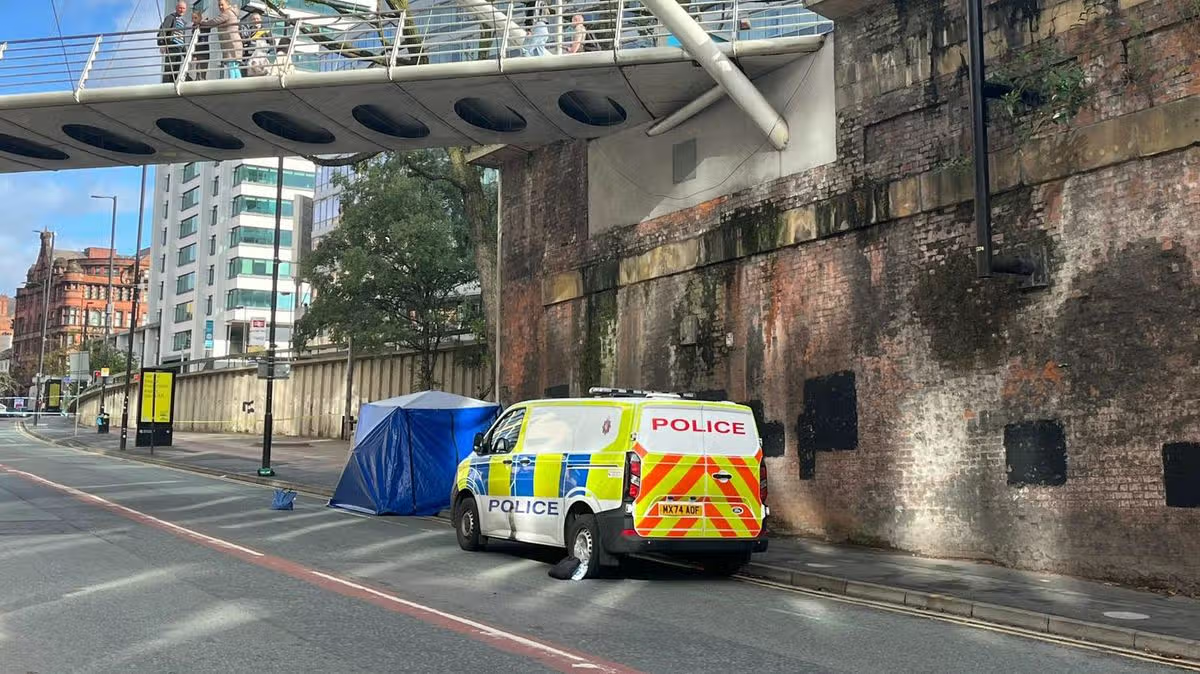
A cordon is in place on a busy Manchester city centre road this morning as officers respond to a serious incident.

London Road is taped off between Aytoun Street and Store Street.

A blue forensic tent has been seen on the road, while police remain in attendance.

Advertisement

Details on the nature of the incident are yet to be confirmed.

The incident had been described as a ‘medical emergency’ by the Inrix traffic monitoring service.

GMP has been approached for information and updates will follow in this blog.

Source link

Advertisement
Continue Reading

NewsBeat

Ukraine’s labour market has been surprisingly resilient during the war with Russia

Published

on

Ukraine’s labour market has been surprisingly resilient during the war with Russia

Russia’s war in Ukraine has generated one of the largest labour supply shocks in recent history. From an estimated pre-war population of 41 million people, close to 6 million have now left Ukraine. This outward migration alone has reduced the country’s worker population by roughly 3 million people.

It has been compounded by the mobilisation of more than 700,000 Ukrainian citizens into the army. At least 55,000 Ukrainian soldiers had been killed in combat by July 2026 (this is likely to be an underestimate as many soldiers are missing in action), with 400,000 more wounded. Most of these people are working-age men.

By conservative estimates, Ukraine’s civilian casualties amount to almost 70,000 people, with the rate increasing over the past few months because of Russia’s extensive use of ballistic missiles. Millions of Ukrainian citizens in the east and south of the country also remain under Russian occupation.

In total, there has been a contraction of about 25% of the initial labour force in areas still under Ukrainian government control. This is a labour supply shock of extraordinary scale.

Advertisement

The shock to labour demand has been similarly severe. A massive, multidimensional reallocation has taken place as a result of the war, with most economic activity shifting to the western part of Ukraine, which is less exposed to air attacks.

In a wartime economy experiencing such massive displacement and reallocation, can workers and firms still find each other? To answer this question, we analysed data from Work.ua, a Ukrainian online platform where companies post jobs and job seekers upload their resumes.

More than 700,000 Ukrainian citizens have been mobilised into the army.
Dmytro Larin / Shutterstock

We estimated the efficiency of matching between workers and firms – in other words, given a certain number of vacancies and job seekers, how often supply and demand actually meet.

Imagine there are ten companies, each with one open position and ten unemployed people. If matching efficiency is maximal, up to ten hires can be generated; if it is minimal, there will be none. The more frictions there are in the market, the more this efficiency decreases.

Advertisement

We traced how matching efficiency has evolved before and after the 2022 full-scale invasion, across Ukraine’s regions and economic sectors.

Labour market resilience

Three facts emerge from the data. First, matching efficiency has declined by about 15% since 2022. It has become more difficult for firms in Ukraine to find workers to hire and for job seekers to find employers willing to hire them.

This decline is significant, but not catastrophic. It is, for example, less than was estimated during the 2008 financial crisis in the US.

Second, the situation is varied. In the regions most exposed to the war, such as Sumy and Kharkiv oblasts in north-eastern Ukraine, the reduction in matching efficiency reaches about 20%.

Advertisement

But in the western regions of Ukraine, the picture is significantly better. In Lviv and Ivano-Frankivsk oblasts, the number of resumes and vacancies both increased compared with before the full-scale invasion – despite the overall decrease in Ukraine’s population and labour force. Matching efficiency in these areas decreased by just 5-7%.

How matching efficiency has changed, by region

A graph showing how declines in matching efficiency since 2022 vary across Ukraine.


Anastasia, Boeri and Zholud (2026) / Economic Policy, Author provided (no reuse)

We found similar variation across sectors. Many blue-collar occupations involving manual labour or skilled trades, from cleaning services to drivers, have experienced relatively modest declines. Non-essential personal services, like travel agencies, have suffered the most.

Finally, direct exposure to conflict – measured using data on air-raid alarms independent of proximity to the frontline – makes it significantly harder to match labour supply and demand. These daily disruptions, which generate fear, uncertainty, damage to infrastructure and blackouts, can severely hamper the labour market.

Advertisement

Overcoming wartime disruption

We also identified mechanisms that may have helped Ukraine compensate for its wartime labour market frictions. Many women have taken on traditionally male job roles, from mining to truck driving. Older people and those with disabilities are also playing a greater role in the labour force.

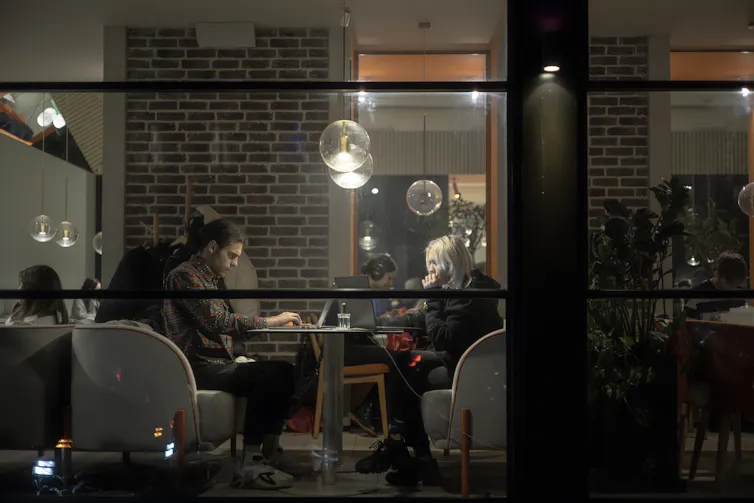
Many firms have adopted remote working and more flexible schedules. This has been especially important for displaced people and refugees, allowing many to stay connected to their employers in Ukraine and continue to provide services, despite the physical distance.

Ukrainian firms have also benefited from greater contractual flexibility. The minimum wage did not increase between the start of the full-scale invasion and 2026, while inflation eroded its real value. This means firms have been able to hire less-productive workers without experiencing profit losses.

People working on their laptops in a cafe in Kyiv.
People working remotely from a cafe in Kyiv.
Sodel Vladyslav / Shutterstock

Worker shortages are affecting many sectors of Ukraine’s economy – most notably in professions such as construction, transport and engineering. A continuation of the war will require more mobilisation in the labour market of people so far inactive, as well as a bigger contribution from those who left the country.

When the war finally ends, mobilising workers at all levels will be the next hurdle. Veterans will need to be reintegrated into the workforce, while refugee return, immigration and worker retention will all have to be encouraged.

Advertisement

Continuing to nudge higher participation among groups underrepresented in the labour market will also be important. But this all represents a sizeable challenge.

Source link

Advertisement
Continue Reading

NewsBeat

Masked protesters block access at Port of Dover

Published

on

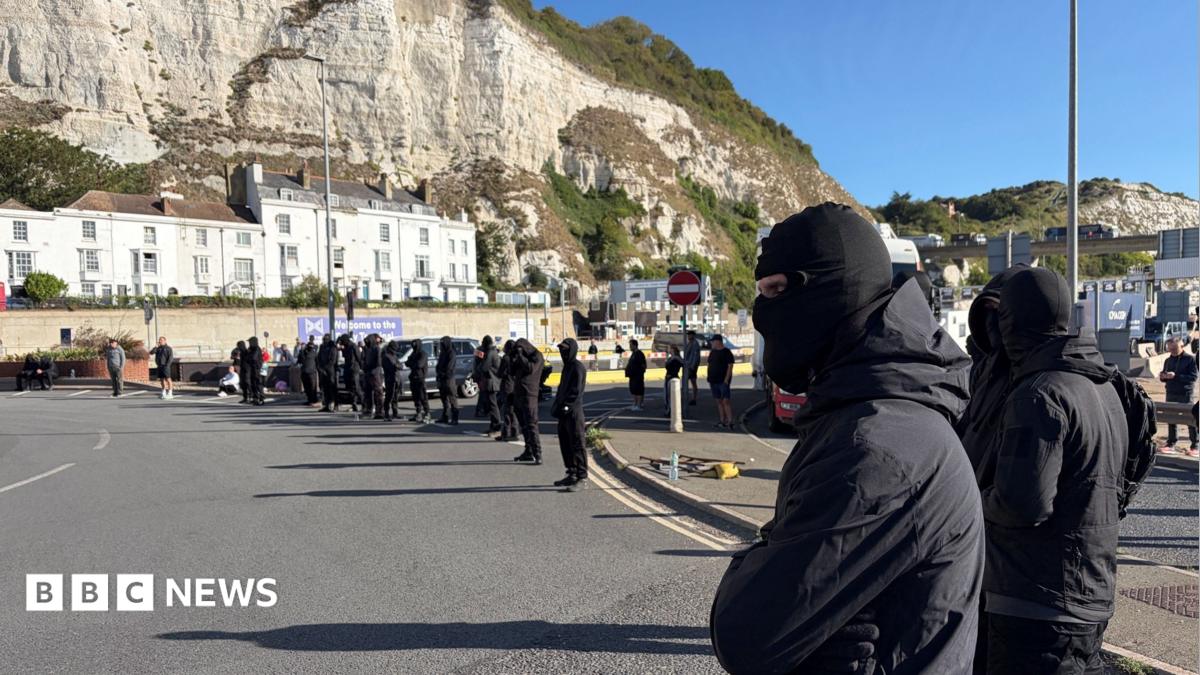
A row of masked men block a road at the entrance to the Port of Dover.

Masked demonstrators are preventing traffic from accessing the Port of Dover.

Kent Police said it was aware of a protest “currently taking place” at the ferry terminal and was “engaging with protesters”.

Traffic has been stopped from going in and out of the port.

Images from the scene appear to show hundreds of protesters, all dressed in black and wearing face coverings.

Advertisement

P&O Ferries said it would get passengers on to the next available sailing if they missed their scheduled crossing.

Traffic is stopped in both directions on the A20, between the A256 York Street and the A2 Jubilee Way in Dover, according to National Highways.

It is reporting four miles (6.4km) of congestion and delays of up to 30 minutes.

Port of Dover said the “ongoing public order incident” was affecting all routes in and out of the port and town.

Advertisement

In a statement, it added: “We are in contact with Kent Police to understand the situation.

“This situation is impacting our local community and our customers, so of course we are hoping for a swift resolution.”

Source link

Advertisement
Continue Reading

NewsBeat

Science uncovers how the brain interprets artistic beauty

Published

on

Science uncovers how the brain interprets artistic beauty

Stand in front of Turner’s Sun Rising Over Water (1825-30) and something odd tends to happen. The painting holds you, even though observers might struggle to say why. Maybe it is the colour, the balance, the composition, or the strange stillness the artwork seems to carry.

Whatever it is, you feel it long before you can explain why. And the stranger next to you, looking at the same canvas with the same awe in their eyes, very likely feels it too.

We often say that beauty is in the eye of the beholder. Yet show almost anyone a
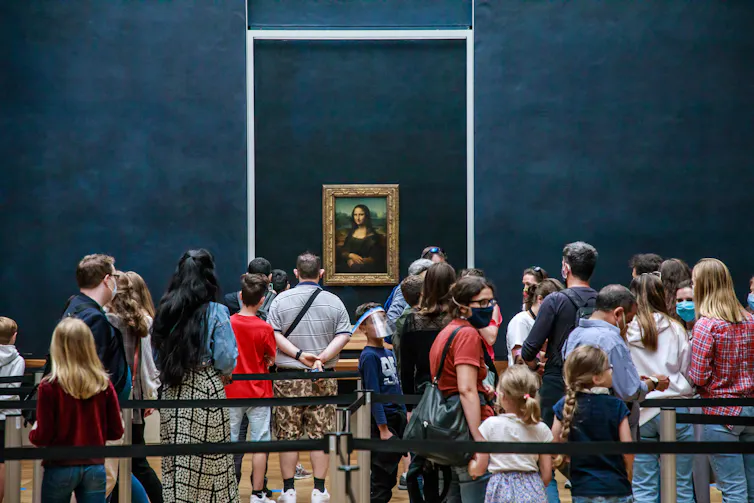
misty Chinese Song-dynasty mountain landscape, or the softly brushed figure of the Mona Lisa, and nearly everyone agrees that something striking is unfolding before them.

Beauty feels intensely private, and, at the same time, we keep discovering that we
collectively share it. That contradiction is one of the longstanding puzzles in
“neuroaesthetics” – the science of how the brain responds to art and beauty. How does our sense of beauty actually take shape in the brain?

Advertisement

In our latest study, published in Nature Communications, we tried to map that shared
experience. We found that instead of representing it as a single entity, the brain
instead splits aesthetic experience into two major strands. One strand handles what
an image shows, whether a landscape, an object or a figure.

Some artworks exert a hold over people, even if they struggle to say why. Pictured is JMW Turner’s The Sun Rising over Water (1825-30).
Album

The other tracks how much pleasure it gives us, drawing on the same circuits that respond to food or money. These two separate neural systems combine to shape every judgment of beauty we make when viewing visual artworks.

Neuroscientists have long argued about this question, from positions that compete
as often as they overlap. One camp focuses largely on perception, on how the brain
takes in composition, contrast and form.

Another emphasises evaluation and reward, placing beauty in the brain’s value circuitry. A third looks to the brain systems behind imagination and self-reflection. Each account captures something real, but they had rarely been tested together in a single study.

Advertisement

Algorithms for art

We asked 34 volunteers to look at 96 traditional Chinese watercolour paintings inside a 7T MRI scanner, powerful enough to pick up the small shifts in blood flow that track the brain’s activity. Once they were out of the scanner, each participant rated how the paintings made them feel.

Instead of working straight from those raw ratings, however, we borrowed a tool from somewhere less obvious: the recommendation engines that power services such as
Netflix and Spotify.

Known as collaborative filtering algorithms, these tools excel at detecting patterns of agreement buried in people’s preferences. When applied to our aesthetic ratings, they pulled out two dimensions running underneath everyone’s responses.

Mona Lisa, Louvre
While there is a subjective element to art, it elicits common reactions too.
Christophe Petit Tesson

The first sorted the paintings from most figure-like to most landscape-like, a measure of what each picture conceptually depicts. The second sorted them from most disliked to most liked across all participants, a measure of emotional value, or hedonic value (the sensory enjoyment someone gets from an experience).

Despite their complementary contribution to the overall aesthetic experience, the
brain kept these two dimensions remarkably separate. Visual content was read out
along the visual pathways, the familiar circuits that let us tell a face from a scene.

Advertisement

Hedonic value, on the other hand, was decoded somewhere else, within deeper
regions that handle reward and pleasure. Put simply, the brain seems to judge a
visual painting with much the same machinery it uses to judge the rest of the world
around us.

Changing the brain

We also found that how strongly the brain encoded this two-dimensional aesthetic
landscape depended on a person’s expertise in visual arts. In particular, the
difference showed up in the default mode network, a system of connections in the brain tied to imagination, consciousness, self-reflection and meaning-making that several leading theories place at the heart of aesthetic experience.

These results suggest that, beyond mere exposure, training in visual arts appears to change how the brain represents beauty in the first place.

This last point carries significant weight. If aesthetic experience has a measurable structure in the brain, and if making and viewing art can reshape it, then arts education starts to look less like enrichment and more like a kind of training that alters how perception, emotion and meaning are wired together. The clinical implications run along the same line.

Advertisement

Art-based therapies for depression, trauma and dementia have long been valued on instinct and anecdote. A clearer neural account gives us a way to test and sharpen them. Finally, as more of the images around us, in advertising, in design and on our screens, are generated by machines, knowing what beauty looks like inside the human brain matters more than ever.

Most often, we tend to treat beauty as something purely personal and assume that
asking scientific questions about it misses the point. Building on pioneering work in the field of neuroaesthetics, our results suggest otherwise.

Beauty has a structure, and that structure says something about the kind of creature we have become over countless years of evolution. We do not simply look at the world, instead we cannot seem to stop judging it for its beauty.

Advertisement

Source link

Continue Reading

Trending

Copyright © 2025