
Connect with us

NewsBeat

Azerbaijan Grand Prix: George Russell fastest from Kimi Antonelli in Friday practice

Published

on

Mercedes' George Russell crests a hill during Azerbaijan Grand Prix second practice. In the background can be seen the walls of a castle and a cycling road sign

Mercedes driver George Russell headed both practice sessions at the Azerbaijan Grand Prix.

The Briton led team-mate Kimi Antonelli by 0.552 seconds in the second session. Red Bull’s Max Verstappen was Russell’s closest rival in the first session, when Antonelli suffered a hydraulic failure.

Antonelli’s reliability problems also meant he missed the first half of the second session, and overall the Italian had half the amount of running of Russell.

Racing Bulls’ Arvid Lindblad had his second crash in consecutive race weekends in practice, clipping the wall on the exit of the tight chicane leading into the section around the castle.

Advertisement

In the context of the day, the margin between the two Mercedes drivers is to be expected but Antonelli is likely to close in on Friday in the run up to qualifying.

Mercedes spent the first half-hour of the second session finishing off the repair to Antonelli’s car, which involved an engine change.

That meant he had to go straight into his performance runs on the soft tyre, having missed set-up and development time at the end of the first hour and the beginning of the second.

Source link

Advertisement
Continue Reading
Click to comment

You must be logged in to post a comment Login

Leave a Reply

NewsBeat

‘Caring and gentle’ man, 24, died after ‘confusion’ over scans at Addenbrooke’s and other hospitals

Published

on

Cambridgeshire Live

The hospital says it is ‘committed to learning from this case.’

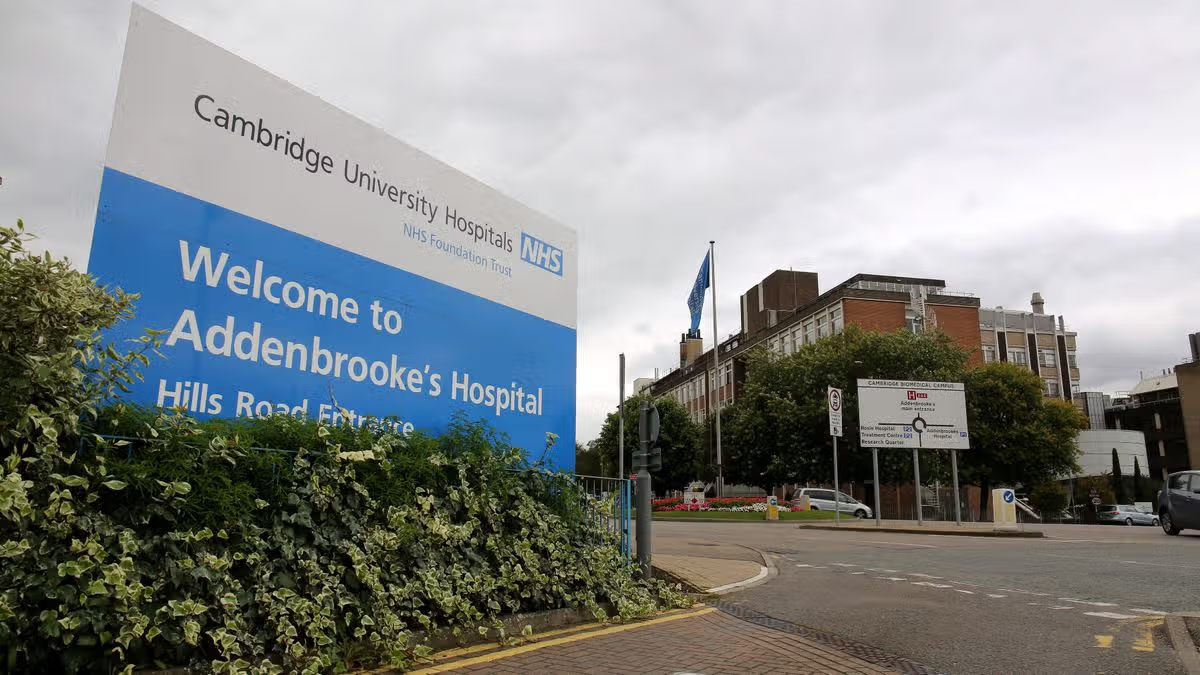
A man died after “confusion” between hospitals meant that the wrong kidney was scanned. A prevention of future deaths report found “chronic” delays and hospital mix ups led to “missed” opportunities to effectively treat Indy Mason-Kidd, prior to his death.

Indy, who is remembered by his family as the “kindest, caring and most gentle man”, died at Ipswich Hospital aged 24, due to either a ruptured arteriovenous fistula or pseudoaneurysm in the lower pole of his left kidney, arising from a biopsy procedure performed in June 2019.

Area Coroner for Suffolk Darren Stewert OBE raised concerns about the planning and management of Indy’s care and treatment, including the poor communication between Addenbrooke’s Hospital in Cambridge and Royal Surrey County Hospital in Surrey.

Advertisement

“Several concerns have national implications”, Coroner Stewert said. The report concerns Addenbrooke’s Hospital, Royal Surrey County Hospital, NHS England and East of England Ambulance Service NHS Trust (EEAST). 24-year-old Indy had suffered from Immunoglobulin A nephropathy and associated hypersensitive heart disease which resulted in him receiving a renal transplant in May 2020.

Indy, who had undergone several biopsy procedures prior to his transplant, had one that resulted in an injury to his native left kidney that subsequently developed into a vascular lesion. An ultrasound scan taken at the Royal Surrey County Hospital in May 2021 identified a vascular lesion in the left native kidney.

The coroner said there was a “missed opportunity to effectively treat his condition as no follow up was taken” at the hospital. Indy underwent a further scan at Addenbrooke’s Hospital in June 2021.

The scan did not identify any abnormality because it did not include the native kidneys – which were the ones of concern. The prevention of future death report reads: “The effect of these failures contributed to the subsequent confusion and misunderstanding relating to the scan undertaken at Addenbrooke’s in June 2021 and which focused solely on the transplanted kidney.”

Advertisement

He was then transferred to Ipswich Hospital for medical care. Although a treatment summary was provided at the time by the other hospitals, no mention was made about the vascular lesions identified in the original scan.

Coroner Stewert deemed this represented a “further missed opportunity to effectively deal with the vascular lesions identified through further investigation and treatment”. Indy became unwell and attended Ipswich Hospital’s accident and emergency department on October 20, 2023. At about 1.50am the following day, Indy suffered a catastrophic internal bleeding and collapsed. Attempts were made to resuscitate him but he was pronounced dead just before 3am.

Coroner Stewert has raised a “failure“ by Royal Surrey County Hospital and Addenbrooke’s Hospital to implement and record a plan regarding the follow up of the vascular lesions and the adequacy of its recorded notes by both hospitals.

The Coroner also raised concerns about the management of electronic patient clinical records at Addenbrookes Hospital and how patient information was provided between the Cambridge and Ipswich hospitals. The report adds: “The full patient record was not handed over and a summary letter provided which omitted important information that was available within the Addenbrooke’s Hospital records.”

Advertisement

NHS England has been advised of concerns regarding the lack of access to patient’s full clinical records in circumstances where multiple NHS Trusts are involved and the ambulance services’ ability to identify the location of patients within high density locations. East of England Ambulance Service (EEAST) has also been scrutinised for its “persistent delays” in meeting response timings.

Indy’s emergency phone call was deemed a category two call with an eight-minute target response. However, an ambulance was not dispatched until 53-minutes after the call. The report states: “The evidence before the court is that such delays are chronic, with few effective measures capable of addressing the problem.”

A Cambridge University Hospitals Trust spokesperson said: “We extend our sincere condolences to the family of Indy Mason-Kidd. Patient safety is our highest priority, and we are committed to learning from this case.

“We have carefully reviewed the findings in the Prevention of Future Deaths report and have taken steps to strengthen our systems and processes. Many of the issues identified involve care delivered across multiple organisations, and we will continue to work closely with our NHS partners to improve communication, information sharing and continuity of care for patients.”

Advertisement

An East of England Ambulance Service spokesperson said: “Our thoughts are with Indy Mason-Kidd’s family and loved ones. The Coroner’s report highlights concerns about the ambulance response on the night Indy became seriously unwell.

“At that time, our response times were being significantly affected by pressures across the wider healthcare system, including delays handing over patients at busy emergency departments, which reduced ambulance availability in the community. We recognise the impact this had on patients waiting for our help.

“Improving response times remains a key priority. We continue to work closely with NHS partners to reduce hospital handover delays and improve ambulance availability so that we can reach patients more quickly when they need us most.”

In a response to the concerns, Medical Director at Royal Surrey NHS Foundation Trust Dr Bill Jewsbury, said: “I would like to extend my sincere condolences to Indy’s family and loved ones.

Advertisement

“We have carefully considered the coroner’s findings and recognise the important lessons arising from this case. In response, we have taken steps to strengthen our processes for documentation and information sharing with partner organisations.”

According to NHS England, CUH was assessed as meeting the Programme’s core Electronic Patient Record (EPR) standards against Digital Capability Framework (DCF). However, Ashford and St Peter’s Hospitals NHS Foundation Trust and Royal Surrey County Hospital NHS Foundation Trust were assessed against the DCF and identified as not fully meeting the Programme’s core EPR standards.

Consequently, funding was secured through the Frontline Digitisation (FD) Programme to support further optimisation and enhancement of the EPR environment. In a response to one of the concerns, NHS England said: “Ambulance services should maintain robust processes and technology to accurately identify and locate patients, including within high-density residential settings, ensuring that crews can access patients safely and without avoidable delay.”

All reports to prevent future deaths are discussed by the Regulation 28 Working Group, comprising Regional Medical Directors, and other clinical and quality colleagues from across the regions. NHS England said this “ensures that key learnings and insights around events, such as the sad death of Indy, are shared across the NHS at both a national and regional level and helps us to pay close attention to any emerging trends that may require further review and action”.
Advertisement

Source link

Continue Reading

NewsBeat

Female welder lost job over lack of women’s toilet

Published

on

Female welder lost job over lack of women’s toilet

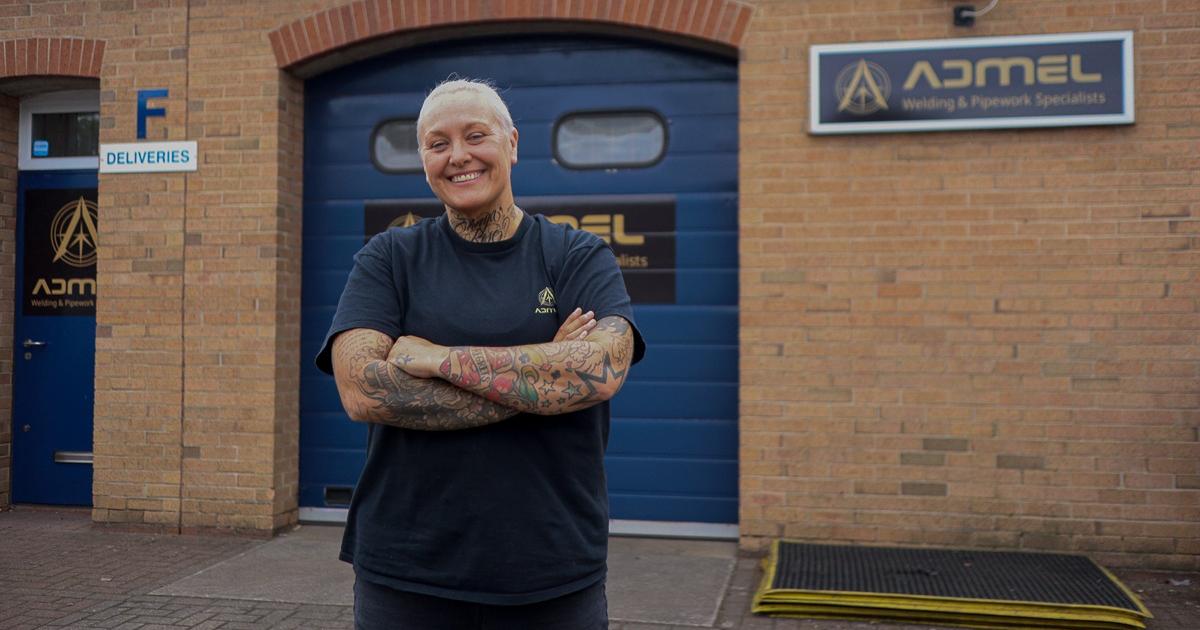
For more than 30 years, Mel Stewart has defied doubters as one of the North East’s first female welders.

Now 50, Mel has faced bullying, sexism and rejection before rising to the top, meeting royalty and launching a successful business with her best friend.

Through AdMel, she is headhunted for work around the world, helping build data centres as far afield as China.

Now she is fighting to help more women weld and remove the barriers she faced for more than 30 years.

Advertisement

“I went through the mill to get into welding, even changing my name on job applications just to get through the front door,” said the Ashington-born welder.

“I had to change my name and fight to get through the door, to prove myself. But once I was in there, they realised I was as good as any man.”

Mel Stewart Mel Stewart (Image: ADMEL)

Yet the sector is still heavily male-dominated.

Industry data shows women make up as few as three per cent of UK welders.

Advertisement

For Mel, “old school” attitudes have long blocked efforts to close that gap.

“When I started as an apprentice, there were no lasses on the shop floor,” said Mel, who now lives in Bedlington.

“I faced a ton of animosity from old-school men from the pits, who didn’t take well to a female on the shop floor.

“I was told that I should be a hairdresser, not a welder.”

Advertisement

After moving to Australia for work, she returned and applied for dozens of jobs but received not even a rejection letter.

Then an agency in Aberdeen called.

“When they heard my voice, the first thing they asked was to speak to my husband, I had to point out I was Mel,” she recalled.

When she was finally considered, she was crushed to learn she could not get the job because the site had no facilities for women.

Advertisement

“I offered to pee in a bucket or share a toilet,” she laughed.

“But there was no way they could get you in. They told me it was health and safety.”

“The job and money were fantastic – and I lost that opportunity just because they didn’t have a toilet.”

Sexism in the industry is less openly aggressive, but decades later Mel believes the underlying attitude remains.

Advertisement

“In one job, a male worker was discussing a young female apprentice welder. He said she was fine at the job, but there wasn’t any point having her on the shop floor because of the distraction she’d cause to the men,” she added.

“I suggested the fix would be self-control.”

“That mindset is still there. A lot of men think we still don’t belong or have the right to weld.”

“And that’s what I’m fighting against, changing the thought process so people realise women deserve to be in this job as much as anyone else.”

Advertisement

And the reality is the sector needs as many new faces as possible.

Britain needs about 1,000 new welders each year, yet just 231 welding apprenticeships began in 2024.

The workforce is ageing, leaving a shrinking pool of skilled people to train the next generation.

At AdMel, Mel and co-founder Adam Maughan are doing just that, passing their years of experience to apprentices at the fast-growing firm.

Advertisement

The company is flourishing, with contracts including NHS projects, while Mel and Adam are often sought for consultancy work.

A self-proclaimed “tinker” at school, Mel has also worked on schemes helping troubled youngsters avoid a life of crime.

After years of struggling to get her foot in the door, AdMel director Mel hopes her story will inspire more women to try welding, especially as Government data shows only one in 10 engineering and manufacturing apprentices are female.

“I had to get my own business to become the person I want to be, because I’ve had so many businesses where I could have been a director but I was never given the opportunity,” she said.

Advertisement

“I just want to have the chance to make sure others get the opportunity they deserve.”

Source link

Advertisement
Continue Reading

NewsBeat

Trust me Mr. Burnham – no woman wants to see more pints being drunk at football matches

Published

on

Trust me Mr. Burnham - no woman wants to see more pints being drunk at football matches

Football was always non-negotiable in my family. My dad, raised in Battersea, is a life-long Chelsea supporter, and for the first five years of my life I spent each game in the Stamford Bridge creche, alongside other CFC orphans.

When I was around seven, my parents deemed it safe enough for me to be in the stands. I loved the energy, the excitement, the celebrations; but the walk to the exit, as a small girl at only waist-height of most other rowdy supporters, filled me with dread – especially on the days we lost.

At 30, the tension that emanates from the streets after a bad day at the Bridge can still fill me with dread. Violence isn’t out of the question.

So, as much as I’d like to agree with Andy Burnham’s support for a lift of the alcohol ban in football stands, it’s an idea that leaves me more conflicted. It feels like throwing gasoline on burning embers.

Advertisement
The Prime Minister has said alcohol ban on football fans is 'unfair'
The Prime Minister has said alcohol ban on football fans is ‘unfair’ (Getty)

Notably, alcohol has been allowed in the stands of women’s games since the start of this season, with a successful 18-month trial period taking place during the last. But the differing factor here is the atmosphere.

At Women’s Super League matches, girls in plaits shout encouragement – rather than abuse – when a player misses a shot or fumbles a pass. I have never, at any of those games, heard racism, sexism, homophobia – or the word c***. Sadly, I cannot say the same for the men’s fixtures.

During the 2025-2026 season the highest number of incidents (1,644) were reported at matches in England and Wales since the UK Football Policing Unit (UKFPU) started collecting the data in 2017, with police calling for help from clubs to handle the scope of match day violence.

Match day at Stamford Bridge for the Women's Super League
Match day at Stamford Bridge for the Women’s Super League (Getty Images)

The domestic violence that can accompany men’s football is well documented. Each England tournament, Women’s Aid run their “He’s coming home” campaign, which reminds the nation that abuse cases increase by 38 per cent after a loss and 26 per cent for a win or draw.

Football doesn’t cause domestic abuse – but the danger is allowing perpetrators to turn a bad result into an excuse. Alcohol, in turn, adds another element of risk and exacerbation where abuse is already present.

As expected, a controlled lab experiment conducted in 2024 found that as participants’ blood alcohol levels increased, so did their aggressiveness. This was most common among those who normally drank heavily.

Advertisement

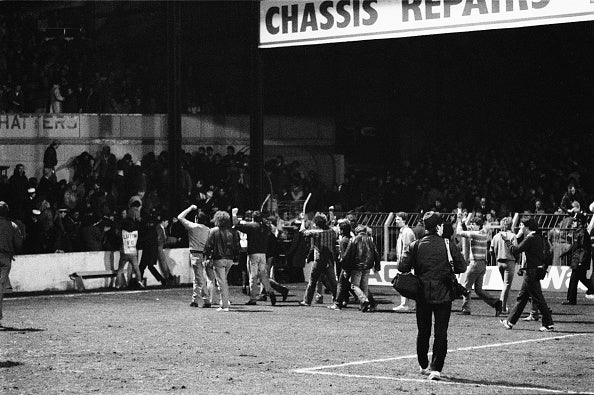
Legislation to ban alcohol was introduced by Margaret Thatcher’s government in 1985. It came after various incidents including the FA Cup quarter-final clash between Luton and Millwall and the Birmingham v Leeds match in May that year, which resulted in pitch invasions, 125 arrests, 80 spectator injuries, and one death; a 15-year-old boy.

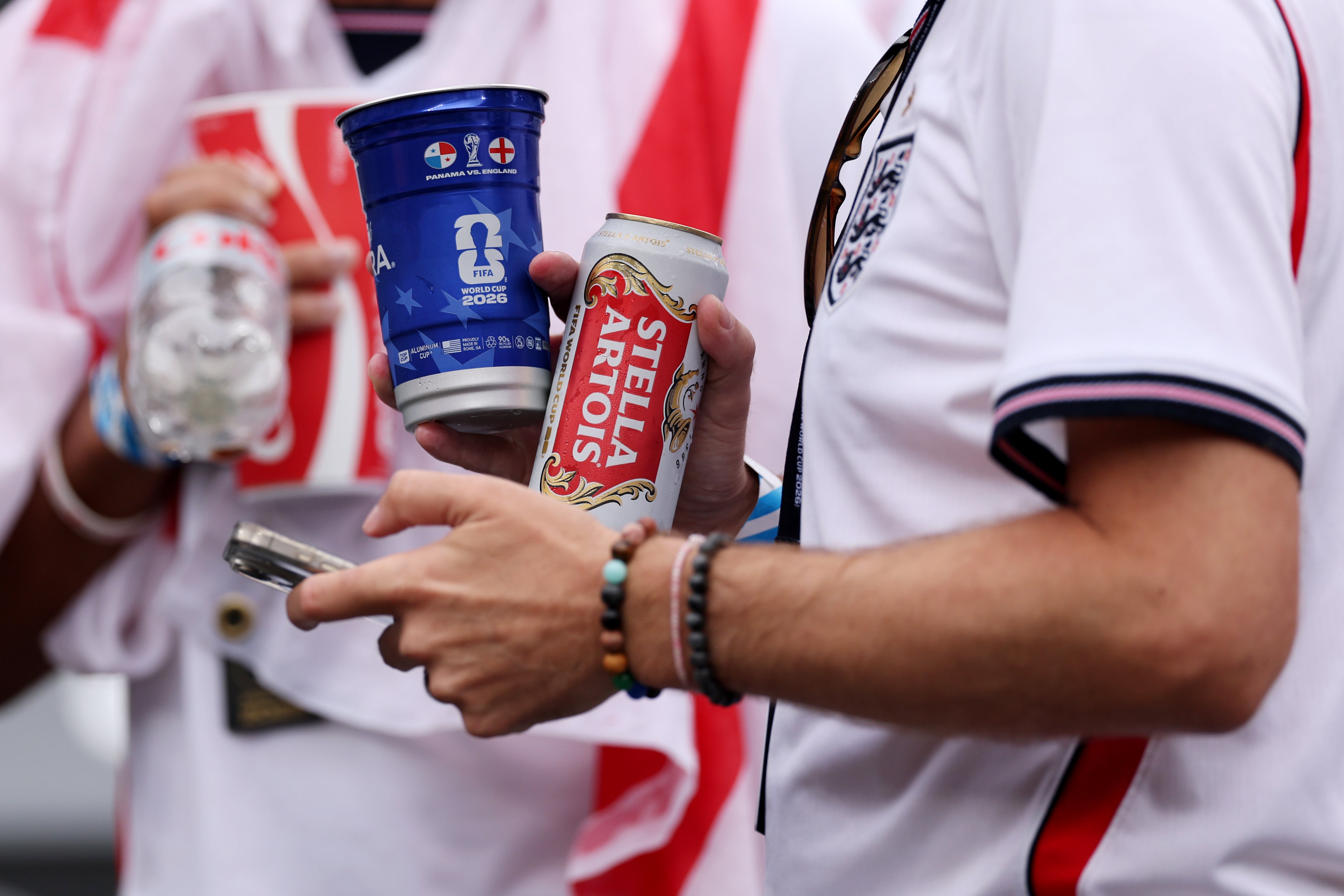
Fans drinking before the England v Panama World Cup game in New Jersey this summer
Fans drinking before the England v Panama World Cup game in New Jersey this summer (Getty Images)

Burnham, like the chairman of the Football Supporters Association (FSA), Tom Greatrex, has said it’s “unfair” to discriminate against football fans for drinking alcohol while it’s allowed in the stands during other sports.

But, as the UKFPU has pointed out, no other sport sees the violence and criminal behaviour from their supporters that football does – even if severity has drastically improved since the hooliganism of the Eighties.

Having a pint (or three) pre and post match is fun. As even those who aren’t supporters of a club will have seen while supporting England this summer, the pub atmosphere can be cheerful and warm. Still, those 45 minutes of each half of the game where alcohol isn’t present gives over excited fans in the stands a brief break from booze that has seemingly helped to stop things getting completely out of control.

Fans invade the field during the 'Luton Riot' in 1985
Fans invade the field during the ‘Luton Riot’ in 1985 (Getty Images)

The risk to women, children – and men – of going backwards, is huge. Stadiums are a hot house of emotions – crammed with tens of thousands of people – waiting for the final push. Change would need to be careful and controlled; a two drink maximum per ticket holder, for example.

But surely the risk here, to those in the ground and at home, does not outweigh the benefit in any meaningful way. Burnham might be a football fan, but he is first a prime minister who has promised to help women to live free from abuse. Allowing alcohol back into football stands amid the epidemic of violence against women and girls is a hazardous move that would leave a significant proportion of the population vulnerable.

Advertisement

The human cost of a couple more pints on match day isn’t worth the gamble. At least, until incident rates are considerably lower, security spend is up, and women can feel safe in crowds of football fans and beyond – on trains, buses, tubes and streets – across the UK.

Fundamentally, living your life in fear is far more “unfair” than not being able to drink a beer for 90 minutes; That change should be the priority.

Source link

Advertisement
Continue Reading

NewsBeat

Most cross-Channel migrant small boat arrivals in single day of 2026

Published

on

Lucy Powell speaking and gesturing with her hand. A small microphone is attached to her lapel.

“I know that people want this to happen faster,” Powell told the BBC. “We are taking those steps, it is working.”

Shadow home secretary Chris Philp said: “Keir Starmer’s pledge to ‘smash the gangs’ was always a farce and open-borders Burnham has learnt absolutely nothing from his predecessor.

“The only way to stop the crossings is to deport all illegal immigrants on arrival, and only the Conservatives have a plan to do that.”

Liberal Democrats home affairs spokesman Max Wilkinson said the government should “tackle the root cause by entering the EU’s landmark migration and asylum pact”.

Advertisement

Until they did so, he said, people smugglers would “continue to find a way through, lives will be put at risk and taxpayers’ money will be wasted”.

Reform UK leader Nigel Farage said his party would “deploy the Royal Navy and stop the boats”.

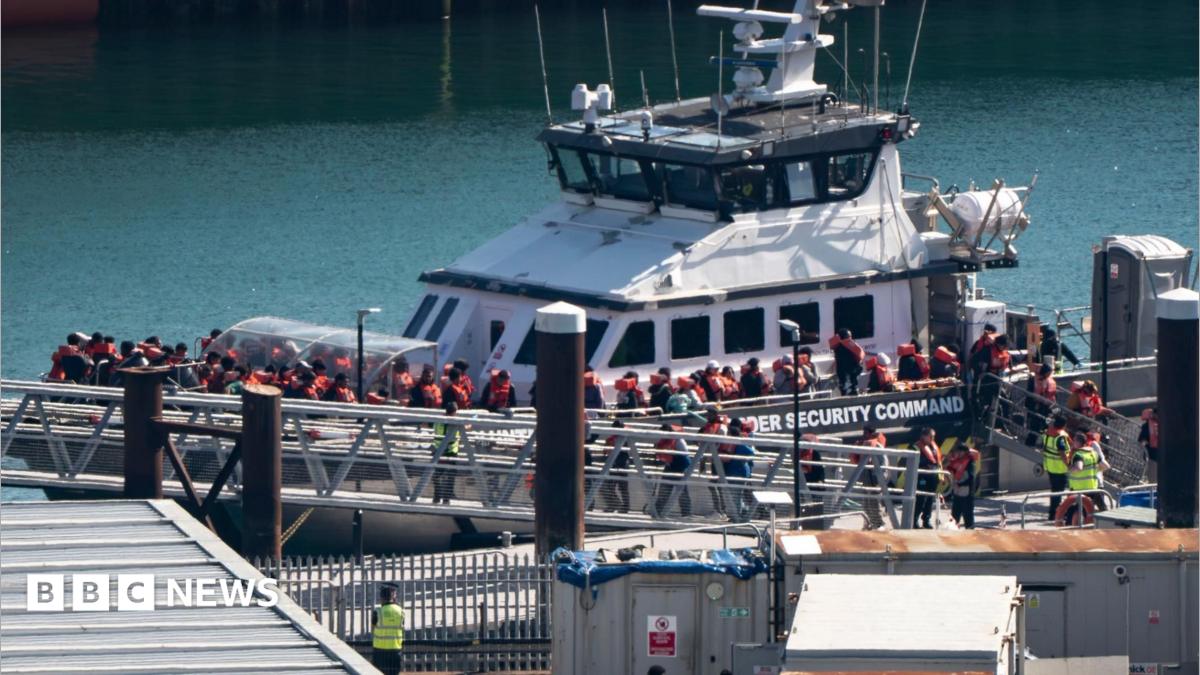
On Tuesday Home Secretary Shabana Mahmood ordered officials to conduct a review after two migrant vessels in as many days made it ashore near Folkestone undetected.

Small boat passengers are usually brought to shore by Border Force officials or on rescue boats and uncontrolled arrivals are rare. Mahmood said the beach landings were “not acceptable”.

Advertisement

The landing on Monday was the first in more than a year and only four have been recorded since the Home Office began keeping data in 2023.

Additional reporting by PA Media

Follow BBC Kent on Facebook, external, on X, external, and on Instagram, external and listen to BBC Radio Kent on Sounds. Send your story ideas to southeasttoday@bbc.co.uk, external or WhatsApp us on 08081 002250.

Advertisement

Source link

Continue Reading

NewsBeat

NATO country orders evacuations as families receive Russia alert

Published

on

Daily Record

A Russian drone crashed near the town of Solca, around 15 miles from the Ukrainian border, forcing nearby schools to cancel their classes.

Poland has evacuated two key crossings on its border with Ukraine after a fresh wave of Russian air strikes prompted security fears close to NATO territory, Prime Minister Donald Tusk has said.

Advertisement

The Dorohusk and Zosin crossings were cleared as a precaution in response to what officials described as an aerial threat lasting around 20 minutes. Thousands of residents in eastern Poland’s Lublin and Podkarpackie regions also received emergency alerts on their phones as the attacks unfolded.

Speaking at a joint press conference with Bulgarian Prime Minister Rumen Radev shortly after the evacuations, Mr Tusk warned that the months ahead could prove especially dangerous, the Mirror reports.

“This situation compels us to act very consistently here in Poland, to cooperate with Ukraine, but also to warn our European partners that these are truly difficult times,” the Prime Minister said, adding, “We need to be well prepared for the coming weeks and months. Autumn and winter could be truly critical.”

Further overnight strikes on Ukraine featured an unspecified number of hypersonic and ballistic missiles, 282 drones and other weapons, Ukraine’s air force estimated, killing two people.

Advertisement

One of the victims was in the car park of a maternity hopsital in the capital city of Kyiv. Six others were killed in an attack which struck a farm in Kharkiv, in the northeast of the country.

NATO jets were scrambled in Polish and Romanian airspace overnight and on Wednesday morning (September 23). Posting on social media, Poland’s Armed Forces Operational Command said fighter jets were dispatched “to ensure safety” due to Russian “strikes using jet-powered unmanned aerial vehicles on targets in western Ukraine.”

No violations of Polish airspace were recorded, and the jets returned to base roughly an hour after setting off, officials said. In Romania, a Russian drone crashed near the town of Solca, around 15 miles from the Ukrainian border, forcing nearby schools to cancel their classes.

Advertisement

The drone was flying “in national airspace” for four minutes, according to Romania’s Ministry of Defence, before falling near the town of Solca in Suceava County. No casualties or material damage were recorded, the ministry reported.

Elsewhere, Moldovan authorities reported four “aerial objects” illegally entering the country’s airspace on Thursday morning. Unlike Romania, Moldova is not a NATO member. President Zelensky said Russia launched its attack while people slept, with flashes from the explosions lighting up the sky in Kyiv.

“As people were sleeping, flashes from explosions ⁠lit up the sky,” Zelensky, who was in New York for the UN General Assembly, said on Telegram. Once again, the main targets of their strike were Kyiv and civilian infrastructure, residential buildings, a maternity hospital, energy infrastructure, and logistics.”

Advertisement

He also urged the US to “respond strongly,” adding: “We need ballistic interceptors to protect lives.”

Ensure our latest stories always appear at the top of your Google Search by making us a Preferred Source. Click here to activate or add us as your Preferred Source in your Google search settings.

Source link

Advertisement
Continue Reading

NewsBeat

Bolton parents fined hundreds over school absences

Published

on

Man, 71, threatened his neighbour with a sword, court hears

Cases brought by Bolton Council in recent weeks involved the parents of children at Little Lever School, Johnson Fold Primary School, St Matthew’s CE Primary School, Halliwell, and Moorgate Primary School.

One parent was left with a £791 bill, while another was handed a community order after admitting more serious school attendance offences.

At Bolton Magistrates’ Court one parent was fined £169 and ordered to pay £85 in costs and a £68 surcharge, bringing the total to £322, after pleading guilty to an offence for failing to ensure her child attended school regularly.

She was ordered to pay the amount in monthly instalments of £40.

Advertisement

In another case a parent was fined for the same offence.

The court heard the child had failed to attend school regularly in the first term.

He was fined £440 and ordered to pay £175 in costs and a £176 surcharge, leaving a total bill of £791.

A parent admitted two offences relating to the attendance of two children.

Advertisement

The parent was handed a community order requiring her to complete up to 25 days of rehabilitation activity.

She was also fined £120 and ordered to pay £85 in costs and a £114 surcharge, totalling £319.

The court ordered her to pay £25 per month.

Another was also taken to court over the attendance of a child.

Advertisement

One charge alleged the child failed to attend school regularly.

She was fined £440 and ordered to pay £175 in costs and a £176 surcharge, again bringing the total to £791.

All four cases were brought under the Education Act 1996 by Bolton Council.

Local councils and schools can use various legal powers if children are missing school without a good reason, including parenting orders, education supervision orders, school attendance orders and fixed-penalty notices.

Advertisement

Parents prosecuted for school attendance offences can face fines and, in the most serious cases, imprisonment.

Source link

Advertisement
Continue Reading

NewsBeat

Parenting Expert Explains What You Should Do If Your Children Start Whining

Published

on

How To Respond To Kids Who Complain And Whine All The Time

There comes a point in every parent’s life when their sprogs discover the art of whining – and boy, can it grate.

While the odd whine is fine (who doesn’t need a good moan now and then?), when whining becomes the default, or children seem to constantly complain, it can be exhausting – especially when you’re trying to work, look after them, juggle endless amounts of life admin (yours and theirs), and everything else in between.

Such is the case for one parent of two young girls aged six and nine, who shared that their children’s complaints are “constant” – and it’s starting to really get to them.

“I reached the point that when I am working alone from home and I hear the main door opening (meaning they are back) I pre-stress and I start to have palpitations,” said the parent on Reddit’s r/Parenting forum. “It should not be like this.”

Advertisement

Why do kids whine?

Abigail Finnegan, a psychotherapist and member of Counselling Directory, said: “For many of us who have worked in the field of child development we know only too well that if a child feels that they can’t get the attention they need through being delightful, they will instead resort to less ‘delightful’ ways to be noticed – because, after all, any attention is better than no attention at all!”

Plenty of parents are increasingly stretched to capacity (a survey from this year found nine in 10 mums have experienced burnout) and unless you’ve got a village nearby, or have a lot of money to throw at childcare, you’re very much on your own.

Add this to the fact we’re increasingly living in fast-paced environments where, as Finnegan says, parents have to meet the competing demands of employers, schools, other children, ageing parents and then kids are coming home from school “past the point of exhaustion”.

Advertisement

Mix it all up and you’ve got a recipe for whiny behaviour.

When we’re stressed and bustling about like headless chickens (which I’ll be the first to admit is my default setting) it’s easy to forget that underneath all that whining and complaining is a need to communicate something.

Psychotherapist Pei-I Yang, also a Counselling Directory member, said: “Children often don’t have the words to say ‘I feel overwhelmed’ or ‘nobody’s really listening to me’, so it can leak out as moaning instead.

“The whining isn’t the problem. It’s a communication for parents from their children telling them that something underneath needs attention.”

Advertisement

The worst way to respond to whining

When your kid whines, your instinct is probably to say something along the lines of: “stop complaining”, “try to be more positive” or “some kids would love what you’ve got”.

However Yang highlights that more often than not, this can leave children feeling “brushed off”. And a child who feels brushed off “tends to complain more, not less”. Eek.

The best way to respond to whining

Advertisement

If whining is your child’s way of communicating something, therapists suggest the best way to nip it in the bud is to get to the bottom of why they’re whining. Or at least try to.

“It’s important to verbally acknowledge to both yourself and your child that there is obviously something making them unhappy – otherwise they wouldn’t be whining!” said Finnegan. “The questions is: what to do about it?”

Her advice for parents is to slow down and check no one is hungry or thirsty. (“Healthy snacks in a bag can make a huge difference to mood at the end of a long day,” she added.)

“As hard as it can be when you’re tired as a parent, maybe ask yourself when the last time was that you were able to slow down enough to play or talk with your child without distractions?” added the therapist. “Is it possible to create some time, on a regular basis, just to be with your child?”

Advertisement

If they get plenty of time with you but still complain a lot, sometimes it can help to simply validate their emotions. Yang noted that even a simple “that does sound annoying” can take the heat out of the moment, because they feel heard.

If your teenager has taken to complaining a lot of late, instead of trying to fix or lecture, Yang encourages parents to be curious. You could ask something along the lines of: “You’ve seemed really fed up lately, what’s going on?”

“Often the small complaints are hiding something bigger, and it’s the space to talk, without you rushing to solve it, that helps them open up,” she explained.

“Whatever their age, it comes down to the same thing: connection and being curious before correction. A child who feels genuinely heard rarely needs to complain to be noticed.”

Advertisement

Source link

Continue Reading

NewsBeat

Wales breaking news plus weather and traffic updates (Thursday, September 24)

Published

on

Wales Online

Yesterday, Port Talbot Coastguard were tasked with two separate cases dealing with a despondent person. At 8.51am, the team was tasked to assist South Wales Police following a report of a despondent person in the vicinity of Monkstone Marina.

Whilst the team was mustering at station, they then received confirmation that the individual was safe and in the care of Police. As a result, our team was stood down.

At 10.12pm, they were called alongside Porthcawl Coastguard, to assist South Wales Police with a report of a despondent person on Porthcawl Pier.

Advertisement

As the team conducted a search of the pier they had news that the CAS was located safe by Police and therefore stood down.

Source link

Continue Reading

NewsBeat

Animal activists who stole King’s lambs from Sandringham found guilty of theft

Published

on

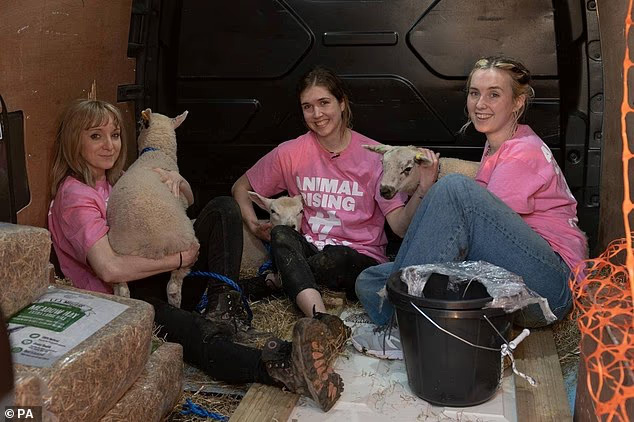
Rose Patterson, 37, along with Rosa Sharkey and Sarah Foy, both 26, spirited away three lambs during an early morning visit to Appleton Farm in Norfolk

Three animal rights activists who took lambs from the King’s estate in Sandringham and claimed Charles would have approved were convicted of theft today.

Rose Patterson, 37, along with Rosa Sharkey and Sarah Foy, both 26, spirited away three lambs during an early morning visit to Appleton Farm in Norfolk.

Footage of the women, who wore pink t-shirts bearing the name of pressure group Animal Rising, was released online afterwards by the organisation.

They were also shown brazenly standing outside Windsor Castle with signs stating they had taken the sheep before handing themselves in to police.

Advertisement

During their trial, they said they wanted to provoke a ‘discussion’ about animal farming and its impact on the environment, while the monarch was targeted because he ‘says he’s an environmentalist and an animal lover’.

Their defence rested on the claim that they had saved the animals from poor welfare conditions and slaughter and there was no ‘dishonesty’ in what they did as the so-called ‘open rescue’ was the morally right thing to do – and the King would have ‘consented’.

Prior to the hearing, Animal Rising said: ‘The open rescue tactic is an attempt to create strong case law foundations to give a legal basis for the rescue of animals from animal testing, farms or other industries.’

Advertisement

Rose Patterson, 37, along with Rosa Sharkey and Sarah Foy, both 26, spirited away three lambs during an early morning visit to Appleton Farm in Norfolk

The case follows other trials where activists have been cleared of alleged offences, leading MPs to warn such verdicts provide a ‘green light’ for people to commit crime.

But a jury took just three hours and 48 minutes to find the defendants guilty of the charge.

Judge Anthony Bate told the defendants, who showed no emotion as the verdict was returned, that he hoped to sentence them later today.

Advertisement

He indicated he was thinking of imposing a community order with unpaid work. 

Conservative MP Sir John Hayes, the founder of the Common Sense Group of parliamentarians, condemned the defendants’ actions, telling the Mail: ‘Anyone who keeps animals needs the protection of the law.

‘The distorted understanding of the relationship between humans and animals is evident in the fact that they carelessly took these babies from their mothers.’

He also branded the claim that Charles would have supported the lambs’ ‘rescue’ as ‘impertinent’, adding: ‘It’s hard to think the King would want anyone to steal animals.’

Advertisement

Immediately after the theft on May 24, 2023, livestock experts and farmers condemned the stunt.

A National Sheep Association spokeswoman said the distressed ewes would have been ‘scouring the field for their lambs, bleating endlessly with no hope of finding them’.

The activists said they target the King because he said he was 'an environmentalist and an animal lover'

The activists said they target the King because he said he was ‘an environmentalist and an animal lover’

Gareth Wyn Jones, a sheep farmer for over five decades, added: ‘These people are absolutely bonkers.

Advertisement

‘It’s distressing for these animals to be handled wrongly by amateur strangers.’

The lambs have never been recovered as they were taken to an undisclosed sanctuary where, Norwich Crown Court was told, they had begun ‘socialising with other animals and had made friends with goats’.

Animal Rising director Ms Patterson said outside court: ‘We are of course disappointed by the verdict today but it doesn’t change how I feel about rescuing Sammy, Sunny and Sooty. 

‘We rescued them because we believed they deserved the chance of a long life, rather than having their lives cut short simply because they were being farmed for food. I don’t regret for a moment giving them that chance.’

Advertisement

Ms Sharkey added: ‘I hope that the rescue of these lambs helps open the King’s eyes to the reality of farming sheep.’ 

During the trial, jurors were told that the King was the official owner of the lambs, which were worth £400-500, but they were in the care of head stockman Gordon Robinson.

Charles, who was then the Prince of Wales, admires sheep being judged at The Great Yorkshire SHow in July 2021

Charles, who was then the Prince of Wales, admires sheep being judged at The Great Yorkshire SHow in July 2021

Giving evidence, the defendants said the farming of livestock was having a devastating impact on the environment.

Advertisement

Food distribution worker Ms Sharkey, of Brighton, said: ‘We discussed wanting to save sheep and the best way to do that.

‘One of the things we were considering was the impact it would have on the farmer and knowing that farming lives are not easy.

‘That was the key reason why we went for the King’s farm as it’s not his primary source of income.

‘And we wanted to do it in a way that would have a wider impact and produce a discussion in the country.

Advertisement

‘The King says he is an environmentalist and an animal lover and I do think that the reality of sheep farming is quite hidden away, and what they face in the slaughterhouse and the impact on the land are not actually things that he’d agree with.’

Prosecutor Dingle Clark posed a hypothetical situation where someone ‘comes into a coffee shop and walks out with a cake’ and suggested: ‘That would be wrong’.

Ms Sharkey told him: ‘It would depend on the context.’

Ms Patterson, of north London, claimed electrodes that stun lambs at abattoirs were often used incorrectly, leaving them ‘paralysed while going to slaughter fully awake’.

Advertisement

The defendant – who was previously arrested on suspicion of conspiracy to cause a public nuisance after being flagged in the group’s plot to sabotage the Grand National – also claimed the ‘scale’ of the animal industry meant there were frequent violations of standards, yet there were ‘very few prosecutions’.

The defendants stood outside Windsor Castle with signs admitting what they had done before handing themselves in to police

The defendants stood outside Windsor Castle with signs admitting what they had done before handing themselves in to police

Ms Foy, an Animal Rising volunteer support co-ordinator from South Normanton, Derbyshire, told jurors the lambs were taken on a hot day and there had been no water for them.

‘We rescued them from neglect or from being killed,’ she said.

Advertisement

She also argued that ‘no aspect of the farm system actually makes sense. Every part of it needs change’.

But Mr Robinson said in a statement read to the court: ‘We unapologetically rear forest-fed lambs to sell for consumption.’

And Mr Clark told the jury in his closing speech: ‘One might have sympathy with the views of some of the defendants but they are all controversial views.’

It might be that farming practices should change, he added, but there are ‘plenty of ways to change the law [and] plenty of ways to campaign lawfully’.

Advertisement

What the defendants didn’t have, he concluded, was permission to ‘take property that belongs to other people’. 

Defence barrister Sarah-Jane Ewart, for Sharkey, said in her closing speech: ‘The three women sat behind me took three sheep. Those sheep, there’s no dispute, belonged to the King. 

‘There’s no suggestion they planned to give them back … but they didn’t do it dishonestly and so the law says that’s not theft.’

She explained that ‘someone isn’t dishonest if they believe the owner would consent to the appropriation of the property if they knew of it and its circumstances’. 

Advertisement

‘They genuinely believed King Charles would be open to this,’ added Ms Ewart.

So-called Open Rescue, where activists use ‘non-violent and transparent’ tactics to ‘rescue’ animals in captivity, was first used by protesters in Victoria, Australia.

Earlier this year, four defendants were unanimously acquitted of burglary after a jury heard they had taken 18 beagle puppies in an ‘open rescue’ at an animal testing site in Cambridgeshire in December 2022.

Other activists cleared of alleged offences include three Extinction Rebellion members who were accused of obstructing the railway after climbing onto a Docklands Light Railway train in East London in 2022.

Advertisement

The Sandringham Estate consists of 2,400 hectares of farmland, with an additional 4,000 hectares rented by tenant farmers. There are around 3,000 royal sheep present.

Source link

Continue Reading

NewsBeat

Trump sparks shock new showdown with reporters just HOURS after judge ordered White House to let them back in as free speech crisis overshadows Xi state visit

Published

on

A Politico reporter had his credentials taken while entering the White House on Thursday despite a judge's ruling for the administration to restore the outlet's access

Advertisement

Donald Trump’s White House has defied a federal judge and seized reporters’ press passes just hours after a court ordered them let back in, marking an extraordinary escalation in the dispute over ‘Fake News’ coverage.

The White House turned away at least two reporters on Thursday, even after the judge reinstated access to the banned outlets. 

Trump banned them last Friday in a fiery social media post accusing them of peddling ‘fake news.’ He was reportedly shown a slate of negative coverage from the outlets by his aide Natalie Harp in the moments before the ban was announced. 

US District Judge Timothy Kelly granted a temporary restraining order early Thursday morning, effectively forcing the Trump administration to restore access to Politico, CNN and MS NOW, which the president shockingly banned last Friday.

Advertisement

Still, a Politico reporter’s credentials were confiscated on Thursday after the ruling allowing re-entry took effect, the outlet reported. 

An MS NOW reporter also had their credentials taken and was denied access, the outlet reported.  

The three outlets filed their lawsuit against the Trump administration on Monday and the case has rapidly progressed. 

In solidarity with the banned outlets, major broadcasters like Fox News, NBC, CBS and ABC – known as the TV pool responsible for covering presidential coverage on a rotating basis – have refused to cover the president in response. 

Advertisement

A Politico reporter had his credentials taken while entering the White House on Thursday despite a judge’s ruling for the administration to restore the outlet’s access 

MS NOW correspondent Akayla Gardner reports outside the White House grounds after President Donald Trump banned MS Now, CNN, and Politico in a Truth Social post

MS NOW correspondent Akayla Gardner reports outside the White House grounds after President Donald Trump banned MS Now, CNN, and Politico in a Truth Social post 

The ban has resulted in a media blackout of Trump's state visit with Chinese President Xi Jinping

The ban has resulted in a media blackout of Trump’s state visit with Chinese President Xi Jinping

Advertisement

As President Donald Trump and First Lady Melania Trump greeted Chinese President Xi Jinping and his wife, Madame Peng, at the airport on Wednesday, many broadcast teams broke down their cameras and watched the events without filming them. 

Trump’s week has been packed with major events from attending the UN General Assembly meeting in New York City to the historic state visit with Xi in Washington, which concludes on Friday. 

The media blackout has prevented widespread coverage of the spectacles, and the broadcasters have mostly not taken any of the events live. 

New media outlets like Real America’s Voice, a MAGA-friendly network, have filled the void with YouTube streams. 

Advertisement

Given the ban on CNN and MS NOW, the broadcast tents they used to occupy on White House grounds are now vacant with their lights off, and correspondents have opted instead to shoot live shots from the streets outside the presidential residence. 

It is unclear when the White House will officially restore the outlets’ credentials. 

The Daily Mail contacted the White House for comment.

The White House Correspondents’ Association (WHCA) released a blistering condemnation of the ban in the wake of the media crackdown.  

Advertisement

‘The president said it plainly in the Oval Office, describing his own planned action as a “ban on the free press,”‘ Jacqui Heinrich, WHCA president, said in a statement. 

‘The Constitution protects the freedom of the press from government interference. That protection does not depend on whether the president likes a news organization’s coverage, agrees with its reporting, or approves of the questions its journalists ask.’

Advertisement

Source link

Advertisement
Continue Reading

Trending

Copyright © 2025