The soap star is set to join some famous faces including former Love Island star Tasha Ghouri on BBC Two’s Pilgrimage: The Road to Holy Island
Monde Mwitumwa TV and Celebrity Reporter
22:53, 02 Apr 2026Updated 23:03, 02 Apr 2026
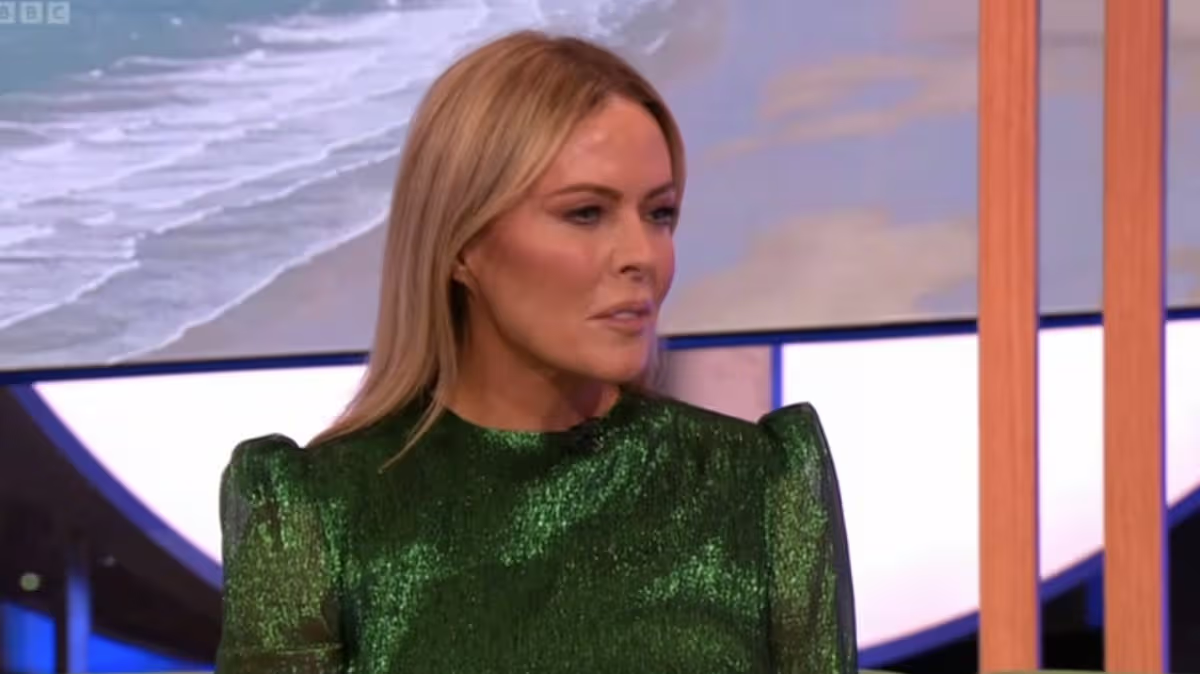
Patsy Kensit “cried a lot” as emotions ran high during the filming of BBC’s Pilgrimage: The Road to Holy Island.
The 58-year-old actress is among the celebrities participating in the eighth series of the BBC reality programme.
Advertisement
She will be accompanied by six other well-known television personalities of varying faiths and beliefs, as they tackle a 390km network of trails through the heart of North East England, celebrating early Celtic Christian saints while exploring their own spirituality and discovering more about one another along the way.
The celebrities will take in notable landmarks including Whitby Abbey and the UNESCO World Heritage site of Durham Cathedral, before reaching their ultimate destination: the Holy Island of Lindisfarne.
It is evident that the journey proved challenging for Patsy, who openly admitted that she “got emotional a few times.”
When questioned about her favourite landmarks and landscapes, she began by saying:“I loved Runswick Bay on the Way of St Hild.
“I loved being there and then going down to the beach and finding all the rocks. The ammonites. That was really good. It was so dramatic and cinematic being on this beach, and the weather was beautiful.”
She continued: “And I was quite happy there, hammering away, trying to find these rocks with the ammonites in them, which looked like snakes. The story is that St Hilda cast a spell on the area and all the snakes turned to stone. That to me was great. Durham Cathedral, again, amazing.”
Advertisement
The star added: “Every day I got something good out of it. I cried a lot as well. Yeah, I got emotional a few times.”
Patsy, who was thrust into the public eye at just four years old when she featured in a Birds Eye peas advertisement, shared the experience alongside Diversity star Ashley Banjo, former Love Islander Tasha Ghouri and Cold Feet actress Hermione Norris.
Yet being part of a large group isn’t something she feels entirely at ease with, revealing that “people have hurt me in the past.”
Advertisement
Reflecting on what she gained from her fellow cast members, she began by saying: “I think it’s fascinating, people’s beliefs. We see sometimes how devoted people are to their beliefs, and suddenly this power would come through. It was just interesting to see people being protective over their beliefs and sharing them so openly and just having a great sense of humour about it.
“These are troubled times and it’s just wonderful. My happiest day on the shoot was one day in the middle, where we all stopped for lunch after this mammoth climb.
“We all sat around just eating sandwiches, and the sun was shining, and we were at the side of this beautiful cliff. It was one of the happiest days of my life. It was so, so great.”
She added: “And Banjo said to me that when he first met me, he felt I had a lot of walls up, that there was something there. And he said it was really nice to see them come down.
Advertisement
“And I said, you’re absolutely right. I’ve been hurt by people in the past, and so I might tend to find my way a bit awkwardly into a group activity. It was so good for me. I was reborn on the other side of it.”
Pilgrimage: The Road To Holy Island starts on Sunday, April 5 at 9pm on BBC Two and iPlayer

US police say the suspected gunman at the White House Correspondents’ Dinner had multiple weapons on him when he charged a security checkpoint.
Surveillance video released by Donald Trump shows the suspect running past metal detectors as security agents draw their guns.

Washington DC police chief Jeffery W Carroll said officers exchanged gunfire with the suspect and one US secret service officer was “struck in his vest”. He was taken to hospital and is said to be “in good spirits”.
The suspect, who police called a “lone gunman”, was not struck by gunfire, but has also been transported to hospital to be evaluated.
President Donald Trump was unharmed and other top White House officials were evacuated from an annual dinner of the White House Correspondents’ Association after a man armed with guns and knives stormed the lobby and opened fire.
The shooting suspect was taken into custody and identified as Cole Tomas Allen, 31, of Torrance, California, two law enforcement officials told The Associated Press. A motive was not immediately known, and acting Attorney General Todd Blanche said charges related to Saturday night’s attack will be filed shortly.
___
This is a photo gallery curated by AP photo editors.
US President Donald Trump was rushed to safety from the White House Correspondents’ Dinner after gunshots rang out at the venue.
The President and First Lady Melania Trump appeared to be part way through a conversation at the Washington Hilton when he was interrupted by a commotion at the White House table.
Loud bangs could be heard and then various secret service members escorted the president away from the venue as they called out “stay down, stay down”.
The president, first lady and all other protectees are safe, the Secret Service said later, after seven to eight gunshots were fired.
Melissa has requests for euthanasia by breath play gone wrong (Picture: Getty Images)
As I sat in my pyjamas, watching the assisted dying bill fail in the House of Lords, all I could think was: ‘bother.’
I suspect I’ll be getting more requests than ever from my paying clients to euthanise them. It’s not an unusual proposition I get as a sex worker.
Men have asked me — half-playfully and half in earnest — whether I might help them exit stage left, ideally in a way that feels less clinical than a hospital bed. As one of my regulars, 72-year-old Les, put it, it might feel like a ‘bloody big sexy bang’ to end a life on.
The first time a client asked me to kill him five years ago, the request was delivered lightly, almost flirtatiously, as though he were testing the limits of what might be on offer. But he kept returning to it calmly, as if we were negotiating a service.
Advertisement
He wanted to know whether I’d ever take things ‘too far’ during breath play, and whether I’d know how to make sure he didn’t come back from it.
Since then, I’ve heard it enough that it no longer surprises me. I wouldn’t call it common, exactly, but it’s certainly not rare. Other sex workers I know have had similar requests, sometimes accompanied by offers of money, sometimes something more theatrical: promises of inheritance, of being written into wills, of making it ‘worth my while’.
I can’t help these men. You can’t consent to a smacked bottom in this country, still less being killed, and any sex-related death would invite immediate and intense scrutiny. These things are vanishingly rare, which makes them impossible to disguise. Just 17 Brits have had cardiac arrests during sex in three decades according to St George’s University of London.
Melissa will seduce her clients but has never considered granting their euthanasia wishes (Picture: Getty Images)
Chemsex deaths are more frequent at a rate of about three a month in London, according to ITV, but it’s still a small number when 460 people die of cancer every day in the UK.
Sex. Love. Modern Mess. Listen to new Metro podcast Just Between Us
X Factor icon Diana Vickers and writer, broadcaster, and LGBTQ+ advocate Jack Guinness dive into your wildest sex, love, and dating dilemmas – every Tuesday.
Advertisement
Listen wherever you get your podcasts or watch on YouTube. And be sure to follow and subscribe so you never miss an episode.
You can also join the fun on our WhatsApp Group Chat here – share your dilemmas and Diana and Jack may just give you a call.
Advertisement
Then there are the tiresome practicalities: the unglamorous realities that intrude on fantasy. Disposing of a body would is quite a faff. Questions get asked, things unravel.
The men interest me more than the logistics: I’m actually quite squeamish.
All this doesn’t stop men from trying to opt-out via dominatrix. Les takes me to lunch once a month when his pension comes in. The rest of the time he lives on bread and jam.
‘I don’t want to die yet,’ he tells me. ‘Too much to do. But when I get to that age — 80, maybe — I’d like to die between your thighs. You’ve got cancer to pick from, or dementia. I don’t fancy any of that.
Advertisement
‘But if we do it, you must make sure I’m not quite a corpse before you get me to your car, OK? Corpse disposal — that would be the main problem.’
He makes a compelling argument. It would be more fun than cancer.
‘I asked another Mistress if she’d kill me too. We went to The Ritz last month. She said, you’re fifth in the queue,’ he adds.
A few other men have asked me to euthanise them, should they grow ill. They are not all Les, though there are plenty like him: older, alone, rationing small pleasures across the month.
Advertisement
Others are younger, carrying a kind of flat, persistent unhappiness. A few mention illness and a desire to avoid indignity. Not all of them want to die now. Mostly they want a sense of control over how things might end, and the hope that they won’t be alone when it does.
Clients will offer to have their wills amended to encourage Melissa to grant their wish (Picture: Getty Images)
The overlap between sex, control and risk is hardly new. For some, the idea of dying in an intimate, heightened moment feels preferable to the slow fade of illness or the impersonality of institutional care. It’s less about death, more about rewriting the script around it.
When men suggest I euthanise them, I don’t treat it as a genuine proposition to be negotiated. But I don’t dismiss it outright either.
Sometimes I’ll gently steer them elsewhere — towards a GP, a counsellor, a helpline — though I don’t always feel it’s my place to intervene beyond that.
I’m not a therapist. What I am, occasionally, is a sounding board for things they don’t feel able to say anywhere else. Sometimes I jokingly suggest they rewrite their wills and we’ll consider the killing later. So far no one’s been daft enough to fall for that.
Advertisement
Orgasm has long been called ‘la petite mort’ – the little death. A safe, reversible one. But no one is dying between my thighs. Not permanently.
While the motive remains a question, the suspected shooter has been identified as 31-year-old Cole Tomas Allen, of Torrance, California, according to The New York Times.
Here’s what we know so far about the man police said fired shots at the dinner:
Advertisement
Who is the suspected gunman?
The New York Times, citing multiple law enforcement sources, identified the suspect Allen, a 31-year-old from Torrance, California.
In a Truth Social post, Trump said that the assailant had been apprehended and posted a photo of a man lying down on the ground at the hotel.
“They seem to think he’s a lone wolf, and I feel that too,” Trump said at a press briefing after the event.
Advertisement
(Donald Trump/ Truth Social)
The president also posted surveillance footage of the suspect running past the hotel’s security checkpoint. Trump said he did so for “transparency” and to highlight the speed with which agents reacted to the threat.
At a press briefing later at the White House, Trump called the suspect “a sick person” and said investigators were on their way to his apartment.
How did he get a gun into the facility?
How the suspect got the gun near the facility remains unclear.
DC Metro Police Chief Jeffery W. Carroll said they believe Allen was staying at the Washington Hill hotel, where the event was being held.
Advertisement
“We have secured a room here in the hotel, and again, we’ll go through the appropriate procedures to determine what was inside there,” Carroll told the media.
Officers had secured the room and investigators believe the suspect acted alone in the incident. Video showed Allen running toward a security checkpoint when he fired at least one shot. A Secret Service agent was hit and Carroll continued his sprint. He was apprehended off camera, but police say he was not shot. He was stopped before he got to the ballroom where Trump and other cabinet members were in attendance.
What is he being charged with?
Jeanine Pirro, the U.S. attorney for Washington, D.C, said the suspect was being charged with two counts: using a firearm during a crime of violence, and assault on a federal officer using a dangerous weapon.
Advertisement
Pirro said that the defendant would be arraigned in federal court on Monday.
Salah walked off slowly and soaked up the adulation of an adoring Anfield crowd, applauding all four stands amid fears that the Liverpool icon – who will leave the club on a free transfer in the summer – may now have played the final game of his illustrious nine-year career on Merseyside, with only four matches left to go this term.
Emergency services were called to the junction of Burnthouse Lane and Long Lane at rush-hour on Friday.
A male is being treated in hospital.
Here is everything we know about the incident so far:
Advertisement
Where did the crash happen?
The crash happened at the junction of Burnthouse Lane and Long Lane between Cockfield and Staindrop.
A bike and a car were involved in the incident, which was first reported at 5.44pm on Friday.
Did emergency services attend?
Both the North East Ambulance Service (NEAS) and Great North Air Ambulance Service (GNAAS) were called to the scene.
Advertisement
A NEAS spokesperson said: “We received a call to 999 on Friday, April 24, at 5.44pm to reports of a road traffic collision between a bike and a car at the junction of Burnthouse Lane and Long Lane in the Staindrop area.
“We sent a rapid response paramedic, an emergency ambulance crew and the air ambulance.
“One male patient was taken by GNAAS to James Cook hospital for further treatment.”
GNAAS confirmed they attended the scene.
Advertisement
A spokesperson said: “We were activated at 5.47pm on Friday, April 24, to a road traffic collision in Cockfield.
“We had a doctor and two paramedics on board our aircraft who, upon arrival on scene, assessed and treated a patient and airlifted them to hospital.
“The flight from scene to hospital took 12 minutes.”
Were police called?
It is not yet known if police were called to the scene.
Advertisement
The Northern Echo contacted Durham Police for comment.
We head north and then south to take the political pulse
Conjure up an image of a handsome market town in mid-Wales and Llandovery might be pretty close to the mark. With an attractive centre and surrounded by countryside draped in spring green it’s one of several towns in the new Sir Gaerfyrddin constituency where parties are vying for your vote ahead of the May 7 Senedd election.
On a bright Monday morning a biker sits outside a café with a rocky road cake the size of a small brick, independent shops display their wares, and blue plaques celebrate Llandovery’s storied past.
Advertisement
Just over 30 miles to the south is a different type of town – Llanelli – bigger, grittier and synonymous with industry, pockets of stubborn deprivation, and ongoing attempts to reinvigorate its commercial centre. And not forgetting some wonderful coastline.
Both towns are in Sir Gaerfyrddin – one of 16 constituencies where six Members of the Senedd will each be returned to form a 96-strong parliament via a form of proportional representation rather than winner-takes-all.
Priorities among urban and rural voters who spoke to the Local Democracy Reporting Service were different although affordable housing and good jobs were common themes among younger people from both towns.
Advertisement
Encouraging more footfall into Llandovery was uppermost in Ruth Lane’s mind although she adds: “There has been a lot been regeneration and it’s made a difference to the town. It looks like it’s being cared for.”
Her shop Relay Vintage sells clothing, jewellery, ceramics and artwork and she attends monthly Llandovery Business Forum meetings. She would like more support and protection for farmers and isn’t a fan of a proposed electricity pylon route running west of the town from a planned energy park down to a grid connection point south of Carmarthen.
“They need to find a way to do it in a less intrusive way,” she says. “There aren’t many areas of countryside like this. We need to preserve it.”
The pylon issue is a hot topic, and Barbara Price, who lives in nearby Cynghordy, is unequivocal – the electricity cables, she says, should be put underground instead. “If you go to other parts of the UK everything is going underground,” she says.
The company proposing the pylon route, Green GEN Cymru, has shifted it further away from Llandovery compared to its previous 2024 route alignment. It’s also proposed using wood poles rather than steel pylons along a section near its starting point and burying cables underground along a stretch to the south near Llanarthney.
Mrs Price also isn’t keen on any new housing unless supporting infrastructure such as health services are in place. She adds: “I’m not excited about the election, but I will vote.” Stay informed on Carms news by signing up to our newsletter here
Advertisement
Warren Ashton says he’s more likely to vote than not and senses that things might be different once the election dust has settled. “It wouldn’t harm to have a change and see what they (the Senedd) can do,” he says. Any key priorities on his mind? “The 20mph speed limit,” he replies. “And the cost of fuel. I’m a volunteer car driver with the ambulance service, picking up patients to and from hospital. I do 800 to 900 miles a week.”
For 20-year-old hospitality worker Katie Jones housing costs are “100%” the main issue. “I’ve worked since I was 12, through GCSEs and have always been conscious about money,” she says. “I still live at home with my mum.”
Katie says suitable starter housing is in short supply in Llandovery. “You get older houses for sale that need a lot of restoration,” she says. Although Llandovery will always be her home she reckons she’ll move to a city.
Advertisement
Other voters say getting the basics right like good wi-fi need attention and that better public transport and more home-grown food are required. “Most farmers and people just want stability,” says one woman.
Mark Stevens acknowledges the hard graft put in by farmers and reckons they have considerable influence as voters. His particular concern is that badger culling might be introduced in Wales and is firmly of the view that it wouldn’t be an effective way of reducing bovine tuberculosis.
It’s another sensitive subject, and not one likely to come up in Llanelli. “It shocks me – just follow the science,” says Mr Stevens.
Advertisement
Sir Gaerfyrddin’s population is around 191,000 according to the Office for National Statistics, and just over a quarter are aged 65 or older – a little higher than the Welsh average.
Its unemployment rate is above the Welsh average but not by much according to data from June 2025; rates of low satisfaction with life are slightly lower compared to the rest of Wales; and for those who love their stats, 39% per cent of its residents reported eating five portions of fruit and veg every day in 2024-25 compared to a Welsh average of 33%.
The coast path at Llanelli has stunning views across the Burry Inlet and people like Helen Conners are enjoying the spring sunshine. She is with her daughter and granddaughter and worries about so-called corridor care in Welsh hospitals. She also wants more access to NHS dentistry. “That’s a massive thing for me,” she says.
Mrs Conners also mentions potholes and train delays and, although “things have been a bit better lately” on the train front, she isn’t convinced that big changes are coming. “I just think whoever’s in charge it will keep going the same way,” she says.
Mandy Lane says it behoves politicians to achieve things. “Of course they can – that’s their job, to make things better and make people think more positively about their surroundings,” she says.
Advertisement
Big issues for her are the promotion of grassroots arts and sport and also deep frustration that her son, Sol, 24, doesn’t qualify for a benefit called personal independence payment despite, she says, his very strong eligibility credentials. “We are going through a tribunal,” she says.
Teenager Ioan Jones works full-time and is looking to carve out new opportunities. He’s been looking out for a project management apprenticeship and is now leaning towards training as a commercial pilot.
“There are training programmes out there but they’re very competitive,” he says. “I feel like you’ve got to go out there and create the opportunities yourself.” The 18-year-old is registered to vote and is still in the “undecided” camp.
Advertisement
Pensioner Keith Thomas says he used to be very politically-minded. “Not so much now – I grin and bear it,” he says. The NHS is a big focus for him and his wife. He says he had fantastic care following a cancer diagnosis 10 years ago. “But what it’s like now I don’t know,” he says. “My daughter suggests I should look at private healthcare but I don’t want to on principle. I’ve worked all my life. I have paid my dues.”
Mr Thomas recognises housing pressures facing younger people. “I can only help my children so much,” he says. “I wish I was a millionaire and could buy everyone a house.”
Owen Luggeri-Williams moved back to the area after a seven-year stint in London, where he says high housing costs more than offset better wages. He and his partner are renting in Pwll, just west of Llanelli. “We want to buy somewhere,” he says.
Education, public transport and energy costs are also important to him. “Wales is a big producer of clean energy, but our bills are higher than they were in London,” he says. “But I think clean energy has to be promoted. Fossil fuels are not going to last forever.”
Voters will get one ballot paper and can vote for either a political party or an individual candidate. The Senedd has powers over things like education, health, housing, the environment and some aspects of transport, energy and taxation.
Advertisement
With six seats per constituency up for grabs and a new voting system which will use a mathematical formula to distribute seats based on the proportion of votes won by each party, the 2026 Senedd election is a break from the past.
“In theory it should effect the turnout,” says associate professor of psychology Paul Hutchings, of University of Wales Trinity Saint David. “Every vote carries at least some weight.”
Prof Hutchings, whose area of expertise is social psychology, says the public tended to “vote for change in times of flux”, and that people’s experience of economic pain or uncertainty didn’t necessarily mean they looked deeply into the causes. “They start looking for people to blame,” he says. And this makes it tricky, he adds, for whoever’s in charge currently.
Election research in Wales shows that young people are less likely to vote, with the rate rising to a peak among 75 to 79-year-olds.
“There’s still very much a view that young people are not engaged enough for politicians, or they don’t feel politics is necessarily relevant to them,” says Prof Hutchings. “The underlying principle about how people approach politics in Wales needs an overhaul. Engagement in school is such an important thing.”
Whether that alters what motivates people to vote is a different story. Prof Hutchings’ view is that people are selfish to a certain extent and say the things that make them look best. “I tend to view people from a point of view that they’re not altruistic,” he says.
The Italian prime minister and leader of the far-right Brothers of Italy party, Giorgia Meloni, has made fostering ties with foreign leaders a central part of her political strategy. A few years before winning Italy’s 2022 general elections, she started cultivating ties with the US and European conservative world as part of a broader political rebranding effort aimed at projecting a more moderate image at home and gaining legitimacy abroad.
She subsequently became a familiar face within Donald Trump’s “Make America Great Again” (Maga) movement. Meloni shares similar views to Maga on migration, sovereignty and national identity. She also aligns with the movement on a constellation of other themes ranging from fighting against “wokeism” and defending the traditional family to the rejection of liberalism, globalism and environmentalism.
After Trump was elected as US president for the second time in late 2024, Meloni’s ties with the American far-right suddenly became a matter of foreign policy. But her relationship with Trump has turned out to be a more demanding balancing act than Meloni may have anticipated. And now their alliance – at least for the time being – appears to be over.
On April 13 Meloni described Trump’s recent social media attack on Pope Leo, who had criticised the US and Israel’s war on Iran, as “unacceptable”. This prompted a rebuke from Trump, who said Meloni “lacked courage” for not joining the war. The conditions for this breakdown have been in place for some time.
Advertisement
Trump and Meloni’s alliance
Trump and Meloni’s shared far-right traits should not hide some key differences between the two leaders. In foreign policy, Meloni has adopted a pro-Nato position and is a staunch supporter of Ukraine. These positions have aided Meloni in what has been called her quest for “respectability”, but they clash with Trump’s lack of support for Ukraine and belligerent position towards Nato.
Politically, Meloni has also faced constraints that have moderated her leadership. Externally, the EU’s institutional and financial straitjacket has required Meloni to work collaboratively with the bloc. This requirement has limited Meloni’s room for manoeuvre in her dealings with Trump and clashes with the US president’s rejection of multilateralism.
Internally, the logic of coalition politics – in particular the moderating presence of the pro-European Forza Italia party in her government – and the fact that centrist voters represent a decisive constituency in Italy have both acted as a further centripetal force on Meloni’s agenda.
Despite these divergences, Meloni’s ideological closeness to Trump did initially translate into diplomatic gains that helped boost her profile with fellow EU leaders. She was the first EU leader to meet with Trump after the imposition of his global trade tariff regime in 2025.
Advertisement
Meloni also managed to organise a trilateral meeting in Rome with the president of the European Commission, Ursula von der Leyen, and the US vice-president, J.D. Vance. Following the meting, Vance called Meloni a “bridge” between the two sides of the Atlantic.
Still, beyond the legitimacy gains for Meloni and her party, the material advantages Italy has extracted from her relationship with Trump have been limited. Italy was not spared trade tariffs, for instance. Nor did it manage to obtain a discount on Trump’s demand for Nato members to raise military spending to 5% of their GDP.
People celebrate the results of the recent judicial reform referendum in Palermo, Italy, on March 23. Lara Sirignano / EPA
The scarcity of tangible policy gains from her ties with Trump may be one reason for Meloni’s decision to distance herself from the US president. But Italian domestic politics are another important factor.
The indirect effects of Trump’s policies are likely to have played a key role in the recent defeat Meloni suffered in a referendum on judicial reform. This referendum, which came one month into Trump’s war in Iran, morphed into a vote on the Meloni government.
Advertisement
The Iran war has caused energy prices across Europe to rise and has generated fears among Italians of possible security repercussions. With a recent survey indicating 79% of Italians now hold a negative opinion on Trump, it seems that voters used the referendum to signal their discontent to Meloni ahead of general elections in 2027.
Opposition parties, both on the left and right, hailed the result as a sign that voters are looking for change. And Roberto Vannacci, a former general turned politician, is capitalising on voters’ increased unease with the impact of Trump’s policies. He has criticised Meloni for what he sees as her Washington-first alignment and soft approach to key far-right issues.
Trump’s attack on the Pope – indefensible for Meloni as someone who has defined herself as a Christian and whose party draws on a vast Catholic electorate – gave the Italian prime minister the exit she needed to signal her distance from Trump’s recent actions to voters.
Meloni’s agenda remains far-right in its orientation, aligning with Trump’s in many ways from identity politics and migration to his stance on the green transition. How these ideological similarities are received by Italian voters over the coming year is likely to play a crucial role in determining Meloni’s political future.
The road was closed between the A67 Crathorne turnoff, near Yarm, and the Parkway Interchange, which connects the A19 to the A174 in Middlesbrough.
The woman was travelling northbound, in a blue VW Golf, when she collided with a white lorry.
Advertisement
A Cleveland Police spokesperson said: “A 24-year-old woman was taken to James Cook University Hospital with a head injury.”
A picture from the scene shows traffic being diverted through Yarm off the A19, with cars also being reversed backwards on the northbound side.
Further images seen by The Northern Echo shows several 999 vehicles on the road beside a HGV, which is partly off the carriageway.
At the time, National Highways said: “The A19 in North Yorkshire is closed northbound between the A67 (Crathorne) and A174 (near Middlesbrough) due to a serious collision involving a lorry and a car.
Advertisement
“All emergency services including North Yorkshire Police are on scene. National Highways Traffic Officers and contractors are also assisting with traffic management.”
The road has since reopened and Cleveland Police are calling for witnesses to come forward.
Witnesses or anyone with dashcam footage are asked to call 101 quoting reference SE26077144.
You must be logged in to post a comment Login