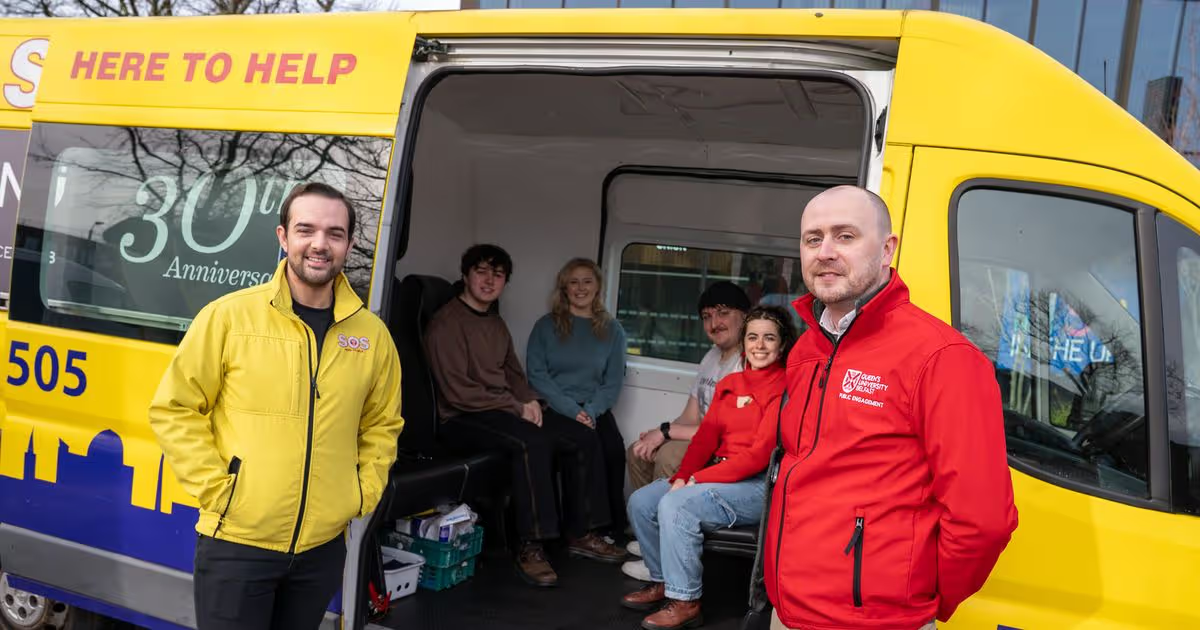
The new service will operate in the early hours of the morning on certain weeknights
Queen’s University’s Get Home Safe bus service
A university has launched a new shuttle bus service to bring students home safely after a night out in town.
Queen’s University Belfast’s Get Home Safe service launched on February 11, and offers students free transport home from Kremlin and Limelight to the Holyland area every Wednesday and Thursday night, with pickups at 12am and 2am.
The pilot initative is delivered in partnership with SOS Bus NI, and is part of the wider Queen’s safety programme, which also includes its PSNI-backed drink check initative to combat drink spiking, and campus safety events.
The new service directly responds to concerns raised by students regarding late-night travel, and aims to provide a safe, reliable way to get home, while supporting a safer night-time economy in the city.
Each shuttle bus fits seven students, and to access the service, they will simply need to show the driver their student card. Students will be picked up at Kremlin and Limelight, with the service going from there to the Holylands area. The pilot scheme is in place from now until the end of April.
Speaking to Belfast Live, the president of Queen’s University Students’ Union, Amy Smith, said the new service is a proactive measure to ensure student safety. She said: “It makes sure students have a great night out and don’t have to worry about how they get home.
“It’s also great as the bus is free which is helping with our cost of living priorities. We know the cost of living is a current crisis for our students, so we would never want them to worry about that and compromise that over their safety.
“All students have to do is have their student card, or have their student card on the app. If they show that to their driver, they’ll let them on then the driver will bring them home safety.
“It’s going to provide a lot of reassurance to students. Rather than reacting to a crisis, it’s just preventing things that could happen in the future.”
Advertisement
Queen’s University’s Neighbourhood Engagement Officer, Ryan Rankin, said the new service is directly responding to concerns students have expressed. He said the selected venues came based on student demand, but that if there is demand for other venues, the university will take this on board.
He added: “Limelight is a very popular student location, and we wanted to pick another location in the city centre which is popular, and somewhere students would maybe otherwise walk to, which is Kremlin.
“We are listening to feedback and if feedback comes back with different venues that would work, we will certainly take that on board in the future.”
Advertisement
SOS Bus NI CEO, Micky Murray, said they are happy to team up with Queen’s University for the initative, and hopes it provides reassurance for students.
He said: “We want to make sure students get home safely during the week on those nights there is no late night public transport.
“We’re hearing straight from students that this initative which only launched last week is making them feel safer, helping them feel more comfortable when they’re out as there is a fear of being assaulted or being a victim when out when travelling home in the early hours of the morning.”
Want to see more of the stories you love from Belfast Live?Making us your preferred source on Googlemeans you’ll get more of our exclusives, top stories and must-read content straight away. To add Belfast Live as a preferred source, simplyclick here.
The Hamnet star scooped the big prize in a historic triumph
Irish actress Jessie Buckley has etched her name into the history books after claiming the Academy Award for best actress in a groundbreaking moment for Ireland.
Advertisement
The 36-year-old has already secured a Bafta, Golden Globe and Critics Choice award for her portrayal of William Shakespeare’s wife in Hamnet during the 2025/2026 Awards Season.
Now, the Killarney-born star has completed the clean sweep, becoming the first Irish performer ever to claim the best actress Oscar.
In the film adaptation of Maggie O’Farrell’s Hamnet, Buckley takes on the role of Agnes – historically known as Anne – Shakespeare’s wife, as the couple navigate the devastating loss of their son. The actress has previously described making Hamnet as a “life-changing experience” and expressed feeling “honoured” to receive her Oscar nomination in the Best Actress category.
Want to see more of the stories you love from Belfast Live? Making us your preferred source on Google means you’ll get more of our exclusives… To add Belfast Live as a preferred source, simply click here.

Advertisement
The County Kerry native continued her remarkable run through awards season last month when she picked up the Bafta for best actress for Hamnet, with industry insiders having strongly predicted her Oscar triumph. Buckley has previously revealed that the role sparked a “deep need” within her to become a mother.
Speaking to British Vogue, she revealed that portraying a character who had experienced the loss of a child fulfilled a “deep need” within her to “find” her own. Buckley married her husband in 2023, and the couple welcomed their first baby last year.
Earlier this month, she set the record straight about being a “lover of cats” after facing criticism from cat enthusiasts who were disappointed by her previous interview comments suggesting she disliked them. During an appearance on Jimmy Fallon’s American chat show, Buckley disclosed she had even auditioned for a feline role once, dismissing as a “misconception” any notion that she harboured animosity towards the creatures.
Advertisement
Hailing from Killarney, Buckley spent five years at an all-girls convent school before participating in the BBC talent competition I’d Do Anything in 2008, when she was just 17. The programme chronicled the hunt for a fresh face to portray Nancy in the West End production of Oliver! Buckley finished as the runner-up behind Coronation Street actress Jodie Prenger.
Buckley has opened up about her struggles with an eating disorder and depression throughout her adolescence. She subsequently trained at the Royal Academy of Dramatic Arts (Rada) in London, earning her BA in acting in 2013.
Her theatrical journey began that very year with an appearance at Shakespeare’s Globe in The Tempest, before sharing the stage with The Holiday star Jude Law in a West End staging of Henry V.
Advertisement
Buckley subsequently took on the role of Marya Bolkonskaya in the 2016 television adaptation of Leo Tolstoy’s War and Peace, and made her cinema debut the following year in Michael Pearce’s psychological thriller Beast, appearing opposite Emma star Johnny Flynn.
She went on to feature in Wild Rose (2018), a coming-of-age musical drama centring on Rose-Lynn, a troubled Glasgow mother of two and ex-convict pursuing her ambitions of country music stardom – a performance that earned her the 2019 Scottish Bafta for best actress.
In 2020, Buckley appeared alongside Jesse Plemons in the psychological thriller I’m Thinking Of Ending Things, where a trip to her boyfriend’s isolated family farm transforms everything she believed she understood about him. Her impressive television portfolio includes her portrayal of Lyudmilla Ignatenko in HBO’s 2019 drama Chernobyl, followed by her performance as Oraetta Mayflower in the acclaimed series Fargo.
On the big screen, she appeared in The Lost Daughter (2021) opposite Olivia Colman, a performance that earned her maiden Academy Award nomination for best supporting actress, and featured in the period piece Women Talking (2022) alongside The Crown’s Claire Foy, which tells the harrowing true account of women in a religious community who come to understand the full scale of sexual abuse they’ve suffered at the hands of men after beginning to share their stories with each other.
Most recently, Buckley joined forces with Colman again in 2023’s Wicked Little Letters and appeared with Four Lions star Riz Ahmed and The Bear’s Jeremy Allen White in the science fiction romance Fingernails, exploring the story of a woman who starts doubting her relationship despite a contentious test confirming them as an ideal couple. In 2022, Buckley secured the Laurence Olivier Award for best actress in a musical for her interpretation of Sally Bowles in Cabaret.
But while the lively tune Golden was being honoured, one of the most ‘painful’ moments of the ceremony also occurred.
Singer-songwriter Ejae accepted the trophy, having also belted out the track with Audrey Nuna and Rei Ami in a stunning performance that saw the whole Dolby Theatre wave lights in the air.
Advertisement
She began her speech alongside co-writers Mark Sonnenblick, Joong Gyu Kwak, Yu Han Lee, Hee Dong Nam, Jeong Hoon Seo, and Teddy Park.
Visibly emotional, she said: ‘Growing up, people made fun of me liking K-Pop, but now everyone’s singing our song and all the Korean lyrics.
Ejae took to the stage to accept the best original song award, joined by co-writers Mark Sonnenblick, Joong Gyu Kwak, Yu Han Lee, Hee Dong Nam, Jeong Hoon Seo, and Teddy Park (Picture: Kevin Winter/Getty Images)
Advertisement
‘I’m so proud, and I realised, the song, like this award, is not about success; it’s about resilience.’
Indeed, the Huntrix lyrics have resonated with many worldwide, causing the single to top the charts and become the first K-pop song to win a Grammy and an Oscar.
However, when Lee took to the mic to deliver his acceptance speech, the higher-ups obviously had other ideas.
In a clip that has since gone viral on social media, he walked up holding a piece of paper, having prepared what he wanted to say.
Advertisement
‘I’d like to thank…’, he began, only able to get out four short words before his voice was drowned out by music, signalling that his time was up.
Fellow songwriter and composer Sonnenblick began jumping up and down in protest, while Ejae was clearly upset and begged for a few more seconds.
The Golden singer grew emotional as she expressed her gratitude for the historic victory (Picture: Reuters)
Viewers are demanding an apology for Lee, who only managed to get four words out before he was drowned out by music (Picture: Kevin Winter/Getty Images)
Unfortunately, despite their efforts, the Oscars were having none of it. While he continued trying to speak, the camera panned out, and a voiceover resumed, announcing that the awards for best director and best actor were coming up after the commercial break.
Who won at the Oscars 2026? Full list of winners
Best picture
One Battle After Another
Best director
Paul Thomas Anderson – One Battle After Another
Advertisement
Best actress
Jessie Buckley – Hamnet
Best actor
Michael B. Jordan – Sinners
Best supporting actor
Sean Penn – One Battle After Another
Best supporting actress
Amy Madigan – Weapons
Advertisement
Best casting
One Battle After Another
Adapted screenplay
One Battle After Another
Original screenplay
Sinners
Editing
One Battle After Another
Advertisement
Cinematography
Sinners
Production design
Frankenstein
Visual effects
Avatar: Fire and Ash
Costume design
Frankenstein
Advertisement
Makeup and hair
Frankenstein
Original score
Sinners
Original song
Golden from K-Pop Demon Hunters
Sound
F1
Advertisement
International feature
Sentimental Value
Documentary feature
Mr. Nobody Against Putin
Documentary short
All the Empty Rooms
Animated feature
K-Pop Demon Hunters
Advertisement
Animated short
The Girl Who Cried Pearls
Live-action short
Tied: The Singers and Two People Exchanging Saliva
Advertisement
Taking to X after witnessing the carnage, @zakfilm raged: ‘This was absolutely shameful by the Academy to not stop the music even after they asked for more time. Especially after they just did a live performance for Golden, they deserved to have their moment to talk.’
@JamiUwUs declared that Lee ‘deserved his moment’, while @alamanecer said the film ‘deserved so much better than this’.
@pixielexiee called for a ‘formal apology’ and @WaashyV2 blasted the move as ‘disgustingly disrespectful’.
‘That poor guy, you can tell English isn’t his first language and he probably practiced a lot for that moment and they cut him off like that!!! [sic]’, said @Szamaximoff.
Advertisement
’Respectfully if they wanna save time they can cut down their unfunny useless jokes and give more time for the speeches’, @zendayaxhat quipped.
Rei Ami, Ejae, and Audrey Nuna performed their lively tune tonight (Picture: Chris Pizzello/Invision/AP)
Last year, Adrien Brody broke the record for the longest-ever speech, coming in at five minutes and 40 seconds (Picture: Frank Micelotta/Disney via Getty Images)
‘I could cry I feel so bad’, added @CoolwithaKatie. ‘the cast needs to record his speech and post it so we can hear what they so rudely cut off’.
Several others asked ‘where was this energy for Adrien Brody last year’, after the American actor, 52, took home best actor for his role in The Brutalist.
He delivered the longest-ever acceptance speech at five minutes and 40 seconds, opening by thanking his castmates and crew before reflecting on issues prevalent in society, such as racism, antisemitism, and war.
Before Brody, the record was held by actress Greer Garson, who won best actress for Mrs. Miniver in 1943. Her speech lasted for five minutes and 30 seconds.
Advertisement
Because of this, the Academy ultimately introduced a 45-second cap on speeches to avoid overrunning on airtime and to ensure fairness across the board for winners. However, as has become apparent, the cap isn’t always adhered to.
Other winners to have waffled on for longer in the past include Hilary Swank and Al Pacino, who have all defied the rules.
As for the shortest speeches, well, those are when recipients simply say ‘Thank you’ and walk off.
Advertisement
Some of the more concise speeches of previous years include Rita Moreno for West Side Story in 1962, who said, ‘I can’t believe it! Good Lord. I leave you with that!’, and Alfred Hitchcock, who had just five words in response to his Irving G. Thalberg Memorial Award in 1968: ‘Thank you… very much indeed.’
In more recent award seasons, after being presented with the best documentary trophy for The Cove in 2009, photographer Louie Psihoyos merely said, ‘Thank you,’ before he was cued off by the orchestra, since producer Fisher Stevens had already eaten up time with his speech.
Got a story?
If you’ve got a celebrity story, video or pictures get in touch with the Metro.co.uk entertainment team by emailing us celebtips@metro.co.uk, calling 020 3615 2145 or by visiting our Submit Stuff page – we’d love to hear from you.
The UK Government advises going indoors during a nuclear emergency, where you might be expected to stay for days
With global tensions running high following recent developments in Iran, many Britons are understandably anxious about what lies ahead.
Advertisement
While the chances remain extremely remote, it’s worth understanding the official guidance for protecting yourself at home should the unthinkable occur.
The British Government recommends a three-step approach in the event of a nuclear incident on UK soil – go in, stay in, tune in.
Should a radiation emergency arise, there are several straightforward measures you can implement to safeguard yourself and your loved ones.
The instruction to ‘go in’ means that if you become aware of a radiation emergency in your vicinity, you must get indoors immediately.
Advertisement
To maximise your protection, make certain all windows and doors are shut, and position yourself as far from exterior walls as possible.
The most secure location is towards the centre of the building, well away from external doors, windows and walls. This helps to “avoid exposure from any radioactive material that has collected on the outside of the building.”
According to gov.uk, remaining indoors significantly reduces your radiation exposure. Once inside, switch off all ventilation systems and air conditioning units, seal all entry points and windows, and block up any air vents.
Should you be instructed to shelter at home, be prepared to remain indoors for potentially one to two days. The Government urges citizens to ‘tune in’, meaning staying abreast of developments through official UK Government guidance on appropriate actions.
These updates can reach you through television, radio, online platforms, social media channels or via police communications.
A nuclear strike would trigger an instant radiation crisis, involving the discharge of radioactive substances. Individuals may encounter exposure through various routes.
Advertisement
According to the Government website: “Breathing in radioactive materials. Direct exposure to radioactive material carried in the air and deposited on surfaces, clothing or skin. Eating or drinking food or water contaminated with radioactive materials.”
While taking preventative measures matters, anyone caught within the immediate blast zone of a nuclear strike faces virtually no prospect of survival.
The extreme temperatures would incinerate human tissue instantly, whilst radiation affecting those at greater distances could still inflict a marginally prolonged, agonising death.
Advertisement
Acute Radiation Syndrome results from such exposure, with initial survivors potentially suffering nausea, vomiting, headaches and catastrophic multi-organ failure. This would ordinarily prove fatal within days or weeks.

The Campaign for Nuclear Disarmament website explains: “If a nuclear bomb were detonated, the heart of the nuclear explosion would reach a temperature of several million degrees centigrade. The resulting heat flash would literally vaporise all human tissue over a wide area.
“At Hiroshima, within a radius of half a mile, the only remains of most of the people caught in the open were their shadows burnt into stone.”
Experts predict that to stand any chance of surviving a significant nuclear strike and avoiding lethal radiation exposure, you would need to be a minimum of 10 to 20 miles from the blast.
Advertisement
To put this into perspective, should an attack strike central London, areas such as St Albans, Brentwood and Windsor would likely experience considerably reduced levels of radiation.
The 2026 Oscars marked a huge night for Michael B. Jordan and Jessie Buckley, who triumphed in the most coveted categories, best actor and best actress.
Jordan’s portrayal of the dual role of twin brothers Smoke and Stack in Sinners ultimately secured him a leading gong, as did Buckley’s performance as Agnes Shakespeare in Hamnet.
Advertisement
Meanwhile, it was Paul Thomas Anderson’s One Battle After Another that emerged the most decorated, taking home six of its 13 noms. This included best picture and Anderson’s first-ever Oscar win after 14 nominations.
Taking to the stage for his acceptance speech, Jordan, 39, was visibly stunned, taking to the mic and declaring: ‘God is good.
Michael B. Jordan took home the leading actor gong for his dual role in Sinners (Picture: Kevin Winter/Getty Images)
The star was visibly emotional as he gave a heartfelt speech (Picture: Reuters)
Advertisement
‘I stand here because of the people that came before me,’ he continued, name-checking Sidney Poitier, Denzel Washington, Halle Berry, Jamie Foxx, Forest Whitaker, and Will Smith.
‘To be amongst those giants, amongst those greats, amongst my ancestors, amongst my guys. Thank you, everybody in this room and everybody at home for supporting me over my career. I feel it.
‘I know you guys want me to do well, and I want to do that because you guys bet on me. So thank you for keep betting on me, and I’m gonna keep stepping up, and I’m gonna keep being the best version of myself I could be.’
His gratitude undeniable, he concluded: ‘Thank you for everybody in this room that has something to do with my success.
Advertisement
‘I love you guys and everybody at home who supported Sinners, who went to go see the movie, once, twice, three, four or five times, thank you, because you guys made this movie what it is. I love you. I love you. I love you.’
Jordan faced competition from DiCaprio (One Battle After Another), Hawke (Blue Moon), Timothée Chalamet (Marty Supreme), and Wagner Moura (The Secret Agent), but proved the bookies right as he collected the golden statue, having been the favourite with odds of over 50%.
Jessie Buckley scored best actress for playing Shakespeare’s wife, Agnes, in Hamnet (Picture: Kevin Winter/Getty Images)
She burst into tears upon hearing her name, hugging co-star Paul Mescal (Picture: Reuters)
Who won at the Oscars 2026? Full list of winners
Best picture
One Battle After Another
Best director
Paul Thomas Anderson – One Battle After Another
Best actress
Jessie Buckley – Hamnet
Advertisement
Best actor
Michael B. Jordan – Sinners
Best supporting actor
Sean Penn – One Battle After Another
Best supporting actress
Amy Madigan – Weapons
Best casting
One Battle After Another
Advertisement
Adapted screenplay
One Battle After Another
Original screenplay
Sinners
Editing
One Battle After Another
Cinematography
Sinners
Advertisement
Production design
Frankenstein
Visual effects
Avatar: Fire and Ash
Costume design
Frankenstein
Makeup and hair
Frankenstein
Advertisement
Original score
Sinners
Original song
Golden from K-Pop Demon Hunters
Sound
F1
International feature
Sentimental Value
Advertisement
Documentary feature
Mr. Nobody Against Putin
Documentary short
All the Empty Rooms
Animated feature
K-Pop Demon Hunters
Animated short
The Girl Who Cried Pearls
Advertisement
Live-action short
Tied: The Singers and Two People Exchanging Saliva
And when it came to best actress, Buckley’s winning moment was equally emotional as she hugged her husband, Freddie Sorensen, and her ecstatic co-star Paul Mescal.
Through tears, the Irish actress, 36, dedicated the award to the ‘beautiful chaos of a mother’s heart’.
Advertisement
‘This is really something,’ she began in disbelief. ‘Thank you to the incredible women that I stand beside. I am inspired by your art and your heart, and I want to work with every single one of you.
The Oscars 2026 – Metro’s Film Expert Tori Brazier gives her verdict from LA’s Dolby Theatre
It’s all over for another year, perhaps without any major surprises, but certainly with the feeling that anything was still possible in the room’s atmosphere throughout. Roars of delight met Michael B. Jordan’s best actor win, where I was in the Dolby Lounge, with calls to turn up the volume for his speech so it could be heard above the din.
Back in the room for Jessie’s win, and there was equal delight for her inevitable victory, too, and the naturally charming acceptance speech she gave.
Conan kept the energy up to an impressive degree over more than three and a half hours of a show that afforded equal time to every category and its winner (or two in the case of live-action short, which presenter Kumail Nanjiani handled with aplomb).
Advertisement
While it was One Battle After Another’s night, it was also one that celebrated Sinners, Frankenstein, and KPop Demon Hunters, with nods for Hamnet, Sentimental Value, Avatar: Fire and Ash, Weapons, and F1 as the major nominees as well.
I do personally wish The Secret Agent could have taken home something too – plus a little redistribution of other Oscars to suit my tastes – but the mood on the ground was very much one of celebrating all the films nominated, winner or not.
Advertisement
‘Mum, Dad, thank you for teaching us to dream and to never be defined by expectation but to carve from your own passion.’
She went on to note that it is Mother’s Day in the UK: ‘We all come from a lineage of women who continue to create against all odds.’
‘Thank you for recognising me in this role,’ Buckley finished off. ‘This is the greatest honour. I can’t even believe it.’
After a string of losses, Paul Thomas Anderson took home best director for One Battle After Another (Picture: Reuters)
Starring Leonardo DiCaprio, it also bagged the coveted best picture (Picture: Kevin Winter/Getty Images)
Advertisement
Other main categories saw the cast and crew of action-thriller One Battle After Another collect best picture, during which Anderson, who also bagged best director, said proudly: ‘What a night. Let’s have a martini. This is pretty amazing!’
The filmmaker also used the night to honour his friend ‘on the other side of the shadows’, Adam Somner, who was Anderson’s long-time collaborator and died in 2024 before the film was released.
Anderson said: ‘He’s at the bar having a gin and tonic, and he’s so happy for me.’
Advertisement
Looking at the award, he added: ‘There will always be some doubt that you deserve it, but there is no doubt in the pleasure at having it for myself.’
Other notable wins of the night came from the supporting actor and actress categories, which went to Sean Penn and Amy Madigan, respectively.
For Penn, it was his third Oscar thanks to his portrayal of corrupt military officer Col. Steven J. Lockjaw in One Battle After Another, and for Madigan, following a successful awards season run, she added another accolade to her collection for playing the villainous Aunt Gladys in horror flick Weapons.
Weapons villain Amy Madigan won in the supporting actress category (Picture: Patrick T. Fallon/AFP via Getty Images)
KPop Demon Hunters also took home two gongs (Picture: David Fisher/Shutterstock)
Sentimental Value won the best international feature film Oscar (Picture: Reuters)
The auditorium cheered as Ryan Coogler accepted the Oscar for best original screenplay for Sinners (Picture: Reuters)
While Penn, 65, stayed true to tradition by opting not to attend, Field of Dreams star Madigan, 75, told the audience how ‘overwhelmed’ she felt upon winning.
Referring to her husband of more than 40 years, she said: ‘The most important is my beloved Ed, who’s been with me forever, and that’s a long-ass time, and none of this would mean anything if he wasn’t by my side.
Advertisement
‘Thank you, I’m very overwhelmed.’
Further winners included Netflix hit Kpop Demon Hunters, which took two prizes, for best original song for Golden, plus best animated feature film, whole
And, interestingly, in the best live-action short film category, there was a tie for the seventh time in Oscars history, meaning it was won by both Two People Exchanging Saliva and The Singers.
After the winners left the stage, host O’Brien congratulated them and quipped: ‘You just ruined 22 million Oscar pools.’
Advertisement
The first tie came in 1932, while the last was in 2012, when Skyfall and Zero Dark Thirty both took home best sound editing.
Got a story?
If you’ve got a celebrity story, video or pictures get in touch with the Metro.co.uk entertainment team by emailing us celebtips@metro.co.uk, calling 020 3615 2145 or by visiting our Submit Stuff page – we’d love to hear from you.
The segement paid tribute to a number of Hollywood stars who died during the past 12 months
Oscars viewers have declared ‘we’re all mad’ over several major omissions from the 98th Academy Awards’ In Memoriam segment.
Advertisement
Rather than airing a standard montage as usual, those gathered in LA’s Dolby Theatre on Sunday night (March 15) saw a number of stars sharing words of tributes after one of the most devastating periods in Hollywood’s history.
Get MEN Premium now for just £1 HERE – or get involved in our WhatsApp group by clicking HERE. And don’t miss out on our brilliant selection of newsletters HERE.
The In Memoriam segment is often one of the most talked about moments of the evening which doesn’t leave a dry eye in the house. The segment pays tribute to the stars who have died from the world of film.
During the poignant segment, comedy icon Billy Crystal shared words honouring his When Harry Met Sally director Rob Reiner and his wife Michelle were killed on December 14 in their home. Their son, Nick Reiner, has been charged with two counts of first-degree murder.
Advertisement
The segment also saw Canadian actress Rachel McAdams pay tribute to the late Diane Keaton whom she described as a ‘legend with no end’. McAdams also used her time on the stage to honour the late Catherine O’Hara.
Music legend Barbra Streisand emerged on stage to speak about Robert Redford. The Butch Cassidy and the Sundance Kid star died at the age of 89 at his home in Sundance, Utah, in September last year.
She said before singing The Way We Were: “After I read the first script of ‘The Way We Were,’ I could only imagine one man in the role and that was Robert Redford. But he turned it down because he said the character had no backbone. He doesn’t stand for anything, and he was right. So many drafts later, Bob finally agreed to do it.
“He was a brilliant, subtle actor, and we had a wonderful time playing off each other because we never quite knew what the other one was going to do in a scene. And I’m thrilled that The Way We Were is now considered a classic love story, but it’s also about a dark time in our history, the late ’40s and early ’50s, when people were informing on each other and subject to loyalty oaths.
“Now, Bob had a real backbone on and off the screen. He spoke up to defend freedom of the press, protect the environment and encouraged new voices at his Sundance Institute, some of whom are up for Oscars tonight, which is so great. He was thoughtful and bold.”
Due to the amount of deaths that occurred in the industry since the last Oscars, a number of stars were only mentioned on the Academy’s website. Among them were James Van Der Beek and Eric Dane.
Dawson’s Creek star Van Der Beek died ‘peacefully’ at the age of 48, his family confirmed in a statement last month. Van Der Beek shared his cancer diagnosis back in 2024, when he announced that he was focussing on spending time with his wife Kimberly and their six children.
Advertisement
Last month also saw TV star Dane die at the age of 53, surrounded by friends, his devoted wife, and his two daughters. He had become a fervent champion for ALS awareness and research following his diagnosis last year.
Dane continued to work despite his deteriorating health, but was too ill to attend the Emmy Awards last month. The father of two, who was born in San Francisco, California, enjoyed a 35-year career, during which he appeared in Grey’s Anatomy, Charmed, Euphoria and numerous other US television series and films.
Also not mentioned during the ceremony, but who appear on the Academy’s website, is The Cosby Show’s Malcolm-Jamal Warner, Lizzie McGuire’s Robert Carradine, Meet Me in St. Louis’ June Lockhart, Harold and Maude’s Bud Cort, Viva Maria’s Brigitte Bardot, Cheers’ George Wendt, the Fantastic Four’s Julian McMahon, Sinister’s James Ransone, What’s Happening’s Danielle Spencer, MASH’s Loretta Swit and Sanford and Son’s Demond Wilson.
Those watching this year’s Oscars at home rushed to X, previously known as Twitter, to express their frustrations with the omissions from this year’s In Memoriam.
Advertisement
@hopeIessromntic said: “so weird not to do a tribute to james ver beek and eric dane?? #oscars.” @stilesbyjune added: “They forgot about Eric Dane? #oscars.”
@KaiEnigma wrote: “I’m glad we’re all mad Eric Dane wasn’t in the memorial #Oscars.” @icaunicdiary stated: “why wasn’t eric dane apart of the tribute??? #Oscars.”
@DeeDees_Opinion commented: “No in memory for Julian McMahon, James Van Der Beek or Eric Dane? #TheOscars #AcademyAwards.” @JuryHouseVet posted: “Wtf they didn’t show James Van Der Beek or Eric Dane. #TheOscars.”
This comes after the second reading of the government’s controversial Courts and Tribunal Bill, which amongst other measures proposes cutting the number of jury trials.
Bolton South and Walkden MP Yasmin Qureshi, who previously worked as a CPS barrister and designated rape and child abuse specialist, abstained on the vote earlier this week.
She said: “I abstained because I believe this Bill contains genuinely important measures that I want to see enacted.
“The investment in legal aid matters. The additional sitting days matter. The funding for our courts matters.
Advertisement
Bolton Crown Court has a backlog of 100s of cases waiting to be heard (Image: Anthony Moss)
“Voting it down at second reading would have put all of that at risk, and I was not prepared to do that.
“But a vote in favour would have been a vote to accept measures I believe are wrong in principle and unproven in practice.
“Restricting the right to jury trial and removing the automatic right of appeal are not minor procedural adjustments.
“They are changes that will fall hardest on defendants who are already the most vulnerable in the system: those from deprived backgrounds, those without legal representation, those who already find the justice system difficult to navigate.”
Advertisement
She added: “My constituency is the 38th most deprived in the country.
“When I consider how these reforms would affect people in Bolton South and Walkden who end up in the criminal justice system, I cannot be comfortable with them.
“The automatic right of appeal exists because magistrates courts get things wrong.
“We know that a significant proportion of those appeals succeed. Removing that right will leave some defendants, the ones who could least afford to challenge an unjust outcome, with nowhere to turn.”
Advertisement
The government has said the Bill is needed to tackle a huge backlog of cases waiting to be heard.
According to the Ministry of Justice as of June last year there was a backlog of 78,329 cases waiting to be heard.
In Bolton alone there was a backlog 938 cases.
But the Courts and Tribunals Bill’s most controversial aspect includes restricting the right of defendants to a jury in triable either way cases.
Advertisement
The Bill also proposes removing the automatic right of appeal from magistrates courts to the Crown Court.
It proposes increases magistrates’ maximum sentencing powers from 12 to 24 months and provides investment in legal aid and additional court sitting days.
Ms Qureshi said: “On jury trials, I have to be honest: I do not accept the government’s case that restricting them will meaningfully reduce the Crown Court backlog.
“When I prosecuted in the 1990s, more cases were heard in the Crown Court because magistrates had sentencing powers of only six months, and yet the backlogs we see today did not exist.
Advertisement
“The delays are the result of years of court closures, cuts to sitting days, reductions in staff and the enormous pressure placed on legal aid. Those are the things that need fixing.
“I want this government to succeed in clearing the backlog. I want victims of rape and sexual abuse to get their day in court faster.
“I spent years of my career working with those victims and I know what delayed justice costs them.
“That is precisely why I am asking the government to think again.
Advertisement
“Introduce properly funded specialist rape courts. Fix the prisoner transport contracts. Reform case management so that cases progress to an early plea.
“Put those measures in place first and see what they achieve before restricting the right to jury trial.
“I will engage fully in the committee and report stages of this Bill. There is much here worth fighting for.
“But I am calling on the government to use those stages to listen, to revise, and to ensure that the measures that reach the statute book are both effective and fair.”
Advertisement
The Bill passed its second reading on March 10 and will go to a committee stage before being brought back to the House of Commons for a third reading.
Justice Secretary David Lammy MP has said previously that the Bill is needed to bring down growing case backlogs which are causing a crisis in the courts.
He said: “Victims are currently worn down, people simply give up, cases collapse and offenders remain free. Free to roam the streets, free to commit more crimes, free to create more victims.
“To restore swift and fair justice, we are pulling every lever available, investment is essential, modernisation is essential, and reform.”
Walkers is recalling its six-pack of Hot Honey crisps because they could contain a Mild Cheese & Onion seasoning which contains milk and is not correctly labelled.
The company said: “Although this product includes precautionary allergen labelling for milk, milk is not included in the ingredients list and therefore the product poses a risk to people with an allergy to milk.”
The affected batch is the six-pack of 25g bags with a best before date of May 16, 2026 and the batch code GBB 584 031.
The Food Standards Agency (FSA) has warned the product may contain milk, which makes it a “possible health risk for anyone with an allergy to milk or intolerance to milk or milk constituents.”
It added: “If you have bought the above product and have an allergy to milk do not eat it.
“Instead, please call the Consumer Care Line on 0800 274 777 or visit contact.pepsico.com/walkers to receive a full refund.”
Advertisement
Walkers confirmed that “no other Batch Codes on this Best Before Code are affected”.
Food recalls explained
What is an FSA allergy alert?
For those who are not aware of FSA allergy alerts, the government department responsible for protecting public health in relation to food explains what they are.
It says: “Sometimes there will be a problem with a food product that means it should not be sold.
Recommended reading:
Advertisement
“Then it might be ‘withdrawn’ (taken off the shelves) or ‘recalled’ (when customers are asked to return the product).
“Sometimes foods have to be withdrawn or recalled if there is a risk to consumers because the allergy labelling is missing or incorrect or if there is any other food allergy risk.
“When there is a food allergy risk, the FSA will issue an Allergy Alert.”
Have you bought Walkers Hot Honey crisps recently? Let us know in the comments below.
Dressed in a red wig with heavy white make up, like the antagonist from the film, he could be seen playing table tennis with Timothee Chalamet in Marty Supreme, running across the stage of the Globe in Hamnet, in the car with del Toro in One Battle After Another and trying to get into the juke joint in Sinners.
MELBOURNE, Australia (AP) — A fifth member of the Iranian women’s soccer team who accepted a refugee visa to stay in Australia has left the country, the Australian government said on Monday.
The player’s departure shortly before midnight on Sunday leaves two of an initial seven squad members in Australia, Home Affairs Minister Tony Burke’s office said.
The Iranian authorities have welcomed the women’s change of heart as a victory against Australia and U.S. President Donald Trump. The Iranian diaspora in Australia blame pressure from Tehran.
Burke reported on Sunday that two players and a team support staff member had left Sydney for Malaysia on Saturday.
Advertisement
Iran’s team arrived in Australia for the Women’s Asian Cup last month, before the war in the Middle East began on Feb. 28.
Initially, six players and a support staff member from a squad list of 26 players accepted humanitarian visas to stay in Australia before the rest of the Iranian contingent flew from Sydney to Kuala Lumpur on March 10.
Another later changed her mind and left Australia.
The rest of the team has remained in Kuala Lumpur since they left Australia.
Advertisement
Assistant Immigration Minister Matt Thistlethwaite described the women’s plight in Australia as a “very complex situation.”
“We’ve been working very, very closely with them, but obviously this is a very complex situation. These are deeply personal decisions, and the government respects the decisions of those that have chosen to return. And we continue to offer support to the two that are remaining,” Thistlethwaite told Sky News television.
“They’re being given all the support of the Australian government and indeed the diaspora community to remain here and settle in Australia,” he added.
Kylie Moore-Gilbert, a political scientist at Sydney’s Macquarie University who spent more than two years in Iranian prisons on spying charges from 2018 to 2020, said “winning the propaganda war” had overshadowed the women’s welfare.
Advertisement
“The high stakes made the Iranian regime sit up and pay attention and try to force their hand in response, in my view,” Moore-Gilbert told the Australian Broadcasting Corp.
“But it wasn’t necessarily to be known that this story would blow up and become the international story that it did. But I do think in this case, had these woman quietly sought asylum without that publicity around them, it’s possible that the Islamic Republic officials might have, as they have in the cases of other Iranian sports people in the past who’ve defected … simply allowed that to happen,” she added.
Iran’s Tasnim News Agency said after the three left Australia on Saturday and that they were “returning to the warm embrace of their family and homeland.”
Concerns about the team’s safety in Iran heightened when the players didn’t sing the Iranian national anthem before their first match.
Advertisement
The Australian government was urged to help the women by Iranian groups in Australia and by Trump.
The Iranian news agency described the women’s return to the team as the “disgraceful failure of the American-Australian project and another failure for Trump.”
Some members of the Iranian diaspora in Australia have accused the support staffer who initially accepted asylum then left Australia on Saturday of spreading Iranian government propaganda to her teammates via text messages.
Thistlethwaite said there was no evidence to support the theory that the staffer had persuaded others to leave. All those who had remained in Australia after the team had left were “genuine asylum seekers,” he said.
Advertisement
Thistlethwaite said the women had been taken to an undisclosed “safe destination” once they had decided to stay in Australia.
“They’ve been able to communicate with family and with others. I understand that some of them did make contact with the Iranian embassy here in Australia. We can’t cut off communications for them,” Thistlethwaite said.
The embassy in the national capital Canberra remains staffed, despite the Australian government expelling the ambassador last year.
Australian Prime Minister Anthony Albanese cut off diplomatic relations with Iran in August after announcing that intelligence officials had concluded that the Revoluntionary Guard had directed arson attacks on a Sydney kosher food company and Melbourne’s Adass Israel Synagogue in 2024.
Advertisement
Australian-Iranian Society of Victoria vice-president Kambiz Razmara said the women who accepted asylum had been under pressure from the Tehran regime.
“They’ve had to make decisions at the spur of the moment with very little information and they’ve had to react to the circumstance,” Razmara said. “I’m surprised that they’ve decided to go, but I’m actually not surprised because I appreciate the pressures that they’re experiencing.”
___
This story has been edited to correct that Macquarie University is in Sydney, not Melbourne.
From a Iron Age hill fort near March where a Roman battle was fought to a Cambridge park where the first football rules were invented. We are truly lucky to be in a county with such interesting history.
Advertisement
There is one property in Cambridgeshire which is considered an “unusual” medieval chapel with a mysterious history. Duxford Chapel, a Grade II listed building, is believed to originally have been a hospital. English Heritage describe Duxford Chapel as an “unusual medieval building with an enigmatic history.”
You may assume that the chapel would be located in Duxford, given its name but it is actually located between the villages of Whittlesford and Duxford, adjacent to Whittlesford Parkway railway station.
Evidence has found that a hospital founded by William De Colville next to Whittlesford Bridge was recorded in the 13th century and the chantry chapel is suggested to have been a part of it.
The chantry chapel was supposedly established as part of a hospital dedicated to John the Baptist, known as The Chapel of the Hospital of St. John.
Advertisement
Unlike a modern hospital, Colville’s medieval foundation was charged with offering accommodation to poor travellers as well as medical care to chronically ill or aged people, according to Britain Express.
In the 14th century, the hospital became a ‘free chapel’ and later in 1548 the chapel was suppressed during the dissolution of chantries by Edward VI. According to Historic England, it supposedly went out of use for seven years and then later it was brought back to use as a barn.
Today, the chapel is managed and owned by English Heritage and members of the public can visit the chapel .