

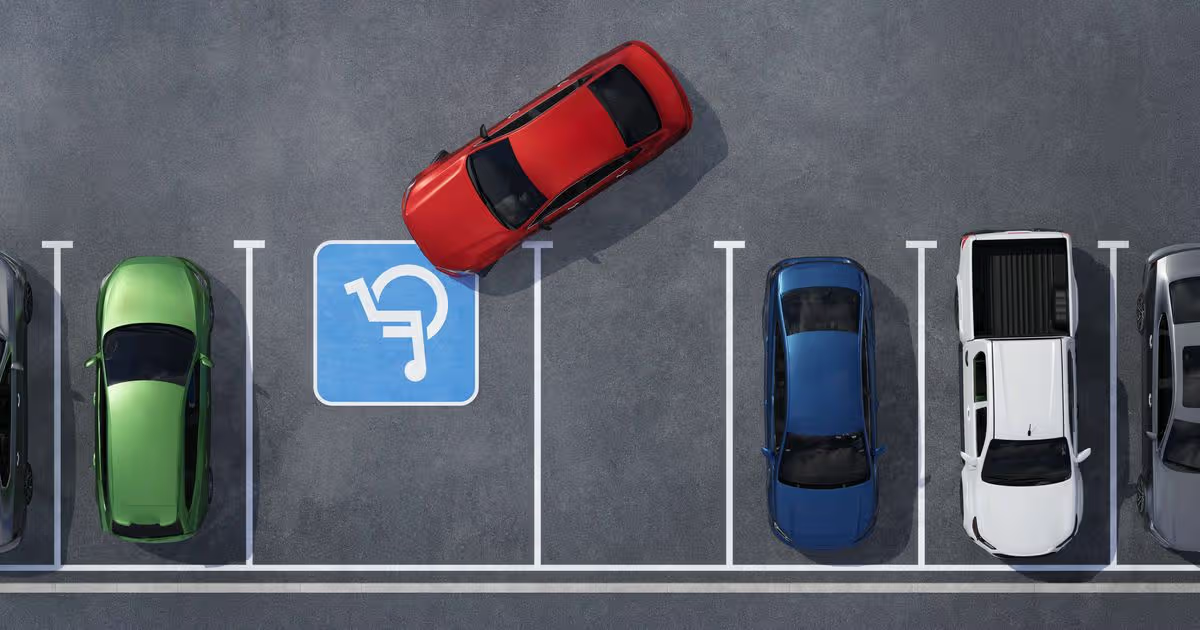
Blue Badges generally remain valid for up to three years, after which a fresh application must be submitted
Blue Badges enable those with mobility difficulties to park nearer to where they need to go. Holders and their drivers can access designated disabled bays and sometimes park on specific double yellow lines.
Eligibility for a Blue Badge falls into two categories, outlined on MyGov.Scot. The first covers people who ‘automatically’ qualify for the scheme, whilst the second involves applications assessed on a case-by-case basis.
Should your Blue Badge application prove successful, you’ll need to pay up to £10 in England or up to £20 in Scotland for the permit. In Wales, the scheme is completely free.
Local authorities manage applications, assess eligibility, and determine costs. Blue Badges generally remain valid for up to three years, after which a fresh application must be submitted.
For comprehensive eligibility criteria, see below, where the Daily Record outlines this in full.
Who automatically qualifies for a Blue Badge?
According to MyGov.Scot, some people receiving certain benefits will automatically qualify for a Blue Badge. This includes people who:
- Receive the Adult Disability Payment (ADP) and have eight points or more in the ‘moving around’ activity, 12 points in the ‘planning and following a journey’ activity or receive the enhanced rate of the mobility component under Special Rules for Terminal Illness
- Receive the higher rate of the mobility component of the Disability Living Allowance (DLA)
- Receive the higher rate of the mobility component of the Scottish Adult Disability Living Allowance (Scottish Adult DLA)
- Receive the Personal Independence Payment (PIP) and scored eight points or more in the ‘moving around’ area of your assessment, scored 12 points in the ‘planning and following a journey’ area of your assessment, or used to get the higher rate of the mobility component of DLA on an indefinite or lifetime basis
- Are appealing a PIP decision
- Used to receive the higher rate of the mobility component of DLA
- Receive the higher rate of the mobility component of the Child Disability Payment (CDP)
- Are under 16, have a visual impairment and have a letter confirming your eligibility from your care team
- Are 16 or over and registered or certified as severely sight impaired
- Are receiving a War Pensioners’ Mobility Supplement – including lump sums from tariffs 1 to 8 of the Armed Forces Compensation Scheme. It also includes anyone who has been certified as having a permanent and substantial disability
- Are diagnosed with Motor Neurone Disease (MND)
Who else could be eligible?
In addition, several other people may qualify for a Blue Badge. These include those who experience the following:
- Cannot walk
- Find walking very difficult
- Are at risk in traffic
- Have a disability in both arms that prevents the use of ticket machines
- Are under three years old and either need to get medical treatment at short notice or keep bulky medical equipment close to them
In England, Scotland, and Wales, Blue Badge applications can be made at GOV.UK. Applications can generally be made for yourself or on behalf of someone else.
Upon receipt of all required documentation, your local council will evaluate your suitability for a badge. The processing of your application may take upwards of 12 weeks. For more information you can also visit MyGov.Scot here.




















































You must be logged in to post a comment Login