
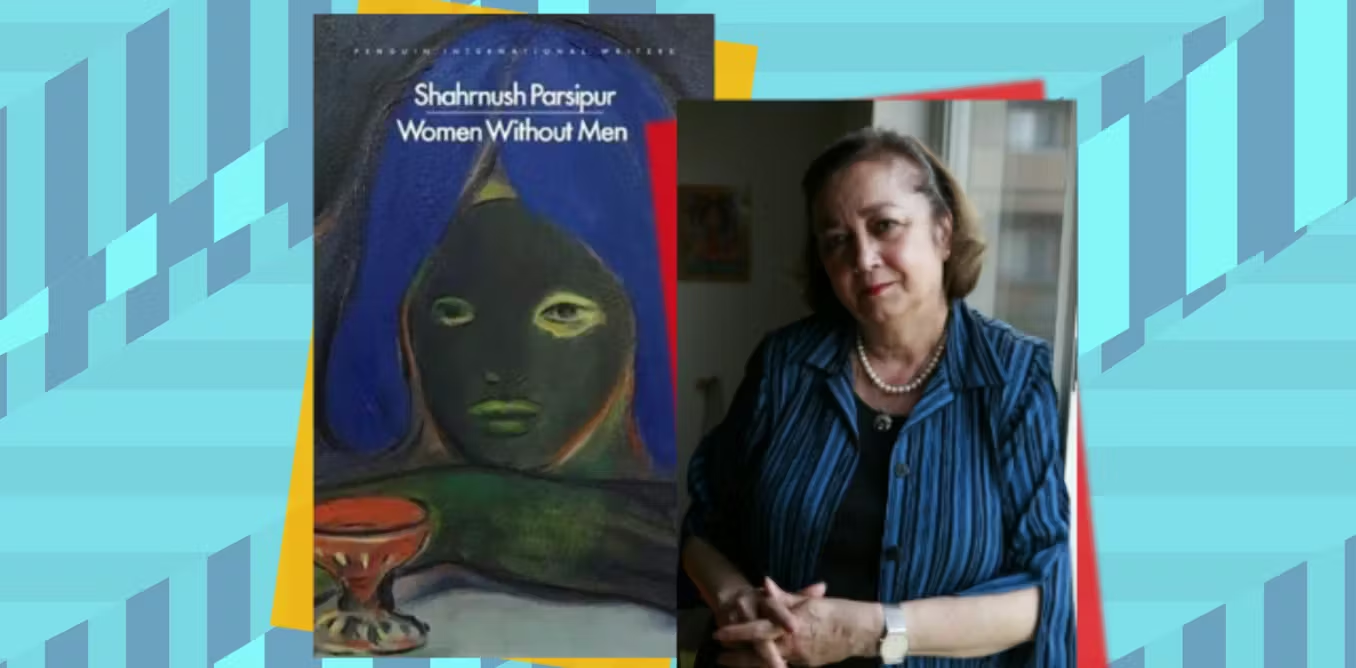
For more than three decades, Iran tried and failed to silence Women Without Men (Zanan bedun-e Mardan in Persian). Shahrnush Parsipur’s novella exposed the brutality of Iranian patriarchy with rare clarity. It did so long before global audiences recognised that violence.
Published in 1989, the book was banned almost immediately and Parsipur was imprisoned twice for writing openly about women’s sexuality and autonomy – an act of artistic courage the Islamic Republic deemed intolerable.
Despite the regime’s attempts to erase it, the novella endured. It moved through underground networks and crossed borders with quiet determination. Today, Parsipur lives in exile in northern California after years of harassment. At 80, she remains one of Iran’s most fearless literary dissidents.
Women Without Men follows five women who flee violent marriages, stifling social expectations, and political chaos. Together, they build a sanctuary in a garden outside Iran’s capital, Tehran.
The book is now available in translation by Faridoun Farrokh in the UK for the first time. It still reads as a fierce, mystical act of feminist refusal, echoing the Woman, Life, Freedom movement – a Kurdish slogan that became a rallying cry for women’s rights when it was adopted during the 2022 Iranian protests. The book also lays bare, yet again, how violently regimes react when women claim the right to live unbounded.
When history tried to silence women but failed
Set against the turmoil of 1953, the novella unfolds in a charged political landscape. That year, a US- and UK-backed coup toppled Iran’s democratically elected prime minister, Mohammad Mosaddegh, and reinstalled the shah, Mohammad Reza Pahlavi, to protect western oil interests. That event reshaped Iran’s future and remains one of its most consequential political ruptures.
Penguin International Writers.
In the years leading up to the coup, Iranian women had been inching towards greater legal and social equality. But the political chaos and regime change set the stage for decades of instability. The tensions paved the way for the revolution 25 years later, and the Islamic Republic’s tightening grip on women’s lives. While these seismic events stay outside the novella’s frame, their presence is palpable in the background.
It is in the shadow of the 1953 coup that Parsipur exposes the intimate humiliations that patriarchy inscribes onto women’s bodies. Virginity becomes a weaponised measure of worth. Menopause is recast as an insult. Sexuality is monitored, contained and punished. Women’s desires are treated as destabilising forces that must be disciplined. Each character carries a different wound from this system.
Munis resists a brother who would rather kill her than allow her freedom. Faizeh absorbs the misogyny that confines her, and turns it inward. Zarrinkolah escapes a life in which her body is endlessly bought, sold and consumed. Mahdokht, pushed beyond the limits of social expectation, seeks literal rebirth as a tree. Farrokhlaqa endures an affluent marriage that strips her of dignity.
These violences mirror the misogyny embedded in the political order itself. That order disciplines women through shame, silence and constant surveillance of their bodies.
The women’s retreat to the garden outside Tehran is not an escape, but a feminist rupture that marks a refusal to live within a world that insists on defining them. It is a choice to build, however precariously, a space where those rules collapse.
Through mysticism and magical realism, the women’s transformations gain political force. Each metamorphosis becomes an act of resistance: women reclaiming autonomy, dignity and possibility in a society intent on erasing them.
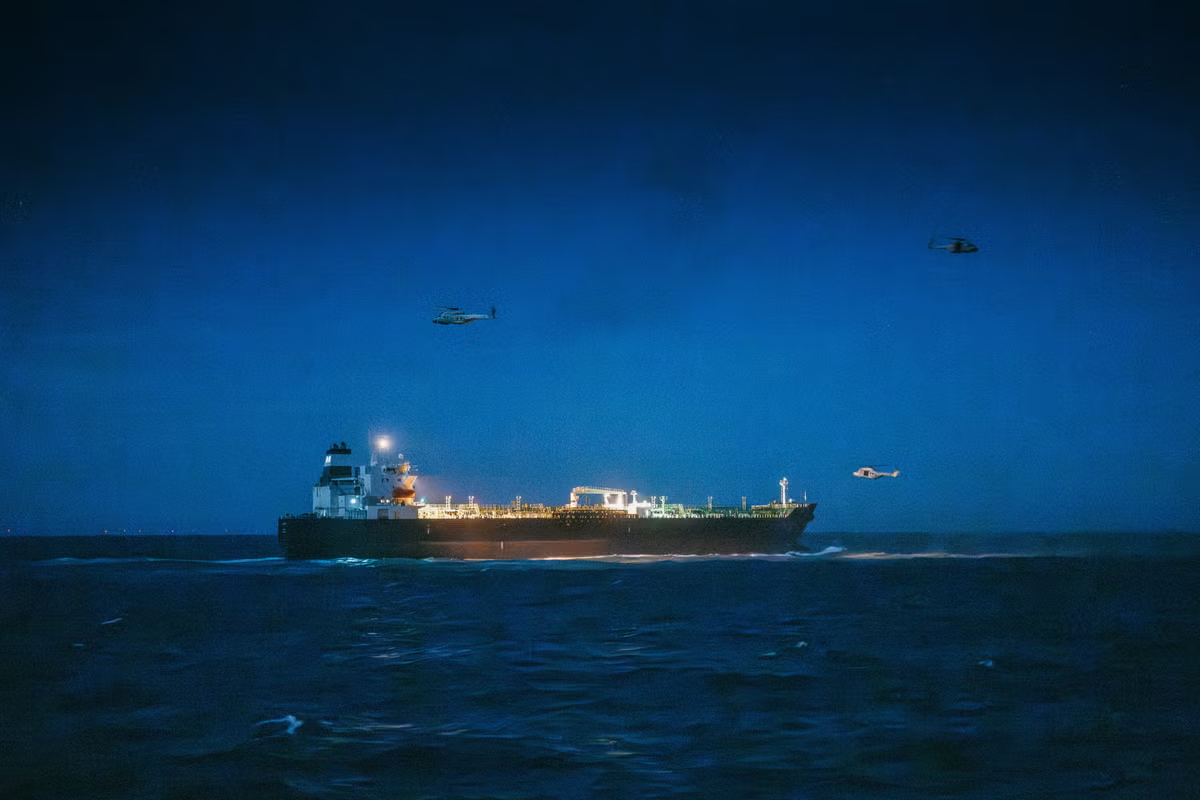
Clemens Bilan/EPA
From 1953 to Woman, Life, Freedom
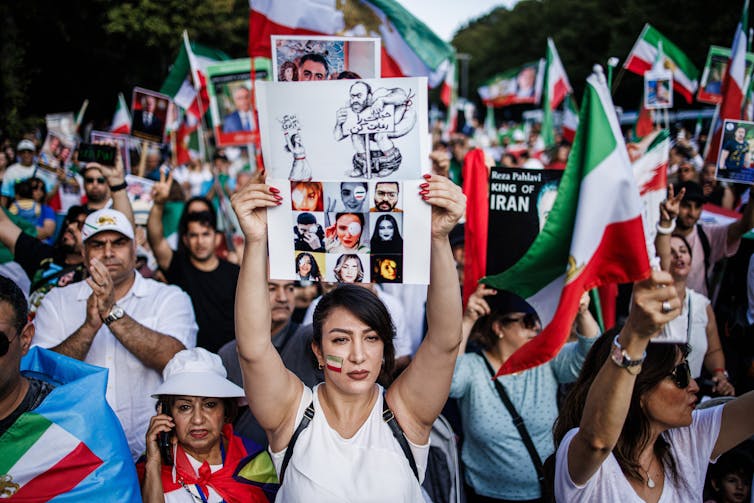
The global cry of “zan, zendegi, azadi” (Woman, Life, Freedom) carries the same insurgent energy that animates Parsipur’s Women Without Men. The slogan rose during the 2022 uprising, after the death of Mahsa Jina Amini in police custody.
The beginning of this spirit of resistance can be seen in Parsipur’s narrative, decades earlier. Her novella advanced a vision of women actively confronting and exceeding patriarchal limits decades before the slogan gained global force.
Reading the book today, it is clear how accurately Parsipur mapped the machinery of state violence, gender policing and systemic oppression – the same forces now driving women into the streets in Iran.
What anchors the novel’s contemporary relevance is its central idea: women imagining and constructing a world outside patriarchal control.
The five women of Parsipur’s story carve out a space where they are no longer defined by violence or expectation. Their garden becomes a blueprint for refusal, one that aligns directly with the ethos of Woman, Life, Freedom: not to endure patriarchy but to reject it, rewrite it, and build a life entirely beyond its reach.
Iran is once again engulfed in turmoil. Women Without Men enters the UK at a moment when Iranian exiles, scholars and activists are issuing urgent warnings about escalating state violence. Public awareness of the daily repression faced by Iranian women is higher than ever, and global literary circles are increasingly spotlighting works that confront authoritarianism with resistance.
In this context, the novella’s English-language publication operates as a bridge between past and present. It makes visible how the structures that constrained women’s lives in the 1950s continue to shape Iran’s political realities today.
This is not simply a reissue. The UK publication marks a hard‑won return for a work that has outlasted bans, by a writer who has survived incarceration and forced displacement. Its re‑entry into global circulation arrives precisely when its analysis of gendered domination carries heightened relevance.