Connect with us
DAPA Banner
DAPA Coin
DAPA
COIN PAYMENT ASSET
PRIVACY · BLOCKDAG · HOMOMORPHIC ENCRYPTION · RUST
ElGamal Encrypted MINE DAPA
🚫 GENESIS SOLD OUT
DAPAPAY COMING

NewsBeat

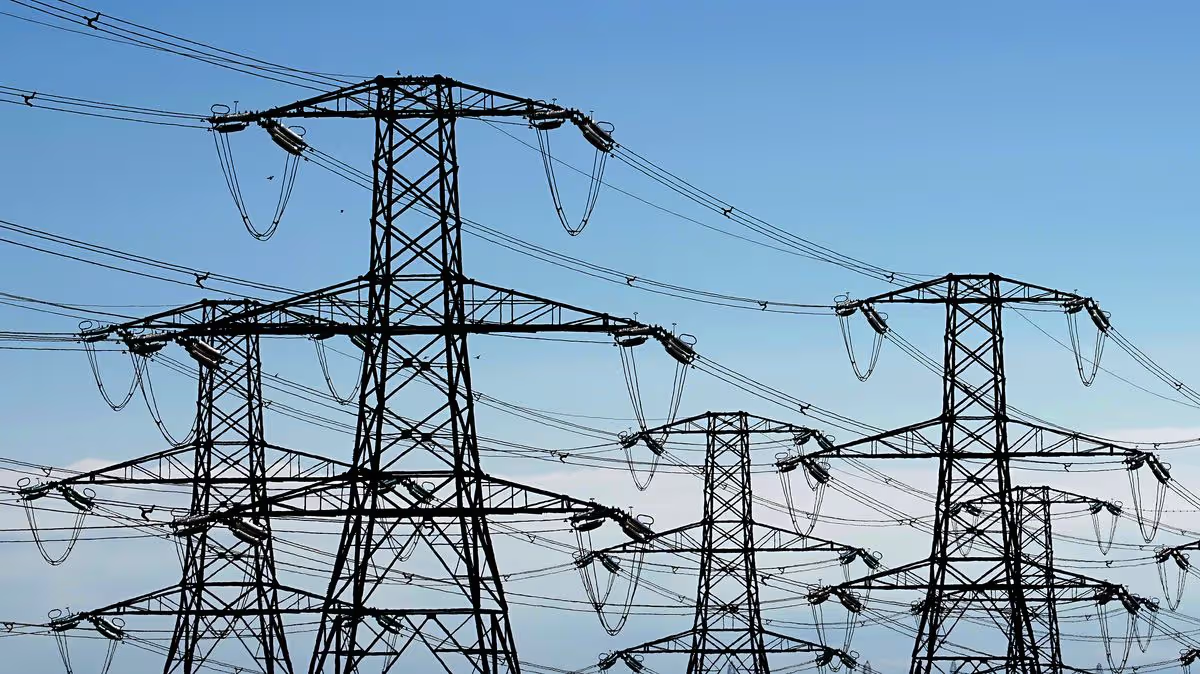
Budget Energy electricity bills to increase by 9.5% in August

Published

on

Belfast Live

It will impact around 105,000 customers

Northern Ireland’s third largest electricity supplier has announced a 9.5% increase to their electricity tariffs.

Advertisement

Budget Energy’s price rise will come into effect on August 4, and will add around £122 a year to the annual bill of a typical credit customer and around £121 a year to the average standard-rate keypad customer.

This will impact around 105,000 customers across Northern Ireland, bringing the annual electricity bill for a typical credit customer on a standard tariff to around £1,403 and a typical keypad customer on a standard tariff to around £1,390.

Raymond Gormley, Head of Energy Policy at the Consumer Council, said: “From 4 August, approximately 105,000 Budget Energy BillPay and keypad domestic customers on variable tariffs in Northern Ireland will see their annual electricity costs increase, bringing the average annual electricity bill for a typical credit customer on a standard tariff to around £1,403 and a typical keypad customer on a standard tariff to around £1,390.

“While this is disappointing for households, the rise reflects the recent increase in energy wholesale costs. Those Budget Energy customers on a fixed price deal will not be impacted and will continue to pay their existing agreed rates for the duration of their contract.

Advertisement

“Any Budget Energy customers who are struggling to pay their electricity bills or top up their keypad meter should contact their supplier without delay to get advice and support.”

Raymond added: “All five electricity suppliers have now either increased their tariffs or have announced that they are doing so. We would encourage consumers to think about the way they pay for their energy and see if they can reduce their energy costs.

“Being on a standard tariff and paying on receipt of a bill is the most expensive way to pay for your electricity. Switching payment methods, changing billing method or even switching supplier may save you money.”

The Consumer Council’s website has a free independent energy price comparison tool which empowers consumers to compare all electricity and gas tariffs across Northern Ireland in one place: Electricity Price Comparison Tool

Advertisement

For consumers who do not have internet access or would like additional support on checking energy tariffs, call the Consumer Council team on 0800 121 6022. You can also contact the team via email: contact@consumercouncil.org.uk.

For all the latest news, visit the Belfast Live homepage here and sign up to our daily newsletter here.

Source link

Advertisement
Continue Reading
Click to comment

You must be logged in to post a comment Login

Leave a Reply

NewsBeat

He’s done it again! Brit sensation Arthur Fery becomes first wildcard to reach Wimbledon semi-final in 25 years with straight-sets win over No9 seed Flavio Cobolli

Published

on

Arthur Fery is into the Wimbledon semi-final after an incredible display

Arthur Fery is into the semi-finals of Wimbledon after demolishing No 9 seed Flavio Cobolli in straight sets.

The 23-year-old world No114 had never previously passed the second round but is now just one match away from the final.

After winning a tense first set 6-4 and then taking the second on a tiebreak, he broke the Italian Cobolli three times in a row to rattle off all six games in the first, winning 6-4, 7-6, 6-0. 

more to follow 

Advertisement

Under the gaze of his country’s Queen, the dancing feet of the irrepressible and seemingly unstoppable Arthur Fery carried him within two matches of his own coronation.

The 23-year-old – who stands at 5ft 9in and plays with the heart of a giant – beat No9 seed Flavio Cobolli in straight sets to become the first wildcard to reach the Wimbledon men’s semi-finals since Goran Ivanisevic 25 years ago.

Two more wins and he will celebrate his 24th birthday on Sunday with the Wimbledon title.

Fery’s run to this stage had been hugely impressive but there were caveats. He had not played anyone inside the world’s top 35; his third-round opponent Zizou Bergs choked spectacularly; in the fourth he met Grigor Dimitrov, a fabulous player but one who had won only x matches in 2026 before this year.

Advertisement

No caveats this time: Fery faced the No9 seed, a French Open finalist last month, and made him look ordinary. What a performance and what an occasion awaits in Friday’s semi-finals.

With respect to Cam Norrie, who made the last four here in 2022, we have not seen grass-court tennis like this from a British player since the heyday of Andy Murray.

In the relentlessness of his double-handed backhand, the aggression of his return, the subtlety of his hand skills and the sophistication of his tactics, Fery looked like the great Scot with x inches sawn off and a handful of Xanax in his system.

For while Murray played with sound and fury, Fery operates with utter tranquility as the storm of excitement rages around him.

Advertisement

Just seconds before he and Cobolli were about to walk out on court, Queen Camilla appeared to wish them luck. What a symbol of the scale of the occasion; what a dose of added nerves.

And yet Fery reacted as if an old friend had popped by unannounced. ‘You snuck up on me there,’ he said, then shouldered his bag, strode on to Centre Court and played the match of his life.

There has been a growing school of thought that grass is losing its uniqueness as a surface – that players can just show up and blaze away as they do on hard or clay. Fery has been a wonderful antidote to that notion and he made Cobolli – a player who took Novak Djokovic to four tough sets in the quarters here last year – look as if he had never played a match on grass in his life.

Fery’s slices off both forehand and backhand, his drop shots and his delicately crafted volleys left Cobolli utterly discombobulated. It was as if the Italian with his modern, muscled topspin forehand had been dragged back into the era when men played here in starched shirts and flannels.

Advertisement

For all Fery’s hand skills, what has really set him apart this fortnight is his feet. He moves so beautifully on a grass court, shimmering over its surface like a bird skimming over water.

As he always has, Fery made a tranquil start and the first nine games passed without threat of a break. Then the Centre Court crowd appeared to come to his aid in a peculiar manner.

At 4-5 in the first set, Cobolli threw up the ball to serve and had to bail out of his action as the pop of a champagne cork split the polite silence. Umpire Arnaud Gabas intervened, telling the crowd: ‘Ladies and gentlemen, please enjoy your drinks but wait until the end of the point before opening a bottle’ – a ticking off that was the Wimbledon equivalent of firing tear gas at hooligans.

All very silly but it seemed to affect Cobolli’s rhythm, for in the three points that followed he coughed up two unforced errors, a double fault and thus the opening set.

Advertisement

They traded breaks early in the second set and we found ourselves in a tiebreak. Fery took it 7-4 and he has now won all five of the tiebreaks he has played here this fortnight – he is at his very best in the biggest moments.

If one looked at these players’ rankings – No10 in the world vs No114 – the scoreline was absurd. If you looked at the respective quality of their tennis it made perfect sense.

One of the advantages of being a bolter at a Gr is the field does not have much of an idea how to play against you. Cobolli looked like he did not know whether he was trying to blast Fery off court or grind him down.

Still, surely we would see a response from the Grand Slam finalist in the third set? Instead, we saw a capitulation. Fery, playing with utter freedom, demolished him.

Advertisement

To pick out one from the many beautiful points he crafted, lets take the one to take a 5-0 lead. After a baseline exchange Cobolli came into the net and chopped a forehand volley diagonally across the net. Fery was way out on the other side of the court, he was nowhere near it, but he sped across the grass and slid it down the line. Cobolli lobbed – not a bad idea against a small man – but Fery did enough with the smash.

As he served out, Cobolli smashed a ball at him and it clipped the net tape, reversing in the other direction. Fery readjusted danced to his left and hit the winner. An ace sealed the hold to love.

You could go to the National Ballet and not see footwork like this. What a performance.

Advertisement

Arthur Fery is into the Wimbledon semi-final after an incredible display

Source link

Continue Reading

NewsBeat

Transfer news LIVE: Arsenal medical booked, Tchouameni to Man Utd, Liverpool enquiry

Published

on

Daily Mirror

Hello and welcome to Mirror Football’s transfer blog for Wednesday, July 8.

Arsenal have reportedly booked in a medical for Illan Meslier, as they look for a new back-up goalkeeper to David Raya. Kepa Arrizabalaga found himself limited to cup competitions in 2025/26 and is said to be heading for the exit door to play more consistent first-team football.

As a result, the Gunners are in hot pursuit of Meslier, who is a free agent after leaving Leeds United upon the expiry of his contract. The 26-year-old failed to make a single senior appearance for the Peacocks last season, shipping six goals in two games for the reserves.

Advertisement

Manchester United, meanwhile, are said to be eyeing a move for Real Madrid’s Aurelien Tchouameni. Having missed out on Elliot Anderson and Mateus Fernandes to Manchester City and Spurs, respectively, the Red Devils are still on the hunt for midfield reinforcement.

While Ederson’s arrival from Atalanta is all but guaranteed, Michael Carrick is clearly looking for a number of stars to fill the void left by Casemiro. As a result, United have started discussions over a move for Tchouameni, although a deal will not come cheaply.

It is suggested that any successful transfer will come for a minimum of £68m, showing the importance of the 26-year-old Frenchman to Los Blancos.

Elsewhere, Liverpool have made initial enquiries over the possibility of signing Gilberto Mora from Club Tijuana, following an outstanding World Cup run with Mexico. It is understood that the 17-year-old attacking midfielder has a release clause of around £18m in his current contract, which runs until 2029.

Advertisement

Stay with us throughout the day as we bring you the latest transfer updates…

Source link

Continue Reading

NewsBeat

Nigel Farage denies his Clacton resignation is a publicity stunt

Published

on

Nigel Farage sitting in a pub while wearing a white shirt and navy blazer. He is smiling.

Farage said he was not sure if he was still an MP, but soon after the BBC interview Chancellor Rachel Reeves said she had accepted his resignation.

“If he wants to spend the summer arguing with a bin, I won’t stop him,” she wrote on X, referring to by-election rival Count Binface.

Actor-turned-politician Laurence Fox, of nearby Peldon, announced on Tuesday evening he would be standing against Farage, Count Binface and Adham Alkhatip, who leads the Forward Party.

Asked about what he had done for Clacton since becoming its MP, Farage said: “I’ve done my absolute best to put it on the map in terms of tourism and visits.

Advertisement

“I know the road getting here is a pain but, actually, when you get here you’ve got great beaches.”

He pledged to prioritise potholes and stopping housing developments opposed by locals if re-elected.

“You give me a big vote and we’ll continue our political revolution,” Farage continued.

“If you don’t do it then I think the establishment will just go on and go on working together in an attempt to crush a genuine chance at political change.”

Advertisement

Source link

Continue Reading

NewsBeat

Sleeping In Separate Beds Did Wonders For My Marriage

Published

on

Sleeping In Separate Beds Did Wonders For My Marriage

I had to admit it to my cleaning woman first, when I kept asking her to change the sheets in the room off our bedroom. Pretending some guest had slept in the bed could only last for so long.

I went into the room, just as she was snapping the crisp white sheets onto the bed.

“I sleep in here now. There’s nothing wrong between us, though…” I trailed off, waiting for her face to change.

She responded like I’d admitted to preferring one soap brand over another, not confessed to keeping a hidden room inside my marriage. “Half my clients sleep in two rooms, whether they tell me or not,” she replied.

Advertisement

The sleep itself is glorious. I wake softer, steadier, less easily undone by whatever the day brings. Explaining it to people is the only part that feels shameful. My friends tried to talk me out of it. My therapist looked skeptical. My mother was horrified, though I remember the twin beds in my grandparents’ bedroom working just fine for them.

When my husband and I first toured the farmhouse we live in now, the real estate agent pointed to the room attached to the primary bedroom and called it a nursery. The word hung there, soft and presumptive. A room for a baby. A room for the future. A room for the version of a woman a house seems to expect.

Later, I would learn that houses are full of these polite suggestions: nursery, office, guest room, flex space. Architecture has long made room for private need. Marriage narratives have not.

Back then, when we were house hunting, the thought of sleeping in another room would have felt too exposing to say aloud. It belonged with the other things I had to grow up enough to face: my alcoholism, honest conversations with my kids, the truth of my own needs.

Advertisement

But every night, as I lay beside my husband’s steady breath, my heart raced. He slept, and I lay there wired. Angry at him for sleeping. Angry at myself for not. For years, I mistook the problem for a marital one when it was, first, a bodily one.

About one-third of adults in the U.S. now sleep separately from their partners, though one article called it “sleep divorce,” as if leaving a bed were the same as leaving a marriage.

When I first crept down the hall to the little nursery we were never going to use for another baby, I called it a snoring room. I used the phrase with my husband and my kids because it made the change sound temporary, practical, almost medical.

Each morning, I would make the marital bed, messing up the side I used to sleep in so no one would know our secret. Each night, I slowly rolled back the sheets and slipped out of bed as if doing the walk of shame. But once I crossed into my own room, my body finally unclenched. I slept.

Advertisement

I moved into this space full time and started calling it my sleeping room when it became clear that it wasn’t just my husband’s snoring fragmenting my nights, but my own raging hot flashes and perimenopausal anxiety – a private struggle with a public pattern, given how many of my friends in midlife reported disrupted sleep.

For years, I treated distress as something to discipline. If my body objected, I overruled it. But midlife has a way of revoking that authority. The body stops going along with things just because you ask it to.

You can be bone-tired and still lie there, your heart ticking like a small alarm under your ribs, your mind counting tomorrow’s to-do list items instead of sheep. By morning, exhaustion has become a weather system inside the house. You can’t be breezy. You can’t martyr yourself through insomnia. Sooner or later, the body stops letting you pretend. So I finally stopped trying to win at marriage by tolerating discomfort.

I’d sleep in our bed sometimes after a quiet stretch of lying together, or after sex. Once, my husband said, “Thanks for visiting me,” and I heard accusation where he may have meant tenderness.

Advertisement

“Don’t make me feel like a whore,” I snapped. He looked hurt, and I knew I couldn’t have it both ways. I couldn’t keep my sanctuary without acknowledging what it made me in our bed: a visitor.

By then, things had changed – he didn’t snore as much, and hormone replacement therapy had improved my nightly sauna sessions. So now I was left with the harder truth: I simply preferred my own room.

Photo Courtesy Of Wren Hogan

The author walking toward rest, but not away from love.

When I told a friend over coffee that I had a sleeping room – that I didn’t sleep with my husband anymore – she looked at me with a glint of sympathy in her eyes. “I’m just saying, be careful,” she said. “This is how the end of a marriage starts.”

Advertisement

Not sympathy, then. Warning.

I smiled, because that is what women often do when defending a need they are not entirely done defending to themselves.

Sometimes, in the middle of a fight with my husband, even I start to wonder if my friend was right. “What does this say about our connection?” I snap at him. “We don’t even sleep together.”

Then I have to remind myself that sleeping separately is a choice, not a verdict. When I first read the phrase “sleep divorce,” I felt a flicker of panic. Was that what this was? Had I been dissolving something all these years without admitting it?

Advertisement

Culturally, we’re taught to see separate beds as proof of emotional distance. My lived experience has been the opposite: a more regulated nervous system results in more patience and more intimacy. I’m not pulling away. I’m making room.

During an argument, I saw my husband physically recede from me. The fight itself was probably about something small, as most of our worst fights are: a tone, a dish, a plan I thought we had agreed on but I had apparently only rehearsed in my own head. I remember my words coming fast, certain I had been wronged. He folded inward. His shoulders dropped. He looked away like someone taking cover.

“I can’t do this when you talk to me like that,” he said.

For years, I would have heard that as abandonment. I would have chased him with more words, trying to force connection out of a man who was already bracing for impact.

Advertisement

But once I was sleeping, really sleeping, I could see the scene differently. His silence was not proof that he didn’t care. It was his body doing what mine had done at night: asking for space before it broke. Mature love, I’m learning, is not the absence of boundaries. Sometimes it is the boundary that lets love stay.

I have my weighted blanket, my sleep mask and the white noise that lets my body drop its guard. The relief is not just sleep. It is the relief of not absorbing one more thing, even my loving husband. That admission still feels dangerous. Why does time alone only become acceptable once we rename it self-care?

Marriage has a long history of treating proximity as proof: proof of devotion, proof of intimacy, proof that no one has left. Women, in particular, are taught to be available, reachable, porous. And then we teach our children the same logic in miniature: Be bad; go to timeout. Being alone is a consequence.

What I needed was a timeout too. Not because I had done something wrong, but because my body needed what I had failed to give it: quiet, containment, a door. I had to learn to understand solitude not as exile, but as regulation.

Advertisement

The sleeping room is not just about my marriage anymore. It is about rewriting the meaning of space in my family.

In therapy, I kept wanting the room to mean one thing.

“So what does it mean?” I asked. “That I sleep there?”

My therapist paused, which therapists do when they are about to make you answer your own question.

Advertisement

“Maybe the better question is what it makes possible.”

She taught me to stop treating intimacy like a referendum with only two possible outcomes: connected or disconnected, healthy or failing. Bodies change. Desire changes. The meaning of closeness changes too over the course of a shared life. A baby wants skin-to-skin contact. A dog wants a place at the edge of the bed, near enough to belong. There is something useful in that reminder: not all closeness is erotic, and not all distance is rejection.

Deep connection does not happen while we’re asleep. It happens in the hours when we are awake enough to notice each other: his hand reaching for mine in the kitchen, my laugh returning before I have time to censor it, the small relief of being known and not cornered by that knowing.

When we stopped connecting while we were awake, we stopped having sex, and suddenly it didn’t matter what bed we were in. What brought us back was not shared sleep, but the harder work of waking up: putting down alcohol, learning how to be present, tending to the marriage in the daylight.

Advertisement

So now I can say it without fear or shame. I don’t sleep with my husband anymore. I sleep alone, and every morning, I come back.

Wren Hogan is a writer whose essays explore motherhood, midlife, recovery, hormonal change and the quiet ways women are remade by ordinary life. She writes the Substack “A Lotus Grows in Mud,” and you can follow her on Instagram at @wrenhoganburzdak.

Do you have a compelling personal story you’d like to see published on HuffPost? Find out what we’re looking for here and send us a pitch at pitch@huffpost.com.

Advertisement

Source link

Continue Reading

NewsBeat

Police marksman who shot Chris Kaba may no longer face misconduct probe after legal thresholds on force were changed

Published

on

Chris Kaba, 24, (pictured) was shot in the head after he drove towards officers in an attempt to smash through a roadblock in Streatham, south London, in September 2022

The police marksman who shot Chris Kaba may no longer face misconduct proceedings after the Government changed regulations around officers’ use of force.

Martyn Blake shot 24-year-old Mr Kaba in the head after he drove towards officers in an attempt to smash through a roadblock in Streatham, south London, in September 2022.   

The officer was cleared of murder by a jury at the Old Bailey, with fellow police marksmen enraged that he had faced charges.

Sergeant Blake was still due to face misconduct proceedings, but the Independent Office for Police Conduct (IOPC) paused the process while it waited for Government regulation changes to be published.

Advertisement

Today it said it believes the misconduct proceedings should not go ahead, and will consult with the Kaba family who will have the chance to argue there are exceptional circumstances which mean they should.

Dozens of other non-fatal use of force cases in England and Wales may also be affected if police forces take the same approach as the IOPC. 

Andrew Johnson, IOPC director of strategy and policy, said: ‘We carefully considered the law change and its stated intent to address the perceived unfairness and lack of proportionality of the civil law test.

‘We believe this position provides consistency across impacted cases and is fair to officers who are facing potential dismissal for misconduct, which if it occurred now, would not amount to misconduct under the new law.

Advertisement

Chris Kaba, 24, (pictured) was shot in the head after he drove towards officers in an attempt to smash through a roadblock in Streatham, south London, in September 2022

‘We expect the number of relevant cases that are affected by this law change to be relatively small.’ 

After Sergeant Blake’s acquittal, then-home secretary Yvette Cooper vowed to raise the legal test used by prosecutors to determine whether to bring charges against police officers over use of force into line with the standard used for members of the public.

Advertisement

The test used by the IOPC over whether to bring misconduct proceedings would also be raised to the level used in criminal law, she said.

Metropolitan Police Deputy Commissioner, Matt Jukes, said acquittal after a criminal trial should have brought the case to ‘a clear and definitive conclusion’.

He said: ‘We recognise the impact on NX121, his family and the wider firearms community, who have endured almost four years of uncertainty while these processes have unfolded, as well as the family of Chris Kaba, who continue to live with the loss of a loved one.

‘We have consistently said since the criminal trial that there is no basis for further action against this officer and that remains our position.

Advertisement

‘I know this change will also provide reassurance to firearms officers across London and the wider country, who carry immense responsibility on behalf of the public and need confidence that decisions made in good faith, in fast-moving and dangerous situations, will be judged fairly.

‘At the same time, this case has exposed that the current system is too slow. A split-second decision, taken in circumstances which presented an immediate threat, has been followed by years of investigations and legal proceedings.

Footage of the moment armed officers ran towards Mr Kaba's car as he tried to escape from a roadblock

Footage of the moment armed officers ran towards Mr Kaba’s car as he tried to escape from a roadblock 

‘That has had a profound impact on everyone involved and demonstrates the need that both policing and the IOPC recognise for a swifter system that maintains both public confidence and rigorous accountability.

Advertisement

‘That is why I welcome the recent changes to the law, introducing a presumption of anonymity for firearms officers during court proceedings until conviction and restoring the criminal test for the use of force in misconduct cases.’

On the night Mr Kaba died, police had followed and penned in the Audi that he was driving because it had been linked to three previous firearms incidents in five months.

They were not aware of his identity at the time, but Mr Kaba was a member of one of London’s most violent street gangs and was accused of being involved in two shootings in the six days before he died.

Following the previous decision to pause the proceedings, Mr Kaba’s family said they were ‘devastated’. 

Advertisement

‘Martyn Blake fatally shot Chris when he was unarmed and without knowing who he was,’ they added at the time. 

Source link

Continue Reading

NewsBeat

Who is Count Binface? The candidate taking on Nigel Farage in Clacton by-election

Published

on

Manchester Evening News

The satirical candidate is the Reform leader’s highest-profile opponent

Nigel Farage is gearing up to fight for his Clacton seat in a by-election after he announced his resignation as an MP on Tuesday afternoon. While the main parties have said they will not be fielding candidates, Count Binface has announced his intention to take him on.

The Reform UK leader officially resigned as MP for Clacton-on-Sea on Tuesday (July 7), confirming that he will stand in the resulting by-election in an attempt to win his seat back. The 62-year-old has come under intense pressure in recent weeks over claims of unregistered cash donations and support.

In a video statement posted online, Mr Farage said: “I have done nothing wrong. I have not broken the law in any way at all.”

Advertisement

Click here to get the biggest stories straight to your inbox in our Daily Newsletter

The Reform UK leader is being investigated by the Parliamentary Standards Commissioner over whether he should have registered a £5 million gift from cryptocurrency tycoon Christopher Harborne, which he said was needed to fund the security he required as a result of multiple threats against him. He has also faced questions over reports that long-term ally George Cottrell had provided undeclared funding in the year before he was elected.

Mr Farage insisted his £5m gift from Mr Harborne was given to him on an “unconditional basis” and has criticised the Sunday Times investigation into his finances, saying: “Standards are now being used as a political tool.”

The former Member of the European Parliament (MEP) for South East England dubbed the upcoming contest at the polls a “people versus the establishment” fight.

Advertisement

In the wake of Mr Farage’s announcement, several political parties declared they would not be standing candidates against him. Labour, the Conservatives, the Liberal Democrats, the Green Party and Rupert Lowe’s Restore Britain have all said they will not stand candidates in the poll.

The one candidate who appears to fancy the fight is Count Binface.

Who is Count Binface?

Count Binface – real name Jonathan David Harvey – is a self-described ‘intergalactic space warrior’ who has become a familiar face of British democracy in recent years.

Known for bringing a comic element to the ballot box, he describes himself as the leader of the Recyclons from the planet Sigma IX, and claims to be over 5,900 years old. His name and appearance – typically seen wearing a black and grey uniform with a long silver cape and a helmet shaped somewhat like a dustbin – were taken from a character in Todd Durham’s 1984 film Hyperspace, a low-budget parody of science fiction films such as Star Wars.

Advertisement

The waste-themed figure’s first brush with political parody came in 2017 when he ran as ‘Lord Buckethead’ against then-prime minister Theresa May in Maidenhead. Following the 2017 election, American filmmaker Durham contacted Harvey and asserted his ownership of the character.

In response, Harvey introduced a new character, Count Binface, and stood in the 2019 UK general election.

Whenever an election is declared, it has become commonplace to see the metallic-costumed candidate standing beside suit-and-tie politicians from the main parties.

Advertisement

Most recently, Binface was one of 14 candidates in the Makerfield by-election, standing against Andy Burnham. He stood on a manifesto that included forcing cyclists who break the highway code to ride unicycles, bringing back Ceefax, and renaming HS2 to FFS1.

Binface’s aim is to lampoon UK politics and poke fun at Westminster’s traditions. His campaigns, while comedic, often include pointed commentary on policy, political culture, and the limitations of the two-party system. In Makerfield, he campaigned on a pledge that elected mayors should be ineligible for Parliament until they have served their term in office.

Some of his other most notable policies include reducing the price of 99 Flake ice creams to 99p, introducing conscription for former prime ministers, and renaming London Bridge to “Phoebe Waller-Bridge” and Hammersmith Bridge to “Wayne Bridge“.

Declaring his intention to run against Farage in the Clacton by-election, Count Binface said: “I will be a unity candidate and pledge to build at least one affordable house. Nigel Farage says he wants the people versus the establishment. So be it. Leave him to me.”

Advertisement

After his announcement, he told BBC Radio 4’s Today programme: “My job is to celebrate and defend the wonders of British democracy.

“And look at this, eh? The fact that you are interviewing me on the Today programme, because all the other parties aren’t standing, says more about them than it does about me.

“Are they running scared from old Binny, or do they think that Nigel’s running a cunning stunt? And I pronounced that carefully at 8.55 in the morning.”

Chancellor Rachel Reeves accepted Mr Farage’s request to be appointed steward and bailiff of the Manor of Northstead, the formal mechanism for him to resign, on Wednesday afternoon.

Advertisement

She said: “It is a farce and a desperate distraction, and the people of Clacton deserve better. But if he wants to spend the summer arguing with a bin, I won’t stop him.”

Source link

Continue Reading

NewsBeat

Sir Jim Mackey: NHS boss threatens to sack staff for snooping on medical records

Published

on

Sir Jim Mackey: NHS boss threatens to sack staff for snooping on medical records

The head of the NHS has threatened any unauthorised staff member who views patient medical records with dismissal after he described the action as a “disgraceful breach of patient trust and against the law”.

Sir Jim Mackey’s strong remarks follow a series of investigations into healthcare workers accessing sensitive information without legitimate cause.

Last month, Cambridge University Hospitals (CUH) launched an inquiry after approximately 40 staff members reportedly accessed the medical records of a three-year-old boy injured in a crocodile pit.

The trust has referred itself to the Information Commissioner’s Office (ICO) and is assessing whether each individual had a valid reason for viewing the child’s data.

Advertisement

Separately, CUH recently dismissed five employees for similar inappropriate access to patient records.

In the same period, a former healthcare worker received a caution from the ICO for attempting to obtain and sell the medical records belonging to the Princess of Wales.

Cambridge University Hospitals (CUH) said it was investigating after the medical records of a three-year-old boy hurt in a crocodile pit were accessed by around 40 members of hospital staff
Cambridge University Hospitals (CUH) said it was investigating after the medical records of a three-year-old boy hurt in a crocodile pit were accessed by around 40 members of hospital staff (Johnson’s of Old Hurst)

In May, Nottingham University Hospitals NHS Trust (NUH) said “11 members of staff have been dismissed and a further 14 have had actions taken against them” for inappropriately accessing medical records of the Nottingham stabbing victims.

Students Barnaby Webber and Grace O’Malley-Kumar, plus grandfather Ian Coates, were stabbed to death by Valdo Calocane in 2023.

Sir Jim said on Wednesday that looking at records for personal reasons or out of curiosity would not be tolerated by the NHS.

Advertisement

The health service has launched a new campaign to remind staff what constitutes unlawful access, the potential impacts on patients and how staff could end up losing their jobs.

Employers can report breaches to the ICO and the police, who can launch criminal prosecutions, as well as to professional regulators.

The guidance from the NHS also tells employers to ensure appropriate technical controls are in place to protect people’s information without stopping staff from doing their jobs.

Sir Jim Mackey said on Wednesday that looking at records for personal reasons or out of curiosity would not be tolerated by the NHS
Sir Jim Mackey said on Wednesday that looking at records for personal reasons or out of curiosity would not be tolerated by the NHS (PA Wire)

These can include “role-based” controls so only those involved in a patient’s care can access records and multi-factor authentication.

Sir Jim said: “Patients must be able to trust that their personal information is kept confidential by the NHS – any instance of staff looking at records without a valid reason is wholly unacceptable, a disgraceful breach of patients’ trust and against the law.

Advertisement

“While the majority of NHS staff handle patient information responsibly and professionally every day, it’s been incredibly worrying that a small number have chosen to undermine the trust that patients place in them and caused such additional distress for families who deserved so much better from us.

“Anyone considering accessing records for personal reasons or out of curiosity should be in no doubt they could be putting their career at risk and may face disciplinary action, dismissal, referral to the regulator or even time in prison.

“We will not tolerate a culture of curiosity when it comes to patient confidentiality – there is no place in the NHS for those who misuse patient information and together we will take firm action to prevent and monitor unlawful access, and to act decisively when that occurs.”

Source link

Advertisement
Continue Reading

NewsBeat

Two girls, 13, are injured in knife ‘rampage’ at German school

Published

on

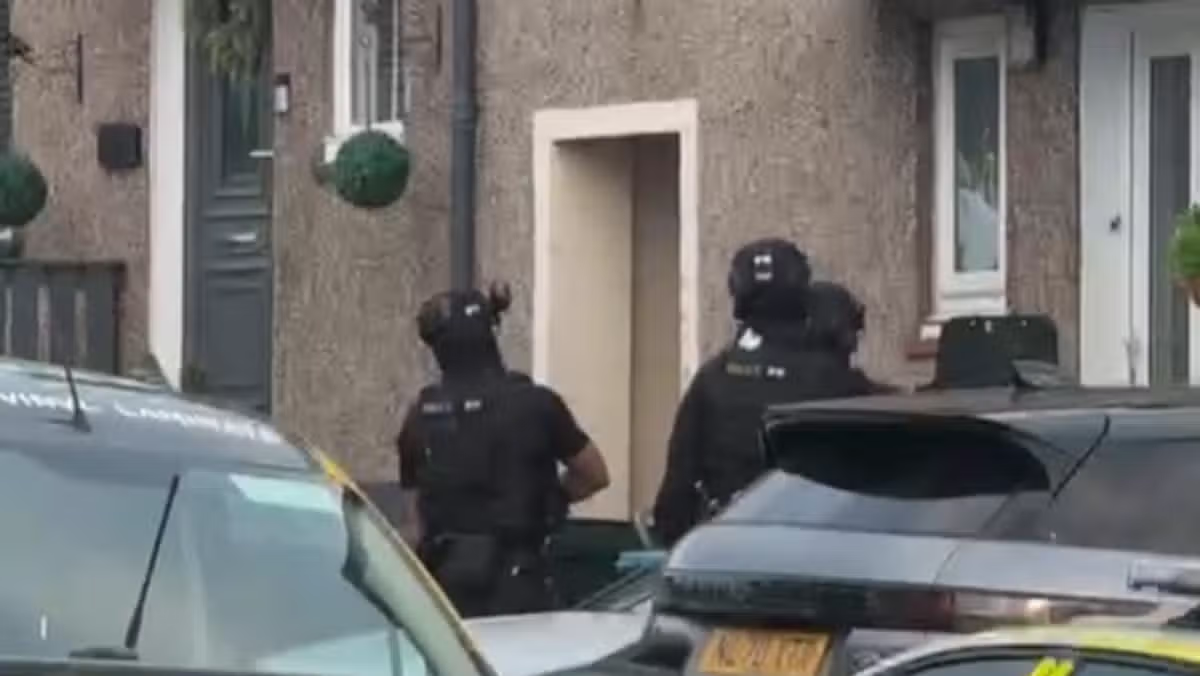
The Support Unit (USK), a specialized unit of the Bavarian police, is moving through the grounds of the Welfen Gymnasiu

Two 13-year-old girls have been seriously wounded and a 16-year-old suspect arrested after an attack at a secondary school in the southern German state of Bavaria on Wednesday, according to police and local media.

‘The arrested individual is a 16-year-old juvenile,’ police confirmed in a post on X, later adding that there ‘are no indications of additional individuals involved in the offence’. They later added that this was a ’16-year-old boy’.

While the full extent of casualties is still being clarified, the two girls were confirmed as ‘seriously’ wounded, after police initially said ‘several’ people were injured.

The perpetrator appeared to have deliberately targeted the Welfen grammar school in the town of Schongau in a suspected ‘rampage’, a police spokeswoman told AFP.

Advertisement

She was unable to confirm press reports according to which the assailant used a knife in the attack.

More than 15 patrol cars were dispatched to the Welfen-Gymnasium in Schongau, southwest of Munich.

A police spokesperson previously told Bavarian broadcaster BR there were indications of a possible shooting spree, as officers urged the public to avoid the area.

The alarm was raised around 12.50pm local time, during school hours.

Advertisement

The Support Unit (USK), a specialized unit of the Bavarian police, is moving through the grounds of the Welfen Gymnasiu

More than 15 patrol cars were dispatched to the Welfen-Gymnasium in Schongau, southwest of Munich, according to police

More than 15 patrol cars were dispatched to the Welfen-Gymnasium in Schongau, southwest of Munich, according to police

The alleged perpetrator apparently attempted to flee the scene but was apprehended a short time later

The alleged perpetrator apparently attempted to flee the scene but was apprehended a short time later

Advertisement

Investigators are currently determining whether the suspect is a current or former student of the school. Police said they are ‘currently assuming that the perpetrator acted alone’.

A police spokesperson told German outlet BILD: ‘We cannot rule out the possibility of a school shooting.’

The incident is believed to have taken place partly outside and partly in the immediate vicinity of the high school.

The alleged perpetrator apparently attempted to flee the scene but was apprehended a short time later. 

Advertisement

A police helicopter was deployed during the search for the suspect.

Schongau is a small town on the banks of the Lech River in western Upper Bavaria, just north of the Alps, with a population of more than 12,000 people.

Police advised the public to continue to stay away from the scene.

‘A major police operation is underway,’ they had warned in an earlier post. ‘We are on site with numerous forces.’

Advertisement

A support centre for relatives and parents of students has been set up at the fire station on Bahnhofstrasse. 

Security sources initially reported four injuries, but the total amount of victims has not yet been confirmed. 

Police said ‘several people’ were injured without giving an exact figure. 

Welfen-Gymnasium is part of a school complex. A secondary school and a middle school are also located nearby but were not affected. 

Advertisement

Last month, a 45-year-old man in an apparent child custody dispute was the suspected shooter at a shelter for mothers and children in northern Germany.

The shooting on June 29 left six people dead.

Several people were wounded and a suspect was arrested in an apparent violent attack at a secondary school in the southern German state of Bavaria on Wednesday, police said

Several people were wounded and a suspect was arrested in an apparent violent attack at a secondary school in the southern German state of Bavaria on Wednesday, police said

Heavily armed police officers guard at the Welfen High School, Schongau, Germany

Heavily armed police officers guard at the Welfen High School, Schongau, Germany

Advertisement

The man ​had an appointment at the shelter in Stade, close to the port ​city of Hamburg, in the morning before opening fire midday.

All ⁠the victims – four women and two men – were employees of the facility. The ​man’s three-month-old daughter and the mother are safe.

Mass shootings are rare in Germany, ​especially when compared to the United States.

 In 2023, a gunman in Hamburg shot ​dead six people before killing himself at a Jehovah’s Witness worship hall. 

Advertisement

In 2016, an 18-year-old ‌German-Iranian ⁠man who was obsessed with mass killings killed at least nine people in Munich. 

While serious violence at schools is unusual in Germany, it is not unknown.

Last year, a 17-year-old seriously wounded a 45-year-old teacher at a vocational college in the western city of Essen and was shot by police before his arrest.

In 2002, a 19-year-old gunman killed 16 people, including 12 teachers and two pupils, at a school in the eastern city of Erfurt.

Advertisement

Source link

Continue Reading

NewsBeat

Taylor Swift’s tacky wedding says more about her than her songs

Published

on

Taylor Swift's tacky wedding says more about her than her songs
Yes, there was a raffle at Taylor Swift’s wedding… (Picture: Getty/Instagram)

Have we finally found the one thing we can’t forgive Taylor Swift for? 

For a wedding that allegedly cost more than $20million, the strangest thing about the ongoing reaction to Taylor Swift and Travis Kelce’s big day is how quickly the backlash moved on from the money. 

Yes, there has been the usual justified muttering about billionaire excess, private jets, celebrity guest lists, and whether anyone really needs to hire out Madison Square Garden to say ‘I do’.

But the criticism that appears to have cut through most forcefully is not that Taylor is too rich, too powerful, or too overexposed; it’s that she’s tacky.

Advertisement

That, somehow, seems to be the one allegation capable of denting the otherwise bulletproof public image.

And for me, that accusation is potent because it’s undeniably true. 

Taylor Swift guest leaks photo of ?5000 Chanel bag won in wedding raffle Jackie Tranquill and her husband Drue Tranquill
Jackie Tranquill shared a picture of her wedding raffle win on Instagram (Picture: @jackietranquill/Instagram)

The latest detail to escape the tightly controlled nuptials is that one guest won a Chanel handbag in a wedding raffle.

Yes, a raffle. Like the things at summer fairs, where you can win a slab of local beef to keep in your freezer or a Wetherspoons gift card. 

The guest shared a picture of a pale pink ticket bearing Taylor and Travis’s monogram, with the bag sitting in the background. According to Chanel’s official website, the bag retails for $6,700 (£5000). 

Advertisement

It should scream classic and extravagant. The bag might, but the raffle has raised eyebrows. It is the epitome of the contradiction Taylor has stumbled into with this wedding.

Taylor Swift guest leaks photo of ?5000 Chanel bag won in wedding raffle Jackie Tranquill and her husband Drue Tranquill
Jackie is married to Kansas City Chiefs linebacker Drue Tranquill (Picture: @jackietranquill/Instagram)

Every new detail somehow manages to sound both eye-wateringly expensive and strangely…trashy.

It’s reminiscent of the weddings I remember from growing up in America, where the buffet was barbecue, the furniture was plastic folding chairs, and the budget was closer to $20 than $20 million. 

A bespoke Dior couture gown, Christian Louboutin shoes, and Cartier jewelry would look out of place at a wedding in the local community gym, just as much as a raffle and a buffet were incongruous with Taylor’s. 

It is the sort of clash that sends the internet into a full anthropological spiral, because we have become extremely good at judging wealth not just by how much of it someone has, but by whether they are performing it correctly.

Advertisement
LOS ANGELES, CALIFORNIA - MARCH 26: (FOR EDITORIAL USE ONLY) (L-R) Travis Kelce and Taylor Swift attend the 2026 iHeartRadio Music Awards at Dolby Theatre on March 26, 2026 in Los Angeles, California. (Photo by Kevin Mazur/Kevin Mazur/Getty Images for iHeartRadio)
Fans are picking apart every detail of the biggest celebrity wedding of the year (Picture: Kevin Mazur/Kevin Mazur/Getty Images for iHeartRadio)

There’s plenty of truth in the phrase ‘money can’t buy you taste’, and Taylor and Travis have proved that $20million can’t stop you being tacky. 

Because tacky things are very often expensive.

Taylor has always built her brand on a very specific kind of relatability. She is not an aloof, old-money fashion sphinx. 

She bakes, she hosts slumber parties, she likes cats, friendship bracelets, ranch dressing, handwritten notes, dark blonde hair with a girlish fringe, and aggressively earnest party themes.

Even as she has become unimaginably rich, she has continued to sell the fantasy that beneath the stadium tours and the billionaire status, she is still essentially the girl next door who felt awkward in high school.

For years, that has been Taylor Swift’s magic trick.

 She has somehow managed to be the biggest pop star on the planet while still feeling like the underdog – a fantasy that was front and centre of the couple’s vows.

Night One Of Taylor Swift | The Eras Tour - East Rutherford, NJ
Swift has long sold a fantasy of a relatable girl-next-door and underdog who gets to live out her dreams (Picture: Getty Images)

According to a People source, Taylor spoke about how Travis was the popular high school athlete who ‘would go sit with the less-popular kids who were being bullied,’ adding that she wished she’d known someone like him when she was at school.

Even now, as a billionaire marrying one of the most famous athletes in America, Taylor’s instinct is still to cast herself as an outsider. 

Advertisement

It’s the story she’s always told best: not the prom queen, but the awkward outsider hoping someone will choose her.

For years, audiences happily accepted that contradiction because the emotional truth still rang true. You didn’t have to believe Taylor Swift was literally a high school loser for it to resonate. 

Kansas City Chiefs v Denver Broncos
Tavia Hunt, wife of Clark Hunt, chairman and CEO of the Kansas City Chiefs, has defended the wedding’s class online, which is an objectively funny turn of events(Picture: Justin Edmonds/Getty Images)

That’s always been her genius: making extraordinary success feel emotionally relatable.

But this wedding feels like the first time that balancing act has started to wobble. It’s becoming increasingly difficult to reconcile the image of the lonely girl eating lunch by herself with a woman hosting what is arguably the most lavish celebrity event of the decade. 

The financial outlay isn’t classless in itself—Taylor has been spectacularly wealthy for years—but for the first time, people seem less interested in questioning her authenticity than her taste. 

Advertisement
KANSAS CITY, MISSOURI - JANUARY 26: Tight end Travis Kelce #87 of the Kansas City Chiefs celebrates with Taylor Swift after the AFC Championship football game against the Buffalo Bills, at GEHA Field at Arrowhead Stadium on January 26, 2025 in Kansas City, Missouri. (Photo by Brooke Sutton/Getty Images)
Is bad taste the one thing we can’t forgive Travis and Taylor for? (Picture: Brooke Sutton/Getty Images)

That’s an important distinction because authenticity is about whether people believe you. Taste is about whether they want to be you.

It’s a criticism that’s been quietly bubbling away for a while, from the mockery of cringe-inducing lyrics on her recent album like ‘You know how to ball, I know Aristotle,’ to a quiet disbelief from some fans that Travis Kelce — and all his dopey charm and history of problematic, misspelled Tweets — is truly the prince in shining armour she’s been pining for in all her music.

Now, we have the wedding buffet, the Chanel raffle, and every other supposedly ‘tacky’ detail. Together, they suggest the internet has stopped asking whether Taylor is still relatable and started asking whether her version of luxury is actually one people aspire to.

A man takes pictures of screens displaying messages referencing singer Taylor Swift and National Football League (NFL) player Travis Kelce outside Madison Square Garden, the venue for their reported wedding celebrations, in New York, U.S., July 3, 2026. REUTERS/Carlos Barria
Screens displaying messages referencing the wedding appeared outside Madison Square Garden (Picture: REUTERS)

The issue is that society has grown much less forgiving of aesthetic missteps than moral ones. For celebrities, that’s often the beginning of the end of the fantasy.

We can argue endlessly about whether it is ethical for billionaires to exist, whether private jets are defensible, whether celebrity weddings should cost more than hospitals. 

Bad taste, however, is immediate. Everyone understands the humiliation of being judged as cringe. Everyone knows that ‘tacky’ is not just a criticism of an object, but of the person who chose it.

That is why this particular backlash rings so true to me.

It is not accusing Taylor of being evil, which her fans can easily dismiss as a bad-faith pile-on. It is accusing her of being embarrassing. Worse, it is accusing her of misunderstanding the very fantasy she has sold.

Taylor has spent two decades convincing us she was just like us. The wedding is the first time people have started asking whether they actually want to be her.

Advertisement

Do you have a story you’d like to share? Get in touch by emailing Ross.Mccafferty@metro.co.uk. 

Share your views in the comments below.

Advertisement

Source link

Continue Reading

NewsBeat

Iran’s environmental catastrophe has also wrecked its economy

Published

on

Iran’s environmental catastrophe has also wrecked its economy

For several decades, Iran has devoted substantial financial, institutional and political resources to military expansion. It has invested heavily in supporting its regional partners, as well as in pursuing geopolitical influence across the Middle East.

Previously, the Islamic Republic has shown few signs of swivelling its resources toward fixing its ever expanding environmental problems.

And those problems are considerable. Around 11% of deaths and 52% of the burden of diseases across the country are attributable to environmental risk factors, according to the World Health Organization.

Excessive groundwater extraction has caused buildings and roads to crack and sometimes collapse. Iran’s capital Tehran is often ranked as having the worst levels of air pollution in the world. In 2025 local media reported 350 deaths caused by poor air quality within a ten-day period. Hospitals at the time reported rising numbers of cases of respiratory and cardiac complications across Iran.

Advertisement

Lake Urmia – once the Middle East’s largest saltwater lake – has dried out, leaving salt-laden dust plumes were capable of travelling hundreds of kilometres and even crossing national borders in less than 12 hours.

The peace agreement that is being hammered out between the US and Iran’s leaders could hand Tehran a significant financial asset. It may unfreeze Iranian assets in foreign banks that they were previously unable to access due to US sanctions. This will give the government access to billions of dollars. Iran is also now exporting millions of barrels of crude oil that had been held in storage during the conflict.

The question then is where will all this money be spent.

Many analysts suggest a massive reconstruction project is needed to rebuild damaged factories, roads, and other essential infrastructure. While it thought highly unlikely that Tehran will see environmental investment as its top priority, the approach could provide major economic benefits.

Advertisement

Iran is now using its groundwater far faster than it can be naturally replenished. As a result, major lakes and wetlands are drying up. Water shortages are undermining agriculture, and forcing some rural communities to leave their farms. Studies indicate that approximately 56,000 km2 (3.5%) of the country’s area is subject to land subsidence, caused by excessive groundwater extraction.

Air pollution imposes significant public health and productivity costs. This contributes to thousands of premature deaths each year, and reduces labour productivity through illness and absenteeism. Dust and salinity storms continue to hit many parts of the country. They damage crops and soils, increase respiratory disease, disrupt daily life, and make already vulnerable regions harder to inhabit.


À lire aussi :
Iran’s record drought and cheap fuel have sparked an air pollution crisis – but the real causes run much deeper


Rich rewards

When a state destroys its basic natural resources, it is not merely experiencing an ecological downturn. Natural systems (water, soil, ecosystems) are the foundations of any country. Without them, a nation has severely undermined its long-term economic output: farms disappear, road and rail systems crack and break, and people struggle to live.

Advertisement

A peace dividend from the US deal could therefore present Tehran with a rare moment of strategic re-evaluation and a chance to fix its long-term environmental problems. A different approach could generate long-term value, economic stability and, potentially, improved public health outcomes.

A serious national investment, and reconstruction, programme needs to focus on repairing leaking urban water networks, restoring wetlands and forests that regulate water and reduce dust storms. It could also upgrade ageing water and energy infrastructure, and redesigning cities to better withstand drought, extreme heat, and air pollution. It would also create jobs and mobilise high-skilled labour across engineering, science, manufacturing and technology sectors. This would begin reversing decades of damage to the natural systems on which Iran’s economy depends.

Iran is struggling with extreme levels of air pollution.

What needs work?

Restoring depleted aquifers, rehabilitating degraded land and modernising water and energy systems would increase the economy’s capacity to produce goods and services while reducing the long-term costs associated with environmental degradation.

Advertisement

Iran should see environmental restoration as its most important long-term growth strategy. A national investment programme could be centred on modern irrigation networks, wastewater recycling and reuse. These alongside renewable energy, and ecosystem recovery, would be a massive economic engine.

More efficient water use would strengthen food security. Investments in infrastructure would continue generating economic returns long after the initial capital has been spent.

Legal caps on groundwater abstraction, and economic diversification away from water-intensive crops are essential. Improved irrigation and wastewater reuse plus adjusting water pricing to reflect scarcity would also help.

This approach could not only be a valuable peace dividend for the Iranian people, but also a massive economic boost. Those financial benefits may have some appeal to a government which has ignored many of these environmental problems for so long.

Advertisement

Source link

Continue Reading

Trending

Copyright © 2025