Connect with us
DAPA Banner
DAPA Coin
DAPA
COIN PAYMENT ASSET
PRIVACY · BLOCKDAG · HOMOMORPHIC ENCRYPTION · RUST
ElGamal Encrypted MINE DAPA
🚫 GENESIS SOLD OUT
DAPAPAY COMING

NewsBeat

Calls for new recycling centre to end ‘ridiculous’ Northern Ireland waste deal

Published

on

Cambridgeshire Live

Cambridgeshire County Council is facing calls to sort recycling locally but says the process is not straightforward

A council faces calls for a new recycling centre to end a “ridiculous” agreement to send waste 400 miles away for sorting. Cambridge City Council and South Cambridgeshire District Council’s recycling waste has been transported to Newry in Northern Ireland since March 2025.

Advertisement

Susie Williams, a member of the public, asked Cambridgeshire County Council how likely it is that a recycling centre could be built in Cambridgeshire and when this could happen. She said: “The trucks generate considerable amounts of carbon emissions and particulates, which is not really acceptable for two councils who are aiming to become net-zero.”

Cllr Ros Hathorn, chair of the county council’s environment and green investment committee, said that the waste market and providers “do not serve the East of England particularly well” and don’t have “sufficient capacity” to take their recycling.

The Liberal Democrat councillor said the waste partnership, Recycling in Cambridgeshire and Peterborough (RECAP) which includes all local authorities in Cambridgeshire, is starting to look at other solutions.

She said: “It is not as straightforward as just building an industrial unit, putting some kit in there and switching it on – it’s a long, expensive process. It requires a licence from the Environment Agency, which is not straightforward to get.

Advertisement

“It needs to get planning permission and, as a new facility would create significant traffic in its area, there is likely to be objections to it.”

Cllr Hathorn said that the upcoming local government reorganisation “has slowed down the prospects of any big project being started in the near future”.

The council was asked to approve a new strategy document for RECAP. Cllr Darren Green said he was “very encouraged” to see it recommended recycling take place locally.

Advertisement

The Green Party councillor said: “I think this council must do everything it can to change this. Other counties can process their blue bin recycling locally – why can’t Cambridgeshire?”

Cllr Mike Black said that “everyone can see that this looks ridiculous”. He called it an example of market failure and “privatisation not working”.

The Labour councillor said: “I don’t like hearing local government review as an excuse for doing nothing or delaying things. We have a new government after 15 years of the same, we have a vast need for change – and we need to change quickly.

Advertisement

“I don’t think we should be saying that local government review stops councils from being innovative and planning for the future. Indeed, I think on these sorts of issues, we should be trying to get things done as quickly as possible.”

Cllr Steve Tierney disagreed, saying “things aren’t always as simple as they appear”. The Conservative councillor said: “It’s not market failure when markets don’t deliver the outcome you want – that’s market reality – it would only be failure if they simply couldn’t do it.

“It’s not ideal to send things to Northern Ireland, I accept that. I would like to see a change that changes that, but only if it’s cost-effective for the taxpayer.

“If this works out to be the cheapest way to do it for the taxpayer, then I’d carry on supporting doing it – for the simple reason I don’t think we need to be layering costs upon the tax payer for virtue projects.”

Advertisement

Source link

Continue Reading
Click to comment

You must be logged in to post a comment Login

Leave a Reply

NewsBeat

Hundreds gather to say goodbye to ‘incredible, glamorous, fearless’ Cardiff woman

Published

on

Wales Online

“Her front door was always open, the kettle was always on”

Hundreds of people gathered in Cardiff to celebrate the life of a “glamorous, fearless” 86-year-old woman. Pauline Osborne died at the age of 86 after a short battle with cancer, leaving behind three children, nine grandchildren, 21 great-grandchildren and eight great-great-grandchildren as well as many of friends “whose lives she touched.”

Born and raised in Old Splott, Pauline’s loved ones filled the streets as her horse-drawn carriage made its way through Splott to St Alban’s Church where every seat was full.

At the family’s request, people attended the funeral dressed in colour to create a joyful and uplifting celebration that “perfectly reflected her vibrant spirit”.

Advertisement

Marrying her husband Desi Johnson, a seaman from the docks, Pauline raised her children then made Tremorfa her home, where she became one of the community’s best-known and most loved characters.

One of ‘Nanna Pauline’s’ grandchildren, James Tranter, paid tribute to his beloved grandmother. Never miss a Cardiff story by signing up to our daily newsletter here

He said: “Glamorous, fearless and larger than life, Pauline belonged to a generation of Cardiff personalities that is sadly fading away. She seemed to know everyone, and everyone seemed to know her.

“Her front door was always open, the kettle was always on, and if someone needed advice, help or simply a listening ear, Pauline was there. She wrote letters to magistrates asking for mercy, encouraged people in prison, helped neighbours through difficult times and believed everyone deserved another chance.

“She was the life and soul of every party. If music was playing, Pauline was dancing, and wherever she went she left people smiling. Her deep Christian faith shaped the way she lived, always offering hope, kindness and encouragement to others.

“Cardiff has not just lost a resident. It has lost one of its last true characters—a woman whose kindness, glamour, humour and larger-than-life spirit left an unforgettable mark on the city she loved.”

Advertisement

Source link

Continue Reading

NewsBeat

Taylor Swift and Travis Kelce’s to host wedding at Madison Square Garden

Published

on

Taylor Swift and Travis Kelce's to host wedding at Madison Square Garden

NEW YORK (AP) — Taylor Swift and Travis Kelce will have their wedding at Madison Square Garden on Friday night, according to a law enforcement official briefed on the security plans.

The festivities will kick off with a smaller rehearsal dinner planned for Thursday night, the official said. The person spoke to The Associated Press on the condition of anonymity because they were not authorized to publicly discuss the events.

Speculation about the superstar singer and football player’s nuptials has built to a frenzy in recent days, following weeks of unconfirmed reports that it would take place over July Fourth weekend at one of New York’s iconic landmarks.

New York City Mayor Zohran Mamdani said on Wednesday that a permit had been filed for a “large event” at Madison Square Garden.

Advertisement

“We are fully prepared,” he added. “There isn’t anything to share beyond that.”

New York Police Commissioner Jessica Tisch said police “will of course have a detail in place,” but also declined to go into further detail.

This week, crews have been unloading equipment from trucks outside the Manhattan arena. A large carpet was briefly unveiled outside one entrance and then promptly removed.

Nothing has been publicly confirmed by the couple, despite multiple requests from The Associated Press to Swift’s representative for comment, including on Wednesday.

Advertisement

Source link

Advertisement
Continue Reading

NewsBeat

Wimbledon star bursts out crying after throwing racket in angry outburst on Centre Court

Published

on

Wales Online

A Wimbledon star was overcome with emotion after suffering a bitter exit

Mirra Andreeva burst into tears during her post-match press conference at Wimbledon after a shock second-round defeat.

Advertisement

The Russian had angrily thrown her racket on Centre Court following the loss to Barbora Krejcikova. The No.5 seed was among the favourites to enjoy a deep run at Wimbledon – she had previously gone far at the tournament and arrived having claimed her first Grand Slam title at the French Open.

However, she was dealt a tough draw, coming up against Krejcikova – a two-time Major champion who won the title at SW19 in 2024 – in the second round. Andreeva battled right to the end, saving six match points in a gruelling game at 5-3 in the deciding set when Krejcikova served for the match.

But her valiant efforts proved insufficient, as the world No. 38 ultimately broke to win 4-6 7-5 6-4.

Andreeva immediately threw her racket towards the side of the court in frustration after sending the ball long to hand Krejcikova the victory, before quickly leaving the court. She appeared in front of the media around half an hour later, and started to cry when asked how she would come to terms with the loss.

Advertisement

“Well, I think of course I’m going to need a couple days,” she said before tearing up. The 19-year-old was asked if she wanted to take a moment, but shook her head and continued.

“Sorry. Yeah, it’s going to take some time, maybe a couple of days, and then I’m going to be back to practice for hard courts. I don’t know what my next tournaments are going to be. I still need to talk to my team to see where I’m going to play next.”

Andreeva also suffered a first-round exit in Bad Homburg last week, yet was reluctant to attribute her struggles to the quick change from clay to grass following her French Open title run. “Well, yeah, it’s not easy. But, I mean, I’m not the only one that does that, so… I think more or less we’re in even conditions,” she said.

Advertisement

The fifth seed also regretted her missed chances, admitting she couldn’t do enough after winning the mammoth ninth game of the final set. Andreeva explained: “I felt as soon as I won that game I felt like I had a lot of great chances to make the score even with my serve.

“Yeah, I didn’t serve very well, didn’t win a lot of free points with my serve as I usually do. I felt like yes, it could have been a turning point. As you can see, it didn’t work and it wasn’t the turning point in the end.

“I think she played well today. She’s a tricky opponent, especially to play against her on grass. She changes the rhythm a lot. The slices and dropshots, here they stay low, they don’t bounce. I’ve had some trouble with that, as well.

“A lot of mistakes today also. Yeah, she played well, but I felt like I could have also played better. That’s it.”

Advertisement

Source link

Continue Reading

NewsBeat

why you should take up bouldering as a hobby for reasons beyond exercise

Published

on

why you should take up bouldering as a hobby for reasons beyond exercise

Shortly after I started my PhD at the end of 2016, a small, community-focused bouldering wall opened on the street I lived on. I was completely new to climbing at the time but thought: why not give it a go. Almost a decade later my love affair with bouldering is still going strong and I’ve found, as a researcher and a boulderer, there are many benefits to my hobby.

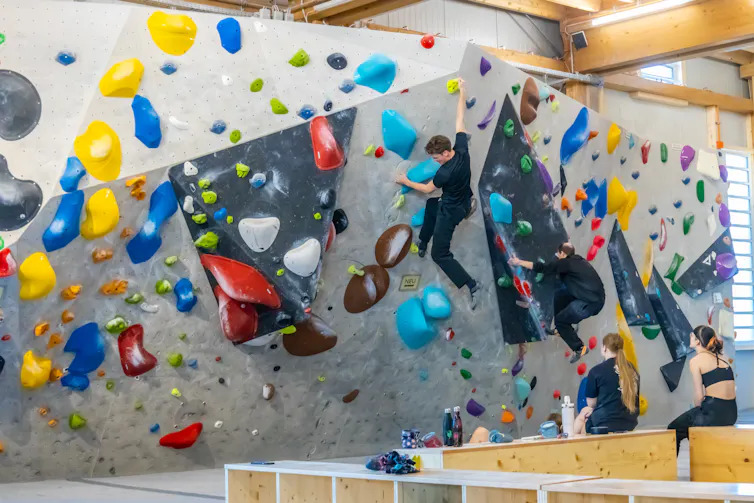
Bouldering is rock climbing without ropes, usually to a fixed height of up to 4.5m, with protection from falling provided by foam crash mats. These short, dynamic climbs are known as “problems” as they not only test physical technique and strength but also strategic problem-solving.

The practice first emerged in the 19th century where it was considered useful practice for roped and alpine climbing. Fast forward to the second half of the 20th century, and the discipline gained a following of its own with indoor bouldering walls opening across cities in North America and Europe.

The sport reached new heights of popularity when it made its Olympic debut as a discipline of Sport Climbing at the 2020 Tokyo Summer Games (held in August 2021).
An extra boost was felt after the most recent Olympics with the Association of British Climbing Walls reporting visits to climbing facilities more than doubled from 2024 to 2025. What’s more, over one quarter of all climbing walls in this country opened within the last half decade, with more than 60% of those offering bouldering exclusively.

Advertisement

All you really need to boulder are some climbing-specific shoes and some chalk to absorb moisture from your hands, which is often provided by facilities.


Hobbies can bring joy, wellbeing and focus to our busy lives, but so many of us don’t have one. If you’re ready to replace scrolling with stitching, or hustle with horticulture, The Hobby Starter Kit (a new series from Quarter Life) will help you get going.


There are of course numerous benefits of bouldering – from the physiological and psychological, to its less obvious social and even intellectual draws.

Advertisement

Relying as much on the main leg muscle groups as core or upper body strength, regular bouldering builds balance and agility, grip strength and cardiorespiratory fitness.

Although it can be completed independently, bouldering at busy climbing walls often brings social benefits too. It is proven that social connections, no matter how small, are good for us, and bouldering offers a great way to spend time with people. The intellectually challenging nature of the sport – including working out how to successfully climb a sequence of colour-coded holds – means climbers often rely on others for tips and guidance, known as “beta”. Nine years since I first set foot in a bouldering wall in east London, I still count several strangers that I met and climbed with there as friends.

A climber being watched by two women.
Climbers often rely on others for tips and guidance when it comes to solving the problem of how to complete a climb.
Julia Mountain Photo/Shutterstock

In my ongoing research project investigating indoor bouldering as a short-term mental health intervention for adults with my colleague Abigail Thompson, we are finding that like climbing more generally, bouldering can produce flow-like states of deep focus and absorption that can help people recovering from addiction, crisis, and trauma.

We’ve also found that with mental and physical problem-solving required, bouldering can increase a person’s belief in their abilities, potential and worth. Insights from our interview data show that feeling a sense of achievement in this way is a common reason our research participants return to bouldering.

Conversely, because of the relatively high amount of time I’ve spent falling off bouldering problems over the years, I have come to see that bouldering can also offer a deep sense of humility that allows boulderers to recognise, understand, and accept their limitations.

Advertisement


À lire aussi :
The science behind why hobbies can improve our mental health


Indoor bouldering also offers a useful gateway for connecting with nature. From Portland to Peak District, Snowdonia, Yorkshire and even Tunbridge Wells, the UK boasts some of the best outdoor bouldering in the world, often in stunning locations.

While bouldering outdoors often requires greater aptitude and experience, as well as a boulder mat to protect you from falling, once you’ve mastered the basics there’s nothing stopping you pulling on some real rock in the great outdoors and benefiting from everything that being outside and engaging with nature brings.

Advertisement

Source link

Continue Reading

NewsBeat

Lord Botham criticises Hope Moor wind farm proposals

Published

on

Lord Botham criticises Hope Moor wind farm proposals

Lord Botham, who lives near Richmond, is backing a campaign to stop the Hope Moor Wind Farm, which would see 23 turbines at least 200m high installed on land between Arkengarthdale and Teesdale.

The former England cricketer has also launched his own campaign to oppose proposals for Hope Moor and three other sites across the North of England.

Writing in the Daily Mail, he criticised Energy Secretary Ed Miliband for his support of wind energy, claiming that there would be “resounding cheers across the North of England” if Andy Burnham did not include the MP in his cabinet if he became Prime Minister.

Advertisement

Lord Botham said: “Miliband is planning to destroy the gorgeous countryside of four counties here in the North with 94 monster wind turbines.”

He added: “These unbelievably huge contraptions – up to 230 metres tall – would be placed on top of hills around County Durham’s stunning Barningham Moor; wild and desolate Ray Fell in Northumberland; rugged Scout Moor in Lancashire; and Walshaw Moor in West Yorkshire – long associated with the Bronte sisters.

“They would be visible for dozens of miles, ruining the landscape over much of the North.

“On top of that, new access roads would cut through the moors along with miles of pylons as the power would be generated where it is not needed.”

Advertisement

The peer said the landscapes were “part of the wealth of the North”, adding: “Walk through the breathtaking beauty of places like Barningham Moor and, whatever kind of day you are having, life is transformed.”

Claiming the proposed wind farms would damage both the environment and the local economy, as well as threaten bird species and disturb areas of peatland, the former cricketer has launched his own “Not One Moor” campaign to oppose the developments.

“We will concede nothing and fight everything,” he added.

In the column Lord Botham called on Northern Labour MPs including  Sam Rushworth, who represents Bishop Auckland and Darlington MP Lola McEvoy to fight against what he called “monuments to Miliband’s madness”.

Advertisement

The comments have been welcomed by members of the Hope Moor Wind Farm Action Group, which was launched to fight the Hope Moor development.

Suzy Wilson, chair of the group, said: “It is almost exactly 45 years since he led England to that amazing Ashes victory at Headingley against overwhelming odds, and we know that he will demonstrate the same fighting spirit against the planned development of Hope Moor Wind Farm.

“He found it incredulous that the wind farm would be so close to the national park and would blight vast swathes of precious landscape and impact upon the Coast to Coast and Pennine Way footpaths.

“We wish him well in his campaign in Westminster and we will continue to work at a grassroots level to raise awareness and build up support to campaign against the industrialisation of the Yorkshire Dales landscape.”

Advertisement

Fred. Olsen Renewables, which is behind the Hope Moor plans, has said it recognised the proposed wind farm had generated a range of opinions, with some people supporting its contribution to renewable energy, local benefits and energy security, while others raised concerns.

Project leaders say the proposal is undergoing a full environmental impact assessment covering issues such as peat, birdlife, flood risk, landscape and construction impacts, with the findings subject to independent scrutiny.

Source link

Advertisement
Continue Reading

NewsBeat

Why Edouard Mendy is out of Senegal vs Belgium at the World Cup | Football

Published

on

Why Edouard Mendy is out of Senegal vs Belgium at the World Cup | Football

Close Overlay

In The Mixer’s World Cup special

Everything you need to know about the World Cup – England updates, the games to watch and stories you missed – in five minutes, at 1pm, every day.

Source link

Advertisement
Continue Reading

NewsBeat

Wales breaking news plus weather and traffic updates (Wednesday, July 1)

Published

on

Wales Online

Gwent Police has charged a Newport man with seven counts of burglary following several reports of commercial premises being targeted across the city.

Neighbourhood officers investigating the series of break-ins arrested the 33-year-old Newport man on suspicion of multiple burglary offences on Monday 29 June.

Rory Hiscox, of Chepstow Road in Newport, was subsequently charged with seven counts of burglary and one count of theft from a shop – with the reported offences taking place between 15 May – 26 June.

Advertisement

Hiscox appeared at Newport Magistrates’ Court on the morning of Wednesday 1 July, when he was remanded into custody.

Superintendent Esyr Jones, Neighbourhood Policing for Gwent, said: “I want to reassure all businesses, shoppers and residents in Newport that we’re continuing to listen to your concerns.

“We’re working with businesses in the city centre to help make their premises more secure, and provide them with crime prevention and security advice.

“We’re also carrying out a range of visible and covert operations to target offenders and increase safety across the city.

Advertisement

“These operations are often helped by information the public provides us, including the recent arrest of Hiscox in Newport, so we’d continue to ask the public to report their concerns to us so we can act and put plans in place to address the problem head-on.”

Source link

Continue Reading

NewsBeat

How glide bombs will shape the future of the war in Ukraine

Published

on

How glide bombs will shape the future of the war in Ukraine

Russian glide bombs killed two people and injured at least 15 others in an attack on the southeast Ukrainian city of Zaporizhzhia on Tuesday, authorities said.

Regional governor Ivan Fedorov, writing on the Telegram messaging app, said Russian forces had launched seven bombs at the city over a 90-minute period.

In Zaporizhzhia and across Ukraine as a whole, these strikes have increasingly come from glide bombs – the low-cost ordnance that experts say are reshaping the war in Ukraine.

Weighing between several hundred and a few thousand kilograms, these ordinary bombs fitted with wings and a guidance system have been among Russia’s most formidable weapons since its 2022 full-scale invasion of Ukraine.

Advertisement

They have become especially deadly of late, with thousands launched in recent months.

At least three people were injured in this Russian glide bomb strike on Kupiansk last year, according to State Emergency Service of Ukraine
At least three people were injured in this Russian glide bomb strike on Kupiansk last year, according to State Emergency Service of Ukraine (State Emergency Service of Ukraine)

Their capacity to devastate an apartment block in Zaporizhzhia or Kherson with a single strike from dozens of miles away inside Russia and beyond Ukrainian air defences has tormented Ukrainian commanders.

That is, until May this year, when Ukraine announced it had developed its own.

Although Western allies had supplied Ukraine with glide bombs, Kyiv had grown impatient with their unwillingness to supply enough and so spent 17 months domestically producing the Vyrivniuvach, or “Equaliser”.

“For a significant period, there was very little practical defence against Russian glide bombs, and that contributed significantly to heavy Ukrainian casualties along the front line,” said Keir Giles, an associate fellow of Chatham House’s Russia and Eurasia Programme and the author of Who Will Defend Europe.

Advertisement
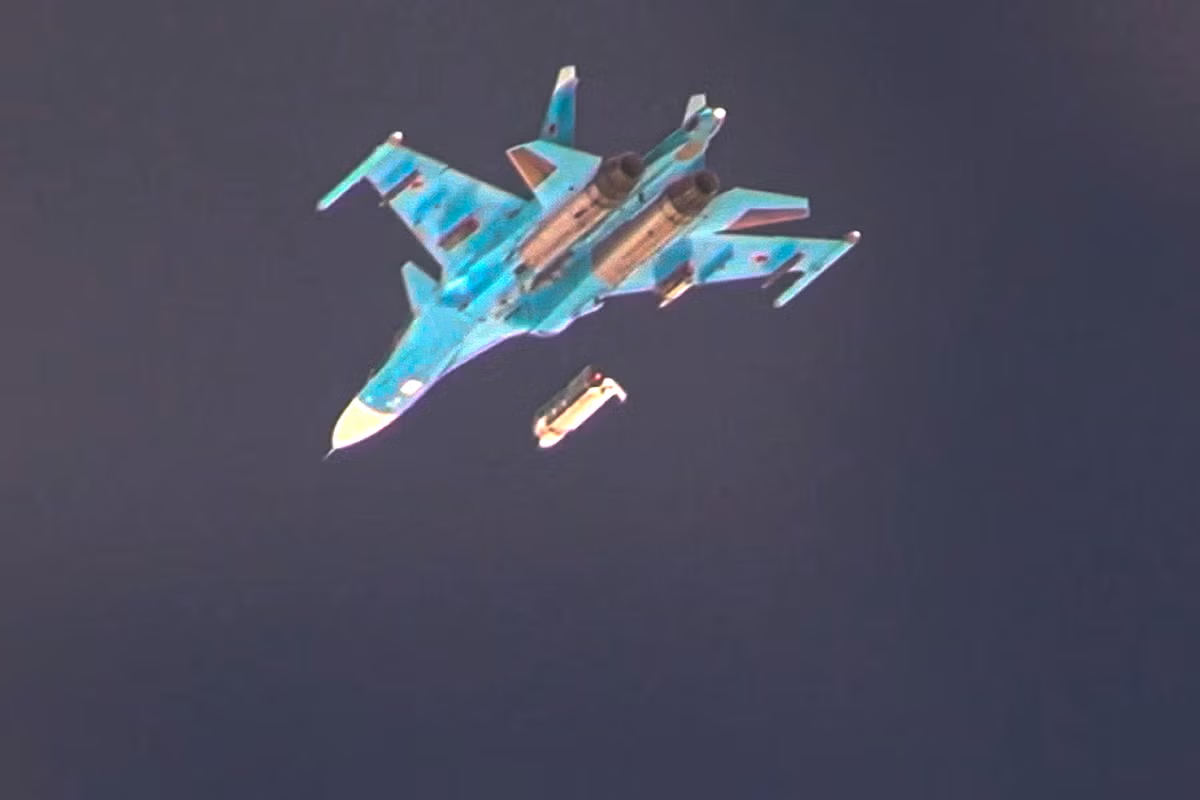
Russian glide bomb launched from a fighter aircraft
Russian glide bomb launched from a fighter aircraft (AP)

Why glide bombs are vital on the battlefield

Although inexpensive and highly reliable, the turn for both sides was largely motivated by necessity, with traditional forms of artillery rendered out of action.

Across the modern battlefields of Ukraine, drones have hunted and destroyed the vast majority of each side’s howitzers, according to Military Balance website.

Their artillery pieces depleted, Moscow and Kyiv saw “stand-off” ordnances like glide bombs as the solution, capable of delivering high-explosives from dozens of miles away.

Recently, their adoption has been accelerated, with Russia reportedly launched more than 1,800 glide bombs in the first week of June alone, according to Forbes.

Advertisement
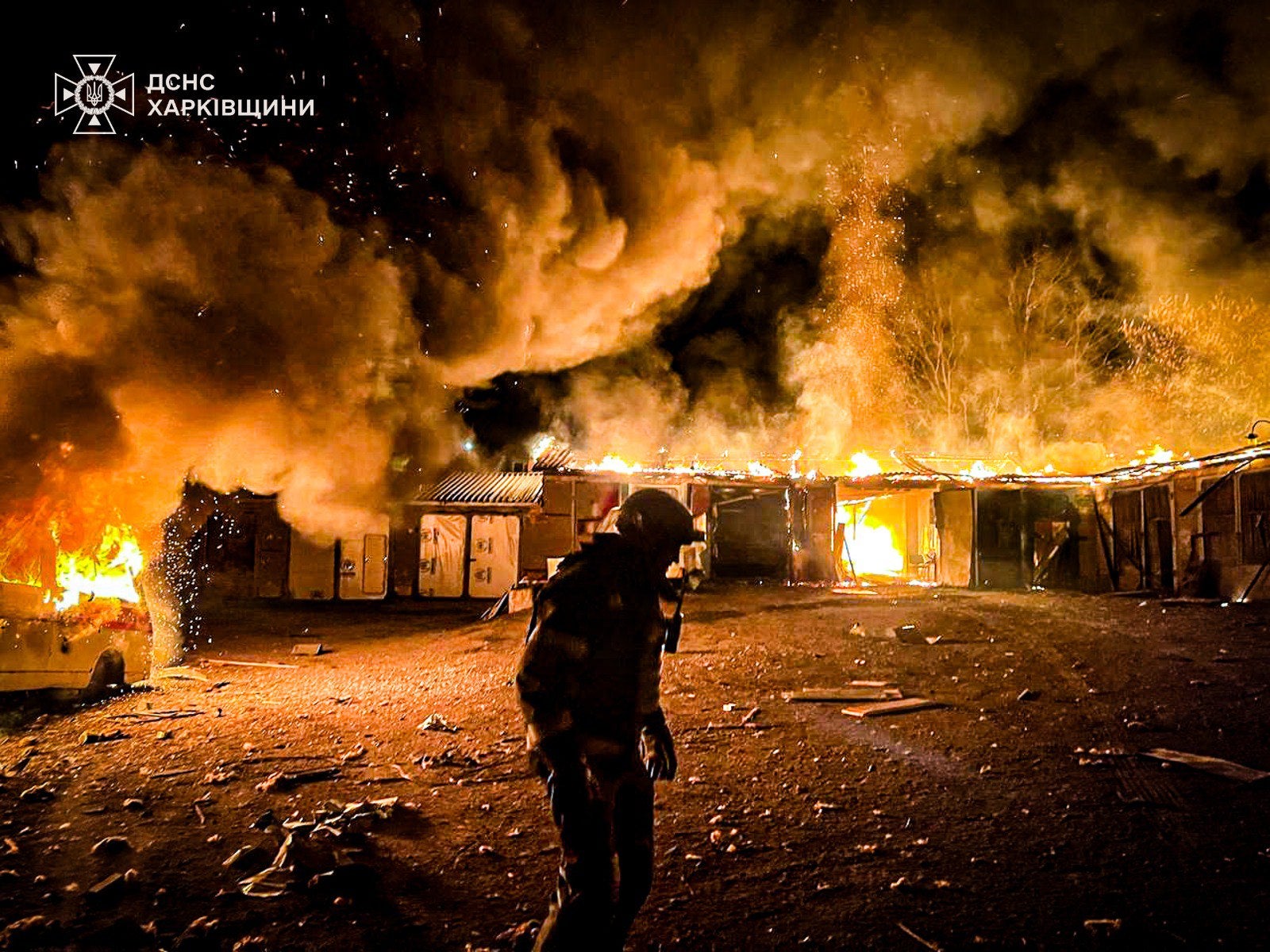
Ukrainian rescuers working at the site of a Russian glide-bomb attack late at night on a nine-flour residential building in Kharkiv
Ukrainian rescuers working at the site of a Russian glide-bomb attack late at night on a nine-flour residential building in Kharkiv (EPA)

Low cost and easily made

Much like the off-the-shelf drones and inexpensive Bayraktar and Shaheeds which have dominated the war, however, Russian and Ukrainian glide bombs are low cost and easily engineered.

The vast majority of Russia’s supply comes from archaic Soviet-era bombs mounted to a rudimentary cage system with folding wings, inertial measurement unit, and satellite guidance called the Universal Gliding and Correction Module (UMPK).

They are designed to be released from Russian fighter aircraft like the Su-34 flying at an especially high altitude, whereafter it glides for 60 to 95km to deliver a bomb of between 250- and 3000-kilograms.

This distance from launch point to target – as well as the fact they lack a heat signature and can fall quickly from a high altitude moments before striking – make them very difficult to eliminate.

Advertisement

Ukraine’s glide bombs are much slighter than Moscow’s, however, produced at only 250-kilograms.

A screenshot from a video posted by Russian military blogger Fighter Bomber allegedly shows the moment a 3000 kg glide bomb explodes in Kharkiv Oblast
A screenshot from a video posted by Russian military blogger Fighter Bomber allegedly shows the moment a 3000 kg glide bomb explodes in Kharkiv Oblast (Telegram)

More explosive than drones

Crucially, both sides have deployed these strikes not simply as strategic hits on cities and industrial areas meant to hamper morale and interrupt supply lines. Instead, these glide munitions have been employed in support of their “fire-centric doctrine” – when artillery is tactically directed on enemy front line positions such as to soften up defences or eliminate surveillance positions ahead of a troop offensive.

Both sides have been keen to promote this in recent social media videos, posting clips of glide bombs striking each other’s positions during combat operations.

“Virtually any frontline artillery positions the Ukrainians have are at risk of being destroyed,” said Christoph Bergs, a research analyst at the Royal United Services Institute (Rusi).

Advertisement

“While small FPV (first-person view) quadcopters and tactical drones can strike targets, they simply do not have the explosive yield of a 250kg or 500kg bomb.”

Source link

Continue Reading

NewsBeat

Thierry Henry stunned by Harry Kane moment vs DR Congo: ‘I’d break my back!’ | Football

Published

on

Thierry Henry stunned by Harry Kane moment vs DR Congo: 'I'd break my back!' | Football

Close Overlay

In The Mixer’s World Cup special

Everything you need to know about the World Cup – England updates, the games to watch and stories you missed – in five minutes, at 1pm, every day.

Source link

Advertisement
Continue Reading

NewsBeat

The big problems facing Thomas Tuchel after DR Congo scare: The England player who must not start another game, the one fear for goal hero Harry Kane, the ‘broken record’ letting the team down and the statistic that exposes one-dimensional attack

Published

on

The big problems facing Thomas Tuchel after DR Congo scare: The England player who must not start another game, the one fear for goal hero Harry Kane, the 'broken record' letting the team down and the statistic that exposes one-dimensional attack

It wasn’t easy and it wasn’t very pretty.

Watching England labour through a hard and stressful 90 minutes against DR Congo was enough to put anybody off their Wednesday dinner.

But all that matters is that Thomas Tuchel’s England are through to the last 16 of the World Cup, to face Mexico in the early hours of Monday morning in the white heat of the Azteca Stadium – where the co-hosts have lost just twice in 89 competitive matches, winning 70 of them.

Their journey goes on, and here Daily Mail Sport examines all the big issues from a crazy afternoon in Atlanta.

Advertisement

The performance we needed? 

If England couldn’t have the dominant and comfortable performance we hoped they could against a team ranked just above Scotland, then maybe this represents a useful second-best.

A come-from-behind win can do all kinds for a team. Just think about how Brazil will be feeling after they turned it round against Japan at the weekend. Just think how Erling Haaland and his Norway team-mates will be feeling after a late winner in a tight game against Ivory Coast.

Advertisement

It wasn’t pretty – but Harry Kane’s double ensured England have a place in the last 16

A come-from-behind win can do all kinds for a team. This is a little bit of what England will have now, the feeling that whatever goes wrong in a game, it can be overcome

A come-from-behind win can do all kinds for a team. This is a little bit of what England will have now, the feeling that whatever goes wrong in a game, it can be overcome

This is a little bit of what England will have now, the feeling that whatever goes wrong in a game, it can be overcome. That can be very valuable fuel. England conceded a bad goal, almost shipped another, had a clear penalty ignored and then saw the DR Congo goalkeeper have the game of his life.

England were not at their best and could have folded. They were ragged at times. But England kept their heads and their belief and ensured that their quality and their experience got them through in the end. The coaches of Germany and the Netherlands would give an awful lot for some of that feeling as they settle back at home and await, in all likelihood, the sack.

Advertisement

Tuchel was right when he said after this one: ‘We have to have that mindset that if it is getting hard, it is getting hard, but don’t lose patience and don’t lose belief.’

Can Kane’s legs last? 

Harry Kane has been on the pitch for all but six minutes of England’s tournament so far and they were only six that didn’t matter, as Tuchel’s side closed out their 2-0 win over Panama in their final group game.

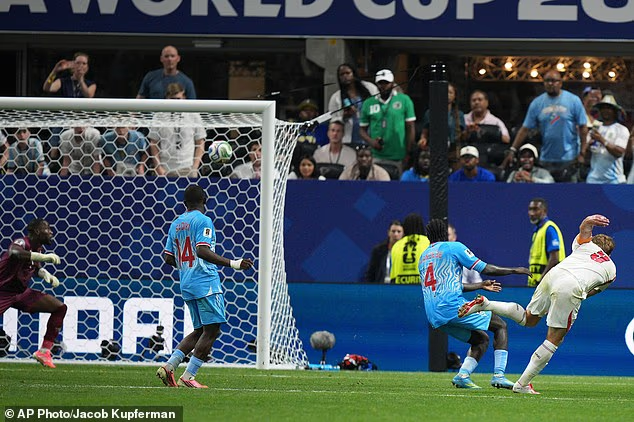
When England need presence and when England need a goal, he stays on, and usually is the man to deliver. At the moment his form is the best it’s ever been in a big tournament. He has five goals – only one less than Kylian Mbappe – and the winner he scored here was straight out of the great France forward’s playbook.

Advertisement

Wayne Rooney called him England’s ‘superstar’ and he isn’t the only former team-mate singing that tune.

‘When his back is to the wall, Kane is stepping up for his country,’ said Joe Hart on the BBC. ‘I love the aggression and fire in his face. He knows that wasn’t a good performance but when it needed to happen he produced a header in front of goal and then that last finish.’

What Tuchel must hope now is that Kane’s legs stand the pace. England will need him in the rarified atmosphere of Mexico City in the next round and that will represent a completely different test to the one England faced here.

When England need presence and when England need a goal, Kane (left) stays on, and usually is the man to deliver

When England need presence and when England need a goal, Kane (left) stays on, and usually is the man to deliver

Advertisement

Defence still out of tune 

The broken record is still turning in the middle of England’s back four.

The defensive structure and understanding that has been a feature of England’s football under Tuchel has not travelled with them to America and the manager and his coaching staff are no closer to solving the problem. Tuchel – publicly at least – has been in denial about it but he can’t be any longer. The early Congo goal was a mess.

Why had the England defence allowed itself to be dragged over to one side of the field? Why didn’t Jordan Pickford save a routine shot low to a near post that should have been covered?

Advertisement

Pickford’s uncertain tournament goes on but his place in the team remains secure. The other two goalkeepers in the party – James Trafford and Dean Henderson – do not have enough international experience to be dropped in to this team.

There were other instances of vague panic, too. Centre-back pairing Marc Guehi and Ezri Konsa were left shouting at each other after Yoane Wissa got between the two of them to prod Aaron Wan-Bissaka’s cross against a post moments before Kane had his big penalty appeal at the other end. Had that one gone in from the Newcastle striker, England’s World Cup would have been over.

Ezri Konsa and Marc Guehi were all over the place at times against Newcastle's Yoane Wissa

Ezri Konsa and Marc Guehi were all over the place at times against Newcastle’s Yoane Wissa

One-dimensional attack

Advertisement

England created enough chances here in Atlanta but the worry is that they all look the same. Until making a bit of a mess of Kane’s equaliser, the Congo goalkeeper Lionel Mpasi had a worldy. On another day, England would have been level before half-time. 

Equally, there has been a predictability about England’s attacking play at this tournament and it involves a series of overlaps and combinations between England’s full backs and wingers. It is as though England only have one idea – they put in 35 crosses from open play in this match, their most for 60 years in a World Cup match since a whopping 37 against Mexico in the 1966 group stage.

Where is the creativity further infield? Where are the neat passing moves needed to open up defences happy to sit in against the established nations in this World Cup? We haven’t seen Brazil and France rely only on balls from wide positions, so why should England?

Tuchel’s team – jeered at times by their own fans here – dominated possession but the truth is that when Congo did advance forward, they had a greater depth of ideas than their famous opponents.

Advertisement

Twice against Panama and here, finally, against Congo, England scored from a cross. That’s fine. It’s a strength. But they must have other ideas too.

Anthony Gordon puts in one of England's 35 open-play crosses in Atlanta - their most in a World Cup match for 60 years

Anthony Gordon puts in one of England’s 35 open-play crosses in Atlanta – their most in a World Cup match for 60 years

Tuchel’s dilemmas 

Does the England manager know what his best team is? With everybody fit, he probably does. But currently, with first, second and third-choice right backs injured, I am not at all sure.

Advertisement

After playing John Stones slightly out of position in the first game – he played him on the left side of a central pairing – he has completely ignored him. Despite the option of shifting Ezri Konsa across to right back and putting Stones back in, he went with Djed Spence again here and it backfired.

The Tottenham full back has pace to burn getting forward but it’s not enough. Spence doesn’t defend well enough to be an international full back and should not start a game in this tournament again. He just has too much to learn.

Here, after Tuchel made some timely and intelligent substitutions, we ended up with Declan Rice at right back and he then ended the game sitting on the bench applying ice to his left hamstring. There is a thought that Reece James may be fit enough for the Mexico game. My goodness, we hope so.

Djed Spence doesn’t defend well enough to be an international full back and should not start a game in this tournament again

Djed Spence doesn’t defend well enough to be an international full back and should not start a game in this tournament again

Advertisement
Jude Bellingham's lunge on Nathanael Mbuku in the first half was late and reckless and fully deserving of the yellow card that followed

Jude Bellingham’s lunge on Nathanael Mbuku in the first half was late and reckless and fully deserving of the yellow card that followed

Best and worst of Jude

Jude Bellingham remains England best and most dangerous player here in America. He, along with Kane, is the one who looks as though his sheer will and force of personality can shape a game or a big moment.

Here also, however, were flashes of the Bellingham we hoped had been left behind. His lunge on Nathanael Mbuku in the first half was late and reckless and fully deserving of the yellow card that followed. Not long after, as frustration grew, he played a ball straight out of play and then started waving his arms at the team-mate it had been intended for. Maybe he was asking him to grow a foot?

Advertisement

We have said before that Bellingham is at his best when he plays on the edge. The problem with that is that over the other side of that edge lies trouble. With a minute of added time left, he gave away a completely unnecessary free-kick.

Lessons to be learned for everyone, no matter who you are.

Source link

Advertisement
Continue Reading

Trending

Copyright © 2025