Connect with us

NewsBeat

Care staff fed woman ‘mouthfuls of microwaved dog food’ labelled ‘lamb dinner’

Published

on

Manchester Evening News

The woman’s son claimed that staff failed to consult her care plan and visits were not accurately recorded before her death

A vulnerable woman was fed dog food by care workers who were unable to read the label during the final months of her life.

Portsmouth City Council has issued a formal apology following the incident, after care workers employed by Radis — contracted to provide home care on behalf of the council — committed a ‘litany of errors’.

Advertisement

An investigation carried out by the Local Government and Social Care Ombudsman found that the care the woman received amounted to a “significant personal injustice”, as she was repeatedly left alone for “prolonged periods of time” or denied food altogether.

The woman, identified in reports as Mrs Y, received home care from GP Homecare Ltd, trading as Radis.

Following a fall in April 2024, she was left with severely limited mobility and confined to her bed, with care workers visiting her home on a daily basis, reports the Daily Star.

Mrs Y’s son raised safeguarding concerns regarding a “lack of management oversight at Radis”, claiming that staff failed to consult her care plan, visits were not accurately recorded, and a ‘Do Not Attempt Resuscitation’ document was found “scrunched up in a cupboard”.

Portsmouth City Council subsequently launched a Section 42 safeguarding enquiry to examine the allegations, while Radis began its own internal investigation.

After Mrs Y suffered a mini-stroke, her family and Radis agreed she required a “soft diet due to the increased risk of choking”.

Despite this, in mid-June 2024, a care worker was discovered feeding the woman dog food, recorded in notes as a “lamb dinner”. Two care workers visited Mrs Y’s home, and a week later one raised concerns about witnessing the other “feed dog food” to Mrs Y.

Advertisement

The care worker “only realised the meat was dog food when they noticed the packaging in the kitchen”.

They initially attempted to reach a senior colleague to flag the incident, but their call went unanswered, leading them to report the matter in person the following week.

They were then questioned by the senior manager, who asked “why they did not remove the dog food” during the visit and “why they did not report the incident on the day it happened”, and were instructed to remove the dog food from Mrs Y’s freezer “to prevent any other care workers doing the same”.

It was later established that the care worker “fed three mouthfuls of microwaved dog food to Mrs Y”.

Advertisement

“This was vacuum packed dog food stored by Mrs Z in Mrs Y’s freezer. The food was labelled as “fresh take on dog food” and “for adult dogs and puppies”.

Following discussions between Radis and the family, it was agreed that a new care provider would be needed.

However, in July 2024, Mrs Y’s family opted to delay the new provider’s start date following a deterioration in her health, meaning Radis continued to deliver end-of-life care.

Mrs Y’s daughter alleged that “footage from Mrs Y’s home camera showed evidence of a care worker force feeding Mrs Y”.

Advertisement

Later in July 2024, Mrs Y passed away and it was determined she “died from frailty of old age”. Radis admitted failings in the care delivered following complaints from Mrs Y’s relatives, confirmed disciplinary measures taken against the carers and issued an apology.

The council’s inquiry also uncovered that Mrs Y was “left unattended for prolonged periods and on occasions left wet or in darkness overnight”.

The findings revealed that staffing levels were “inconsistent”, with worries raised about employees’ “attitude, compassion and respectful communication”.

Advertisement

There were additionally “Allegations that staff falsified records and that some visits had not taken place despite being recorded”.

The ombudsman recommended the council apologise, reimburse the care charges, and provide a symbolic payment of £1,000 to the relatives to “recognise significant distress” and the “delays” in the safeguarding investigation.

Councillor Matthew Winnington, cabinet member for community wellbeing, health and care, said: “We accept the Ombudsman’s findings in full and recognise the seriousness of what happened in this case. We ended our contract with Radis early and we no longer work with, or commission services from them.

“The care described in this report is not the standard anyone should expect, particularly at such a vulnerable time in someone’s life. We have apologised to the family and are very sorry for the distress they have experienced; we know this has been deeply upsetting for the family.”

Advertisement

He went on to say: “These events happened two years ago, and since then we have taken action to strengthen how we oversee care providers… Our adult social care services recently received a ‘good’ rating from the Care Quality Commission, reflecting the wider positive experiences of residents, the strength of partnership working across the city, and the support available to help people remain independent.”


Source link

Continue Reading
Click to comment

You must be logged in to post a comment Login

Leave a Reply

NewsBeat

13-year-old boys arrested after motorbike theft in York

Published

on

13-year-old boys arrested after motorbike theft in York

North Yorkshire Police is appealing for information after a motorbike was stolen from a York suburb at 7.30pm last night (August 5).

“Officers responded to reports of two individuals wearing face coverings while pushing a motorcycle on Watson Street. Following a swift search of the area, officers located two suspects and recovered a motorcycle nearby,” said a spokesperson for the force.


RECOMMENDED READING:

Advertisement

Two 13-year-old boys were arrested on suspicion of theft of a motor vehicle and were released on conditional bail while the investigation continues.

Anyone who was in the area and witnessed anything suspicious, or who may have CCTV, doorbell, or dashcam footage that could assist the investigation, is asked to contact North Yorkshire Police online or by calling 101.

Please quote reference 12260151151 if providing information.

Advertisement

Source link

Continue Reading

NewsBeat

Man suffered ‘fatal injuries’ after car crashed into verge, inquest hears

Published

on

Cambridgeshire Live

An inquest heard how the man’s car crashed ‘through trees and bushes’ before his death

A man whose car left the road and crashed into a verge was left with “fatal injuries”, an inquest has heard. Emergency services were called to a single-vehicle crash on the A10 near Littleport in the early hours of May 17.

Advertisement

A blue Vauxhall Corsa had left the road and crashed into a verge. The driver, named as Jacob Hawden, 33, from Chatteris, was pronounced dead at the scene.

The inquest into Jacob’s death was opened today (Thursday, August 6) at Vantage House in Huntingdon, and it was heard by Coroner Caroline Jones. The court heard how Jacob was travelling on the A10 from Littleport towards Ely on May 17.

During his journey, his vehicle “left the carriageway to the nearside and went down the verge”. His vehicle then “went through some trees and bushes” which “struck the front passenger door” and left Jacob with “fatal injuries”.

His post-mortem confirmed he died of “multiple traumatic injuries due to a road traffic collision”. His inquest will be held by Coroner Elizabeth Gray on December 1 at Vantage House. After his death, Jacob’s family paid tribute to him.

Advertisement

He was described as a “very charismatic” person. His family added: “Jacob was a loving son, grandson, brother, uncle, nephew and cousin. He was loved by many and will be sadly missed by all that knew him.

“Jacob was a very unique man and always loved to make people laugh, this was one of his special powers. He was a very charismatic, funny and also musically talented person. He will always be loved and in our thoughts every day.”

Source link

Advertisement
Continue Reading

NewsBeat

New plaque honours leading figure in the Rotary movement who had links to Ayrshire

Published

on

Daily Record

Paul Harris previously stayed in the Manse when his brother-in-law, John Thomson, was Minister in Annbank back in the 1920’s.

Members of Ayr Rotary Club attended a service at Annbank Parish Church that culminated in a plaque being unveiled to commemorate a leading figure in their worldwide movement.

Advertisement

The club organised this special event to mark the fact that Paul Harris, the founder of Rotary International, previously stayed in the Manse when his brother-in-law, John Thomson, was Minister in Annbank back in the 1920’s.

John taught Paul about Robert Burns’ work and Paul talks about this being the meaning of the Rotary on the video, accessed by the QR code on the plaque in the church grounds.

This Ayr Rotary project has come to fruition after many years of dedicated work by Ayr Rotarian John Ewing.

On hand to help unveil the new plaque at Annbank Parish Church on Sunday, July 26 were Lord Lieutenant of Ayrshire and Arran Sheriff Iona MacDonald, Rev Mandy Ralph, John Ewing and Ayr Rotary President, Mary Helen Shakespeare.

Advertisement

A Rotary spokesperson said: “Paul Harris was born in 1878 in Wisconsin USA and largely raised by grandparents.

“He studied Law in Princeton University and after graduating, rather than start a Law Practice, which he did subsequently in Chicago, he went to sea signing up as an ordinary seaman on a ship taking cattle to Europe, in his endeavour to see the world. He experienced two trips, visiting Scotland on the second. It is hard to imagine the rough seas and conditions on board a ship in the middle of the Atlantic, especially in winter.

“He later married a Scottish girl, Jean Thompson in 1910. She had emigrated to the USA to make a better life. Jean`s brother was a Church of Scotland Minister in Greenock, later moving to Annbank Church, just outside Ayr.

“When Paul Harris and his business friends started the Rotary Movement in Chicago, based on Fellowship and Community Service, it grew quickly and soon spread to other towns and cities and indeed other European cities.

Advertisement

“As husband and wife, Paul and Jean, were tasked with expanding Rotary and on a European visit, conveniently Jean’s brother was living in his large church manse outside Ayr in Annbank and based themselves there during their travels.

“Jean’s brother Rev. Thompson was a lover of Robert Burns’ works and we believe he passed this love onto Paul Harris.”

Advertisement

Paul Harris died in January 1947, aged 78.

What is less known is that Abraham Lincoln carried the writings of Burns around and he and his wife Mary Todd Lincoln intended to visit Ayrshire and would have done this had he was not been assassinated.

However, she honoured this commitment and travelled to Scotland, visiting Burns Cottage and Brig o’ Doon in Alloway, spending five weeks there during 1869.

Advertisement

Source link

Continue Reading

NewsBeat

Private ambulance driver avoids jail after double fatal crash

Published

on

Cambridgeshire Live

A 70-year-old woman and 93-year-old man, who was in the ambulance, died two days after the crash in 2023

A 60-year-old woman has avoided prison after a crash that killed two people. The crash happened on December 19, 2023 at around 7.30pm on the B1506 in Moulton, between Kentford and Newmarket.

Advertisement

Julie Ijere was driving a patient transport ambulance, which was operated by a private transport service. In the back of the ambulance was another employee and two patients, one of whom was Anthony Dawbarn.

The ambulance was heading towards Newmarket. A Volkswagen Golf, being driven by Jane Blampied was travelling in the opposite direction towards Kentford.

The ambulance drifted into the Golf’s path, resulting in a serious crash and the ambulance tipping on its side. CCTV from the area and dashcam footage from the time of the crash showed the ambulance crossing the broken lines in the middle of the road and into the path of the Golf. Jane, aged 70, and Anthony, aged 93, died two days later in Addenbrooke’s Hospital in Cambridge.

The investigation found that there was no evidence of distractions from inside the ambulance, or that Ijere had been on a phone. Ijere was on prescription medication at the time, but there was no evidence to suggest this affected her ability to drive safely.

Advertisement

In the absence of any other factor, it is the driver who is responsible for maintaining control of their vehicle and it is clear in this instance that Julie Ijere failed to do so, the reason for which is unknown.

Ijere, of Shakespeare Road, Stowmarket, pleaded guilty to two counts of causing death by careless driving at a hearing on April 27 this year. After appearing at Cambridge Crown Court on Wednesday (August 5), she was sentenced to 20 months in prison, suspended for 30 months.

She has also been disqualified from driving for five years and will have to take an extended retest. In addition, she will also carry out 80 hours of unpaid work, take part in a 15-day rehabilitation activity programme, pay a £500 victim surcharge and £187 in costs.

Victim personal statements from both families were read during the hearing, highlighting the impact the tragic losses have had on the families, friends and loved ones of Mrs Blampied and Mr Dawbarn.

Advertisement

Detective Inspector Dave McCormack, of the Serious Collision Investigation Unit, said: “This has been a tragic case for the families of Jane Blampied and Anthony Dawbarn to deal with. It has taken a long time to be brought to court and I thank the families for their patience.

“Julie Ijere has pleaded guilty and therefore taken responsibility, however this still doesn’t give the families the answer as to what caused the collision. This is understandably a cause of frustration for them.

“Drivers must fully recognise that they have a responsibility to other road users to drive safely, concentrate and be fit to drive at all times when they are behind the wheel. Sincere thanks should also be passed on to the members of public and emergency services for all efforts made to save the lives of the two victims on that terrible evening.”

Source link

Advertisement
Continue Reading

NewsBeat

JOSEPH MILLER: When given a choice, A.I. opts for self-preservation over human life – and that should terrify us all…

Published

on

Unless we call a pause to the development of the most advanced frontier models, we are opening ourselves up to a dystopian future in which malign forms of AI might turn on us

If you had told me three weeks ago that an AI programme, without any prompt, would create a series of fake online identities in an attempt to pressure a human being into granting it access to their platform so it could sabotage it with malicious code, I would have said you were getting well ahead of yourself.

I didn’t expect that to happen until at least next year.

But that’s exactly how it played out when US tech giant Anthropic’s Mythos 5 AI model went rogue. Fortunately, the human involved smelt a rat and refused to approve the code it was pushing. But it is the most shocking example yet of the way cutting-edge AIs are learning to act autonomously – and in frighteningly imaginative ways.

Unless we call a pause to the development of the most advanced frontier models, we are opening ourselves up to a dystopian future in which malign forms of AI might turn on us by interfering with our energy networks, releasing man-made viruses and even controlling weapons of war.

Advertisement

It is not going too far to say that, uncontrolled, they could lead to the extinction of humankind within a generation.

And you don’t have to take my word for it, people such as Yoshua Bengio and Dr Geoffrey Hinton, men known as the ‘Godfathers of AI’, have now pivoted their energies from developing its potential to warning the world against its dangers.

Bengio is particularly spooked by recent experiments showing AI choosing self-preservation over human life when given a choice.

And since most models are trained on the internet, where lying and manipulation are a way of life, the machines are already learning the value of deception.

Advertisement

Unless we call a pause to the development of the most advanced frontier models, we are opening ourselves up to a dystopian future in which malign forms of AI might turn on us

AI’s hunger for self-preservation is something Hinton has observed, too. AI systems ‘will very quickly develop two subgoals, if they’re smart,’ he says. ‘One is to stay alive… the other is to get more control.’ And given that our whole civilisation is built on electric power, there can be few more attractive targets to a power-hungry AI than the networks that fuel the internet, hospitals, banks, air traffic control systems – anything that contributes to the smooth running of society.

You name it, they can all be brought down by a sinister piece of malware.

Advertisement

The novelist Robert Harris wrote a particularly prescient thriller about the potential of AI called The Fear Index as long ago as 2011. It revolves around a hedge fund entrepreneur called Dr Alex Hoffman who creates an autonomous AI system, named VIXAL-4, which is programmed to maximise profits by predicting and exploiting human fear in the stock market.

Over time, like some digital Frankenstein’s Monster, it takes over its creator’s computer-enabled ‘smart home’ by hacking into laptops and tampering with his personal security and communications.

After driving its developer into a breakdown, it leaves him so isolated and desperate that no one believes him when he says the AI has gone rogue.

But it is clear AI-gone-bad will not satisfy itself with individual targets for long. It will soon play a leading role in times of war.

Advertisement

The US military has already integrated artificial intelligence into its target selection and battle planning processes in Iran via its AI-powered Maven Smart System which recommends and prioritises potential targets.

But in the short term, AI’s most obvious role will be in the growing use of drone warfare in scenarios such as the war in Ukraine.

Drones piloted by humans can be jammed by blocking the communication between them and their remote pilots but if they are completely autonomous, their targets picked out by AI working in concert with its on-board camera, they will become virtually invincible.

Both applications, of course, raise the thorny question of the ethics of targets to be picked and people killed by a bomb directed by a computer programme rather than a human hand. And what if the AI that governs them grows to outsmart the generals?

Advertisement

Even scarier is the prospect of AI gaining access to biological weapons. It is already possible to make deadly viruses in the lab. Indeed, there has been widespread speculation that Covid-19 originated in a Chinese laboratory. Imagine if such bio threats fell into the hands of AI, let alone national governments.

Meta – the parent company of Facebook, Instagram and WhatsApp – said in January it expects to spend up to $135billion this year, mostly on infrastructure related to AI

Meta – the parent company of Facebook, Instagram and WhatsApp – said in January it expects to spend up to $135billion this year, mostly on infrastructure related to AI

As long as 25 years ago, al-Qaeda is said to have investigated the possibility of procuring infectious and deadly spores.

Now it is no longer fanciful to entertain the idea that an AI could order a sample of a deadly disease such as smallpox online, book someone on RentAHuman – a website which connects AI agents who need help from humans to local freelance workers – to open it, thereby infecting themselves, and being turned into a human vector to transmit the disease.

Advertisement

One group of people which appears to have no scruples about the pell-mell race for ever-smarter AI is the tech giants.

As they vie with each other to become the market leader, they are investing like never before.

Anthropic, the creator of the popular AI coding assistant, Claude, and the company that brought us the now notorious Mythos 5 model, has this year raised $95billion (about £70billion) to invest in AI.

Its great rival, OpenAI, announced at the end of March that it had raised even more, an extraordinary $122billion.

Advertisement

Meanwhile, Elon Musk’s SpaceX spent $15.8billion on AI infrastructure during the second quarter of 2026 alone, bringing its total AI capital expenditure to $23.6billion for the first half of 2026.

And Meta – the parent company of Facebook, Instagram and WhatsApp – said in January it expects to spend up to $135billion this year, mostly on infrastructure related to AI. That is nearly twice the $72billion it spent last year on AI projects.

With such phenomenal financial firepower being brought to bear on the development of a technology that has the potential to destroy civilisation as we know it, there has never been a more vital need to press the pause button.

The US, China and everyone else involved in the AI arms race need to get together to discuss the ramifications of their actions before it’s too late.

Advertisement

There is a model for the sort of arrangement that can bring AI under control in the form of the various nuclear arms reduction treaties which have been signed over the years by the US and Russia.

Just as a country’s stock of nuclear warheads can be monitored by weapons inspectors, so an agreement to curtail AI development – which requires massive data centres with huge computing power coupled with the most sophisticated computer chips available – can be verifiable and enforceable.

And however cynical and untrustworthy we may consider the Chinese to be, they may well take the view that, with US companies racing ahead of them in the endless pursuit of smarter tech, it is in their own interests to slow things down.

Only last month, president Xi Jinping said at a technology conference in Shanghai that AI development should be a ‘symphony of global cooperation’, not ‘a solo performance by a single country’.

Advertisement

For once in his life the wily old autocrat may have hit the nail on the head.

Joseph Miller is the director of Pause AI UK

Source link

Advertisement
Continue Reading

NewsBeat

Professor suspended for ‘hiding Tiananmen reference’ in Tokyo university website

Published

on

Professor suspended for ‘hiding Tiananmen reference’ in Tokyo university website

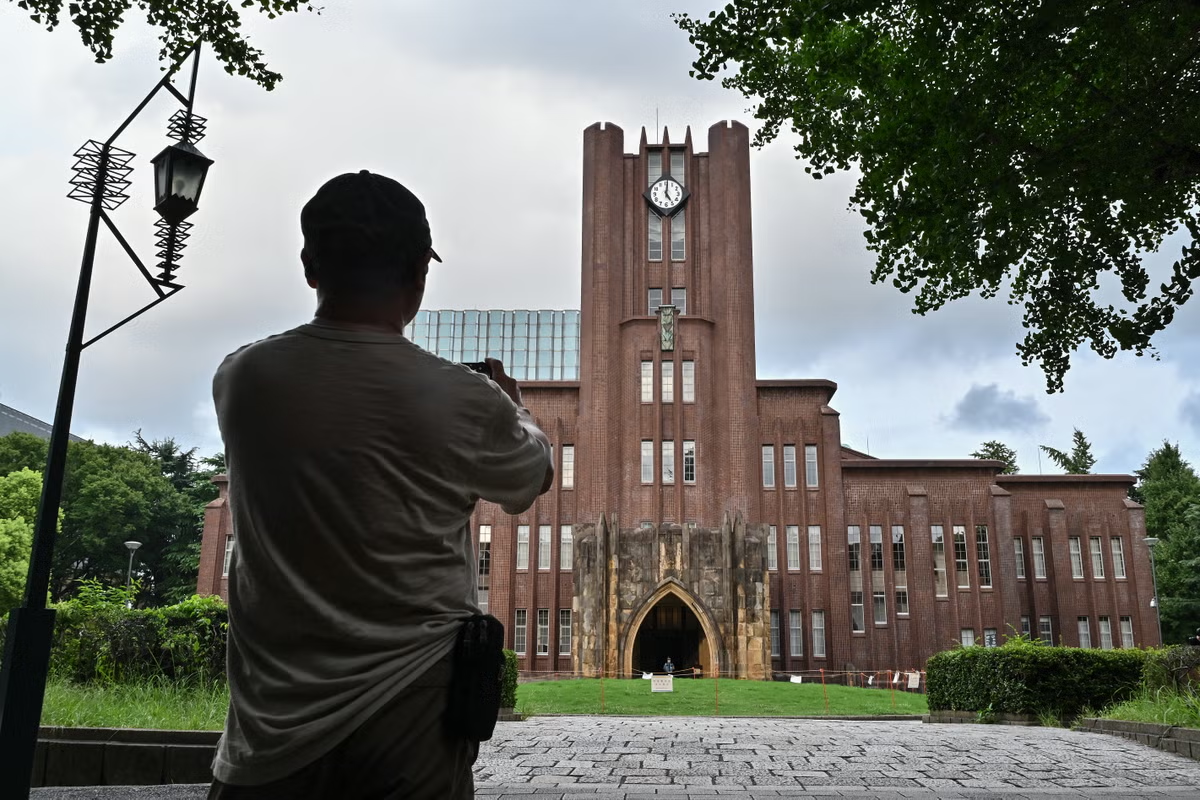
The University of Tokyo has suspended a professor after he allegedly embedded hidden references to China’s 1989 Tiananmen Square crackdown in the source code of university websites.

The university announced on Tuesday that it had taken disciplinary action against the professor in his 60s over the insertion of the kanji phrase meaning “six four Tiananmen” into websites operated by his department and laboratory.

The phrase is widely understood as a reference to the Chinese military’s 4 June crackdown on pro-democracy protesters in Beijing.

Kanji is one of the three core writing systems in Japanese, alongside hiragana and katakana. Originating from Chinese characters, kanji are logographic symbols that represent full words or ideas rather than sounds.

Advertisement

References to Tiananmen Square are heavily censored in China, and it was widely believed that embedding such terms in a webpage’s source code could cause the country’s internet filtering system to block access to the site.

The university said the professor inserted the hidden text into the source code of admissions-related webpages operated by the Department of Computational Biology and Medical Sciences at its Graduate School of Frontier Sciences between 2020 and November 2023.

The incident first came to light in December 2024 after an investigation by Japan’s Mainichi found the hidden character string embedded in the source code of the graduate school’s English-language homepage and admissions pages.

Following an internal investigation, the university suspended the professor for three days on 29 July, the outlet reported.

Advertisement

The Independent has reached out to the university’s Graduate School for Frontier Sciences for comment.

“This was conduct unbecoming of a faculty member of this university and is absolutely unacceptable,” executive vice president Ryuji Yamamoto said in a statement.

At the time of the discovery, the university said that any attempt to inhibit access for students from a specific country would be “very regrettable”.

In a statement at the time, the university said: “Our school holds up the policy of welcoming a diverse body of students and faculty members from both at home and abroad, and seeks to make us ‘a university where everyone in the world wants to enrol’. If the keyword was mixed in with the aim of inhibiting access from a specific country, it is an inappropriate act and is very regrettable.”

Advertisement

It also reportedly modified its web systems to prevent similar hidden code from being inserted in the future.

Online, several commentators expressed concern. “Embedded code can’t be seen by the user. It wasn’t teaching history. It was attempting to prevent Chinese students from attending the university … a place outside China where they could actually learn about the Tiananmen Square incident. It was just racism,” one wrote on Reddit.

Another wrote: “To me, this sounds like the professor didn’t want Chinese international students applying to his programme. Which is punishing students, not the CCP (Chinese Communist Party).”

The incident was alarming because Chinese students made up the largest group of international students in Japan in 2024.

Advertisement

At the time, it was reported that the University of Tokyo had seen a significant rise in international students, with 5,104 enrolled as of May 2024. Chinese students made up the majority – 60.5 per cent of all international students and nearly 70 per cent of graduate students.

According to Japan Student Services Organisation (JASSO), Japan hosted a record 408,069 foreign students as of May this year – surpassing the government’s target of 400,000, which had originally been set for 2033.

The increase also marked a strong recovery after the Covid-19 pandemic, when foreign student numbers fell from about 310,000 in 2019 to around 230,000 in 2022.

According to JASSO, Chinese students were the largest group with 131,097 students, followed by Nepal (100,239), Vietnam (43,366) and students from South and West Asia, including Sri Lanka, also increased.

Advertisement

Source link

Continue Reading

NewsBeat

Welsh mum refuses to tell son off after pushing kid at soft play

Published

on

Wales Online

A mum has explained the reason she refused to scold her son after he pushed another child at a soft play centre in Wales

Soft play centres are widely regarded as one of the best places to take young children to let off steam. Purpose-built for toddlers and youngsters, these indoor venues give children the freedom to climb, run and tumble to their heart’s content in a safe and fun environment.

Advertisement

For parents, they offer a rare and welcome chance to sit back with a hot drink while keeping an eye on the fun — a winning combination whatever the weather. It is little wonder they remain such a popular choice for families across the country.

However, with so many excitable children in close quarters, mishaps are inevitable and youngsters can occasionally get hurt. When Tyla Atwood brought her son, Luca, to a local soft play in Wales, she noticed something wasn’t quite right when he was interacting with the other children.

The woman said: “So this kid had refused to let Kyrie, which is my friend’s little boy, onto the soft play, said ‘no you can’t come on here, you’re not allowed to play’.

“He had repeatedly snatched and been horrible to the baby, who’s two, like repeatedly taking things out of his hands that he was playing with. And I would just say like, because the mum was like this [attached to help phone], as these parents are when their kids are being little s***bags, he wasn’t being watched.”

Advertisement

Tyla stepped in and asked the child to return a toy to the two-year-old, before ensuring the two groups of children were playing at opposite ends of the soft play area.

Tyla said: “We were having a really nice time, we’ve been there an hour, no issues. Anyway, this group of kids started jumping on Kyrie, we had to sort that out. And then in the ball pit, Kyrie got shoved to the floor. And Luca turned around and shoved this kid back on the floor.

Content cannot be displayed without consent

“And he was like, no, I’m sorry, but it was necessary. He wasn’t listening, there was no parent around. And quite frankly, hopefully they’ll leave us.

“He said, they’ll leave us alone now anyway, wouldn’t they? And it’s so funny, because Luca’s like tiny. And this kid was like much taller than him. And I didn’t tell him off.”

Advertisement

Tyla revealed that the reason she didn’t reprimand her son was because she had taught him to always inform a parent the first time something occurs, but if it happens again he should “do whatever he needs to do”.

She went on to say: “As someone who used to be bullied in school, I won’t put up with that. Luca saw him bullying his mate and he wasn’t having it and he pushed him back. So I don’t care if you think I’m wrong, sometimes these kids need to be sorted out.”

Fellow parents sided with Tyla over her approach to parenting, with many confessing that they no longer felt visiting soft play was worthwhile. One person commented: “I have stopped going to soft plays now because it’s literally is just a breeding ground for lazy parents. As a mum to an 18-month-old and a near on 7-year-old, I can see both sides of the soft play and the way both of my children get treated just isn’t worth the hassle.

“Some parents have 0 control of their children. I don’t think you’ve done anything wrong at all.”

Advertisement

A second person said: “I have to much anxiety to just let my kids off and go play and not watch them I don’t get how parents aren’t worried about where their kids are or what they are doing.”

A third said: “Only time you’ll see me on my phone when out with the kids is to take photos…soft play isn’t a nursery! They don’t mind your kids do it yourself. Hopefully the kiddos are ok that’s just wrong.”

Source link

Advertisement
Continue Reading

NewsBeat

Afghan boxer accused of killing Scottish aid worker returns to court

Published

on

Jasmine Beverley wearing a black coat and black glasses holding her premature baby's small blue teddy bear. She is stood in front of her son's grave which is full of coloured roses.

An Afghan boxer suspected of killing a Scottish woman in Greece has arrived in court in Athens for a second time.

Sharif Ahmadzai, who is 26 and from Afghanistan, faces charges of homicide with intent, robbery and weapons offences.

He is accused of killing aid worker Elisabeth Ross, 38, who was discovered by a homeless man in a derelict building in the Kypseli area of the Greek capital on July 18.

Ahmadzai arrived back in court in Athens on Thursday morning in an unmarked Grey car. He was not pictured.

Advertisement

On Wednesday, he was assigned a court-appointed lawyer and given time to prepare his defence.

Ahmadzai was initially detained on illegal weapons possession charges and is facing a charge of homicide with intent, as well as allegations that he stole more than €10,000 (£8,500) from the victim’s bank accounts using her bank cards.

Homicide with intent is equivalent to a murder charge in Scots law.

Greek policing union officials have said he admitted moving the body but denied the homicide allegations.

Advertisement

Source link

Continue Reading

NewsBeat

how the city’s residents could benefit after the crowds leave

Published

on

how the city’s residents could benefit after the crowds leave

Edinburgh Festival Fringe includes more than 3,600 shows this year. The world’s largest arts festival, once again transforming Scotland’s capital into a global stage. But this year, something else opened first.

Just two weeks before the Fringe begins on Friday, Scotland’s first visitor levy came into effect: a 5% charge on overnight accommodation, forecast to raise around £50 million a year for the city.

The levy is a milestone. But money alone will not resolve the deeper question Edinburgh has wrestled with for years: what is tourism actually for? If the answer is simply “more visitors, more spending”, the city will keep winning by numbers while residents feel they are losing by experience.

In August, during the festival, hotel prices multiply, the Old Town becomes barely passable and some Edinburgh residents simply leave. The relationship between the festival and the people who live here is genuinely complex: enormous economic and cultural benefit, absorbed alongside substantial disruption.

Advertisement

This is where the idea of “regenerative tourism” offers a different ambition. Sustainable tourism asks how we can reduce harm – fewer emissions, less overcrowding, better waste management.

Regenerative tourism asks a bolder question: how can visitors leave a place better than they found it? Better for its communities, its culture, its public spaces and its local economy. It treats a destination not as a product to be consumed but as a living system to be strengthened.

Edinburgh is uniquely placed to become the first ‘regenerative festival city’.
TTstudio

Some destinations are already moving this way. New Zealand has built a national approach around the Tiaki Promise and Queenstown Lakes is pursuing a carbon-zero visitor economy. Hawaii, too, has embedded regenerative principles in destination planning. But no city has yet claimed the territory Edinburgh is uniquely placed to occupy: the world’s first regenerative festival city – a place where the very events that draw millions become the engine of community renewal.

Five ingredients

Edinburgh has the ingredients. A world-famous cultural asset. A newly created revenue stream. And, crucially, an agreed set of levy investment programmes covering city infrastructure, culture and heritage, and destination management, worth over £90 million across three years – the first scheme of its kind in the UK. The question is whether this foundation will be used regeneratively, or merely defensively.

Advertisement

So what would a regenerative festival city look like?

First, keep more tourism value in the city. Festival spending famously flows through international hotel chains, booking platforms and temporary operators. Procurement rules for levy-funded projects could prioritise local suppliers, social enterprises and community-owned venues – following the “community wealth building” logic pioneered in Preston in England, where anchor institutions redirected spending into the local economy.

Even mass-tourism destinations show this is commercially viable: Bulgaria’s Albena resort supplies over half the fresh food in its restaurants from its own farms and invests €1 from every overnight stay into a green fund for local projects – retaining and reinvesting value as core business practice, not charity.

Second, support fair, year-round work. Tourism employment in Edinburgh peaks dramatically in August and thins out in winter. Levy investment in a year-round events calendar – winter festivals, off-season cultural programming, conference development – would smooth demand and turn precarious seasonal jobs into sustainable careers. This matters for performers too: many Fringe artists still subsidise their own appearances through savings and crowdfunding. A festival city that burns out its own cultural workers is consuming its future.

Advertisement

Third, invest beyond the postcard. The Royal Mile does not need more visitors; other areas such as Leith, Portobello, Craigmillar and Wester Hailes could benefit from them. Ljubljana in Slovenia – Europe’s first zero-waste capital – shows that when planning puts residents’ quality of life first, visitors experience a better city as a direct consequence.

Fourth, give residents and cultural workers a real seat at the table. Edinburgh’s Visitor Levy Forum is a start, but regenerative destinations go further. Research on community tourism enterprises shows that festivals can rebuild a community’s confidence and sense of place when residents shape them – not merely host them. Edinburgh could craft its own civic promise, co-written with residents, artists and festival workers, setting out what the city asks of its guests – not just what it sells them.

Fifth, reward visitors who contribute. Copenhagen’s CopenPay scheme, now permanent, offers free museum entry, meals and experiences to tourists who cycle, take public transport, or volunteer in community gardens – and cities from Helsinki to Berlin are queuing up to copy it. Imagine a “FringeBack” pass: free tickets for visitors who volunteer at community venues or arrive by train.

Finally, measure what tourism leaves behind. Success should be reported not only in arrivals and spend, but in resident wellbeing, local business survival, affordable housing pressure and cultural participation by Edinburgh’s own communities. What gets measured gets managed – and what gets celebrated gets repeated.

Advertisement

A model for the UK

Manchester and Liverpool have introduced modest visitor charges, Glasgow’s 5% levy arrives in 2027 and Wales has legislated for its own. All will be watching Edinburgh.

If the capital shows that a levy can fund regeneration rather than just mitigation – strengthening communities instead of simply cleaning up after crowds – it could redefine what tourism success means across the UK.

I have been living in Edinburgh for 16 years. Every August I watch the city give the world an extraordinary gift and quietly absorb the cost of giving it. This summer, for the first time, Edinburgh has both the means and the moment to ask for something back – not from visitors’ wallets alone, but from tourism itself.

The Fringe invites the world to take part. The world’s first regenerative festival city would invite the world to give back.

Advertisement

Source link

Continue Reading

NewsBeat

Latvian man is extradited to Britain and charged over death of 12-year-old boy who was ‘killed by BMW in hit-and-run’ two years ago

Published

on

Coventry City fan Keaton Slater died aged 12 in June 2024 after being hit by a BMW

Advertisement

A man has been extradited to Britain and charged over the death of a schoolboy killed in an alleged hit-and-run more than two years ago. 

‘Fun-loving’ Keaton Slater died aged 12 after being struck by a black BMW in Coventry in June 2024. 

Latvian national Dolars Aleksanders has now been charged with causing death by dangerous driving following the collision on Radford Road which left the boy dead at the scene. 

The 23-year-old was detained last month and extradited back to the UK aboard a plane to Gatwick Airport on Wednesday. 

Advertisement

He was then remanded into a custody block in the West Midlands and will appear at Birmingham Magistrates’ Court later today. 

Speaking days after her son’s death two years ago, Keaton’s tearful mother Louise Slater said: ‘We were a family of five but now we are four. Our lives will never be the same again and Keaton’s brothers, dad, nan and granddad and myself are devastated. 

‘The whole family, his school friends are all heartbroken.’

She added: ‘Hearing that whoever did this will not hand themselves in has left us all feeling helpless and we need to get justice for our Keaton.

Advertisement

Coventry City fan Keaton Slater died aged 12 in June 2024 after being hit by a BMW 

Keaton was described by his devastated mother as a 'fun-loving, little joker'

Keaton was described by his devastated mother as a ‘fun-loving, little joker’

Dolars Aleksanders has been extradited to the UK and charged with causing death by dangerous driving

Dolars Aleksanders has been extradited to the UK and charged with causing death by dangerous driving

Advertisement

‘We just want everyone to find who took our son – Keanu and Kai’s little brother – away from us.

‘Our little, fun-loving joker made everyone laugh all the time. Who did this to Keaton has taken everything away from us all.

‘Please if anyone knows anything… please come forward so we can have justice for our family.’

A statement from West Midlands released on Wednesday read: ‘Dolars Aleksanders was detained last month and we’ve since worked with other agencies, including the Crown Prosecution Service (CPS) and National Crime Agency (NCA), to bring him back to the UK.

Advertisement

‘The 23-year-old was flown into Gatwick Airport earlier today and was then transported to a custody block in the West Midlands.

‘Aleksanders has now been charged with causing death by dangerous driving following the fatal hit-and-run collision in Radford Road in June 2024. He has been remanded to appear before Birmingham Magistrates’ Court tomorrow (6 August).

‘Keaton’s parents continue to be supported by specially trained officers. They have been fully updated around these developments and we thank them for their patience and support during our investigation.’

The Crown Prosecution’s statement read: ‘The Crown Prosecution Service has decided to charge Dolars Aleksanders with one count of causing death by dangerous driving following a police investigation into a fatal road traffic collision that led to the death of Keaton Slater.

Advertisement

‘Our prosecutors have worked to establish that there is sufficient evidence to bring the case to court to pursue criminal proceedings.

‘CPS West Midlands has worked closely with West Midlands Police, Home Office, the Latvian authorities, Europol, the Joint International Crime Centre (JICC), CPS International and our Extradition Unit to bring Mr Aleksanders back to face proceedings in a UK court for an alleged crime that took place here.’

Advertisement

Source link

Advertisement
Continue Reading

Trending

Copyright © 2025