Donald Trump has not been seen in public since May 27 as speculation mounts over the US President’s health, despite a medical report declaring him in ‘excellent health’
Tannur Anders UK & World News Reporter and Kirstie McCrum
07:43, 03 Jun 2026
Questions are mounting regarding Donald Trump’s wellbeing after the US president hasn’t been spotted in public for six days.
On Tuesday, May 26, Trump had a medical check-up at Walter Reed National Military Medical Center – his fourth publicly acknowledged medical assessment at the facility since taking office. Presidents typically attend once annually.
One social media user posted on X: “Trump has no public events on his schedule again today. The last time he was seen publicly for something other than a pre-taped interview was six days ago — Wednesday, May 27 — for his cabinet meeting. (He went to Walter Reed the day before.)”
Another remarked: “Regular citizens are expected to show up to their jobs every single day without excuses, so why should the President be any different?”
Advertisement
A third posted: “Six days between public appearances feels like a long time for a president. Wonder if something is up or if this is just how his schedule works now.”
Trump, though, apparently played golf on Sunday, May 31, two days after medical results from his Walter Reed appointment declared the 79 year old in “excellent health” and “fully fit”.
Trump’s doctor released a copy of the president’s most recent medical assessment late on Friday, May 30. The report from Dr Sean Barbabella stated: “President Trump remains in excellent health, demonstrating strong cardiac, pulmonary, neurological, and overall physical function.
“His demanding daily schedule, including multiple high-level meetings, public engagements, and regular physical activity, continues to support his overall well-being.
Advertisement
“Cognitive and physical performance are excellent,” Barbabella noted.
“He is fully fit to carry out all duties of the Commander-in-Chief and Head of State.”
Ensure our latest stories always appear at the top of your Google Search by making us a Preferred Source. Click here to activate or add us as your Preferred Source in your Google search settings.
Michelin-starred chef and restaurateur Giorgio Locatelli is set to join the judging panel of Celebrity MasterChef, bringing his rigorous culinary standards to the BBC spin-off programme.
Locatelli, whose appearance in the upcoming 21st series has already been filmed, announced the news on the podcast Table Manners with Jessie and Lennie Ware. He described his judging approach, stating: “I think I was a bad cop. I’m strict. Strict about cleanliness and organisation. Those little skills that you teach them slowly.”
Reflecting on the celebrity contestants, he noted the unique dynamic compared to aspiring professional chefs. “We’re working with celebrities which is different from working with people who wanted to be a chef, but still, you can really see them growing in what they do, and so this is the thing that interests me more on the whole experience.”
Advertisement
He hinted that one star particularly impressed him, adding: “There was somebody who really surprised me a few times in the positive.”
The chef also observed a distinct difference in performance based on the celebrities’ professional backgrounds. “The people who worked in entertainment found it so difficult to cook to the time. The sportspeople always hit the time. Their life is run by time. While the other people are all about creativity.”
Locatelli’s arrival follows significant changes to the judging line-up.
Advertisement
He joins after TV presenter John Torode was dismissed from the BBC following allegations of using racist language, which were upheld as part of the Lewis Silkin report.
Torode had appeared in the most recent series alongside Dent, who herself replaced TV presenter Gregg Wallace after his sacking due to a series of misconduct allegations during his time on the show.
Watch Apple TV+ free for 7 day
New subscribers only. £9.99/mo. after free trial. Plan auto-renews until cancelled.
ADVERTISEMENT. If you sign up to this service we will earn commission. This revenue helps to fund journalism across The Independent.
Advertisement
The spin-off series challenges celebrities to test their culinary skills under the watchful eyes of the judges, culminating in one star claiming the Celebrity MasterChef trophy.
Previous winners include professional dancer and choreographer Vito Coppola in 2024, and RuPaul’s Drag Race UK winner Ginger Johnson, whose real name is Donald Marshall, in 2025.
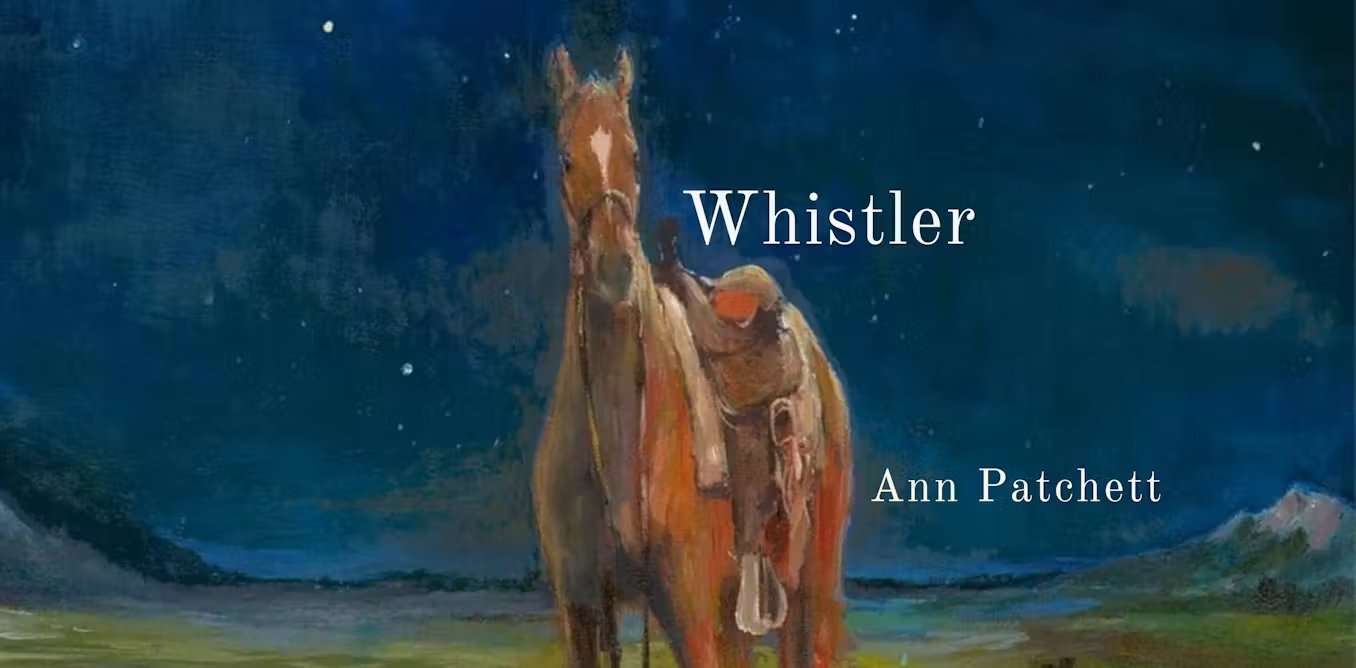
In Ann Patchett’s 11th novel Whistler, a former stepfather and stepdaughter, Eddie and Daphne, meet again by chance after 44 years. They rekindle their bond (before long, Eddie is introducing Daphne as “my daughter”) and revisit the events that prompted Eddie’s abrupt departure from her life when she was nine.
Eddie is a fiction editor beloved by everyone – his name “a bass note called again and again”. Daphne is a private school English teacher “safely past 50”, who describes her post-Eddie childhood as a period of “estrangement”. Both had (unrealised) ambitions to be novelists.
We meet them in the present, in New York’s Met Museum on a spring day, and leave them in their past, “hand in hand” in an ambulance, in Massachusetts in the snow.
Their reunion brings together a handful of wealthy, white-collar, middle-aged and elderly people who are related either by blood, marriage or former marriage. They all reflect, gently, on their lives and relationships. Forgotten family stories are brought tenderly into the light.
Advertisement
There are characters called Trip and Buddy and Candy and Dr Ocean. Despite broken marriages, closeted sexuality and at least one long-term affair, everyone gets along pretty well.
They visit each other’s homes, eat brunch, and occasionally drink slightly too much. They give each other lifts, and take each other to hospital appointments. They bring each other glasses of water, and offer up the guest room. They are forgiving of each other:
I remembered she was a person who had lived her own autonomous life full of mistakes and disappointments and judgements and thwarted love.
The novel’s characters are thoughtful about the past and how to approach it. “Let me know when I cross the line,” Daphne says to Eddie, as they probe the origins of the lifelong affair he has had with his married best friend.
Despite occasional gestures to interpersonal conflicts, everyone is just quite nice to each other. Patchett’s gathering cliches to describe these disputes (the odd “whiff of betrayal” or knowledge of “something fishy going on”) undermine any tension.
Advertisement
Eddie is gay. This is the reason Daphne’s mother divorced him – but there’s no bad blood between them. Their reunion is oddly affectless, as described by Daphne:
“Look at you,” Eddie said when we came through the door. He went right to our mother, took her in his arms. “Look at my beautiful ex-wife.”
Whistler is a chestnut mare in a book Eddie never got to edit. Bloomsbury Publishing
Whistler is full of doomed marriages – deaths, divorces and stepparents abound – but none are framed as tragic or traumatising. Rather, the lingering dead – a roguish father; a wife whose main character trait is collecting rabbit paintings; even a curmudgeonly stepfather whose contribution to American letters is a book series called Positivity! – are spoken of with warmth by those whose new unions their deaths have occasioned.
The dissolution of parental relationships and the formation of new ones are received by turns with delight, equanimity or, at worst, indifference.
Health crises – a car accident, a fall from a horse, appendicitis, leukemia – are not catastrophes. Rather, they occur in the context of high-quality healthcare (“Every patient had their own pod with frosted-glass dividers and floor-to-ceiling windows overlooking the city”) and bring characters together in service of the novel’s central theme: the endurance of familial love, in its multifaceted iterations.
Advertisement
Whistler is a chestnut mare, and the central figure in an unwritten book-within-the-book that editor Eddie “tried for years” to acquire.
It’s a slightly hokey parable about a near-death experience that reads like a pitch for a Mitch Albom (Tuesdays with Morrie) novel. Stranded on a remote hillside, “badly hurt and alone”, Whistler’s rider is benignly visited by her dead dog, son, father and best friend, before the horse returns to save her life.
Like several of Whistler’s key plot points (a broken ankle; the protagonists’ novelistic ambitions; a sister who is a therapist and can therefore unpack any narrative complexities the reader may have overlooked), Patchett offers this story knowingly. Whistler is a novel that knows it’s a novel.
Its metafictionality is sometimes subtle, but it collapses under its own weight in the closing pages, when Eddie suggests that Daphne write “it all down”. In the proposed book, Eddie, who has leukemia, suggests: “I don’t die. In the book, we’re sitting on this bench, talking about a book about the two of us, and then the story stops.” Reading this felt like learning it had all been a dream.
Whistler reminded me of William Stafford’s poem The Magic Mountain, which begins:
Advertisement
A book opens. People come out, bend this way and talk, ponder, love, wander around while pages turn. Where did the plot go?
And yet, there is something compelling about it. Whistler is even, strangely, a pacy read, partly because it’s heavy on dialogue. It doesn’t always work – Patchett’s prose is placid, and there is a lot of exposition.
But it’s interesting to read a novel that so relentlessly engages the idea of niceness, especially among the kind of wealthy people – people who own boats or live in apartments with doormen – who are more often found, in literary and popular fiction, stabbing each other in the back. As Eddie says to nine-year-old Daphne: “I swear to you, it’s mostly good people out there.”
This article features references to books that have been included for editorial reasons, and may contain links to bookshop.org. If you click on one of the links and go on to buy something, The Conversation UK may earn a commission.
Police have launched a major incident public portal as part of their investigation after a man was “stabbed in the chest” in Carrickfergus.
Advertisement
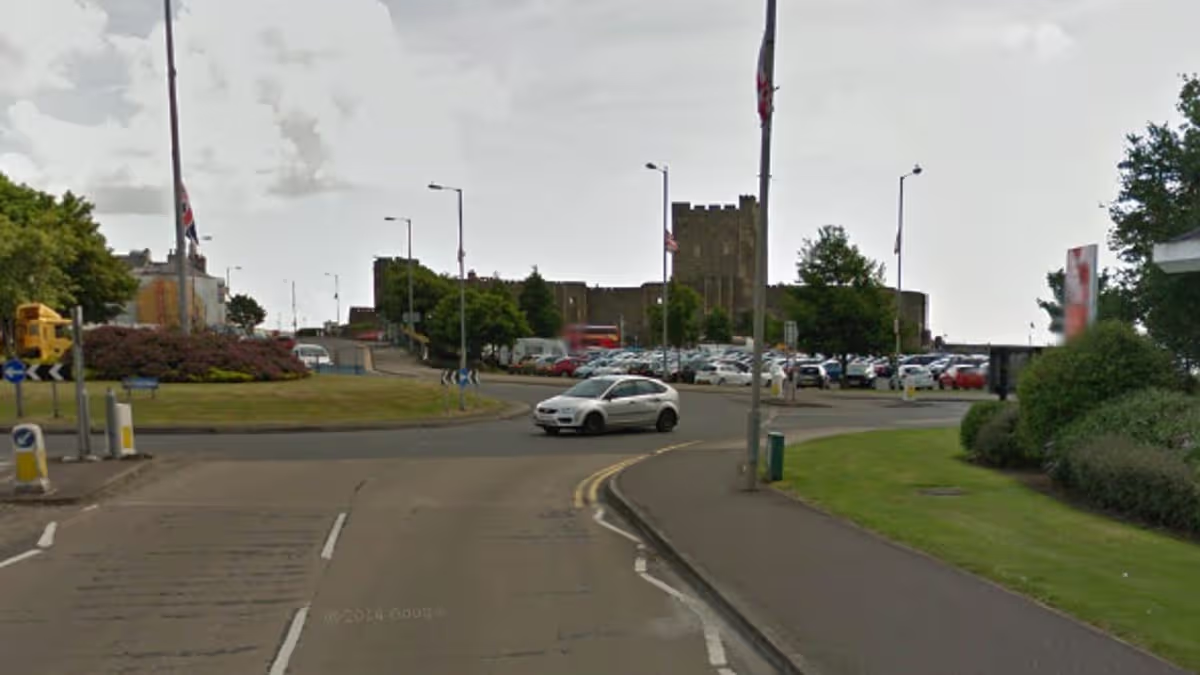
Emergency services attended the Rodgers Quay area at around 7.30pm on Wednesday, May 27, after reports of a stabbing incident. A man was hospitalised after allegedly being stabbed in the chest during the incident, with a suspect reportedly fleeing the scene on a motorcycle.
A 37-year-old man was arrested on Monday, June 1, on suspicion of attempted murder and has since been released on bail to allow for further enquiries.
A 41-year-old man was also arrested on suspicion of attempted murder on Saturday, May 30, and has since been released on bail.
Issuing a further appeal for information, police have launched a major incident public portal to allow the public to submit information directly.
Advertisement
A PSNI spokesperson said any photos or footage, including CCTV, mobile phone, or dash cam footage can be shared with police through the portal. This can be accessed by clicking here, or by scanning the QR code.
A spokesperson for the PSNI added: “Detectives investigating a stabbing incident in the Rodgers Quay area of Carrickfergus at around 7.30pm on Wednesday 27th May, continue to appeal for information.
“Information can also be shared with the Crimestoppers charity anonymously on 0800 555 111 or online at http://crimestoppers-uk.org/.”
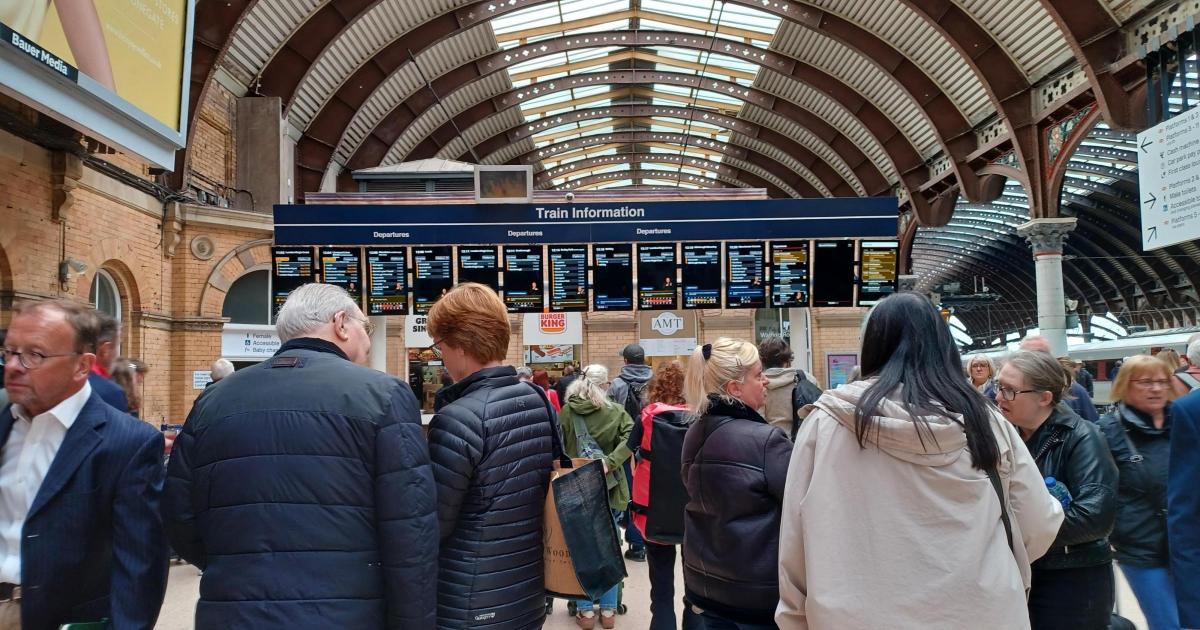
National Rail said a safety inspection of the track between Darlington, Yarm and York means that trains have to run at a reduced speed on the line towards the city.
Recommended reading:
A spokesperson for the train operator information group said as a result, trains may be cancelled, delayed by up to 30 minutes or revised.
Advertisement
Meanwhile, York-based LNER is reporting that none of its services can depart south of York while a safety inspection is carried out between York and Doncaster.
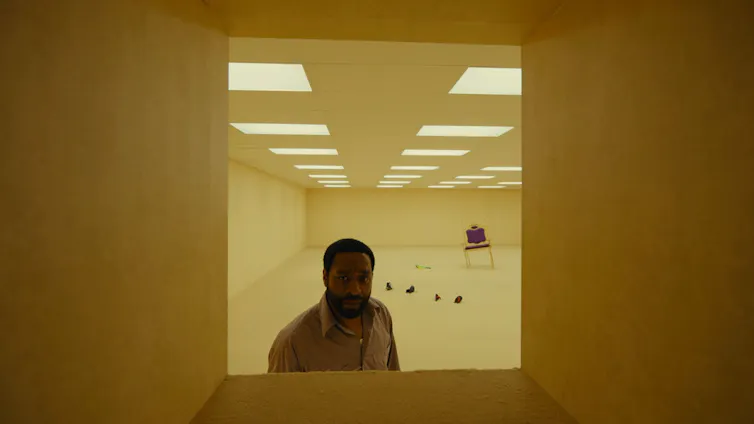
In Backrooms, the latest horror film from production company A24, Chiwetel Ejiofor plays Clark – a failed architect who accidentally slips out of reality. He ends up trapped in an endless labyrinth of yellow-tinted rooms, humming fluorescent lights and eerie, disembodied sounds – the “Backrooms”.
The film is an adaptation of a popular internet horror concept and urban legend, about an impossibly large, alternate-reality maze of claustrophobic spaces with architecture that appears uncannily familiar but menacingly alien.
Yet the film also plays upon a deeper source of modern anxiety: the experience of trying to survive in an economy that fails to deliver on our vision for the future.
Movie audiences will (hopefully) never find themselves trapped in a nauseatingly jaundiced and never-ending labyrinth. But they may recognise Clark’s experience of living among failed promises, diminishing aspirations, precarity, social isolation and the growing fear of becoming obsolete.
Many may also appreciate – if not fully empathise with – Clark’s creeping resentment, sense of entitlement and vitriolic blaming of others for his loneliness and stagnation. The film’s most profound insight emerges through the suggestion that the real nightmare began long before Clark entered the Backrooms.
The trailer for Backrooms.
Trapped before the Backrooms
Clark finds himself ever more adrift from the life he expected to lead. Instead of designing skyscrapers, he runs a struggling discount furniture store at a strip mall. His business is in terminal decline. Customers are scarce, bills are mounting and, unable to afford anything better, Clark sleeps on one of the display beds at his store, waking up to resume work ad nauseam. His life appears to become ever more closed and contracted.
Clark’s tragedy reflects a social experience described by the social theorist Steve Redhead as “claustropolitanism”. It’s the feeling of being “locked citizens” – hostage to circumstances that cannot be changed, dreams that are thwarted before they can be pursued and futures that appear even worse than the present.
Putting aside personal ambitions to take jobs that offer little fulfilment, and enduring difficult working conditions simply to make a living, are increasingly familiar realities in today’s crowded, high-pressure economy. For Redhead, such experiences are symptomatic of “a contemporary cultural condition where we are starting to feel ‘foreclosed’, almost claustrophobic, wanting to stop the planet so we can get off”.
Renate Reinsve plays Clark’s therapist. A24
Cut off from stable social ties, Clark’s growing resentment over his limited economic mobility further holds him back and creates tension between him and the people around him.
Advertisement
When exploring the mysterious Backrooms, Clark ropes his low-wage store employees into a dangerous situation, treating them as largely expendable. He resents his estranged wife’s desire to leave work in pursuit of higher education, a grievance that reveals a malignant sense of entitlement. He uses his therapist (Renate Reinsve), who is dealing with her own difficulties, as an emotional punching bag.
This reflects a significant feature of the claustropolitan experience. In today’s heightened state of economic insecurity, social atomisation and perceived loss of options, where everyday life is marked by existential uncertainty and a diminished sense of control, frustration is often redirected away from structural causes and projected onto vulnerable groups.
The biggest threat to Clark becomes his misplaced anger that attempts to devour anyone who tries to help him. As the world itself feels like it is closing in on him, Clark is revealed as both a victim and participant in this nightmare.
Chiwetel Ejiofor as Clark in Backrooms. A24
The real horror of the Backrooms
The Backrooms, as a concept, offers an important means of thinking about personal and economic anxieties as a tangible environment – anxieties that are reflected not only through enclosure, but by an irregular experience of movement and stasis. In the film, nobody stops moving through nightmarish monotony, yet nobody seems to really get anywhere either.
Characters drift with varying degrees of desperation through an endlessly expanding maze of corridors under the repetitive drone of overhead fluorescent lights. But they never find anything better. There is a primal urge to run away from it all but – just as all options are found to be foreclosed in a claustropolitan economy – all exits are blocked.
Advertisement
The Backrooms film, perhaps even more than the internet legend it’s based on, offers a cautionary reflection on what it feels like to move through a society hemmed in by insecurity, limited opportunities and shrinking possibilities. Its ultimate message is that perhaps the most frightening labyrinth is the one we already inhabit.
My kids tell me this is the BEST toad in the hole ever. They preferred it with cheddar sprinkled over the top rather than Stilton, but you could use either, or indeed any similar cheese (just not Parmesan types, that’s too hard).
You can make this in a roasting tin or ovenproof pan, and serve at the table straight from the vessel. Choose good-quality sausages for the best result.
A police interview with the second alleged victim in Jeffrey Donaldson’s sexual offences trial was played at Newry Crown Court, before she was cross-examined.
17:25, 02 Jun 2026Updated 17:42, 02 Jun 2026
A woman who claims she was raped as a child by Sir Jeffrey Donaldson has told a jury that the alleged incident will stay with her forever.
The complainant told a court of hearing the former DUP leader’s “heavy breathing” during the alleged sexual assault.
A police interview with the second alleged victim in Donaldson’s sexual offences trial was played at Newry Crown Court, before she was cross-examined.
Advertisement
The ex-MP, 63, has pleaded not guilty to 18 alleged offences.
The charges span a time period between 1985 and 2008 involving two alleged victims.
Eleanor Donaldson, from Dublinhill Road, Dromore, Co Down, denies several charges of aiding and abetting her husband’s alleged offending.
She is facing a trial of the facts.
Advertisement
Complainant B, one of the two alleged victims, was not in the courtroom, but appeared via a video link.
Her ABE (achieving best evidence) interview with police was played to the jury of seven men and five women on Tuesday morning.
Jeffrey Donaldson sat in the dock at the rear of the courtroom, while the interview, which was recorded in March 2024, was played.
Occasionally he shook his head during the evidence.
Advertisement
In the interview, the complainant said that growing up she was “sexually abused by an adult”.
She said she particularly remembered two incidents.
The woman frequently became emotional during the interview.
In the first, she claimed, Donaldson had put his hands down her underwear, pulled her legs apart and then sexually assaulted her.
Advertisement
She said the second incident occurred when she was slightly older when, she said, Donaldson “lifted up my top” and touched her breasts.
Asked by a police officer if there were other incidents, she said she remembered “his hands down my pants a lot”.
She said: “I remember I couldn’t tell anybody, I remember telling my imaginary friend.”
Asked by police for the name of her alleged abuser, she said “Jeffrey Donaldson MP”.
Advertisement
Asked about the first incident, she said it occurred when she was of primary school age.
She said: “I remember being really still and all I could hear was his breath.”
The complainant said she remembered Donaldson putting his hands down her pants and thinking “please, let this be it”.
The complainant said Donaldson put his feet between her feet and pulled her legs apart.
Advertisement
She said: “I kept thinking ‘it is OK, it will be over soon’ … I remember hearing his breathing.”
The complainant then said she felt “something different”.
She said: “First of all, I didn’t know what it was because I could still feel his hands.”
She then said he sexually assaulted her.
Advertisement
The complainant said: “I don’t know if it continued or if that was it.”
She added: “I just kept my eyes closed.”
She said: “I just remember hearing his heavy breathing.”
Complainant B said the second incident occurred when she was of secondary school age.
Advertisement
She said: “He lifted up my top and started playing with my breasts.”
She said Donaldson was standing “right in front” of her.
The complainant said that Eleanor Donaldson had witnessed part of the alleged incident and “walked away”.
Complainant B later told the jury that Donaldson had apologised to her at a meeting arranged at a Christian centre in Co Antrim years later.
Advertisement
“He apologised for what he had done to me in the past,” she said.
The witness was then cross-examined by Kieran Vaughan KC, barrister for Jeffrey Donaldson.
He referred to her claim that she had told her imaginary friend about the abuse while playing with a Christmas present she had received as a young child.
The barrister said: “It is a detail you have conjured up to make your account more plausible.”
Advertisement
She responded: “I disagree with you on that.”
The barrister pointed to an inconsistency in the age she told a counsellor the abuse had happened and what she later told police.
He said: “I am suggesting none of this happened.”
Complainant B said: “It is quite naive for you to say that.
Advertisement
“Everything I am saying is the truth … no matter how many questions people ask me it will never change that.”
He said: “I suggest you are in the position now that you just have to stick with the story you gave.”
She said: “Nothing will change what that man did to me.”
The barrister put it to her that she said she remembered two incidents of abuse “vividly”, but was “less certain” about the details of other events.
Advertisement
She said: “I know that they happened, I just don’t want to remember details.”
Turning to the alleged rape, he said her recollection of what had happened was “very poor”.
Complainant B responded: “My recollection is really vivid because I live with that every day.”
The barrister pointed out that she could not remember what age she was at the time of the alleged incident.
Advertisement
She said: “The actions that night I will never forget, what happened that night will live with me forever.”
She continued: “What did I do, what did I wear, what did I say to make that OK?”
Mr Vaughan suggested the incident “did not happen” and asked her why she did not tell anyone about it at the time.
She said: “It was my biggest mistake not telling anybody back then … I regret that every day.
Advertisement
“I didn’t know the words, I knew it was wrong.”
Turning to the second incident, the barrister said the defence case was that Donaldson had not touched the complainant inappropriately.
Again, he asked her why she did not tell anybody.
She said: “I was this kid who had stuff done to her that shouldn’t have been done by an adult.
Advertisement
“I wish I could go back in time and shout and scream and do something. I have to live with that.
“I was a kid, I didn’t know what to do, so therefore that kid did nothing.”
The trial resumes on Wednesday.
Jeffrey Donaldson, a former long-standing MP for Lagan Valley, was arrested and charged at the end of March 2024.
Advertisement
He resigned as DUP leader and was suspended from the party after the allegations emerged.
Weeks before his arrest, he had led the DUP back into devolved government at Stormont after a two-year boycott of the powersharing institutions.
Gardening expert Alan Titchmarsh has shared his natural approach to June lawn care
Gardening enthusiasts know all too well that summer brings a mountain of jobs, from tending to flourishing plants in hanging baskets and borders to ensuring potted varieties grow tall enough to produce delicious fruit. While maintaining lawns is crucial year-round, it becomes even more important during spring and summer.
Advertisement
Despite the rising trend of ‘no-mow May’ aimed at boosting biodiversity through wildflowers, gardening legend Alan Titchmarsh chose not to embrace the movement.
He stated: “All gardens should have a bit of long grass, but it’s how you garden that matters. If you’re organic, as I have been for 40 years, and have a garden with lots of flowers, all types of wildlife will be happy.”
This philosophy also underpins his fuss-free lawn maintenance approach.
Writing for Country Life magazine, the celebrated British gardener revealed his straightforward lawn care routine, which he restricts to “weekly mowing and fortnightly edging in spring and summer”.
However, come June, he dedicates himself to one crucial task for encouraging healthy grass: a straightforward technique that anyone can follow.
Alan remarked: “I feed with the ubiquitous blood, fish and bone in April and again in June, and extract any large rosettes of plantain or dandelion with a daisy grubber.”
This specific fertiliser, fish, blood and bone, replenishes nutrients that have been lost, promoting vigorous grass growth and helping to create a healthier lawn. The nitrogen-rich nutrients present in organic lawn feed are gradually absorbed by plant roots, making it a superb fertiliser for leafy vegetation including grass, lettuce and brassicas.
Advertisement
Instructions for using organic lawn nourishment advise that for established lawns, a spreader should be used to apply it uniformly at 70g/m2 as a top dressing.
After application, it’s advisable to water the lawn immediately with a hose fitted with a gentle spray setting.
The product also works well for flowering plants, as specialists note. Prior to planting, Fish Blood and Bone Meal should be incorporated into flower bed soil at a rate of 140g/m2.
Advertisement
Alan, who also presents ‘Love Your Garden’, revealed he ditched chemical lawn feed and weed killers “years ago”, resulting in greater wildlife presence in his garden.
He describes his pleasure at watching blackbirds extracting worms from his chemical-free lawn to nourish their young, satisfied that no herbicides are involved.
Regarding weed management, deploying a daisy grubber can effortlessly extract large clumps without them looking conspicuous amongst the diverse plants flourishing in Alan’s own lawn.
Despite his preference for an organic lawn care approach, Alan still values the look of a striped lawn. Explaining his method, he commented: “My rotary mower has a rear roller that produces the stripes I love, but, mercifully, the botanic-garden mixture of close-mown plants that constitutes my lawn offends my sensibilities not one jot.”
The Scottish parliamentary election in May saw Reform UK return the same number of MSPs to Holyrood – 17 – as Scottish Labour. This remarkable result – effectively from a standing start – showed that the party is now a force to be reckoned with in Scotland just as in other parts of the UK. But where did it attract votes north of the border?
My analysis examines constituency-level patterns in support for Reform UK, compared with the other main parties. It focuses on three constituency characteristics: deprivation levels, whether it is classified as urban or rural, and centre–periphery location. The aim is to identify broad territorial patterns in party performance, rather than to draw firm conclusions about individual voters.
The figures discussed here are average vote shares across constituencies within each category. In other words, they show the average party result in, for example, more deprived constituencies compared with less deprived constituencies. This approach is useful for mapping the territorial profile of party support, but it should be complemented with individual-level data before drawing firm conclusions about voter motivations or social characteristics.
The first pattern concerns deprivation. Reform UK support appears to be higher in the most deprived third of constituencies than in the least deprived third. On this dimension, Reform looks closer to the SNP-Green and Labour pattern than to the Conservatives and Liberal Democrats, whose support is more concentrated in less deprived constituencies.
Advertisement
This does not mean that Reform voters are necessarily more deprived at the individual level, as constituency-level data cannot show this. But the aggregate pattern is still important. It suggests that Reform is performing relatively better in places where socio-economic pressures are more visible, and where dissatisfaction with existing political options may be more pronounced.
Party support and socio-economic territorial divideReform performed relatively better in areas with visible socio-economic pressures. Dr Davide Vampa, CC BY
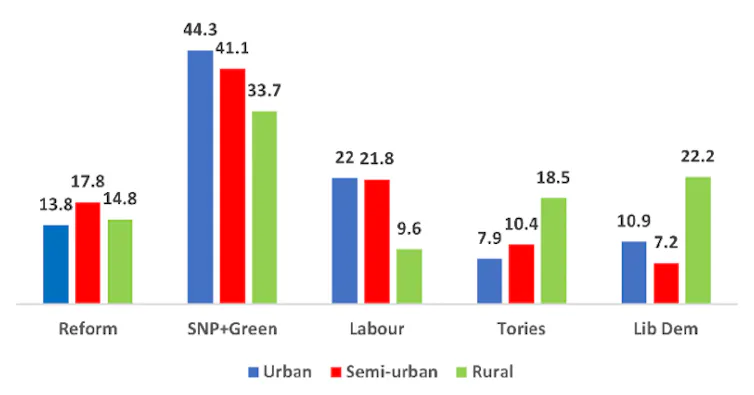
The urban-rural pattern points to a distinctive Reform geography. Reform appears to perform best in semi-urban constituencies, rather than in the most urban or most rural areas. This separates Reform from the Conservatives and Liberal Democrats, who perform more strongly in rural constituencies. It is also different from the SNP-Green vote, which is strongest in urban constituencies.
Semi-urban constituencies may be politically important because they often combine proximity to major cities with a feeling of distance from them culturally or socio-economically. These areas may therefore provide fertile ground for parties appealing to voters in places that are close to urban centres, but do not necessarily share fully in their economic opportunities, public investment or cultural politics.
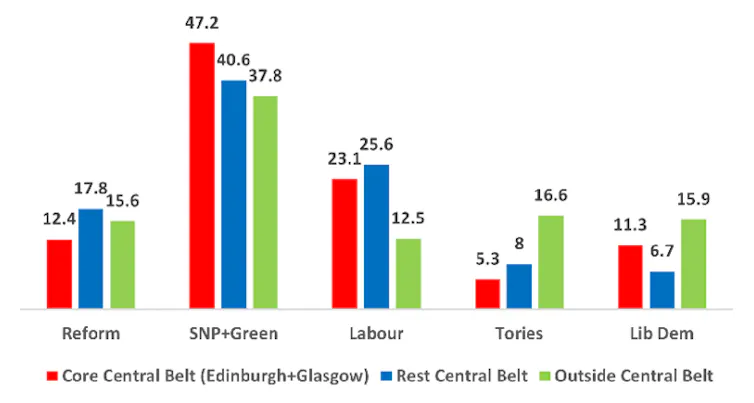
The centre-periphery divide adds another layer to this picture. Here, centre-periphery refers to three types of area: Edinburgh and Glasgow as the core of the central belt (Scotland’s main population corridor), other constituencies within the central belt but outside the two-city core, and areas beyond the central belt. Reform performs better immediately outside the Edinburgh-Glasgow political core than within it.
This pattern is again distinctive. The SNP-Green vote is more clearly concentrated in the core central belt, while the Conservatives are stronger in more peripheral constituencies. The Liberal Democrats display a U-shaped profile across the centre-periphery divide, performing relatively well both in core and more peripheral areas.
Reform’s profile is different: it is generally stronger in the periphery of the central belt than in the periphery of Scotland as a whole. In this sense, its geography is not simply one of rural or peripheral conservatism, but one of places within the central belt but outside its core. In other words, close to where political power is concentrated, but not fully part of it.
Party support and the centre-periphery divide
Advertisement
Reform’s vote was strong in constituences that lie close to – but outside – where power is concentrated. Dr Davide Vampa, CC BY
The contrast with the Conservatives is one of the most important findings. Reform UK’s pattern of support looks quite different from the Conservative map. While there may be overlap between the two electorates, Reform does not simply reproduce the traditional Conservative geography.
This matters because it challenges the idea that Reform’s support in Scotland can be understood simply as a Conservative splinter or replacement vote. Its territorial profile points to a potentially broader appeal, particularly in more deprived and semi-urban constituencies.
Overall, the results suggest that Scottish party competition is structured not only by ideology or national identity, but also by clear socio-economic and territorial divides. The SNP-Green and Labour vote is more urban and central, with some strength in deprived constituencies. The Conservative and Liberal Democrat vote is more rural, peripheral and less deprived.
Reform UK occupies a distinctive position: more deprived than the Conservative map, more semi-urban than rural, and stronger outside the core central belt without simply replicating the geography of established unionist parties.
These findings remain preliminary. Still, the constituency-level evidence suggests that any serious analysis of Reform UK’s performance in Scotland needs to take these territorial divides seriously.














































You must be logged in to post a comment Login