One day last September, a five-page letter landed on the desk of Chris Havergal, the editor of Times Higher Education.
It was sent by Carter-Ruck, a famously combative law firm whose roster of clients has included various Russian oligarchs, crypto fraudsters and scandal-affected celebrities, along with the ultra-litigious Church of Scientology.
This time, they were representing a different sort of complainant: Jason Arday, a man the letter described as a ‘distinguished and highly respected scholar of race, inequality and education’ at Cambridge University.
Arday, 41, is a high-profile academic who boasts a Hollywood-style life story. Raised on a housing estate in Clapham, south London, by working-class immigrants from Ghana, he was allegedly diagnosed with a severe form of Asperger’s aged three.
This not only rendered Arday unable to speak until the age of 11 (and incapable of eating unaided until he was seven), it also resulted in him being completely illiterate for his entire childhood.
After finally learning to read and write when he was 18, in 2003, Arday’s life was transformed. Dragging himself up by the bootstraps, in a manner reminiscent of Forrest Gump, the disabled child from a hard-scrabble background (who had been written off by teachers and society) commenced a remarkable career in academia.
First, Arday studied for a BTech at the local college. Then, in 2008, he earned a bachelor’s degree (in PE and education). Two master’s degrees followed, plus a PGCE teaching qualification, and, in 2016, a PhD from Liverpool John Moores University.
Professor Arday, as he duly became, continued his miraculous ascent up the greasy pole of higher education via a series of increasingly senior jobs at Leeds Beckett, Warwick, Glasgow and Durham universities.
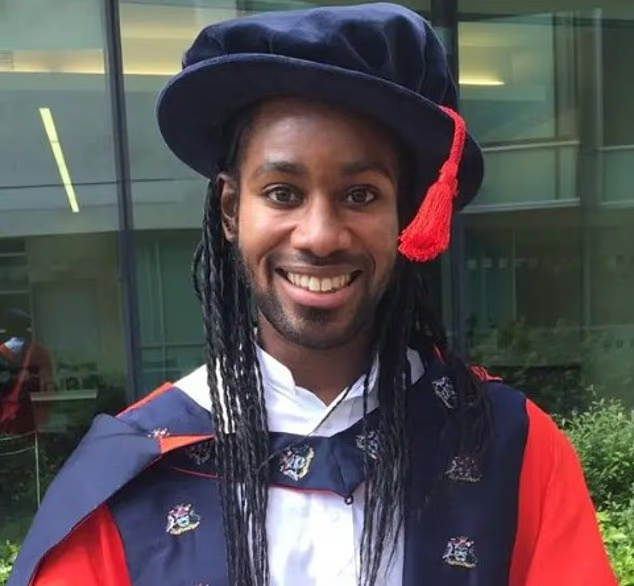
Jason Arday was described as a ‘distinguished and highly respected scholar of race, inequality and education’ in a letter complaining to the editor of Times Higher Education
Professor Arday appeared on This Morning in March 2023 to discuss becoming Cambridge’s youngest ever black professor
In 2023, he was made Professor of Sociology by Cambridge, the academic equivalent of climbing Everest. Fawning interviews in The Guardian and on the BBC duly celebrated his status as the ancient seat of learning’s ‘youngest ever black professor’. Oh, and along the way, he single-handedly raised £5.5million for charity.
Lucrative accolades followed, with Arday hired to give Ted talks and motivational speeches at corporate events in the UK and US. At least four universities handed him honorary degrees and he was nominated three times for a Pride of Britain award. The Royal Society of Arts made him a fellow, and he was invited to guest-host a Christmas edition of Radio 4’s Today programme.
So far, so heartwarming. Yet in the dusty corridors of academia, where petty rivalries often fester, not everyone was convinced by the fairytale rise of this poster boy for diversity.
Specifically, there were growing rumours that much of Arday’s work, including his PhD thesis and several studies he’d published in academic journals, had been plagiarised. Some peers had concerns about his methodology.
Perhaps unfairly, given not only his background but also the fact that he identifies as dyslexic, there was also sniping about spelling and grammar. Critics noted that the title of his PhD thesis contains an errant apostrophe, while in a 2019 presentation about alleged racism in the university sector he’d complained about the ‘poultry numbers’, rather than ‘paltry’, of ‘black academic leaders’.
That’s where Times Higher Education came in.
The prestigious magazine, which covers academia, was tipped off in early 2025 about the thorny allegations. A reporter named Jack Grove had spent at least four months scrutinising them, before submitting a series of questions to Professor Arday.
By September, an article was on the verge of publication, only for Carter-Ruck to send off its five-page letter, which threatened dire consequences should any such claim of wrongdoing be made.
Grove never did publish an article about the plagiarism claims. Or to put things another way, the story appears to have been killed. Good controversies are rarely hushed up for ever, though. And last week, the plagiarism controversy finally reared its ugly head via a blog post from one Nathan Cofnas, an academic formerly of Emmanuel, a Cambridge college, but now based at Ghent University in Belgium.
He identified more than 100 passages from Arday’s thesis that he claims are identical (or nearly identical) to an obscure 2009 PhD thesis by Paula Zwozdiak-Myers, of Brunel University in west London. After several newspapers, including the Daily Mail, reported his findings, various online sleuths piled in, using X to post screenshots of purportedly flawed or plagiarised studies and articles from his back catalogue.
Perhaps inevitably, the whole thing quickly became the subject of a vigorous culture war.
More than 100 passages from Arday’s thesis were claimed to be identical (or nearly identical) to an obscure 2009 PhD thesis
Professor Jason Arday after delivering a lecture on equity, diversity and belonging, which was chaired by Professor Heath Rose and Dr Debbie Aitken
Cambridge insists there is no case to answer, saying it ‘takes allegations of academic misconduct incredibly seriously’ and stating that ‘allegations of plagiarism regarding his thesis and some of his journal publications have been investigated by Liverpool John Moores University and the journals in question’ with no wrongdoing found.
A Left-wing pressure group, the Good Law Project, went a step further, urging supporters to sign a ‘solidarity letter’ claiming the controversy was part of a ‘smear campaign’ motivated by racism. Signatories include such hard-Left politicians as Zack Polanski, Clive Lewis and John McDonnell.
On the other side of the divide stand a host of academics and commentators (including, I am told, many at Cambridge). They believe the university’s handling of the dispute risks seriously damaging its reputation for academic integrity. Several high-profile figures have argued that, to quote an article by the philosopher Professor Kathleen Stock, Arday is being given special treatment due to his ‘heroic, DEI-friendly back-story’ – ‘DEI’ referring to ‘diversity, equity and inclusion’.
Whoever is right, the dispute comes at an awkward time: Arday will, at the end of the month, publish an autobiography called Great And Unfortunate Things.
It purports to be an ‘unforgettable book about resilience and love’ and carries an endorsement from the actress Kathy Burke, who dubs him a ‘unique and extraordinary man’. The publisher Simon & Schuster has arranged for Arday to undertake a ‘lecture tour’ across both Britain and America to promote it.
Such events won’t just be overshadowed by a plagiarism row, either. For Arday is now navigating further scrutiny of claims he’s made about his life outside higher education.
The most striking involve the aforementioned charity work. Since his elevation to academic superstardom, the professor has been repeatedly dubbed a ‘prolific fundraiser’ and ‘philanthropist’. Specifically, he claims to have raised an astonishing £5.5million for good causes, largely by taking part in a series of sponsored athletic-endurance events.
Like so much about Arday’s life, this contention hinges on a heartwarming back-story, which has been told, and retold, countless times since he achieved fame. It begins at homeless shelter, where he was taken by his mother at the age of 18 in 2003, the year he says he learned to read. After being introduced to residents, Arday claims to have decided, to quote a 2021 Ted talk, ‘to dedicate my life towards helping people… dedicate my life towards charity’, saying: ‘My lifelong ambition was to raise £1million for charity before I turned 40. And at 36 I have raised just over £5million.’
His citation for a Pride of Britain award said that ‘in total, he has raised more than £5million for 80 charities over an 18-year period’. And by 2024, the amount had risen to £5.5million, according to a paid speech Arday made in New Orleans to America’s National Funeral Directors Association.
Perhaps ironically, given that he was facing a room of people who make their living from cremation, his speech was entitled You Can’t Start A Fire Without A Spark.
‘My target was to raise £1million for charity before I turned 40, but by the time I’d got to 30 I’d raised over £3million and at the moment it’s £5.5million and counting,’ he told the assembled undertakers. Five and a half million pounds is a spectacular sum. In fact, it would make Arday one of Britain’s most successful charity fundraisers since Captain Tom.
But details about his selfless exploits (for which he once claimed to have been offered, but turned down, an MBE) are shrouded in mystery.
It’s unclear, for example, which charities were among the 80 lucky recipients of Arday’s largesse (only three or four have ever been named). There have been no media reports or press releases issued to mark him handing over five or six-figure sums to particular good causes. No financial breakdown of his donations has ever been published.
The most detail Arday has provided came in that National Funeral Directors Association speech, in which he told the audience that almost all the loot was raised via three big sponsored runs: ‘I had an opportunity to do a series of ultra-marathons over a five-year period, which earned just over £5million for charity,’ he said.
It seems that the five-year period in question kicked off in 2010, when local newspapers in south London covered an attempt by Arday to complete 30 marathons in 35 days, mimicking a similar initiative by the comedian Eddie Izzard.
A JustGiving page for that project, which was quite widely documented by the local media, shows that it generated a grand total of £6,285 for the Shooting Star Children’s Hospices.
Professor Arday runs the first of 30 marathons across 35 days in 2010, which was shown to raise £6,285 for the Shooting Star Children’s Hospices
Arday completed his ultra-marathon challenge at Piccadilly Circus and later was reported to be running to raise loot for the homeless charity Shelter
The charity said this week that he’d raised just over £10,000 in total. Arday was photographed completing the challenge at Piccadilly Circus. Whether he actually completed his second high-profile fundraiser is trickier to establish, however.
In July 2011, the Wandsworth Guardian reported that he’d be running 300 miles in three days on treadmills to raise loot for the homeless charity Shelter, starting at the Fitness First gym at Clapham Junction and finishing at Latchmere Leisure Centre in Battersea. ‘He aims to be on the treadmill from 6am to 10pm every day,’ it wrote.
A post on Shelter’s social media feed five hours into the endeavour, which kicked off on August 10, suggests that he did indeed start. But no photos or other records of him finishing survive.
A Facebook page dedicated to the challenge suggests it ended in failure, with a post from someone called ‘Elain’ saying: ‘You’ve overstepped the mark and your body has said enough !!! . . . sorry that your challenge is over but your body and health come first.’
Since Arday has, in recent years, given dozens of speeches claiming that he did run 300 miles in three days, we must assume he tried again at a later date. No records of such a venture survive, however, and it received no contemporary local media coverage. A surviving JustGiving page for the initial attempt records earnings of £380.
The Cambridge professor’s third and most extraordinary feat of alleged endurance came in 2015. This time he claims to have run from Edinburgh to London. Although the cities are 400 miles apart he says he covered 600 miles in just six days.
Arday has repeatedly spoken about this remarkable journey, but his memory of specifics can be sketchy. In a speech at the Greenbelt Festival in 2024, for example, he claimed the whole thing put his earnings for charity over the £1million mark, rather than the £5million he cited at the later speech in New Orleans.
‘The final challenge when I was 30, I ran 600 miles in six days. And I was fortunate that I got to that target of £1million before I turned 30,’ he said.
No photographs or other contemporary records of the 600-mile run have ever been published. Which, in turn, has led to scepticism among experts. Damian Hall, who has represented Great Britain at ultra-running, told reporters this week: ‘I haven’t heard of Jason before. Running 30 marathons in 35 days is perfectly possible and several runners, not necessarily elite, have done similar.
‘Running 100 miles in 24 hours is also perfectly possible, but it’s very hard to keep that going for two more days without good breaks for sleep. Not impossible, but pretty unlikely.
‘The 600 miles in six days is, again, not impossible, but would be remarkable, akin to the very best record-breaking ultra-runners. It seems odd that there appears to be no evidence of that.’
Intriguingly, Southampton Solent University, which awarded Arday an honorary degree in 2023, recently changed the original reference of 600 miles in six days to 600 miles in 12 days on its website.
Whatever actually happened, Arday’s exploits came at a physical cost. Andy Murray, who met him during the 2012 Olympic torch relay, once told journalists that Arday ‘is an epileptic who ran 30 marathons in 35 days. He told me on the 20th day he fell – he had a seizure – and had a hairline fracture in his leg but carried on . . . It was pretty cool speaking to someone like that’. In a separate interview, Arday has claimed that the fracture caused his leg to swell up to twice its normal size.
Epilepsy isn’t the only severe medical issue he claims to have overcome, either. In a 2022 interview, Arday made the dramatic admission that while studying for his PhD (and, we assume, training to run 600 miles in six days) he was also suffering from a debilitating brain tumour.
‘I completed my PhD in 2.5 years working full time, but the reason why it was particularly significant . . . is that at the time I had a brain tumour, and I had my brain tumour removed two weeks before I had my viva.’
He added that he’d also suffered a stroke ‘straight after’ the operation ‘so I didn’t remember anything’ during the viva, Cambridge’s much-feared oral examinations, at which candidates are interrogated in person by dons to defend their theses.
Whether this chapter in his medical history features in his autobiography is unclear. But it suggests that the professor is a living, breathing medical miracle with remarkable powers of recovery, especially since in a 2023 interview The Guardian reported that ‘he has barely slept over the past 15 years . . . working through most nights – often on his academic and charity work, but sometimes just to make ends meet’.
No photographs or other contemporary records of the promised 600-mile run from Edinburgh to London have ever been published
Arday said he suffered a stroke ‘straight after’ an operation and therefore ‘didn’t remember anything’ during the viva, Cambridge’s much-feared oral examinations
Arday’s mysterious sporting prowess doesn’t just involve running, either. He has also claimed to be an elite soccer player, telling one interviewer: ‘As a child, I was fortunate to play football well, so I was in the academy system and then played semi-professionally.’
It’s unclear which academy he represented, but his senior career, such as it was, seems to have involved a stint as goalie for Lewisham Borough in the Southern Counties East Division One, which is the tenth tier of English football, at the bottom of the non-league pyramid.
Elsewhere, confusion surrounds other aspects of his charitable endeavours. A potted biography on the Greenbelt Festival website, for example, states that he ‘has also undertaken and completed relief work in South America and West Africa with WaterAid installing water points, which provide drinkable and clean water’.
Oddly, according to WaterAid’s website, it has a policy of never sending volunteers abroad, adding that ‘out of respect for the people we work with, we don’t encourage or facilitate self-funded visits either’. WaterAid has no record of him doing any volunteer work, but says it’s possible that he travelled overseas with a partner organisation of some sort.
After questions were raised about this discrepancy, the Greenbelt Festival web page (which carried a recording of his speech) disappeared.
Of course, whether the professor’s academic reputation (along with that of his employers at Cambridge) is also about to vanish remains to be seen.

























































You must be logged in to post a comment Login