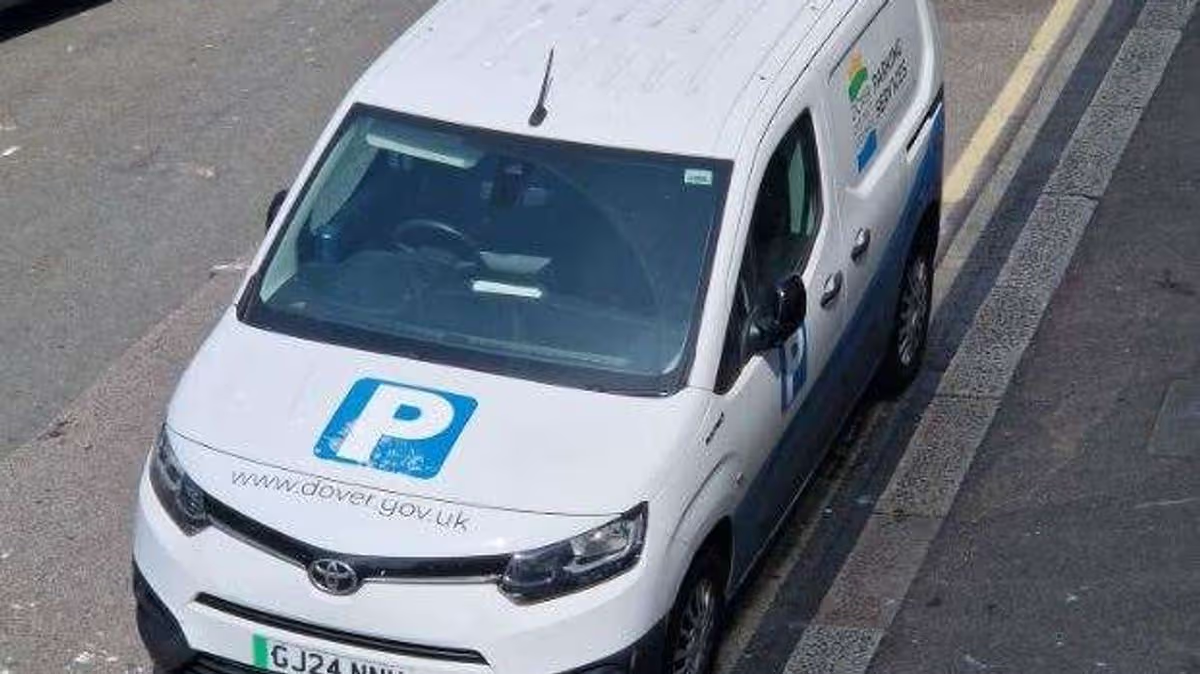
A driving instructor was “outraged” to see a parking warden leave their van on double yellow lines – but the local council insists it was all above board. John Allison took a picture of the scene outside his home in Russell Street, Dover, where a double yellow line is in place as otherwise emergency vehicles are obstructed from getting past.
“Do they give themselves a ticket?” the 48-year-old asked. “My gut instinct was that it was a double standard. I’ve seen other cars get tickets for exactly the same thing. You see so many other cars getting parking tickets for stopping there, even just for a few minutes. My feeling is that it’s just a bit outrageous that they feel like they can park there.”
Mr Allison says he took the picture just before 11am on Friday, May 29. His frustration is exacerbated because he can’t get a parking permit to use the bays on the other side of his street. He says he has to either park in the neighbouring St James’ Retail and Leisure Park or on residential streets further away, meaning he needs to walk some distance to and from his car.
Advertisement
Parking wardens, officially known as civil enforcement officers (CEOs), are employed by Dover District Council (DDC). A spokesperson said: “Parking services were carrying out operational duties at this time, which included loading and unloading from the vehicle, which is permitted under the regulations.”
According to the RAC, parking on double yellows while loading and unloading “may be permitted, providing you can be seen doing so continuously”. It is not allowed if there are specific restrictions against it, indicated either by signage or yellow ‘kerb dashes’.
In a similar incident elsewhere in Kent two years ago, parking wardens in Whitstable came under fire for leaving their vehicle on double yellow lines to issue a ticket to someone else, sparking an investigation by Canterbury City Council.
One officer told the person filming them that they could stop there in an emergency. When asked what that was, they said: “To give that ticket.”
In a post on Truth Social, the president wrote: “Yesterday, in a meaningless vote, the House voted, 4 bad Republicans and all of the Dumocrats, to limit my War Powers, right in the middle of my final negotiations to end the War with the Islamic Republic of Iran. Who would do such an unpatriotic thing.”
WASHINGTON (AP) — President Donald Trump is facing warnings from foes and allies alike that he’s getting boxed in on the Iran war, a conflict he sold as a brief military incursion but that has since settled into a holding pattern.
But Trump has called for unspecified changes to the agreement and Iranian officials — perhaps calculating that the Republican president is reluctant to restart the bombardment after burning through key weapons systems — are showing no signs they’ll give in to new demands.
A series of strikes by the U.S. and Iran this week has raised fresh concern that the ceasefire could collapse. Trump on Wednesday downplayed the significance.
Advertisement
“It’s a different part of the world,” Trump told reporters in the Oval Office. “You know, I’d say in that part of the world, a ceasefire is when you’re shooting in a more moderate manner.”
The shaky moment follows repeated claims by Trump since a 14-day ceasefire was agreed to on April 7 — following 38 days of U.S. and Israel bombing of Iran — that a deal is just days away and the Iranian side is begging to come to a settlement. Trump on Wednesday said it was possible something could come together “over the weekend.”
Without an interim settlement in place to reopen the Strait of Hormuz,global energy prices remain elevated and are adding to anxieties around the world about the impact of rising costs spurred by the three-month conflict on the cost of food, fuel and other goods.
After a string of reports this week that Iran was shutting down talks, Trump told CNBC he “couldn’t care less” if the negotiations had bogged down and even mused they had become “boring.”
Advertisement
There’s anxiety Trump is getting boxed in
There’s growing concern inside the administration and among key advisers and allies that Trump now finds himself in a bind, according to a U.S. official and another person familiar with the administration’s internal deliberations, both of whom spoke to The Associated Press on condition of anonymity to discuss private conversations.
Trump is privately hearing from other Republican lawmakers as well as Pentagon officials and Gulf allies that a return to the bombing campaign is a bad idea.
Those advising against returning to military action note that the U.S. has burned through munitions at too fast of a rate. It could take three years to replenish some key weapons systems.
Advertisement
Meanwhile, Gulf allies are worried that Iran will retaliate against them and their critical infrastructure and energy interests and further set back their economies.
At the same time, Trump has bristled at the idea of accepting a deal that resembles the 2015 nuclear agreement brokered by Democrat Barack Obama’s administration, which restricted Iran’s nuclear program in exchange for lifting international economic sanctions.
Trump during his first term abandoned the pact that he said had failed to permanently stop Iran’s nuclear program, ignored Iran’s ballistic missile development, and did not penalize Iran for supporting militant proxy groups across the Middle East.
Now, Trump, according to those familiar with internal deliberations, has made clear he feels strongly he can’t make “a bad deal” and is acutely aware that he’s at a moment where he’s at risk of tarnishing his legacy if he missteps.
Advertisement
White House spokeswoman Anna Kelly dismissed the notion that Trump has been boxed in or that there’s any concern within the administration about the pace of talks.
“These mysterious so-called ‘administration officials’ have no idea what they’re talking about — those actually involved in sensitive discussions know to trust in President Trump, who will always do what is best for U.S. national security,” Kelly said in a statement.
Trump resisted Israel push for Lebanon bombings
Israeli and hawkish allies in Washington have made the case to Trump that a deal at this point would amount to unconditional surrender, urging him to ratchet up economic pressure on Iran and back Israel’s assault on the Hezbollah militant group in Lebanon.
But Trump earlier this week in a heated call with Israeli Prime Minister Benjamin Netanyahu demanded Israel stand down, and on Wednesday, Israel and Lebanon said they agreed to renew a ceasefire. Hezbollah was not part of the Israel-Lebanon talks, which have been held at the ambassadorial level in Washington since the beginning of last month.
Advertisement
Remaining in the current status quo with Tehran — neither a full resumption of hostilities nor sealing an interim agreement to restart nuclear talks — is a situation that Iran appears better poised to exploit, argues Behnam Ben Taleblu, a senior fellow at the hawkish Washington think tank Foundation for Defense of Democracies.
Despite being the weaker party, Iran appears to be calculating that the longer the holding pattern lasts, the better the chances are they can “box in” Trump, he added.
“Either way, Tehran appears more resolute than ever to not provide Trump with a victory image, hence why it isn’t budging on the battlefield or negotiating table,” Taleblu said.
Holding pattern isn’t helpful for Republicans on the ballot
At the same time, Democrats are trying to capitalize on Trump’s handling of the unpopular war ahead of November’s midterm elections. The House of Representatives on Wednesday for the first time passed a symbolic resolution calling for a halt in military action against Iran, with four Republican lawmakers joining Democrats in the rebuke of Trump’s war.
Advertisement
During hours of hearings on Capitol Hill on Tuesday and Wednesday with Secretary of State Marco Rubio, Democrats laced into Trump for discounting the economic impact of the conflict on Americans and for failing to anticipate that Iran would shutter the Strait.
In one tense exchange, New Jersey Democratic Sen. Cory Booker pointed to the unsteady ceasefire as a sign that Iran has the upper hand.
“We are the strongest nation on the planet Earth, and we’re in a stalemate with Iran,” Booker said. “And now we’re begging to get back into a deal that you all trashed in the first place.”
Rubio dismissed the criticism, underscoring that Iran has been placed on its heels with the strikes that have taken out multiple layers of senior leadership and left Iran’s economy in shambles.
Advertisement
“There’s no one begging,” Rubio responded. “I don’t know where you’re getting this perception that Iran is stronger.”
Another Democrat, Sen. Chris Van Hollen of Maryland, homed in on Trump’s comments last month that voter anxiety about the cost of living was “not even a little bit” of a motivating factor for him to reach a deal to end the war.
The president continues to downplay the rising costs for Americans at the pump and predict that gas prices would fall sharply after the conflict ends.
Christopher Borick, the director of the Muhlenberg College Institute of Public Opinion in Pennsylvania, said that Democrats running in swing districts around the country are already zeroing in on Trump’s rhetoric on the war’s impact on Americans’ pocketbooks.
Advertisement
“There’s significant risk in having this thing drag on for Republicans,” Borick said. “It’s certainly going to hurt if Trump ends up in a place where the war ends and Iran’s nuclear program is in the same place. But for Republicans in some of these tough swing districts, there’s a case to be made to rip the bandage off now, get some easing in the oil markets and hope there’s enough time for voters to turn the page.”
___ Associated Press writers Farnoush Amiri in New York and Lisa Mascaro contributed to this report.
HAVANA (AP) — On a recent afternoon in Cuba, the temperature climbed and anxiety grew among the residents of a Havana street.
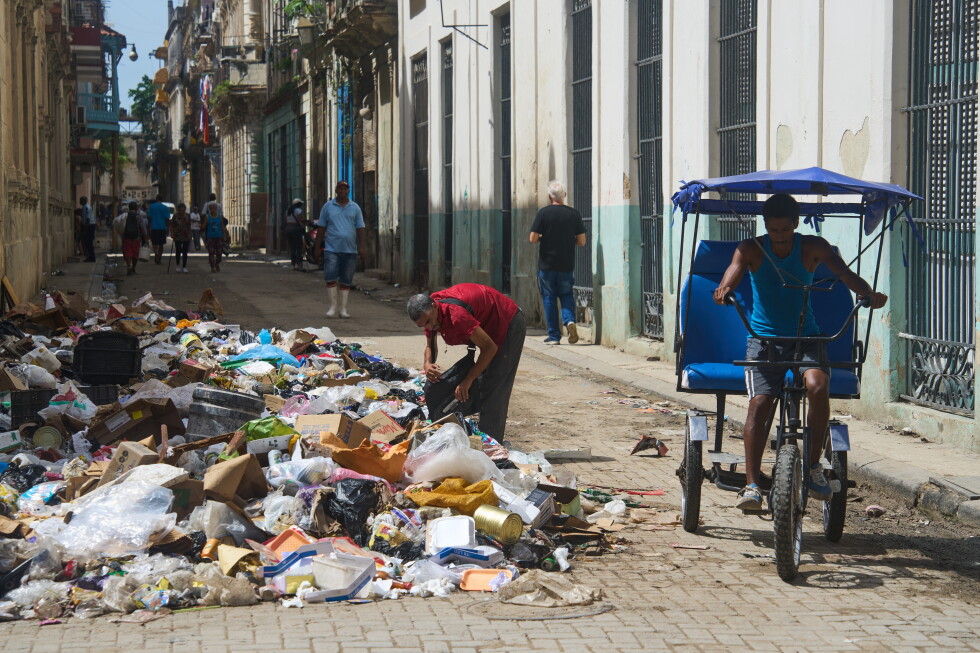
Their focus was an improvised dump site on the sidewalk with rotting food scraps, torn bags, cardboard and rubble. Swarms of flies and stray cats gathered around the trash whose stench wafted on the breeze from the nearby sea.
“What you’re looking at is depressing,” lamented María Odalys Ramírez, a 63-year-old who lives across the street from the capital’s iconic Hermanos Ameijeiras hospital. “The trash in this area, the flies, the rats, the filth — it’s completely unsanitary.”
For months, residents of Havana — home to 2 million of Cuba’s almost 10 million residents — have lived with piles of garbage accumulating on almost every street corner. The situation deteriorated after a U.S. energy blockade triggered power outages, water shortages and a fuel crisis that brought state-run garbage trucks to a standstill.
Advertisement
Without garbage collection, residents have begun burning waste in the streets, raising alarm among health officials over potentially toxic smoke.
Residents fear the coming months will bring worse conditions as summer heat intensifies and hurricane season begins.
A citywide tour by The Associated Press revealed identical scenes across Havana neighborhoods where locals said garbage trucks pass only irregularly.
In the city center and on the outskirts, cars, bicycles and pedestrians weave around the trash piles. Others pick through it, hoping to salvage something useful.
Advertisement
Havana as of last July was producing the equivalent of about 12 Olympic-sized swimming pools of solid waste every day, according the latest municipal figures available. Even then, municipal services collected just 57%.
The “improper management of urban solid waste” has been identified as a primary environmental challenge in Cuba’s national strategy, said Odalys Goicochea, an official at the ministry of science, technology and the environment.
Now, Goicochea warned, the current garbage collection situation, combined with rising temperatures and impending rains, could worsen the situation. The heat and moisture threaten to trigger a proliferation of disease-carrying flies and mosquitoes.
The crisis has sparked citizen initiatives to clean up neighborhoods.
Advertisement
One is El Batazo, an initiative operating across eight Havana blocks. A collector rings a bell twice daily to pick up pre-sorted household trash, while other project members sweep the streets.
Members then sell recyclable raw materials like aluminum and glass, repurpose food scraps to feed livestock and place the remaining trash into a container for later transport to a landfill.
“The fundamental impact of this project is proving to the community that it can be done,” said Evelyn Martínez, a collaborator at El Batazo. “It is entirely possible to live in a cleaner environment, give value to what we call ‘trash’ and put it to good use.”
Timothy James David Coleman, 66, was found dead in Bredbury Drive, Farnworth, on 2 June.
There are believed to be no suspicious circumstances surrounding his death.
A spokesman for Greater Manchester Police said: “Anyone with information about Timothy’s next of kin should contact the Police Coroner’s Office in Bolton on 0161 856 4687.”
Advertisement
Officers are asking anyone who may have information about Mr Coleman’s next of kin or family members to come forward.
The Police Coroner’s Office in Bolton can be contacted on 0161 856 4687.
In UK law, there is no definition of next of kin, but it is understood to be the closest relative, whether a partner, parent, child or sibling.
Tyne Grange, located in Grainger Park Road and part of Exemplar Health Care, supports up to 21 adults with complex mental and physical health needs.
Following an inspection in February 2026, the CQC praised the home’s “exceptional” care and upgraded its rating for responsiveness from “good” to “outstanding.”
Katherine Swainston, home manager at Tyne Grange, said: “We’re absolutely delighted to have retained our ‘outstanding’ rating and to have improved our responsive rating to ‘outstanding’ as well.
Advertisement
“Our team puts so much care and compassion into supporting the people who live here, so it means a lot to see that recognised by CQC.
“What makes me most proud is the feedback from the people who live at Tyne Grange.
“Hearing that they feel safe, listened to, and happy in their home is what really matters.”
Residents told inspectors they felt safe, valued, and listened to.
Advertisement
One resident said: “I feel comfortable talking to staff because they know me well and I feel safe.”
Another resident added: “The best thing about living here is the amount of stuff you can do, there isn’t anything I would change.”
Karen, the home’s Service User Ambassador, said: “Every few months, I meet with Ambassadors from other Exemplar Health Care homes, and we make decisions about the way the company is run.
“I enjoy being an ambassador because I feel like I make a difference.”
The biscuit has an interesting bit of history behind its ‘ornate’ pattern
One of Britain’s most iconic treats, available for under £1 in most supermarkets, has kept a distinctive piece of history to this day. Few people actually understand why the beloved Custard Cream features such an “ornate” pattern compared to other biscuits.
Advertisement
On Instagram (@Theotherbritishmusuem), radio presenter Annabel Port delves into unusual aspects of British heritage, uncovering entertaining ‘did you know’ facts. In a viral video viewed by over 612,000 people, she examined the reason behind one of Britain’s most recognisable biscuits having its “over the top” design, reports the Mirror.
She said: “You will not believe what the swirls on a custard cream are supposed to be. These are one of the UK’s favourite biscuits and also one of the cheapest.
“It’s a very bog standard food with an incredibly over-the-top, ornate decoration – like a semi in Swindon with a recreation of the Sistine Chapel inside.” Custard cream biscuits have been savoured in Britain since 1908, Annabel revealed, with the Victorians responsible for the biscuit’s “ornate” appearance.
She continued: “[The Victorians] were mad for ferns. They were so obsessed that they held fern-hunting parties and collected them to the point that some species became extinct.”
Advertisement
Content cannot be displayed without consent
“The reason ferns got so massive was [because of] George Loddiges. He built the largest greenhouse in the world in Hackney, East London, and it was really expensive – so he needed people to visit.” More powerful than sticking an advert somewhere, Loddiges spread a rumour that an appreciation for ferns showed a sign of intelligence.
“Somehow, this actually worked,” Annabel joked. She added: “There was such a craze for them that they put a fern-like decoration on this biscuit. That’s what those swirls are supposed to be.
“Not sure they did the greatest job. At least now I can think ‘Oh this makes me look more intelligent’ – even though they are a little bit boring.”
To this day, Custard Creams remain a British favourite that millions enjoy nationwide every day. Retailers stock these baked goods for as little as 45p per pack.
Previously, Annabel revealed the “rule” that prompted nearly all UK washing-up liquids to choose the exact same colour – green – despite only one having a logical explanation. People were fascinated to discover that another slice of Victorian-era history has shaped major brands to this day, including Asda, Tesco, Morrisons, Sainsbury’s, Aldi and Lidl.
Annabel explained: “Back in 1898, Fairy Soap was launched and was used for everything – clothes, dishes, skin, whatever. It was made in Newcastle by Thomas Hedley and Co, and early ads show that the soap was also green, olive green, and for a reason, it contained olive oil.
“The olive oil is gone now, probably as it’s more expensive than gold or printer ink. This was their brand colour and they stuck with it, even if it got more lurid over the years and other companies blindly followed.”
Who are the best young talents on the baize? (Picture: Getty Images)
Snooker’s top stars are lasting longer than ever, with some of the best in the world now in their 50s and still competing for titles.
The legendary trio of Ronnie O’Sullivan, Mark Williams and John Higgins have all passed the half-century and all remain in the top 16 in the world rankings.
Then come the 40-somethings who are also as good as ever: Mark Selby, Neil Robertson, Shaun Murphy, Mark Allen and Barry Hawkins among them.
30 years old used to be seen as the beginning of the end on the baize, but now it seems unlikely to even be the halfway mark of a career.
Advertisement
That is not to say there aren’t young talents around, as we have seen at the Crucible of late, with the last two world champions lifting the trophy in their twenties.
It is as difficult as ever for youngsters to make the breakthrough, with legendary names somehow still producing brilliance for at lot longer than they ever did in the past.
Are you snooker loopy?
You’re in the right place. I’m Phil Haigh, and I cover the game we all love for Metro.
In my newsletter, The Table, I analyse the biggest talking points, pull back the curtain on the sport and crown the biggest winners and losers every week.
Phil has been reporting on snooker for over a decade
There are bright young things around on the professional tour, though, and here are the 30 youngsters shining brightest, ranked by both what they have done so far and what they are likely to achieve in the future.
Liam Davies has long been one of the UK’s brightest prospects (Picture: Getty Images)
29. Iulian Boiko – 20 – Ukraine
Still just 20, it feels that Iulian Boiko has been around a while since first turning pro at 14. Progress has not been rapid since then, but has been noticeable, looking more comfortable on tour last season.
28. Wang Xinbo 18 – China
Only just turning pro this season, but Wang Xinbo could make quick strides up the rankings. Won his first ranking match three years ago as a wildcard and won two World Championship qualifiers comfortably in April. Looks great.
Advertisement
27. Michal Szubarczyk – 15 – Poland
Michal Szubarczyk is gaining experience on tour at an incredibly young age (Picture: Getty Images)
The youngest ever professional could easily have gone his whole first season winless, but picked up some impressive victories. Notably two of those came in World Championship qualifying. He doesn’t turn 16 till January.
26. Lan Yuhao – 17 – China
It was just the odd win here and there in his first season on tour, but Lan Yuhao passes the eye test and looks to have a lot of potential. Mark Selby, Matthew Stevens and Michael Holt have all noted how good the teenager looks.
Artemijs Zizins has picked up some impressive wins over higher-ranked players (Picture: Getty Images)
Some big wins at key times last season over the likes of Ali Carter and Luca Brecel saw the Latvian cling onto his tour card. Isn’t delivering consistently yet, but progress continues.
24. Gao Yang – 21 – China
WSF Championship winner last year, Gao Yang is in his second stint on tour and is looking more the part. Two years on the spin he has won three matches in World Championship qualifying, but just missed out on the Crucible both times.
23. Long Zehuang – 29 – China
Quickly established himself as a solid mid-ranker since turning pro in 2023, but more steady than spectacular. A very good player, but not with the potential of some on this list.
22. Ben Mertens – 21 – Belgium
It’s been very under-the-radar progress from Ben Mertens, but into the top 64 in the world rankings at 21 is impressive. Still waiting for a deep run outside the Shootout, but it is coming.
Advertisement
21. Julien Leclercq – 23 – Belgium
Julien Leclercq made it to the Barbican at the UK Championship this season (Picture: Getty Images)
The Belgian Beast has shown flashes, with a run to the Shootout final in 2023 and qualifying for the UK Championship last season, but it feels like there is plenty more to come from the 6’6″ giant.
20. Antoni Kowalski – 22 – Poland
Needed to win three World Championship qualifiers to save his tour card in April and he did just that, with impressive victories over Joe O’Connor and Jamie Jones. A confident character, he’s capable of kicking on now.
19. Jiang Jun – 20 – China
Jiang Jun plays at his own pace but it works for him (Picture: Getty Images)
One frame away from a Crucible debut in April after beating Elliot Slessor in the penultimate round. A slightly odd player to watch, Jiang downed the likes of Mark Selby, Barry Hawkins, Dave Gilbert, Thepchaiya Un-Nooh, Chris Wakelin and Hossein Vafaei last season.
18. Louis Heathcote – 28 – England
Two of his three ranking quarter-finals have come in the last two seasons, so progress continues, but we are still waiting for a big breakthrough for the Hoover. The talent is there, but one thing he must start doing is win more matches on the road as Chinese events are a huge help on the rankings.
17. Liam Pullen – 20 – England
Liam Pullen had a great run to the Crucible this year (Picture: Getty Images)
The Yorkshireman’s first two years on tour were tough, as you’d expect them to be, but last season he started showing what he’s got. Wins over the likes of John Higgins and Chris Wakelin, a first ranking quarter-final and winning four matches to make a Crucible debut.
16. He Guoqiang – 25 – China
A Crucible debut this year – beating Jack Lisowski in qualifying – continued He’s rapid progress since turning pro in 2023. He has two wins under his belt over Ronnie O’Sullivan, plus victories over the likes of Neil Robertson, Wu Yize, Kyren Wilson and Barry Hawkins.
15. Liu Hongyu – 22 – China
Made a splash in his first season by making the semi-finals of the 2023 English Open, beating Shaun Murphy, Chris Wakelin, Mark Williams and Ding Junhui en route. That remains his most impressive performance, but he has been steady in climbing the rankings.
Advertisement
14. Lyu Haotian – 28 – China
One ranking final, four more semis and four trips to the Crucible, it’s a very decent return, but Lyu Haotian’s progress has stalled. He sits at number 61 in the world rankings, having reached 24 at one stage, but there is clearly great talent in there.
13. Jackson Page – 24 – Wales
Action Jackson is becoming a more regular face at the business end of events, with a ranking final and four quarter-finals over the last two seasons but consistency is still evading him. Progress seemed to stall a bit over the last campaign, but is devastating when he hits form.
12. Xu Si – 28 – China
Xu Si is yet to fulfil his potential (Picture: Getty Images)
The 2024/25 season was Xu Si’s best of his career, but the last campaign saw him return to the unspectacular results of previous years. He looks great at times, making three maximums, but consistency is still lacking after nine years on tour.
11. Yuan Sijun – 26 – China
Turning pro in 2017, Yuan Sijun has been a coming man for nearly a decade but he is still yet to arrive. There’s still plenty of time and is impressively ranked 30 in the world, but he is still to fulfil the potential he was showing a few years ago.
10. Aaron Hill – 24 – Ireland
Two 147s last season and a third ranking quarter-final continued the Irishman’s march up the world rankings to well inside the top 50. Improvements are clear and the next step seems imminent, perhaps semi-finals Triple Crown qualification.
Advertisement
9. Fan Zhengyi – 25 – China
Out of nowhere Fan Zhengyi beat a load of top players including Ronnie O’Sullivan in the final to win the 2022 European Masters. He hasn’t really seemed like repeating that since, but three wins in World Championship qualifying this year and then an epic 10-9 loss to Shaun Murphy saw him looking good again.
8. Stan Moody – 19 – England
Stan Moody had a thrilling Crucible debut this year (Picture: Getty Images)
The teenager reached his first two ranking quarter-finals last season and is up to a career high ranking of 40 after making a Crucible debut in April. He may have lost that World Championship opener to Kyren Wilson, but a thrilling opening session showed what a danger he is to anyone. He beat Wilson, John Higgins, Ali Carter (twice), Barry Hawkins, Ding Junhui and Zhou Yuelong (twice) last season.
7. Lei Peifan – 23 – China
The 2024 Scottish Open victory was entirely out of the blue but was a stunning win. He has backed it up to an extent, qualifying for the Crucible twice since and beating defending champion Kyren Wilson there last year. He came through UK Championship qualifying in each of the last two seasons as well, so is racking up serious experience for his age.
6. Pang Junxu – 26 – China
One of the least flashy youngsters to emerge from China in recent years but one of the more effective. He has a ranking final and two semis to his name and has reached the Crucible four years on the bounce. Wins a lot of games and looks a pain to play, which is a compliment.
5. Si Jiahui – 23 – China
Si Jiahui’s progress has stalled but is still a great talent (Picture: Getty Images)
After his incredible World Championship semi-final run in 2023 it looked like Si Jiahui was the next big star. It continued to look like that when he reached the German Masters and Wuhan Open finals, while he also beat Ronnie O’Sullivan and Judd Trump in spectacular fashion in big events. Last season saw him stall and drop behind a couple of compatriots on this list, but clearly the game is in there.
4. Chang Bingyu – 23 – China
Back on tour last season after a ban, it was an eye-catching return and there is a lot of excitement about what Chang Bingyu can produce in the coming campaign. A ranking final, two 147s and a whitewash win over Shaun Murphy with 100 per cent pot success were notable highlights of the 2025-26 season. On his way to the Scottish Open final he beat Stephen Maguire, Si Jiahui, Kyren Wilson, Mark Selby and Mark Allen.
Advertisement
3. Zhou Yuelong – 28 – China
Turning professional in 2014 with a huge amount of expectation, it is surprising Zhou Yuelong is yet to land a ranking title, but he has come close, with four finals to his name. Because we have seen so much of him it is tempting to think he may have peaked, but he could easily replicate thetitle-winning success of the likes of Xiao Guodong and Zhang Anda. In fact, his ceiling is probably higher.
Wu Yize conquered the Crucible in May (Picture: Getty Images)
Crucible success in May turned Wu Yize into a superstar as he became the second youngest world champion ever. It was just his second ranking title, but he could rack up a huge amount over the next 20 years.
Zhao Xintong became China’s first world champion in 2025 (Picture: Getty Images)
Wu Yize has pushed hard for top spot, but Zhao Xintong still holds on for now after a brilliant season as world champion saw him add three more ranking titles to his collection.
He doesn’t turn 30 until April next year and we can expect a few more trophies on the mantlepiece by then.
What does it all mean?
Nationalities of snooker’s 30 under 30
China – 18 England – 3 Belgium – 2 Poland – 2 Wales – 2 Ireland – 1 Latvia – 1 Ukraine – 1
Advertisement
As we have known for some time, the top young talent is overwhelmingly coming from China more than anywhere else.
Britain is lagging behind, with more coming from mainland Europe than the UK right now.
North Yorkshire Police said a blue-coloured electric bicycle with Twofish branding and two seats, was stolen from accommodation in King Street, around 11.25am on Tuesday, April 14.
Recommended reading:
The force has issued an appeal for to the public for information along with an image of a person its officers said could assist its investigation.
Advertisement
A spokesperson for North Yorkshire Police said: “If you can help our appeal, please email clair.bailey-lane@northyorkshire.police.uk.
“Or call 101 and ask for PC 1411 Clair Bailey-Lane.
“If you wish to remain anonymous, you can pass information to Crimestoppers on 0800 555 111.
“Please quote reference 12260068068 when passing on information.”
As our beloved NHS continues to wobble, anyone with an ounce of sense has turned their attention to preventative healthcare. Time to get intimately acquainted with NAD, then.
It’s a trending ingredient in longevity science and has been lauded as a “can-do” everything molecule. More formally known as nicotinamide adenine dinucleotide, NAD is essentially a bioactive form of vitamin B3 and an essential coenzyme found in every single cell of the human body.
NAD is increasingly being studied for its role in supporting healthy ageing and extending life spans. “NAD metabolism is fundamentally involved in mitochondrial function, cellular repair, oxidative stress regulation and metabolic signalling,” explains Jana Buzkova, NAD scientist and co-founder of Finnish biotech company NADMED, which has developed an innovative blood test.
A question of supply and demand
Advertisement
Supplements might seem like the easiest shortcut for a NAD boost, but popping a pill without insider knowledge might not always be the most effective way to top up levels. This is because the way each body converts the ingredient into active NAD in tissues can significantly vary.
While the body produces NAD naturally, levels are thought to be influenced by a range of lifestyle and environmental factors. Poor diet, stress and sedentary living may all tip the balance, and this is where demand begins to outstrip supply.
Studies also suggest levels of NAD decline as you get older. The research shows this dip can negatively impact mitochondrial function, DNA repair and the activity of longevity-associated proteins known as sirtuins. In response, attention has shifted towards strategies to support NAD levels, with diagnostic testing emerging as a new frontier. The research highlights that identifying the NAD markers linked to energy metabolism, oxidative stress and overall cellular function has the potential to support healthy ageing.
NADMED is among the players leading this space, partnering with UK longevity clinic Altheome to launch consumer NAD testing designed to reveal how NAD-related metabolites are functioning within the body. The blood test takes a deep dive into the balance between oxidative stress and the body’s ability to repair damage.
Advertisement
A snapshot of cellular ageing
The NADMED test claims to be the NAD test that meets the EU’s safety requirements available in the UK, and, with a £199 price tag, the test brings laboratory-grade analysis into a consumer setting.
The process is simple: order the test online, book an at-home or clinic-based blood draw, and receive results within 10 working days. What to expect next? A detailed snapshot report of NAD levels, offering personalised insights that may inform supplementation choices, lifestyle adjustments or wellness strategies.
Buzkova cautions that results should be interpreted carefully. “If low NAD levels are detected, the results should be assessed by a healthcare professional alongside other biomarkers, symptoms and medical history.” The bottom line is this: while the test doesn’t diagnose disease, NAD testing offers an intriguing window into your biological ageing. It’s not a crystal ball for longevity, but another crucial piece in the puzzle.
Traffic hums along the busy Bolton Road, in Ashton-in-Makerfield, where neat front gardens and clipped hedges have become unlikely political battlegrounds.
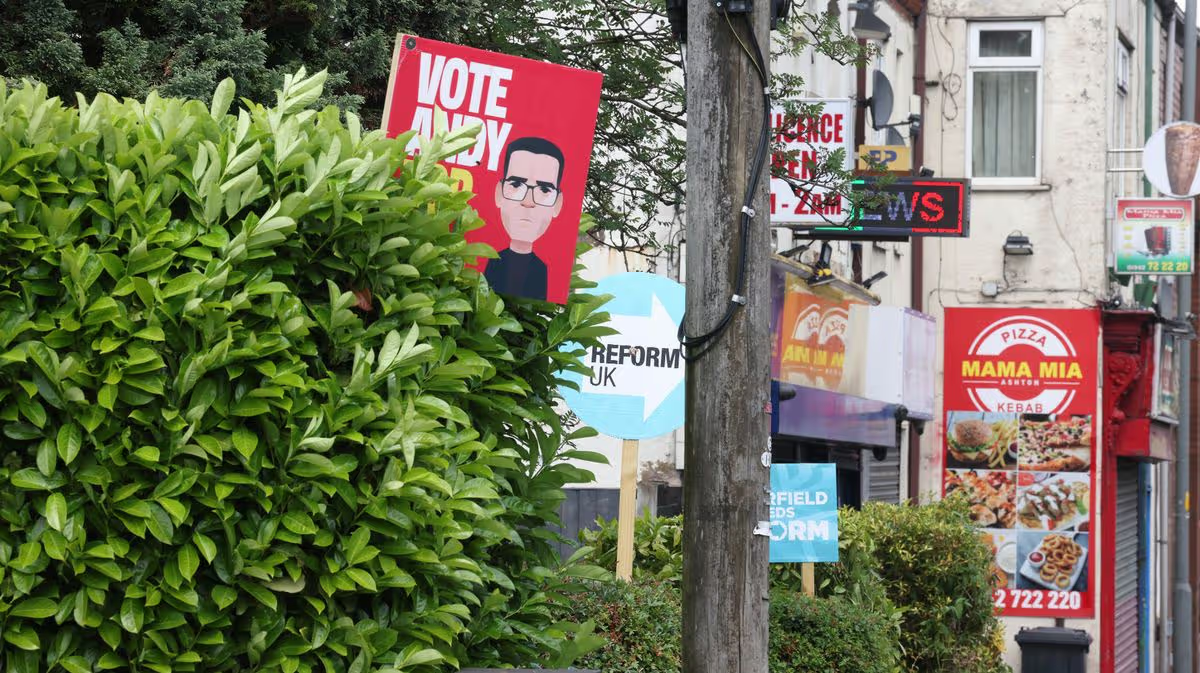
The houses are dotted with Labour red and Reform turquoise placards. On one short stretch of this road, politics is no longer confined to television studios or social media feeds – it’s literally on the doorsteps.
Within a few hundred yards, five different households display five different political stickers.
Arguably, they serve as a microcosm of what we have seen and heard across the constituency over the past few weeks: former Labour voters switching to Reform, while some remain loyal to the party.
Neighbours disagree sharply about immigration, trust and overall decline of the country as well as the constituency. Because the stakes couldn’t be higher.
On June 18 the people in Makerfield will go to the polls in a by-election triggered by the resignation of its MP Josh Simons, clearing the way for Andy Burnham to return to Westminster.
Burnham, one of Labour’s most recognisable and popular political figures, is gambling that the personal brand he has built over nearly a decade as mayor of Greater Manchester can overcome wider frustrations with the party nationally.
Advertisement
For Reform UK, the contest presents an opportunity to deliver an embarrassment to Labour in one of its traditional heartlands. This constituency voted Leave in 2016 and, in a seat shaped by post-industrial decline and deep frustration with politics, Nigel Farage’s party believes it has fertile ground.
And nowhere is that contest more visible than on this stretch of Bolton Road. We often hear how the country is divided, but what about a divided street?
Can a neighbourhood stay neighbourly when the political stakes are so high?
While national parties trade blows on television or online, these neighbours still share a fence line.
The MEN managed to knock on four of the five semi-detached houses to find out the answer to that question.
One house stands out immediately. Behind an immaculately kept garden – with trimmed hedges and colourful flower beds that give the place an almost stately feel – a large turquoise Reform banner flutters atop a flag pole.
Advertisement
The Reform “flag flier” is 79-year-old Albert Bretherton. A retired haulier, he says one reason for putting up the banner was practical: to stop campaigners knocking at the door.
But it’s also an act of political defiance.
“All our friends are just fed up with Labour” he says. But a lot of people don’t want to admit they’re voting Reform, because “they’re frightened of getting the racist card chucked at them,” says Albert.
Like many people I spoke to across Makerfield, Albert is a disillusioned former Labour voter, frustrated about immigration, policing, crime and what he sees as Labour abandoning working people.
Advertisement
“Look at the government we’ve got now,” he says. “I predicted what would happen when Labour got in. I knew they would take off them who saved, and got a pension, and give it to them what don’t want to work. They’re Labour’s main policies.”
In some ways, the Reform banner could be construed as a red rag – or turquoise in this instance – to a bull.
But Albert insists there have been no issues with the neighbours “Oh no, no, everybody’s entitled to their opinion,” he says.
Advertisement
He remains critical of Andy Burnham’s record, particularly questioning the efficiency of the public transport policies and urban regeneration projects.
But immigration comes up repeatedly. “I don’t mind immigration but it should be done in a fair way. People should apply and not come on a boat and come to the front of the queue.”
He claims some of the neighbours are only voting for Andy Burnham because “they’re retired and have a house in Spain. [Burnham] wants to go back into the EU.”
Albert doesn’t agree with Josh Simons stepping down as MP and clearing the path for Burnham.
Advertisement
“That’s why they brought Andy in by the back door by the way. I think that’s a bit naughty isn’t it,” he says.
He admits that he liked Josh – “He was alright” – but insists he shouldn’t have stood down.
As for Burnham, he adds: “Since he’s been in Manchester he’s never been back here. He’s a career guy isn’t he?”
A few doors down, one house is bearing multiple Labour placards, featuring the slogan ‘Vote Andy For Us’ alongside an avatar of the Greater Manchester mayor.
Advertisement
The hardcore Burnham fan in this house is a 19-year-old man, who declines to be named.
“I think he’s a great guy, he’s local,” he tells me. He’s voting for Labour because “they’re better than Reform”.
He brings up Rob Kenyon’s old social media posts, adding: “He’s clearly sexist isn’t he?”
Advertisement
The teen says he had an altercation on the street with Reform while they were out canvassing.
This was shortly after Nigel Farage’s visit to Chapo’s at The Caledonian across the road. The Reform UK leader was visiting the pub as part of the party’s ‘Save Our Pubs’ campaign.
“I saw the candidate, Rob Kenyon. I just pulled over in my car, rolled down the window and called him an aristocrat,” the young man continues. “They started taking pictures and said they’d get me done for a Public Order offence.”
Why did he do that?
Advertisement
“Nigel Farage is a Tory at the end of the day and he’s an aristocrat,” he replies.
Reform told the MEN it has no recollection of this happening.
Apart from that, the man insists that conversations with his neighbours are more cordial.
“I do have some conversations with the neighbours. They’re not bothered, we get along,” he says.
Advertisement
Asked about Reform voters, he adds: “I think people are focused on immigration but what’s the problem? I don’t see a problem. I think it’s great for the economy.”
Voting for Labour seems to be in his blood. His parents are voting for Burnham and his granddad “used to go around with a megaphone screaming ‘vote Labour’ back in the 80s,” he says.
For him, Labour identifies problems and implements change, even if Keir Starmer’s performance hasn’t been perfect. Next door the contrast couldn’t be more stark
Advertisement
Engineer Andrew, who declines to give his surname, is Albert’s son-in-law.
He makes no secret of his voting for Reform, with two turquoise placards on his property.
“It’s mainly because we don’t like Keir Starmer,” he tells the MEN. “I want to get rid of him, he’s useless. It’s everything.”
Nigel Farage, on the other hand, is a “good communicator. All the things he stands for is more or less what we stand for,” says Andrew. “We’re working people and we get taxed far too much.”
Advertisement
Reform’s candidate, Robert Kenyon, has faced criticism over previous online comments about various issues, including his position on Brexit, abortion and sexist remarks about women. But Andrew dismisses this as Labour “spin”.
He dislikes Andy Burnham, describing him as “Keir Starmer part two”.
Immigration is one of the main concerns, and says the country is letting in too many people. But he rejects the label of “far right”, describing himself and his partner as “concerned people,” adding: “I’m not racist. My partner’s not racist. We’ve got friends from different religions and that. It’s not a problem.”
Advertisement
For Andrew, the window signs also serve a practical purpose. Since he put the signs up, he’s had no door knocks from any of the parties.
When asked if the different political views cause any tensions on the doorsteps, he gestures towards the neighbours and jokes: “I might not take her parcels in anymore.”
Next door to him, Mike Brumskill has put up a Labour placard because he feared people would assume the Reform sign, on the neighbour’s hedge, was on his house and might present him as a target.
He’s put up Andy Burnham stickers in the window. “I just think he’s a very genuine man, I think he’s got a moral compass,” he tells me. “He’s set himself apart from normal politicians.”
Advertisement
Citing Burnham’s record, including campaigning for the families of Hillsborough and as Health Secretary, he believes “nobody but Andy Burnham would have a chance of beating Reform around here.”
Farage’s vote share has been dented slightly by newcomer Restore, whose candidate, Rebecca Shepherd, is polling at seven percent in her party’s first parliamentary contest.
For that reason, Mike is “so glad” that Restore is “going to take away a chunk of the Reform vote and weaken them.”
A retired police officer and used to putting down riots and disorders, Mike expresses deep alarm over Nigel Farage’s rhetoric.
“I’ll be totally honest with you. I see Nigel Farage as someone like [Oswald] Mosley in the 1930s,” he says. “I really, really am scared of the community tensions.”
Like the 19-year-old Labour voter, Mike brings up Rob Kenyon’s “misogynistic” social media posts.
“I like to think of myself as a decent man and I find him abhorrent,” he continues. “I’ve got three daughters, a wife and granddaughters and I wouldn’t want that man anywhere near politics and power.
Advertisement
“That level of misogyny offends me as a man. My wife was horrified when she saw that and I don’t blame her.
“He’s got the potential to go to Parliament and he’s supposed to represent women. And if you’ve got that contempt… you know I just don’t understand that as a man.”
Yet, despite these sharp divides, Mike remains committed to his community.
“I love my neighbours, they’re really lovely decent people,” he says. “I even love the fella who’s flying the Reform flag. Everyone’s entitled to their opinion.”
Advertisement
Nonetheless, he struggles to understand “how anyone can even contemplate voting for Reform.”
Whichever way Makerfield votes on June 18, the striking thing is that despite all the different political views, people still manage to live side by side. They’ve managed to do something that national politicians increasingly struggle with – disagreeing fiercely without falling apart.
After the by-election the placards will come down. Some will wake up to the results feeling disappointed, others vindicated.
But the people of Bolton Road – and Makerfield overall – will have to find a way to live with the results.


















































You must be logged in to post a comment Login