



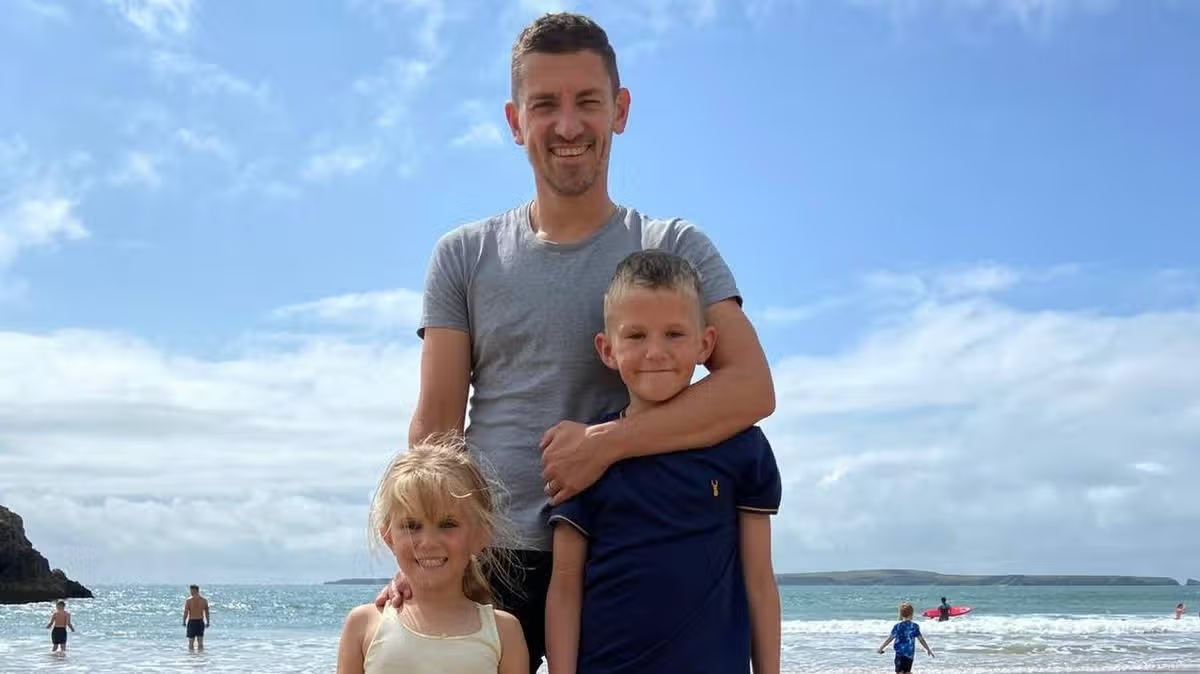
A Gwynedd family struggling to remain in their home village claim residents are at risk of being priced out by the planning system. Father-of-two Marc Evans worries Llanberis will become “the next Abersoch” unless local residents receive greater backing from the local authority.
Last week his application to construct a modest family dwelling in his garden was turned down for a second time. Planning officers determined the two-storey property would “not respect the traditional character” of neighbouring homes, predominantly stone-built quarrymen’s terraced houses, reports North Wales Live.
Arguing that Llanberis features a variety of housing styles, Marc, 43, emphasised his argument by photographing the 21 new properties erected in the village since 2011. “Many are large buildings with masses of glazing and features such as wood cladding and overhanging roofs,” he said.
“Several were built by the council itself.
“In contrast, our proposed family home is much more traditional with a pitched slate roof and local stone cladding. It’s not a multi-storey in glass, and no one locally has objected to the scheme.
“The rules seem to be different for local people and those coming here from outside the area with deeper pockets. It’s a scandal and it’s very frustrating.”
In recent years, Llanberis has been fighting to preserve its cultural identity. Nestled at the base of Yr Wyddfa (Snowdon) beside Llyn Padarn, one of Wales’ largest natural lakes, the village’s rising profile as a tourist hotspot has proved to be a double-edged sword.
Challenges surrounding over-tourism have emerged, while properties have been bought up as second homes and, notably, holiday lets, reducing availability and driving up prices. At one stage, a sticker campaign was launched throughout the village in protest at the surge in Airbnb properties established since the Covid pandemic.
According to AirROI, a data analytics platform, there are currently 99 active Airbnb listings in the village. With average nightly rates of £190, annual earnings sit at approximately £25,700.
AirROI added: “Supply has held steady year over year while revenue and nightly rates climbed – a mature market where existing hosts capture more value per listing.”
Marc, a former teacher now working as a project manager at Anglesey Solar, resides in a row of terraced houses originally built to house families employed at the nearby former Dinorwic slate quarries. He shares his home with his wife Kellie, also a former teacher originally from Deiniolen, and their two children, Leo, aged 11, and Isla, aged eight.
They’re hoping to construct a more appropriate dwelling in their garden alongside their existing property.
“Our house is fine but it’s too small for a growing family and it lacks modern amenities,” Marc explained.
“We’re looking to complement what’s here, not knock it down.
“Children have a simpler perspective on life and Isla can’t understand why this is happening – why we can’t have a new house when there are so many other properties in the village with more modern designs.”
He argued that planning regulations needed to be recalibrated to support local families wishing to remain in their communities. Without this, he warned, cultural decline would persist across Gwynedd’s towns and villages, draining their vitality.
“Houses here are affordable for people outside the area who earn three to four more times than local residents do,” Marc stated.
“A lot of the new homes built here are owned by people with addresses in London.
“I realise we can’t keep Llanberis secret forever but the planning system must do more to slow the trend. If it doesn’t, Llanberis will be like Abersoch in 10 years time – less Welsh language spoken and the primary school closed.
“We need tourism here but there has to be a balance. Currently, not enough is being done – it seems like local people are being left to fail. Councillors need to show more conviction on planning matters.”
According to the latest Cyngor Gwynedd data from October 2025, Llanberis still has some way to match Abersoch’s lack of local housing availability, where 57.8% of homes are holiday lets, second homes or empty. In Llanberis, the corresponding figure stands at 9.8% – yet Marc contends there is a noticeable upward trend.
The Evans family are hoping to construct a three-bedroom home with an inverted layout – positioning its kitchen and living space on the first floor. Owing to the shape of the garden, a new-build can only be accommodated with its gable end facing the road, meaning the roofline would slope in a contrasting direction to the neighbouring terraced properties.
Cyngor Gwynedd’s planning officers argue this is significant because Llanberis sits at the heart of the Dinorwig Landscape of Outstanding Historic Interest, a designation recognising its distinguished quarrying heritage.
Marc’s architect has redesigned the proposed dwelling so that it features no windows on one side, ensuring it won’t overlook the family’s existing home. A proposed raised platform area, accessed from the front floor, has been reduced in size – yet this continues to concern planning officers, who fear it will overlook an adjacent property at the rear and create a “noise nuisance”.
This neighbouring property is Capel Preswylfa, a former Presbyterian chapel constructed in 1882 that closed a century later. It now operates as a residential flat, topped by an Airbnb with its own raised decking.
“The lower storey is subterranean with no windows at the back,” said Marc.
“The first-floor apartment for 12 people is an Airbnb owned by someone in the Peak District – but the planners seem to want to protect these Airbnb owners over the needs of local people.”
A planning report deemed the proposed design to be at odds with the neighbouring terraced properties and concluded it would not “blend in”.
Given the plot’s hillside location, officers warned it would also “stand out in the landscape”, with its positioning likely to have a detrimental impact on the adjoining property where the family currently reside.
Despite this, the application received backing from Cllr Gwilym Evans, who represents Llanberis on Cyngor Gwynedd.
The planning report noted: “The local member emphasises that granting a dwelling house for a local family will assist to reduce the real shortage of housing for local residents that already exists in the village – and has an impact on the number of pupils in the local school.”
In the meantime, Marc’s architect has produced a second redesign, with hopes that a fresh application will be lodged shortly. Cyngor Gwynedd was approached for a response.















































You must be logged in to post a comment Login