




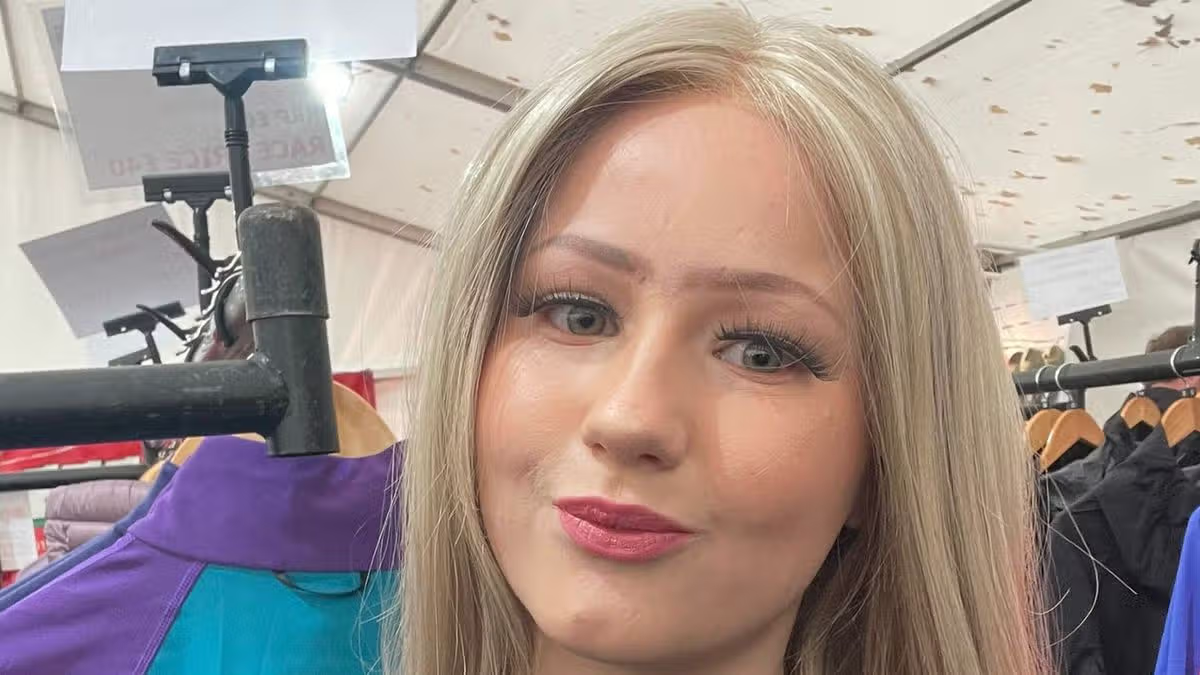
Enlli Thompson has had chemotherapy, lost her hair, had a full hysterectomy, had to freeze her eggs, and entered immediate menopause all before turning 20
Enlli Thompson was 19 when she first went to her GP for help with the persistent headaches and stomach issues she was suffering from. What followed was a journey resulting in a diagnosis of ovarian cancer. Since then, she has had chemotherapy, lost her hair, had a full hysterectomy, had to freeze her eggs, and entered immediate menopause all before turning 20.
Her story is one of life-changing medical procedures, and understandable physical and mental strain. It is also a story of what she believes were missed chances to diagnose her, but it is one of hope, and strength, because she says her cancer, the treatment and all she went through – and continues to do so – has changed her life for the better.
March 2024 is where Enlli starts her story, but her symptoms had actually started before that. She was underweight and was struggling a lot with stomach pains and migraines so she went to her GP.
She was on the birth control pill and the GP recommended she come off that, wait for two cycles, and return if things hadn’t improved. They hadn’t and the pain was unmanageable.
At the time she was an apprentice motor mechanic and had to keep paracetamol in her toolbox constantly. “I was just taking it every four hours by the end because I was in so much pain, counting down the hours till I could take another one,” she said. For our free daily briefing on the biggest issues facing the nation, sign up to the Wales Matters newsletter here
In October 2024 she went to A&E at Ysbyty Gwynedd hospital in Bangor with suspected appendicitis. When her blood test came back clear, she was told she wasn’t a priority because it wasn’t appendicitis and she had a total 16 hour wait. Enlli says a junior doctor told her it was likely a urine infection, and that she shouldn’t be wasting A&E time.
When she was told she would be discharged, she asked for a second opinion.
A senior doctor then arrived, the 20-year-old said. “He barely examined me, and he could see the pain I was in, and he just instantly told me, ‘You need a CT scan’.”
It was that which revealed a mass in her pelvic area. She says she was told in the waiting room and told she would be taken to the gynaecological ward. “I was just sat there then, millions of thoughts in my head. I instantly thought, ‘I have cancer’,” she explains.
After an ultrasound and other tests she asked that question aloud and was told they couldn’t say.
In the first week of December she went back for another ultrasound and eventually a 10cm mass was found. She says it wasn’t until she was put under the care of Richard Peever’s team, a leading cancer specialist gynaecologist, she felt she was taken seriously.
“I could never ask for a better team from then. Honestly, if it wasn’t for them and the senior doctor in A&E, I would not be here today, which is really scary. Especially the senior doctor in A&E, if he wouldn’t have listened to me, I would definitely not be here today,” she says.
In February 2025, she had one ovary, a tube and the tumours removed, and biopsies were carried out but it actually took until the following month for her to have an official diagnosis of cancer.
Enlli, from just outside Caernarfon, immediately had to go through fertility treatment in the hope of one day having a family.
“I always knew I wanted a family of my own, but at 19 I had no plans of having children for a good while. It wasn’t on the agenda.
“I wanted to get my career on the go, I wanted to do everything else. I wanted to get married,” she says.
Then in May 2025, she had a full hysterectomy which put her into immediate menopause. She was 19.
How did she keep going through the diagnosis, chemo, surgery and then menopause? “It was hard, but I think I’m quite grateful that I’m the type of person who can’t sit still. Even when I was in agony, I was going 100 miles an hour. I was desperate to get back to work,” she said.
She went into remission on November 6, 2025, just before her 20th birthday. She continues to have checks, every few months, but remains on medication.
Of the many changes she’s faced, another is her career. She loved training as a mechanic, but had to give it up due to the physical effect of cancer. She initially began work as an NHS admin, but that too had to stop.
“I had suffered a real bad burnout. But I always knew after being diagnosed, I wanted to do something with cancer, being a public speaker advocating for people, or advocating for better knowledge and awareness for gynaecological cancers and young people’s cancers.
“If that means me going into the medical world and becoming a specialist nurse I am not sure at the moment, but I am absolutely loving the public speaking at the moment,” she says.
“I think cancer has changed me for the better, because it’s given me this passion for advocating and gaining awareness and fighting for change.
“Whilst I was going through treatment, I was doing a lot of TikToks, and I tried to not show the negative side at that point, because I felt enough of that was in the media. When I got diagnosed, I was watching a show where someone got diagnosed with cancer, and I thought, ‘Oh my God, that’s what I’m going to be like’. So, I wanted to show you can actually still smile, you can still be dancing whilst you’re going through treatment.”
One of the first things she did with Tenovus was a fashion show, at the suggestion of her specialist nurse, some with wigs, some without.
“I could not say no to that. I was so excited and so grateful I got that chance, and from that I think I gained a lot more confidence because I went on without a wig, I went on with a blonde wig and then I went on at the end with a brown wig as well, which I loved,” she says.
Between the menopause symptoms and heatwave, she has had to put wearing a wig to one side for now. Instead, she is embracing the curls that have grown after her chemo.
“Everyone knew that I was a patient as well, and again, I think that shows that cancer’s not just all this depressing stuff. You can still live your life when you can,” she said.
Tenovus recently carried out a survey of GPs in Wales to try and understand issues with diagnosing gynaecological cancer, a survey in support of Claire’s campaign, set up by the late Claire O’Shea.
Every year, there are nearly 1,200 cases of gynaecological cancers in Wales and around 470 women die of the disease and targets for timely cancer treatment are not being met, while women report feeling dismissed, delayed and unheard when presenting with symptoms.
The survey found 34% of GPs feared over-referring patients to the NHS, there was limited consultation time for GPs as well as difficulty distinguishing cancer symptoms from other benign issues.
Download our mobile app for the best reading experience or subscribe to WalesOnline for just £1 to see fewer adverts
For Enlli all that rings true. She doesn’t, she says, blame her GP for not immediately suspecting cancer but she does think her diagnosis and treatment were delayed because of her age and gender. She was repeatedly told her symptoms could be due to anxiety or her mental health.
“If I was a bit older, I don’t think they would have been saying ‘Yeah, it’s mental health’. Even after my diagnosis and my treatment and being in remission, they’d still tend to say, ‘Oh yeah, it’s anxiety. It’s this, it’s that’.
“I do also think it’s because I am a woman, because they were not fussed about the gynaecological aspect to it.
“I did tell them that I was getting really bad pains, and my periods were getting much more painful that even when I was not on my period, I was getting a lot of pelvic pain. A lot of things to do with that, my periods were getting heavier, which was not usual for me and they never thought to refer me to a gynaecologist.
“I was young, I had bleach blonde, long hair. I looked very girly, but I was a mechanic so I wasn’t one of those girls who would complain, ‘Oh, I’m in pain’ after stubbing my toe. I was like, ‘Get on with it’.
“I do think they just saw what I looked like. I think, ‘Oh yeah, she’s not really in pain. She’s just a young girl that has a low pain tolerance’ but realistically, I was working full-time as an apprentice as a mechanic in constant pain.”
A number of times, as she explains her story, she says she “regrets” not speaking up sooner.
Of the period between scans, she says: “I regret letting them do that looking back, because once you’ve heard that you’ve got a mass, I personally, I regret I didn’t advocate for myself in that time, asking them to do more tests then, and not being discharged,” she said.
“Maybe if I had advocated for myself earlier, it wouldn’t have reached stage three,” she says.
Referencing the finding that GPs said they didn’t have time to look at notes properly, she says: “If they had looked at my symptoms in the time that I was going back and forth between March and October, I was going nearly every month at this point and I was complaining about the same issues, and a lot of it was a gynaecological issues.
“I don’t blame them for not thinking cancer, because who does expect ovarian cancer in an 18-year-old?
“I don’t blame them for that. I blame them for not taking the gynaecological issue seriously, because it points to so many different gynaecological issues.”
She says even now, when she arrives at an appointment, the bulk of time is spent with her explaining her history.
“I still have to advocate for myself, I’m still not listened to. Even after everything I’ve been through, I’m still not listened to, and it’s still pointed to anxiety or my age or whatever,” she says.
A Welsh Government spokesperson said: “As a new government, we are taking decisive action on cancer by developing a 10-year National Cancer Strategy to transform how the health service prevents, diagnoses, and treats the disease, with a focus on earlier diagnosis.
“We are determined to ensure women’s pain is taken seriously. The Deputy Minister for Women’s Health recently brought together clinicians, researchers and women with lived experience at a summit to tackle the normalisation of pain in women’s healthcare.
“Following this, minimum standards for service user engagement will be drafted to ensure women’s voices continue to shape the Women’s Health Plan.”











































You must be logged in to post a comment Login