Here’s what the stars have in store for your day (Picture: Metro.co.uk)
The Moon in Capricorn forges a bond with Neptune while the Sun is angles with Saturn. Conflicting energies could cause tension toay.
Aries, Taurus and Gemini, hard work lately will pay off. Keep focused, and don’t be distracted by the noise.
Concentrating could be hard, but you have the capacity for great things. Navigate many stimuli and go forth with confidence.
Ahead, you’ll find all star signs’ horoscopes for today: Tuesday June 2, 2026.
Advertisement
Like checking your horoscope every morning? You can now sign up to our free daily newsletter to get a personalised reading for your star sign delivered straight to your inbox.
To order your unique personal horoscope based on your time, date and place of birth, visit patrickarundell.com.
Aries
March 21 to April 20
The Moon is in the most practical of locations. This can give you a serious outlook, though solid expectations about what you can get done. However, her square with the nebulous Neptune, in your sign, may see your plans get lost if other, more creative or imaginative opportunities come up. Still, chances are you can be very perceptive about others.
Today brings two contrasting energies, Taurus. The solid link between the Sun and Saturn suggests that past hard work, experiences, or knowledge can be helpful with managing everyday finances. However, a more sensitive vibe can see your mind wander and make it tricky to concentrate on these more earthy, practical considerations and opportunities
With your creativity so abundant of late, the plans that you have that have long-term potential can really shape up, as the Sun angles helpfully to the sage, and realistic Saturn. Further, with a cluster of energy in your money sector, now including your ruler, Mercury, June can start to see all your hard work pay off, with the potential for a reassuring boost in income.
This month gives you a special platform to express your flair, artistry, and individual talent. You may also give yourself a makeover and the chance to reset your personal appearance. Yet as much as you may sense this potential, a work-based issue may draw your attention today. This could require discretion and tact, but your people skills can help ease things.
Whether it is embracing personal development courses or videos, adding to your professional skillset, or gaining an academic qualification, they all take grit. Fortunately, the industrious energies of Saturn can be such an asset to you in the next two years, Leo. And today, his link to the Sun suggests the advice a friend or mentor provides can be invaluable along the way.
With your ruler, the sharp-eyed Mercury newly arrived in your sector of future plans and collaboration, it’s an excellent time to think about how you can structure things. So, the clearer you are about long-term goals and financial security, the better. Today’s link between the Sun and Saturn can help you to do precisely this, and this can be noted, by someone key.
Cosmic messages for Cosmic messages for Virgo today
Libra
September 24 to October 23
June can be a time when you find yourself mixing with influential people, so a wardrobe makeover may be in order. Creating greater elegance can call out to you at home too, whether with some tasteful new items or redecoration. Yet your knack today can come from leaning into the advice and support of some solid but smart friends who can share great tips.
Dreamy and practical energies compete today. The dreamy ones can see you thinking about faraway places or person. The practical ones, if you can focus on them, can help you be productive on the domestic front. Whether it’s catching up on chores or DIY tasks you’ve put off, once you get going, you’ll likely make some solid progress, Scorpio.
Through to the end of June, it is a very special celestial window for you personally, Sagittarius. This won’t be repeated for 12 years. Why? Well, your ruler, the fortunate Jupiter, can bring some very special gifts, of connection, warmth, and even windfalls. Yet don’t be passive. Today, the Sun and Saturn ask you to apply yourself to what’s showing promise.
The Moon in your sign can see you more attuned to wherever you find yourself, and you’re likely to feel more sensitive. Her early link to the nebulous Neptune can also amplify perceptions of home or family. You can astutely pick up on other people’s moods, even before they tell you how they are. Mind, if anything is untidy or disordered, it can drain you.
How many late-night brainwaves convert into something more tangible and lasting? As the routines of everyday life click in, what seemed like a world beater at 3am can feel like nothing more than a frivolous distraction. However, today gives you the celestial toolbox to turn any inspiration into something workable. Don those proverbial overalls and get stuck in!
Your modern aquatic ruler, the king of the sea, Neptune, spends some time coming in the arid hot Aries. And along with the zodiac’s Steady Eddie of Saturn, in the next two years, collectively, they urge you to remould some of the foundations of your situation. This will require a mix of common sense and flair. Today gives you a chance to embrace both.
Your daily Metro.co.uk horoscope is here every morning, seven days a week (yes, including weekends!). To check your forecast, head to our dedicated horoscopes page.
As a loyal Metro reader, we want to make sure you never miss our stories when searching for your news. Whether it is the latest politics news explained, live football coverage or a showbiz scoop.
Click the button below and tick Metro.co.uk to ensure you see stories from us first in Google Search.
Scotland’s Group match with Morocco was played on a knife-edge the entire match, but they were left furious when they were not awarded a penalty
01:02, 20 Jun 2026Updated 01:35, 20 Jun 2026
ITV referee analyst Christina Unkel believes Scotland should have been awarded a penalty in their World Cup defeat to Morocco. Steve Clarke’s side were beaten 1-0 by the Africa Cup of Nations winners in Boston.
They struggled to create any real opportunities against the North Africans, who were good value for their win with Ismael Saibari grabbing the game’s only goal in the second minute. However, the Scots were denied a clear penalty in the eyes of Unkel.
McTominay charged into the 18-yard box when he was tackled from behind by Neil El Aynaoui. It was deemed by VAR that the Moroccan midfielder got a touch on the ball, but replays suggested otherwise.
Unkel was convinced they should have been awarded a penalty when the Napoli ace was bundled over. She said: “The first thing you’re looking for as VAR is any touch on that ball and the answer is no.
“We saw that second replay there and exactly what I was looking for, there was no contact on that ball. There is a trip up from behind, contact on the left lower leg.
“For this, I do think there is a missed incident from the var to recommend a penalty as well as the referee to not make a decision on penalty. I know this referee is calling a more physical game but it is a very clear penalty in my opinion.”
Ally McCoist, who was commentating for ITV, also believed his countrymen should have earned a penalty. He said: “I did say when I watched it second time there is a challenge on the left leg. But I did say I’m enjoying the referee allowing the game to go. However, Christina is right, he did get that one wrong.”
McTominay looked shocked as his appeals were waved away before furiously protesting. Roy Keane, however, was less than convinced it was a penalty. He said: “I don’t think it was a penalty. As simple as that. He was kind of looking to go down. I think he was looking to go down. There’s a difference.”
Advertisement
Fellow ITV pundit Ange Postecoglou also agreed with Keane, saying: “The Moroccan penalty gets his leg out, but I don’t think that’s enough to be a penalty. He does get across him, but not for a penalty, I think he was going down anyway.”
McTominay was furious when the Uzbekistani official Ilgiz Tantashev did not point to the spot. That was not the only time they believed they deserved a penalty.
Early in the second half, John McGinn appeared to be brought down by the same player when he broke into the penalty area. While there also appeared to be little contact with the ball, it was also deemed not enough to be a penalty.
Advertisement
The defeat leaves Scotland with work to do to advance to the knockouts, with their final group match against one of the tournament favourites, Brazil, next Wednesday.
Upgrade your World Cup TV setup with the Sky Glass ‘designed for football’
This article contains affiliate links, we will receive a commission on any sales we generate from it. Learn more
Sky is knocking 20% off its entire range of Glass TVs to mark the start of the 2026 FIFA World Cup. Until June 17, shoppers can upgrade to the Sky smart TV that’s ‘designed for football’ from £4.50 per month when taken alongside a Sky TV and Netflix package.
While the return of summer weather is welcome for many, rising temperatures can quickly lead to discomfort, making it harder to focus, relax or sleep.
While the sun is great when you want to have fun, it can be hard when you’re hoping to work or sleep, and keeping your home cool can be tricky.
Chris Michael, chair of air treatment specialists Meaco – they do more than just dehumidifiers – shares his favourite ways to stay cool.
Advertisement
Five ways to stay cool and get a restful night’s sleep this summer
1. Use a cold water bottle
Fill your hot water bottle with water and freeze it before bedtime. This makes a simple and effective ice pack to keep you cool overnight without adding to your energy bill.
2. Close blinds and curtains
Direct sunlight through windows quickly heats up your home. Keep blinds, curtains and windows closed during the hottest part of the day, especially those facing south. Once the temperature drops in the evening, open them to let cooler air in.
3. Take warm showers
Although it seems counterintuitive, a warm shower before bed helps the body regulate its temperature more effectively. Cold showers can trigger the body to generate heat, whereas a warm shower encourages the body to cool down naturally.
4. Buy a fan (ideally before the rush)
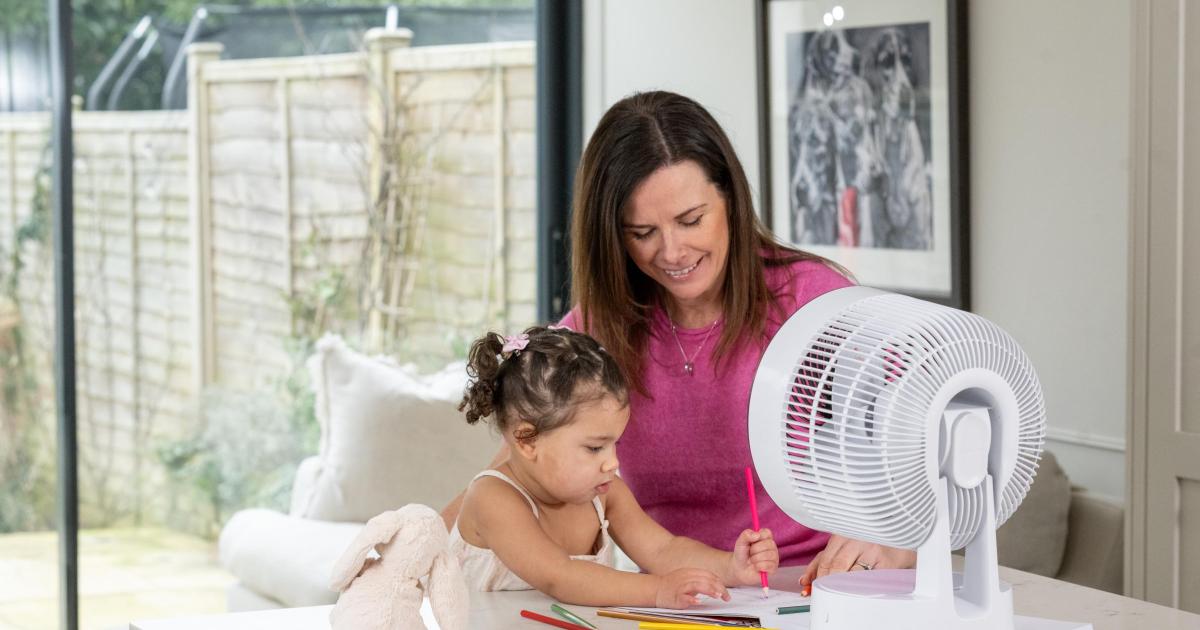
As soon as warm weather is forecast, fans start to sell out quickly. Buying a high-quality air circulating fan in advance ensures you’re ready. Look for reputable brands with strong reviews and clever features like ECO mode to save energy.
Advertisement
For bedroom use, choose a quiet fan. Loud fans can disturb sleep, so consider models that are Quiet Mark accredited and include Night Mode for uninterrupted rest. Low energy consumption is also key, especially if you plan to run the fan all night.
5. Check windows and doors
Gaps around windows and doors can let in heat during summer just as they let out heat in winter. Sealing these gaps is a quick, cost-effective way to keep your indoor space cooler with less effort.
How a Meaco fan can help you keep your home cool this summer
With Quiet Mark accreditation, Meaco fans are ideal for bedrooms, children’s rooms and home offices, as they include timers, temperature sensors, night modes, and intuitive controls to help you stay focused, relaxed, and well-rested.
It offers mains or battery operation, making it ideal for use at home, while travelling, or outdoors. The replaceable battery extends the fan’s life far beyond that of typical sealed battery models, aligning with upcoming EU regulations and reducing waste.
With better sleep being the number one reason people buy a fan, it’s worth investing in one that’s quieter, more energy-efficient, and ideally features a dedicated night mode.
Advertisement
Meaco has a glow-in-the-dark remote control to make it easier to adjust settings without turning on a light.
It’s also worth thinking ahead for long-term use, low energy costs and comfort, to help you stay cool through this summer and many more.
What do you use to help get to sleep in warmer weather? Let us know in the comments.
Beamish’s streets, trams and shops double as Edwardian London in the new film, and these three are among the best‑known actors to have walked its cobbles for the production.
Director Tina Gharavi (right) and Haley Bennett who stars in the film. (Image: BRIDGE & TUNNEL PRODUCTIONS)
Here’s a look at what they’re famous for, and who they play in Night and Day:
Lily Allen – pop star turned actor
Lily Allen is still best known to most people as a chart‑topping singer, breaking through in the mid‑2000s with hits like Smile and The Fear and becoming one of the defining British pop voices of that era.
She has since built a parallel career as a writer and performer, publishing a memoir, working in television and moving into acting on stage and screen.
Advertisement
Her recent work in theatre has been widely praised, marking her shift from pop star to serious actor in the last few years.
In Virginia Woolf’s Night and Day, Allen appears in a supporting role within the film’s Edwardian social world, trading the stage and studio for the period streets of Beamish.
Her character moves through the salons and drawing rooms that are recreated in and around the museum, helping to bring to life the gossip, wit and social pressures that surround the film’s central love story and its questions about women’s choices and independence.
Advertisement
Timothy Spall – one of Britain’s most recognisable character actors
Timothy Spall is one of Britain’s most familiar screen actors, known for his work in everything from Mike Leigh dramas to big‑budget franchises.
Many viewers will recognise him from films such as Secrets & Lies, Mr Turner and his long‑running role as Peter Pettigrew in the Harry Potter series, as well as numerous television appearances over several decades.
His ability to shift between quiet, character‑driven dramas and larger‑scale productions has made him a stalwart of British film.
In Night and Day, Spall brings that experience to an Edwardian setting, playing an older figure within the story’s network of families and institutions.
Advertisement
On the recreated London streets at Beamish, his character embodies the weight of tradition and expectation that younger characters have to push against, adding depth and gravitas to scenes that balance romance with questions of class, duty and change.
Timothy Spall was one of the stars who descended on Beamish Museum to film Night and Day. (Image: BEAMISH MUSEUM)
Haley Bennett – Hollywood lead bringing Woolf’s heroine to life
American actor Haley Bennett is best known for her leading and supporting roles in major films on both sides of the Atlantic.
Audiences may know her from projects ranging from music‑driven drama and psychological thrillers to high‑profile period pieces, where she has often played complex, emotionally rich characters.
That mix of screen presence and nuance has made her a popular choice for literary and period adaptations.
Advertisement
(Image: BEAMISH MUSEUM)
In Virginia Woolf’s Night and Day, Bennett takes on the central role inspired by Woolf’s heroine: a young woman whose keen intelligence and passion for astronomy sit uneasily alongside the expectations of Edwardian society.
She is at the heart of the scenes filmed at Beamish Museum, moving through the “London” streets, shops and trams as she navigates family demands, suitors and the pull of scientific work.
Her performance anchors the film’s blend of humour, social observation and quiet rebellion, helping turn a North East museum into the backdrop for a classic story.
Former transport secretary Louise Haigh, one of his supporters, said after his by-election victory: “We really hope that this can be a managed and orderly transition and Keir Starmer will reflect on the results, and Andy and Keir can meet in the coming days, and over the next week, and agree a path forward.”
Sherry and garlic are the smells of Spain, of course, but not just because you smell them when you’re there. Sherry smells of warmth, and of complexity – it’s not a one-note ingredient – which backs up what I have felt about Spain as a country. If it’s not a dry one, it can be quite buttery with hints of caramel, especially once you reduce it. Here the sherry vinegar undercuts the sweetness while adding more depth and ‘woodiness’.
This makes an excellent quick dinner. Serve with olive-oil roast potatoes (cooked with either rosemary or thyme), or good bread and a green salad. I know it seems like a pain to keep the thighs on the bone – and in small pieces – but that’s what makes this dish taste so good.
Neil El Aynaoui and Bilal El Khannouss both missed close-range efforts they could and perhaps should have buried, but despite the seemingly unstoppable tide, Scotland kept heads above water, and the abnormally subdued Tartan Army were spurred back into life when John McGinn recorded their first shot of the match in the first minute of injury time.
After one of the worst weeks in its 25 year history, Xbox seems like it’s on the ropes and a reader isn’t sure they want to see what happens next.
I wasn’t going to try and write anything about what’s been going on with Xbox this week, because I didn’t think I could really add to it. It’s clear Microsoft is acting its usual uncaring self towards the livelihoods of thousands, it’s clear they’re only really interested in gaming in terms of whether they can dominate it or not, and it’s just as clear that none of them really know what they’re doing.
That’s obvious to everyone and all I can really add is the usual stuff about me loving the Xbox 360 back in the day and wasn’t it great when everyone was really into Halo? Lots of you reading this probably have those memories and I hate to break it to you (and Microsoft) but that was 20 years ago, and those days aren’t coming back.
Realising how long it is since Xbox was on top, it brings home to me what a mess they’ve made of things and how Phil Spencer only ever made things worse, even though he seemed to know what he was talking about. At least he wanted the business to grow though, but I think it’s looking increasingly obvious that the new boss has been told to wind things down.
Advertisement
Although it seems that Game Pass is the biggest cause of Xbox’s downfall, since It’s super expensive to do but it doesn’t attract enough people to make it all worthwhile, it was obvious to me that the Xbox Series X was doomed the minute it didn’t launch with Halo or any games that anyone cared about.
Worse than that, Xbox said, as if it was a good thing that everyone would approve of, that there would be no Xbox Series X exclusive for, I think it was two years. So if you bought a new Xbox Series X console at launch you could guarantee it wouldn’t be used to its full potential for at least two years. The fact that when Halo Infinite eventually came out it was rubbish, hardly seemed to matter compared to that, because the Xbox Series X was already bleeding out by that point.
Expert, exclusive gaming analysis
Sign up to the GameCentral newsletter for a unique take on the week in gaming, alongside the latest reviews and more. Delivered to your inbox every Saturday morning.
Advertisement
You could easily say the console was dead on arrival, because at no point did it ever look like it was going to be a contender and then when Starfield came out and was a dud, that was it, you could tell that’s when they gave up and said let’s just release everything multiformat on PlayStation 5.
That’s a sad way for Xbox to go out but we’ve been there before with Sega, so we know it doesn’t have to be the end. But now I think it is for Xbox, even if it’s going to be a slow, agonising death filled with denial and false hope. Whereas my memory with Sega is they just shrugged their shoulders and got on with the job of being a third party publishers almost immediately.
Advertisement
I don’t particularly blame the new Xbox boss for the last few weeks of madness, she’s been given a job and they knew she didn’t know anything about games when they hired her, so she’s trying to speak to people and fans to get ideas of what to do. The whole exclusivity thing is stupid, and everyone can see their rules for it don’t make any sense, but at this point I get the feeling even hardcore Xbox fans have lost hope.
It’s a death of a thousand cuts, very literally because after all that nonsense about making Xbox (sorry, XBOX) great again we’re now into the cold reality of the situation: massive job cuts and studio closures.
It’s Wednesday afternoon as I type this and there hasn’t been any new news for a couple of days but as far as I’ve read we’re looking at probably Ninja Theory being shut down or sold off, as well as maybe two or three studios – the smaller ones like Double Fine that make art house games that never sell (which makes you wonder why Microsoft bought them in the first place).
I don’t know if there’s any accurate prediction of how many people are going to be laid off but it seems to be in the thousands rather than hundreds… again. And not just the smaller developers but people from Bethesda and Activision as well. Talented people that have been making games we all enjoy for years and then are thrown out at a moment’s notice because Microsoft’s graph isn’t going up quickly enough.
Advertisement
And then what’s left after that? A bunch of crippled studios with not enough people to do the work needed, that are constantly fearing for their job and planning to leave Microsoft as soon as they can. Good job Microsoft, you’ve killed Xbox. Except it’s not a quick death and I’m not sure I’ve got the stomach for watching it happen over the next few weeks.
By reader Xane
It’s a long time since Halo was the biggest thing around (Xbox Game Studios)
The reader’s features do not necessarily represent the views of GameCentral or Metro.
You can submit your own 500 to 600-word reader feature at any time, which if used will be published in the next appropriate weekend slot.
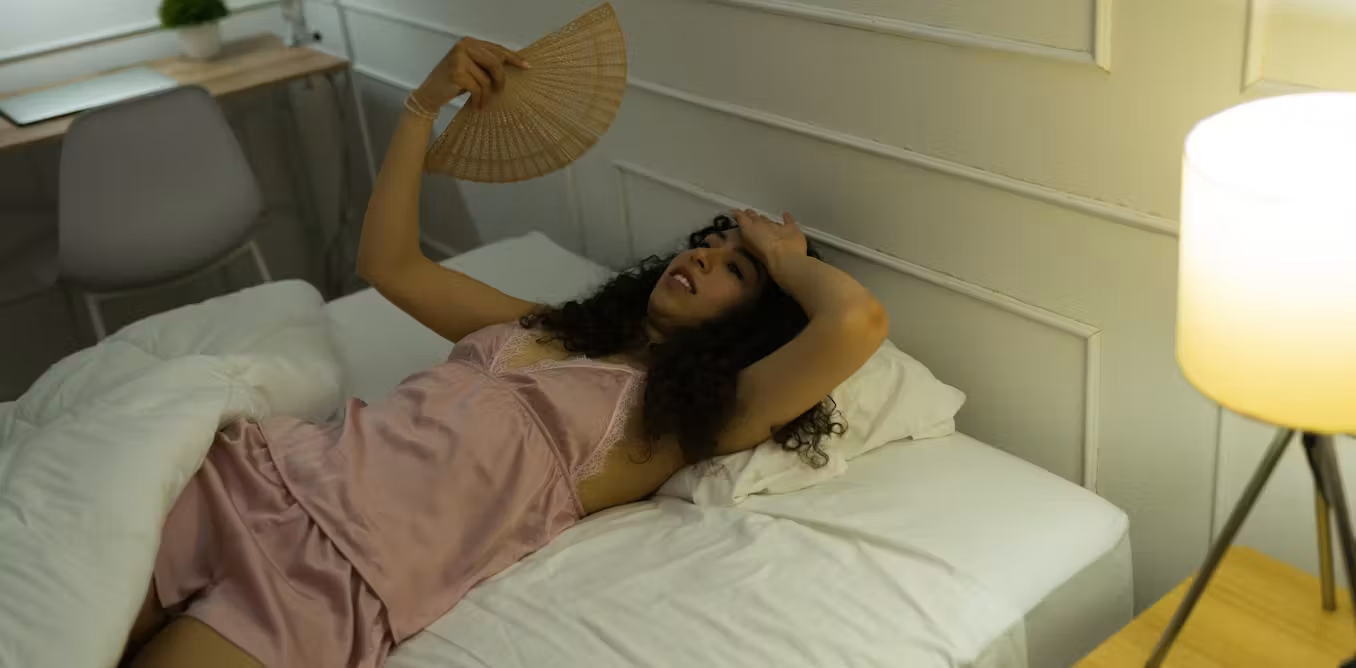
When temperatures rise, sleep often suffers. Hot nights can make it harder to fall asleep, increase waking during the night and leave people feeling less rested the next day.
One reason is thermoregulation, the body’s ability to keep its internal temperature within a safe range. Sleep is closely linked to body temperature: to fall asleep and stay asleep, the body usually needs to lose some heat. Hot bedrooms make that harder.
And UK summers are becoming hotter. The Met Office has reported that the chance of exceeding 40°C in the UK is now more than 20 times higher than it was in the 1960s, with a 50% chance of another 40°C day in the next 12 years.
Humidity can make the problem worse. Research on humidity and heat stress shows that high humidity can increase the strain heat places on the body. The body cools itself partly by sweating. As sweat evaporates from the skin, it carries heat away. But when the air is already humid, evaporation becomes less efficient.
Advertisement
So how can you sleep better in hot weather?
Air conditioning is one answer, but it is not affordable or practical for many households. According to the Energy Saving Trust, the electricity unit rate under the July to September 2026 price cap is 26.11p per kWh for direct debit customers. A small portable air-conditioning unit using about 1kW for seven hours a night over 30 nights would cost around £54.83 in electricity alone, before buying the unit.
Research on overheating in homes shows that shading and ventilation can be important passive cooling strategies: reducing indoor heat without mechanical cooling. Before cooling the air, then, it helps to reduce the heat entering the home. Overheating usually comes from sunlight entering through windows, known as solar gain, and warm outside air.
Advertisement
These eight steps can help keep bedrooms cooler before nightfall.
1. Keep sunlight out during the day
On sunny days, keep curtains or blinds closed on sun-facing windows. This reduces sunlight entering the room and heating up floors, walls and furniture. External shading, such as shutters, awnings or shades, can be even more effective because it stops some sunlight before it reaches the glass.
Be careful with windows. If the air outside is hotter than the air inside, opening windows can bring heat in. Open windows when the outside air is cooler than indoors, often early in the morning, evening or overnight. Close them during the hottest part of the day if the outside air is warmer.
2. Use cross-ventilation when the air outside is cooler
Cross-ventilation means opening windows or doors on different sides of a home so air can flow through. When outdoor air is cooler, this can help remove heat that has built up indoors. Studies of passive cooling in homes have found that night-time ventilation can reduce overheating, although effectiveness depends on the building, outdoor temperature, safety, noise and air quality.
Advertisement
3. Reduce heat from conservatories and sun-facing rooms
Conservatories can become very hot because sunlight passes through the glass and warms the surfaces inside. Keep them ventilated during the day and, where possible, close internal doors between the conservatory and the rest of the house. Reflective films, blinds, shutters, awnings and shaded roofs can all reduce heat gain.
Window shutters and retractable awnings in Mediterranean countries. (Professor Amin Al-Habaibeh, author provided) Professor Amin Al-Habaibeh, Author provided (no reuse)
Loft spaces and top-floor rooms can also become hot because roofs absorb solar heat. Loft ventilation or reflective roof materials may help in some homes, although these are usually more substantial interventions. For example, solar panels on the roof can generate electricity and at the same time act as a barrier to reduce heat transfer to the building.
4. Move where you sleep
If your bedroom is on an upper floor or faces south or west, it may be one of the hottest rooms in the house. Heat rises through the building, and sun-facing walls and roofs can continue releasing stored heat after sunset.
Advertisement
During a heatwave, sleeping on the ground floor or north-facing side of the home may help.
5. Reduce heat and humidity indoors
Ovens, hobs, tumble dryers, washing machines and dishwashers can all make indoor spaces warmer. Cooking and drying clothes indoors can also increase humidity, making it harder for sweat to evaporate.
On very hot days, use heat-producing appliances earlier in the day or later in the evening. Use extractor fans when cooking or showering because they remove warm, moist air before it spreads through the home. Research on moisture movement and extractor fans has shown that fans can reduce the movement of moisture from kitchens and bathrooms to other rooms.
6. Choose breathable bedding and clothing
A review of sleepwear and bedding fibre types found that bedding and clothing can affect thermal comfort during sleep. Light, loose sleepwear and bedding can help the body lose heat. Cotton and linen are often comfortable because they absorb moisture and allow air movement, although fabric weave, thickness and moisture handling also matter. Avoid heavy bedding, thick duvets and tight synthetic fabrics that trap heat and moisture.
Advertisement
7. Use fans carefully
Evidence on electric fan use in hot weather suggests that fans can be useful in many hot conditions, but their safety depends on temperature, humidity, age, hydration and health.
Fans do not cool the air. They move air across the skin, which can help sweat evaporate and make people feel cooler.
In very high temperatures, especially for older adults or people who are dehydrated or unwell, fans alone may not be enough. If using a fan, drink water, avoid directing it continuously at the face while sleeping, and stop using it if it makes you feel hotter, dizzy or unwell.
8. Try low-cost cooling aids safely
Reusable ice packs, freezer blocks or cooling pillows may help some people feel more comfortable. Wrap ice packs in a cloth or place them on a tray to avoid condensation soaking bedding or direct cold contact with skin.
Advertisement
Cooling mattress toppers and bedding that use water or phase change materials may also help. These materials absorb, store and release heat as they change state, although cost and effectiveness vary.
In hot weather, better sleep starts long before bedtime.
The most effective approach is usually a combination: block sunlight during the day, ventilate when outside air is cooler, reduce heat from appliances, sleep in the coolest room available and use bedding that allows the body to lose heat.
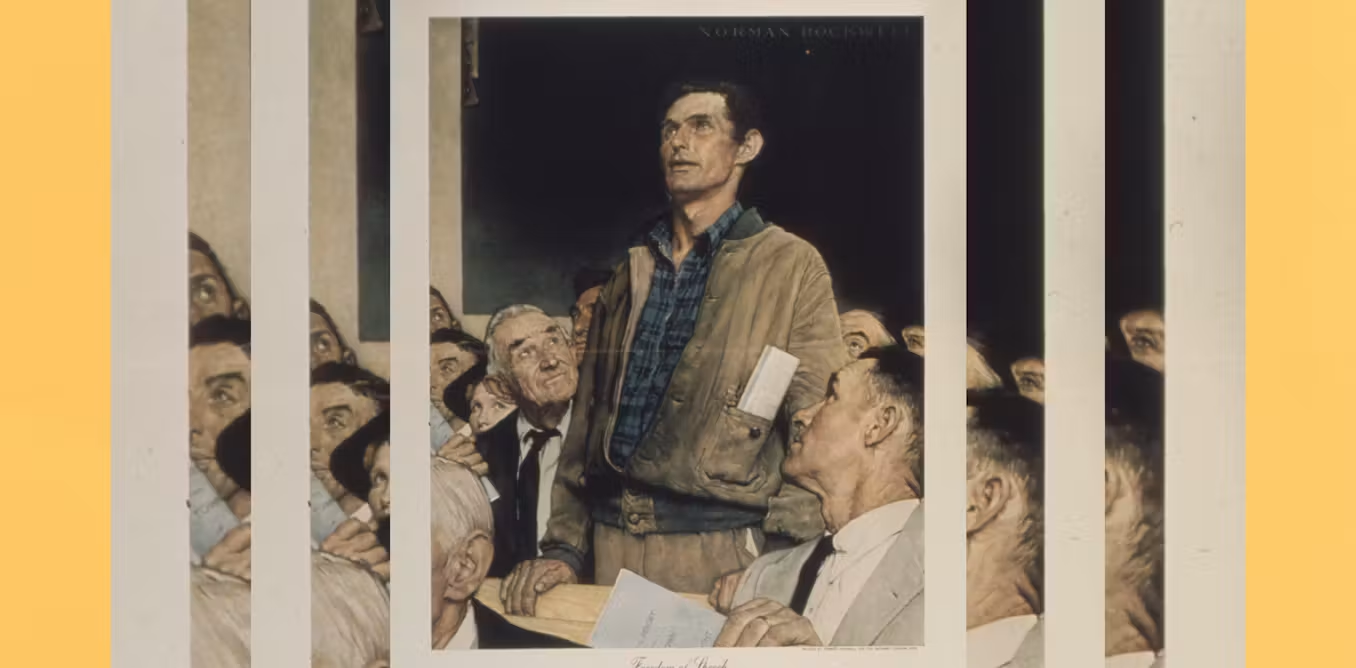
In the early 20th century, American anthropologist Franz Boas argued that being free just means being fully in harmony with your culture. The Inuit with whom he had done fieldwork saw themselves as incomparably free, even though he saw them as constrained by traditional rules.
But the opposite was also true: they saw his (freely chosen) decision to live among them as a strange cultural compulsion. For Boas, there is no absolute freedom: “We are free in so far as the limitations of our culture do not oppress us; we are unfree when we become conscious of these limitations and are no longer willing to submit to them.”
This idea sheds light on a puzzling aspect of free speech debates. Speech is never truly free: we are limited by grammar, context, politeness, style and genre. Controversies arise not because there are limits to what you can say, but because limits feel wrong. Limitations that follow your own inclinations feel sensible and natural – merely a question of hitting the right tone, avoiding some words in order to be convincing, impressive, civil or reasonable. Even free speech absolutists are polite to their mothers.
Cultures of free speech
This vision of free speech is disturbing, though. As Boas’s contemporary Bronislaw Malinowski pointed out – if freedom is just alignment on your culture, then a fully indoctrinated citizen of a totalitarian state would be entirely free.
Advertisement
But none of us live in just one culture. Our commitments are multiple, cross-cutting and conflicting, and there are dissidents even in totalitarian regimes. Dissidents are not outside culture, however. Their desire for free speech may reflect misalignment with official truth, but it is also rooted in other cultural and historical commitments and values.
In my new book, I argue that our free speech wars could be seen as a struggle between three main visions, each with its own notion of freedom.
Pelican Books
“Reason” envisions the rational exchange of opinions within the law. “Carnival” values free speech as a radical attack on established laws and orthodoxies. “Honour” is concerned with the bravery and honesty of truth-speakers doing their duty.
Carnival and honour
The real problem with Boas’s view is that it assumes freedom is just one kind of thing – being in line with your culture. His critics often think it is the opposite: thinking outside the box and being conscious of yourself as an individual rather than following the herd.
Advertisement
This idea is central to certain free speech stances: the more shocking or unconventional, the more one is a genuine free speaker. When French students took to the streets in May 1968, their most famous graffiti read “it is forbidden to forbid”. But this freedom as the absence of constraint is itself a cultural vision, with specific historical roots. It echoes medieval carnival where there was a suspension of all rules and the inversion of all propriety.
Yet when people break cultural rules, it is often in pursuit of another cultural ideal. The 17th century Quakers, for instance, were famously bold and unconventional speakers, often insulted and beaten for refusing to call people “sir” or observe common courtesies. Committed to speaking purely and truly in the eyes of God, they rejected deference as insincere flattery and worldly pride. They broke with propriety, but their freedom of speech was the very opposite of “it is forbidden to forbid”. Instead, it entailed saying less, not more, and was felt as an obligation.
Religious freedom-as-obligation might sound strange to secular ears, yet free speech is often experienced precisely in this way. Think of whistleblowers, martyrs and truth-speakers who might say, like Martin Luther did, “here I stand, I can do no other.” This is freedom as an honourable commitment to the truth.
Honour and reason
It also echoes the ancient Greek figure of the parrhesiast – the brave truth-speaker, like the orator speaking to an angry crowd. Parrhesia (truth telling) requires personal courage and a certain disrespect for conventions.
Advertisement
But the ancient Greeks also had isegoria – an equal right to speaking in public, a matter of law and formal equality. Isegoria required not individual courage but collective rules, civility and reasonable turn-taking.
Historian Teresa Bejan has argued this distinction echoes in contemporary no-platforming debates: no-platformed speakers see themselves as courageously saying what no one wants to hear; while no-platformers claim to equalise access to public speech by giving the marginalised their turn.
But we could also read it the other way: no-platformers are sometimes seen as bravely speaking out against the system, while critics of no-platforming wish that everyone would be a bit more civil and reasonable and listen to people they disagree with.
Counting to three
None of these modes of free speech are absolute. Reason implies standards of civility some speakers fall foul of. Carnival rarely gives voice to the enemy, to those deemed “powerful” or to the “establishment”. Honour is also the language of reparation, insult and offence.
Advertisement
Reason, carnival and honour are not mutually exclusive cultures. Rather they are “modes” of free speech – like modes of transport, each gets us there differently, with different costs and implications.
In a debate on free speech which is so often binary and polarised, counting to three can help us see that the hardest choices are not always between less and more free speech – they are about the kind of freedom we are reaching for and what limits it comes with.
This article features references to books that have been included for editorial reasons, and may contain links to bookshop.org. If you click on one of the links and go on to buy something, The Conversation UK may earn a commission.
















































You must be logged in to post a comment Login