When Sir David Attenborough was born in 1926, George V was on the throne, Stanley Baldwin was in Downing Street, and the BBC, the institution where he would spend many productive decades, was, itself, still in nappies.
Over the years, Attenborough has become the face and voice of natural history the world over. From chasing animals through jungles and deserts, to observing the myriad changes to our ecosystem in his near century on planet earth, Attenborough has been a guide through the wild citizens and untouched places of our world.
Here, ahead of his 100th birthday this week, we look at some of the moments from his televisual oeuvre that have defined Attenborough for generation after generation.
Attenborough and the puffins, Wild Isles
Advertisement
As the years have gone by, Attenborough’s forays in front of the camera have become increasingly rare. Appearing in 2023’s domestic-focused Wild Isles, Attenborough sits amid a colony of Pembrokeshire puffins. “Never has there been a more important time,” he implores the audience, “to invest in our own wildlife.” In its accessibility and urgency, it shows a man still, somehow, in his prime.
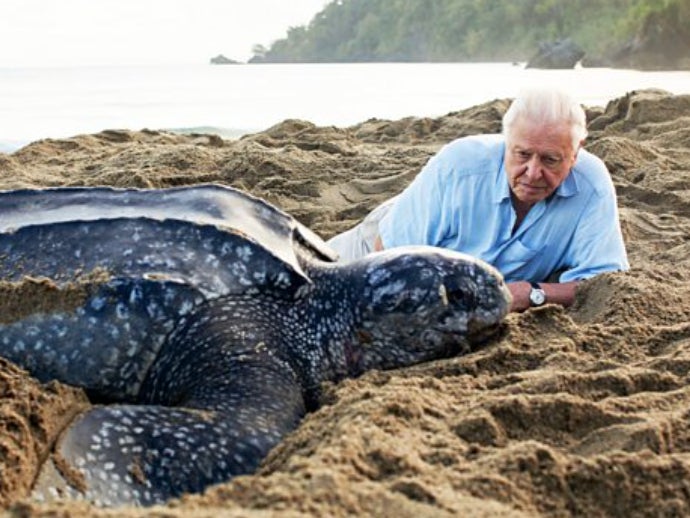
Attenborough and the leatherback, Blue Planet II
David Attenborough and a leatherback turtle on ‘Blue Planet II’ (BBC)
At the ripe age of 91 years old, Attenborough could’ve been forgiven for reclining on a beach in the Caribbean. That he would do so, back in 2017, in the moonlit company of leatherback turtles is typical of the man. “Whoops,” he exclaims, with a half-chuckle, as a giant leatherback turtle prepares to lay her eggs. All that’s missing from the scene is a striped beach towel and pina colada.
Attenborough vs curling at the Winter Olympics, Radio 1
Attenborough’s voice and intonation make him ripe for parody, a fact he made light of when appearing on Greg James’s Radio 1 show back in 2014. Lending his dulcet tones to the women’s curling event at the Winter Olympics, he narrated proceedings in trademark fashion. “The frisking is frantic,” he said, as the stone slid down the Sochi ice, “and often futile.” The seriousness of his voice paired with the lack of self-importance has been key to his success (both as a sports commentator and, more often, a wildlife presenter).
Advertisement
Attenborough on Raine Island, Planet Earth III x Zoo Quest
“As far as I know,” Attenborough told viewers, during 2023’s Planet Earth III, “I was one of the first people to film on Raine Island, back in 1957.” It was 66 years ago when Attenborough first set foot on this coral cay in the Great Barrier Reef to witness the world’s largest population of green turtles for an episode of his show Zoo Quest. Reflecting on this so many decades later, with the same issues at stake, is a remarkable feat of both zoological and televisual longevity.
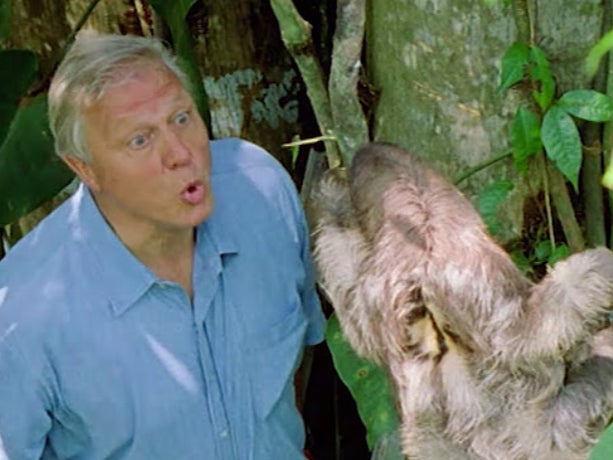
Attenborough and sloth, The Life of Mammals
David Attenborough saying ‘boo!’ to a sloth in ‘The Life of Mammals’ (BBC)
In 2002, Attenborough was back to his roots as a hands-on zoologist for this 10-part series about earth’s dominant animal class. But it was an intimate interaction shared with a sloth (“the most extraordinary plant predator”) that captured viewers’ imaginations. “Boo!” he says to the sloth, with somewhat uncharacteristic playfulness. The central American herbivore looks back at the naturalist, stretching its head out in measured curiosity, and for a beautiful moment it’s ambiguous as to who is scientist and who is subject.
Attenborough vs python, Zoo Quest
Advertisement
Back in the 1950s – long before bravura herpetologists had turned snake wrangling into a TV artform – a young Attenborough found himself in Indonesia, face to face with an enormous python. Not much older than 30, Attenborough already possessed that recognisable voice of his – but what is utterly unrecognisable is the figure nimbly scuttling up a tree, khaki shirt unbuttoned to reveal a rippling torso. The conscientious tone that would come to typify Attenborough’s later narration is entirely absent as he stuffs the python’s head into a burlap sack and grins for the camera in his moment of triumph.
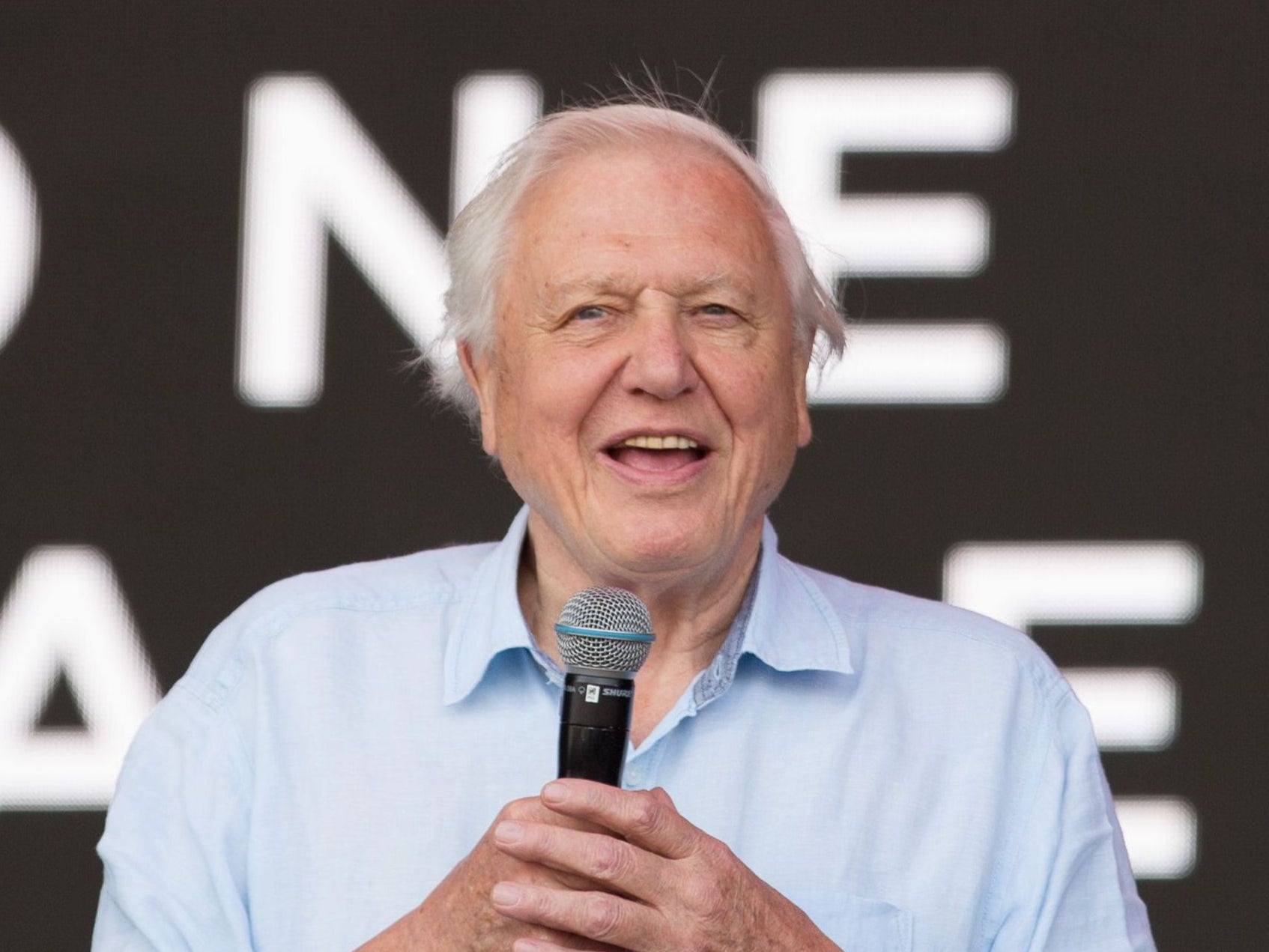
Attenborough at Glastonbury 2019
Watch Apple TV+ free for 7 day
New subscribers only. £9.99/mo. after free trial. Plan auto-renews until cancelled.
ADVERTISEMENT. If you sign up to this service we will earn commission. This revenue helps to fund journalism across The Independent.
Advertisement
David Attenborough addressing the Glastonbury crowd in 2019 (Maja Smiejkowska/Shutterstock)
Bob Dylan, Radiohead, Jay-Z: all the biggest acts in the world have played the Pyramid Stage at Glastonbury. So, it was oddly fitting when, in 2019, this titan of the natural world took prime position at Worthy Farm to give a rousing speech about the festival’s accomplishments in divesting itself of plastic. “This great festival has gone plastic-free,” he told the enormous crowd. “That is more than a million bottles of water that have not been drunk by you in plastic bottles.” The roar that greeted the nonagenarian’s rather banal appearance was the sort usually reserved for teen idols or ageing rock superstars.
Attenborough and the Cargo Cult, The People of Paradise
It’s not unfair to say that David Attenborough walked so that men like Bruce Parry and Anthony Bourdain could run. In 1960’s The People of Paradise, a youthful Attenborough deviated from his zoological background for a sojourn in the cultural anthropology arena. His episode amongst the Cargo Cult of Vanuatu, who worship a mystic figure called “John Frum” is particularly excellent. Watching it in 2023 is a good reminder of how much smaller the world seemed when Attenborough first began broadcasting.
The clever killer whales, Frozen Planet II
One of Attenborough’s key skills as a narrator is his ability to read meaning into animal behaviours, parsing them for a lay (read: human) audience. One of the most striking examples came during 2022’s Frozen Planet II. A pod of killer whales swim in formation to create waves that displace a delicious, succulent seal skulking safely on an ice floe. “It’s an ingenious solution,” he says, with almost grandfatherly pride, as the whales rip the seal to smithereens and sup on its exquisite blubber.
Advertisement
Lizard vs snakes, Planet Earth II
There’s nothing audiences love more than the rare moments when the animal kingdom pits one species against another. The best example of this, in recent years, comes from 2016’s Planet Earth II. A death match is waged between a lizard – sprinting through the desert as though it’s in Mad Max – and countless deadly snakes. This was one of the first clips from an Attenborough documentary to go viral on social media, aided by a legendary slot on Channel 4’s Gogglebox.
Attenborough and the Queen, The Queen’s Green Planet
When David Attenborough met the Queen (ITV)
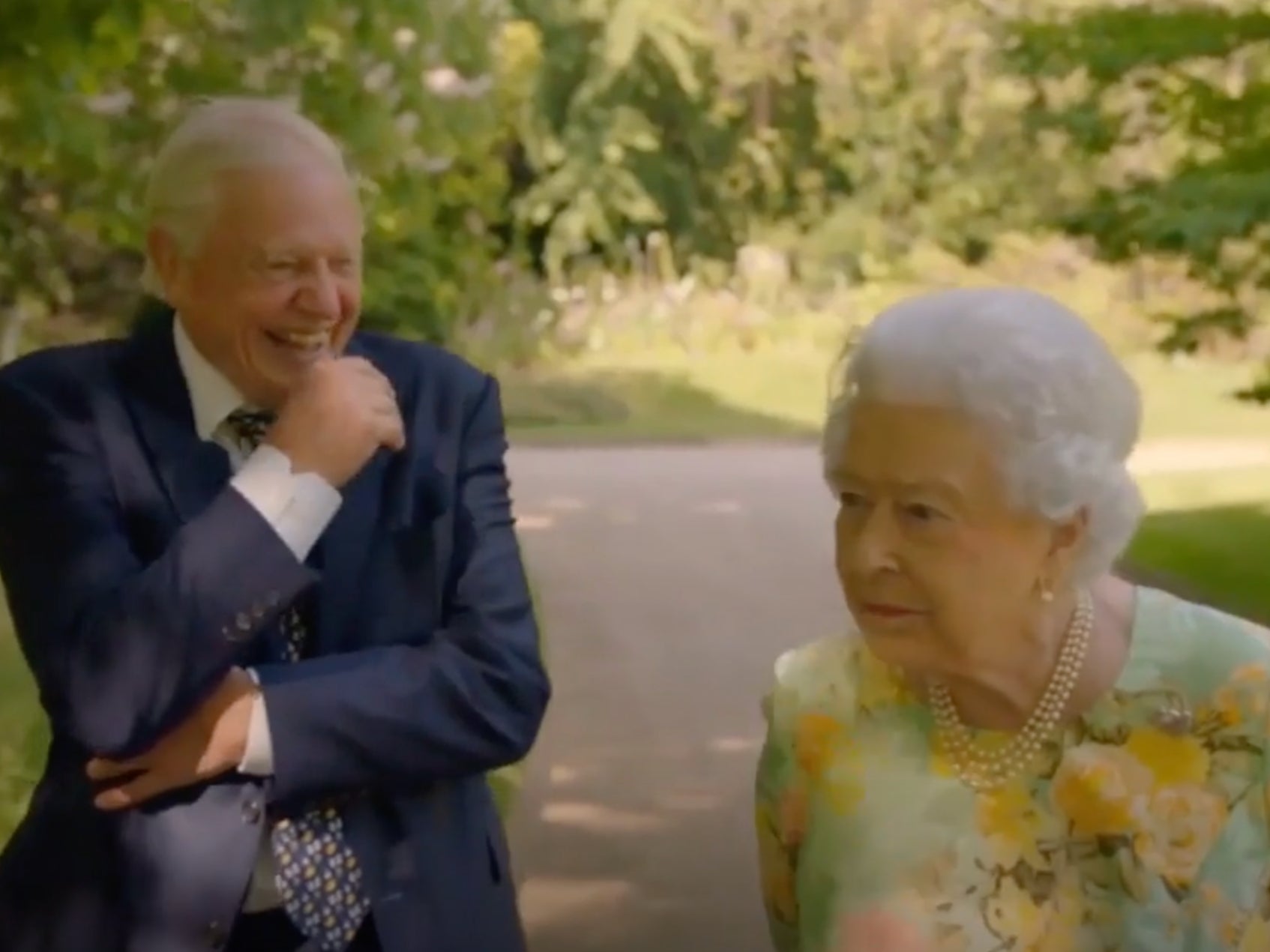
ITV really bagged the big guns for its 2018 documentary, The Queen’s Green Planet. David and Elizabeth, the nonagenarians, who were born just a couple of weeks apart in 1926, were filmed going for a pleasant stroll in the gardens of Buckingham Palace. The conversation itself isn’t exactly scintillating – the Queen compares a variety of trees to her awful children – but there’s something pleasing about the sight of these two figures, both of whom had acquired living (at the time) legend status, pottering around the garden.
Attenborough and Obama, 2015
Advertisement
In his later years, Attenborough began to transition from naturalist to campaigner. In 2015 he sat down in the Oval Office with then-President Barack Obama to discuss life on our “blue marble”. The two discuss the renewable energy transition, population urbanisation and educating children about the natural world. But what’s most striking, perhaps, is that both these men look infinitely more statesmanlike than those politicians now convening at COP after COP to talk about these same issues.
Attenborough and Lonesome George, Galapagos 3D
“This is the rarest living animal in the world,” whispered Attenborough, as Lonesome George, the last Pinta Island tortoise, crawled beside him. Attenborough’s 2013 series Galapagos 3D – made during the short-lived 3D fad – saw him get up close and personal with a creature who, having been born in 1910, made the silver-haired presenter look like a spring chicken. Even more remarkably, the tortoise died a fortnight later at the age of 102, making it his last on-camera interview. Attenborough was not, to my knowledge, questioned in connection with the tortoise’s death.
Attenborough and the mountain gorillas, Life on Earth
Advertisement
Probably the most instantly recognisable on-camera sequence from Attenborough’s decades at the BBC, this 1979 encounter with mountain gorillas at Dian Fossey’s sanctuary in Rwanda is a remarkably tactile piece of broadcasting. These huge apes – who could comfortably rip his face off and use it as a banana dish – start to tussle with the presenter in the foliage. Rather than run for his life, Attenborough submits, even grinning broadly as two baby gorillas remove his shoes. For a man best known to a whole generation as a disembodied voice, it is a wonderfully corporeal moment.
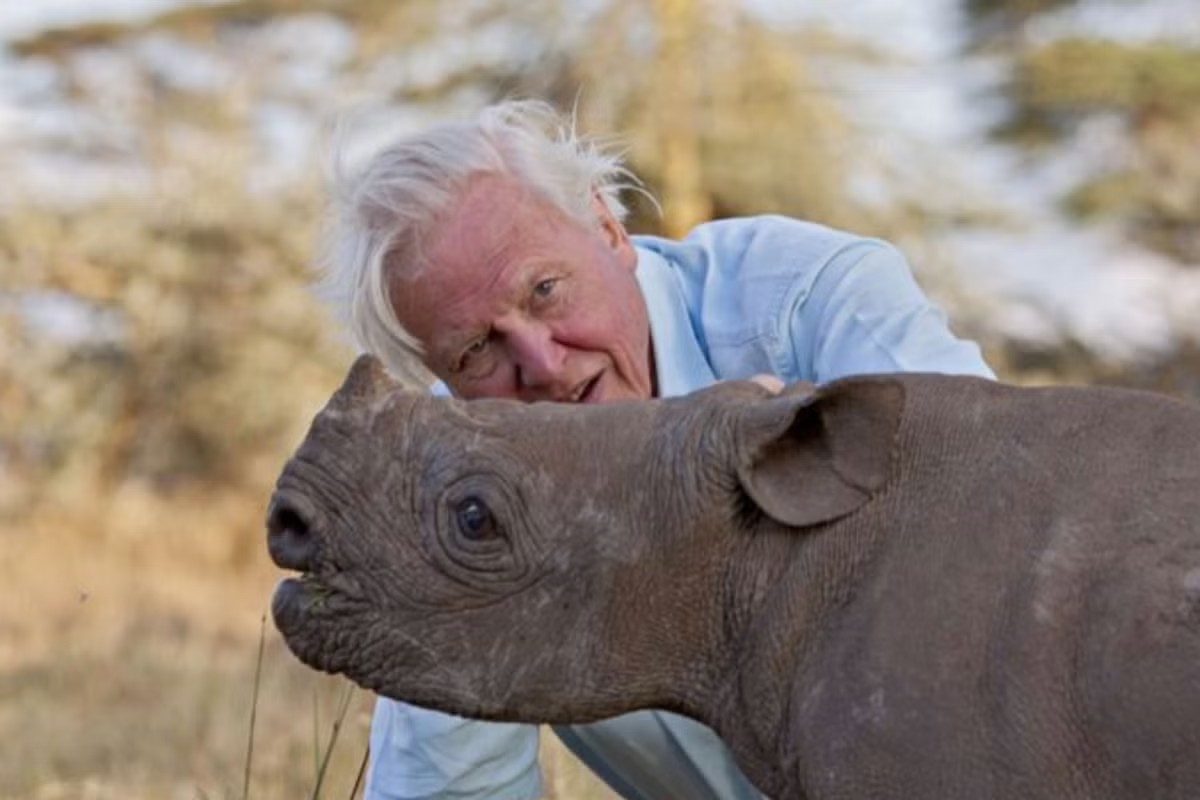
Attenborough and the baby rhino, Africa
David Attenborough and a rhino in ‘Africa’ (BBC)
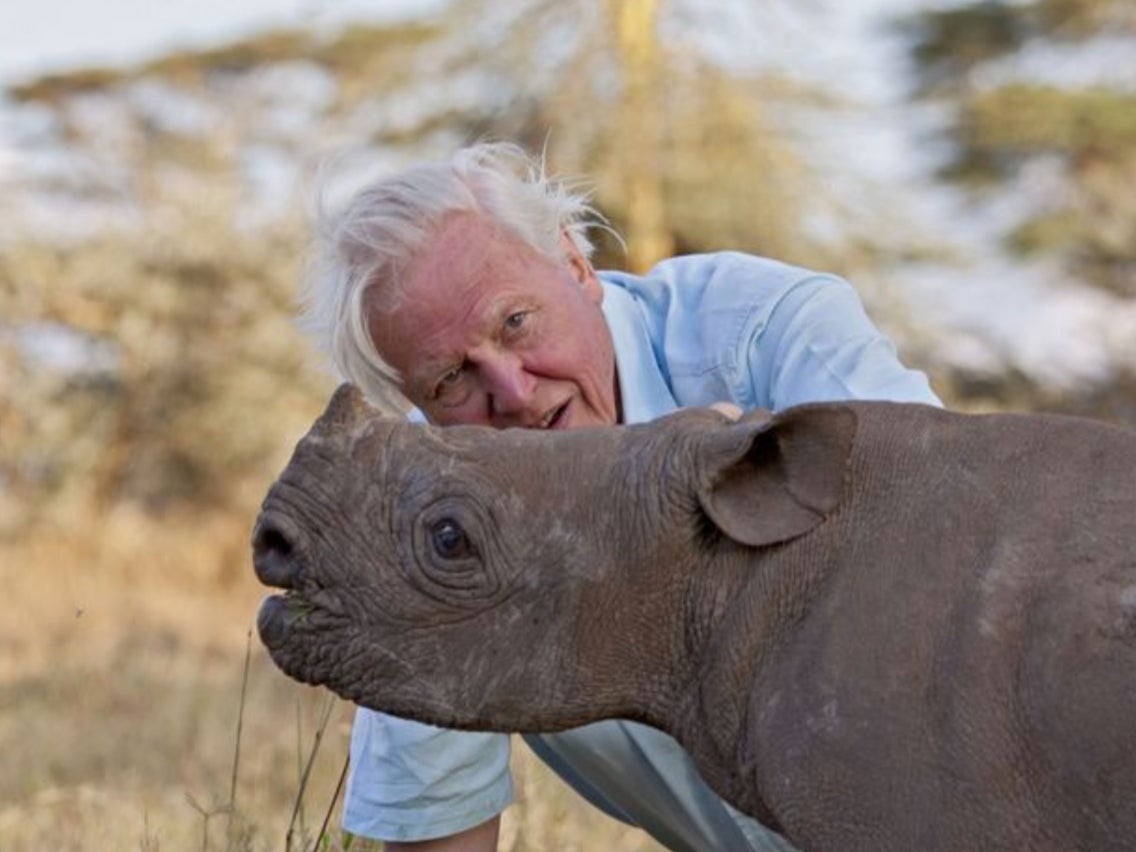
What’s better than a full-sized rhino? A baby one, of course! On all-fours in the African savannah, Attenborough comes face to face with a pint-sized rhinoceros. They squeak at one another, the older man replicating the younger mammal’s juvenile calls. “Enchanting creature,” Attenborough muses afterwards, but that shot of them locking eyes – one gnarled and wrinkled by evolution, the other craggy and lined with age – remains iconic. It is a moment not of enchantment, but of fraternity.
Attenborough’s butterfly, Micro Monsters
Big cats, giant snakes, great apes: these showstopping animals might take the headlines, but Attenborough is as adept working on a far smaller canvas. There is no more poignant example of this than a scene from 2013’s Micro Monsters, in which a butterfly lands on the presenter’s index finger. The insect seems to hold its poise while Attenborough delivers his trademark narration, his eyes staring inquiringly at the patterned wings just a few inches from his face.
Advertisement
Attenborough’s orangutan, Zoo Quest
Zoo Quest, the show that made Attenborough’s career as a presenter, was based on a premise that now seems wildly dated: the staff of London Zoo, and the BBC, travel the world to capture animals for the site’s permanent collection. All the same, the show introduced the British public to far-flung locales and their equally eye-catching denizens. The highlight is, perhaps, the search through Indonesia for an orangutan. Tracking discarded fruit on the floor, Attenborough spots their distinctive orange fur through the foliage. The ape proceeds to hang there “screaming and breaking off branches to throw down at [Attenborough]”. Fair enough – anything to avoid a trip to 1950s London.
Attenborough at COP26 2021
With Britain hosting COP26, the global climate change summit, it was natural that the organisers would turn to the nation’s most respected voice on issues of the natural world. Opening the summit in Glasgow, Attenborough delivered a rousing speech against a backdrop of dramatic images of planet earth – together with illustrations of humanity’s impact on it. “If working apart we are a force powerful enough to destabilize our planet,” he told attendees of the conference, “surely working together we are powerful enough to save it.” At a conference famous for half-measures and backroom deals, it was a spine tingling moment of public performance.
Advertisement
Dancing with the capercaillie, The Life of Birds
The capercaillie – the horse of the wood – is the world’s largest grouse. Up in Scotland, Attenborough gets up close with the local alpha male. “He is so charged up,” Attenborough observes wryly, as the bird, tail feathers standing erect, bears down on him. Moments later, the capercaillie has, somewhat over-dramatically, knocked the long-in-the-tooth presenter to the ground. “Now, now!” he exclaims, with a chuckle, as the beak of the capercaillie rattles with indignation.
Attenborough, tortoise and Graham Norton, The Graham Norton Show
David Attenborough jokingly narrating raunchy tortoise video on ‘The Graham Norton Show’ (BBC)
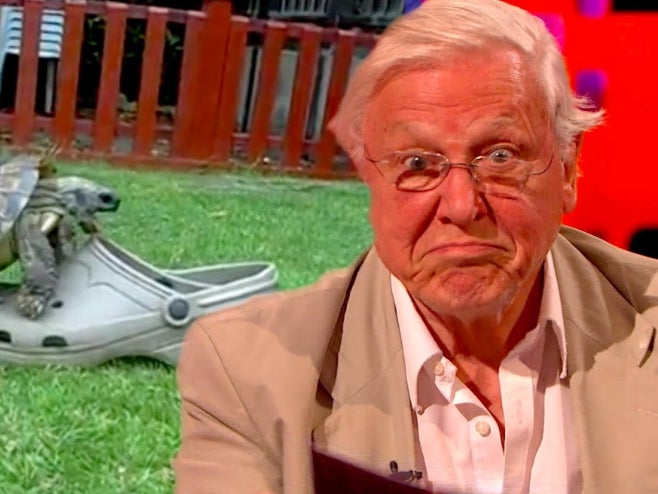
Attenborough has a long association with animals mating. “Does it get to the point where you just feel like an old perv?” asked Graham Norton when the esteemed knight of the realm sat on his red couch in 2012. Attenborough was a fixture of talk shows, from Parkinson to Friday Night with Jonathan Ross, and a very good sport. Following his cheeky enquiry, Norton made Attenborough provide his trademark narration to grainy video footage of a tortoise attempting to have its way with a rubber Croc. “The humble tortoise gently mounts his chosen mate,” Attenborough says soberly, “in a dance as old as time itself.”
Evil shoebills, Africa
Advertisement
Attenborough’s reassuring voice was often utilised to good effect in heart-warming stories of survival against the odds, but it could also run counter to that grain. There’s no better example than in 2013’s Africa, when two shoebill chicks start to fight in their mother’s absence. “This is more than scrap between two siblings,” Attenborough growls, as the comically grotesque shoebill bites at its runty brother’s neck. “It reveals a dark side.”
Lions vs elephant, Planet Earth
The BBC’s Natural History unit has always been at the cutting edge of technological developments. Underwater photography, drones and infrared are now staples of their broadcasts. Back in 2006, for the first series of Planet Earth, the team caught an extremely rare natural event using what was then considered state of the art technology: night vision. “They’re specialist elephant hunters,” Attenborough says of a pack of lions chasing their next meal, using narration sparingly as audiences bear witness to the elephant being dragged to the ground. He concludes, with trademark pragmatism, that “this elephant will feed the whole pride for at least a week”.
A Colorado man pleaded guilty to state charges including murder on Thursday for a fatal 2025 firebombing attack on a group of Jewish marchers.
The June attack in Boulder targeted a group of elderly activists advocating on behalf of Israeli hostages in Gaza, ultimately leaving one dead and a dozen people injured.
“Guilty,” Mohamed Soliman reportedly told a state court through an Arabic interpreter.
Soliman, 46, still faces federal charges related to the attack, in which he used a makeshift flamethrower and Molotov cocktails to ambush the marchers. Originally from Egypt, Soliman disguised himself as a gardener and shouted “Free Palestine!” during the attack.
Advertisement
He faces life in prison without parole.
Mohamed Soliman, 46, pleaded guilty on Thursday to murder and other state charges stemming from a 2025 attack on a group of marchers in Boulder, Colorado, who were advocating on behalf of Israeli hostages in Gaza (Boulder Police Department)
About a month after the attack, Karen Diamond, 82, died of injuries she sustained in the firebombing.
After his arrest, Soliman told police he had planned the attack for a year and would do it again if could, according to federal officials. He also allegedly told police he wanted to “to kill all Zionist people.”
Advertisement
This is a breaking news story and will be updated with new information.
In a statement, the NIO said: “We welcome the clarity provided today by the Supreme Court, which has confirmed that the ICRIR is fully equipped to deliver human rights-compliant investigations, and reaffirms the Government’s position on the interpretation and application of Article 2 of the Windsor Framework.
Netflix’s The Crown actor Ben Miles has landed a role in an upcoming series on ITV
17:40, 07 May 2026Updated 17:41, 07 May 2026
The Crown’s Ben Miles is to star in ITV‘s “suspenseful” new space thriller about a woman who vanishes during a lunar mission.
The actor, who played British Royal Air Force officer Peter Townsend in the royal drama, joins Adolescence star Ashley Walters in six-part series First Woman.
Ashley plays Ben Reith, who wakes up one morning to discover his wife Claire (Andrea Riseborough) has disappeared. It marks the beginning of an international news story “because Claire is an astronaut crewing the UK’s first moonbase and she’s disappeared into the long lunar night”, according to the broadcaster‘s synopsis.
Advertisement
It adds: “Claire is the first woman to set foot on the moon.
“A biologist taking part in a groundbreaking research project, her disappearance throws suspicion on her fellow astronauts and China’s rival base.
“With hundreds of thousands of miles between them, can Ben uncover the truth behind his wife’s disappearance?”
The cast also includes Pride and Prejudice star Jennifer Ehle and Alex Hassell, who will soon be seen reprising the role of Rupert Campbell-Black in the second series of steamy Disney+ hit Rivals.
Ben, who is also known for conspiracy thriller The Capture, is joining the cast of First Woman alongside The Tower’s Jimmy Akingbola, Fra Fee from Unchosen, You’s Kathryn Gallagher, Nautilus’ Shazad Latif and Neuromancer’s Christian Ochoa Lavernia.
Sharing the cast update on Instagram, ITV teased: “A groundbreaking project. A missing biologist. A mystery that reaches across the stars.”
Polly Hill, ITV’s director of drama, said the series would take viewers on “an incredible journey”, adding: “I wanted ITV to make this the moment I read it.
Advertisement
“The team that has come on board on and off screen is incredible, and a testament to the wonderful and original scripts.”
When the series was announced, creator Lydia Yeoman said: “Set in the exciting (and as-yet-unexplored) world of private space travel, First Woman is a thriller unlike anything else we’ve seen.
“This is the story of a marriage put through the ultimate test. It’s rare that you get given the opportunity to tell a story with such ambition and scope, and we’re eternally grateful to Polly at ITV and Alcon for allowing us to do that.”
A CPR trainer suffered a real heart attack while demonstrating the signs of a cardiac arrest in Canada.
Advertisement
Karl Arps and his students had the fright of their lives when the 72-year-old first aid instructor went into a cardiac arrest during a training session.
Arps was showing his students how to spot the symptoms of one when he suffered a medical emergency in March.
He ended up being rushed to the hospital for an emergency triple bypass surgery following the incident.
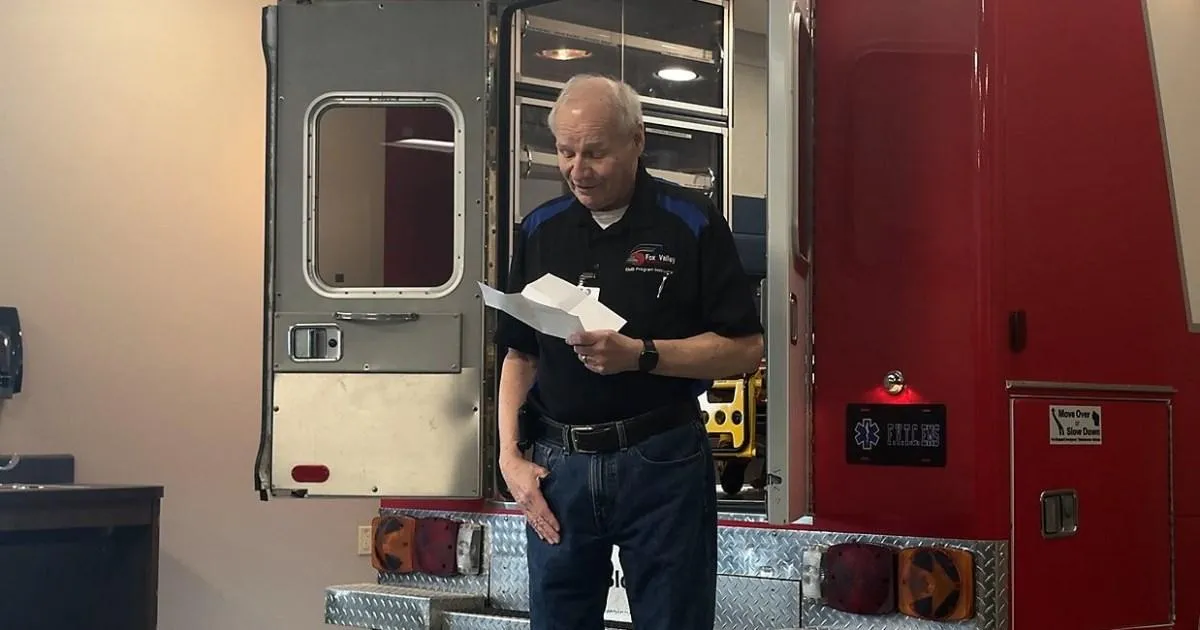
CPR trainer Karl Arps spoke at a special recognition held for the six students who saved his life with first aid when he suffered a heart attack (Picture: Spectrum News 1/Rhonda Foxx)
Students said they first thought he was pretending before realising it was real.
Advertisement
Sign up for all of the latest stories
Start your day informed with Metro’s News Updates newsletter or get Breaking Newsalerts the moment it happens.
Arps was feeling dizzy in the moments before the attack, while hearing his students around him saying he didn’t look well.
Advertisement
Next time he came around was in the back of an ambulance.
He told As It Happens: ‘From what I was told, they did everything like we told them to do in CPR class.
‘Thank you does not seem enough. They saved my life, period.’
The students jumped into action when Arp’s hands curled outward, his face contorted and he started to snore, Logan Lehrer, a firefighter learning first aid at the Fox Valley Technical College in Appleton, said.
Advertisement
Another instructor tried to wake up Arps before realising he wasn’t fooling around.
He told CBC: ‘That’s immediately when we started responding to the situation.’
Lehrer alerted the emergency services, while five other students performed CPR and used a defibrillator on the 72-year-old.
Arps said after his bypass surgery that he is lucky to be alive as many heart attack cases he has been involved with end up passing away even after successful CPR.
Advertisement
He CBC: ‘I’ve been in practice for a quarter of a century, and I can count the number of CPR saves that I’ve had on one hand.
‘[Sometimes] we get a pulse back in the ambulance or on scene, but the person ends up passing away two or three days later in the hospital.’
An ambulance chief, Nick Romenesko, said the students’ early recognition and the immediate actions ‘directly contributed to Mr Arp’s positive outcome.’
Graham Norton almost said no to The Neighbourhood, which has proven to be a bit of a miss in terms of viewing figures, before ITV’s brand new game series went to air
Graham Norton almost said no to The Neighbourhood before the series went to air. The presenter, 63, is front and centre on the broadcaster’s new gameshow format in which real-life households have gathered in a purpose-built neighbourhood to be in with a chance of winning a £250,000 cash prize.
Advertisement
There were clearly high hopes for the series as it premiered in between both segments of the explosive I’m A Celebrity…South Africa final on April 24, and has been airing at 9pm on Thursdays and Fridays ever since, where it has managed to pull in just half a million viewers.
Speaking before the series launched, Graham told an audience in the Lake District, where the show is filmed: “You are the first people in the world to get a sneak peek at The Neighbourhood, and it’s a show that I’m really excited to be at the helm.
“Anyone that knows me will know that as much as I enjoy my job, I’m also very lazy, so when the brilliant teams from Lifted Entertainment and The Garden asked me in for the pitch, I thought, well I’ll do that but then I’ll say no. And then as I was sitting there, I thought, ‘Oh, this is really good. I have to say yes to this,’ so here I am!”
Despite Graham’s optimistic outlook on the whole thing from the start, the programme will now air at 10.45pm which takes it away from the coveted slot it was initially given, implying that it has not lived up to expectations in terms of viewing figures.
This Thursday, viewers tuning in at 9pm will instead see a repeat of Davina McCall’s Long Lost Family, and an episode of Beat The Chasers: Celebrity Special, which was initially aired in 2021, will be shown instead. A spokesperson for ITV confirmed the schedule shift as they said said: “The full box set of The Neighbourhood is now available to stream on ITVX. Additionally, the show will continue to air in an evening slot on ITV.”
Advertisement
But sources have claimed that whilst the broadcaster pulled out all the stops to make the programme into a hit, it just hasn’t gone that way in the end. An insider told The Sun : “They threw everything at The Neighbourhood to make it a big success, but it’s ended up a bit of a damp squib.”
The six households competing are The Bradons, The Kandolas & Samra, The Lozman-Sturrocks, The Pescuds, The Scouse Haus and The Uni Boys. Challenges put every neighbour to the limit as they try and eliminate one another without becoming unpopular enough to get the axe themselves.
Opening up on his first reaction when he saw the entirety of the set, Graham said: “Arriving in Derbyshire and seeing the set, I’d seen pictures but I didn’t quite understand the scale of it. It really is like being on a movie set, except it’s 360 – everywhere you look, it’s real.
Advertisement
“The art department did an extraordinary job of building up that town square where we do the removals, the pub, the cafe, the interiors of the houses. It really took my breath away!
Until recently, AI’s role in research felt like having a useful assistant. It could summarise a paper, clean up a dataset or draft an abstract. Researchers were still in charge of the thinking.
That changed in late 2025 when cutting-edge “frontier” AI models became capable of reasoning and planning reliably by themselves. A key feature of these models is “tool calling” – the ability to interact with external tools in order to act on the world, not just describe it.
This marks the rise of agentic AI: systems that do not just respond to instructions but can independently plan, execute and iterate. In science as in other fields, chatbots have become coworkers that can autonomously complete real work, end to end.
An example of this is Tokyo-based Sakana AI’s The AI Scientist. Unveiled in mid-2025 and now in its second iteration, the Japanese tech company bills this as “the first comprehensive system for fully automatic scientific discovery”.
Advertisement
The AI Scientist scans existing literature, generates hypotheses, writes and executes code, analyses results and produces a full research paper – largely without human involvement. It reasons, fails and revises, just as a junior scientist would.
This represents something genuinely new: an autonomous AI system passing a milder version of the Turing test by demonstrating scientific quality, if not (yet) machine intelligence.
Advertisement
The AI Scientist’s peer-reviewed paper explained. Video: Matthew Berman.
Other significant achievements include Singapore-based startup Analemma carrying out a live demonstration of its Fully Automated Research System (Fars) in February. It produced 166 complete machine-learning research papers in roughly 417 hours for around US$1,100 (£810). That’s one academic paper every 2.5 hours at a cost that would sustain a research assistant for a couple of weeks.
And Google Cloud AI Research recently unveiled PaperOrchestra, which takes a researcher’s raw experimental logs and rough notes and converts them into a submission-ready manuscript, with figures and verified citations. In blind evaluations by 11 AI researchers, it easily outperformed existing autonomous systems in this area.
Having spent two decades researching disruptive technological innovations, I believe a significant threshold has been crossed. While there is a way to go before AI systems match the very best human-produced work, the era of fully automated research has arrived.
Implications for academia
The arrival of autonomous research systems lands on an academic system under severe strain in many countries. Over the last decade, the number of papers submitted to academic journals has grown much faster than the pool of qualified peer reviewers, leading to suggestions that the science publication system is being “overwhelmed”.
Advertisement
If systems like Fars can produce thousands of papers per year, the publication infrastructure of science faces a volume it was never designed to handle. Some academic reviews have already been identified as using AI-generated content. As submission numbers continue to rise, this may alter the role of a published academic paper as a definitive signal of the quality and skills of human researchers.
An optimistic take is that AI may shift academia away from its strong reliance on quantity-based metrics, in favour of how influential or innovative publications are. This is a reform critics of the current system have long called for.
Less optimistically, as AI research scales up, an academic system designed for coherent, methodologically defensible contributions may inflate the proportion of incremental, rather than radically novel, scientific contributions. Both the quality and originality of research could suffer as a result.
Science has always needed its heretics to advance. Italian astronomer Galileo, the “father of modern science”, was forced to recant his defence of heliocentrism before the Catholic Church’s Inquisition. Hungarian physician Ignaz Semmelweis died in a psychiatric institution having failed to convince his colleagues that handwashing could save lives.
Advertisement
Yet historically, the ability of scientific institutions to encourage radical approaches has also been a mainstaple of how science has progressed. To sustain this, AI systems will need to be trained to maximise novelty and transformation, rather than plausibility and incremental progress.
AI’s impact on creative industries
The transformative effects of this new breeed of AI extend well beyond scientific research. A striking example is The Epstein Files. This fully AI-generated podcast reached number one the UK Apple Podcasts and Spotify charts in early 2026, drawing 700,000 downloads in its first week.
Music is further along and more conflicted. By mid-2025, the fully AI-generated band The Velvet Sundown had amassed over a million monthly Spotify listeners. In 2026, the platform was forced to introduce artist-protection features after AI tracks began displacing human music on popular playlists, while Deezer, facing roughly 50,000 AI-generated uploads daily, began excluding them from curated lists.
Ownership remains the elephant in the room. US courts have ruled that AI-generated works cannot be copyrighted, since human authorship remains a legal requirement. AI can produce at industrial scale, but no one can own the output legally.
Advertisement
This matters far beyond intellectual property law. In creative industries, it threatens the royalty streams, licensing deals and catalogue valuations on which artists, labels and publishers have built their entire business models for generations.
In science, meanwhile, it is destabilising the entire incentive architecture, which rests on the foundational assumption that knowledge is both generated and owned by humans. When that assumption dissolves, so does much of the institutional logic that has governed how we produce, reward and trust expertise.
The question, across all these fields, is no longer whether AI can produce the work. Rather, it is whether sufficient thought has gone into what we will gain and lose when it does.
Manchester plays host to only the seventh-ever all-British world heavyweight title showdown in boxing as Wardley defends his WBO belt for the very first time in front of a sold-out crowd.
The unbeaten former English, British, European, Commonwealth and Continental titlist had a second reign as an interim champion after stopping Joseph Parker in the 11th round in an upset at the O2 Arena back in October, then was upgraded to full champion a few weeks later after the title was relinquished by Oleksandr Usyk, who also gave up his undisputed status.
In February came confirmation that Wardley’s maiden defence would come in a blockbuster clash with Dubois, the former IBF champion who has not fought since losing that gold in a second stoppage defeat by Usyk at Wembley Stadium last summer as he missed out on becoming undisputed.
He now has his sights set on becoming a two-time world champion, getting back to the sort of form that saw him knock out Anthony Joshua in destructive fashion at Wembley having previously overcome the likes of Filip Hrgovic and Jarrell Miller, but forced to pull out of a meeting with Parker due to illness and also withdrawn from an IBF world title eliminator against Frank Sanchez that could have put him on a collision course with Usyk again.
Advertisement
Wardley vs Dubois fight date and venue
Wardley vs Dubois on a fight card called ‘Don’t Blink’ takes place on Saturday May 9, 2026 at the Co-op Live Arena in Manchester, England.
Wardley vs Dubois fight time and ring walks
Wardley and Dubois are expected to make their respective ring walks at approximately 11pm BST on Saturday night, with the main event to start shortly afterwards. That is 6pm ET and 3pm PT in the United States.
Advertisement
The televised undercard starts from 6:30pm BST, 1:30pm ET and 10:30am PT. As ever, the exact timings are subject to change.
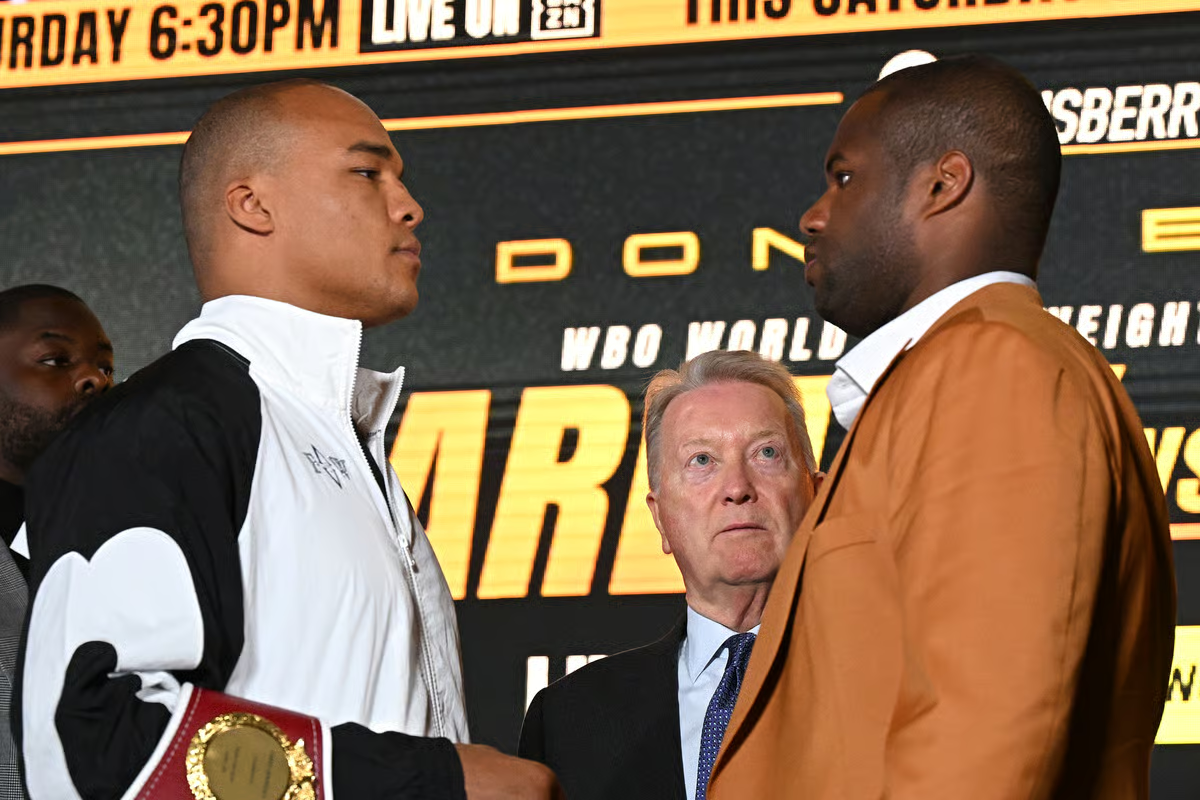
Face-off: It has been a tense week of build-up between Fabio Wardley and Daniel Dubois
Getty
How to watch Wardley vs Dubois
Advertisement
TV channel and live stream: Wardley vs Dubois is available to watch live and exclusively in the UK via DAZN pay-per-view, at a cost of £24.99.
Live blog: You can follow all the action as it happens on fight night with Standard Sport’s live blog.
Wardley vs Dubois undercard
Saturday’s chief support act sees former British super-lightweight champion Jack Rafferty make his welterweight debut against Ekow Essuman, who is coming off that late stoppage loss to Jack Catterall on the Chris Eubank Jr vs Conor Benn 2 undercard in November.
Advertisement
Bradley Rea and Liam Cameron collide in a light-heavyweight showdown, while in the same division Zak Chelli takes on Cuban David Morrell, whose battle with Callum Smith was postponed last month.
Welsh former British and European lightweight champion Gavin Gwynne rises to super-lightweight to meet Bolton’s Khaleel Majid, while there is another heavyweight tussle between two-time Olympic gold medallist Bakhodir Jalolov and Croatia’s Agron Smakici.
Fabio Wardley vs Daniel Dubois
Jack Rafferty vs Ekow Essuman
Advertisement
Bradley Rea vs Liam Cameron
David Morrell vs Zak Chelli
Khaleel Majid vs Gavin Gwynne
Bakhodir Jalolov vs Agron Smakici
Advertisement
Wardley vs Dubois prediction
A knockout seems virtually guaranteed when these two explosive heavyweight punchers lock horns, with ‘Don’t Blink’ an apt name for the event given by promoters Frank Warren and Queensberry.
It is a really intriguing fight that is a difficult one to call, with both men containing the ability to end proceedings in a split second.
Former white-collar boxer Wardley can often flatter to deceive with his technical shortcomings as seen most notably against Huni, but his sheer power, determination, aggression and one-punch knockout capabilities means he is never out of any bout – as late wins over both Huni and Parker can attest.
Advertisement
Let him get to you early, though, and it can be all over so quickly, as Clarke found out to his cost in their swift rematch.
Upset: Wardley stopped Joseph Parker late in an engrossing fight in London back in October
Getty
Dubois is every bit as heavy-handed and should have learned more valuable lessons against Usyk, but this will be a firefight that is more suited to his strengths.
When it’s all said and done, however, we’re backing Wardley to pull out another sensational knockout once the fight has entered deep waters.
Advertisement
Wardley to win by late stoppage.
Wardley vs Dubois weigh-in
Wardley and Dubois will both hit the scales in Manchester on Friday, having exchanged barbs at a final press conference on Thursday.
The two men also unexpectedly engaged in a tense 57-second face-off during open workouts on Wednesday.
Advertisement
Wardley vs Dubois latest odds
Wardley to win on points/by decision: 13/2
Wardley to win by knockout, technical knockout or disqualification: 11/8
Dubois to win on points/by decision: 11/2
Advertisement
Dubois to win by knockout, technical knockout or disqualification: 9/5
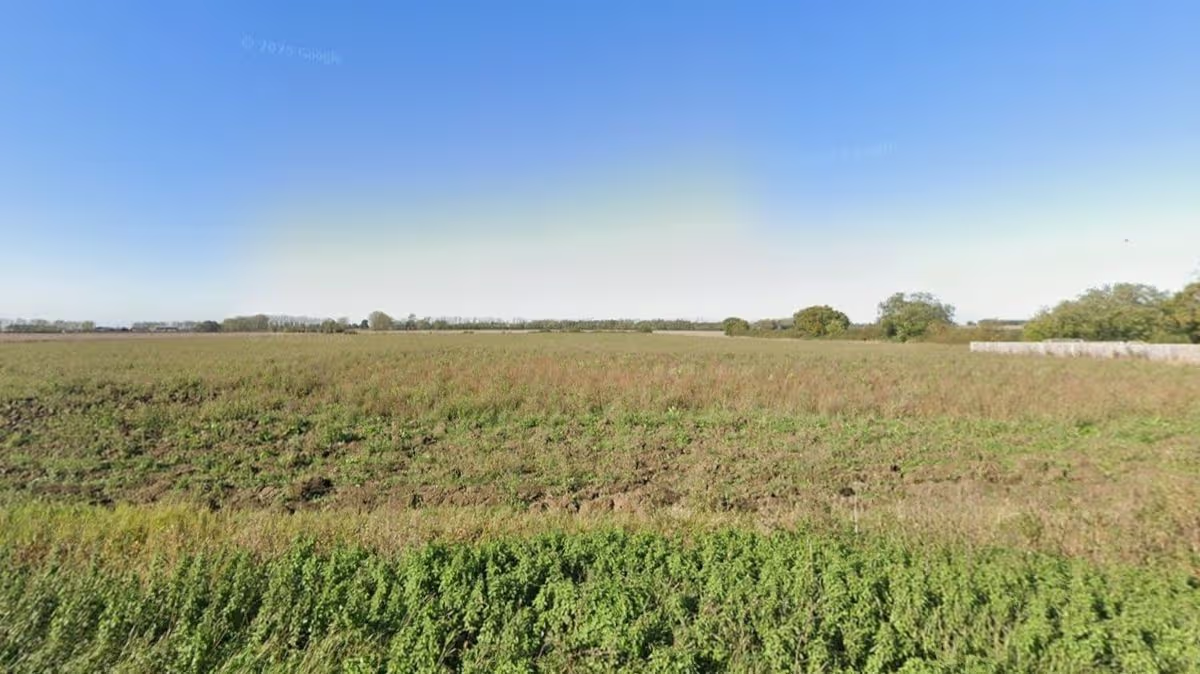
The developer argued there was a need for affordable housing across East Cambridgeshire
A development of 100 affordable homes which was refused for being “too big” for a village will now go ahead following a successful appeal.
Advertisement
A proposal for 83 homes had already been approved on the land at the edge of Stretham, off the A10 near Ely, but permission was sought for a further 43. East Cambridgeshire District Council refused the application for 126 homes which they said went far above the affordable housing need in Stretham and nearby Little Thetford.
Long Term Land Limited appealed the decision and said there is “an ongoing and acute need for more affordable housing” in both East Cambridgeshire and Stretham. They said half of the homes will be affordable rental properties and the other half will be sold for affordable home ownership.
A range of road improvements are also proposed including street lighting, a puffin crossing, footpath improvements and measures to reduce vehicle speeds.
‘History’ of affordable housing schemes
A hearing was held by the Planning Inspectorate on March 4 and 5 with inspector T Burnham visiting the site on the second day. They noted “a history” of affordable housing schemes being granted outline planning permission on the land.
Advertisement
Initially refused by the council, permission for up to 19 homes was granted on appeal in 2023 and up to 38 were allowed by the council later that year. The need for affordable housing in the area was said to be between 44 and 72 homes, which the council said was “appropriately met” by the approved 83 homes.
The inspector agreed, but said Stretham is linked by buses to Ely and Cambridge which both have a “wide range of services” and “railway stations served by multiple routes”. They added that the “harm and implications” from building too many affordable homes “has not been clearly made out to me”.
Inspector Burnham said the benefits of the homes “should be afforded substantial weight” and approved the appeal.
For months, the Iran war was framed through the language of military success. This was shaped in part by longstanding orientalist assumptions reflected in the rhetoric of leaders such as Donald Trump and Benjamin Netanyahu about the relative weakness and fragility of states such as Iran.
Encouraged by Israeli intelligence capabilities, precision strikes and overwhelming American military superiority, many policymakers appeared to assume Tehran would eventually collapse under pressure. Iran, in this view, was too isolated, internally divided and economically weakened to withstand sustained US-Israeli escalation. Some even suggested American troops would be welcomed by sections of a population frustrated with the regime.
But this hasn’t been the reality of the past two months. The Trump administration now appears to be groping for any settlement it can sell as a “win”. This may be hard if, as has been reported, the US military campaign ends without Iran being forced to make any meaningful concessions over its nuclear programme.
If that transpires, it will suggest that the German chancellor, Friedrich Merz, was right when he said that the US has been humiliated by Iran in a lesson about how power really works.
Advertisement
The problem was not simply military miscalculation. It was strategic incoherence rooted in assumption that Iran could not meaningfully endure prolonged confrontation. As the war progressed, the fantasy of decisive victory collapsed under the weight of economic, political and strategic reality.
No clear objective
At the same time, at least in public, America’s leadership appeared regularly to change its mind about what would represent a “win”. Was it destroying Iran’s nuclear and ballistic missile programmes, neutralising its armed forces, forcing regime change, or ending Tehran’s regional influence? Throughout the conflict, the objectives shifted constantly. That ambiguity was not a minor flaw in strategy. It was the strategy’s central weakness.
Modern wars require a clear objective and a realistic path to achieving it. Throughout this conflict, the US and Israel never convincingly defined either.
If the aim was regime change, there was never serious appetite for the kind of occupation and state reconstruction that had in Iraq and Afghanistan already proved disastrously costly.
Advertisement
If the aim was simply degrading Iran’s military capabilities, that was always going to be a temporary fix – Iran has spent decades building a system designed around resilience, decentralisation and survival under pressure.
And if the aim was to end Iran’s role as a regional power, that has clearly failed. Iran remains intact. Its institutions survived and were able to install a new generation of leadership. And, as we’ve seen over Tehran’s ability to control the Strait of Hormuz, Iran’s strategic relevance survived.
This was never going to be a conventional war about controlling territory. It was a clash between two very different understandings of victory. The US and Israel wanted a decisive and demonstrable victory. Iran wanted to endure. That distinction changed the entire war and handed the strategic advantage to Tehran.
Iran understood something many policymakers in Washington continue to underestimate: weaker states do not necessarily need to defeat stronger powers militarily in order to succeed. They simply need to avoid collapse while imposing sufficient economic, political and strategic costs that the stronger actor eventually recalculates.
Advertisement
This is not a new lesson. It runs through modern history, from Vietnam to Afghanistan. Superior military power does not automatically produce political victory. But more importantly, the conflict also revealed the increasing cost of escalation in an interconnected global economy.
Global battlefield
The war’s consequences spread across the global economy as oil prices surged, shipping routes faced disruption and already fragile supply chains came under renewed pressure. The closure of the Strait of Hormuz – through which roughly one-fifth of the world’s seaborne oil supply passes – was enough to trigger market anxiety. Iran does not need to fully close the strait to create economic shockwaves. In the modern global economy, uncertainty itself is a weapon.
Iran is well aware of the leverage that control of the Strait of Hormuz has brought it. EPA/Abedin Taherkenareh
The longer the war continued, the harder it was to remain politically sustainable – not just regionally, but globally. That is why, despite aggressive rhetoric, neither side now appears eager to return to full-scale war.
There is a broader lesson here that western powers repeatedly struggle to absorb: military power can destroy infrastructure and impose suffering, but it cannot easily manufacture legitimacy, political order or strategic clarity. That is why “winning” modern wars has become increasingly elusive even for the most powerful states on earth. Wars without realistic theories of victory tend to end the same way: through exhaustion, recalculation and negotiation. That increasingly appears to be where this conflict is heading.
Advertisement
The limits of power
Perhaps the greatest irony of the Iran war is that all sides now appear to recognise what should have been obvious from the beginning: total victory was never truly achievable. The war became a demonstration – not of the absence of power, but of its limits.
That matters in an increasingly fragmented global order where wars are becoming less about decisive triumph and more about endurance. States shaped by sanctions and prolonged isolation often develop a capacity to absorb pressure beyond what outside powers anticipate. Iran’s resilience was not created during this war. It was built over decades.
Military superiority still matters enormously. But the ability to endure politically, economically and socially matter just as much. Iran is a state with a complex, resilient structure, and depth of legitimacy especially when it comes to conflicts with the US and Israel. Iran understood that from the beginning.
It has taken Iran’s opponents too long to grasp the same facts. But they have now been educated by experience.
An initial request for ways to slow traffic through the village has been met with a comprehensive redraw of the centre including widened pavements, road realignment and regimented parking.
Controversial plans to change the centre of Winchburgh have been backed by West Lothian Council.
Advertisement
Almost 200 people objected to a scheme to slow traffic through the rapidly growing village.
And community groups have turned their backs on plans drawn up by the charity Sustrans, now known as Walk Wheel Cycle Trust (WWCT).
A major redraw of proposals resulted in only four of the 196 objections being withdrawn.
And despite calls by councillors for further refinements, and promises by the trust to engage more with local people, few in the village seem to want the package.
An initial request for ways to slow traffic through the village has been met with a comprehensive redraw of the centre including widened pavements, road realignment and regimented parking.
Debate at the Development Management Committee this week only produced tweaks including the removal of a planned bus shelter outside of one villager’s house and the promise to look at the relocation of another.
In papers to the DMC, planners explained: “The application site extends from the bridge over the Union Canal to the west of Bennet Wood Terrace, where a traffic calming pinch point is proposed at the access to Fernlea, Nirvana and Easter Cottage.”
Advertisement
Winchburgh Community Development Trust, in partnership with West Lothian Council and Winchburgh Developments Ltd, applied to WWCT for Scotland’s Street Design Programme in 2018. This project is intended to form part of a wider vision for the regeneration of Winchburgh as a whole.
Planning officer Gillian Cyphus told the meeting: “There remains a significant body of objections from the residents. Residents are concerned about the impact of work on businesses and on residential amenities.”
She added: “The key issues for determination are the impact on road and pedestrian safety and the impact on amenity.”
Advertisement
Mrs Cyphus told the meeting that controversial proposals for the bus shelters had been changed in planning conditions and plans for bench seats had also been removed as part of conditions because of concerns about householder privacy .
While plans have been formulated since 2023 revision was demanded earlier this year.
The Community Council appeared at the DMC meeting to say that it could not support the revised proposals.
One Main Street resident Sylvia White told the meeting: “I am not opposed in principle but concerned whether the layout choices are correct and proportionate.”
Ms White said proposed changes in the siting of lights and crossings would mean “more stop-start traffic” along the street.
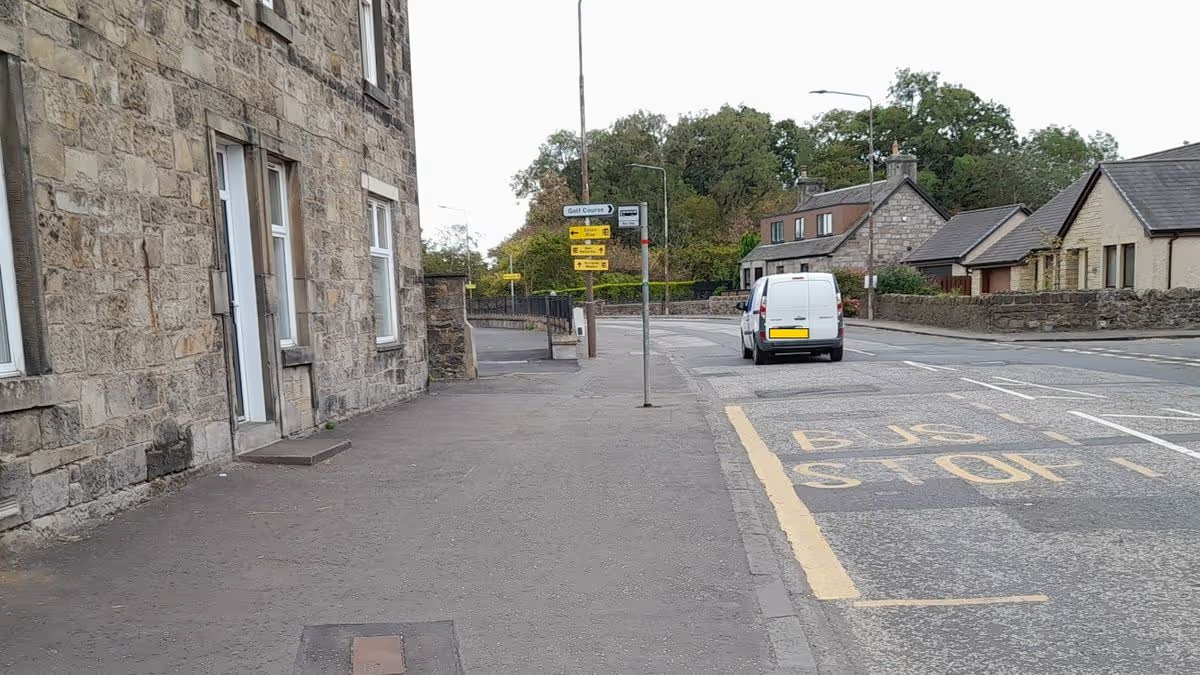
Lars Cook pointed out that 70 to 90 buses stopped outside his house each day. He and his family had to put up with foul language and people urinating against his home as well as general disruption from the existing bus stop. The building of a bus shelter would only exacerbate the disruption and invasion of his family’s privacy.
Jordan Wright who owns a pet supplies shop in the Main Street said that parking changes could take customers away from his shop and surrounding businesses.
Advertisement
Graham Campbell, the chair of Winchburgh Community Council said: “There are matters that are still up in the air for both businesses and residents. This was a community led project until a year ago when the cycle trust took on the community feedback and provided something that was really not what had been asked for.”
In its defence the engineering firm ARUP which had provided detailed design for the WWCT said: “The proposal creates a more accessible Main Street which prioritises people with additional access needs, including through the provision of additional parking bays (and disabled parking bays in particular) interlinked with improved footways for wheeling.”
Representatives from the charity and Arup said they were prepared to continue discussions with residents over issues raised and make changes where possible.
Advertisement
Details were debated over two hours before councillors reconvened to make a decision.
Councillor Willie Boyle said: “I am delighted at the dialogue this morning. I have to say in some ways I envy Winchburgh. What’s being proposed is positive.”
He pointed to the council’s own plans for decriminalised parking enforcement and 20mph zones coming into communities as part of national road policy changes. “These schemes in themselves are not enough, they can be ignored and can be difficult to enforce but engineering our streets to be safer I think is very positive.”
“I think this is the way forward. It has been unfortunate about the issues of communication but I think we have an opportunity to salvage this.”
He said a decision by the council would allow further conversations to take place.
Local ward councillor Tony Boyle said: “I think the best thing today would be take this plan back and get back into a discussion with the communities and come back in with a fully refined plan, But I know because of funding constraints that’s not going to happen. I would support this plan if conditions could be attached regarding the siting of the bus stops”.
Councillor Boyle suggested that the bus stop also be moved from outside Mr Cook’s house but planners suggested this would be difficult to condition as part of the proposals before the committee. It is something which can be considered by another committee.










































You must be logged in to post a comment Login