UK gardens struggling with damaged and yellowing grass can bring their dead lawns back to life and revitalise them if gardeners do four simple lawncare tasks now in autumn.
Countless gardeners have been left grappling with brown, straw-like lawns, parched cracked soil, and drooping plants – yet early autumn actually offers an ideal opportunity for revival.
Fortunately, there are several straightforward methods to restore life to your struggling garden. With autumn providing the perfect conditions to address brown and yellowing lawns, implementing a handful of simple measures now will set your garden up nicely for both winter and next summer.
James Lewis, gardening experts from MyBuilder.com, explain: “Over the summer our gardens have been put through hell, with the hosepipe bans, hot weather, and lack of rainfall making this summer hard to keep our gardens full of life.
“The key this autumn is to give your garden time, don’t make any rash decisions. It will take time for your garden to regain strength. Some plants may take weeks, while others may take much longer, depending on the plants and how severe the damage is.”
Advertisement
4 jobs to do for lawns in autumn
Rake
The experts at James Lewis advise: “Rake out dead material, such as dead grass roots, stems and debris (thatch) that has built up over summer just below the surface, which will block moisture and nutrients from getting into the roots of grass.”
Deal with compacted areas
Areas subjected to repeated foot traffic will have become compacted, stopping water from penetrating the surface. Gardening specialists recommend using a fork or aerator to spike the ground, creating holes 10-15 cm deep, which will open up the soil and allow water and air to reach it, encouraging your grass to thrive and strengthen, reports the Express.
Reseed
The gardening experts add: “After raking out the lawn thatch, your lawn may look sparse or have bare patches. Adding grass seed and keeping the soil moist while the new grass establishes will create a thicker and greener lawn in just a few weeks.”
Advertisement
Keep mowing
Don’t put the mowers away just yet, the experts advise. Instead, carry on mowing until growth starts to slow.
Aim to raise the mower blades and cut your grass at a higher level to protect the soil and allow grass roots to recover, while letting the shorter clippings fall back onto the lawn, returning vital nutrients to the soil.
Give your garden time
Finally, while it isn’t strictly a gardening task, it’s a vital part of ensuring lawns bounce back – and that’s simply giving your garden adequate time to recuperate.
Advertisement
While achieving lush, green grass is the ambition for most homeowners, patience is absolutely essential when it comes to restoring your lawn this autumn.
The gardening specialists explain: “Your grass needs to regain strength and energy to grow and regain its original colour, so taking hasty long-term steps from the get go isn’t advisable.”
Several other areas green-fingered gardeners can concentrate on include watering sensibly. The gardening experts recommend: “Some water bans are still active, but if they have been lifted in your area, it’s wise to water early in the morning and later in the evening to prevent evaporation. This consistent moisture is key to help your plants recover, but ensure you don’t overwater them, as you can risk drowning them.”
Another method to boost your garden’s overall health involves resisting the temptation to immediately throw out plants showing brown leaves or looking wilted, as they may still bounce back. Instead, the gardening professionals advise being patient and watching for new green shoots before deciding something has perished.
Advertisement
Lastly, experts warn against over-tidying your outdoor area. Gardening experts at James Lewis state: “As counterintuitive as this sounds, giving your garden too much of a tidy can actually sweep away vital material that retains moisture for your lawn.
“Fallen twigs and leaves, for example, act as a natural mulch that traps water in the soil, keeps away harsh sun rays and improves the soil nutrients as it decomposes. Instead of removing every bit of dirt and debris, clear anything that looks like it could cause disease, while retaining enough cover to help protect your garden down the line.”
A “happy” girl whose stomach pain turned out to be a sign her heart was failing now has a mechanical heart pumping blood for her while she waits for a transplant. Her parents, Annemarie, 41, and Michael, 46, said she began showing “subtle” changes in 2024, including not wanting to cycle to school and being “chubbier” than her siblings.
Annemarie and Michael, from Dublin, noticed Essie, seven, had “lost her spark” the following summer. By March 2026, she had developed worsening stomach pain, exhaustion and vomiting, and was initially diagnosed with constipation.
Advertisement
As her condition continued to worsen, further tests uncovered that she had hybrid cardiomyopathy, a rare heart condition that affects the heart’s ability to pump blood, which explained her earlier symptoms.
She was subsequently transferred to Great Ormond Street Hospital in London after medical staff warned that she would likely require a heart transplant to survive. In order to keep her heart functioning while she awaits a donor organ, Essie was placed on an advanced life-support system for 12 days before being fitted with a Berlin Heart mechanical pump on May 5.
Now, with Michael and Annemarie dividing their time between London and Dublin while also caring for their two other children, Ayla, 13, and Cael, four, young Essie takes around 25 medicines each day as she waits for a new heart.
Annemarie, a Montessori teacher, told PA Real Life: “When I see Essie with the biggest smile on her face, or she’s got some story to tell me about winding up the doctors, you just think to yourself, ‘If she can get through this all, then so can we’.”
Advertisement
Michael, a streaming media engineer, added: “She’s an inspiration to us every day.”
Essie had always been constantly “running around” and “cheeky”. However, at the age of four in 2024, her parents Annemarie and Michael began noticing some “subtle” shifts in her behaviour, including becoming “very concerned” about whether they would drive or cycle to school.
They also noted she appeared “a bit chubbier” than their other two children, though they did not think “too much of it” at the time. By the summer of 2025, the couple felt that Essie had “lost her spark” and sought the help of a play therapist, though she appeared to be “was fine”.
Advertisement
Despite this, Essie continued to seem not “quite herself” and by March 2026 she had started “complaining” of stomach pains.
Annemarie added: “She was saying that she was tired and wanted to go to bed early, which wasn’t like her. We took her to the St Patrick’s Day parade and she wanted to be carried and not stand. It just got worse – over the next day or two she started vomiting and couldn’t keep anything down.”
At the end of March, the couple took their daughter to their GP, who diagnosed her with constipation and prescribed medication. However, when her condition failed to improve over the following days, they brought her to their local children’s hospital, where she received the same diagnosis.
Annemarie and Michael had a “feeling” that “something wasn’t right”, prompting them to return to hospital, where she underwent a series of tests, including an ultrasound, electrocardiogram (ECG) and X-ray. Just hours later, on April 15, a meeting with the cardiac nurse specialist and chief cardiologist confirmed it was “something serious”.
Advertisement
Michael recalled: “They told me separately to Annemarie that they thought Essie had restrictive cardiomyopathy. I didn’t know what that meant, but they mentioned the word transplant, and of course, in between going in and out the room, I Googled it, and that was probably the worst day of my life. It wasn’t a good day.”
Restrictive cardiomyopathy, as described by the NHS, is a condition in which the walls of the heart’s main chambers become stiff and rigid, preventing them from relaxing properly after contracting and stopping the heart from filling with blood adequately. According to the National Library of Medicine, the average survival rate following diagnosis is estimated at between two to five years.
Essie was admitted to intensive care before undergoing a cardiac catheterisation to assess her heart function. The couple revealed her diagnosis was subsequently changed to hybrid cardiomyopathy, meaning she displayed signs of both restrictive and dilated cardiomyopathy, and that treatment was a viable option.
In dilated cardiomyopathy, the muscular walls of the heart become stretched and thin, preventing them from squeezing properly to circulate blood around the body, according to the NHS. This explained Essie’s exhaustion, and the condition can also cause swelling, which accounted for her appearing “chubbier” than her siblings, as well as stomach pain, as a weakened heart causes fluid to accumulate in the digestive organs.
Advertisement
Three days later, she underwent additional tests to determine whether she was eligible for a mechanical heart at Great Ormond Street Hospital, and was confirmed as a suitable candidate. The mechanical heart, known as a Berlin Heart Ventricular Assist Device (VAD), is used to support children suffering severe heart failure while awaiting a heart transplant.
It takes over the function of a child’s own heart when it becomes too weak to pump sufficient amounts of blood to the lungs and around their body, according to Great Ormond Street Hospital.
“We were just trembling, sitting there, holding each other, shaking with fear and anxiety and everything you can imagine,” Michael said. “Eventually they came and told us, and we were just so happy and relieved.”
However, in the long run, Michael and Annemarie would need to alternate between one of them remaining at Great Ormond Street Hospital with Essie while the other stayed in Dublin with their other children.
Advertisement
“It was very difficult to accept, but it meant saving Essie – we had a good cry and we knew it was something we needed to do,” Michael said.
Within days, Essie was airlifted from Dublin to Great Ormond Street and placed on an advanced life-support system that temporarily pumps and oxygenates a patient’s blood outside the body for 12 days before receiving the mechanical heart on May 5.
Annemarie said: “It’s horrific to watch your child go through something like that. Essie has been through some things adults will never, ever go through. When she got on to the Berlin Heart, we just felt like we’re one step closer to transplant and she got her spark back.”
Essie remained in intensive care for several weeks following the procedure, with her parents beside her, and gradually started to recover her strength. While in intensive care, they received news of a matching donor for transplant, but were subsequently told the tissue wasn’t suitable and they couldn’t go ahead, leaving them “so disappointed”. Yet Michael and Annemarie credit Essie’s “character” with helping her survive the experience.
Michael said: “We always said her sassiness and sense of humour will do her well when she’s older, we just didn’t realise that she was going to need it so soon.”
In June 2026 Annemarie’s mother died and she felt she did not “get time to grieve” while worrying about Essie, balancing care for her other children and making repeated trips between Dublin and London.
“It’s all just been so tough, and I don’t know if I’ve processed it all, I feel like maybe I will years later,” she said. “I believe there will be some major breakdowns once this is over, but it’s just about putting one foot in front of another for now.”
Advertisement
Currently, Essie undergoes regular wound dressing changes and monitoring, taking approximately 25 medications daily. The Berlin Heart VAD features a plastic pump or chamber positioned outside the body, with the air-filled section connected through a lengthy plastic tube to a driving unit that Essie wheels alongside her.
She receives bedside schooling at Great Ormond Street for an hour each day and interacts with other children and nursing staff, frequently pretending to be a nurse on the ward.
“The team have just been incredible at making life feel as normal as possible, and there are parents here that all understand what we’re going through,” Michael added.
Michael will remain at Great Ormond Street until Essie can receive a transplant, though they “have no idea” when that might be. “It’s just a waiting game for us and our little girl now,” Michael said.
Oasis fans are entering the nail-biting wait to find out whether they have been selected for a ticket code for the band’s huge 2027 tour.
The Britpop legends are gearing up for a live tour next year with dates in Glasgow, Manchester, Munich, Barcelona, Amsterdam, Paris, Rome, Boston, Las Vegas, Slane Castle and Knebworth.
Oasis will play 38 dates on tour in 2027
PA Wire
Fans who were asked to pre-register are eagerly waiting to see whether they on track to bag a prized ticket.
Advertisement
Here’s everything you need to know about Oasis’s 2027 tour ticket sale.
When will you find out if you have a sale code?
Fans who have been selected at random will be contacted between Thursday, September 24 and Sunday, September 27, according to the official Oasis website.
You will need a Ticketmaster account to buy tickets
PA Archive
Advertisement
The email will contain the unique sale code and details of the specific onsale window the fan has been allocated. You cannot use your code outside of your allocated city and time.
What should you do when you enter your specific onsale window?
Fans can enter the Ticketmaster waiting room up to 30 minutes before their allocated time using the dedicated link included in their email.
The email address used for your Ticketmaster account must be the same as the email address you used to register for Oasis Live ’27.
Advertisement
You will need this to access the queue for your onsale.
Am I guaranteed a ticket if I receive a sale code?
No, receiving a sale code also does not guarantee a ticket. It simply gives the selected fan access to the onsale, with tickets remaining subject to availability.
The email address used for your Ticketmaster account must be the same as the email address you used to register for Oasis Live ’27
PA Archive
Advertisement
What happens if I am successful?
You will receive a ticket barcode if you are able to successfully purchase tickets. However, Ticketmaster has also warned that those lucky fans will not receive their ticket barcodes immediately.
The ticketing platform said this is to allow it to confirm that ticket limits have been followed and that the rules of sale have not been breached.
Fans will be notified once their barcodes are ready, while their order can still be viewed in their Ticketmaster account in the meantime.
Advertisement
What happens if I am not successful?
Receiving a ticket a sale code is the only current way of buying tickets, as there is no general onsale planned.
Receiving a ticket a sale code is the only current way of buying tickets, as there is no general onsale planned
AFP/Getty
How much are Oasis tickets?
Advertisement
For the upcoming tour, standard ticket prices will be fixed and range between £71.50 and £266.60, including fees, for all UK dates.
Here’s a breakdown of the three UK dates.
Standard ticket prices are available at £170.50 for general admission and £203.50 for front standing.
Coach package prices are available at £239.50, £249.50, £259.50, £272.50, £282.50 and £292.50.
VIP package prices are available at £317.50, £508.50 and £513.50.
The band will kick off the tour with five nights at Celtic Park
PA
Standard ticket prices are £71.50, £104.50, £170.50, £203.50 and £263.50 for seated tickets and £170.50 and £203.50 for standing tickets.
Hotel packages are available for £470, £475, £485 and £495.
Coach packages are available for £225.50, £228, £234.50 and £236.50.
VIP packages are available for £303.50, £363.50, £508.50 and £568.50.
Ethihad Stadium, Manchester
Standard ticket prices are £74.60, £107.60, £173.60, £206.60 and £266.60 for seated tickets and £173.60 and £206.60 for standing tickets.
Hotel packages are available for £475, £485, £490 and £495.
Coach packages are available for £227.60, £229.60, £232.60 and £238.60.
VIP packages are available for £306.60, £366.60, £511.60 and £571.60.
How many tickets can I buy for the Oasis tour?
Fans will remember the chaos of trying to buy tickets for the Live ‘25 tour
AFP/Getty
Advertisement
You can buy up to four tickets on each unique code.
How is this year’s sale different to Oasis Live ‘25?
Fans will remember the chaos of trying to buy tickets for the Live ‘25 tour, with more than 10 million people from 158 countries queuing online at peak times on ticketing sites.
Many fans left the virtual queue empty handed, with only about 1.4 million to 2.2 million tickets available across the UK and Ireland tour dates.
Advertisement
Demand drove up prices and and tickets – which started at £73 for basic seats and £135 for general admission standing – surged drastically, with resale rates hitting £350.
The tour announcement was teased with a drone display in Manchester
PA
The band say they hope the new process means more genuine fans will get hold of tickets and not touts.
A spokesperson for the band said: “This structure has been created to ensure the purchase process is as fair and smooth as possible for Oasis fans.”
Advertisement
There will also be real-time updates to notify fans during the queue when cheaper tickets sell out.
Where are Oasis playing in 2027?
Here is the list of the venues and dates for the 2027 tour.
The UK will grow by less than expected next year amid the ongoing US-Israel war in Iran, an international agency has said.
It is one of many countries whose economic prospects are facing a hit due to the prolonged conflict, the Organisation for Economic Co-operation and Development (OECD) said.
The downgrade to the UK’s economic growth outlook is moderate, according to the OECD, which predicted it will grow by 1% in 2027, against an earlier forecast of 1.1%.
The agency also upgraded the UK’s growth outlook for 2026, from an expected 0.9% to 1.1% for the year.
Advertisement
The prediction comes as Chancellor John Healey prepares to deliver his first Budget at the end of October.
In the short-term, UK growth in 2026 is expected to be higher than the OECD predicted in June after “solid domestic demand growth”.
But it will be lower than predicted in 2027 as higher fuel prices eat into growth. The effects of this depend on how long supply disruptions last, it said.
Risks to the global economy include the war in the middle east and climate-change related supply shocks, the OECD said.
Advertisement
Next year, global growth is expected to also be 0.1% lower, with countries affected including Australia, Canada, and the Euro-area.
Conflict in the Middle East has contributed to higher oil and gas prices globally, pushing up inflation in countries including the UK.
Weather-related shocks, including from a strong El Nino, could hit farmers and help push up food prices, it added.
The hospital is one of those that was built using Reinforced Autoclaved Aerated Concrete (RAAC)
Plans to rebuild Hinchingbrooke Hospital have taken another step forward as new land has been acquired. North West Anglia NHS Foundation Trust has secured around six-hectares of former Cambridgeshire Police land and associated highways land.
Advertisement
This forms part of the Hinchingbrooke Hospital Redevelopment Programme. Hinchingbrooke Hospital in Huntingdon was built in 1983 and is one of four in the East of England with Reinforced Autoclaved Aerated Concrete (RAAC) in some of its walls and roof, causing ongoing structural issues.
The land acquisition represents a significant milestone in plans to develop a modern new hospital at Hinchingbrooke, which was added to the New Hospital Programme in May 2023. It will provide the land required to deliver critical infrastructure that supports the future redevelopment programme, the trust said.
The land will, subject to planning consent, enable the creation of a new access road, around 682 parking spaces, environmental mitigation works and low-carbon energy infrastructure, helping prepare the site for future development and construction activity.
The redevelopment programme is designed to address the challenges associated with ageing hospital infrastructure while ensuring healthcare services can continue to meet the needs of a growing population across Huntingdonshire and surrounding communities, the trust said.
Advertisement
The project will also aim to improve access to the hospital site and support measures to reduce congestion in the surrounding area, benefiting patients, visitors, staff and local residents.
Senior Responsible Officer for Hinchingbrooke Hospital Redevelopment, Deborah Lee, said: “Reaching agreement on this land acquisition is a major milestone for the Hinchingbrooke Hospital Redevelopment Programme. Securing this site will allow us to deliver the vital infrastructure needed to support our plans for a modern hospital that meets the needs of our patients, staff and communities for decades to come.”
Police and Crime Commissioner (PCC), Darryl Preston added: “As owner of the police estate in Cambridgeshire, I have a duty to ensure that land no longer needed for policing purposes is used in a way that delivers the greatest benefit to the public. Once finalised, this sale will help improve access to local healthcare facilities, providing a positive outcome for residents and the wider community.”
The transaction remains subject to legal completion and final approvals as well as the transfer back of land to the PCC from National Highways following completion of the Views Common scheme.
The following story is the winner of The Conversation Prize for writers 2026, a competition run in partnership with Faber and Curtis Brown. Read more about the competition here.
“It’s a heck of a way”. My parents are surprisingly resistant to visiting Spurn Point. It’s the second summer of the COVID pandemic, and my husband, young son, and I are holidaying near their home, so we can sit with them in their garden. I’ve suggested a day trip to the very edge of the land – a skinny, hooked, peninsula, far off to the east of Hull.
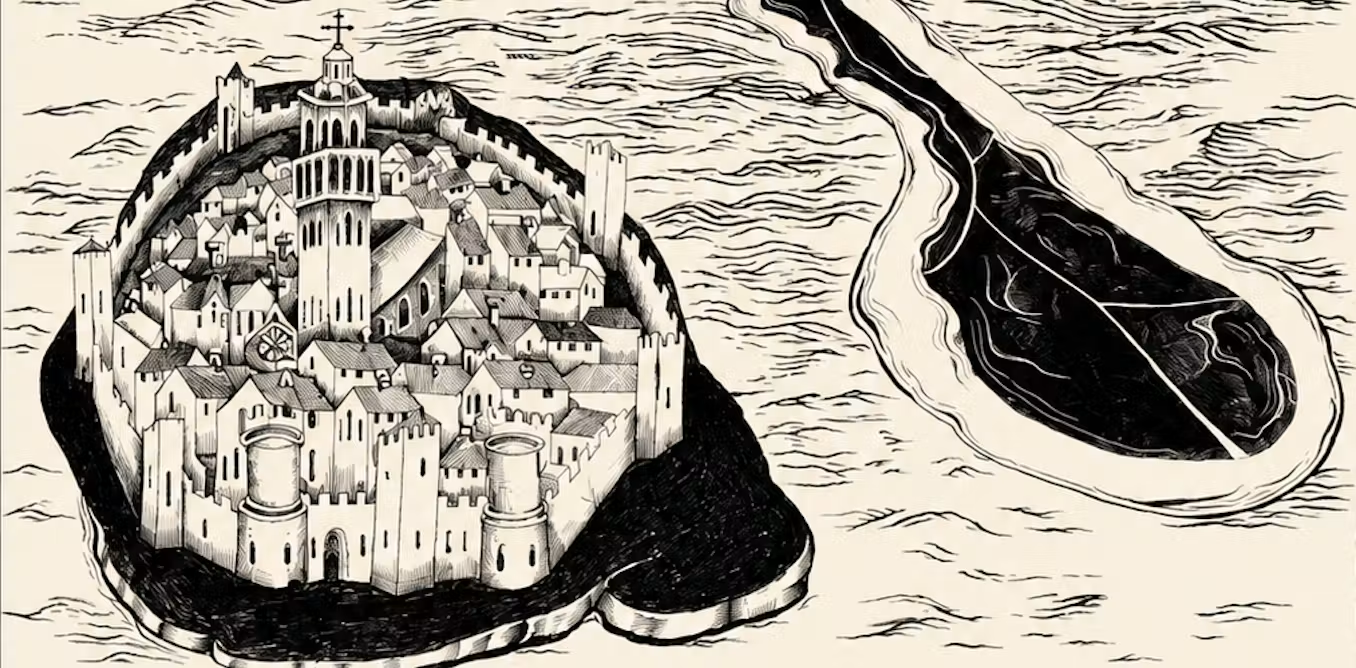
Windswept and bleakly beautiful, Spurn Point (or Head) has coastal sand dunes on one side and estuarial mud flats on the other. It is a National Nature Reserve, littered with the military detritus of two world wars, an abandoned railway, and a lighthouse. It is also the closest we can get to Ravenser Odd – the sunken medieval island that obsesses me.
Ravenser Odd was a real place. And yet it feels like myth. Its story is brief and dramatic. New land emerged in the mouth of the Humber estuary, sometime in the early 13th century, and was quickly inhabited and developed. Within decades, it was a wealthy royal borough with two MPs, embroiled in accusations of piracy and conspiracy, and in wars against Scotland and France. And then, the storms came. The island was reclaimed by the waters. All this within 130 years.
Advertisement
This is the kind of story you’d expect to know. Especially if you had been the kind of kid who was taken to local historical sites at weekends, and who traipsed around medieval ruins, posing gothically as a teen. But I didn’t. Not until decades later, when I was living on another coast, staring at a different sea, looking for distraction from my career as a historian of modern Britain.
Gathering the fragments
I could tell you that this is a lost history. But that isn’t true. Not quite. Ravenser Odd isn’t well known, even locally. But it does have something of a cult following. A handful of scattered “facts” have coalesced into the outlines of a story, endlessly repeated in obscure blogs, news stories, and “weird history” podcasts. They’ve formed the basis of an ever-growing list of poems, songs, stories, and games.
There is a canon behind this: a collection of weighty tomes by Georgian, Victorian, and Edwardian authors who pieced together its fragmented archival traces. But while this isn’t a lost history, it is one which has somehow come to seem lost – or at least to lend itself to being continually refound, always resurfacing.
Thomas Thompson, a retired MP and close friend and business partner of William Wilberforce, was the first to gather the pieces. His 1821 account opens with an image of “the patient Antiquary”, “sit[ting] on the banks of the Humber, and watch[ing] the ebbing of the tide, without being able to discern a blade of grass, where once stood the market-town, and sea-port”.
Advertisement
In the absence of either a physical site, or local memories or legends, Thompson turned to “ancient records, neither numerous, nor generally accessible,” noting that it was only through “a careful collection of scattered facts, that a faint representation can be given of a place which has had no local existence for many generations”. Yet for all its mystery, his search proved so fruitful that he was unable to fit it all into one pamphlet and had to write another.
Over the next century, Thompson’s successors added to his tale – using collections of printed documents and sources held at the newly-opened Public Record Office. The best known of these texts, J.R. Boyle’s Lost Towns of the Humber and Thomas Sheppard’s Lost Towns of the Yorkshire Coast, are still key reference points. Their flourishes, speculations, and suppositions have become inextricably part of the island’s lore.
The Insights section is committed to high-quality longform journalism. Our editors work with academics from many different backgrounds who are tackling a wide range of societal and scientific challenges.
Advertisement
But even the archival sources are extraordinary. I team up with medieval expert, Kathryn Maude, of The National Archives, who traces the records of this upstart new town. She finds customs accounts detailing trading relations with Scandinavia, the Low Countries, the Baltic – and the complaints that follow when things turn sour: theft; extortion; murder. Closer to home, Ravenser Odd was accused of intercepting ships heading for Grimsby and impoverishing its neighbours.
Most striking are the records of its physical structures – and the sheer size of the town they suggest. Along with the docks, court, prison, chapel, goldsmiths, and tannery, Kathryn uncovers records of three windmills and hundreds of houses.
The year after two thirds of the town was annihilated by storms, a further 145 houses (seemingly belonging to a single woman) were destroyed, along with many other buildings and 42 plots of land. This is more than a lost village. Its trace has been left on numerous world maps of the time.
Yet, despite all this, I am still unable to answer one of the biggest mysteries of all: where exactly was Ravenser Odd?
Advertisement
When we finally get to Spurn Point (without my parents), I realise I don’t know where I should be looking. Was it out in the North Sea, or within the estuary? How far away? The earliest sources say a mile out to sea; others that it was joined to the mainland by a sandy road. Since 2013 the end of the peninsula has become a tidal island. Maybe the same thing happened back then in reverse. When land first appeared perhaps it looked like a “true island”, which “the sea surrounds”, but over time more of the peninsula emerged. In any case, the point itself has moved, drifted, extended over the centuries. The sandbanks, mudflats, and saltmarshes appear and disappear with the tides.
I’d assumed that once I got here, I’d feel it somehow. I’d know. But the idea of a busy, noisy port in this isolated landscape seems impossible, unfathomable. We content ourselves with a seal, a deer, and a full array of wading birds.
In the months before our trip, a team of geographers from the University of Hull started looking for Ravenser Odd. Their hi-tech scans of the seabed led to media claims that “Yorkshire’s Atlantis” would soon be found. Five years later, there is still nothing to see.
But something is definitely happening. The handful of blogs, pamphlets, and a couple of songs, have multiplied. Every time I search, I find more – more songs, more poems, more podcasts, more novels and short stories and plays. The most recent have an element of AI-assistance. I start collecting these works, talking to their creators, asking what brought you to this story? What does it mean to you?
A lawless place, unmapped, untamed –
some boats that sprawled to make a town: illustrious and briefly famed.
But sand ran through. The sky dropped down.
The waves stood up and raised their voice
until there was no other sound.
And I find it is the lostness that matters. Ravenser Odd cannot be visited and that gives it a poetic element, an allure, a hauntingness. A musician describes the fact that “on the maps it keeps moving” as “really magical”, it makes it feel “almost not real”. A poet says: “The fact that it is unstable, that you can’t pin it down, to me is the wonder”.
Advertisement
While most of the people I speak to are local, only a few knew the story as children, most came to it in later life. Like me – and my parents – they were intrigued that they had never heard of it before. Others are from further afield: London, Scotland, Ireland, the United States, Ukraine. Surprisingly few have seen the media coverage of the physical search for the island; surprisingly many have stumbled across Boyle’s and Shepherd’s books in libraries or online booksellers.
Lots of these creators find Ravenser Odd because they are looking for it – or rather for this type of story, set in this kind of place. They search “lost coastal Yorkshire village”, or “sunken English island”. And this is what they find. It satisfies a narrative need. Partly, Ravenser Odd is standing in for all lost settlements, all drowned landscapes. Interviewees frequently mentioned their interest in other lost places: mythical and real; ancient and modern; local and international. But it also offers something new. An American role-playing games designer describes Ravenser Odd as “memetically sticky”, but with “its own weird details”: like Dunwich (a thriving medieval port city in Suffolk, England, that largely vanished into the North Sea because of coastal erosion) with added – if historically ambiguous – Viking influences.
The main difference is its obscurity, although that is a shrinking resource. A video artist tells me how shocked she is by the sheer quantity of internet sources now available – a stark contrast to 2006, when she last looked. A songwriter who found the story in 2025 was disconcerted to discover she was not the first, that it was already ‘trendy’. And yet, she found she couldn’t give it up – and “just got drawn in deeper and deeper.”
A very odd name
She was not the only one to get hooked or to find it had got under her skin. As one novelist put it: “I immediately saw it and thought, well, that is fascinating, and it is odd that I’ve never heard of it before, and I haven’t actually stopped thinking about it since.”
Advertisement
Her reference to it being odd is telling. The strange name of the island is a key part of its appeal. One creator explained his inspiration came from a search for lost local places, “and seeing those words, ‘Ravenser Odd’, and that being odd in itself”.
JR Boyle suggested that the name was Viking, meaning “Raven’s Tongue”, and that has stuck – although the medieval spellings are too variable to be sure of anything, and its 13th-century emergence seems rather late for that. Other key aspects of Ravenser Odd’s popular mystique are similarly ambiguous. Although it was repeatedly accused of piracy, this was common to many of its neighbours; part of a medieval economy of complaint and recompense.
The reason we don’t remember Hull or Grimsby as notorious pirate havens is because they went on to have other lives. Yet already in 1400, Ravenser Odd’s story could be wrapped up with a dramatic moral conclusion. In the retrospective account of the Chronicle of Meaux Abbey – a monastery which had itself lost land on the island – “by its wicked works and piracies, [Ravenser Odd] provoked the wrath of God against itself beyond measure”.
As a historian of public heritage, I initially approached this as an example of what academics call popular medievalism. But it soon became clear that this is one of the least important aspects of its appeal. Only a handful of writers were drawn to it because it is a medieval story; for most a generic sense of pastness and unspecified authenticity is enough.
Instead of historical period, I find that it’s really the location that matters. Geographers are interested in what the island’s position reveals about longshore drift, whereby sediment is moved along the coastline, forming new land formations. Locals complain that it has been forgotten because it’s in a neglected part of the north. And Spurn Point has its own allure. Interviewees described being startled and staggered by the idea that “such a tiny little place on the end of nowhere”, a desolate place, had been “a port that kings used” or could have once been “this enormous place with half a dozen churches, or more.” In truth, it seems that Ravenser Odd only had one church, but the exaggeration is telling in itself; the unimaginability of a place like that in a landscape like this.
It also turns out that my dad was onto something. Spurn Point is indeed a heck of a way from most places. And that matters too. A local historian tells me that it is much further away than you think it’s going to be and that “you’ve really got to be alert because it’s so neglected often you can’t see the road markings”. Even when you reach the peninsula, the point itself is still some distance, with no remaining road.
Having walked with my family as far as the lighthouse and back, I leave them to eat cakes in the visitor centre, while I hire a bike in a panic to take me on the eight-mile round trip to the very end of the land. We’ve come all this way and I need to get there and back before the tide cuts it off. I soon regret this. A bike is not an ideal form of transport on sand, and I end up pushing more than riding, with the rain setting in as I struggle up and down the bramble-covered hillocks before the final point.
But, in the words of a local folk musician: “Once you do it and you get past the kind of grass scrubland onto that final beach, I mean it’s just because you’re there on your own … It’s just stunning. It’s brilliant … I think that adds as well to the Ravenser Odd sense of being magical”.
Advertisement
I breathe in the salt air, look across the estuary at (the medieval-inspired) Grimsby Dock Tower, and out at the windfarms on the horizon. And I wonder what would be lost if this story were to be fully found, if it became a well-known history of a mapped-out place. Without its mysteries would Ravenser Odd still astound and intrigue? Would it still allow us to wonder?
East Bay Ray of Dead Kennedys, one of the most legendary living punk guitarists, has revealed he has Parkinson’s disease (Picture: Tim Mosenfelder/Getty Images)
Legendary punk guitarist East Bay Ray has revealed a heartbreaking diagnosis, but has said he has no intention of putting down his guitar just yet.
The 67-year-old musician, who co-founded the influential American punk band Dead Kennedys nearly five decades ago, shared that he has been diagnosed with Parkinson’s disease through the group’s management on Tuesday.
Despite the diagnosis, Ray, whose real name is Raymond John Pepperell, is determined to continue performing with the band for as long as his health permits.
In a statement shared on the group’s official Instagram account, management confirmed: ‘Dead Kennedys management announced today that the band’s guitarist and founding member, East Bay Ray, has been diagnosed with Parkinson’s disease.’
Advertisement
Addressing what the news means for his future on stage, the statement continued: ‘Ray says he plans to continue performing and touring with Dead Kennedys for as long as his health allows, and expressed his appreciation to everyone for their continued support.’
The announcement prompted an outpouring of support from fans, many of whom have followed the guitarist’s career since the band’s earliest days in San Francisco.
The guitarist has said he intends to keep touring as long as he can(Picture: Scott Legato/Getty Images)
No further details about the musician’s condition or when he received his diagnosis have been disclosed.
Parkinson’s is a progressive neurological condition that affects movement, with symptoms potentially including tremors, muscle stiffness, and difficulties with balance.
Although there is currently no cure, treatments are available to help manage symptoms, and the condition progresses differently from person to person.
Advertisement
For now, Ray appears determined to carry on doing what he has spent much of his life doing: making music.
Dead Kennedys were founded in San Francisco in the 70s (Picture: Ruby Ray/Getty Images)
Dead Kennedys have several performances scheduled for October, including a show at Seattle’s Showbox at the Market on October 6 and another at the Riverside Municipal Auditorium in California on October 11.
The group is also due to perform in San Francisco on October 9, sharing the bill with fellow punk acts Flipper and The Avengers.
There have been no announced changes to the band’s upcoming performances following Ray’s diagnosis.
The guitarist’s influence on punk music stretches back to 1978, when he helped establish Dead Kennedys in San Francisco.
Advertisement
Ray was instrumental in developing the group’s distinctive sound, which combined the aggression of hardcore punk with unexpected influences ranging from surf rock to the dramatic guitar sounds of 1960s spy films.
They quickly became one of the biggest punk bands of the era (Picture: Richard McCaffrey/Michael Ochs Archive/Getty Images)
His unconventional playing helped distinguish Dead Kennedys from their contemporaries, while the band’s provocative lyrics and confrontational performances established them as one of the most recognisable names in American punk.
Their early releases included California Über Alles and Holiday in Cambodia, followed by their landmark 1980 debut album, Fresh Fruit for Rotting Vegetables.
The group went on to release records including Plastic Surgery Disasters and Frankenchrist before splitting in 1986. However, their story was far from over.
Dead Kennedys reunited in 2001 without original frontman Jello Biafra, with Ray remaining central to the band’s subsequent touring career.
Advertisement
In fact, according to the group’s official website, Ray is the only musician to have remained a constant member throughout its history.
From left to right: Klaus Flouride, Jello Biafra, East Bay Ray (kneeling), and D. H. Peligro, founding members of the band (Picture: Getty)
The current line-up also includes fellow founding member and bassist Klaus Flouride, vocalist Ron ‘Skip’ Greer and drummer Steve Wilson.
Ray’s diagnosis comes during an already difficult year for the band’s extended musical family.
In March, former frontman Biafra suffered a haemorrhagic stroke, prompting concern among fans about his recovery.
However, an encouraging update shared on his Facebook page on May 2 revealed that the musician was making considerable progress.
Advertisement
‘Jello is progressing nicely,’ the statement read, explaining that his speech had largely returned and that, cognitively, he appeared to be unaffected by the stroke.
Although he was still experiencing weakness on his left side, his condition had improved significantly, and he had become increasingly independent during his recovery.
The band also suffered a devastating loss in October 2022 when longtime drummer D.H. Peligro died aged 63.
Advertisement
Peligro, who joined Dead Kennedys in 1981, had also briefly performed with the Red Hot Chili Peppers and was a significant figure in the American punk scene.
Now, as Ray faces his own health challenges, the guitarist has made clear that he hopes to continue the musical career that has spanned almost half a century.
Celebrity Traitors is set to have a contestant unlike any before, with mathematician Professor Hannah Fry bringing her statistical expertise to the game in a bid to sniff out the suspicious contestants.
Self-described “toxically competitive” Fry, who teaches at the University of Cambridge, is also a presenter on several BBC TV and radio shows, including The Secret Genius of Modern Life.
Ahead of filming Celebrity Traitors earlier this year, Fry revealed that she used her knowledge of statistics to preparing for her appearance.
The professor went back through all previous seasons of the show to “try and find statistically significant patterns” in a process not dissimilar from “the same bit of math that Alan Turing used to crack the Enigma machine” – a cipher device used by the German military during World War II.
Advertisement
‘Celebrity Traitors’ contestant Professor Hannah Fry (Getty Images)
Fry told the BBC that she identified a pattern in the way that the assigned Traitors behave, including the fact that they “often do a burn vote” in the first few episodes when they’re settling in to throw suspicion on somebody random.
She called it “just one example of a little bit of maths that I’ve got in my back pocket”.
“Whether it’s going to work or not, honestly, your guess is as good as mine!” she said. “I’ve got spreadsheets coming out of my eyeballs. I close my eyes and it’s like there are numbers tattooed on the inside of my eyelids at the moment for how much I’ve been looking at them.”
Fry acknowledged that a big wrinkle in her plan is how bad the Faithfuls often are at detecting the Traitors. “They are so all over the place that it’s really hard to pick out what the signal is,” she said.
One of Fry’s fellow contestants, comedian James Acaster, said he was most fearful of Fry as she “will probably tell you that probability-wise, there’s most likely to be at least one comic chosen as a Traitor because there’s enough of us”.
Advertisement
Watch Apple TV free for 7 day
New subscribers only. £9.99/mo. after free trial. Plan auto-renews until cancelled.
“I think we’re going to be the first ones under the magnifying glass being looked at – particularly at the beginning when you have absolutely nothing to go on,” he told the BBC.
“There will be suspicions that it’s going to be at least one of these guys – that we might form an alliance if we’re not broken apart.”
There are several actors on the billing this year, including The Last of Us’s Bella Ramsey, The Damned United’s Michael Sheen, and Withnail and I’s Richard E Grant. Myha’la (Industry), Sharon Rooney (Two Doors Down), former Coronation Street and EastEnders stars Julie Hesmondhalgh, and Ross Kemp will also feature.
There are also well-known musicians in the running, including former Little Mix star Leigh-Anne Pinnock and “You’re Beautiful” singer James Blunt.
Advertisement
Others set to enter the Scottish castle include broadcaster Amol Rajan, presenter Maya Jama, model and actor Jerry Hall, musician and actor Sebastian Croft and content creator King Kenny.
Claudia Winkleman will be back to host the smash-hit show’s second season on Thursday 1 October at 8pm.
The multi-award-winning game of deception will air two nights a week on Thursday and Friday evenings.
The UK is reviewing its deal to hand over the Chagos Islands to Mauritius, the defence secretary has said.
Wes Streeting confirmed the deal was being looked at again after US President Donald Trump called it “terrible” at the UN General Assembly on Tuesday.
The original agreement would see the UK cede sovereignty of the territory to Mauritius and pay an average of £101m ($136m) per year to lease back a joint UK-US military base there, prized for its strategic location in the Indian Ocean.
In April the deal, agreed under Sir Keir Starmer, was paused indefinitely because Trump pulled his support.
Advertisement
Streeting said “we have to” review the deal “because the United States doesn’t support it”.
“What President Trump said yesterday wasn’t new but I think it does provide absolute clarity that his position on this Chagos deal as currently drafted is not changing,” he told BBC Breakfast.
“So we have to do more work with our American allies, with President Trump and his administration, to get the deal to a place where we can support it.”
































































You must be logged in to post a comment Login