If anyone can write a great breakup album, it’s Ben Gibbard. For almost 30 years, the Death Cab for Cutie frontman has channelled misery into such emotionally ruinous songs as 2003’s “Tiny Vessels”, with its cool and cruel detached lover, to “The Sound of Settling”, a lesson in unending, unrequited pining.
Today, though, Gibbard is reluctant to call the band’s new project a “divorce record”, despite the fact that, yes, it was written in the aftermath of his marriage ending. “Oftentimes those records are someone saying, ‘I’m going to bring this into the court of public opinion and tell my one-sided story about how this went down,’” he says. “You know the phrase, only a fool goes to court thinking the jury are bound to see it their way?”
Gibbard is the first to admit he’s played the fool before. “I’ve certainly taken that tactic before, when I was younger,” he says, citing 2015’s Kintsugi, written in the wake of his split from actor and musician Zooey Deschanel – to whom he was married for three years – as the most obvious example. “I’ve long since realised that painting yourself as the aggrieved narrator… well, there is a time and place for that, but at a certain moment in life, you’ve got to grow out of it.” Anyway, he adds wryly, “Does anyone really think the biggest pop star in the world is always the innocent bystander in their own life? I don’t think so.”
Nearing 50, Gibbard has grown out of it and then some. Released last week, the band’s 11th album, I Built You a Tower, opens with mellow, melancholic guitar and the line: “Please forgive me.” It’s as much a plea to himself as it is to the person he’s speaking to. Later, on the jittery “Punching the Flowers”, Gibbard sings of words “sharpened like axes” that a man swings around “blindly”. Lyrically, Gibbard appears ready to look inward, to hold his hands up and own his mistakes. It’s not you, it’s me, he seems to be saying. Or at the very least, it’s both of us.
Advertisement
Death Cab for Cutie have released their 11th album, ‘I Built You a Tower’ (Provided by label)
The songs are no less potent for their maturity; age has given them a hard-won patina. Even after they aged out of it, Death Cab have always tuned into that high frequency of youth, when everything is either the end or the beginning of the world. The confessional lyricism and assured sound of their Grammy-nominated fifth studio album Plans, released in 2005, proved to be their breakthrough from the Pacific Northwest music scene. It was also the first record they released on a major label (Atlantic), and the first time they’d recorded outside of their hometown.
“I felt less comfortable in my own skin in the world,” Gibbard says of their cultural “peak”, a time when their music was inescapable thanks to relentless syncing by hit shows such as The OC, Grey’s Anatomy, and One Tree Hill. “Trying to go about my life the way I’d gone about it before, I felt that more people were staring at me in places I was not used to being stared at. It’s kind of a headf*** when you feel like your presence is a topic of conversation whereas before nobody gave a s***.” Increasingly, celebrity felt like anathema to Gibbard, both living his life, and later, making music.
Those feelings were amplified when he began dating Deschanel. Pre-New Girl but post-500 Days of Summer, she was considerably more famous than Gibbard, who had to adapt.
Gibbard with Zooey Deschanel in 2009 (Getty)
“Without going into detail, there were some scary people around, and that changed how I had to live my life,” he says. “I felt like I was living my life in public like a Secret Service agent.” When they went out on dates, Gibbard would locate the exits by second nature; he and Deschanel had code words for emergencies.
Enjoy unlimited access to 100 million ad-free songs and podcasts with Amazon Music
ADVERTISEMENT. If you sign up to this service we will earn commission. This revenue helps to fund journalism across The Independent.
Advertisement
That feeling of being surveilled 24/7 invariably had an impact on Gibbard’s songwriting: “When you’re with someone who’s recognisable, you start taking on some of that reticence as well. I found myself deferring to her level of reticence because, well, it was different for her than it was for me. I think I retreated as a writer as a result of that.”
We’re speaking over a video call, but Gibbard’s screen is dark. “I’m a pacer when I talk,” he explains, and I get the sense that he is more open because of it. The absence of video, though, does mean I have to rely on recent photographs to know that he is no longer sporting that age-old emo signifier: the side fringe. Instead, the hairs sweep up, optimistic and hopeful.
Without going into detail, there were some scary people around, and that changed how I had to live my life
As we get older, we find new ways of coping. I Built You a Tower refers to Gibbard’s penchant for compartmentalisation, a process in which he assigns the memories and people in his life – whether wonderful or painful – a place in his psychological skyline. Death Cab, for example, looms large on the horizon, like a skyscraper. The tower was erected after his last marriage: “But sometimes the memories, the people, find their way out of the structures. You hear a song, or smell something, and all of a sudden you’re back in that time of your life,” he says. The album’s title track explores exactly this: “’Cause I needed you/ I needed you contained.”
Advertisement
But nothing stays contained for ever. His second divorce, from tour manager and photographer Rachel Demy, spilled over into a 2023 anniversary tour for both Death Cab and Gibbard’s other longtime band, Postal Service. In some ways, performing became a salve, he says. “To be back in my 26-year-old self, so to speak, for two hours a night, and play these songs from a very different time in my life…” Other times, the clashing of his two lives felt disorientating: “One moment you’re emailing with a lawyer, dealing with the ugly elements of divorce – I wouldn’t recommend it, of course – and then, all of a sudden, it’s time to go on stage.’”
It helped that everyone – from his bandmates to the crew – knew what was going on. “Everyone understood the pressure that was on me,” he says. “The timing of it was not ideal, but at the same time, there really couldn’t have been a better group of people to be around.”
In truth, playing anniversary shows is weird even without the divorce element, says Gibbard. Coming face-to-face with your 20-year-old self isn’t always flattering. But it can also be funny. “I’ll be listening to songs on the first record about some girl I dated for two months, and it’ll be like, ‘Oh my God! I can’t believe this happened!’ and then you get older and it’s like, yeah, s*** happens. Life is a series of s*** happening. That’s how life works.”
Gibbard: ‘The girl I wrote “Tiny Vessels” about… We laugh about it now’ (Getty)
Gibbard sees the gulf between himself now and himself back then as a sign of emotional growth, reassurance that he isn’t the same mercenary lover who whined “you are beautiful but you don’t mean a thing to me” on “Tiny Vessels” more than 20 years ago. “The girl I wrote that song about… We laugh about it now,” he says. “ I just think, ‘Oh my God. I was really being such a little b**** about this.’”
On I Built You a Tower, he’s as candid as he was when the band first started. It’s their first release since going independent again – the original plan was one more album with Atlantic, until a personnel change prompted them to leave. “It was like an episode of Succession,” says Gibbard, recalling how former CEO Julie Greenwald left in 2024. “This nepo baby [Elliot Grainge, son of Universal Music Group CEO Lucian Grange] was given the label,” he says critically. “We took one look at this guy’s picture and we were like, ‘This guy didn’t have a Transatlanticism phase in college. This guy didn’t rock with Plans. I think we can safely say that this isn’t our guy.” And so they left.
Advertisement
At Anti, Death Cab are in good company with fellow artists MJ Lenderman, Waxahatchee, Fleet Foxes, Slow Pulp, The Beths. “I mean, f***ing Tom Waits,” continues Gibbard. “It felt like the perfect place for us. We’re not being put out to pasture on a retirement label.”
He has no interest in giving in to the pull of Noughties nostalgia; beyond the lyrical evolutions, I Built You a Tower is expansive and diverse in sound, too. That said, he knows what it means to fans to hear their old stuff live, because he is a fan first and foremost himself. “What’s the point of playing a show if you’re not going to honour the connection that people have with that music?” he asks. It’s further evidence of how Gibbard has matured. He cares how the other side feels.
“I know you like Yesteryear,” podcast host Jack Edwards began, referencing the Caro Claire Burke novel about a tradwife influencer who wakes up one day in the 19th century.
“This is a book about a woman who wants to write a bestselling novel,” he continued, explaining that when she looks online and asks how to do that, her searches on the topic suggest, “go sad, go dark, go gay”.
With a huge grin, Anne opened her arms, saying, “Gimme, gimme, gimme! I can’t wait… I’m going to tear through this.”
Advertisement
And now, it seems we might all be able to watch the story unfold on the small screen.
Deadline has shared that A24 has optioned the book for a TV show. They won the rights to adapt the novel after a “competitive” bidding process.
Author Josh Silver will executive produce the pilot, they added.
The story follows Mallory, a well-known literary star, who’s desperate to rekindle her career. Leo, a young homeless man, proves the perfect spark.
Advertisement
“It’s been a surreal few weeks – I’m incredibly grateful and very excited,” Silver shared on his Instagram.
In the comments of his announcement, one Instagram user wrote: “This sounds amazing!! @annehathaway needs to be Mallory!”
“Couldn’t agree more,” a reply reads.
Only time will tell whether the Devil Wears Prada 2 actor really does make an appearance in the adaptation.
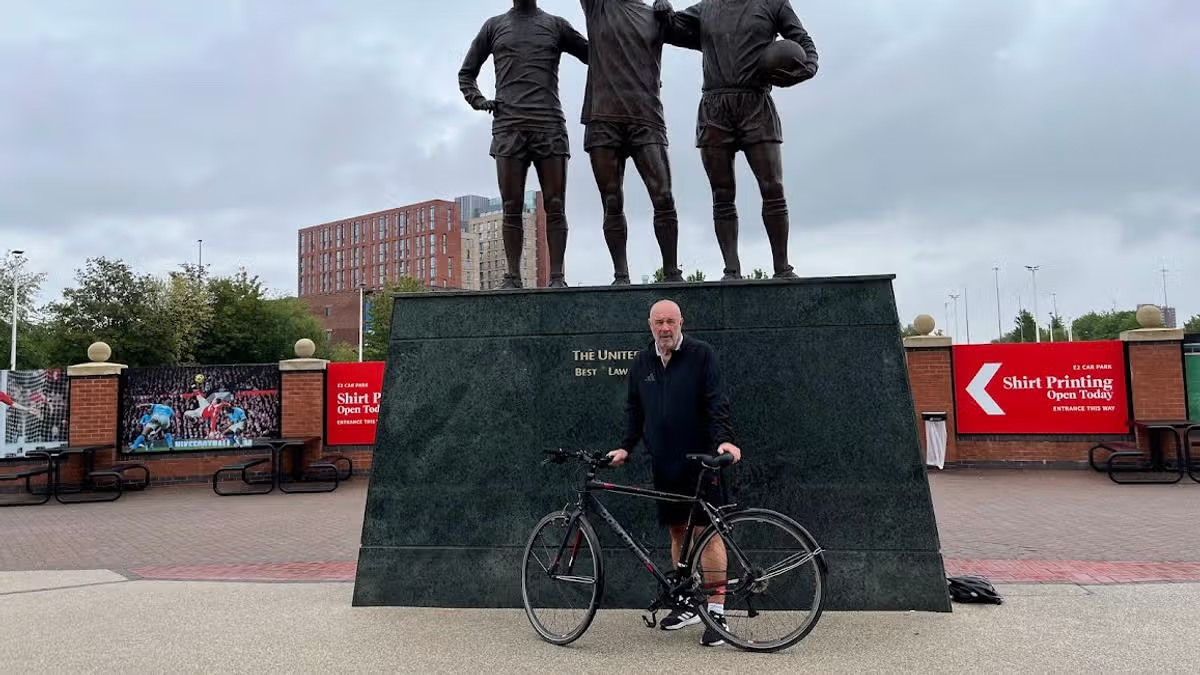
On the 60th anniversary of England’s World Cup win, John Shiels is on the forecourt at Old Trafford talking about why he is riding up and down the country at the age of 67, visiting all 92 Football League clubs, to raise money for a charity started by one of the heroes of ’66.
Shiels is a Nottingham-born lad who moved to Manchester at the age of 18 and never left. Until June, he was the chief executive of the Manchester United Foundation, a position he had held for 16 years and one that matched his passion for football with his passion for helping the community.
He retired from that job on June 10, and on June 11 he set off on his mission to visit every EFL club, raising the profile of the community work they do, and raising funds for the Sir Bobby Charlton Foundation.
Shiels is one of five on the ride, with 70 clubs and 1,316 miles completed so far, and all of them met Sir Bobby through his pioneering soccer schools. Shiels became so close to Sir Bobby, one of Manchester United’s and England’s greatest ever players, that he delivered a eulogy at his funeral three years ago.
For Sir Bobby, despite all he went through with the Munich air disaster, football was the beautiful game, and Shiels believes that it is in danger of being lost. Which is why he started tapping those pedals.
“Having worked with him and knowing him for so long, the beautiful game mattered to him,” said Shiels. “And you look around, things are happening at a right old pace, the stuff from FIFA [selling the World Cup] and, and you think, you know what, we have to fight to keep the beautiful game.
“To some extent, I think he sort of got the role of being the statesman of the game because of what happened, and he stood up to that. But he never lost that love for it, he’d say, “Football is the best toy ever invented.” And the power to play is so important that we have lost.
Advertisement
“You look at what’s happening with FIFA, and you look at what’s happening around, and we are losing that access to the game, unless someone starts standing up and talking about it, we will lose it.”
Sir Bobby’s foundation started as a landmine clearance charity, before shifting its focus on to football, and offering children across the world access to the game he loved.
Now Shiels and his team are raising funds to make sure that can continue, but closer to home. The cost of playing has increased at home, and as the game becomes ever more like a business, he believes it is in danger of losing its essence.
“Shockingly, there are still tens of thousands of young people in England who can’t afford to play affiliated football,” he said. “To play for a team now costs you between £35 and £40 a month. If you’re unfortunate and you’re born in a family that is struggling, they’re not going to pay £35 to £40 a month to let you play football.
Advertisement
“Football wasn’t about kicking a ball. It’s about making lifelong friendships. It’s about keeping yourself fit. It’s about being part of something, belonging to something. If you’ve not got it, your life isn’t the same as it could be. And it costs pennies.”
This is a mission with which Sir Bobby would undoubtedly agree. He founded his soccer schools in 1978 with a clear aim and never stopped wanting others to have the opportunity that he had.
“He just loved it so much,” said Shiels. “To the extent that when we were talking to him about Bobby Charlton Soccer Schools, what did he want that to feel like for a kid? And he’d go, “I want every day to feel like Christmas Day.”
“He came from a working-class background. Football was his way out. He never forgot his roots. He understood the privilege he had, but also the responsibility he had to make sure that it keeps getting passed on.
Advertisement
“Football is the national game; it’s magical. If we’re not careful, it is losing its magic… We are losing that access to the game, which unless someone starts standing up and talking about it, we will lose it.”
James Finlay, 38, from Redcar, was sentenced to four years in prison at Teesside Crown Court for sexual assault and inciting a child to engage in sexual activity today (July 30).
The court heard Finlay simulated sexual intercourse against the child over her clothing.
James Findlay from Redcar. (Image: CLEVELAND POLICE)
He was found guilty by a jury following a trial.
Detective Constable Bonnie Dowson, from Cleveland Police’s Protecting Vulnerable People unit, said: “Finlay abused his position and took advantage of a child that understandably left her distressed.
Advertisement
“I want to take this opportunity to acknowledge how swiftly the girl informed an adult on what had taken place and the ongoing courage and bravery she has shown to report it to police and see it through the criminal justice system.
“While no sentence will ever undo the harm Finlay caused, I hope it can provide a sense of justice and an opportunity to begin moving forward with the help and support available.”
Cleveland Police have encouraged anyone who has experienced sexual abuse to come forward.
The force said victims of sexual assault, rape or sexual abuse can contact police on 101, or dial 999 in emergencies.
Advertisement
Alternatively, reports can be made anonymously via Crimestoppers on 0800 555 111.
Victims can also seek help from Teesside Sexual Assault Referral Centre (SARC) without involving police.
The centre offers 24-hour crisis intervention and support and can be reached on 0330 223 0099.
SARC can also refer individuals to specialist services including Barnardo’s and Arch.
The findings are part of Manchester Airport’s Holiday Mode: Activated campaign, which identifies four unique personality types according to how people spend time at the airport before boarding.
After the Airport Dad, the second most common personality is the “Switch-Off Specialist”, the traveller who looks for a quiet spot to relax or people-watch. That’s followed by the “Terminal Foodie”, who says every holiday should start with a meal or drink, and the “Shopaholic”, who browses airport shops before take-off.
More than four in ten Brits see themselves as the Airport Dad, according to a new study by Manchester Airport. (Image: Manchester Airport)
The research suggests airports, with their wide variety of food, drink and shopping options, such as Great Northern Market, Joe & the Juice, Rituals, Boutique Mall and LEGO at Manchester Airport, have become much more than simply somewhere to catch a flight.
More than one in ten people (13%) say their holiday begins the moment they arrive at the airport, while almost a quarter (24%) enjoy food or drink during the hour before boarding. Separately, 14% say shopping forms part of their ideal pre-flight routine.
Advertisement
The poll of 2,000 Brits also found that 42% typically arrive at least three hours before departure, filling their time by people-watching 23%, relaxing with a coffee 22% or browsing shops and World Duty Free 22%.
Manchester Airport’s campaign centres around this, encouraging Brits to switch into holiday mode from the moment they step into the airport, rather than when travellers land at their destination.
Travellers can discover which airport personality type they are thanks to a new interactive Airport Personality Quiz from Manchester Airport. The quiz matches travellers to one of the four personalities while showcasing the variety of places to eat, shop and relax across the airport.
The new departure lounge at Terminal 2 has more than doubled in size since its £1.3 billion transformation. It features six kitchens at Great Northern Market food hall, a premium boutique mall and an airport-first Fever-Tree cocktail and champagne bar, alongside stores like LEGO and Pandora.
Advertisement
To celebrate summer 2026, passengers can also enter a competition to win prizes tailored to their airport personality, ranging from shopping and dining experiences to a dream holiday.
Richard Jackson, Retail Director at Manchester Airport, said: “Everyone experiences the airport in their own unique way. Some people are counting down to boarding from the minute they arrive, while others get straight into holiday mode with a meal or shopping.
“Our new Airport Personality Quiz celebrates those different travel personalities while highlighting just how much there is to enjoy before take-off.
“Whether you’re an Airport Dad, a Terminal Foodie, a Shopaholic or someone who simply likes to switch off, there’s something for everyone at Manchester Airport.”
Donald Trump has struck a ‘historic deal’ that includes the ‘complete disarmament’ of Hamas in Gaza in an effort to end terror attacks on Israel.
Trump said the agreement made by the Board of Peace was part of his 20-point plan to bring peace to the Middle East. Hamas confirmed to the BBC that they have agreed to the deal.
In a Truth Social post Thursday night, Trump celebrated what he called a ‘monumental step toward lasting PEACE and SECURITY’ in the region.
‘This agreement is a critical step towards Gaza finally being governed by a new Palestinian government that will work closely with the Board of Peace to help the Palestinian people,’ he said.
Advertisement
Trump added: ‘At the same time, Israel will have the security it deserves, with Gaza no longer used as a base for terror attacks.’
The President said the agreement will be put into place ‘in carefully structured phases’ that will eventually lead to Israeli forces withdrawing from Gaza.
An International Stabilization Force and new Palestinian police force will work together to keep Gaza ‘safe for its residents and neighbors.’
Advertisement
Donald Trump’s Board of Peace has made a ‘historic deal’ that promises ‘complete disarmament’ of Hamas as part of his 20-point plan to stop the fighting between Israel and the terror group
The President said the agreement will be put into place ‘in carefully structured phases’ that will eventually lead to Israeli forces withdrawing from Gaza
Trump thanked mediators on behalf of Egypt, Qatar and Turkey ‘for their important efforts’ alongside his own team.
‘One year ago there was a violent raging war, humanitarian crisis and hostages kept in brutal captivity. We have made historic progress and there is still much work to do,’ he said.
Advertisement
‘CONGRATULATIONS TO ALL ON THIS AMAZING DEVELOPMENT, THAT EVERYBODY SAID COULD NEVER BE ACHIEVED!’
Trump has been meeting with Israeli Prime Minister Benjamin Netanyahu this past week.
The Daily Mail has reached out to the prime minister for comment.
In the four-page ‘roadmap’ for the deal, US officials said that both Hamas and Israel will remain at the same phase until both have reached its stated goals.
Advertisement
Smaller Hamas groups in Gaza will be taken apart to start before they get rid of their tunnel infrastructure.
Once the roadmap is complete, a new version of the Palestinian authority will control all weapons in Gaza.
Earlier this month, Hamas dissolved its government in Gaza and is preparing to transfer power to a technical committee backed by the United Nations as part of the deal.
Last October, Trump outlined the plan to end the war spurred on by the October 7, 2023 terror attack by Hamas.
Advertisement
The US President pledged not only an ‘immediate end to the war’ in the Strip but ‘the whole deal’ to stop conflict that has ravaged the entire region for ‘thousands of years’.
Trump has been meeting with Israeli Prime Minister Benjamin Netanyahu this past week
Palestinians Hamas militants wave their group’s flag as they celebrate on the roof of a destroyed synagogue of the former Jewish settlement of Netzarim, in the Gaza Strip
Advertisement
The plan states that on agreement by both sides, ‘the war will immediately end’ with Israeli withdrawals timed to release of the last hostages held by Hamas. During that initial period, there would be a ceasefire.
Existing ‘battle lines’ would be frozen in place and Hamas would lay down its arms with the terror group’s offensive weaponry being destroyed.
While ‘full aid’ would be immediately sent to the Gaza Strip.
Key points include the deployment of a ‘temporary international stabilization force’ and creation of a transitional authority headed by Trump.
Advertisement
The deal would demand Hamas militants fully disarm and be excluded from future roles in the government. However, those who agreed to ‘peaceful co-existence’ would be given amnesty.
Following Israeli withdrawal, the borders would be opened to aid and investment.
In a crucial change from Trump’s earlier apparent goals, Palestinians will not be forced to leave and instead, the document said, ‘we will encourage people to stay and offer them the opportunity to build a better Gaza.’
Police would be ‘nationally recruited’ and ‘professionally vetted’ and be tasked with maintaining public order, investigating crimes and protecting civilians within Gaza.
Advertisement
Smoke from an explosion can be seen after an Israeli attack on July 28, 2026
Smoke rises during an Israeli military bombardment of the northern Gaza Strip on November 15, 2023, amid the ongoing battles between Israel and the Palestinian group Hamas
Meanwhile the ISF – a multinational force – would guard borders, stop weapons smuggling, deter militant resurgence with targeted counter terror raids, and protect reconstruction projects.
The October 7, 2023, attack by Hamas-led militants that sparked the war killed some 1,200 people in Israel and saw 251 others taken hostage. Israel’s retaliatory offensive in Gaza has killed 73,098 Palestinians, according to Gaza’s Health Ministry.
Advertisement
The ministry, part of the Hamas-led government, is staffed by medical professionals and maintains detailed records viewed as generally reliable by UN agencies and independent experts.
It does not distinguish between civilians and militants but says women and children make up around half of all fatalities.
Israeli strikes have lessened considerably since the ceasefire took effect on Oct. 10, but they continue almost daily.
Israel’s military says it targets Hamas and other militants, often asserting they were planning attacks. The strikes have also killed many civilians.
Advertisement
Trump’s 20-point peace plan
Gaza will become a terror-free zone with all militant groups dismantled so it does not pose a threat to its neighbors.
Gaza will be redeveloped for the benefit of the people of Gaza, who have suffered more than enough
If both sides accept the deal, hostilities would stop immediately. Israeli forces would halt operations and withdraw to a set line while the truce holds.
Within 72 hours of Israel agreeing, all hostages would be released, alive or deceased.
Once all hostages are returned, Israel would release 250 prisoners serving life sentences and 1,700 Palestinians detained after October 7, 2023. It would also return the remains of 15 Palestinians for every deceased Israeli hostage.
Hamas fighters who commit to peaceful co-existence and to decommission their weapons will be given amnesty once all hostages are returned. Fighters who refuse would be allowed to leave Gaza safely for other countries.
Large-scale aid would enter Gaza immediately after agreement. This would include water, electricity, sewage repair, hospital rehabilitation, and rubble clearance.
Relief would be delivered through the UN, Red Crescent and other neutral international bodies. The Rafah crossing would be reopened under this system.
A transitional technocratic committee made up of Palestinians and international experts would run Gaza. Oversight would be provided by a new international ‘Board of Peace’ chaired by Donald Trump, with other leaders such as former British prime minister Tony Blair suggested as members.
An international panel of experts would create a plan for Gaza’s economic redevelopment. The plan would draw on experience from major Middle East projects.
A special economic zone will be established, with preferred tariff and access rates to be negotiated with participating countries.
No one will be forced to leave Gaza, and those who wish to leave will be free to do so and free to return. People will be encouraged to stay to help build Gaza.
Hamas and other factions would not take part in Gaza’s governance. Their direct or indirect involvement in running the territory would be banned. All military, terror, and offensive infrastructure, including tunnels will be destroyed and not rebuilt. Independent monitors will supervise the demilitarization of Gaza.
A guarantee will be provided by regional partners to ensure that Hamas, and the factions, comply with their obligations and that New Gaza poses no threat to its neighbors or its people.
An International Stabilization Force would deploy to Gaza to train vetted Palestinian police. It would also help secure borders with Israel and Egypt in coordination with Jordan and Egypt.
Israel will not occupy or annex Gaza. As the ISF establishes control and stability, the Israel Defense Forces (IDF) will withdraw based on standards, milestones, and timeframes linked to demilitarization that will be agreed upon between the IDF, ISF, the guarantors, and the Unites States, with the objective of a secure Gaza that no longer poses a threat to Israel, Egypt, or its citizens.
In the event Hamas delays or rejects this proposal, the above, including the scaled-up aid operation, will proceed in the terror-free areas handed over from the IDF to the ISF.
An interfaith dialogue process will be established based on the values of tolerance and peaceful co-existence to try and change mindsets and narratives of Palestinians and Israelis by emphasizing the benefits that can be derived from peace.
While Gaza re-development advances and when the PA reform program is faithfully carried out, the conditions may finally be in place for a credible pathway to Palestinian self-determination and statehood, which we recognize as the aspiration of the Palestinian people.
The United States will establish a dialogue between Israel and the Palestinians to agree on a political horizon for peaceful and prosperous co-existence.
Summit meetings on the fringes of funerals, diplomacy after death as the British political scientist Geoff Berridge put it, have a long and useful tradition. Not only can such working funerals force a meeting at a time that would not otherwise have happened, but they can remind those assembled of the transience of life, physical as well as political, and the urgency of now.
Each visitor, ostensibly in Washington for Graham’s memorial service, was granted 90 minutes in sequential closed-door meetings with Trump and his advisers. All sides later conveyed that the meetings were, in the words of White House press secretary, Karoline Leavitt, “positive and productive”.
Tale of two meetings
First up was Zelensky. For the Ukrainian president, this is not the first instance of funeral diplomacy with his US counterpart. The two presidents’ meeting at the Vatican in April 2025 for the funeral of Pope Francis provided the opportunity to put their relationship on to a more constructive footing just two months after their infamous clash at the White House.
Advertisement
Far from not having “the cards”, as Trump exclaimed in February 2025, Zelensky arrived at the White House this week in a much stronger position. Ukraine has demonstrated its capacity to strike deep into the Russian heartland causing substantial economic and military damage to the Kremlin’s war machine.
Ukraine is also an increasingly a high value tech partner in drone technology to the US and its allies in the Gulf and Europe.
Zelensky also stressed Ukraine’s usefulness as an intelligence partner to Washington. He reported he had supplied evidence to suggest that Russia has provided Iran with targeting information on US bases in the Middle East. While Trump himself tends to dismiss such allegations, posting recently on his TruthSocial platform that he doesn’t believe either Russia or China are assisting Iran, they almost certainly helped Zelensky in his subsequent meetings on Capitol Hill.
In a rare demonstration of bipartisan consensus, the Senate – in an 86-12 procedural vote – moved forward a sanctions package against countries who continue to trade with Russia and Iran. This was billed as a tribute to Graham, who – together with his Democrat senate colleague Richard Blumenthal – had conducted long and protracted negotiations to obtain approval from the White House.
Advertisement
Trump’s support for the sanctions package is another indication that his calculations on the Russian war against Ukraine are beginning to shift. The US president also repeated his commitments to allowing the manufacture of Patriot missiles in Ukraine and to advocating for the resurrection of the stalled peace talks between the US and Russia.
While Zelensky’s star is, for now at least, clearly on the rise in Washington, Netanyahu arrived for his meeting with Trump in a more precarious position. With Israel heading into crucial parliamentary elections in October, Netanyahu has most to gain domestically from being seen close to Trump.
Their meeting covered several issues where the two leaders’ views differ – from how to prevent Iran from developing a nuclear weapon to US sales of F35 fighter jets to Turkey. No details emerged of any tangible agreements. Netanyahu was nonetheless full of praise, characterising the meeting as: “It was one of the best conversations I’ve had with our friend, US President Trump.”
Israeli prime minister, Benjamin Netanyahu, and Ukrainian president, Volodymyr Zelensky, at the funeral of Senator Lindsey Graham, July 28 2026. Annabelle Gordon/UPI/Alamy Live News
While mainly aimed at his electorate back home, these hyperbolic statements from the Israeli prime minister were also designed to signal to Iran that Netanyahu still has influence in the White House and that the Iranian nuclear issue has not been abandoned in the new focus on the Strait of Hormuz.
And these are just some of the links between two conflict theatres that are individually growing in complexity. Yet, Trump still uses the same over-extended and under-qualified duo of Steve Witkoff and Jared Kushner to lead US mediation efforts in both.
The best that the US president, therefore, could have hoped for as a result of his back-to-back meetings with Zelensky and Netanyahu was reminding them and everyone else of how the pivotal role of his administration in both wars continues to be. What Trump achieved instead was to highlight that the White House remains unable to bring either, let alone both, wars to a satisfactory conclusion on terms acceptable to Washington and its allies.
Under Trump, it seems, that funeral diplomacy is less about diplomacy after death than the death of diplomacy.
It is alleged that a teenage boy was assaulted in a park
A teenage boy has been sexually assaulted in a park. Lincolnshire Police were called to the Snowden Pavilion Park area, near Six Acre Lane in Crowland, near Peterborough, at around 12.51pm on Tuesday, July 28.
Advertisement
It is alleged that a teenage boy was seriously sexually assaulted by a man. The suspect is described as “being of slim build, believed to be of mixed race, and wearing a grey tracksuit consisting of a hooded top and jogging bottoms, a black cap, a black face covering over his mouth and nose, and black gloves”.
The incident is believed to have taken place between 12.15pm and 12.45pm. The teenage boy is being looked after by specialist trained officers.
Detectives are carrying out extensive enquiries to establish the facts of the incident and the identity of the suspect.
Detective Chief Inspector Marc Horsewood, who is leading this investigation said: “We have been working around the clock to identify the person responsible. Multiple lines of inquiry are well underway, and we are now asking for the public’s help.
Advertisement
“If you were in the area at the time, no matter how insignificant you think the information may be, please get in touch. We are particularly keen to hear from anyone who may have captured images, dashcam footage, doorbell camera footage, or any other recordings that could assist our inquiries.
“We understand this incident will cause great concern within the community. Please be reassured that this investigation is being treated with the utmost seriousness and significant resources are being dedicated to identify, locate and arrest the suspect.
“Members of the public will see an increased police presence while the investigation continues.”
Anyone with information should call Lincolnshire Police on 101 or report it online and quote incident 254 of July 28.
Manchester United have already been busy in the summer transfer window and have been linked with a move for Newcastle’s Lewis Hall
Manchester United are on the hunt for new recruits to bolster their squad ahead of an important campaign for Michael Carrick’s side. The club are set to return to Champions League football while hoping to mount a Premier League title challenge.
Advertisement
Andrey Santos and Youri Tielemans have been the team’s most prominent signings so far as United look to reshape their midfield options. The Reds spent a combined £85million on the pair but have been linked with a third midfield recruit.
Despite the emphasis on midfield, Carrick will be aware of the necessity to address other positions within his squad. The club hold an interest in Newcastle left-back Lewis Hall, who is reportedly open to joining United.
Get MEN Premium now for just £1 HERE – or get involved in our United WhatsApp group by clicking HERE. You can also join our United Facebook page by clicking HERE and don’t miss out on our brilliant selection of newsletters HERE.
Meanwhile, United have confirmed the departure of an academy prospect and have been linked with further exits. Here, MEN Sport examines some of the most significant stories surrounding the club.
Advertisement
Lewis Hall transfer update
United are reportedly mulling over a move for Newcastle full-back Hall. The development follows Thursday morning’s news that Eddie Howe had left Newcastle, bringing the manager’s almost five-year tenure at St James’ Park to a close.
The Sun reports that United are “weighing up” a move for Hall, given the uncertainty surrounding the Magpies. However, it is claimed that the England international could yet be persuaded to remain, depending on who succeeds Howe.
From United’s perspective, the former Chelsea academy product is seen as a long-term replacement for left-back Luke Shaw. However, Newcastle may be unwilling to part with another star player after losing Anthony Gordon and Sandro Tonali this summer, while Bruno Guimaraes has also drawn attention.
Hall featured 46 times for Newcastle across all competitions last season. The 21-year-old is tied down until 2029, having joined the club in a £35m deal from Chelsea in 2023.
Advertisement
Man United defender completes transfer
United have announced that young defender Tyler Fredricson has finalised a permanent switch to Swiss outfit Lausanne-Sport. The 21-year-old centre-back made four senior appearances for United after progressing through the club’s academy system. Upon leaving United, Fredricson posted on his Instagram story: “Once a red, always a red.”
A club statement read: “Tyler Fredricson has agreed a permanent transfer to Lausanne-Sport, subject to registration. A lifelong Red from south Manchester, he worked diligently while proudly rising through the ranks of our world-famous youth system.”
The statement continued: “Joining the club at Under-9 level, Tyler has been a model professional throughout his time with the club and a popular member of our Academy squads. His place in United’s history books is also secured as a recipient of the prestigious Denzil Haroun Reserve-Team Player of the Year award in 2025.
Advertisement
“Lausanne finished ninth in the Swiss Super League last season, and they hope to progress this term following July’s appointment of new head coach Luka Elsner. Everybody at United thanks Tyler for all his efforts during his time with the club and we wish him all the best for the next chapter of his career.”
Countdown to Kickoff: The Ultimate 26/27 Sky Sports Bundle
This article contains affiliate links, we will receive a commission on any sales we generate from it. Learn more
Sky’s Ultimate TV and Sky Sports bundle includes at least 215 live Premier League clashes across the 2026/27 season with more than 1,400 live games across the EFL and beyond, plus F1, golf and darts.
Every subscription now comes with 135 channels alongside free subscriptions to HBO Max, Netflix, Disney+, discovery+ and Hayu.
Coastal villages Groomsport and Donaghadee will be focal points for the celebrations
Ards and North Down Council has revealed more details of the ongoing USA 250 celebrations in the borough.
Advertisement
While American Independence Day, the Fourth of July, has passed, from September to November 2026 Ards and North Down Council is highlighting a programme of commemorative activity continuing to mark the Semiquincentennial. This year the USA marks the 250th anniversary of the signing of the Declaration of Independence when the US became an independent nation, overthrowing British rule.
The council says the programme will reflect the borough’s historic connections with the United States and align with existing borough events.
Groomsport, beside Bangor on the North Down coast, will be the focal point for two of the council’s anniversary events. It is the oldest port on the North Down coast and the scene of the Eagle Wing’s attempted emigration to America in September 1636.
The Eagle Wing was the first emigrant vessel to attempt a voyage from Ulster to North America, carrying 140 passengers seeking religious freedom, primarily Ulster-Scots Presbyterians fleeing persecution. Bad weather conditions off the coast of Newfoundland forced the 150-ton wooden sailing ship to return to Belfast Lough.
On Saturday August 16, at Donaghadee Harbour, there will be two dramas marking the 250th anniversary of the signing of the declaration, delivered by local drama provider Valhalla Street Theatre. The dramas have been planned by the Donaghadee Community Development Association.
On Saturday September 5, at Cockle Row Cottages, Groomsport, there will be a themed heritage event by the council focusing on Ulster American migration and shared history, which the council says will be “delivered in a family-friendly and engaging format.” That weekend will also see the Eagle Wing Festival in the village, delivered by Discover Groomsport.
Advertisement
On Wednesday September 9, there will be a commemorative tree planting at Donaghadee by the council. A civic ceremony will mark the USA 250 anniversary, featuring the planting of five trees “symbolising enduring links between Ards and North Down and the United States, providing a lasting and visible legacy.”
In November the council’s existing Leid AND Lairn festival, which celebrates Ulster-Scots language, culture and history, will have a special focus on USA 250 commemorations.
The council states: “The programme will provide opportunities to explore Ulster-Scots traditions through music, storytelling and related experiences, highlighting language, folklore and cultural heritage. It will also consider the historic influence of Ulster-Scots communities locally. Events will take place across the borough, offering accessible opportunities for residents, schools and visitors to engage with shared heritage through learning, participation and cultural celebration.”
The council says it has also explored links with local author Philip Johnston and the possibility of a literary event aimed at children, based on his current book, “The Story of Charles Thomson and the Declaration of Independence.” A copy of the book was presented to the congress-approved America 250 Commission, when they recently visited the Public Records Office of Northern Ireland in Belfast.
Advertisement
The council states it has also had discussions with Trevor Marshall, creator of the “On Eagle’s Wing” musical, about the possibility of staging an event. The council says the proposed events at this point will be incorporated into existing council programmes and will not require additional funding.
Two local tourism providers, Sustainable Journeys and NI Silver, have secured funding from Stormont to develop “immersive experiences for North American and domestic markets.” A blog has been created on the visitardsndnorthdown.com website, setting out the borough’s links with the USA.
In April elected representatives at the council agreed to a motion by DUP Councillor Carl McClean to commit to “mark and celebrate” the United States semiquincentennial. He said it would “require a significant financial contribution.”
The motion stated that the Ards and North Down Borough is “mindful of our close connections to the United States and our role in their history” and would “consider options for events of different scales, including the theming of an existing event in the calendar, as well as exploring options to collaborate on an event of an appropriate level that complements the proposals of other councils.”
Advertisement
At the Ards and North Down Council full council meeting held this week (July 29) Councillor McClean said: “I want to stress how understated and unknown, but how critical and crucial the story of the Ulster Scots people is, to the foundation of the United States, with which we have one of our most important and enduring relationships.
“Some 200,000 Ulster Scots people went over from Ulster in the 65 years before the US rebellion, as it was then, and played a critical role in that, and also the shaping of the country. I only found out today that a contemporary described the United States independence movement and rebellion as “nothing more than an Ulster Scots Presbyterian movement.”
“I think we should be placing ourselves very squarely at the heart of that story. All across the United Kingdom and the island of Ireland we should (stress) the broader contribution this island made to America. But we have drastically undersold our story.
“It is notable and pleasing that it is starting to become more understood on the other side of the Atlantic. We have given a huge chunk of American presidents through Ulster.”
Melanie has got four children at home during the holidays (Picture: Myles Goode)
Welcome to How I Do It, the series in which we give you a seven-day sneak peek into the sex life of a stranger.
This week we hear from Melanie*, a 45-year-old married mother of four who has sex about once a week on average.
But, the PR executive would like her sex life to be more frequent, with parenting often getting in the way of any one-on-one time with her husband Ian*.
‘Sex is something I have a bit of a hangup about,’ Melanie explains. ‘I’m happily married but I’d like my sex life to be more numerous, because four kids means it doesn’t happen that often.’
Advertisement
She met Ian when they were at university together and married a few years after graduating, with children following close behind.
Ask Metro
Use AI to go deeper into the stories you care about – powered by Metro and trusted publications.
Advertisement
Without further ado, here’s how Melanie got on this week…
The following sex diary is, as you might imagine, not safe for work.
Monday
Sign up to The Hook-Up, Metro’s sex and dating newsletter
Love reading juicy stories like this? Need some tips for how to spice things up in the bedroom?
Sign up to The Hook-Up and we’ll slide into your inbox every week with all the latest sex and dating stories from Metro. We can’t wait for you to join us!
Advertisement
I pull myself out of bed and get the kids dressed, feed them breakfast, and ferry them off to school.
Unusually for us we arrived home late last night from a weekend abroad in Brittany where all six of us shared two rooms, which obviously meant intimacy was off the cards.
Advertisement
In a normal working week there is precisely no action from Monday to Friday for my husband and I.
I spend the day working from home and, as soon as the kids walk through the door, Ian and I feed them dinner and pack them off to bed so we can get an early night.
I think what makes us a strong couple is that we have the same dry sense of humour, which means we can laugh about pretty much anything, including sex droughts.
I go to sleep, knowing I love my husband and how he tries to be a better person each day, and always thinks deeply and profoundly about everything.
Advertisement
Tuesday
Our daughter has finished her exams, so today she’s at home all day.
With the summer holidays in motion, it usually means a dry sex spell is coming my way. It’s manageable, but I do find that if it reaches over two weeks Ian and I start to bicker.
It doesn’t affect me so much, unless I’m in my fertile period, but I have noticed it really affects Ian’s mood.
Midweek, the only opportunity to ‘do it’ is when no children are at home, to avoid being awkwardly walked in on. With older teenagers around, intimacy is virtually impossible.
Advertisement
Tonight it’s the typical post-work routine and off to sleep.
Wednesday
The summer sex drought continues — but this time, it’s our fault.
Our son was working in London this week and our daughter was at her Sixth Form taster day so if we had been organised and intentional about it we could have had sex today.
But, as usual, we were working and forgot all about this opportunity that was staring us in the face.
Advertisement
I don’t attach meaning to it though. We’ve been married long enough to know that sometimes, these opportunities pass up by — there’ll always be another one.
Thursday
Today I’m fortunate enough to be given last minute tickets to a sporting event so I take a friend (not my husband who is not interested in sport and large crowds) and arrive home at 10:30pm.
This could be a good opportunity for physical intimacy because, by some miracle, Ian has managed to put the younger children to bed.
Bu he wants to talk about the news that some friends of ours are getting divorced.
Advertisement
As we talk, it’s a relief that both of our points on separation are aligned and we agree that the couple’s lack of humour, minimal connection and communication was probably the reason it ended.
It’s rare for us to have such an unusually good chat, not because we can’t communicate, but because it’s rare we have to time during the week to do so.
Plus, at weekends we often have people over and the kids’ friends over. We have to practically diarise a deep conversation.
We both go to bed happy, despite not having had sex.
Advertisement
Friday
Today is a busy day catching up on work. Ian and I have an argument with our daughter who is being difficult and hormonal, and by 6pm I’ve received a text from my husband saying: ‘I’m so tired I could curl up and go to bed!’
Sometimes I wonder about how frequently we have sex, especially because I have a lower libido to my partner — I don’t think the frequency of our intimacy is ideal from his point of view.
My libido tends to be quite up and down depending on mood, where I am in my cycle (during my fertile periods I am much more interested) and, to be honest, if I’m a bit tipsy after a dinner party it’s much more likely to happen.
We go to bed early and sexless.
Advertisement
Saturday
Today is a calmer day for us. Despite having all of our children at home we find a place at the bottom of the garden to have sex. It’s hidden from the house, so I’m not that worried about anyone seeing.
I think the precursor for this is the children being inside watching a film, while I was out sunbathing in my bikini.
After a gay friend of mine recently said ‘never have sex sober’ I joked to my husband that he needs to ply me with more wine to get me in the mood.
Ian found it funny but actually agreed that setting the mood with a few drinks could help our sex life, and I feel the same.
Advertisement
I’ve given up drinking midweek (unless we’re on holiday) but it’s the weekend and I’ve been indulging in a bottle of wine as I tan.
In my experience men are much more visual than women, so after a week without sex, I think lying on the grass in a slinky bikini is just too tempting for Ian. We manage to do a quickie there and then, missionary style with him on top.
The sun is in my eyes and it’s fairly romantic, but quite short, as we worry about someone appearing and getting the shock of their lives.
It’s nice for sex to feel good, rather than be on a deadline and it feel like a chore.
Advertisement
Sunday
Today I’m up bright and early to take my older children with a friend to a sporting event.
It lasts all day so I arrive home late and tired. My husband, despite looking exhausted from looking after the younger two children, doesn’t look too downtrodden, as he’s still riding on a high from our quickie yesterday.
Then we head off to bed and get ready to do it all over again next week.
Do you have a story you’d like to share? Get in touch by emailing MetroLifestyleTeam@metro.co.uk





























































You must be logged in to post a comment Login