

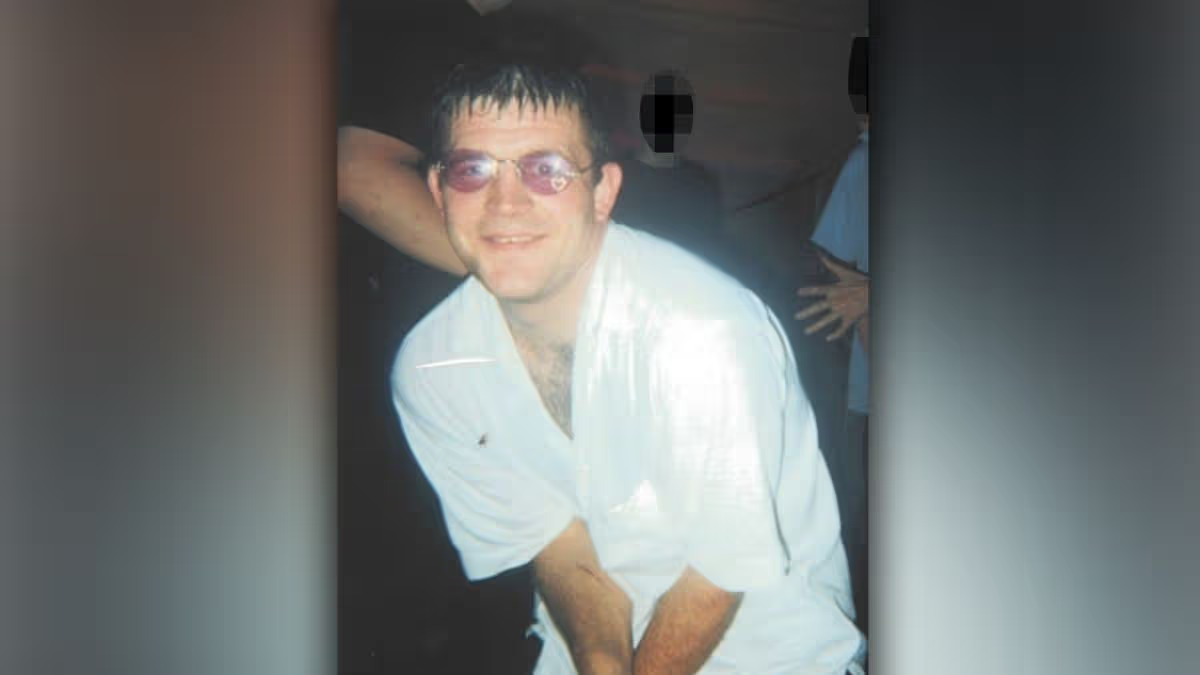
Paul Quinn watched on as an innocent man, Andrew Malkinson, served 17 years in jail for his crime
He is a notorious rapist described as ‘disturbing’ and ‘dangerous’, who watched on as an innocent man served 17 years in jail for his crime. And now, after Paul Quinn was convicted of brutally raping and attacking a woman in 2003, senior detectives fear the predator may have carried out more crimes undetected.
“It’s a line of inquiry that we have been actively following,” said Detective Chief Inspector Rebecca McKendrick, after Quinn was found guilty by a jury at Manchester Crown Court.
“We haven’t, as of yet, been able to find any definitive links with any other offences. We will continue to do so and we would urge any members of the public with information regarding Quinn and additional offending to come forward and to give us that information.”
Quinn’s shocking criminal past dates back to 1986, when he was just 12. He received a caution for indecently assaulting a female. When Quinn was 16, he was convicted of two counts of having unlawful sexual intercourse with a girl under 13. His victim was 12, in a crime which police said would be classified as rape under modern law.
Click here to hear the latest from Manchester’s courts in our newsletter
Then in March 1993, aged 18, Quinn, formerly of Little Hulton, Salford, was detained for two years in a young offender’s institute for arson with intent after starting a fire at the home of an ex-partner, where her two children were living. Thankfully no-one was hurt.
There were then gaps in his offending history until 1998, when he was convicted of trespassing on land with an air weapon on railway tracks in Walkden, and then in 2013 for producing cannabis, in relation to a small grow of the drug.
Police fear that Quinn may have committed more offences during the gaps in his offending history. They have used policing tools to identify unsolved crimes in the local area which could bear similarities to Quinn’s offending, but so far have been unable to link him to any further offending.
Detectives investigated stranger rapes committed in Swinton in 2005, Little Lever in 2010 and Little Hulton in 2012 as part of their enquiries. No link has been made with Quinn but DCS McKendrick said it is an angle which the force is pursuing.
She said: “I think that it is a distinct possibility that he has committed other offences. I’m not saying of exactly the same type, but other sexual type offences, either before 2003 or after 2003.”
Explaining her reasoning, the detective added: “The nature of this attack, the amount of violence that was used, the sexual nature, coupled with the sexual nature of the attack, A complete stranger, the early hours of the morning, that we think that Quinn was probably hanging around Armitage Avenue in Little Hulton waiting for a lone female, to see if a lone female would pass him. The following of her.”
DCS McKendrick was handed the task of leading the investigation into the 2003 attack after DNA had identified Paul Quinn as a new suspect in the case, following the appalling miscarriage of justice suffered by Andrew Malkinson.
Heading a fresh team of detectives, none of whom worked on the original inquiry, she described her task as ‘completely unique’.
But central to the new probe was gaining the trust of the victim. DCS McKendrick described how at first, the woman, who was 33 in 2003, communicated with police only by phone. It was a one way relationship originally, in which GMP kept her abreast of developments in the case.
Slowly but surely, trust was built and she became more of an active participant in the investigation. But DCS McKendrick said the impact of the wrongful conviction only added to her original trauma.
The officer said: “It has added to what she’s gone through in the first place. I think it’s really difficult to understand exactly how that’s made her feel, but it can only have compounded what’s happened to her in the first place
“She thought that she’d done everything that she needed to do, and she thought the right person was arrested, and then to find out all those years later that’s not the case.”
The DNA match for Quinn on the victim’s vest top provided strong evidence, but the investigation, codenamed Operation Canopy, sought to build up a much fuller picture of who Quinn was and the life he led.
DCS McKendrick said she believes that Quinn has lived with the knowledge of his true past for the intervening 23 years, and has kept it a secret.
She said: “We have done extensive inquiries. If he had confided in somebody that he had committed this rape, I’m confident that we would have been told, because we spoke to everybody close to him. So I’m confident that we would have been told if he had confided in anybody that he had committed. I just don’t think he told anybody.”
Asked how she found the reaction to Quinn’s arrest among those who knew him, the detective said: “I’m not sure that this was a great surprise to too many people. That doesn’t mean that I think there are people out there who knew he’d committed this. I’m not saying that.
“I don’t think there is anybody out there who could have picked up the phone and told us, I really don’t think there was anybody who knew that he had committed this or in any way suspected enough to pick up the phone to the police. I just think that maybe it wasn’t as much of a surprise as you would expect it to be for people.”
DCS McKendrick said she believed that Quinn had exaggerated his account of living a promiscuous lifestyle, which he gave to police in the only one of four interviews in which he asked questions, in order to account for the DNA evidence.
She said: “I absolutely believe that he has been unfaithful to Catherine Quinn [his ex-wife], and I absolutely believe that over the years, there will have been other women. What I don’t believe is to the degree that he made out in that first interview.
“I believe that that was a manufactured story to explain away why his DNA was on the victim’s best top. I think the truth of it lies maybe somewhere in between. He will have had other relationships. But I don’t believe anywhere near the extent that he has made out.”
Asked how she would describe Quinn as a character, the detective said: “Disturbing, dangerous, maybe lacking the full range of human emotions, because I don’t know how you can possess the full range of human emotions if you are firstly able to commit this attack with no regard for the victim, and then watch someone completely innocent and sit in prison for 17 years while you’d go about living your life.”
GMP previously said they were ‘truly sorry’ for the ‘grave miscarriage of justice’ which Andrew Malkinson endured. And Assistant Chief Constable Steph Parker issued another apology following the verdicts.
She said: “I cannot imagine the impact that that has had on him and his family, and for that, we are profoundly sorry for what happened to him, and we are determined that we will work closely, committed and fully supportive of the Independent Office for Police Conduct investigation, and the inquiry that is due to commence soon.
“We are aware there have been failings in this case. The fact that Andrew was imprisoned for 17 years, for a crime he didn’t commit, is clearly a failing of Greater Manchester Police, and the wider criminal justice system. And for that, we are absolutely sorry.
“We are determined that this cannot happen again. And we also offer our apologies to the victim, who we’ve let down – we have let down in this case. She felt she wasn’t listened to. “We absolutely need victims that have taken the steps to come forward, that have the courage to come forward, to feel supported by the police, but also to be confident that we will do the right things by them.
“So we offer our apologies to the victim, with strength and courage, not only reliving this once, but having to go through the ordeal again, a second time. She absolutely needs to be applauded, but we are sorry for what she went through. And again, I’d like to reiterate, we are determined that this will not happen again.”
She added: “We know that some of the exhibits were disposed of. We know that there were queries around the identification procedure. But we really need to understand how those errors occurred, and why those errors occurred, and only at that point would we be able to understand whether there is blame for the police, for anybody else, and indeed, if there is, I can assure you, we will learn from that, because we cannot let this happen again.”
Asked if the Crown Prosecution Service wanted to offer a similar apology, Senior District Crown Prosecutor Martin Hill said: “As you are aware there’s a pending public inquiry in respect of Mr Malkinson, and it’s not appropriate for me to comment on that until the outcome of that.
“That sounds obtuse, but if I can say it this way, the public inquiry started before Mr Quinn’s trial commenced. We had discussions with the inquiry to make sure that the Quinn trial remained a fair trial. Which meant they had to hold off certain lines of inquiry until the conclusion of the Quinn trial.
“I am extending the same courtesy to them that they extend to the prosecution team. I am not going to prejudge the outcome of that Malkinson inquiry, and therefore not make an apology at this stage.
“We don’t know what the findings of the inquiry are in respect of what we are held accountable for as an organisation. For that reason, I am not prejudging the outcome of that.”
A public inquiry was ordered by the Government in August 2023, and Old Bailey judge Sarah Munro KC was appointed as its chair. A separate GMP operation has been launched to support the force’s involvement. It is not yet clear whether there will be public hearings as part of the inquiry, or whether it will mainly be a paper based exercise.
IOPC
The Independent Office for Police Conduct (IOPC) previously said four retired GMP officers were under investigation for potential gross misconduct in connection with the case. That number is now five. Another officer, who is still serving, is being investigated for possible misconduct.
One of the former officers is also under criminal investigation for potential offences of misconduct in public office and perverting the course of justice.
In an update, IOPC director Amanda Rowe said: “A team of highly experienced investigators continues to carefully consider Mr Malkinson’s complaints, relating to the actions of GMP during the investigation and the trial in 2004.
“This is a hugely complex and time-consuming process, in part because of the passage of time and the large amount of evidence and lines of inquiry to consider, but our work is vital to get Mr Malkinson the answers he deserves and give the public confidence that, when things go wrong like this, there will be scrutiny and lessons will be learned.
“Now that the criminal matters have concluded, we will consider how any evidence heard during the trial may affect our investigation and resume paused lines of inquiry, including approaching witnesses we believe may be able to assist us.
“We understand the impact this investigation will have for those involved and we will do everything in our power to conclude matters as soon as possible, while ensuring all of Mr Malkinson’s complaints are thoroughly investigated.”






















































You must be logged in to post a comment Login