Connect with us

NewsBeat

Doctors discover intriguing op can cut risk of ‘hidden killer’ ovarian cancer risk by 80%

Published

on

It's estimated that there are more than 7,000 new cases of ovarian cancer in the UK each year

Doctors have discovered a pioneering procedure that can prevent nearly 80 per cent of deadly ovarian cancers.

Known as the ‘silent killer’, ovarian cancer kills more than 4,000 British women every year – with one in 50 women developing it in their lifetime. 

The disease causes notoriously few symptoms until it has already spread to surrounding organs. 

As a result, nearly 80 per cent of ovarian cancers are caught at a late stage, when they are no longer curable. Just 17 per cent of women with stage four ovarian cancer  live for five years or more. 

Advertisement

Now, new research suggests there may be a way to prevent the disease from developing in the first place. 

Studies published over the last 20 years have shown that nearly all ovarian cancers – and certainly the vast majority of the deadliest ones – are actually cancers of the fallopian tubes. 

These tubular ducts, responsible for carrying eggs from the ovaries to the uterus, are just 10cm long, on average. 

By removing them, research suggests, you can slash the risk of deadly cancer by up to 80 per cent. 

Advertisement

It’s estimated that there are more than 7,000 new cases of ovarian cancer in the UK each year

The five-minute operation can be done as part of nearly any abdominal surgery – including hysterectomies, tubal ligations, gallbladder surgeries, hernia repairs and even caesarian sections. 

And a growing body of research suggests it could be the future of ovarian cancer prevention.

Advertisement

In Britain, women considered ‘high-risk’ for ovarian cancer – whether from a family history of breast or ovarian cancer, or those carrying inherited gene mutations like BRCA1 or BRCA2 – are already offered preventative surgeries to reduce their chance of developing the disease. 

Standard NHS guidance advises removing both the ovaries and fallopian tubes. 

But this procedure sends women into early menopause, which carries its own health risks – including increased chance of bone-thinning disease osteoporosis, neurocognitive decline and even heart disease. 

Instead, a new nation-wide trial in Britain is examining whether these high-risk women should instead be offered fallopian tube removal alone – with the option to remove the ovaries after menopause. 

Advertisement

While results won’t be published for another few years, initial findings of the PROTECTOR trial suggest that this two-tiered approach can considerably improve a woman’s quality of life by not sending her into early menopause, while still cutting her cancer risk by 80 to 96 per cent.

Now, a growing number of experts say that the procedure should be offered to women at average risk of the disease as well. 

Studies show that removing the fallopian tubes of all women – no matter theirrisk level – can slash the likelihood of developing some of the most common, and lethal, forms of ovarian cancer by as much as 80 per cent. 

The graphic shows the warning signs of ovarian cancer, including bloating and back pain

The graphic shows the warning signs of ovarian cancer, including bloating and back pain

Advertisement

The 20 per cent or so of cancers that begin in the ovaries, meanwhile, tend to be the more curable forms of the disease, research suggests. 

While stand-alone surgery to remove the tubes is still typically reserved for women at high genetic or familial risk, experts say the procedure should be offered to any women already undergoing an unrelated pelvic operation, once she has completed her family. 

Health bodies in the US are now recommending that all women above the age of 45 – when they are unlikely to want to conceive – who are already undergoing abdominal surgery, be given the option to have their fallopian tubes removed. 

In the last few years, the American College of Surgeons, American Cancer Society and even EU body the European Society of Gynaecological Oncology, have all issued statements encouraging doctors to offer tube removal at the time of other abdominal procedures. 

Advertisement

And the American Cancer Society is even working on a national campaign to make more women and doctors aware that tube removal can help prevent most ovarian cancers.

Experts say that the procedure is already being offered in Britain to women of average risk of ovarian cancer during routine abdominal surgeries. 

But more awareness is needed about the procedure amongst women and doctors alike, says Dr Ranjit Manchanda, professor of gynaecological oncology at Queen Mary University of London and chief investigator on the PROTECTOR trial.

‘This is a huge and important finding. But there needs to be more awareness of the procedure,’ he said. 

Advertisement

‘It’s something where practice is gradually changing as data emerges. Over the next few years we should see it more embedded in practice.’  

Source link

Continue Reading
Click to comment

You must be logged in to post a comment Login

Leave a Reply

NewsBeat

‘Small but mighty’ dehumidifier helps banish mould and damp now cheaper than Amazon

Published

on

Wales Online

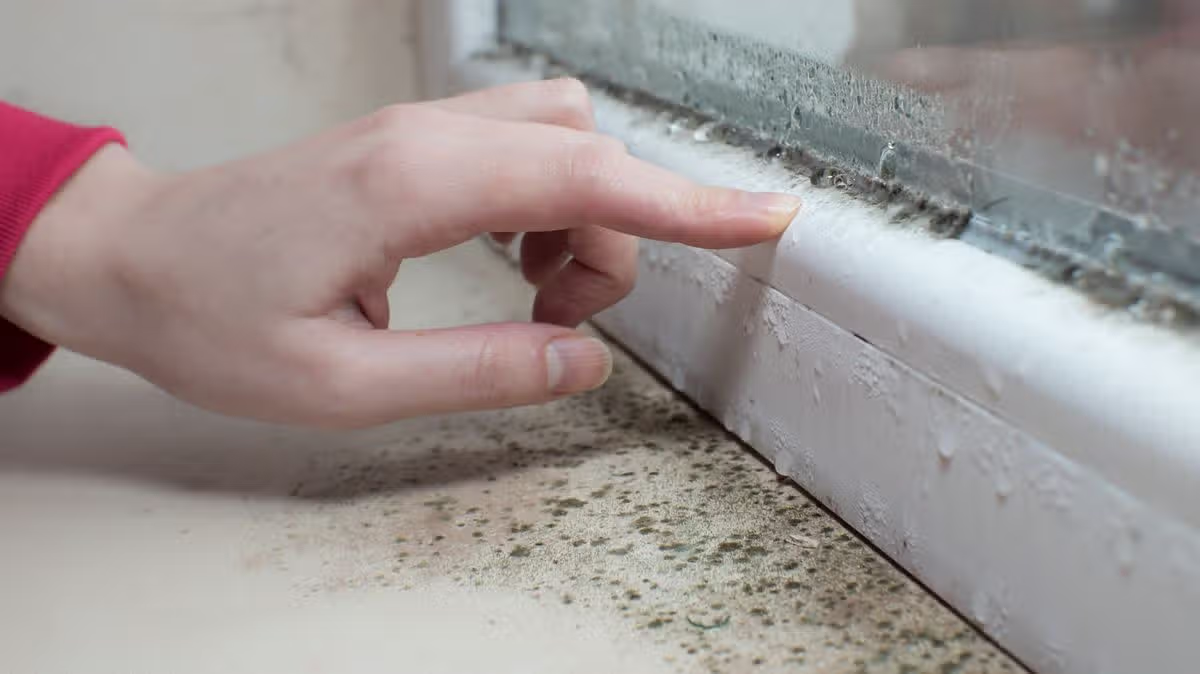
Dehumidifiers can help with damp, mould and condensation in homes – and we’ve found one with a discount

With autumn and winter weather around the corner, many homes in the UK will suffer from damp, mould and condensation. A dehumidifier could help tackle mould growth, combat condensation and also help to dry your laundry.

And you’re in luck as we’ve found a deal on a ‘small but mighty’ dehumidifier on Yimbly, a marketplace owned by this publication’s parent company, Reach PLC.

Advertisement

The Air Pro Mini Dehumidifier Portable Electric Mould and Damp Remover 600ml comes in three colours – light blue, white and black. It is currently available for £29.99 on Yimbly – but we’ve found a way to get it even cheaper.

By using the discount code SUMMER10 at checkout, it will take a further 10 per cent off the price. This reduces the Air Pro Mini Dehumidifier to £27 before delivery.

The Yimbly discount deal makes it even cheaper than the current Amazon price. Available in black, blue and purple, Amazon is selling the Air Pro Mini Dehumidifier for £29.99.

Air Pro Mini Dehumidifier

Advertisement
Content Image

Use the discount code SUMMER10 to save 10 per cent off the price

Dehumidifiers can help to prevent condensation, speed up the drying of clothes, hinder mould growth, protect home furnishings and help to alleviate humidity-related respiratory problems. Yimbly has described the Air Pro Mini Dehumidifier as ‘whisper-quiet’ and states the device as a auto shut-off function to prevent it overflowing.

The device is said to consume minimal energy, ‘making it cost effective’ and ‘promoting environmental sustainability while maintaining optimal performance’.

Elsewhere, Dunelm sells the 1L Dehumidifier for £25. Dunelm says the device is ‘ideal for rooms up to 20 square metres’.

While, Amazon has the PureMate Dehumidifier 600ml for £26.99. Amazon states it ‘assists in the relief of allergies, breathing difficulties, congestion and itchy watery eyes by reduce mould spores’.

Advertisement

Back to the Air Pro Mini Dehumidifier Portable Electric Mould and Damp Remover 600ml, while there are no reviews on Yimbly, it does boast a 4.3 star rating on Amazon at the time of writing. Anthony said: “Quiet running and very efficient. Easy to empty the water reservoir and cuts off when full.”

Lara simply commented: “Small but mighty.” While Norrie posted: “Nice little dehumidifier and it works.”

However one shopper wrote: “Catches water slowly. Good to have as an extra dehumidifier, not powerful enough for as a main one.”

Advertisement

And Tina added: “This little dude is so good, I live in a small flat that is not very well insulated. I tested it by leaving it on every night for two weeks. Then left it off for a few nights. What a difference this makes. I will be ordering another one.”

Source link

Continue Reading

NewsBeat

Man arrested, fans and athletes stuck and medal ceremonies delayed in armed police operation at European Championships

Published

on

Man arrested, fans and athletes stuck and medal ceremonies delayed in armed police operation at European Championships

Medal ceremonies at the European Athletics Championships in Birmingham were postponed on Saturday evening and transport was suspended after a man was arrested on suspicion of fraud, leaving fans and athletes stranded at Alexander Stadium.

Athletes started queuing for official transport at 10.15pm but many did not arrive back at their hotels until 12.45am on Sunday, with some set to compete again on Sunday night.

Britain’s triple gold medallist Amy Hunt was among those caught up in the chaos, with her quest for a quartet of European titles continuing in the mixed 4x100m relay on the final day of the event.

Tournament organisers said transport operations had returned to normal in the early hours of Sunday.

Advertisement

A statement from Birmingham 2026 read: “Birmingham 2026 can confirm that transport operations have returned to normal following a police incident on Saturday evening.

“Championship transport was suspended until the necessary security measures had been carried out whilst West Midlands Police arrested a man in his thirties on suspicion of fraud.

“The safety and wellbeing of our spectators, athletes, workforce and the wider Championships’ family will always be our first priority.

“We recognise that the delays presented challenges for those affected and would like to thank everyone for their patience, understanding and cooperation throughout the evening.

Advertisement

“Further information will be issued on Sunday relating to the evening’s postponed medal ceremonies.”

A West Midlands Police spokesperson confirmed that a man in his 30s was arrested on suspicion of fraud and remained in custody for questioning.

The crowd at the Alexander Stadium appeared to be near its 23,000 capacity to watch Saturday’s evening session, which concluded with Great Britain winning a pair of gold medals in the men’s and women’s 4x100m relays.

At one point during the session, there was an announcement that the six medal ceremonies, scheduled to take place after the final event between 10pm and 11pm, were cancelled.

Advertisement

Outside, there was a visibly heavy police presence and huge static queues of people waiting for shuttle buses.

Alex Ridout wrote on X: “Crazy queues for the shuttle bus after tonight’s European Athletics Championships session.

“Definitely seems like something has gone on that has potentially caused blockages, with blue flashing lights seen on the main road outside Alexander Stadium.”

Susie Barnacle wrote on X that she had been “waiting for nearly two hours to leave” and described “armed police at the buses”, adding: “We were told precisely nothing!”

Advertisement

A statement on the event’s official account, posted on X at 11:03pm, read: “We apologise for the significant delays in leaving the Alexander Stadium venue this evening.

“Buses and coaches will start to arrive and departures will begin to gradually take place.

“We thank you for your patience with this matter. Please listen to the instructions from the safety personnel and marshals who are there to support you.”

Source link

Advertisement
Continue Reading

NewsBeat

Growing corgi race features 150 dogs competing for honors

Published

on

Growing corgi race features 150 dogs competing for honors

VILNIUS, Lithuania (AP) — It’s not all about short-legged speed when 150 corgis gather for an international race celebrating the little dogs. There’s a costume parade, the “smartest nose,” and — of course — the loudest bark.

The fifth Corgi Race Vilnius drew dogs and their owners to the Lithuanian capital’s Vingis park on Saturday for what organizers said was the biggest edition yet. There were competitors from Lithuania, Latvia, Poland, Estonia, Germany, Ukraine, the Czech Republic, the United States and Britain — the country most closely associated with the breed, famously a favorite of the late Queen Elizabeth II.

“In the first year, we gathered 40 corgis from one city. This year, it’s 150 from nine countries, and for the first time we have a participant from the place where the breed originated,” organizer Edvinas Miskas said.

“We call Vilnius the European capital of corgis, and when people from the breed’s homeland start coming to us rather than the other way around, that title begins to sound a little more serious.”

Advertisement

Ninety-four dogs took part in the main running event, competing in qualifiers, semifinals and the final.

In the final, which pitted corgis against each other over 25 meters (82 feet), the winner was American competitor GG, short for Gustave the Girl Dog. Another U.S. entrant, Mr. Corgington, finished a close second. Lithuania’s own Moka, a two-time former champion, was third.

But much of the program dispensed with speed to explore the other skills of the dogs — and their owners.

There was a costume parade featuring 38 corgis in diverse outfits including a dinosaur suit, a dress and doggy sports gear. Amigo swept both the four-judge jury and the public Facebook vote for a flawless costume entry with a knight-like look.

Advertisement

In the “smartest nose” challenge, dogs searched for hidden treats. Latvian corgis Tora and Rusty shared the win.

And then there was the loudest bark competition. The first British competitor, 12-year-old Pembroke Welsh corgi Duke from Sedbergh in northwest England, didn’t participate in the main race because of his stately age but was a hopeful in the barking stakes after, as his owner put it, training for his whole life.

It was Mr. Corgington who won the loudest bark contest, though.

He was one of the most traveled competitors. The final race offered him a rematch after he finished second against GG at a major race at Emerald Downs in Auburn, Washington — her second consecutive win there.

Half of the corgis registered in Vilnius this year were taking part for the first time. But six veterans — costume winner Amigo, Foksas, Foksis, Madeira, Bulka and Dziugas — have attended every edition.

Advertisement

Source link

Continue Reading

NewsBeat

How to downsize without regret: From picking the right property to location, here’s what you MUST do

Published

on

Karen, 64, and her husband Patrick, 67, moved from a £750,000 four-bedroom house in north London to a £350,000 property in Essex. But now she feels they sacrificed too much

On the face of it, downsizing seems like a win-win way of future-proofing your finances in later life. It can boost your bank balance and free up wealth for retirement. It’s an opportunity to move closer to family and find a home that will suit your needs. And moving out of a large property means you’ll have lower bills and less upkeep – it also helps free up the housing market for younger people.

But do it at the wrong time or choose the wrong property in the wrong location and it could be a move you soon regret.

For some, the upheaval has forced them to say goodbye to a life they loved and now miss.

Wealth And Personal Finance has spoken to those who have downsized in recent years to hear what they would do differently and the lessons they learned. We have also weighed up the costs of swapping your family home for a smaller property and spoken to experts about whether it makes financial sense.

Advertisement

‘I am left with a sense of grief for the life we loved’

Karen Dempsey, 64, has always put her family first. So when her daughter Jane, who is now 38, couldn’t afford to buy a home for her growing family eight years ago, Karen knew what she would have to do.

The adult social care worker and her husband Patrick, 67, agreed to downsize from their £750,000 four-bedroom Victorian house in Barnet, north London, to free up cash.

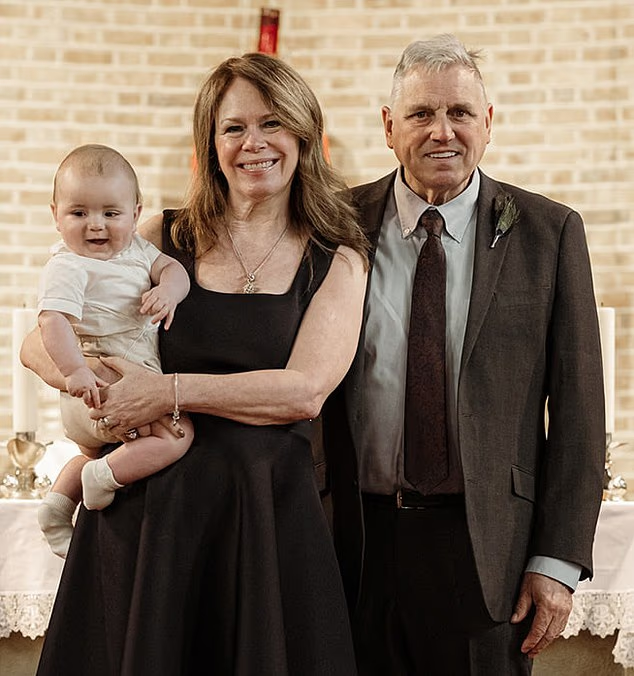
Karen, 64, and her husband Patrick, 67, moved from a £750,000 four-bedroom house in north London to a £350,000 property in Essex. But now she feels they sacrificed too much

Advertisement

By selling their home in the area they had lived in for 35 years, Karen and Patrick would be able to give Jane enough money to buy her own home. Moving to a smaller home was a change they knew they would one day make anyway, so didn’t see the harm in doing it sooner than planned.

The money from the sale would enable the couple to buy their own £350,000 property and have enough for her daughter to also buy a £350,000 home.

They decided to move closer to Jane and their now four grandchildren and found a three-bedroom semi-detached house in Witham, Essex. But within weeks of making the move, Karen said she felt they had made a mistake.

She says: ‘The idea was to help our daughter and her young family. By selling up, we could do this.

Advertisement

‘Initially they moved in with us while looking for a property. But the strain of living on top of each other pushed us apart rather than closer together – the opposite of why we made the move.’

Karen says that since making the move in 2018, she has missed the old life she had in the capital. She says: ‘Unfortunately I am left with a sense of grief for the life we loved in London and have lost – the vibrancy of the city and having more space and friends close by.

‘It makes me feel guilty, but I think we sacrificed too much.’

Karen says she doesn’t feel bitter about the decision and was happy to see Jane buy a home just eight minutes down the road.

Advertisement

She has also made new friends since setting up a local walking group – but fears it did not save her and Patrick any money.

She says: ‘We were delighted to help our daughter – and we are closer than ever. But we now find the cost of living more expensive.

‘My husband still works in London, and I regularly return to meet up with friends and this adds £600 a month to bills. We also have a son, Robert, 36, in London who we often visit.’

Although the couple still commute into London for work or to visit friends, they are pleased to be much closer to their daughter and four grandchildren, who live just eight minutes away

Although the couple still commute into London for work or to visit friends, they are pleased to be much closer to their daughter and four grandchildren, who live just eight minutes away

Advertisement

Karen advises others to weigh up the sacrifices they are making against the benefits of downsizing before taking the plunge.

She says one of the key mistakes they made was to move while they were both still working. In hindsight, Karen says she would have rented a property until they had both retired before committing to buying a smaller home.

Meirion Shaw, founder of removal firm The Homemover Specialist, believes making the move from around the age of 65 can be a ‘good time’. She says: ‘Never retire without a plan. Do not rush into a downsize without thinking through what you are going to do with your life when you stop working. This is why a good time to take the plunge is often once you have retired.

‘While it can be good to move close to family, you may want to keep your independence and must be aware that family often lead their own busy lives. You do not want to end up feeling lonely.’

Advertisement

But similarly, those who wait too long to make the big move could regret it. Moving can be both physically and emotionally draining, so it is important to do it while you still have the energy.

Shaw says she would recommend doing it within ten years of leaving full-time work.

She adds: ‘Downsizing can be part of a new exciting chapter, and you should do it while still fit and active if possible – it is important that you do not leave it too late.’

‘I am a glass half full type of person’

Keen golfer Annabel White, 93, realised it was time to downsize last year when she found completing her usual round of 18 holes at her Holywood Golf Club was getting too much last year.

Advertisement
Moving specialist Meirion Shaw advises waiting until you have retired before 'taking the plunge' and downsizing

Moving specialist Meirion Shaw advises waiting until you have retired before ‘taking the plunge’ and downsizing 

This golf course in County Down was just six miles up the road from her three-bedroom Belfast apartment.

Widow Annabel decided the physical demands of walking five miles across the course were becoming too challenging.

It was an eye-opening moment that made her realise it was perhaps time to downsize to a smaller home. So last October, she bought a two-bedroom bungalow in the village of Markethill, County Armagh, more than 40 miles south-west of her old home.

Advertisement

This meant she now lived close to family, including her daughter, 70, granddaughter, 40, and three great-grandchildren, aged 13, 11, and five.

Annabel says: ‘I am a glass half full type of person but am not getting any younger. I miss the golf friends who I lunched with twice a week. They are in their late 80s, so although we had plans to meet up more often since I moved, it is a long drive now.

‘I have joined local bowls and bridge clubs, enjoy lots of reading and have a cat for company.’

The retired housewife, whose husband died 22 years ago, didn’t divulge how much she sold her home for but says the move means she now has no financial worries.

Advertisement

Annabel says: ‘I never want to be a burden – and do not want family to invite me to Sunday lunches out of duty. Keeping independence was key to the move. The nearest supermarket is 15 miles away, so thank goodness I still drive. But it is good to know family is around if required.’

Similar to Karen, Annabel says that in hindsight she should have rented out a place before buying her new home.

She adds: ‘Finding the right bungalow was like hunting for hen’s teeth. I lost a stone in weight due to stress. But fortunately my home sold in just a few days.’

‘Memories are in your head, not in bricks’

Susan Roberts, 78, and husband Jeffrey, 79, said it felt like they were on holiday for the first year after downsizing – and they have never looked back in the two decades since.

Advertisement

At age 58 and 59, when their son had moved out of the family home but the couple were still enjoying active working lives, they sold their three-bedroom semi-detached house in Newton Mearns, seven miles south of Glasgow, for £350,000, and bought a two-bedroom apartment in a 12-flat complex in Giffnock, three miles north-east, for £250,000.

Susan Roberts, who downsized to a two-bedroom flat, says her biggest tip is to start clearing out junk a few years before moving, as it can be therapeutic. (Picture posed by models)

Susan Roberts, who downsized to a two-bedroom flat, says her biggest tip is to start clearing out junk a few years before moving, as it can be therapeutic. (Picture posed by models)

Susan, a semi-retired medical secretary, says: ‘We had a lovely big house where we brought up our son. But after 20 years there, it was just the two of us and we didn’t need all that space.

‘The maintenance of houses as you get older can be a burden. We decided to take advantage of owning a home in a sought-after area for schools – something no longer important to us – and sell up.’

Advertisement

Susan says her biggest tip is to start clearing out the loft and garage of junk a couple of years before you take the leap.

She says: ‘Having a big clear-out is therapeutic – even if you never move. It also helps you realise there is stuff stored away you do not need or use.

‘There is no need to worry about what you leave behind. Memories are in your head and not the bricks of a house.’

The couple were keen to move before they got too old. Susan says: ‘Moving is stressful at any age but still being relatively young meant we could take a hands-on approach with a complete refurbishment of our new home.

Advertisement

‘We can go on holiday and not worry about returning to a leaky roof because the property is managed while away – and there are neighbours looking out for you.’

The new home is on the first floor and has lift access to shared gardens and a balcony. They pay £4,000 a year for property maintenance, including roof and electricals, window cleaning, gardens and regular bin collections.

Susan says: ‘Moving before it is too late ensures you are in control of the decision. My son came round and was concerned there was not much room for his family to stay. But your children do not have such worries when they buy a home. Why should you?

‘You can work it all out later.’

Advertisement

Top tips for downsizers

The first step is to imagine how you want to spend your time in retirement. Picture your golden years and consider whether you want to go to the theatre or eat out regularly, go on long walks with a dog, spend time gardening, see loved ones or travel the world.

This will help determine where you should settle and what kind of home you might need.

Shaw says: ‘Living in a city can hold a great attraction as you get older – all that free travel and entertainment you never had time for when working or the family were still living at home. If you are a couple you need to discuss future hopes, but if you live alone, be selfish.’

Location is often dictated by family, but Shaw says it’s common for downsizers to worry about being a burden without talking to loved ones first. She says: ‘No one wants to be a hindrance, and it is important you discuss this with your family. Although you may want to support them, it’s likely you also want to stay independent.’

Advertisement

Her guidance goes against the grain for most homeowners. Fewer than one in five people – 19 per cent – consider downsizing in retirement, according to a survey by Opinium for wealth manager Hargreaves Lansdown.

It's crucial to weigh up the financial pros and cons before moving, as extra costs such as stamp duty can be a deterrent for many

It’s crucial to weigh up the financial pros and cons before moving, as extra costs such as stamp duty can be a deterrent for many

And for those aged 55 or older, this figure fell to only 14 per cent. Some 37 per cent did not want less room for their belongings, while a third said they were too attached to their home. And 21 per cent said moving was too expensive, considering all the disruption.

Shaw says: ‘People look for excuses to do nothing – even clearing out is hindered by decision paralysis. We recently had someone with a dining table they could not fit into their new home, which they had bought for £12,000 and it was valued at just £1,200.

Advertisement

‘They were devastated until I asked them why it had been bought and to consider the many years of service and meals they had enjoyed on it. It had already done its job really well.’

If you are concerned about how physically demanding a move might be, consider a removal firm to do your packing and removals. You might pay anything from £1,500 to £5,000 or more.

Be prepared to face up to the costs

Downsizing can be a useful way of freeing up some cash, unless you move to an area with higher property prices. But it’s still important to weigh up the financial pros and cons.

Stamp duty is a major deterrent for many. It applies to the purchase of all homes above £125,000. You pay 2 per cent in tax between £125,000 and £250,000 and 5 per cent between £250,001 to £925,000.

Advertisement

A couple buying a £300,000 home would face a stamp duty bill of £5,000, on top of estate agent fees. But there is no capital gains tax to pay on selling a home.

And once you’ve moved, there should also be lower maintenance costs and cheaper energy bills, as your new home is likely to be smaller and more energy-efficient.

Downsizing dos and don’ts 

DO

  • Decide what you want from retirement 
  • Have a financial plan 
  • Talk to family and friends about the future 
  • Clear out clutter early 
  • Consider renting before buying 
  • Take the time to enjoy the house-hunting 

DON’T

  • Put off planning until tomorrow 
  • Feel beholden to your family 
  • Avoid facing challenges of old age 
  • Underestimate need for family and friends 
  • Rush in – consider sacrifices being made 
  • Forget to keep savings aside 

<!- – ad: https://mads.dailymail.co.uk/v8/de/money/moneysaving/article/other/mpu_factbox.html?id=mpu_factbox_1 – ->

Advertisement

Have you downsized? Tell us about your experience: money@mailonsunday.co.uk

Source link

Continue Reading

NewsBeat

TOM PARKER BOWLES on the once-mighty burger chain that’s now a shadow of its former succulent self: ‘A thick, dry patty wedged into an untoasted bun and distinctly average fries’

Published

on

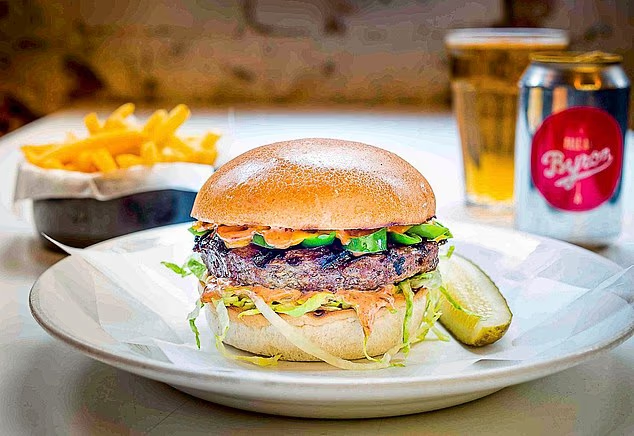
‘There’s no juice or joy’: a Byron cheeseburger

Advertisement

Byron was, in many ways, a modern burger pioneer. Sure, GBK may have opened in 2001, with its ‘gourmet’ creations. But I was never a fan, finding them dull and oversized. And yes, before that, there was always Tootsies (a childhood favourite) and the Hard Rock Cafe (once thrillingly exotic, now plain sullen). But when Byron was opened by restaurateur Tom Byng way back in 2007, they did things rather differently. Inspired by the classic American cheeseburger found at the likes of New York’s Corner Bistro, this was all about good ingredients and pared-back simplicity. No baroque, overstuffed comedy creations here, rather top-quality British beef patties, cooked pink, then slipped into soft, toasted buns, with fresh tomato, lettuce, onion and proper plastic cheese.

‘There’s no juice or joy’: a Byron cheeseburger

Hardly reinventing the wheel, but god they were good: held in one hand and devoured in three bites as the juices surged down your chin. Where they led, dozens followed. MeatLiquor (then operating out of a truck in a Peckham pub car park, and known as MeatWagon) came a year later with their iconic Dead Hippie, followed by Honest, Bleeker, Patty & Bun, Black Bear, Five Guys and a never-ending surge of those damned smashburgers. Anyway, Byron grew fast before being sold to some private equity group, who wanted rapid expansion. No surprises there. At its peak, the chain had 67 branches across the land. But as so often happens, corners were cut, standards dropped and in 2020, during Covid, they went into administration.

Advertisement

Now, there are just six outlets left, and I’ve lost track of who owns what. The South Kensington branch is clean, but only a quarter full on this Tuesday lunchtime. Still, the service is warm and Coca-Cola cold. Burgers, though, are no longer cooked medium, just well done – and they can’t, for once, blame council regulations. Honest Burgers, a few doors down, still does them pinkly medium. After a 20-minute wait, I’m greeted by a thick, dry patty wedged into a thick, dry untoasted bun. There’s no succulence or succour, no juice or joy, just an excess of ketchup and malaise. After a few dyspeptic bites, I give up. The meat may well be decent quality but cooked this long, the flavour has long since passed. Fries are distinctly average, while the less said about the poutine, the better. What was once a pioneer is now an also-ran. Byron has gone the way of all flesh.

About £20 a head. Byron, 93-95 Old Brompton Rd, London SW7; byron.co.uk

Rating:

Advertisement

Advertisement

Source link

Continue Reading

NewsBeat

Indonesian rescuers rush to save earthquake victims trapped in the rubble after 7.7-magnitude tremor collapses buildings – as death toll rises to 51 and thousands evacuated

Published

on

A rescue team searches for victims in the ruins of the Laurensius Say Port in Maumere, Sikka, East Nusa Tenggara yesterday

Rescuers started arriving today for thousands of evacuees on Indonesia‘s Flores Island after a powerful 7.7-magnitude earthquake killed 51 people, injured dozens and damaged hundreds of houses and buildings.

Some 5,000 people fled their homes as the quake hit the island on Saturday at 5.58am local time – around 11pm in the UK.

It was followed by at least 341 aftershocks, a spokesman for the BNPB national disaster agency, Berton Suar Pelita Panjaitan, said.

BNPB head Suharyanto said Sunday at least five helicopters, several planes, a naval vessel and search and rescue ships were on their way to help.

Advertisement

The National Search and Rescue Agency (Basarnas) said Sunday the death toll had risen to 51 from 47 the day before. Another 132 people were injured, with no reports of missing persons.

Survivors were in urgent need of assistance in the form of emergency tents, food, medicines, blankets, camp beds, mats, clean water and electricity generators.

The epicentre of the shallow quake was located just off the north coast of the island, geological authorities said. The affected areas have few, if any, high-rise buildings.

Berton said at least 914 houses were severely damaged and hundreds of others to a lesser degree.

Advertisement

Dozens of public facilities were also stricken, including 93 educational and 36 health facilities, and 38 government offices.

A rescue team searches for victims in the ruins of the Laurensius Say Port in Maumere, Sikka, East Nusa Tenggara yesterday 

Indonesian military and rescue personnel search through debris at a damaged building

Indonesian military and rescue personnel search through debris at a damaged building

Advertisement
Evacuees affected by the earthquake were moved to temporary shelters in Maumere, East Nusa Tenggara province today

Evacuees affected by the earthquake were moved to temporary shelters in Maumere, East Nusa Tenggara province today

The International Federation of Red Cross and Red Crescent Societies said Saturday preparations were under way to bring aid to thousands in temporary shelters.

The Indonesian government sent 50,000 aid packages weighing a total of 275 tonnes to the area and European Union chief Ursula von der Leyen offered help from the bloc’s Copernicus Earth observation satellites.

‘Europe stands ready to deploy Copernicus, our eyes in the sky, to support search and rescue efforts. Indonesia, we stand with you,’ she wrote on X.

Advertisement

In Ruteng, a town about 124 miles from the worst-hit part of the island, heavy machinery was seen clearing rubble from the street on Sunday.

Yohana Raisita Damalia Mari, a spokeswoman for the local hospital, said the building had been badly damaged, and patients were evacuated to tents erected outside.

A woman underwent an emergency C-section in an intact storage room converted into a temporary operating theatre.

‘Thank God, the surgery went smoothly and both the patient and her baby are safe,’ said Yohana.

Advertisement

Herybertus Geradus Laju Nabit, mayor of the Manggarai regency, said it was impossible to predict when the aftershocks would end.

‘Therefore, our first appeal is: be vigilant. Stay alert,’ he said.

After Saturday’s quake, Flores residents ran for the hills as the sea retreated, a possible sign of an approaching tsunami.

A tsunami warning was later lifted, but authorities urged people not to return to damaged buildings for fear that aftershocks may bring them down.

Advertisement

Waves of up to 1.6 metres (5.2 feet) were reported in some coastal regions, according to Indonesia’s BMKG geological agency.

Indonesia experiences frequent earthquakes due to its location in the Pacific ‘Ring of Fire’, an arc of intense seismic activity stretching from Japan through Southeast Asia and across the Pacific basin.

A man walks amid the debris from a damaged building on Sunday following the quake in Borong, East Manggarai, East Nusa Tenggara

A man walks amid the debris from a damaged building on Sunday following the quake in Borong, East Manggarai, East Nusa Tenggara

Police officers inspect a heavily-damaged house after the earthquake was felt in Manggarai, East Nusa Tenggara province

Police officers inspect a heavily-damaged house after the earthquake was felt in Manggarai, East Nusa Tenggara province

Advertisement
People rest in shelters at a makeshift evacuation center at a stadium in the aftermath

People rest in shelters at a makeshift evacuation center at a stadium in the aftermath

People in some areas were left without electricity and telecommunications and at least one emergency access road remained inaccessible.

‘We need food, drink, medicines, and diapers for the children,’ Umri, a resident of Nangahale village on the north coast of Flores, told AFP on Sunday morning.

The 55-year-old, who like many Indonesians uses one name, has been hiding out on a hilltop for 24 hours with others afraid to return home.

Advertisement

Nurhidayati, also 55, spent the night on a mat on the same hill.

‘I’m still terrified; my heart is pounding hard remembering yesterday’s tremor… We just ran up here yesterday. I’m very scared now, still traumatised by the quake in 1992. I don’t dare to go home,’ she said.

‘I hope the government will soon distribute logistics to help us,’ said Nurhidayati.

Source link

Advertisement
Continue Reading

NewsBeat

Early hours crash reported on Goldsmith Street, Bolton

Published

on

Early hours crash reported on Goldsmith Street, Bolton

The collision happened on Goldsmith Street in Daubhill just after 1am in the early hours of Saturday August 15.

Goldsmith Street is found between Derby Street and Bridgeman Street, both major routes through the western side of the town.

A Greater Manchester Police spokesperson confirmed that the incident was a “minor injury road traffic collision” and that no arrests had been made in connection with it.

At least two cars are believed to have been damaged (Image: Public)

The street is primarily residential and is lined with the side of end of terraced houses turning on to neighbouring streets in the area.

Advertisement

Images from the scene appear to show that at least two vehicles were damaged on Goldsmith Street that evening.

Members of the public have been urged to always call 999 in the event of an emergency as soon as it is safe to do so.

Source link

Advertisement
Continue Reading

NewsBeat

Popular burger restaurant to close as owners give damning assessment of Swansea city centre

Published

on

Wales Online

Those behind the restaurant described their ‘genuine worry’ for the centre’s future as it relocates

A popular burger restaurant has announced it is relocating, with a damning assessment on the current landscape of Swansea city centre. Burger Freakz will stop trading at its Mansel Street base on Sunday, switching to a new location in Blaenymaes.

A statement described the move as a “tough decision”, stating a lot of happy memories had been made trading in its current location.

But explaining the reasons behind the move, those behind the restaurant described their “genuine worry” for the city centre, pointing to the closures of big name shops and small independent retailers. For the latest restaurant news and reviews, sign up to our food and drink newsletter here.

Advertisement

The statement read: “After a lot of thought and tough decisions we’ve had to make the last few weeks, we have made the decision to close Burger Freakz, 29 Mansel Street.

“It was a tough decision to make and something we would’ve preferred not to do, but with the rates/overhead of the city and the struggle in hospitality at this moment, especially during the summer, it just wasn’t financially making sense anymore.

“The city itself is losing foot traffic by the week, businesses are closing down all over the city, from small independents to big names. With a team of local people who have grown up here, it’s genuinely worrying to think what will actually be left of our city centre within the next 18 months.

“The most valuable math you can learn is how to calculate the future cost of your current decisions. But we’re not closing, we’re relocating. While going through some ups and downs over the last few weeks and questioning this decision, we got offered an opportunity for a second shop in an area some people may question, because of the name/reputation it has, but an area that has a massive community and is already our most popular postcode area – SA5.

Advertisement

“So turning a negative into a positive, we’ve already started work on the new shop and it’s going to give us so much more opportunity.

“There will be 25 to 30 seats and new delivery areas at Penllergaer, Gowerton, Gorseinon, Clase and Morriston.

“There will be lower overheads, more opportunity to give back through deals and offers, and a bigger and better Burger Freakz.

“But we won’t ever forget the amazing memories we’ve had in 29 Mansel Street. Thank you for allowing us the opportunity to meet some amazing people from staff to customers, who have become friends to this day from the walk-ins, deliveries, colleections, locals – we really appreciate your support. We hope to still catch you at the new premises and that you continue to support us.

Advertisement

“Sunday, August 16 is our last day trading at 29 Mansel Street. This week, the opening date will be revealed for the new shop, so keep your eyes out for that one. Remember, this is the end of 29 Mansel Street, not Burger Freakz. Next stop SA5 5LN.”

Get Swansea news updates on your phone by joining our WhatsApp community here. We occasionally treat members to special offers, promotions and ads from us and our partners. See our Privacy Notice.

Source link

Advertisement
Continue Reading

NewsBeat

Cheryl Tweedy’s killer stalker is moved to secure hospital from prison months after being put back behind bars

Published

on

Convicted killer Daniel Bannister (pictured), who repeatedly stalked Cheryl Tweedy, has been moved from prison to a psychiatric hospital

A convicted killer who repeatedly stalked Cheryl Tweedy has been moved from prison to a psychiatric hospital. 

Daniel Bannister, 51, was sectioned under the Mental Health Act after spending five months behind bars.  

Health service bosses and the Ministry of Justice made the decision ahead of his release date this year. 

The transfer means Bannister is now considered a patient rather than a prisoner, and has access to round-the-clock care from nurses and psychologists. 

Advertisement

The move is predicted to cost the taxpayer up to £300,000 per year – compared to the £60,000 cost of a prison place. 

Bannister was jailed for a year last September for turning up to Cheryl’s house – which she shares with her nine-year-old son Bear – for a fourth time, leaving her ‘terrified’. 

His appearance at the star’s home was a breach of a restraining order already placed on him. 

Just months later he was released, with photographs showing him walking through the streets, chatting to people waiting at a bus stop and casually smoking a vape. 

Advertisement

Convicted killer Daniel Bannister (pictured), who repeatedly stalked Cheryl Tweedy, has been moved from prison to a psychiatric hospital 

Cheryl Tweedy was left 'terrified' after Bannister turned up at her home four times

Cheryl Tweedy was left ‘terrified’ after Bannister turned up at her home four times 

In January, he was put back behind bars after breaking the rules of his halfway house, where he is alleged to have kept alcohol in his south London bail hostel room. 

Advertisement

The Ministry of Justice confirmed at the time that Bannister was issued with a recall warrant on January 13 for breaching his licence conditions.

His sentence was set to expire in June this year, meaning he could no longer be held in custody. 

But he has been moved to a psychiatric hospital, where he will be under the care of the NHS, The Sun first reported. 

Bannister, who was previously convicted for manslaughter, began his campaign of harassment against Cheryl in January 2024.

Advertisement

It then continued after Cheryl’s former partner, One Direction star Liam Payne, died aged 31 after falling from a balcony in Argentine capital Buenos Aires in October 2024. 

The former X Factor judge, 43, told the court in a victim impact statement how she felt ‘on edge every time I open my gate’. 

She said she was ‘stunned’ when Bannister visited her home for a fourth time, and that she has been forced to hire personal security. 

‘Each time he returns the worry of his intentions intensifies,’ she said.

Advertisement

‘I’m worried, nervous and on edge every time I open my gate. No person should have to feel this way.

‘Daniel has made my young child scared,’ she added. 

Bannister, a musician, turned up to Cheryl's house four times, leaving her 'terrified'

Bannister, a musician, turned up to Cheryl’s house four times, leaving her ‘terrified’ 

The singer dated Liam Payne for two years, with the pair welcoming their son Bear in March 2017. Liam passed away in Argentina aged 31 in October 2024 (pictured together in February 2018)

The singer dated Liam Payne for two years, with the pair welcoming their son Bear in March 2017. Liam passed away in Argentina aged 31 in October 2024 (pictured together in February 2018)

Advertisement

Judge Alan Blake previously told Bannister: ‘She does not wish any contact with you and you are causing her anxiety. 

‘You have shown defiance to the court order. 

‘You need to draw a line under that behaviour.’ 

The stalker showed up at the singer’s rural home for the fourth time on June 19, arriving in a taxi just before 10pm, and rang the intercom system twice before peering over the gate, the court heard. 

Advertisement

Bannister believed the singer had invited him to her home over Microsoft Teams, the court was told. 

The court heard Bannister is a musician, and trained to a very high level as a figure skater as a child. 

The stalker was jailed in 2012 for two-and-a-half years for the manslaughter of Rajendra Patel, 48, who he assaulted at a south London YMCA homeless shelter. 

Source link

Advertisement
Continue Reading

NewsBeat

Trump’s critics say he’s a misogynist, others praise his promotion of women to top posts. As president’s press chief quits, insiders reveal what it’s REALLY like to be a White House Glamazon

Published

on

Donald Trump pictured with former White House Press Secretary Karoline Leavitt on July 15, 2025

The calls from the boss can start as early as 2am. By 6am there is little time to think about sleep. 

There is a professional blow-dry appointment to make, layers of impeccable make-up to apply and a designer outfit to choose – because in Donald Trump‘s White House, looking the part is almost as important as doing the job.

As one woman who worked inside the Trump orbit described it, the desired aesthetic had to be no less than ‘Maga perfect’.

Those glossy smiles and immaculate clothes are, of course, what the outside world sees when the parade of highly intelligent women who work for the Trump administration appear on television alongside the President at Maga rallies and press conferences.

Advertisement

But in a White House plagued by accusations of misogyny and sexual misconduct by its commander-in-chief, the reality for those working there is rather different. 

Limited pay for demanding, 24/7 roles. No time to raise a family. And, of course, an implicit requirement to spend considerable amounts of their time and hard-earned cash on their appearance.

To pull back the curtain on life as a Republican ‘glamazon’ at the heart of US politics, several former female staffers have described, in confidence, what it is really like to The Mail on Sunday.

Summed up in a word? Exhausting. ‘It gets to be utterly draining,’ as one burned-out employee admitted to me last week. 

Advertisement

Donald Trump pictured with former White House Press Secretary Karoline Leavitt on July 15, 2025

Natalie Harp, aide to Trump, walks to a vehicle after arriving with Trump on the Ellipse near the White House on August 9, 2026

Natalie Harp, aide to Trump, walks to a vehicle after arriving with Trump on the Ellipse near the White House on August 9, 2026

Trump with former US Attorney General Pam Bondi (centre) and former US Secretary of Homeland Security Kristi Noem (left) in the Oval Office of the White House in Washington, DC

Trump with former US Attorney General Pam Bondi (centre) and former US Secretary of Homeland Security Kristi Noem (left) in the Oval Office of the White House in Washington, DC

Advertisement

Join the discussion

Is it empowering or exploitative for women to be expected to look flawless while serving in politics?

‘You have to be exceptional at your job, which is a given, but if you’re a woman you have to look a certain way, dress a certain way and be available 24/7, because this is a President who barely sleeps.

‘Add to that the pressure of a family at home and it’s no wonder so many of us flame out.’

Advertisement

That tension was laid bare just last week when Karoline Leavitt, Trump’s formidable press secretary, announced she was leaving the White House to become a full-time mother to her two young children. 

The 28-year-old admitted her decision was ‘bittersweet’, saying that since returning to the White House following the birth of her daughter in May she felt she could not be the mother her baby and two-year-old son deserved – while simultaneously giving the job the ‘constant time, energy and attention’ it required. 

It was a remarkably candid admission from someone who has become one of the most recognisable women in Trump’s Washington. 

Despite that, Leavitt was photographed on Friday night, looking fiercely chic in a scarlet-red dress alongside the President as they prepared to board Air Force One to New York. She is due to step down this month.

Advertisement

And she is not the first to do so even this year alone.

In fact, six women from Trump’s inner circle have left since January: Director of National Intelligence Tulsi Gabbard, Attorney General Pam Bondi, Homeland Security chief Kristi Noem, Labour Secretary Lori Chavez-DeRemer, Deputy Press Secretary Abigail Jackson and Director of Media Affairs Sonny Joy Nelson.

But perhaps it is little wonder. Quite aside from the normal pressures of a high-powered job in government, 80-year-old Trump is a man known for objectifying women (who can forget his famous ‘grab her by the p***y’ remark?) who is infamous for demanding total fealty, has unrelenting, exacting standards, and who sleeps only four hours a night. 

He is known for throwing ‘tantrums’ when things don’t go his way and expects those closest to him to be available all hours of the day and night.

Advertisement

And it is also no accident, commentators say, that the women elevated to work for Trump – who, in a previous life, owned the Miss Universe contest – are all beautiful, perfectly manicured and extremely capable.

Those who spoke to the MoS did so on condition of anonymity because their subsequent roles are within Trump-supporting organisations. 

The enduring fallout of working at the heart of the Maga movement under such a ‘polarising’ boss is such that many discovered they were viewed as a ‘liability’ by some employers, particularly blue-chip companies. Others have left the workplace completely.

A legal source said: ‘The President is always ‘on’. When he wants someone he shouts your name. And you’d better come running. He thinks nothing of calling you at 2am. 

Advertisement

‘You are expected to look a certain way. Most of the women at the White House get their hair blown out at least twice a week before work and then there is pressure to go to the gym and dress well. 

‘A lot of the younger aides don’t make that much money. You’re talking maybe $50,000 [£37,000] to $70,000 [£52,000] a year. It’s not only a stressful business working in Trump’s world – it’s an expensive one.’

Trump and Margo Martin, his deputy director of communications, at the 1st tee during LIV Golf Bedminster on August 11, 2023

Trump and Margo Martin, his deputy director of communications, at the 1st tee during LIV Golf Bedminster on August 11, 2023

For Karoline Leavitt, sources suggest, the pressure of her job while juggling two very young children simply got too much.

Advertisement

One source said Trump was so ‘dependent’ on her he ‘constantly’ called her during her most recent maternity leave, asking when she would return.

During her first maternity break she returned to work three days after giving birth because of the assassination attempt on Trump in Butler, Pennsylvania.

Karoline told an interviewer: ‘I had the baby in my arms and I looked at my husband and said: ‘I guess I’ll be going back to work.”

Another source close to the President’s inner circle said: ‘I don’t think Karoline minded being called but I think reality set in this time around. 

Advertisement

‘She’s always going to be expected to put the President first and maybe it’s time to put her kids first?’ Other women have been open about their time in Trump’s corridors of power.

For Blanche Sprague, who served as his high-powered executive and enforcer long before he became a force in politics, no time of day was off-limits for a call.

Now 67, Sprague has described her role as ‘like a nanny’ dealing with Trump’s petty grievances and requests.

‘He used to call me up at night and say, ‘Did you know that there’s a soda bottle in front of Trump Plaza?’ and I would have to make sure that it was picked up right away because he would drive past again to see that it was gone,’ she recalled.

Advertisement

On another occasion, at a book signing in Florida following the publication of Trump’s The Art Of The Deal in 1987, Sprague’s task was to make sure his favourite pen, with robin’s egg blue ink, did not run out. 

More recently, Susie Wiles, White House chief of staff, has credited her upbringing with an alcoholic father for her ability to work alongside Trump.

While the President does not drink, Wiles said that he had an ‘alcoholic’s [exaggerated] personality’ and governs with the mindset that ‘there’s nothing he can’t do. Nothing, zero, nothing’.

Join the discussion

Advertisement

Should working mothers in powerful roles be expected to sacrifice family for their careers?

Meanwhile, other published accounts of life in his inner circle give more troubling insights into his alleged behaviour.

Stephanie Grisham, who worked as press secretary during Trump’s first term – and became First Lady Melania’s right-hand woman – wrote a scathing memoir, I’ll Take Your Questions Now, in which she accused the President of constantly berating her, describing his anger as ‘terrifying’. 

‘I began to see how his temper wasn’t just for shock value or the cameras,’ she wrote. 

Advertisement

‘I began to regret my decision to go to the West Wing.’ In one outburst, she said, Trump ‘unleashed on me’.

‘His eyes were fixed and filled with anger. His face had passed red and was turning almost purple.’

She also accused him of allegedly targeting young female employees, including a press aide who he invited into his private Air Force One cabin because he ‘wanted to look at her a**’.

But Trump has dismissed Grisham as a disgruntled former employee who had become ‘angry and bitter’ and was ‘paid by a radical Left-leaning publisher to say bad and untrue things’.

Advertisement

There is another way of looking at Trump’s interest in women, of course. The ‘dichotomy’ with Trump, as one source points out, is that – while he clearly loves being surrounded by brilliant, feisty (and good-looking) women – he is also a champion of their skills.

One said he had ‘always promoted women to senior positions, going all the way back to his early days in business’.

Many of the women who have worked for him are only too happy to acknowledge this fact.

One said: ‘You have to remember, this is a man who had two women – Kellyanne Conway and Susie Wiles – leading his election campaigns. During his first term his daughter [Ivanka] was front and centre.

Advertisement

‘He gave Karoline Leavitt the press secretary’s job at 26 and even people who disagree with her political views agree that she’s been one of the most impressive and effective press secretaries of all time. 

‘It’s unfair that people attack the President when he has been a great supporter of women in a town that has always been male-dominated. 

‘People criticise him for wanting women around him to have a certain level of professionalism and beauty, but that’s who he is.

‘He’s a businessman at heart and he has always believed that you need to dress to impress. 

Advertisement

‘To be fair, it’s not just the women. I’ve seen him attack men for wearing jeans or an ill-fitting suit.’

And those same defenders argue that it is natural ‘female competition’ that drives Trump’s women to focus so heavily on appearance.

‘He doesn’t force these women to have 6am blow-outs or get plastic surgery or go on weight-loss drugs,’ the source points out.

‘They get the Botox and fillers because the White House is a competitive place.

Advertisement

‘Everyone is vying for his attention. He’s the President of the United States, for God’s sake.’

Trump doesn’t mind that attention at all, according to author Michael Wolff, who has written four books about the President.

He says: ‘I think part of it is Trump saying, ‘They are available to me’. That’s what he wants people to think. I think that it remains enormously important to him to be seen as the guy the women are around.’ (For his part, Trump’s spokesman Steven Cheung has in response called Wolff ‘a lying sack of s***’.) But there is no suggestion that Trump does not recognise female expertise – far from it.

Two of his closest aides are Natalie Harp (social media) and Margo Martin (press). Both are impossibly leggy and glamorous and are reported to have the President’s ear.

Advertisement

Meanwhile, when it comes to Leavitt, she will firmly remain on Trump’s speed dial.

‘The President trusts her judgment. He respects her decision to spend time with her kids but he will continue to seek her guidance,’ one loyalist said.

Some have suggested that Leavitt has chosen to jump ship ahead of November’s mid-term elections in which Trump is expected to get a drubbing. 

But the legal source said: ‘I would strongly refute that. I think Karoline has shown how times have changed.

Advertisement

‘If anything, Trump has empowered women. He’s made it very clear that he’s keeping her on as a trusted adviser. She’s only 28.

‘In the 1980s, women had to choose between a career or family. Now they don’t. 

‘She’s more than proved herself at her job and she’s not going anywhere. Mark my words. Karoline will remain a force behind the scenes.’

With applications to fill positions at the White House at an all-time high, particularly from young women hoping to emulate the success of others like Leavitt, there is unlikely to be a shortage of glamazons to take her place.

Advertisement

Source link

Continue Reading

Trending

Copyright © 2025