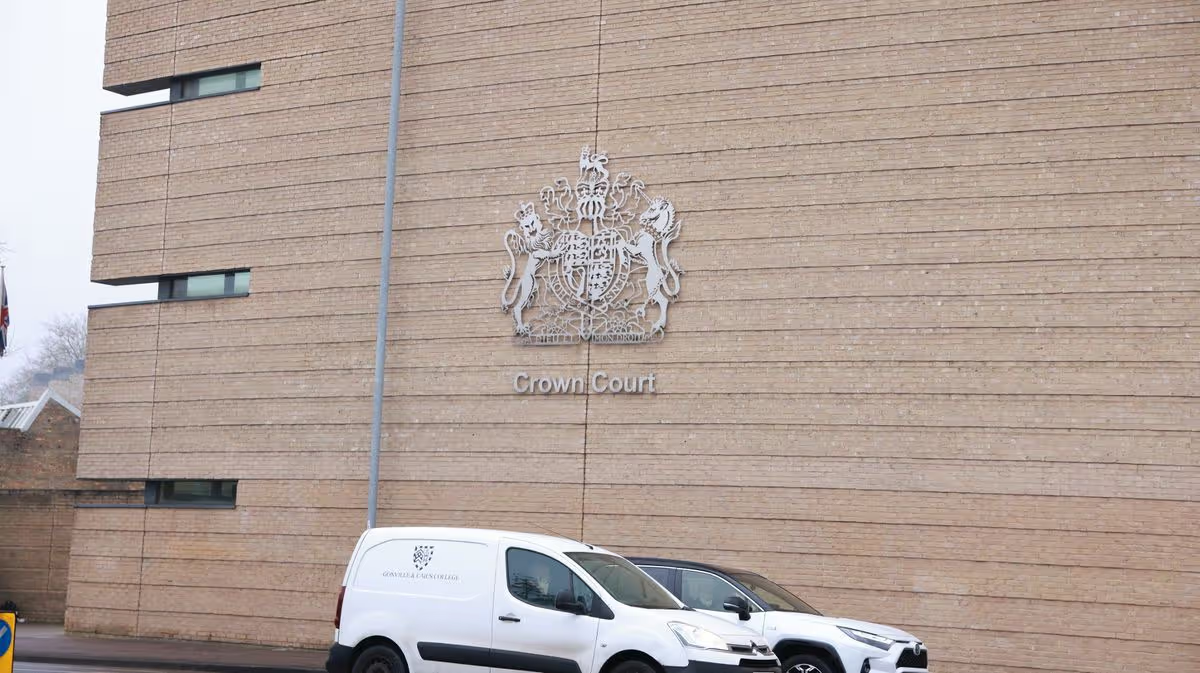
Jeffrey Donaldson, 63, has pleaded not guilty to 18 alleged offences.
The historical sexual offences trial of former DUP leader Sir Jeffrey Donaldson is “on track” to begin on May 26, a judge has said.
Advertisement
Judge Paul Ramsey told Newry Crown Court he is hopeful the process of swearing a jury in the case will begin on that date.
Proceedings against Donaldson and his wife Lady Eleanor Donaldson have been delayed twice due to medical issues related to her.
Jeffrey Donaldson, 63, has pleaded not guilty to 18 alleged offences.
The charges include one count of rape and allegations of indecent assault and gross indecency, and span a time period between 1985 and 2008, involving two alleged victims.
Eleanor Donaldson, 60, of Dublinhill Road, Dromore, is facing charges of aiding and abetting, which she denies.
Neither of the Donaldsons attended Tuesday’s hearing in Newry courthouse.
During the brief hearing, the judge said the court had received a report relating to Eleanor Donaldson which would require some legal argument.
Advertisement
The judge said: “We are on track to commence the case next Tuesday.”
Prosecuting barrister Rosemary Walsh KC said the timeline worked “as far as the prosecution is concerned”.
Defence barristers also indicated they hoped to be in a position to begin the case next week. The judge said he hoped to make a start on swearing the jury in on Tuesday.
Advertisement
Jeffrey Donaldson, a former long-standing MP for Lagan Valley, was arrested and charged at the end of March 2024.
He resigned as DUP leader and was suspended from the party after the allegations emerged. Weeks before his arrest, he had led the DUP back into Stormont after a two-year boycott of the powersharing institutions.
Hello and welcome to coverage from day two of Wimbledon where Katie Boulter represents Great Britain’s best chance of a presence in the second week after a dismal opening day.
Ten Britons were beaten on Monday, which is one of the worst set of results in recent history.
It could have been even worse but Jack Pinnington Jones was spared by bad light against Brandon Nakashima at two sets down and will have to finish his opener on Tuesday.
Advertisement
The tally of losses is the worst for the home nation since daily records began in 2000, while there is a possibility the record of 16 first-round defeats could be exceeded when the remaining players take to the court today.
Fran Jones, who became the final faller when she lost 6-4, 6-4 to France’s Diane Parry, said: “It will create bad headlines, probably slightly unfairly. I think, with some of the draws that people are handed, it was always going to be difficult.
“But no one can hide from the heaviness of Wimbledon. It’s important to everyone, and I’m sure it played a factor being at the home slam.”
The Lawn Tennis Association can justifiably point to the fact that the draws were particularly unkind this year, with only Cameron Norrie facing a player ranked lower than him.
Advertisement
The British No 1’s defeat by American Michael Zheng was undoubtedly the most disappointing of the day, although the qualifier played a terrific match to win in a fifth-set tie-break.
It was a sixth defeat in a row for last year’s quarter-finalist Norrie, who said: “If I could have had a few more matches leading in, I think I can win this match. There were so many small moments in the match that he did really well to go on his side.”
Harriet Dart was close to pulling off a sizeable upset against former French Open champion Jelena Ostapenko, eventually losing out 6-3, 3-6, 6-4.
Qualifier Oliver Tarvet, who lost in the second round to Carlos Alcaraz last year, also played at a high level in a four-hour battle against 25th seed Arthur Rinderknech but was unable to force a deciding set.
Advertisement
Britain’s teenage trio of Mimi Xu, Hannah Klugman and Mika Stojsavljevic were also among the losers after being handed very difficult draws.
Xu won her first senior set at Wimbledon against former quarter-finalist Daria Kasatkina but fell to a 6-2, 3-6, 6-2 defeat while Stojsavljevic was quickly beaten 6-2, 6-1 by last year’s semi-finalist Belinda Bencic.
Klugman, 17, took on 2024 champion Barbora Krejcikova and was left feeling encouraged after a close second set in a 6-1, 6-4 loss.
“I feel so motivated because it was 4-4, I had points to go 5-5,” said Klugman. “In the first set I think I had a break point in most of her service games. So it’s close.”
Advertisement
Elsewhere, wild card Felix Gill was beaten by rising Spanish star Rafael Jodar while fellow debutants Alicia Dudeney and Max Basing also lost.
When football commentators analyse a World Cup match, they tend to focus on tactics, technical ability, physical conditioning and psychology. If a team wins away from home, we hear about mentality. If a player scores a spectacular goal, we praise their vision or instinct. Yet there is another factor that receives remarkably little attention: the stadium itself.
The 2026 Fifa World Cup, hosted across the United States, Mexico and Canada, presents perhaps the greatest architectural experiment in the tournament’s history. Sixteen stadiums, spread across the three countries, are staging matches in environments that differ dramatically in size, scale, form, lighting conditions and spatial character.
Some are purpose-built football grounds. Others are enormous NFL arenas adapted for the world’s game. Several feature retractable roofs. Others remain open to the elements. Together, they create a fascinating question: can the architecture of a stadium influence player performance?
As an interior designer, I have spent several years researching the relationship between footballers, spatial awareness and stadium design. My research began with a simple observation: across football, teams consistently perform better at home than away.
Advertisement
Traditional explanations focus on crowd support, yet during the COVID pandemic, when matches were played behind closed doors, home advantage did not disappear. This suggests there may be more complex factors at work.
Playing the space
A player receiving a pass rarely begins processing information at the moment the ball arrives. Long before that pass is played, they have already built a mental picture of their surroundings. They understand where they are positioned in relation to the touchline, the penalty area, teammates and opponents. But they also orient themselves through a series of architectural cues embedded within the stadium itself.
These cues can be obvious or subtle. The angle of a stand. The location of a tunnel. The shape of a roof. The position of advertising. The colour surrounding the pitch. The direction of sunlight. The edge of a seating tier. Together, these become reference points that help players orient themselves and make decisions faster.
John Beck, Cambridge City manager in the early 1990s, would set up key markers in each of the four corners of the team’s home ground. The markers would be hoardings printed with the word “quality”. When full backs would receive a ball deep in their own half they would look up and were asked to hit the ball as hard as they could towards the quality signs. These were nicknamed “quality passes”. While quite a primitive tactic, it was effective for Beck; he guided the club to two successive promotions and to two successive quarter-final appearances in the FA Cup.
Advertisement
Mercedes-Benz Stadium in Atlanta, Georgia is one of the 16 venues for the 2026 World Cup. Kurtis Toliver/Shutterstock
At the 2026 World Cup, players have encountered some of the most distinctive football environments ever assembled for a single tournament. In Dallas, matches are taking place inside a stadium capable of holding more than 90,000 spectators. For many players, this will be the largest enclosed sporting environment they have ever experienced.
Suspended above the field are giant video screens so large they have become part of the stadium’s identity. Whether consciously or unconsciously, such dominant visual elements contribute to the player’s reading of space.
In Atlanta, a retractable roof and climate-controlled interior create conditions unlike those found in most traditional football grounds. The stadium’s vast pinwheel-esque roof structure and glass end wall produce a highly controlled environment where wind, temperature and external distractions are largely removed.
Mexico City’s Estadio Azteca provides a very different experience. It is one of football’s great cathedrals, steeped in memory and history. Generations of players have competed there, from Pelé in 1970 to Maradona in 1986. Unlike many newer venues, the Azteca was designed specifically for football, creating a spatial relationship between players and spectators that feels fundamentally different from many multipurpose grounds.
Meanwhile, venues such as Vancouver’s BC Place, with its retractable cable-supported roof, or Seattle’s Lumen Field, with its dramatic open end framing the city skyline, create visual identities that players must quickly learn to navigate and interpret.
Estadio Azteca in Mexico City is one of football’s great cathedrals. Macbeth_GP/Shutterstock
From a football perspective, the challenge is adaptation. The German footballer Thomas Müller once described himself as an “interpreter of space”, a phrase that captures something important about elite performance. Great footballers appear to slow down time. They often know what they are going to do before the ball reaches them. This ability is developed through experience and familiarity.
The more often players operate within a particular environment, the more effectively they build what psychologists call cognitive maps. Over time, the surroundings become familiar and require less conscious processing. This familiarity creates fractions of a second of additional thinking time. At the elite level, those fractions can make the difference between scoring and missing, winning and losing.
The challenge of a World Cup is that players rarely have this luxury. Teams move rapidly between venues. Conditions change from match to match. Architectural cues that were familiar in one stadium disappear in the next. Players must repeatedly rebuild their understanding of space and place. This is why preparation becomes so important.
Advertisement
For decades, coaches have analysed opposition tactics in meticulous detail. Yet comparatively little attention has been paid to preparing players for the architectural characteristics of the stadium itself. Understanding sightlines, lighting conditions, pitch orientation, roof structures and spatial landmarks could offer marginal gains that become decisive in elite competition.
From a design perspective, this raises an equally interesting question. Modern stadiums are increasingly designed around fan experience, hospitality and commercial revenue. Yet the primary performers within these spaces remain the players themselves. If architecture can influence orientation, perception and decision-making, should stadium design place greater emphasis on players? Perhaps this will be the next frontier in sporting performance.
He was allegedly involved in setting fire to the Glider and a property at McMaster Street.
A man was remanded into custody today, charged with attempted murder during racial rioting on the streets of Belfast.
Advertisement
Christopher McLaughlin, 29, is also accused of arson attacks on a Glider bus and a house in the east of the city earlier this month.
Violent disorder erupted on June 9 in the aftermath of a serious knife attack allegedly carried out by a Sudanese asylum seeker.
A series of protests developed into unrest breaking out across Belfast and other parts of Northern Ireland, with vehicles torched and some families forced to flee their homes.
McLaughlin, of Devon Drive in the city, appeared at the city’s Magistrates Court on charges of riotous assembly and two counts of arson endangering life with intent.
Advertisement
He was allegedly involved in setting fire to the Glider and a property at McMaster Street.
McLaughlin is further charged with the attempted murder of a man as part of the same series of incidents.
All of the alleged offences were committed on June 9.
A PSNI detective involved in the investigation said she could connect the accused to all four charges.
Advertisement
No further details about the circumstances were disclosed during the brief hearing, and McLaughlin did not seek bail.
A defence solicitor told the court he has no suitable address at this stage.
District Judge Natasha Fitzsimons remanded McLaughlin custody until July 28.
It is a first-ever meeting between the two nations, with either co-hosts Mexico or Ecuador lying in wait in the last 16 at Mexico City’s Estadio Azteca on Sunday night.
They will likely face a tricky test from DR Congo, who are through to the World Cup knockouts for the first time on only their second finals outing and first since they previously appeared as Zaire in West Germany in 1974, where they went winless and lost 9-0 to Yugoslavia.
Sebastien Desabre’s side proved their quality by holding Portugal to an opening 1-1 draw in a tough-looking Group K – sealing a maiden World Cup point – and were only narrowly edged out by group winners Colombia 1-0 following a 3-1 come-from-behind victory against debutants Uzbekistan.
Date, kick-off time and venue
Advertisement
England vs DR Congo is scheduled for a 5pm BST kick-off on Wednesday July 1, 2026.
The match will take place at Atlanta Stadium (Mercedez-Benz Stadium) in Atlanta, Georgia, USA.
Where to watch England vs DR Congo for FREE
TV channel: In the UK, the game will be televised live and free-to-air on BBC One, with coverage starting at 4pm.
Advertisement
Live stream: UK viewers can also catch the contest live online via the BBC iPlayer and BBC Sport website.
Live blog: You can follow all the action on matchday via Standard Sport’s live blog, featuring expert analysis from England correspondent Dom Smith at the ground.
Free highlights: World Cup highlights are available on FIFA’s official YouTube channel, along with the BBC iPlayer and ITVX app.
England vs DR Congo team news
Advertisement
Rice – who has also been managing nerve pain in his hamstring for several months – was also the only England player who would have been suspended, had he picked up a second yellow card of the tournament in the final game in Group L.
First-choice right-back Reece James also looks set to miss out again with his latest hamstring injury, while Tino Livramento flew home before the tournament started after sustaining a calf problem in training that has since required surgery and was replaced by a centre-back in Trevoh Chalobah.
Tuchel faces a key dilemma over who to field at right-back against DR Congo, with Djed Spence the only natural candidate.
Tuchel made five changes in total for the win over Panama, with Quansah, Nico O’Reilly, Morgan Rogers, Marcus Rashford and Bukayo Saka replacing James, Spence, Rice, Anthony Gordon and Noni Madueke.

Advertisement
Rice’s return will see Jude Bellingham pushed back forward to No10, with Rogers set to make way as the manager considers his best wing pairing to support captain Harry Kane.
Return: Declan Rice will be back in England’s midfield to face DR Congo in the World Cup round of 32
Getty
Goalkeepers: Jordan Pickford, Dean Henderson, James Trafford
Advertisement
Defenders: Reece James, Trevoh Chalobah, Marc Guehi, Ezri Konsa, John Stones, Jarell Quansah, Nico O’Reilly, Dan Burn, Djed Spence
Midfielders: Declan Rice, Elliot Anderson, Jude Bellingham, Jordan Henderson, Morgan Rogers, Kobbie Mainoo, Eberechi Eze
Forwards: Harry Kane, Ivan Toney, Ollie Watkins, Bukayo Saka, Noni Madueke, Marcus Rashford, Anthony Gordon
DR Congo are not believed to be dealing with any new injury concerns ahead of their first knockout match at the World Cup.

Advertisement
Newcastle forward Yoane Wissa is their star man and the Leopards’ squad features a number of other Premier League players past and present, including West Ham right-back Aaron Wan-Bissaka, Sunderland pair Noah Sadiki and Arthur Masuaku, Burnley defender Axel Tuanzebe, ex-Newcastle man Chancel Mbemba, Watford’s Edo Kayembe and former Chelsea winger Gael Kakuta.
Kilmarnock midfielder Aaron Tshibola – who replaced the injured Rocky Bushiri – is formerly of Reading and Aston Villa, while Real Betis striker Cedric Bakambu, now 35, needs just one more goal to equal the all-time national record.
Influential: Newcastle forward Yoane Wissa is the key threat for DR Congo
Defenders: Dylan Batubinsika, Gedeon Kalulu, Steve Kapuadi, Joris Kayembe, Arthur Masuaku, Chancel Mbemba, Axel Tuanzebe, Aaron Wan-Bissaka
Midfielders: Theo Bongonda, Brian Cipenga, Gael Kakuta, Edo Kayembe, Nathanael Mbuku, Samuel Moutoussamy, Ngal’ayel Mukau, Charles Pickel, Noah Sadiki, Aaron Tshibola
The Panama game was a difficult one to assess for England, with opinions largely divided on the performance until quick-fire second-half goals from Bellingham and Kane eased any lingering nerves.
While it was improved on a really sluggish and toothless display against Ghana, the Three Lions remained some way off their scintillating second half against Croatia.
Any win will do seems to be the mantra from Tuchel, whose side are likely to face another uncomfortable, nervy test in the round of 32 in Atlanta.
DR Congo had a long road to only their second World Cup as they toppled both Nigeria and Jamaica in tense play-off ties, but showed no signs of tiredness during an impressive showing in a difficult group as they frustrated Cristiano Ronaldo and Portugal, and pushed Colombia hard.
Advertisement
Expect them to make life very difficult indeed for England here, though for the favourites to narrowly prevail in the end – hopefully without the need for extra time or dreaded penalties.
Head to head (h2h) history and results
These two nations have never met previously in a senior men’s international.
England vs DR Congo match odds
Advertisement
We aim to offer every online gambler and reader of The Standard a safe and fair platform through unbiased reviews and offers from the UK’s best online gambling companies.
Gambling can be addictive, always play responsibly and only bet what you can afford to lose. Gambling sites have a number of tools to assist you to stay in control, including deposit limits and time outs. If you think you have a problem, advice and support is available for you now from BeGambleAware or Gamcare.
Any offers or odds listed in this article are correct at the time of publication but are subject to change. Terms & Conditions apply to all offers.
The Cambridgeshire shopping centre announced the news at the end of June
A Cambridgeshire shopping centre is welcoming a new brand this summer. In recent months, Peterborough’s Queensgate Shopping Centre has welcomed a number of new shops and restaurants.
Advertisement
This includes Seoul Plaza, the UK’s leading Korean food retailer as well as coffee shop Jamaica Blue. On its social media, Queensgate announced it will be welcoming Charlotte Tilbury to its Boots store.
According to Boots, from July 3, the brand will open in 31 stores across the nation. Stores will stock the luxury beauty brand – from its iconic Magic Cream to its Airbrush Flawless Finish.
Announcing the upcoming opening, a spokesperson for Queensgate Shopping Centre said: “You asked for it.. and it’s finally happening. Charlotte Tilbury is coming to Boots at Queensgate VERY soon. Stay tuned for all the glam updates – you won’t want to miss this one.”
Reacting to the announcement, people commented that this was “fantastic news” and that they are “so excited”. Another commented: “OMG best news I’ve heard all year.”
Advertisement
Other stores to stock the highly-popular brand include Bury St Edmunds, Stockton-on-Tees and Lincoln. Queensgate shopping centre houses more than 90 shops, 15 places to eat and thousands of brands.
The 53-year-old was arrested in Middlesbrough on Monday (June 29) after a Vauxhall Astra was stopped on Marshall Avenue in Brambles Farm, around 3.45pm.
Anthony Siviter, of Rainsford Crescent in Middlesbrough, was arrested on suspicion of possession with intent to supply class A drugs, driving while disqualified and using a motor vehicle without insurance.
Suspected crack cocaine and cash were recovered from the car, and police said further suspected class A drugs were found during a search in custody.
Advertisement
Siviter was charged with driving while disqualified and without insurance, and is due to appear at Teesside Magistrates’ Court in July.
He remains on police bail in relation to the drugs offences. The Astra was seized by police.
A yellow rain warning has been issued for parts of central Scotland from 2pm until 9pm on Tuesday, which could lead to temporary flooding, while a yellow thunderstorm warning for large parts of Northern Ireland is in place from midday until 6pm, where hail, thunderstorms and flooding is forecast, the Met Office said.
He was taken to hospital by ambulance crews and remains there fighting for his life in a critical condition today (June 30).
Durham Police has now confirmed that two people have been arrested in connection with the incident and remain in custody this afternoon.
Advertisement
A brief statement said: “Two people have been arrested in connection with the incident and remain in custody this afternoon.
“The victim remains in a critical condition in hospital.”
Ambulance crews were called to the incident just after 1pm on Saturday.
A Great North Air Ambulance Service (GNAAS) spokesperson previously said: “Our critical care team was activated at 1.17pm to reports of an assault in Murton.
Advertisement
“We had a paramedic and doctor on board our aircraft and they arrived on scene at 1.28pm.
“Our team worked alongside the North East Ambulance Service (NEAS) to assess and treat a patient.
“The patient was taken to hospital by a NEAS road crew, accompanied by our team.”
Anyone who has any information that could help should call police on 101, quoting crime reference number CRI00690607, or contact the force online.
Advertisement
Information can also be submitted anonymously to Crimestoppers on 0800 555 111, or online.
Cross border trains have been affected after a number of cows blocked the West Coast Main Line in Staffordshire.
Thousands of train passengers are suffering disruption after a herd of cows wandered onto one of the UK’s busiest railway lines.
Advertisement
Information on National Rail Enquiries shows the West Coast Main Line has been blocked in Staffordshire between Lichfield Trent Valley and Rugeley Trent Valley for more than three hours.
This is causing delays and cancellations for Avanti West Coast and Lumo services between London Euston and Scotland, as well as London Northwestern Railway and West Midlands Railway services.
The Press Association understands there were difficulties contacting the farmer responsible for the animals.
The incident was reported at 8.57am and passengers are being warned to expect disruption until 4pm.
Advertisement
Tickets are being accepted on certain alternative routes.
Get more Daily Record exclusives by signing up for free to Google’s preferred sources. Click HERE.
You must be logged in to post a comment Login