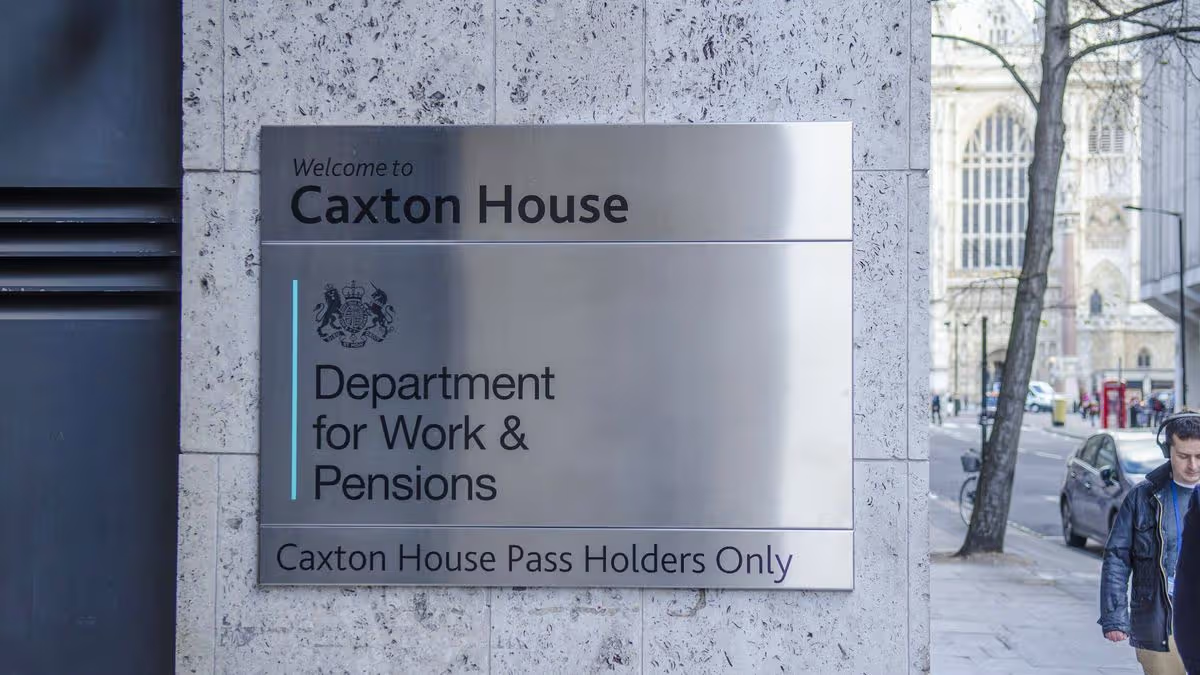
The DWP has confirmed details of the Winter Fuel Payment for 2026-27, including eligibility criteria for the £100-£300 heating benefit and which state pensioners won’t receive it
Alex Evans Deputy Audience Editor
21:00, 13 Apr 2026
The DWP has confirmed five categories of state pensioners who will be ineligible for a Winter Fuel Payment in 2026. It comes after it released details about the £200 to £300 heating benefit available to pensioners next winter.
The Department for Work and Pensions has outlined who qualifies for the payment this year, covering the period from winter 2026 to 2027, including the amount to be paid. It also outlined the five groups of state pensioners who cannot receive it, even if their earnings fall below the £35,000 threshold.
Advertisement
The Winter Fuel Payment has undergone numerous modifications in recent years, shifting from a universal entitlement for all to a heavily restricted Pension Credit-linked benefit. It then returned to a largely universal payment with certain conditions, following policy amendments and resistance from pensioners.
The Winter Fuel Payment scheme for winter 2025-26 has now concluded, with final payments having been issued to pensioners by the end of January. This coming winter, the next payment cycle will commence in October 2026. The DWP has confirmed eligibility criteria and payment amounts, reports the Express.
It said: “If you were born before 28 June, 1960 you could get between £100 and £300 to help you pay your heating bills for winter 2026 to 2027. This is known as a ‘Winter Fuel Payment’. You can get a Winter Fuel Payment if you were born on or before 27 June, 1960 and live in England or Wales.” Those who qualify will receive a letter in October or November outlining the payment amount they can expect.
It added: “The amount you get is based on when you were born and your circumstances between 21 to 27 September, 2026. This is called the ‘qualifying week’. Any money you get will not affect your other benefits.”
Advertisement
However, it stated that the following five groups will not qualify:
You live outside England and Wales
You were in hospital getting free treatment for the whole of the week of 21 to 27 September, 2026 and the year before that
You need permission to enter the UK and your granted leave says that you cannot claim public funds
You were in prison for the whole of the week of 21 to 27 September, 2026
You get Universal Credit, Pension Credit, Income Support, income-based Jobseeker’s Allowance (JSA) or income-related Employment and Support Allowance (ESA) and you lived in a care home for the whole time from 23 June 2025 or earlier.
There is one additional caveat: if your annual income exceeds £35,000, including from the state pension itself, you will be ineligible to retain it and must return the funds to HMRC through taxation.
The DWP adds: “If your income is over £35,000. HMRC will take your Winter Fuel Payment back by either: changing your tax code; adding the amount to your Self Assessment tax return.”

Barcelona were knocked out of the Champions League by Atletico Madrid on Tuesday 3-2 on aggregate, with Marcus Rashford feeling the sting of European football away from Manchester United
Raphinha has claimed that Barcelona were “robbed” as his club were knocked out of the Champions League – a match that Marcus Rashford was widely expected to start in but was given just 20 minutes. The Catalan giants faced Atletico Madrid at the Riyadh Air Metropolitano on Tuesday evening in a second leg quarter-final clash.
Advertisement
Hansi Flick’s side understood the monumental task at hand. given they headed into the 8pm kick-off with a 2-0 deficit to overcome thanks to Julian Alvarez and Alexander Sorloth raining on their parade last week at the Camp Nou.
However, Barca were ultimately unable to conquer their La Liga rivals on the road, leaving the Spanish capital 2-1 up on the night – but 3-2 down on aggregate. Lamine Yamal took very little time to offer his team a glimmer of hope by netting withing four minutes, before Ferran Torres diminished Atleti’s 2-0 aggregate lead completely 20 minutes later.
Get MEN Premium now for just £1 HERE – or get involved in our United WhatsApp group by clicking HERE. You can also join our United Facebook page by clicking HERE and don’t miss out on our brilliant selection of newsletters HERE.
It took Ademola Lookman a matter of moments to ensure that Atletico ultimately advanced to the semi-finals of Europe’s premier footballing competition, however, with a goalless second half seeing Barcelona sent packing.
Advertisement
However, Raphinha had some strong words for referee Clément Turpin in the aftermath. He told TNT Sports Brasil: “For me, we were robbed.
“I don’t want to talk about the refereeing, but we played extremely well, they committed I don’t know how many fouls, and the referee didn’t even pull out a single yellow card against them. The refereeing was very bad in all the decisions he made.
“What I really want to understand is, by what criteria is Barca being refereed? I’d really like to understand the secret behind this fear that haunts these people at the thought of Barca winning.
Get MEN Premium now for just £1 HERE – or get involved in our United WhatsApp group by clicking HERE. You can also join our United Facebook page by clicking HERE and don’t miss out on our brilliant selection of newsletters HERE.
Advertisement
“Yes, we’re all human and we can make a mistake in a match, that’s something I can understand, but for it to happen in two consecutive matches? That’s not normal. I think the result of this double confrontation isn’t fair.”
Elsewhere, Manchester United loanee Rashford suffered a double heartbreak in the fixture. Not only were Barcelona ousted from the Champions League in what has otherwise been a largely successful spell for the 28-year-old, but he also didn’t have the full 90 minutes to make a difference.
That’s despite Spanish media touting Rashford to start the match. The Englishman was afforded just over 20 minutes to make a difference as he entered the field as a late substitute for Fermin Lopez.
However, he was ultimately unable to make much of an impact as Barcelona crashed out of the Champions League. It comes as Rashford’s future in sunny Spain is currently up in the air.
While Barcelona have an option to make his move permanent come season’s end to the tune of around £26million, it looks as though they are set to use limited funds to recruit Alessandro Bastoni from Inter Milan to strengthen their defence.
But with Robert Lewandowski potentially leaving the club this summer, the board could opt to keep Rashford as a replacement for their talisman – given he can also operate through the middle as well as on his favoured left flank.
TOKYO (AP) — Asian shares mostly rose in Wednesday trading, echoing the rally on Wall Street that came as oil prices eased on hopes the United States and Iran may try again on talks to end their war.
Japan’s Nikkei 225 gained 0.4% in afternoon trading to 58,122.52. Australia’s S&P/ASX 200 was little changed, inching up less than 0.1% to 8,978.70. South Korea’s Kospi jumped 2.1% to 6,092.77. Hong Kong’s Hang Seng edged up 0.4% to 25,980.69, while the Shanghai Composite declined less than 0.1% to 4,023.40.
On Wall Street, the S&P 500 added 1.2% to its leap from the day before, and the index at the heart of many 401(k) accounts is just 0.2% below its record set in January.
The Dow Jones Industrial Average rose 317 points, or 0.7%, and the Nasdaq composite climbed 2%.
Advertisement
On Wednesday, benchmark U.S. crude fell 58 cents to $90.70 a barrel. Brent crude added 7 cents to $94.86, or less than 1% after falling 4.6% the day before. While that’s still above its roughly $70 price from before the war began in late February, it’s well below the peak level of $119.
Lower oil prices help bring down costs for all kinds of businesses. But some analysts noted the war was still ongoing, warning that the optimism may be unfortunately unfounded.
“The counterintuitive decline in crude appears driven by growing hopes that a second round of peace talks between Washington and Tehran could soon materialize, after the first attempt fizzled out. Traders are clearly choosing to price in the possibility of de-escalation rather than the immediate reality of restricted flows,” said Tim Waterer, chief market analyst at KCM Trade.
Asian nations depends on access to the Strait of Hormuz, a narrow waterway that’s the main avenue for crude oil produced in the Persian Gulf area to reach customers worldwide. Blockages there have kept oil off the global market, which has in turn driven up its price.
Advertisement
Global inflation this year looks set to accelerate to 4.4% from 4.1% in 2025, according to the International Monetary Fund, which had earlier thought inflation would slow to 3.8%. The IMF on Tuesday also downgraded its forecast for global economic growth to 3.1% this year from the 3.3% it had forecast in January.
All told, the S&P 500 rose 81.14 points to 6,967.38. The Dow Jones Industrial Average gained 317.74 to 48,535.99, and the Nasdaq composite climbed 455.35 to 23,639.08.
In the bond market, Treasury yields eased as the fall for oil prices took some of the pressure off inflation. The yield on the 10-year Treasury fell to 4.25% from 4.30% late Monday.
In currency trading, the U.S. dollar edged up to 158.95 Japanese yen from 158.79 yen. The euro cost $1.1790, down from $1.1797.
Advertisement
___
AP Business Writer Stan Choe in New York contributed to this report.
The Brandon Street site is on the market with a guide price of £72,000 and is set to go under the hammer at an online auction on April 29.
A Motherwell town centre property is up for sale with potential to convert into flats.
Advertisement
The Brandon Street site is on the market with a guide price of £72,000 and is set to go under the hammer at an online auction on April 29.
The property is being managed by Town & Country Property Auctions, based in Chester and is being shown on property website, Rightmove.
Writing on the website, Town & Country Property Auctions state: “There is strong potential for conversion into four 2-bedroom flats and one 1-bedroom flat, with layout feasibility supported by architectural input, giving confidence in the development opportunity (subject to planning).
“Alternatively, the property may suit residential units or continued use as office suites.
Advertisement
“From an income perspective, four 2-bedroom flats are estimated to achieve £750 per month each, with the 1-bedroom flat achieving £600 per month, generating a total of £3,600 per calendar month (£43,200 per annum).
“For serviced accommodation, each unit is projected to generate approximately £24,000 per annum based on a £98 average daily rate and 68% occupancy, equating to a total potential income in excess of £120,000 per annum across five units.
“The asset is well suited to a range of strategies including flat conversion, HMO, or commercial use (subject to planning).
Advertisement
“Located on Brandon Street, the property is within walking distance of the high street, supermarkets, schools, and colleges, with excellent transport links via the M74 and M8.
“Motherwell is currently benefiting from approximately £19 million of investment focused on town centre regeneration, new housing delivery, infrastructure improvements, and public realm upgrades across areas including Forgewood and North Motherwell, all of which are driving increased demand and long-term growth.
“A low entry price with significant upside makes this an ideal opportunity for investors and developers seeking strong returns.”
British Airways is making permanent changes to its network, announcing the cancellation of all flights from London Heathrow to Jeddah, Saudi Arabia, from 24 April. Having suspended most Middle East services shortly after the conflict began, British Airways will resume flights to Dubai, Doha, and Tel Aviv in the second half of the year, though at a much-reduced scale.
While airspace in the region is starting to reopen, with Bahrain’s Gulf Air set to resume London flights, BA’s decision marks a strategic pivot away from the Middle East.
Adding to the strain, jet fuel prices have soared since the conflict’s onset, intensifying pressure on carriers already rerouting to bypass the volatile region.
Advertisement
Below is the latest on which airlines have cancelled flights to the region, in alphabetical order:
Aegean Airlines
Greece’s largest carrier cancelled flights to Riyadh and Amman until June 27 and to Tel Aviv and Beirut until June 26. It cancelled flights to Erbil and Baghdad until July 2 and to Dubai until June 29.
airBaltic
Advertisement
Latvia’s airBaltic says all flights to Tel Aviv have been cancelled until May 31. All flights to Dubai are cancelled until October 24.
Air Canada
The Canadian carrier has cancelled all flights to Tel Aviv and Dubai until September 7.
A display in the arrivals terminal of the Henri Coanda International Airport shows cancelled flights originating in Middle East countries (Copyright 2026 The Associated Press. All rights reserved.)
Air Europa
The Spanish airline has cancelled all flights to Tel Aviv until May 3.
Advertisement
Air France
Air France has suspended its Tel Aviv, Beirut, Dubai and Riyadh flights until May 3.
It plans to reduce services to Dubai, Doha and Tel Aviv to one daily flight from July 1, and to cut Riyadh services from two daily flights to one from mid-May. Changes apply through the summer season that ends on October 24, with one Dubai service restarting on October 16.
Cathay Pacific
The Hong Kong airline has cancelled all passenger flights to Dubai and Riyadh until June 30. To cater for a surge in demand to Europe, it will operate extra passenger flights to London, Paris and Zurich in April.
Delta
Advertisement
The U.S. carrier has cancelled its New York-Tel Aviv flights and delayed the restart of its Atlanta-Tel Aviv route until September 5. It said the launch of its Boston-Tel Aviv route, planned for late October, has been delayed until further notice.
EL AL Israel Airlines
The Israeli carrier said customers who planned to depart Israel through April 18 had their flights cancelled, including relevant return flights. It will increase the number of destinations to about 30 from April 13 and will gradually expand that number through the rest of the month.
Emirates
Advertisement
The UAE carrier has said it is operating a commercial flight schedule between Dubai and around 110 destinations.
Ethiad Airways
The UAE carrier said it had resumed a limited commercial flight schedule between Abu Dhabi and around 80 destinations.
Finnair
Advertisement
The Finnish carrier has cancelled its Doha flights until July 2, while continuing to avoid the airspace of Iraq, Iran, Syria and Israel. The airline only restarts its Dubai flights in October.
Flynas
The Saudi budget airline has suspended flights to Dubai, Abu Dhabi, Sharjah, Doha, Bahrain, Kuwait, Iraq and Syria until April 15.
Iberia Express
Advertisement
IAG’s low-cost airline, Iberia Express, has cancelled all flights to and from Tel Aviv through May 31.
Indigo
The Indian airline suspended operations to Doha, Kuwait, Bahrain, Dammam, Fujairah, Ras Al Khaimah and Sharjah until March 28.
ITA Airways
Advertisement
ITA Airways has suspended flights to Tel Aviv until April 2 and extended Dubai cancellations until March 29, continuing to avoid the airspace of Iraq, Iran, Syria and Israel.
Japan Airlines
Japan Airlines has suspended scheduled Tokyo-Doha flights until May 10 and Doha-Tokyo flights until May 11. The airline also announced extra flights between Tokyo and London on April 25.
KLM
Advertisement
KLM has suspended flights to Tel Aviv, Riyadh, Dammam and Dubai until May 17.
LOT
The Polish airline has suspended all its flights to Tel Aviv until May 31. It has also cancelled flights to Riyadh until June 30 and to Beirut from March 31 to May 30.
The airline plans to operate its winter route to Dubai in October.
Advertisement
Lufthansa Group
Lufthansa, Swiss, Austrian Airlines, Brussels Airlines, ITA Airways and Edelweiss suspended flights to Dubai and Tel Aviv until May 31, and to Abu Dhabi, Amman, Beirut, Dammam, Riyadh, Erbil, Muscat and Tehran until October 24.
Lufthansa Cargo is the same, except for the Tel Aviv suspension, which will last through April 30.
Low-cost carrier Eurowings plans to suspend flights to Tel Aviv, Beirut and Erbil through April 30 and to Dubai, Abu Dhabi and Amman through October 24.
Advertisement
Passengers wait amid flight disruptions as a result of the Israeli-US strikes on Iran, at Ngurah Rai International Airport on Indonesia’s resort island of Bali. (AFP/Getty)
Malaysia Airlines
The Malaysian carrier has suspended all flights to Doha until June 14.
Norwegian Air
The low-cost airline has pushed back planned launches of its Tel Aviv and Beirut services to June 15.
Pegasus
Advertisement
Turkey’s Pegasus Airlines cancelled its Iran, Iraq, Amman, Beirut, Kuwait, Bahrain, Doha, Dammam, Riyadh, Dubai, Abu Dhabi and Sharjah flights until May 1.
Qantas
Australia’s flag carrier is adding flights to Rome and Paris to meet an upswing in demand for European routes.
Flights to Paris will increase to five return flights per week from three and the Perth-Singapore service will increase from daily to 10 flights per week.
Advertisement
An updated schedule will come into effect progressively for flights from mid-April and run until late July.
Qatar Airways
The carrier said it is gradually increasing flights from Doha to more than 120 destinations by mid-May.
Royal Air Maroc
Advertisement
The Moroccan carrier says flights to Doha are cancelled until June 30 and those to Dubai until May 31.
Singapore Airlines
The carrier extended its Singapore-Dubai flights suspension until May 31, while adding services on the Singapore-London Gatwick and Singapore-Melbourne routes from late March until October 24 to meet higher demand.
Turkish Airlines
Advertisement
SunExpress, Turkish Airlines’ joint venture with Lufthansa, has cancelled flights to Dubai until April 30.
Wizz Air
The low-cost airline suspended flights to Israel until April 13, and to Dubai, Abu Dhabi and Amman from mainland European destinations until mid-September. All flights to Medina have been suspended indefinitely.
AO.com experts have warned that Brits’ bad laundry habits are not only affecting how clothes look and feel, but also shortening their lifespan – meaning they could end up paying as much as £275 a year replacing their favourite items.
The Bolton-based online electrics online retailer, which has its own laundry advice hub, conducted a survey of 3,000 Brits, which revealed that many still use outdated laundry habits – and are washing their favourite items more than they need to.
Jeans were revealed as the most overwashed item, with 8 in 10 Brits (79%) saying they wash their jeans too often, despite guidance suggesting jeans can be worn up to 10 times before needing a wash.
Hoodies were also identified as an overwashed item, with two thirds of Brits (65%) admitting they wash this beloved staple more often than the recommended 7 wears, and half of Brits (51%) are washing jumpers more frequently than needed.
Advertisement
However, whilst Brits have an over-washing tendency in general that is damaging their favourite items, the survey also revealed some interesting guilty habits.
A third of Brits (35%) admit to rewearing socks, despite guidance stating these should be washed after one wear, and a quarter of Brits admit they wear underwear items like briefs and knickers more than once.
The top five clothing items Brits are washing wrong – and cost them over £275 a year to replace:
Jeans – 79% of Brits are washing them too often, despite being wearable up to 10 times before needing a wash. With jeans costing £40–£80+ on average, this is one of the most costly items to replace if damaged in the wash.
Hoodies – 65% of people are washing them too often, even though they can usually be worn 6-7 times unless visibly dirty. Hoodie prices typically range from £30-80, so it’s important not to overwash this item.
Jumpers – Half of Brits (51%) wash them too frequently, despite getting around five wears out of them when layered over other clothing. Overwashing your favourite jumpers and knits could cost you from £25-75 to replace based on highstreet prices.
Socks – 35% of Brits admit to wearing them more than once, even though guidance suggests they should be washed after every use. Whilst socks are on the cheaper end of wardrobe staples, a new multipack could cost £5-15 to replace damaged items.
Underwear – A quarter (24%) of Brits say they wear their briefs and knickers more than once, despite guidance suggesting these should be changed daily. Multipacks for underwear can range from £10-30, meaning this staple can easily wrack up costs if it’s damaged during the wash.
Gwil Snook,Washing Machine Expert atAO.com, says that laundry behaviours are often based on assumptions rather than expert guidance.
“People tend to stick to the routines they’re used to, but a lot of the time those habits don’t match how clothes are designed to be cared for, or how washing machines are designed to help you get the most out of your clothes,” Gwil explains.
Advertisement
“Jeans are one of the most commonly overwashed items, as people think that washing them regularly will help the denim to stay structured. In reality, they don’t need frequent washing, and wearing them multiple times actually helps preserve their shape and colour.”
“Jumpers are really easy to overwash, as people often think they’re the same as t-shirts and should be washed after 1-2 wears. But actually, if you’ve got a layer on underneath, then they can be worn for up to 5 wears. That makes a big difference in keeping them in good condition.”

“The same goes for hoodies: unless a hoodie is stained or starting to smell, it doesn’t need to go straight in the wash. Washing it too often just puts unnecessary stress on the fabric.”
“Socks are different, they should always be washed after one wear. They’re in constant contact with sweat, so rewearing them isn’t recommended from a hygiene point of view.”

Advertisement
Gwiladded that incorrect laundry habits can also affect washing machines, stating: “Washing machines work by gently aggravating the fabric of your clothes, and different settings do this at different levels. So washing items more than you need to, or even worse on the wrong settings, can easily reduce the lifespan of clothing by weakening fibres and fading colours. Underwashing on the other hand can create hygiene issues, so it’s really important to get the balance right to help both your clothes and your machine to last longer and avoid unnecessary washing.
(Image: Tom Molloy)
“Running unnecessary cycles or using the wrong settings can lead to a build-up of detergent and residue inside the machine.
“Over time, that can create conditions where bacteria and mould develop.”
He advises checking care labels, avoiding unnecessary washes and using appropriate settings for different fabrics.
The Coronation Street legend shared an update as she awaits news following her early-stage breast cancer diagnosis
Beverley Callard has been flooded with messages of support as she shared a tearful update on her cancer diagnosis. The actress first announced in January that she had been diagnosed with early-stage breast cancer.
Advertisement
She told how the news came just 20 minutes before she filmed her first scenes on Irish soap, Fair City, where she now plays Lily Patterson, having relocated to Ireland for the role.
But Beverley, who is famed for playing Liz McDonald in Coronation Street, recently revealed she was thrilled to learn that she does not need a second operation after she had two lymph nodes removed as a precaution to ensure the cancer does not spread, but she is waiting results which will indicate whether she is cancer-free or not.
Click here to sign up for more Coronation Street updates in our newsletter
However, Beverley, who is currently on-screens having returned to I’m A Celebrity… Get Me Out of Here for its South Africa spin-off, shared at the beginning of April that she’d suffered a setback, explaining that there was a “backlog” in the system delaying her results.
Advertisement
Now, the soap star has taken to Instagram to update her followers once again on the situation, with her captioning the update: ” “Had a bit of a weird update and not sure how to feel about it…trying to be brave and strong.”
Speaking to the camera, Beverley said: “Oh well, I’ve been painting all day again and I’ve nearly finished it, which is amazing. God, I’ve put some hours in that room, but I really want it finished for when Jon gets back. As you know, I’m waiting for my results, which has made me paint for England, well, for Ireland!
“Anyway, I got a text just a couple of hours ago. It says that my consultant is away at the moment, but there is someone else who I have seen before, another consultant, who wants to discuss my results on Thursday at 12 o’clock, so I’ve got a consultation then. I don’t know what that means. So I’m sort of like, ‘Okay… I just thought that the nurse was going to ring.’
Advertisement
“I spoke to one of the cancer nurses last week, she was great, and she said they would ring me as soon as they know anything. So I’m thinking, ‘Well, why have they not rung me then?’ Or am I mistaken? I don’t know but I will know more on Thursday at 12 o’clock so I will be glad when Jon is home.”
Appearing tearful, she added: ” I wasn’t going to tell him but [my daughter] Rebecca said to tell him, so I have just told him. There we are. I just wondered if this has happened to anyone else. Lots of love everyone – I’m being strong.”
And she was soon flooded with messages of support. @kate290669 said: “Sending loads of love- the wait is awful but you are tackling it in the best way – staying busy & talking . I’ve said it before but you’re such an inspiration Bev – on screen in I’m a Celeb & on here . Sending the biggest hug.”
@melissaknight90 commented: “We are all rooting for you. Sending positive vibes your waymrbenbryantactor wrote: “Be strong, stay strong. These times will pass and better ones are ahead!” @mauralyons13 replied: “Try not to overthink things Beverley. You are strong. Thoughts and prayers are with you.” @susparkes added: “Stay strong girl you got this.”
The comments by US treasury secretary Scott Bessent put him at odds with the chancellor, who has gone public with her anger and frustration at the “folly” of America’s actions in the Middle East and its financial fallout on families.
The pair were due to hold face-to-face talks in Washington DC on Wednesday during the spring meetings of the International Monetary Fund (IMF), which will be dominated by the ongoing crisis in the Gulf, which has inflicted a global economic shock and sent energy prices soaring.
Families are bearing the cost of the conflict in the Middle East, said the chancellor (PA)
Prior to the chancellor heading stateside, the influential financial body slashed Britain’s economic growth forecast as a result of the conflict and warned a worldwide recession could be a “close call” in a severe scenario.
Of the major economies, the UK faces the biggest hit to growth, the IMF said, with forecasts slashed for the next two years. In a further blow to Sir Keir Starmer, the IMF also warned that inflation and unemployment will rise.
However, despite the “large” jolt to the global economy, Bank of England governor Andrew Bailey insisted the UK was much better placed to deal with it because of its resilient banking system, forged in the wake of the 2007-2009 financial crisis.
Meanwhile, President Donald Trump has said a second round of talks between the US and Iran could happen “over the next two days”, after negotiations at the weekend collapsed.
Rachel Reeves is set to meet with US treasury secretary Scott Bessent (PA)
In an interview which is due to be broadcast on Wednesday, Mr Trump told the Fox Business Network he viewed the conflict as nearing completion and said Iran was keen to make a deal.
“If I pulled up stakes right now, it would take them 20 years to rebuild that country,” he said. “And we’re not finished. We’ll see what happens. I think they want to make a deal very badly.”
Advertisement
Tehran’s nuclear ambitions were a key sticking point.
Diplomats have been working behind the scenes as the US imposed its blockade of Iranian ports and Tehran threatened retaliatory strikes across the region, amid a shaky ceasefire.
At the same time, Sir Keir Starmer is seeking to coordinate international efforts to ensure the strategic Strait of Hormuz can remain open to shipping after hostilities end.
The critical waterway, used to move one fifth of the world’s oil and gas supplies, has become a major flashpoint in the conflict, with its effective closure by Iran hiking the cost of fuel, food and other basic goods.
Advertisement
However, responding to the spike in prices, Mr Bessent said “a small bit of economic pain for a few weeks is worth taking off the incalculable tail risk of either a nuclear Iran or a nuclear Iran that uses that weapon”.
The US has put in place a blockade of the Strait of Hormuz (PA Graphics)
He insisted “there is nothing more transient than what we are seeing now”, and added: “So the conflict will end, prices will come down, and then headline inflation will come down, and with that, gasoline prices will come down.”
Mr Bessent made his remarks after Ms Reeves told The Mirror: “I feel very frustrated and angry that the US went into this war without a clear exit plan, without a clear idea of what they were trying to achieve.”
She branded it a “folly” that impacted households in the UK and around the world.
The Resolution Foundation think tank has warned the average UK household could be £480 worse off over the current financial year as a result of the conflict, a figure Ms Reeves claimed she did not recognise.
Advertisement
The chancellor also took aim at Mr Trump’s blockade of the Strait of Hormuz, saying: “We’re not getting involved in the US blockade, we don’t think that is the right approach.
“All the way through this conflict, we have said de-escalate, de-escalate. The Conservatives and Reform – they both wanted to jump in feet first into this conflict and for us to play a part in active, aggressive, offensive action.”
The US president has defended the blockade aimed at putting pressure on Iran, arguing its control of the strait amounted to blackmail and extortion. He has warned that any hostile Iranian boats approaching American warships would be “immediately eliminated”.
US Central Command, which directs military operations in the Middle East, said no vessels have so far run the blockade.
Advertisement
Among those ships being barred are Chinese tankers. In response, the country’s president Xi Jinping said nations should “oppose the world’s retrogression to the law of the jungle”.
A key provision of the Foreign Intelligence Surveillance Act permits the CIA, National Security Agency, FBI and other agencies to collect and analyze vast amounts of overseas communications without a warrant. It incidentally sweeps up the conversations of any Americans who interact with those foreigners targeted for surveillance.
The program expires Monday, and critics want changes, including a requirement for warrants before authorities can access the emails, phone calls or text messages of Americans. They also want limits on the government’s use of internet data brokers, who sell large volumes of personal information gleaned online, offering the government what critics say amounts to an end-run around the Constitution.
Despite bipartisan criticism, the chances of significant reforms dropped when Trump announced his support for the program’s renewal, saying it had proven its worth in supplying information vital to recent U.S. actions in Venezuela and Iran.
Advertisement
“The fact is, whether you like FISA or not, it is extremely important to our military,” Trump said on social media Tuesday.
U.S. authorities say the program, known as Section 702 of the law, is vital to national security and has saved lives by uncovering terror plots. Critics question what they call a dangerous infringement on civil liberties and privacy.
In a Truth Social post, Trump said a different FISA provision was used to spy on his 2016 campaign but that he supported Section 702’s renewal despite misgivings that political adversaries could use parts of the law against him in the future. He called on lawmakers to extend the foreign surveillance program for another 18 months.
Advertisement
“My administration has worked tirelessly to ensure these FISA reforms are being aggressively executed at every level of the Executive Branch to keep Americans safe, while protecting our sacred Civil Liberties guaranteed by our Great Constitution,” Trump wrote.
Trump is a longtime critic of the nation’s intelligence services and was once opposed to Section 702 before he reversed himself. “KILL FISA” Trump posted on social media in 2024, when the provision was last reauthorized.
Trump isn’t the only one-time critic to change their mind: Director of National Intelligence Tulsi Gabbard sponsored legislation to repeal Section 702 as a Hawaii congresswoman but now supports it after being tapped to coordinate the nation’s 18 intelligence agencies.
Gabbard says new protections added since her time in Congress helped change her mind.
Advertisement
Sign up for Morning Wire:
Our flagship newsletter breaks down the biggest headlines of the day.
Advertisement
Greater protections are sought
for Americans’ communications
In addition to a requirement for a warrant to access Americans’ data, critics also want greater protections on how the FBI or other agencies can search communications and how that is reported to the public.
“Journalists, foreign aid workers, people with family overseas, all could have their communications swept up in this surveillance merely because they talked to someone outside of this country,” said Sen. Ron Wyden, D-Ore. The longtime critic of the law is pushing for changes that he said will ensure the government isn’t violating civil rights in secret.
Advertisement
Several Republicans also have suggested changes, such as the warrant requirement.
“National security and civil liberties are not mutually exclusive,” said Rep. Andy Biggs, R-Ariz. “We can give our intelligence professionals the tools they need to target foreign threats while ensuring that Americans are not subjected to unconstitutional surveillance.”
Gabbard’s office releases an annual report showing the number of foreign surveillance targets and number of searches likely to identify an American.
For 2025, the number of foreign surveillance targets increased to nearly 350,000 from almost 292,000 in 2024. Searches using terms likely to identify an American decreased slightly to 7,724 from 7,845 in 2024.
Advertisement
The totals are incomplete because agencies like the FBI have found ways to access the data without reporting the searches publicly, said Elizabeth Goitein, senior director of the Liberty and National Security Program at the Brennan Center for Justice at New York University.
“It’s reminiscent of J. Edgar Hoover’s tenure at the FBI,” Goitein said, referring to the FBI’s founding director who used illegal surveillance to harass and spy on Americans. “They can pretty much target anyone.”
There’s little time to make changes to the law
Despite bipartisan concerns about the law and its implications for civil liberties, time is running out for Congress to make any changes before Monday’s expiration.
Advertisement
Trump’s support also reduces the odds that enough Republicans will break ranks and join Democrats to push for reforms.
Wyden said Section 702 votes are routinely delayed until the last minute, then lawmakers are told that national security demands they vote yes. Lawmakers are told, he said, that “if they vote for any amendments, the program will die and terrible things will happen and it will be all their fault.”
The best chance for inserting changes likely is the House, where a large number of lawmakers from both parties have expressed concerns.
But Rep. Rick Crawford, an Arkansas Republican who chairs the House Intelligence Committee, is backing Trump’s call for an 18-month renewal.
Advertisement
Crawford has taken aim in the past at what he calls the weaponization of intelligence but said last month that he believes the government can empower spy agencies while also holding them accountable.
“We can walk and chew gum at the same time,” Crawford said.
Donald Trump is to host King Charles and Queen Camilla later this month.
08:07, 15 Apr 2026Updated 08:07, 15 Apr 2026
Donald Trump has revealed what he really thinks about King Charles in a bombshell phone call, during which he spoke warmly about the monarch ahead of his upcoming trip to America. Speaking to Sky News, the US President described the King as “a great gentleman”, “a great friend of mine” and “a fantastic person”. Trump made the remarks in a conversation that took place just an hour after Buckingham Palace announced details of the King and Queen Camilla’s historic four-day visit to the United States.
The King and Queen are due to start their trip in Washington to meet the US President before travelling to New York and Virginia. In a call to presenter Mark Stone’s personal mobile, Trump appeared enthusiastic about the visit and made clear his admiration for the monarch. However, despite his warm words for the King, the President also launched into criticism of Sir Keir Starmer and the UK Government. During the exchange, he hit out at Britain’s current immigration and energy policies, highlighting a sharp contrast between his views on the monarchy and the administration, reports Express.
Asked whether his repeated criticism of the Prime Minister risked making things awkward for the King during the visit, Trump insisted that would not be the case.
Advertisement
He said: “No, not at all. I like Starmer.” But he then went on to attack what he described as the “tragic mistakes” made by Sir Keir and his Government.
Stone said that when he first asked Trump about the UK and US’ special relationship, the presenter said: “At one point, he didn’t appear to even know what I was talking about when I asked him about the special relationship, which one he said.
“His assessment of the British government, of Kier Starmer, of Britain’s policies, when it comes to immigration, when it comes to energy, we’re really quite surprising.
” I mean, we know he’s talked about this sort of stuff before, but I felt his tone was different. He seemed really, well, ‘sad’, as you say, was how he described the special relationship.
Advertisement
“But then, you know, almost in the same sentence, he was saying how much he loved the king, how much he loved the royal family, how much he was looking forward to the state, visit the details of which we had only been revealed by Buckingham Palace an hour before we spoke.”
Trump was also reported to have given a ‘veiled threat to the UK’ in regard to the two countries relationship.
Stone reported: “He said to me: ‘Well, it’s been better, but it’s sad, and we gave them a good trade deal, better than I had to, which can always be changed.”
“I think that is very interesting. There was a threat there – barely veiled – from the President that he could potentially change the trade deal Britain has done with the United States.
Advertisement
“Remember, the UK was the envy of much of the world when it secured this preferential trade arrangement with the US.
“He is now suggesting that, because of the state of the special relationship, because he does not think Britain was supportive enough of his stance on Iran, and because he disagrees with UK Government policies, the deal could be revisited.
“The sense I got was that he believes Britain is heading in the wrong direction.”
Speaking more broadly about the relationship between the two countries and UK policy, he said: “I love your country.
Advertisement
“I would love to see it succeed, but if you have bad immigration policies and bad energy policies, you have the worst of both. You can’t succeed. Not possible.”
Trump was desrcibed as ‘completeley differentiating’ the King, the Royals and the pomp from the politics.
Stone pointed out that the King’s visit to Washington was taking place at the request of the UK Government, to which Trump was reportedlysurprised by that and did not seem to realise that Royal visits are arranged in that way.
Stone added: ” I think he thought almost as if the king was coming here because he wanted to come here. So an interesting point there.”
The Chorley Old Road Methodist Hall and Sunday School, dating back to 1892, forms part of a retrospective planning application submitted on April 9, 2026.
The building, rub by charity organisation Qasr-e-Sajjad AS, has been operating as a community centre and madrassah since November 4, 2024.
The Grade II listed former Methodist hall in Bolton (Image: Bolton Council)
The application was submitted by Shabaz Hussain on behalf of Qasr-e-Sajjad AS, with the scheme prepared by RA Design & Project Management Ltd.
The centre is intended to serve the Shia Muslim community, described as a “relatively small and underrepresented group in Bolton.”
Advertisement
Chorley Old Road Methodist Hall, which could be formally approved as a Shia community centre and prayer room. (Image: Bolton Council)
The charity aims to advance the Islamic faith, promote mutual understanding between different faiths, and provide a base for worship, religious education, and cultural activities for the Shi’ite community in Bolton and Manchester.
The planning documents state the site would not be used for congregational Friday prayers but will function as a community facility with an ancillary prayer room.
Madrassah classes for up to 50 children are expected to run between 5pm and 7pm on weekdays.
The building is intended to serve Bolton’s Shia Muslim community as a centre for worship and education. (Image: Bolton Council)
The proposed opening hours are listed as 9am to 11pm, Monday to Sunday.
Advertisement
The plans indicate only minor internal changes, including the removal of a small internal wall in the ladies’ area to create a larger hall.
No significant external changes are planned, although the proposal seeks to retain a flagpole at the front of the site.
A heritage statement concluded the reuse would not harm the character or significance of the listed building, arguing the new use aligns with its historic role as a religious and community space.
You must be logged in to post a comment Login