A huge police cordon is in place in Edgware Road, north-west London, with the Tube station on the street closed as emergency services deal with a serious incident.
Videos shared on social media show multiple police vehicles and other emergency crews outside the underground station, while part of the street has been closed off.
Transport for London (TfL) says on its website: “This station is closed while police respond to an incident. Tickets are being accepted on London Buses.”
Advertisement
Closures are in place on multiple roads, including Marylebone Flyover, Marylebone Road and Edgware Road.
The units are being transported from the Port of Goole to Eggborough via inland waterways, following their arrival by sea.
They are being transported using the MB Off-Roader barge, which is owned and operated by Humber-based Casper River and Canal Transport Limited.
Sean Taylor, operations manager at the company said: “This project demonstrates exactly why we established Casper River and Canal Transport.
Advertisement
“These transformers have arrived into Goole by sea and, rather than immediately placing two units weighing more than 180 tonnes each onto the road network, we have been able to transfer them onto MB Off-Roader and continue their journey by water to Eggborough.”
A temporary pontoon has been installed at Eggborough to allow the transformers to be safely offloaded from the barge for the final leg of their journey by land.
Mr Taylor said: “The installation of the temporary pontoon at Eggborough is an especially important part of the project because it demonstrates that we are not necessarily limited to established facilities.
“Where the waterway, engineering and site conditions allow, project-specific loading and discharge solutions can open up many more locations to waterborne freight.”
Advertisement
The Aire & Calder Navigation, used for the inland leg of the journey, is part of a historic industrial transport network that once carried millions of tonnes of freight across Yorkshire and the Humber.
Casper River and Canal Transport Limited, established in 2024, aims to revive commercial freight transport on the region’s inland waterways.
Police are urging residents to be on the alert and want to know if any of the stolen items are offered for sale on online selling platforms.
The thieves struck between 11pm on Monday 18th August and 7am on Tuesday 19th August in Yarborough Close and South View, both in Tunstall near Catterifk Garrison.
They took a grey DGI Mini drone, a Falcon FQ50 thermal spotter, a PARD night vision add-on, a Lenovo Magic Pad, wireless Logitech headphones and two pairs of Tommy Hilfiger designer glasses.
Advertisement
Officers are asking local residents to check their CCTV and doorbell cameras to see if they have recorded suspicious people or vehicles in the area.
They are also urging residents to remain vigilant, ensuring vehicles are locked and valuables are removed from sight.
If you believe you have seen or see any of the stolen items being offered for sale on sites such as Facebook Marketplace, eBay, Gumtree, or other online marketplaces, police ask that you report this to them together with any relevant screenshots, seller details, or listing information where possible.
If you witnessed anything unusual, have information about these offences, or believe you have seen any of the stolen property, please contact North Yorkshire Police quoting these reference numbers:
Advertisement
Yarborough Close: 12260161525 and South View: 12260161662.
North Yorkshire Police can be contacted by ringing 101, reporting online via the North Yorkshire Police website, or by emailing jordan.salt@northyorkshire.police.uk.
And for those seeking a deep belly laugh, you can’t go wrong with 2023’s Theatre Camp, which is now streaming on Disney+.
The film, which has earned an impressive 90% from Rotten Tomatoes’ audience-generated Popcornmeter, stars Molly Gordon (The Bear, Booksmart), Ayo Edebiri (The Bear, Bottoms), Ben Platt (Pitch Perfect), and Noah Galvin (Booksmart).
Advertisement
On paper, Theatre Camp sounds pretty conventional. A documentary crew follows counsellors Rebecca-Diane (Gordon) and Amos Klobuchar (Platt) as they oversee the kids’ end-of-camp musical. The business has suffered the tragic loss of a beloved leader and must also battle buyouts and money woes.
Troy Rubinsky (Jimmy Tatro), the son of the camp’s absent owner Joan (Amy Sedaris), is tasked with wading out of this mess. But it’s hard to believe the selfie-obsessed, non-theatre-going influencer will truly “vibe” with his new home’s cut-throat earnestness.
None of this, however, can prepare you for just how funny the joke-riddled script is. There’s an unspeakably hilarious seance. A child who uses a tear stick is confronted like a budding addict – “she’s using,” a suspicious Rebecca-Diane mutters to her co-leader before rolling on the stage, Action Man-style.
A nose-related incident later in the movie might be one of the funniest I’ve seen.
Advertisement
If you don’t believe me, the critics have my back. The Guardian called Theatre Camp “hilarious” and “zippy,” while Empire said, “barely 20 seconds ever go by without you laughing”. Both gave the movie four stars.
I also dare you not to get the endlessly catchy Camp Isn’t Home song stuck in your head all week.
Despite its warm critical reception, it’s hard not to feel the side-splitting comedy has remained a little under-sung in the UK. It made around $400,900 (£298,484) at the international box office, which I’m pretty sure mostly came from me (I saw it in the cinema six times).
Safe to say you know my verdict by now: I think Theatre Camp is the funniest film of this decade. And luckily for all of us, it’s available to stream on Disney+ now.
Robins are a common sight in British gardens all year round, but they can struggle to find food during summer and need a helping hand to survive
Robins are often associated with winter, but they live in Britain year-round and can struggle to survive in summer. Earthworms are their main food source, but during hot, dry spells, worms burrow deeper into the ground and become hard to find.
Advertisement
Providing food for robins can make a real difference to their survival, but where you place a feeder in your garden matters just as much as what you put in it. James Martin, an expert from Woodland Trust, says attracting robins is as simple as long as you keep the feeder away from plants.
He said: “Robins, and other birds, are more likely to spend time in your garden if they feel safe from predators like cats. Ideally, bird feeders should be positioned around two metres away from dense vegetation.
“This will reduce the chance of a surprise attack by cats, and means birds can still easily retreat to cover if needed.”
Bushes, trees and flowerbeds all make good hiding spots for cats, and most birds will avoid feeders placed too close to the ground or near foliage
Keeping feeders near plants can also harm your garden. Bird droppings falling on flowerbeds or crops can introduce bacteria, disease or other pathogens to your plants.
Try to place your feeder in a shaded spot and keep it well clear of fences and sheds, which cats can climb to reach it.
Position it somewhere visible from your home so you can easily see when it needs refilling and enjoy watching the birds feed.
Advertisement
Once you have found the right spot, stock your feeder with fat balls, which give robins a big energy boost when food has been scarce.
Robins also eat fruit, sunflower seeds and crushed peanuts, but mealworms are a particular favourite and will bring them back time and again.
Helping robins now means they are more likely to stay healthy going into autumn and winter, and your garden will become a regular stop for them throughout the year.
The practice has treated numerous dogs with grass seeds lodged in their ears, noses, paws and even under their tails, causing severe irritation, infection and pain.
Since May, Harrison Family Vets’ 10 practices have treated more than 460 cases linked to grass seeds.
Grass seeds (Image: Harrison Vets)
Grass seeds have pointed, barbed tips that let them move in one direction through a dog’s coat and, once caught in fur, burrow into the skin or body openings, often needing removal by a vet under sedation or general anaesthetic.
Grass-seed problems rise in summer when grasses flower and produce seeds; warm, dry weather makes seed heads break away more easily and cling to passing dogs, while long grass, meadows and roadside verges pose the biggest risk.
Advertisement
James Harris, group clinical director from Harrison Family Vets, said: “Grass seeds are always a problem in the summer months, but we’ve seen a noticeable increase in cases this year, which could be due to recent high temperatures combined with very little rainfall.
“Whilst they may look harmless, these tiny seeds can cause an incredible amount of discomfort and, if left untreated, can lead to serious infections or even migrate deeper into the body.
“Unfortunately, it’s almost impossible to stop dogs exploring grassy areas altogether and most love running through long grass, especially during the summer. However, there are simple steps owners can take that can dramatically reduce the risk.”
Thoroughly check their dog’s coat after every walk, paying particular attention to the ears, paws, between the toes, armpits and under the tail.
Brush their dog’s coat regularly to remove any grass seeds before they become embedded.
Trim excess hair around the paws and between the toes if appropriate, especially for long-haired breeds.
Be alert for signs that a grass seed may have become lodged, including persistent head shaking, excessive licking of a paw, limping, repeated sneezing, swelling, redness or sudden discomfort.
Owners should not try to remove deeply embedded grass seeds themselves, as they could make the injury worse, and should seek veterinary advice quickly if their dog keeps shaking its head, limping or sneezing, or appears to be in pain after a walk.
Grass seeds can also lodge in a dog’s eyes, with a sore or weepy eye among the warning signs that need prompt veterinary attention, as veterinary guidance highlights.
James added: “Early treatment is important because grass seeds rarely work their way back out once they’ve penetrated the skin. The sooner they’re removed, the less likely they are to cause complications and infection. A few minutes spent checking your dog after each walk could save them a great deal of pain and help avoid more invasive treatment.”
A road closure was put in place while emergency services attended and tests were carried out on the substance.
A woman has been arrested and charged after an unknown substance was discovered on a lamppost in Edinburgh.
Advertisement
The incident was reported on Thursday evening, August 20, after officers were alerted to “items being placed on a lamppost” on Morningside Road.
A road closure was put in place while emergency services attended and the substance was removed. Police and firefighters were at the scene, while public transport services in the area were disrupted and a cordon was erected around the lamppost.
It remains unclear what the substance was, however it was tested and found to pose no threat to the public.
A 30-year-old woman has now been arrested and charged in connection with culpable and reckless conduct, reports Edinburgh Live. She is due to appear at Edinburgh Sheriff Court at a later date.
Advertisement
A Police Scotland spokesperson said: “On the evening of Thursday, 20 August, 2026, a further report was made about items being placed on a lamppost in the Morningside Road area of Edinburgh.
Advertisement
“A short closure was put in place while this was removed and further tests are being carried out on the substance to establish exactly what has been used. However, it was found to pose no further threat to the public.
“A 30-year-old woman has been arrested and charged in connection with culpable and reckless conduct.
“She is due to appear at Edinburgh Sheriff Court at a later date.”
Get more Daily Record exclusives by signing up for free to Google’s preferred sources. Click HERE.
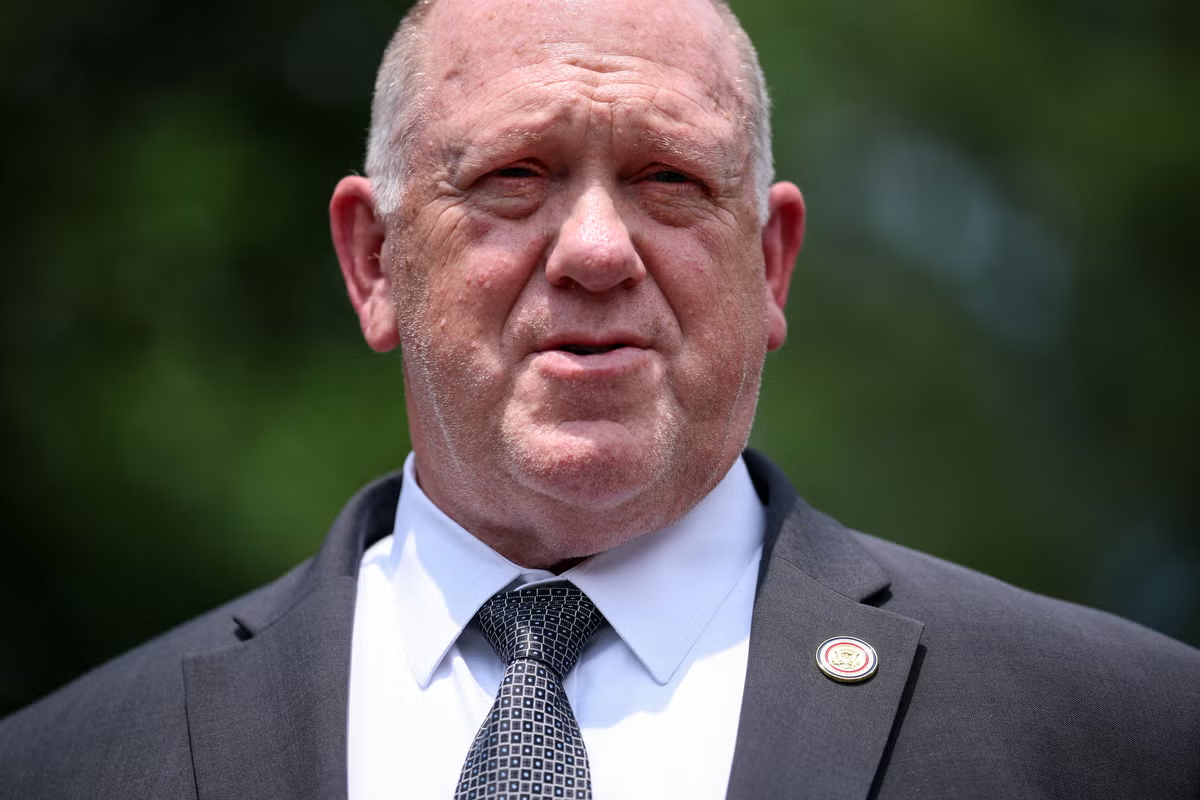
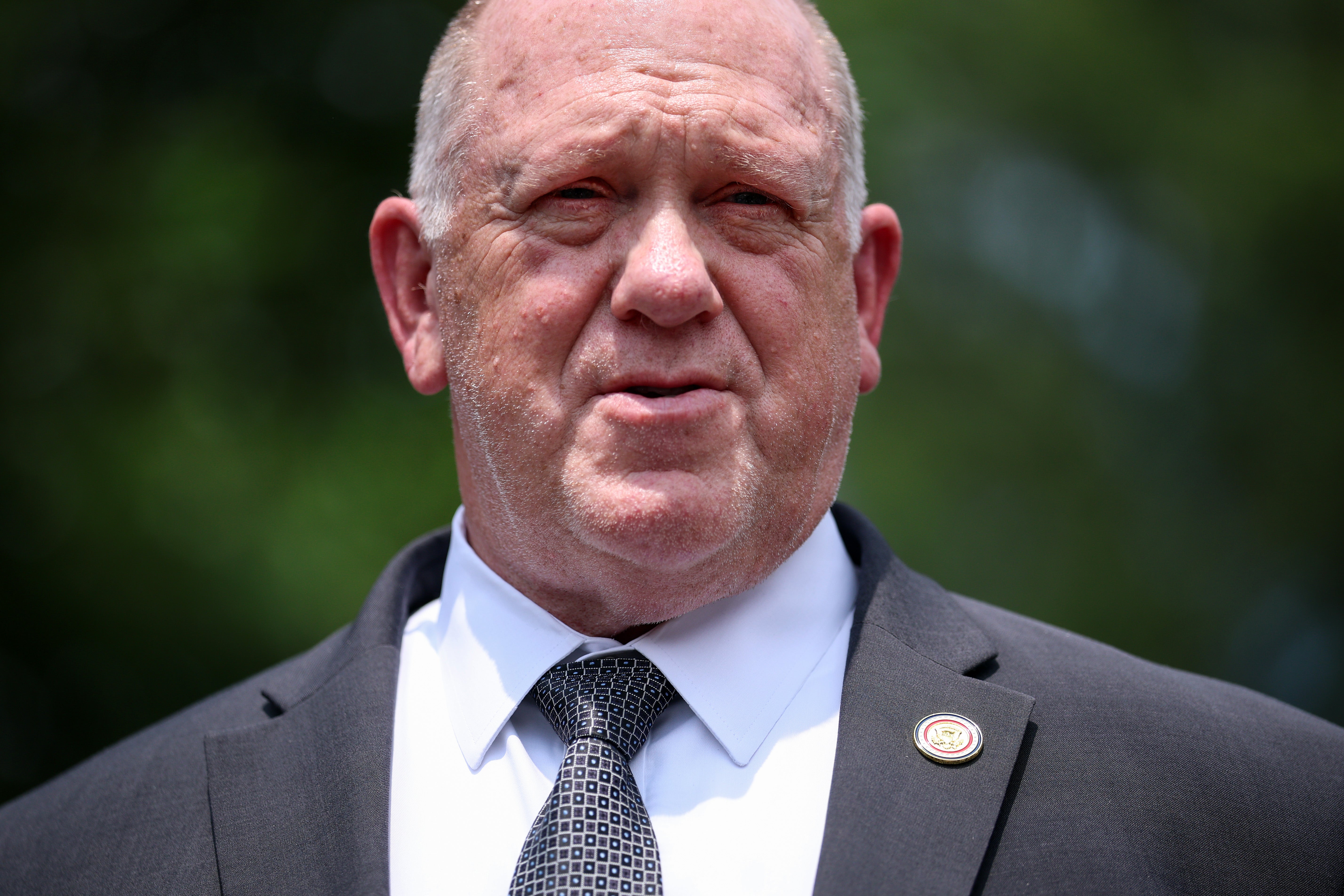
President Donald Trump’s border czar offered a stunning denial Saturday to the claim that immigration officials engage in racial profiling — by calling himself “an equal opportunity deporter.”
Tom Homan made the boast while responding to a suggestion by progressive Democratic Senate candidate Angie Nixon of Florida that Immigration and Customs Enforcement officers would “shoot and kill” Black Americans after mistaking them for immigrants “from Jamaica or Nigeria.”
“It was a ridiculous statement. Look, we don’t racially profile,” Homan told Fox News’ Saturday in America. “We don’t arrest people based on the color of their skin.”
Homan then said, “I’m actually an equal opportunity deporter.”
Advertisement
“I deported people to 180 countries last year, so I don’t care if you’re from Asia, you’re from Europe, or you’re from other countries. If you’re in the country illegally, you’ll be deported, regardless of the color of your skin,” he added.
Border czar Tom Homan says, ‘If you’re in the country illegally, you’ll be deported, regardless of the color of your skin’ (Getty)
Trump has repeatedly pledged to carry out the largest mass deportation operation in U.S. history, and more than 356,000 people have been deported during fiscal 2026, which ends September 30, ABC News reported last month, citing ICE data.
But the White House has set a goal of 1 million a year, which Mullin is unlikely to meet despite vowing to increase the number achieved by predecessor Kristi Noem, Politico reported early this month.
Homan’s Saturday remarks came after host Kayleigh McEnany played a video clip of Nixon, who is Black, recently telling the South Dade NAACP’s The Empowerment Zone Podcast that ICE was “gonna profile us, too.”
“They can’t tell the difference between an African-American or, you know, a Black American that is a descendant of slaves here in this country, or someone from Jamaica or Nigeria,” she said. “Like, they are going to racially profile us, and they are going to escalate things, and they are going to shoot and kill us.”
Advertisement
Federal law-enforcement officers have been involved in a series of fatal shootings during immigration crackdowns across the country, including the January killings of protesters Renee Good and Alex Pretti in Minneapolis.
Progressive Democratic Senate candidate Angie Nixon of Florida says ICE officers will ‘shoot and kill’ Black Americans after mistaking them for immigrants ‘from Jamaica or Nigeria’ (Getty)
More recently, ICE officers killed Mexican national Lorenzo Salgado Araujo in Houston and Colombian national Johan Sebastián Durán Guerrero in Biddeford, Maine, on July 7 and July 13, respectively.
Both men were shot during traffic stops, but neither was the target of an investigation.
Their slayings led Mullin to order a temporary halt to vehicle stops by ICE, but his directive was immediately criticized by President Donald Trump, leading Mullin to countermand it the following day.
On Tuesday, Nixon scored an upset victory over Alexander Vindman, a retired Army lieutenant colonel, in Florida’s special Democratic primary to challenge Republican Senator Ashley Moody.
Advertisement
Outgoing Florida Governor Ron DeSantis appointed Moody, then the state’s attorney general, to fill the Senate seat vacated by Marco Rubio after he was confirmed as Trump’s secretary of state in January 2025.
Nixon’s landslide, 56-44 win over Vindman came despite her raising less than $1 million, compared to the $16 million war chest he amassed as of July, according to the Miami Herald.
The Herald credited Nixon’s victory to her campaign platform, which calls for universal Medicare, free childcare, a national rent freeze and a $25 minimum hourly wage.
Vindman, who was a key witness in Trump’s first impeachment trial, ended his primary campaign with more than $7 million on hand, and the state’s Democratic Party said he was donating $400,000 to “support General Election candidates up and down the ballot,” the Florida Politics website reported Thursday.
A damaged rotor blade from an earlier incident may have caused the helicopter crash that killed a British couple on honeymoon in Greece last week.
The Bell 206 helicopter was carrying Alexander Cromie, 31, and Marie Ebert, 30, when the pilot apparently lost control while coming in to land on the island of Sifnos on Monday.
Witnesses saw the helicopter spinning out of control, suggesting it had a tail rotor failure, before it crashed, killing the newlyweds and the Greek pilot.
Investigators are said to be looking at whether the crash was linked to a scare involving the helicopter 11 weeks earlier.
Advertisement
Restraining straps were put in place after the aircraft landed on Paros on June 1 to immobilise the tail blades so they would not move in high winds.
But the pilot failed to ensure the straps had been removed before starting the engine again to fly passengers off the island, according to a report filed with Greece’s Civil Aviation Authority.
Experts are said to be assessing whether the straps could have caused any strain or damage to the tail assembly.
The investigation will be hampered by the intense fire that destroyed much of the helicopter.
Advertisement
Alexander Cromie and Marie Ebert,were taking a ride in a private air taxi before it was suspected to have suffered a mechanical failure and crashed near a heliport in Sifnos, Greece
Footage showed the helicopter immediately engulfed in a fireball, with smoke seen billowing into the sky from the blackened wreckage
Pictured: Aerial view of the area where a Bell 206 helicopter crashed on the island of Sifnos
Advertisement
Flight tracker records suggest the helicopter remained in Paros for three weeks after the June 1 incident. It later received an air-worthiness certificate, on July 2.
The civil aviation authority has ruled that ‘visual and functional checks’ be carried out on the tail rotors of all Bell 206 helicopters before every flight in Greece as a precaution following the crash.
Mr Cromie, a vice-president in private wealth solutions for asset management company Blackstone, and Ms Ebert are thought to have booked an 80-mile flight to Sifnos costing £1,300 as a honeymoon treat.
A spokesman for Blackstone said Mr Cromie was ‘beloved by everyone who worked with him’.
Advertisement
Management consultant Bain & Company, which employed Ms Ebert as a senior specialist, described her as a ‘much-loved and deeply respected’ member of its London team.
Relatives of Mr Cromie and Ms Ebert are reported to have flown to Athens to formally identify their bodies.
Share or comment on this article:
Damaged rotor blade may be to blame for Greek helicopter crash that killed British newlyweds
PUERTO MALDONADO, Peru (AP) — Eight Peruvian navy personnel jumped from a helicopter into a clearing carved out of the Amazon rainforest by illegal gold miners along the Malinowski River in Peru’s Madre de Dios region, sending sand and dust swirling as they ran toward the mining site.
The forest gave way to giant holes gouged into the earth and filled with opaque, muddy water, gasoline and other chemicals glistening on the surface. Makeshift wooden mining platforms straddled the pools, surrounded by pumps and thick plastic tubes used to suck up and sift through sediment for tiny particles of gold.
As the troops closed in, several miners stood watching from a distance. The officer leading the patrol fired a warning shot into the air. Within seconds, they vanished into the forest.
The raid over several days this week was part of an intensified government campaign against illegal gold mining in Madre de Dios, one of Peru’s most biodiverse regions, as authorities try to stop the activity from advancing into protected areas of the Amazon. Mining has stripped away vast areas of rainforest, leaving behind a scarred landscape of contaminated pools and altered rivers in the hunt for lucrative gold. Mercury used to separate gold from sediment has contaminated waterways, wildlife and people, including Indigenous communities that depend heavily on fish.
Advertisement
Members of the Peruvian Navy destroy a dredge used for illegal mining near the Malinowski River in the Tambopata National Reserve in Puerto Maldonado, Peru, Tuesday, Aug. 11, 2026. (AP Photo/Guadalupe Pardo)
Advertisement
Members of the Peruvian Navy destroy a dredge used for illegal mining near the Malinowski River in the Tambopata National Reserve in Puerto Maldonado, Peru, Tuesday, Aug. 11, 2026. (AP Photo/Guadalupe Pardo)
Advertisement
Advertisement
Advertisement
Advertisement
An illegal miner flees as members of the Peruvian Navy arrive near the Malinowski River in the Tambopata National Reserve in Puerto Maldonado, Peru, Tuesday, Aug. 11, 2026. (AP Photo/Guadalupe Pardo)
Advertisement
An illegal miner flees as members of the Peruvian Navy arrive near the Malinowski River in the Tambopata National Reserve in Puerto Maldonado, Peru, Tuesday, Aug. 11, 2026. (AP Photo/Guadalupe Pardo)
Advertisement
Advertisement
Advertisement
Behind them was a camp abandoned in haste. Crushed beer cans and empty liquor bottles littered the ground alongside mattresses, clothes and tools. That day’s lunch — rice and plantain — still sat in plastic containers. Freezers and fuel containers dotted the camp, alongside live chickens and guinea pigs kept for food.
Advertisement
The troops were one of eight patrols, flown by helicopter to separate points along the Malinowski River. The aircraft touched down only long enough to drop each group before lifting off and moving to the next site.
Illegal mining is advancing toward protected areas of the Amazon
Deforestation from illegal mining is visible in the Tambopata National Reserve in Puerto Maldonado, Peru, Tuesday, Aug. 11, 2026. (AP Photo/Guadalupe Pardo)
Advertisement
Deforestation from illegal mining is visible in the Tambopata National Reserve in Puerto Maldonado, Peru, Tuesday, Aug. 11, 2026. (AP Photo/Guadalupe Pardo)
Advertisement
Advertisement
Advertisement
Advertisement
Edy Reynaldo Dariquebe, an official with FENAMAD, an Indigenous federation representing communities in Peru’s Madre de Dios region, said criminal groups linked to illegal mining have been operating near or inside protected Indigenous communities. He said mining is destroying forests and contaminating rivers with mercury that accumulates in fish, spreading the impact to communities far from the mining sites.
Ronald Flores Yáñez, a deputy prosecutor for Peru’s Office of the Attorney General, said illegal mining has advanced close to military monitoring points and into protected areas.
“We can attest today that they have already entered the Tambopata National Reserve,” Flores told The Associated Press. “We are inside the reserve and around us we see dredges numbering in the hundreds.”
Advertisement
Peruvian Navy soldiers run as they get off a helicopter during an operation to combat illegal mining in the Tambopata National Reserve in Puerto Maldonado, Peru, Tuesday, Aug. 11, 2026. (AP Photo/Guadalupe Pardo)
Advertisement
Peruvian Navy soldiers run as they get off a helicopter during an operation to combat illegal mining in the Tambopata National Reserve in Puerto Maldonado, Peru, Tuesday, Aug. 11, 2026. (AP Photo/Guadalupe Pardo)
Advertisement
Advertisement
Advertisement
Illegal miners flee as members of the Peruvian Navy arrive near the Malinowski River in the Tambopata National Reserve in Puerto Maldonado, Peru, Tuesday, Aug. 11, 2026. (AP Photo/Guadalupe Pardo)
Illegal miners flee as members of the Peruvian Navy arrive near the Malinowski River in the Tambopata National Reserve in Puerto Maldonado, Peru, Tuesday, Aug. 11, 2026. (AP Photo/Guadalupe Pardo)
Advertisement
Advertisement
Advertisement
Illegal mining declined in parts of Madre de Dios after Peru launched a major military and police crackdown known as Operation Mercury in 2019. But miners have since moved back toward protected areas, prompting authorities to intensify operations.
Global Conservation, a U.S.-based nonprofit working with Peruvian authorities, said ongoing operations will combine satellite monitoring, aerial reconnaissance and law enforcement raids over the coming year to identify and dismantle illegal gold mining camps and equipment.
Destroying the motors hits miners where it hurts most
Advertisement
The Peruvian Navy destroys a dredge used for illegal mining near the Malinowski River in the Tambopata National Reserve in Puerto Maldonado, Peru, Tuesday, Aug. 11, 2026. (AP Photo/Guadalupe Pardo)
Advertisement
The Peruvian Navy destroys a dredge used for illegal mining near the Malinowski River in the Tambopata National Reserve in Puerto Maldonado, Peru, Tuesday, Aug. 11, 2026. (AP Photo/Guadalupe Pardo)
Advertisement
Advertisement
Before setting out Tuesday, Navy Lt. Cmdr. Renato Miranda told troops at a briefing that the mission’s objective was to “neutralize and dismantle” illegal mining activities. Once on the ground, that meant searching for anything that allowed the mines to function: pumps, batteries, fuel, dredging equipment and makeshift infrastructure.
“The most important thing is to destroy the main machinery,” Miranda said. “And the main machinery is the motors.”
Advertisement
The powerful engines are among the most valuable pieces of equipment at a mining site and a key economic pressure point for authorities trying to make it more expensive for miners to restart operations. Miranda said larger engines can cost around $30,000 to $45,000. He estimated that motors targeted in the raids can extract 30 to 50 grams of gold a day. At current gold prices, that would be worth about $4,000 to $7,000.
Peruvian Navy soldier discover a motor used for illegal mining near the Malinowski River in the Tambopata National Reserve in Puerto Maldonado, Peru, Tuesday, Aug. 11, 2026. (AP Photo/Guadalupe Pardo)
Advertisement
Peruvian Navy soldier discover a motor used for illegal mining near the Malinowski River in the Tambopata National Reserve in Puerto Maldonado, Peru, Tuesday, Aug. 11, 2026. (AP Photo/Guadalupe Pardo)
Advertisement
Advertisement
Advertisement
Advertisement
Peruvian Navy soldiers pour gasoline onto a dredge during an operation to combat illegal mining in the Tambopata National Reserve in Puerto Maldonado, Peru, Tuesday, Aug. 11, 2026. (AP Photo/Guadalupe Pardo)
Advertisement
Peruvian Navy soldiers pour gasoline onto a dredge during an operation to combat illegal mining in the Tambopata National Reserve in Puerto Maldonado, Peru, Tuesday, Aug. 11, 2026. (AP Photo/Guadalupe Pardo)
Advertisement
Advertisement
Advertisement
Miranda told AP the three-day operation destroyed 56 motors, 78 mining rafts and 13,751 gallons (52,050 liters) of fuel, with the destroyed material valued at more than 15 million soles ($4 million). On the ground, soldiers said they had destroyed around 115 motors over the previous three months during operations carried out nearly every week.
Advertisement
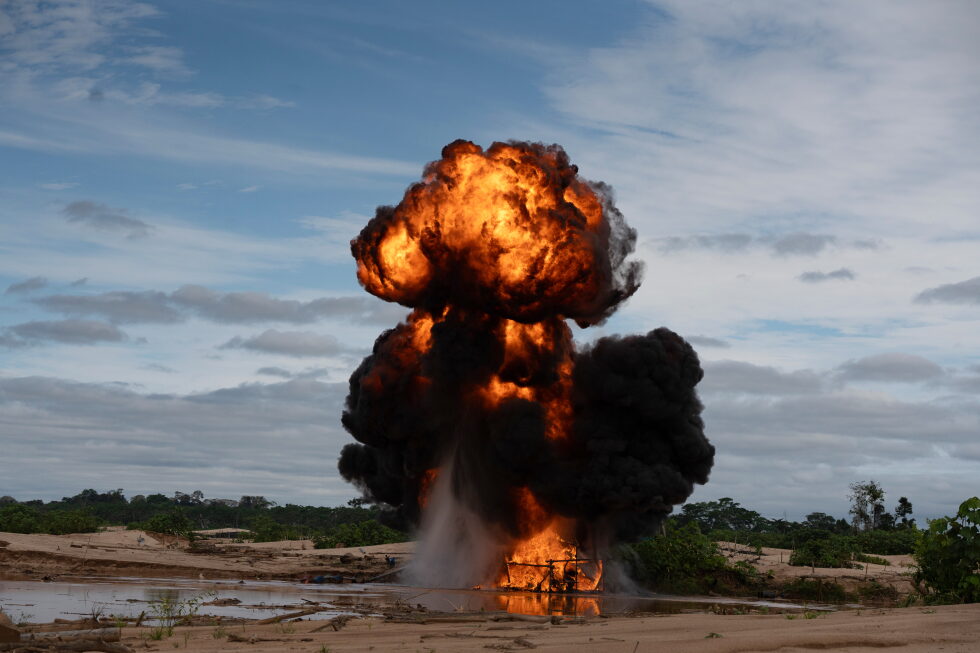
The remote sites give miners time to hear approaching boats or helicopters and flee, often hiding motors in sand, behind trees or in muddy pools to recover later. Specialized navy divers search the murky pools for submerged engines, entering water where mercury and other chemicals may be present. When they find one, they attach explosive charges and destroy it.
At one site, as troops prepared to leave, a soldier spotted disturbed sand and began digging. He uncovered a motor, threw it onto a pile with a mattress and chainsaw, doused it with gasoline and set it alight. A dog abandoned at the site fared better: soldiers took a liking to it, bringing it along for the rest of the day’s mission and eventually back to their military base.
Elsewhere, troops used dynamite-like explosives to destroy equipment and burned structures and supplies that could be used to keep the mining camps running.
Advertisement
A Peruvian Navy soldier swims in a human-made pool to extract gold using chemical products during an operation to combat illegal mining in the Tambopata National Reserve in Puerto Maldonado, Peru, Tuesday, Aug. 11, 2026. (AP Photo/Guadalupe Pardo)
Advertisement
A Peruvian Navy soldier swims in a human-made pool to extract gold using chemical products during an operation to combat illegal mining in the Tambopata National Reserve in Puerto Maldonado, Peru, Tuesday, Aug. 11, 2026. (AP Photo/Guadalupe Pardo)
Advertisement
Advertisement
Advertisement
Members of the Peruvian Navy destroy a dredge used for illegal mining near the Malinowski River in the Tambopata National Reserve in Puerto Maldonado, Peru, Tuesday, Aug. 11, 2026. (AP Photo/Guadalupe Pardo)
Members of the Peruvian Navy destroy a dredge used for illegal mining near the Malinowski River in the Tambopata National Reserve in Puerto Maldonado, Peru, Tuesday, Aug. 11, 2026. (AP Photo/Guadalupe Pardo)
Advertisement
Advertisement
Advertisement
A 10-minute boat ride away, another, larger camp offered a glimpse of daily life at the mining sites. A chest freezer was packed with meat, while wooden shelves held plates and coffee mugs. Several separate sleeping areas were strewn with personal belongings: a ledger filled with lists of needed supplies, freshly washed underwear hanging from string to dry, bottles of vitamins and even pills marketed as increasing penis size and sexual endurance. All was set alight by the troops. Before moving on, some of the soldiers cooked and ate food they found in the abandoned camp.
The expensive machinery and valuable gold contrasts with the precarious conditions of many living and working in the camps.
During the operation, another patrol encountered a woman with her 1-year-old child at a mining site. Flores told AP she had come to Madre de Dios from Cusco after failing to gain admission to university and, after being left by the father of her child, needed work. She responded to an advertisement seeking a cook and ended up preparing food for illegal miners.
Advertisement
Authorities say raids alone will not stop the mining
A Peruvian Navy soldier walks over a pipe to get to a dredge used for illegal mining near the Malinowski River in the Tambopata National Reserve in Puerto Maldonado, Peru, Tuesday, Aug. 11, 2026. (AP Photo/Guadalupe Pardo)
Advertisement
A Peruvian Navy soldier walks over a pipe to get to a dredge used for illegal mining near the Malinowski River in the Tambopata National Reserve in Puerto Maldonado, Peru, Tuesday, Aug. 11, 2026. (AP Photo/Guadalupe Pardo)
Advertisement
Advertisement
Advertisement
The destruction of machinery is intended to hit miners where it hurts most: the cost of restarting. But authorities themselves acknowledge that raids alone are not enough.
Advertisement
Miranda said that with gold prices high and mining highly profitable, operators can acquire another engine, rebuild their equipment and return to the same location or move elsewhere.
“Every day they are advancing more and more and more, and we are being very slow,” said Flores, adding that their strategy needs to change.
Advertisement
Deforestation from illegal mining borders the Malinowski River in the Tambopata National Reserve in Puerto Maldonado, Peru, Tuesday, Aug. 11, 2026. (AP Photo/Guadalupe Pardo)
Deforestation from illegal mining borders the Malinowski River in the Tambopata National Reserve in Puerto Maldonado, Peru, Tuesday, Aug. 11, 2026. (AP Photo/Guadalupe Pardo)
Advertisement
Advertisement
Advertisement
Prosecutors, he said, are now pursuing two fronts: continuing operations against dredges, motors and other equipment while also following the money behind the mines — identifying the financiers who provide the capital for expensive machinery and tracing the profits generated by the gold.
That approach could be critical to breaking the cycle visible along the Malinowski River: authorities destroy equipment, leave and miners find the money and machinery to start again.
“These operations have to be permanent,” Flores said.
Advertisement
Members of the Peruvian Navy destroy a dredge used for illegal mining near the Malinowski River in the Tambopata National Reserve in Puerto Maldonado, Peru, Tuesday, Aug. 11, 2026. (AP Photo/Guadalupe Pardo)
Advertisement
Members of the Peruvian Navy destroy a dredge used for illegal mining near the Malinowski River in the Tambopata National Reserve in Puerto Maldonado, Peru, Tuesday, Aug. 11, 2026. (AP Photo/Guadalupe Pardo)
Advertisement
Advertisement
Advertisement
___ The Associated Press’ climate and environmental coverage receives financial support from multiple private foundations. AP is solely responsible for all content. Find AP’s standards for working with philanthropies, a list of supporters and funded coverage areas at AP.org.
Prince Harry and Meghan Markle are reportedly set to return to the UK with their children, however, royal biographer Andrew Lownie believes Meghan may struggle with one part of life in Britain
Prince Harry and Meghan Markle sent shockwaves around the globe when they revealed plans to return to the UK.
Advertisement
The former working royals are anticipated back in Britain later this month, with their children, Archie and Lilibet, set to begin at British schools for the upcoming academic year, which commences in September.
However, one leading royal commentator believes there’s a particular challenge Meghan will find especially difficult to cope with as the couple readjust following more than six years living in California.
Considerable speculation has surrounded where Harry and Meghan will settle when they arrive back. As private individuals no longer within the Royal Family, their exact location is unlikely to be made public.
It’s anticipated they’ll reside on a private estate away from London, with two areas being widely discussed, reports the Express.
Advertisement
One possibility is Northamptonshire, close to the ancestral home of Harry’s late mother, Princess Diana. The alternative is the Cotswolds, an area already populated by celebrities and the ultra-wealthy.
According to royal biographer Andrew Lownie, there’s one aspect Meghan might not have fully considered – Britain’s notorious weather.
While the country has experienced (or suffered through) successive heatwaves over the past three months, conditions are set to deteriorate as winter draws near.
Advertisement
Andrew told The Daily T podcast: “I can’t see Meghan enjoying a Cotswolds winter with the rain coming down, and her mother a long way away. So I just can’t see this working.”
The writer has penned several volumes about the Royal Family, most recently Entitled: The Rise and Fall of the House of York, which examines the Andrew Mountbatten-Windsor controversy.
Throughout the podcast, he also discussed what Harry and Meghan’s apparently abrupt choice to abandon their American lifestyle and return to the UK reveals about the evolving balance in their marriage. The move was so unexpected that it reportedly caught Harry’s father, King Charles, off guard.
He explained: “I think it’s a really interesting dynamic because we’ve always thought that Harry was under the thumb of Meghan, and that there wasn’t much give or take there.. And now there seems to be an understanding that he wants to have children with a British education, he wants to come back to his friends, I think he’s felt very isolated in California.”
In other developments, a property specialist suggested the family’s new residence might not be the most impressive for one significant reason.
Cal Graham, from We Buy Any Home, reckons this will be true if privacy and security are their primary priorities.
To prevent people from identifying their whereabouts, Cal suggests a “shielded” property would be the ideal choice, which doesn’t automatically mean a luxurious one.
Advertisement
Cal told us: “If the reports are correct, the most suitable property would probably be one that looks relatively unremarkable from the public road but offers considerable privacy once inside.
“A modern home on a privately managed estate, set well back from the road and shielded by mature landscaping, would attract far less attention than an instantly recognisable country mansion.”


























































You must be logged in to post a comment Login