Connect with us
DAPA Banner

NewsBeat

Eight wonders of the world

Published

on

Eight wonders of the world

This roundup of The Conversation’s environment coverage was first published in our award-winning weekly climate action newsletter, Imagine.

Every scalable solution has to start somewhere small. With a spark of an idea, an anomaly during an experiment or, perhaps, an empty seashell on an Irish beach.

Juan Diego Rodriguez-Blanco at Trinity College Dublin has found a clever use for discarded oyster shells – a byproduct of the shellfish industry. Remarkably, these shells can capture rare earth elements from water and lock them into new minerals. Rare earth elements are an essential ingredient for the green transition – they are used to make high-performance magnets used in wind turbines and electric cars, for example. So capturing these “vitamins of modern industry” by crystallising them into the calcium carbonate of the shell (rather than just sticking or adsorbing to it) is a reliable way to recover these valuable resources for future use.

Of course, this tech is in its infancy but it just goes to show, there are so many hidden surprises within nature that might, on the surface, look like worthless waste.

Advertisement

The Conversation is made up of a dozen English-speaking editions plus various non-English ones, including French, Spanish and Indonesian. One of the most joyful parts of my job is coordinating regular meetings for the environment editors at each edition to share ideas, develop collaborations and support each other.

Together, we cover the planet’s biggest story – the climate crisis. This beat can sometimes feel relentless. But uncovering scientific discoveries, breakthroughs and insights from academics all over the world gives me hope. Here, my global colleagues share some of their favourite – and most promising – stories from recent weeks.

Knowing what actually works

Some climate policies really do make a difference. Now, we know which ones says Lucía Caballero, Environment and Energy Editor at The Conversation Spain.

Governments deploy dozens of different policies simultaneously, such as carbon taxes, renewable energy subsidies and emissions standards, but which ones are the most effective? Evaluating and comparing the results of climate strategies actually presents a major challenge for researchers and policymakers.

Advertisement

After analysing 1,737 climate policies across 40 countries over 32 years, scientists at the universities of Barcelona, Ludwig Maximilian of Munich, Lausanne and Oslo, have identified 28 measures that consistently reduce emissions. Their discovery will enable governments to focus on really effective strategies and avoid wasting resources, making climate action more successful.


À lire aussi :
Which climate policies actually make a difference? Our new analysis has the answer


Securing water supplies

In the western US, seven states rely on water from the mighty Colorado River, but a long-running drought and rising water demand have left reservoirs near record lows and cities’ water supplies at risk. Cities have been scrambling to lower their water use and finding creative solutions to encourage residents to make cuts, from low-flow shower heads to tearing out lawns and replacing them with xeriscaping (an approach to gardening and landscaping that reduces the need for irrigation). Las Vegas, a fast-growing city in the desert, has cut its per-capita water use by nearly 60% in the past two decades with steps like those. But as temperatures rise and the snowpack that feeds the river diminishes, we’ve wondered, can conservation alone be enough?

Environmental scientists Renee Obringer of Penn State and Dave White of Arizona State University recently ran computer models to understand what three cities – Las Vegas, Phoenix and Denver – will face in the future and how each city’s climate solutions for a dwindling water supply will hold up.

Advertisement

Stacy Morford, Senior Environment, Climate and Energy Editor at The Conversation US, says these results are eye-opening. This research suggests the region needs to start thinking beyond just conservation to much bigger solutions, the kind that Obringer and White describe that take years to build.

Las Vegas has water investigators who can issue tickets for illegal water use.
Jim West/UCG/Universal Images Group via Getty Images

Anna Weekes, Environment and Energy Editor at The Conversation Africa, particularly loved a story highlighting another innovative way to tackle drying up water supplies. This time in South Africa’s dry Karoo desert.

Groundwater pumped from boreholes is the only water supply for many small towns. But as the climate warms and rain falls later in the year, aquifers aren’t replenishing enough to meet the demand for water. Surina Esterhuyse, Fanus Fourie and Danita Hohne are hydrologists and groundwater scientists who’ve designed and built low-cost aquifer recharge systems, drilling infiltration boreholes through hardened clay in dry river beds so that when it finally rains, the war goes straight into the aquifer instead of flowing away across the surface.

Advertisement

In the rural Karoo towns of Carnarvon, Vanwyksvlei, Williston, Sutherland and Calvinia, these recharge systems have been a huge success. They’re affordable and easy to implement at a small scale and offer a practical, scalable way to strengthen drought resilience and secure water supplies for vulnerable communities.

Buds, butterflies and bees

Gabrielle Maréchaux, Environment and Energy Journalist at The Conversation France loves a story about a free smartphone app called PlantNet. This “shazam” for plants, which is available on both iOS and Android, covers 85,000 species out of an estimated 400,000.

It’s popular among hikers and botanical enthusiasts. But what’s less well known is that it was developed by scientists and also helps with research by tracking abundance and locations of particular flowers, fruit, twigs and bark. It’s also a vital tool for monitoring the spread of invasive or “alien” non-native species that can disrupt ecosystems.

Meanwhile, butterflies, with their captivating patterns and colours, don’t always receive the attention they deserve, according to Ibrahim Daair, Environment and Energy Editor at The Conversation Canada. They are a fundamental part of global ecosystems, but insects have been declining at alarming rates in many places. Now, a group of researchers is working on developing a global butterfly index to track how environmental changes are affecting butterflies worldwide. They assembled a dataset of 45,000 population trends for over 1,000 butterfly species to help guide conservation and better understand the scale of the biodiversity crisis.

Advertisement

Imagine weekly climate newsletter

Don’t have time to read about climate change as much as you’d like?

Get a weekly roundup in your inbox instead. Every Wednesday, The Conversation’s environment editor writes Imagine, a short email that goes a little deeper into just one climate issue. Join the 47,000+ readers who’ve subscribed so far.


In 2015, a mining dam in Mariana, in Minas Gerais state, collapsed and released about 55 million cubic meters of toxic waste – crushed rock, water and chemicals left after extracting iron – sending a massive, polluted mudflow downstream. At the time, it was the largest human-made environmental disaster in Brazil. After observing the devastated landscape, Sandra Moura, a professor at the Federal University of Ouro Preto, discovered a plant capable of accelerating the recovery process in the areas affected by the disaster.

But simply recovering the landscapes was not enough, and the professor decided to create a project to assist the affected communities by using beekeeping as a reforestation and income-generating strategy.

This story is featured in one of the episodes of the podcast Voices from the South produced by The Conversation Brazil, about solutions to the environmental problems facing Brazil and Australia.

Advertisement

While visiting the project’s apiary, Luciana Julião, Journalist and Audiovisual Producer at The Conversation Brazil, met incredible people, all with very diverse specialisms, who are working together in the search for possible ways to save the planet.

The coolest library on Earth

And finally, Sarah Sermondadaz, Head of Environment and Energy at The Conversation France, loved learning about first ice core library in Antarctica, designed to preserve humanity’s “climate memory”. With an average temperature of -50°C, Antarctica’s first-ever 100% natural sanctuary protects endangered ice cores from global warming. On January 14 2026, the coolest library on Earth was inaugurated at the Concordia station, Antarctica. Samples from glaciers rescued worldwide are now beginning to be stored there for safekeeping.


Source link

Advertisement
Continue Reading
Click to comment

You must be logged in to post a comment Login

Leave a Reply

NewsBeat

Supermarket oven chips compared: Aldi, Morrisons, Lidl

Published

on

Supermarket oven chips compared: Aldi, Morrisons, Lidl

HOW would we manage without frozen chips? Easy, quick and convenient, they are a staple freezer item in most homes. Simply pop them on a baking tray, stick them in the oven, and, 20-or-so minutes later, your tea is ready.

The market is thriving, with supermarkets now competing with big brands like McCain, which pioneered what became known as oven chips in Canada, and introduced them to the UK in 1979.

By the 1990s and early 2000s oven chips became increasingly popular, leading to a significant drop in chip pan fires and offering a healthier option with roughly half the fat of deep-fried chips.

They can be teamed up with almost anything, from a basic bowl of chips with tomato sauce, to British favourite fish and chips, chicken and chips and pie and chips. And, of course, with bread and butter for a chip sandwich. Most varieties can also be grilled or air-fried.

Advertisement

I tried eight varieties of chips from leading supermarkets. I oven-cooked them. Here’s what I thought.

*Four Seasons (Aldi) Straight Cut Chips,1.5kg, £1.65

These were quite small in length compared with some others, but had a decent potato taste. They crisped up nicely on the outside – not too crisp, just enough – to an appetising colour and were soft and fluffy inside. Good price, if you like them.

Pros: taste and texture.

Advertisement

Cons: chips were quite small.

Mark: 3/5

*Hearty Food Co. (Tesco) Straight Cut Chips, 1.5g. £1.65

Hearty Food Company oven chips from Tesco.jpeg (Image: Supplied)

Like Morrisons and Sainsbury’s, there were a lot of quite small chips in this bag, among the chips of acceptable size, Cooked to a good colour. The outside was nice and lightly crisps, the inside fluffy. They had a good, fairy natural potato taste. Quite nice, but let down by the size issue. Good price, if you like them.

Advertisement

Pros: good appearance, natural potato taste.

Cons: a lot of small chips.

Mark: 3/5

*Morrisons Savers Straight Cut Chips, 1.5kg, £1.65

Advertisement

Like Tesco and Sainsbury’s, there were a lot of small chips mixed within this bag. The chips crisped up well, with a decent colour, and the texture inside was light, but they tasted very bland, rather floury. Good price, if you like them.

Pros: crisped up well, good texture.

Cons: floury taste.

Mark: 2/5

Advertisement

*M&S Food Straight Cut Chips, 1.5kg, £2.50

The front of the bag says these are made using only British potatoes, which is a plus point.

When cooked these had an appetising golden colour, lightly crisp surface and a light, fluffy inside. They had a mild, very natural potato flavour which I liked.

Pros: very pleasant, light and fluffy.

Advertisement

Cons: more expensive.

Mark: 4/5

*Straight Cut Chips by Asda, 1.5kg, £2.67 (these seemed expensive and when I checked online they are now £2.20).

Quite long chips – the longest of the selection. They didn’t crisp up much on heating and had a dry texture. Though they were correctly cooked, they tasted as though they needed longer in the oven – they were floppy and rather cardboardy.

Advertisement

Pros: more chip for your money.

Cons: dry, with a cardboardy taste. Cost more than the others.

Mark: 2/5

*Iceland Straight Cut Chips, 1.25kg, £2.00

Advertisement

Winner – these oven chips from Iceland (Image: Supplied)

These were a good-sized chip. Prior to cooking they were the lightest in appearance and looked very unappetising, but they crisped up well, and had a good colour. The potato was light and fluffy. In taste these were the most similar to chip shop chips. I enjoyed them very much..

Pros: good appearance and taste.

Cons: none.

Mark: 5/5

Advertisement

*Sainsbury’s Stamford Street Chips, 1.5kg, £1.65

Like Morrisons and Tesco, this bag contained quite a lot of small chips among the mix. Having said that, the texture was light and fluffy, and they had a good potato taste.

Pros: texture and taste.

Cons: a lot of small chips in the bag.

Advertisement

Mark: 3/5

*Harvest Basket Straight Cut Chips (Lidl), 1.5kg. £1.65

These were thicker than most, a good size and a nice light golden colour. They had a light consistency and pleasing potato flavour. Not bad at all. Good value.

Pros: size, colour, good taste; good value.

Advertisement

Cons: none.

Mark: 4/5

Source link

Advertisement
Continue Reading

NewsBeat

How Iran cryptocurrency demands explain a key role of money throughout history

Published

on

How Iran cryptocurrency demands explain a key role of money throughout history

When Iran began demanding payment in exchange for safe transit through the Strait of Hormuz, it offered the option to pay in cryptocurrency. Likewise, the shadowy network of tankers that have smuggled Russian oil to world markets since the full-scale invasion of Ukraine in 2022 have often been paid this way.

Illicit actors the world over have increasingly turned to cryptocurrency as a way to conduct business while avoiding the risk of US sanctions. In so doing, countries like Russia and Iran are drawing on a characteristic of money that has been around since at least the bronze age: its ability to facilitate trade between strangers and across political boundaries.

In my book Shell Money (2024), which investigates some of the world’s earliest forms of money, I show how similar dynamics have been at play throughout history.

Advertisement

Cryptocurrency has been Iran’s preferred payment method for safe transit through the Strait of Hormuz.
Somkanae Sawatdinak/Shutterstock

Modern currencies like the US dollar and euro are backed by confidence in the financial institutions of nation states – in a similar way to the first metal coins of antiquity, which were issued by Greek city states in order to collect taxes and pay soldiers.

In prehistory, however, there are many examples of monetary systems that developed without state support, such as bronze ingots.

The bronze age (roughly 3300BC to 1200BC) was a time of long-distance voyaging and interregional connectivity. Against this backdrop, having a shared medium of exchange was critical for maintaining trade connections.

Bronze tools were made from copper and tin, which were only available in a few locations in the ancient world. In northern Europe, copper came from sources such as Wales, the Alps, Austria, Sardinia and Iberia, while tin largely came from Cornwall and Devon. This meant that all the copper used in Scandinavia, for example, had to be acquired through long-distance trade.

Advertisement

Much of this trade was dominated by bronze ingots – rings, bars or axe-heads – that were highly standardised in weight and form across regions. This meant that each ingot was interchangeable – a critical characteristic of money. Bronze objects were also broken down into sizes consistent with market-based trade.

The bronze age need for money

Travel during the bronze age would not have been easy. Long-distance journeys would have been dangerous and could take months to complete.

A travelling merchant would have no way to know if the traders they dealt with on one journey would still be around on the return trip. The reciprocity you could depend on in your home community would no longer hold – exchanges needed to be transactional.

Against this backdrop, bronze became standardised into a medium of exchange. By carrying bronze ingots, a traveller could conduct business across the world, confident that wherever they went their money would be accepted.

Advertisement

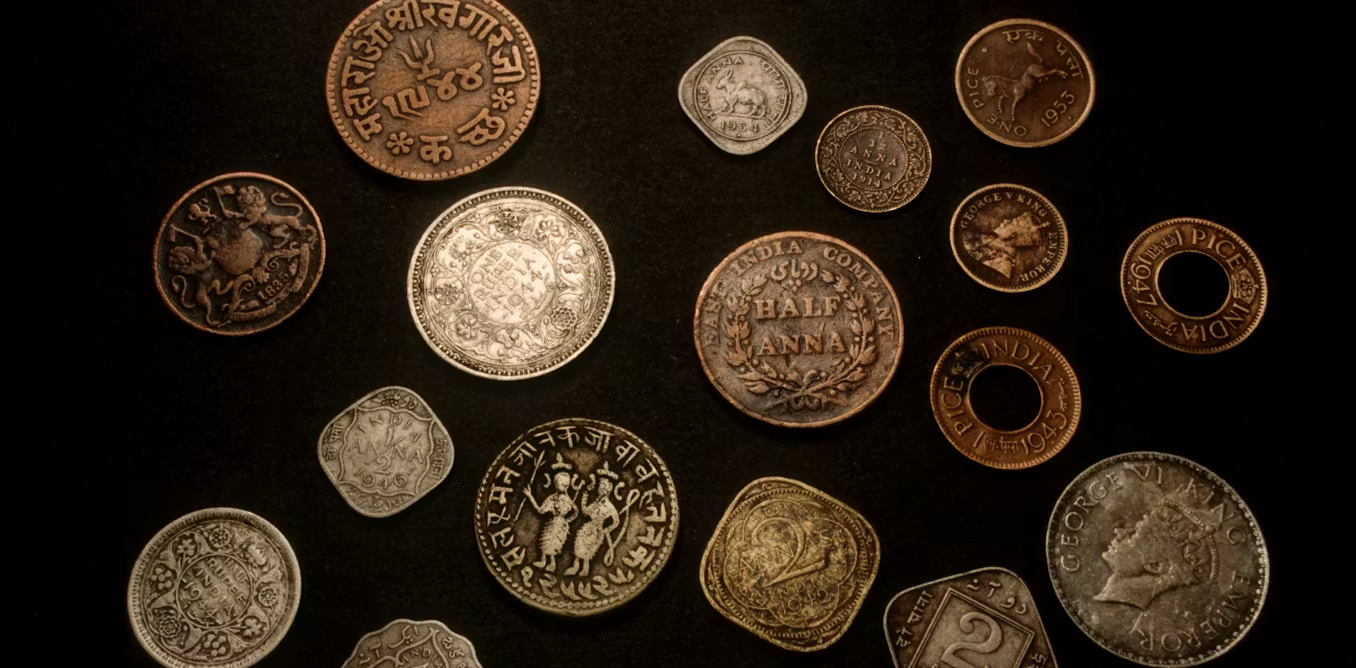
In other parts of the ancient world, shells and shell beads were accepted as money. The Chinese symbol (bèi) originated as a pictograph of the cowrie shell and is now used in hundreds of finance-related Chinese characters, including those for buy, sell, wealth and profit. Cowrie shells were traded to China from the Indian Ocean and used as money during the Zhou dynasty.

In North America, small shell beads were used as money and circulated throughout the interior of the continent, thousands of miles from the oceans where they were collected and produced. These examples show that trade money was not restricted to metals but could develop from anything that was desirable and scarce.

The US dollar diminished

The dominance of government-issued “fiat currencies” (meaning they are not backed by physical commodities such as gold) depends on the trust, liquidity and institutional backing they provide.

International trade is currently dominated by the US dollar. However, as we move into an increasingly multipolar world – with competing centres of gravity in North America, Europe and China – we can expect to see the dollar’s role diminish.

Advertisement

Indeed, there is some evidence that this has already happened. The dollar’s role as the world’s reserve currency (meaning it is held in large quantities by other governments and central banks to stabilise their economies) has declined from around 70% in the late 1990s to less than 60% today. This trend is likely to continue amid signs of increased US isolationism, strains in North Atlantic cooperation, and the rising economic position of China.

Political fragmentation, however, hardly means the end for international trade. History is rife with periods, from the bronze age on, when political fragmentation coexisted with bustling trade economies. And for those seeking to avoid state control in future, this may mean a growing shift in the type of money that is used.

Video: Bloomberg Television.

New forms of money

There are many differences between cryptocurrency in the modern world and the commodity money of prehistory. Cryptocurrency is still rarely used or accepted in daily transactions, is highly volatile and, as with modern fiat currencies, does not have “use value” in the same way as bronze ingots or even shell beads.

Advertisement

Nonetheless, both are forms of “bottom-up” (non-state controlled) money that exist outside of the oversight of any single government or large financial actor.

This lack of state control is exactly what drives sanctioned states such as Iran and Russia to request payments in crypto. As US financial leverage weakens, crypto payments become harder to block and sanction, potentially reshaping how future conflicts are financed.

Cryptocurrency may be well positioned for this environment, continuing to provide one of money’s oldest functions: the ability to conduct business with strangers.

This article references a book included for editorial reasons with a link to bookshop.org. If you click on this link and go on to buy something from bookshop.org, The Conversation UK may earn a commission.

Advertisement

Source link

Continue Reading

NewsBeat

Chelsea FC’s recruitment strategy under the microscope

Published

on

Chelsea FC’s recruitment strategy under the microscope

PSG were far better than Chelsea in their 8-2 last-16 aggregate win but also vastly more experienced. Chelsea’s second-leg XI had played 137 Champions League matches between them, PSG’s 545. That has to have counted for something. Sunderland and Brentford can attest. Granit Xhaka, 33, and Jordan Henderson, 35, respectively, have added football IQ, not just leadership, to their new teams.

Source link

Continue Reading

NewsBeat

Man jumped into boiling lake to save dog and suffered ‘worst death imaginable’

Published

on

Daily Record

David Alan Kirwan had been visiting the impressive natural beauty at Yellowstone National Park when he rushed into the thermal spring — he would die one day later

A man endured what is believed to be one of the “worst deaths imaginable” after he dove into a boiling hot thermal lake to save his friend’s dog.

He would end up passing away in hospital due to the severity of his burns just one day later.

Advertisement

David Alan Kirwan jumped headfirst into the thermal spring to save his friend’s dog, Moosie, who had also jumped in to swim in the water.

In an act of true heroism, Kirwan ignored all warnings about the safety of the spring and jumped in to save her.

However, his actions eventually turned out to be in vain, as Moosie was never rescued — either by Kirwan himself or by investigators over the coming days.

Kirwan was burned alive as a result of the dive and suffered horrifying injuries before his death.

Advertisement

Back in 1981, Kirwan was walking through the impressive natural structures of Yellowstone National Park. He had been walking through the park with good friend Ronald Ratliff and his dog, Moosie, according to JOE.

However, what was meant to be a pleasant walk through the magnificent natural park soon turned into a nightmare as they passed the Celestine Spring, a well-known thermal spring in the park.

With temperatures in the spring reaching well over 200°F (93°C), it is known for being a dangerous lake as it pumps out heat straight from the Earth’s core.

Advertisement

Moosie, clearly excited at the pool of water jumped into the hot spring, leaving Ronald and David immediately unsure what to do.

David quickly decided, however, that they needed to save the dog and jumped into the spring to rescue Moosie, who was a mixed-breed boxer.

He dove headfirst into the boiling water of the spring, and immediately began to feel the effects of the near-boiling temperatures. The 24-year-old tried to steady himself as he swam to reach the dog, but soon went underwater himself as he tried to bring the dog to safety.

Advertisement

Ronald, for his part, tried to help haul David out of the water himself, eventually managing to haul him to safety. However, Ronald would go on to suffer serious second-degree burns to his feet as a result.

But David, who dived straight into the hot water, suffered far worse than his friend. The heat of the water had melted David’s skin and when a park ranger tried to take off his shoe, his skin came with it.

The move also left David entirely blinded, as a clearly injured Kirwan screamed out in pain. He could be heard asking: “That was stupid. How bad am I? That was a stupid thing I did.”

Advertisement

He was taken to a hospital in nearby Salt Lake City, where doctors found third-degree burns across the entirety of his body. David fought for his life but died from his injuries the following day.

In a heartbreaking tribute to his son, dad James Kirwan described David as a kind and caring person. He explained: “He liked dogs and when the dog went in, his friend told him not to go in after her, but David went in.”

Ensure our latest headlines always appear at the top of your Google Search by making us a Preferred Source. Click here to activate or add us as a Preferred Source in your Google search settings.

Source link

Advertisement
Continue Reading

NewsBeat

Anthony Hopkins spotted in Welsh town

Published

on

Wales Online

The Port Talbot-born actor is currently filming a production he said allows him to ‘return to my Welsh roots’

Welsh acting legend Sir Anthony Hopkins has been drawing crowds during filming in a Welsh town. The two-time Oscar winner is appearing in A Visit To Grandpa’s, an adaptation of the coming-of-age tale by Welsh writer and poet Dylan Thomas.

Filming is taking place in and around Dolgellau, Gwynedd, with road closures in place this week. Sections of the town have been redesigned for the production, and on Thursday Anthony Hopkins was spotted on set.

Ian King, of photography.wales, captured the renowned Welshman in the town, reports North Wales Live. He posted on his Dolgellau Facebook page: “Sir Anthony Hopkins filming in Dolgellau this afternoon. I saw him later in the Marian car part talking with people and having photos taken.”

Advertisement

Councillor Linda Morgan was amongst those who had the opportunity to meet the star today. Make sure you never miss Wales’ biggest updates by getting our daily newsletter

She said: “I am really pleased they have chosen Dolgellau for the filming. Very exciting put Dolgellau on the map again. Very well organised. It was great to meet Sir Anthony Hopkins.”

The film follows a young boy who spends a summer on a secluded Welsh farm with his charismatic grandfather, discovering a world of imagination and mischief.

Directed by D.J. Caruso, the production stars Anthony Hopkins as the eccentric grandfather. The cast also includes Artie Wilkinson-Hunt as the boy, Aimee-Ffion Edwards as the mother, Aneurin Barnard as The Hunter, and Celyn Jones as Mr. Griff.

Advertisement

Speaking about the film, the Port Talbot-born actor commented: “This is a powerful and profoundly beautiful story, one that allows me to return to my Welsh roots while exploring the remarkable vision and prose of Dylan Thomas. It is a privilege to collaborate once again with DJ, with whom I share a deep creative bond.”

Source link

Continue Reading

NewsBeat

Antoine Semenyo leaps to Erling Haaland’s defence and gives fascinating insight into tactics

Published

on

Manchester Evening News

Manchester City sensation Antoine Semenyo has rejected the assertion that Erling Haaland doesn’t have a rounded enough game. The Norwegian blew Premier League opponents away when he first arrived in England but has since been increasingly scrutinised.

Haaland, 25, has already matched the Premier League goal tally that saw him clinch last season’s Golden Boot (22). And it would be a safe bet to assume he’ll add even more to that total between now and the end of the campaign.

He’s been called on to contribute even more around City’s game as they look to take the title edge off Arsenal this Sunday. But January signing Semenyo already sees the major benefit of playing alongside such an accomplished force up front.

You can listen to brand new episodes of In The Mixer on Spotify and Apple Podcasts!

Advertisement

“He’s a big problem,” he told In The Mixer, brought to you by Sky Bet. “Just in the games, when people mark him; it’s not just one person marking him, it’s like three people.

“It’s like [relieved expression] the space for everyone else is fantastic. But he causes so many problems. He’s tall, fast, can finish. [He’s] essentially the complete striker. Anything in the box, he’ll score.”

While he may have become a fan of his team-mate since leaving Bournemouth, Semenyo isn’t getting ahead of himself in his Haaland appreciation. And he stopped short of putting his colleague on too high a pedestal when asked where he ranks among the best Premier League strikers of all time.

“That’s a tough question,” he replied. “He’ll be up there, for sure. His numbers are a scandal. Forty-one goals in one season.”

Advertisement

He continued: “It’s not even just his goalscoring. What he does for the team, not many people see it but he’s so important.


“Just holding up the ball, bringing players into play, massively important to our game. He can do a lot of things, I’ll give him that.”

Advertisement

The former Premier League Player of the Year will be expected to put all those attributes on display this Sunday. City host Arsenal with a chance to close the gap at the top of the table to just three points, with a game in hand still to play.

Sky Sports, HBO Max, Netflix and Disney+ with Ultimate TV package

This article contains affiliate links, we will receive a commission on any sales we generate from it. Learn more
Content Image

Sky has upgraded its Ultimate TV and Sky Sports bundle to now include HBO Max, Netflix, Disney+, discovery+ and Hayu, as well as 135 channels and full Sky coverage of the Premier League and EFL.

Sky broadcasts more than 1,400 live matches across the Premier League, EFL and more with at least 215 live from the top flight alongside Formula 1, darts and golf.

Semenyo also believes his side are playing the Gunners at the right time following a run of just one win in five games: “Our form over the last couple of games has been good and we’re playing probably the best football we’ve played in the second half of the season.

Advertisement

“So it’s a good time to play them, I guess. Where they’ve dipped in form, we’ve picked up form, so it’ll be interesting.”

ANTOINE SEMENYO EPISODE ON YOUTUBE: Subscribe now to be the first to watch the latest episodes of In The Mixer and other original shows, brought to you by Sky Bet. Watch All Out Football’s episode with Antoine Semenyo here.

Source link

Advertisement
Continue Reading

NewsBeat

Road for self-driving vehicles could form part of science park transport plans

Published

on

Cambridgeshire Live

The government has provided funding for a year-long study into electric autonomous vehicles

A road designated for self-driving vehicles could form part of plans for the expansion of a Cambridgeshire science park. Wellcome Genome Campus is investigating the potential for a dedicated route for electric autonomous vehicles between its Hinxton-based site and Whittlesford Parkway railway station.

Advertisement

The campus said it had received funding from the government to carry out a year-long study. It aims to create a safe, sustainable, and reliable way for people travelling to and from the campus.

Robert Evans, Chief Executive campus, said it would be “game-changing” for the site. He continued: “As we progress with our major expansion – which will see our Campus triple in size over the next 10-15 years – we are looking at new transport solutions that support sustainable growth and better connectivity.”

The campus runs shuttle buses and coaches to and from Whittlesford Parkway. A spokesperson for the Wellcome Genome Campus said a dedicated road for the autonomous vehicles would make it easier for workers and visitors to reach the campus, offer predictable journey times, and help to cut congestion and emissions.

The proposed road could enable a controlled environment for the self-driving vehicles without mixing in normal traffic. The study is funded as part of the CAM Pathfinder Programme by UK Government.

Advertisement

Source link

Continue Reading

NewsBeat

Ukraine-Russia war latest: Zelensky calls Putin a ‘global threat’ after Moscow’s deadliest aerial attack this year

Published

on

Ukraine-Russia war latest: Zelensky calls Putin a ‘global threat’ after Moscow’s deadliest aerial attack this year

Romanian defence ministry says radars caught Russian drone breaching air space

Romanian radar systems caught a drone breaching its ⁠national airspace during a Russian overnight attack on neighbouring ⁠Ukraine ​before ⁠losing contact southeast of the ⁠border village of ​Chilia ⁠Veche, the ‌defence ministry said on Friday.

Romania, an ‌EU and Nato state, shares a 650km (400-mile) land border ⁠with Ukraine and has had drones breach its airspace and fragments fall onto its ‌territory repeatedly since ​Russia began ‌attacking Ukrainian ⁠ports across the ⁠Danube river from ‌the country.

Shweta Sharma17 April 2026 06:30

Advertisement

Russia sentences Pole who fought for Ukraine to 13 years in prison camp

A court ​in Russian-controlled Luhansk sentenced a Polish citizen to 13 years in a maximum-security penal colony for ⁠participating in armed conflict on the side of Ukraine, the Russian Prosecutor General’s Office said on Thursday.

The 47-year-old Pole, ⁠Krzysztof Flaczek, arrived ​in September ⁠2024 in Ukraine, where he began participating in combat operations ⁠after receiving training, it said.

Russia ​said ⁠he received financial ‌compensation for fighting for Ukraine. He was detained by the Russians in ‌November 2024.

“Taking into account ‌the position of the state prosecutor, the court sentenced the militant to 13 ⁠years of imprisonment to be served in a maximum-security penal colony,” prosecutors said.

Advertisement

Flaczek had been tried by a court in Russian-controlled Luhansk, one of four Ukrainian regions which Moscow ‌claimed as its own in ​2022 in a move ‌Kyiv and the ⁠West rejected as an illegal land ⁠grab.

Russian courts have sentenced several western ‌Europeans for fighting ​for Ukraine, including ‌two Britons.

Shweta Sharma17 April 2026 06:15

Advertisement

Ukrainian PM says she feels optimistic of US support after visit

Ukrainian prime minister Yulia Svyrydenko left Washington on Thursday describing her talks with top US officials as “very supportive”, amid waning attention on Russia’s war as the focus has shifted to Iran conflict.

She said treasury secretary Scott Bessent backed Kyiv’s position on maintaining pressure on Russia in an interview with Reuters.

In her only interview during the visit, Svyrydenko said she urged US officials not to weaken, waive or delay sanctions imposed on Moscow after its full-scale invasion, stressing their importance in limiting Russia’s war capacity.

“I think Secretary Bessent stands with Ukraine,” she said, adding that US counterparts understand the need to tighten sanctions and prevent circumvention.

Advertisement

Svyrydenko also reiterated Kyiv’s stance that any peace deal with Russia must include firm security guarantees and a clear reconstruction plan.

“I dream that this war will end,” she said, “but with proper security guarantees and a recovery plan that allows Ukrainians to live the life they deserve.”

Shweta Sharma17 April 2026 05:45

Advertisement

Russia warns Finland and Baltic states it may invoke ‘self-defence’ over Ukraine drone strikes

Russia has warned Finland and the Baltic nations that Moscow reserves the “right to self-defence” if Ukrainian drones strike using their airspace.

Russian Security Council secretary Sergei Shoigu issued the warning to Finland, Estonia, Latvia, and Lithuania.

Sergei Shoigu, who was Russia’s defence minister at the time of Moscow’s full-scale invasion in 2022, pointed to incidents where drones crashed in Finland and the Baltic states during Ukrainian strikes on Ust-Luga, a key Russian deep-water port in the Gulf of Finland.

He said that Ukrainian drone attacks on Russia have been launched through the Baltic states via Finland.

Advertisement

“This could occur in two scenarios: either Western air defence systems are extremely ineffective… or the states in question are deliberately allowing their airspace to be used, meaning they are actively complicit in the aggression against Russia,” he said.

“In the latter case, under international law, Article 51 of the UN Charter regarding the inherent right of states to self-defence in the event of an armed attack comes into effect.”

It comes a day after Moscow warned that Europe’s support for Ukraine’s drone capabilities could bring “unpredictable consequences,” and said these countries have become part of Kyiv’s “strategic rear.”

The Baltic states have denied these accusations as false.

Advertisement

Shweta Sharma17 April 2026 05:30

Deadliest Russian aerial attack in months kills 18 in Ukraine

A Russian attack on Thursday with more than 700 drones and missiles across Ukraine has killed at least 18 people in what local officials said was the deadliest attack in months.

Officials said nine people were killed in the southern port city of Odesa, five in the central city of Dnipro, and four, including a child, in the capital, Kyiv.

Advertisement

In Russia, Moscow said a Ukrainian drone strike killed two people, including a child, in the southern Krasnodar region.

Ukrainian rescuers work at the site of heavily damaged buildings following a Russian air attack in Dnipro, on April 16, 2026, amid the Russian invasion of Ukraine (AFP/Getty)

The attacks follow a brief ceasefire over Orthodox Easter last weekend, with both sides accusing each other of hundreds of violations.

In Kyiv, air raid sirens woke residents at around 2.30 local time on Thursday (23.30 GMT Wednesday), with explosions heard shortly afterwards.

Shweta Sharma17 April 2026 05:00

Advertisement

Russia should not be the winner of the Iran war, German minister tells US

It is not in the ⁠interest of the United States that Russia is the ⁠winner ​of the ⁠Iran war, German finance ⁠minister Lars Klingbeil ​said ⁠on Thursday ‌in Washington.

“It’s not in our interest and ‌it cannot ‌be in the interest of the ⁠United States,” he said in a joint statement with the finance ministers of Ukraine and ‌Norway on ​the sidelines ‌of the International ⁠Monetary Fund ⁠spring meetings.

Klingbeil said the Russian economy is ⁠growing thanks to the Middle East conflict and is making a profit ​from the energy situation.

Advertisement

“All the meetings here are about the question of what’s happening ​with the war in Iran, and I think it’s really important that we show ‌solidarity with ⁠our friends in Ukraine,” Klingbeil said.

Shweta Sharma17 April 2026 04:30

Ukraine’s Zaporizhzhia nuclear power plant loses off-site power

Ukraine’s Zaporizhzhia ⁠nuclear ​power ⁠plant temporarily lost ⁠all off-site ​power ⁠for ‌around 40 minutes before ‌being restored ‌on Thursday ⁠evening, ​the International Atomic Energy Agency (IAEA) ⁠said.

Advertisement

The cause of power loss is not yet known, ‌the ​IAEA ‌said ⁠in a post ⁠on X.

Shweta Sharma17 April 2026 03:59

EU set to release €2.5–2.7bn to Ukraine after reforms

The European Union is expected to disburse between €2.5bn and €2.7bn to Ukraine after its parliament completed key reforms last week, according to EU enlargement commissioner Marta Kos.

Advertisement

Speaking in Washington alongside Ukrainian finance minister Serhiy Marchenko, Kos said the EU would also move ahead with a €90bn loan package following Hungary’s election, which saw prime minister Viktor Orbán voted out of power.

Marchenko said Ukraine’s $52bn financing gap for 2026 would be covered once the EU loan is in place, though discussions are ongoing over how to bridge a projected shortfall in 2027.

Part of a high-level delegation attending the spring meetings of the International Monetary Fund and World Bank, Marchenko noted that the EU has already covered nearly two-thirds of Ukraine’s financial needs. However, uncertainty remains over whether other major governments will step up support.

“If Ukraine fails, it means all of our partners will feel this,” he said. “We cannot give even the slightest chance of failure.”

Advertisement

Shweta Sharma17 April 2026 03:54

Ukrainian drone attack kills 2 including 14-year-old, Russia says

A Ukrainian drone attack on the Russian Black Sea port of Tuapse killed two people, including a 14-year-old girl, injured seven, and sparked a large fire, Russian officials said on Thursday.

Tuapse is one of Russia’s major southern ports, serving as an oil product export hub and also handling dry bulk cargo such as coal and fertiliser. It is also home to a major oil refinery of the same name owned by Rosneft, Russia’s biggest oil producer.

Advertisement

Veniamin Kondratiev, governor of the Krasnodar region, said that an unidentified adult woman had been killed in what he called a massive attack by Ukrainian drones on Tuapse in addition to the teenager.

Drone fragments had damaged 24 private houses, six apartment blocks, two educational facilities and a music school, he added.

The Ukrainian military later said it had struck two oil depots in Russia-occupied Crimea and infrastructure in Russia’s southern port of Tuapse, Kyiv’s drone forces commander said on the Telegram app.

Alex Croft17 April 2026 03:00

Advertisement

Photos show damage after Russian strike in Kyiv, Ukraine, as residents take shelter

Residents surveyed the damage and took shelter Thursday following a Russian strike on a residential area in Kyiv, Ukraine.

This is a photo gallery curated by photo editors for The Associated Press:

Alex Croft17 April 2026 01:29

Advertisement

Source link

Continue Reading

NewsBeat

UK weather: Rain set ease for weekend as sunshine returns

Published

on

photo looking out to sea but with some greenery in the foreground and a person walking their dog.  A headland in the distance

Our analysis of rainfall data shows that parts of East Anglia and the south-east of England have been very dry.

Across the county of Essex, around a fifth of the rain we’d usually expect by this time in spring has actually fallen.

In the month of March, rainfall was broadly below average in eastern and south-east England, April has started even drier.

According to Met Office data, between 1 – 14 April there has only been 4.5mm of rain compared to the average of around 20mm for the time of the year

Advertisement

In contrast, Western Scotland has had around double of its normal April rainfall so far.

During March things were broadly average across Scotland but a succession of weather systems in April has brought a lot of rainfall.

Looking just at April, an average of 70mm fell across the whole of Scotland compared to the 40mm you’d usually expect at this stage of the month.

While a lot can change in the second half of spring, the mostly dry weather is likely to continue into next week.

Advertisement

Droughts and hosepipe bans featured widely in 2025 after the driest spring in 50 years and the hottest summer on record.

But in late March 2026 – after one of the wettest winters since 1836 – the Environment Agency confirmed that eastern England the last region still in ‘recovery’ to ‘normal’ conditions.

Source link

Advertisement
Continue Reading

NewsBeat

Last week to bid on community fund for North Yorkshire

Published

on

Last week to bid on community fund for North Yorkshire

The Mayor’s Community Fund, supporting projects across the region with grants from £500 to £30,000, closes to applications on Thursday, April 23.

Jo Coles, deputy mayor for policing, fire and crime, said: “The Mayor’s Community Fund provides valuable support for groups and organisations across the region, supporting 47 projects over the last two years.

“Last year, David Skaith, the Mayor, doubled the size of this pot, delivering more early intervention and prevention and creating more safe community spaces.

Advertisement

“If you have a project that will help to keep our communities safe and requires support, we would love to hear from you.”

The fund, focused on community safety, supports prevention and early intervention projects.

Recent recipients include the Pathfinders U17 driving course, which delivered a week of practical training at Rufforth Airfield for 36 young people and their parents.

Ian Goring, Yorkshire coordinator at Pathfinders U17, said: “We have been delighted by how many young people have signed up to attend our events.”

Advertisement

Further funding rounds will open later in the year.

To find out more information or apply, visit yorknorthyorks-ca.gov.uk. 

Source link

Advertisement
Continue Reading

Trending

Copyright © 2025