






Social media giant Meta will pay almost $17 billion to settle a lawsuit that claimed its products Instagram and Facebook harmed young users.
Wednesday’s settlement resolves a lawsuit brought against Meta by 29 states over claims Instagram and Facebook were deliberately designed to get children hooked.
Meta was also accused of misleading users about how safe minors were on its platforms, and of improperly collecting personal data of children under 13 while they used its platforms.
As part of the settlement, Meta will impose daily usage limits on users under the age of 18, and also make it harder for minors to access its platforms at night.
‘Today, we have secured a settlement with Meta that will make social media less dangerous for our kids and make a world of a difference for children and their families,’ California Attorney General Rob Bonta said in a statement celebrating the development.
He maintained that Meta will enact the ‘massive transformations’ on its platforms ‘within months.’
The trial was co-led by Bonta and AGs from Colorado, New Jersey and Kentucky.
Meta owns and operates Facebook, Instagram, and Threads.
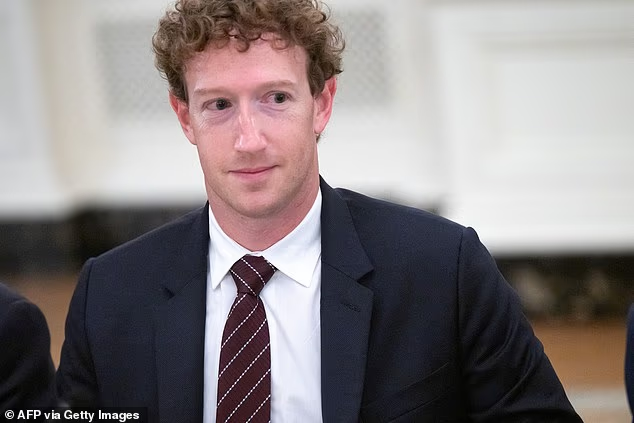
Meta boss Mark Zuckerberg, pictured in the White House in September 2025

California Attorney General Rob Bonta, who co-led the 29-state effort to sue the social media company, said in a statement that changes would be seen on platforms like Facebook and Instagram ‘within months’
Proceedings for the landmark federal trial began in Oakland, California, last week. It had originally been scheduled to run through early October.
‘I am proud to deliver this settlement that addresses the concerns at the core of our lawsuit and institutes real change, real transparency, and real enforceable protections for children on Facebook and Instagram – right now, no more waiting,’ Bonta’s office said in its statement.
The AG specifically said Meta had agreed to install a default time limit of two hours for users under the age of 18, as well as a nighttime block between the hours of midnight and 6am. Parents can lift both settings.
Other mandated defaults include restrictions on the notifications youngsters and teens receive during school and nighttime hours, and a ban on showing the numbers of ‘likes’ or reactions to posts published by minors.
A ban on cosmetic surgery image filters for young users was agreed upon as well, Bonta said.
Also included in the settlement but not required is an option for young users to elect for a ‘non-personalized feed,’ rather than one fueled by an algorithm.
Meta must also hire an independent auditor to ensure the company adheres to another provision- that the company no longer peddles ‘further false, misleading, or deceptive statements around its safety features,’ Bonta said.
The settlement is set to be paid to the states who participated in the 2023 lawsuit over the next ten years.

Proceedings began last week at the Oakland federal courthouse in California and had been scheduled to run another few months

Key testimony came from former Meta staffers like Arturo Béjar, a former Meta and Facebook safety engineer and Instagram consultant who said his job often included briefing Meta’s CEO, Mark Zuckerberg, personally
The amount is one of the highest ever to be paid by a tech firm to US states. Meta said that ‘participating states’ will receive about $12.7 billion in a statement after the states filed their agreement Wednesday morning in the US Northern District of California.
The state of California is set to receive somewhere between $1.5 billion and $2.1 billion when the settlement is officially approved, according to Bonta’s office.
The state and other ‘participating states’ represented by the AGs will receive about $12.7 billion, or 70 percent, of the total settlement over the next decade according to Meta – with the other $5.3 billion hinging on whether its rivals, namely Google’s YouTube and TikTok, implement certain app changes as well.
This includes daily time limits for youth and a ‘night mode.’
Key testimony came from former Meta staffers like Arturo Béjar, a longtime Facebook safety engineer and Instagram consultant who said his job often included briefing Meta’s CEO, Mark Zuckerberg.
In his testimony, Béjar said he repeatedly raised issues about the type of content being pushed on to Zuckerberg and other Facebook and Instagram executive, but was rebuffed due to a culture obsessed with increasing user numbers at any cost.
Meta’s internal studies showed young users were exposed to harmful experiences at much higher rates than what the company acknowledged publicly, Béjar said.
Instagram head Adam Mosseri was also brought to the stand to speak about the effectiveness of some features that have been added to Instagram over the years to address those concerns.

Meta’s internal studies showed young users were exposed to harmful experiences at much higher rates than what the company acknowledged publicly, Béjar – seen here outside the Oakland court last Wednesday – said during his bombshell testimony

Instagram head Adam Mosseri was grilled about the effectiveness of recent features added to Instagram meant to address those concerns
‘Most people don’t turn it on, but I don’t think we knew that yet because this was still under development,’ Mosseri admitted last week, referring to the platform’s ‘Take a Break’ feature.
‘Actually, we found out that a lot of people didn’t turn it on, and we’ve had to make a lot of changes over the last few years in order to have it be more adopted. This was back in 2021.’
Instagram Director of Product Design Francesco Fogu testified that Instagram knew that fewer people would use ‘Take a Break’ by not making it a default setting.
He also acknowledged the company allowed the removal of data from a presentation slide that showed that teenage Instagram users saw 1.5 times the rate of bullying-, suicide-, nudity- and violence-related content than their adult counterparts.
Brian Schwalb, the attorney general of the District of Columbia, said in a statement: ‘This is a monumental public health victory for young people in DC and across the country, and the safety features Meta is required to install will fundamentally and immediately change how young people use Instagram and Facebook.’
Schwalb added that while Meta was the first social media outfit to settle ‘but it will not be the last,’ with Snap, TikTok and YouTube also facing state enforcement actions and investigations from the consortium of states.
The Mata settlement is still subject to the approval of United States District Court Judge Yvonne Gonzalez Rogers. She is expected to sign off on the agreement.
‘Meta wouldn’t settle unless it sees the writing on the wall and feels really exposed,’ Standford law progressor Nora Freeman Engstrom told the New York Times on Wednesday.





















































You must be logged in to post a comment Login