Business is at a ‘tipping point’ as costs being piled on by Labour risk sending jobs and investment into reverse, the boss of high street chains Monsoon and Accessorize has warned.
Nick Stowe said the company behind the two brands had already cut the number of new stores it is investing in this year to 10, from 25 last year.
Writing for the Daily Mail, Stowe said: ‘It’s because rising costs mean the investment case doesn’t add up.’
It comes after Labour hiked employer national insurance and minimum wages as well as enacting a botched business rates reform. Firms are also facing a sharp rise in energy bills.
Stowe said: ‘Retailers are not asking to be insulated from every increase in the cost of doing business. We have already navigated significant shocks and cost increases, and are paying more tax than ever.
‘But Government does need to recognise the cumulative impact its decisions have on whether businesses invest and hire and recognise when those decisions reach a tipping point and employment and investment goes into reverse. We’re at that point.’
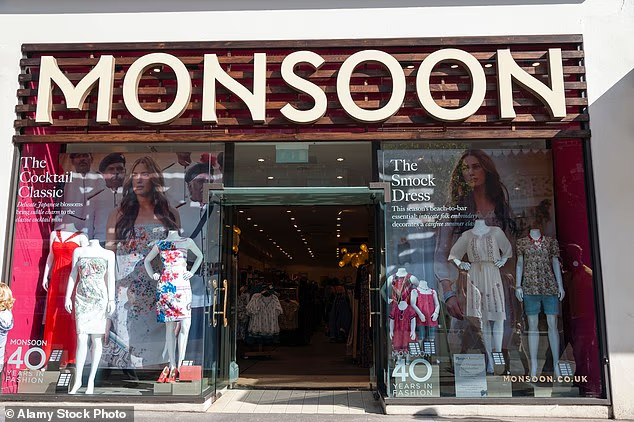
The company behind Monsoon and Accessorize invested in fewer stores this year
The comments come after figures last week from the British Retail Consortium showing a fall in consumer confidence, which will add to pressure on the high street.
Separately, a survey from the Confederation of British Industry (CBI) revealed that a persistent downturn in sales had prompted retailers to cut back order volumes at the fastest pace on record since the poll began in 1983.
Stowe urged Chancellor John Healey to use next month’s Budget to cancel business rate hikes next year. And he echoed a calls from across the sector to spare larger stores from a shake-up of the rates system that is designed to level the playing field between physical retailers and online rivals.
Many fear that a reform targeting larger premises – that is designed to target huge warehouses used by the likes of Amazon – could backfire on big ‘anchor’ stores.
Stowe said: ‘Larger stores are significant investments in town and city centres, they are the anchors around which other retailers build their businesses.
‘Making them disproportionately more expensive risks discouraging exactly the kind of investment Government says it wants and threatens the core of our high streets.’
It comes after the bosses of B&Q owner Kingfisher and department store chain John Lewis also urged Labour to avoid targeting larger stores.
Mike Ashley, the billionaire behind Frasers Group, has said the Government would be ‘simply delusional’ to heap more pressure on big retailers.
We are already seeing what happens when costs go up
By Nick Stowe, chief executive of Monsoon and Accessorize
Andy Burnham has made reviving Britain’s high streets a priority for his Government. But unless next month’s Budget tackles the rising cost of running a store, that ambition is going to be very hard to achieve.
For retailers deciding whether to open stores, invest or walk away from locations where the numbers no longer add up, cost is the make-or-break factor.
So to help revive the high street, there is one obvious place where the Government can have an immediate impact: business rates.
Monsoon chief executive Nick Stowe
At Monsoon and Accessorize, we want to keep investing in physical retail.
We are continuing to open stores because we believe in the high street and know that, when the right ingredients are there, everyone wins: our business grows, we create jobs, and we play our part in creating thriving town centres.
But every decision to open a store ultimately comes down to whether the numbers add up. And in too many parts of the country (mainly those most in need of jobs and investment) that calculation is becoming harder.
We’re now rejecting more stores than we’re moving forward with. Last year we invested in 25 new stores; this year we’ll invest in 10.
That isn’t because we don’t have the capital to invest. It’s because rising costs mean the investment case doesn’t add up.
Retailers have already shouldered £6.5 billion in additional employment costs over the past two years, alongside rising energy bills and spiralling transport costs. With business rates rising as well, the cumulative cost burden is becoming unmanageable.
At the same time, customers are becoming more cautious. Latest BRC figures show consumer confidence weakening ahead of the Budget.
Confidence in the economy fell six points in September, with people more pessimistic about their own finances and expecting to spend less as a result. As spending declines while costs increase, retailers are squeezed even harder.
Business rates are particularly difficult because they are a fixed tax on having a physical presence. Whether a store is thriving or struggling, the bill still needs to be paid.
Rates are also set centrally, so mayors and local authorities have no say in the level of tax, and no way to encourage businesses into their area to support jobs and redevelopment.
What can be done now? Most important: stop the situation from getting worse. The Chancellor should cancel next year’s inflation-linked increase and freeze the business rates multiplier, ensuring no shop sees its bill rise in April simply because of inflation.
The Government should also remove shops from the higher multiplier, the higher level of rates that ratchets up the tax.
Larger stores are significant investments in town and city centres, they are the anchors around which other retailers build their businesses.
Making them disproportionately more expensive risks discouraging exactly the kind of investment Government says it wants and threatens the core of our high streets.
We are already seeing what happens when costs become too difficult to absorb. Retail has lost 122,000 jobs in just two years, while the number of part-time retail jobs is now at its lowest level on record.
Retail remains Britain’s largest private sector employer and, for many people, provides that vital first step into working life. When stores disappear, jobs and opportunities disappear with them.
Retailers are not asking to be insulated from every increase in the cost of doing business. We have already navigated significant shocks and cost increases, and are paying more tax than ever.
But Government does need to recognise the cumulative impact its decisions have on whether businesses invest and hire and recognise when those decisions reach a tipping point and employment and investment goes into reverse. We’re at that point.
Freezing the multiplier and removing shops from the higher multiplier would provide some immediate breathing room. We then need the hard work on meaningful reform of a system that places too much of the tax burden on retailers simply because they have a physical presence.
That reform must reduce the overall burden without leaving individual stores paying more as a result.
Andy Burnham has been clear that he wants to breathe new life into Britain’s high streets. Retailers are ready to play their part, investing across the country and creating good jobs.
But ambition alone is not enough: the Government needs to prove that it is committed to providing the breathing room it talks about, in this case by not making the rates burden worse.
Next month’s Budget is the moment for the Government to show that it really wants to partner with businesses, that it understands how to help revive local communities, that it is committed to creating jobs.


























































You must be logged in to post a comment Login