Wildfires could engulf ‘all of Europe’ within days, the EU’s emergency response chief warned on Wednesday, as two firefighters were killed battling a blaze in Greece and infernos continued to rage across France, Spain and Portugal.
Greece, Italy and Central Europe are now expected to face the highest wildfire risk in the coming weeks, raising fears of fresh disasters even as firefighters continue battling major blazes across southern Europe.
Maria Zuber, head of the EU’s Emergency Response Co-ordination Centre, said the next few days would be ‘very difficult’ and warned the wildfire threat was shifting eastwards after devastating parts of France and the Iberian Peninsula.
‘The next risk, it’s already moving to Greece and also Central Europe,’ Ms Zuber told reporters. ‘Greece for the moment was spared, and now we see that it will go to Greece.
‘Italy will face risk at the beginning of August, and we will need to see what will happen with the Iberian Peninsula, because if (it is) there as well, we will have all Europe on fire.’
The forecast reflects weather conditions that help fires ignite and spread rapidly, such as high temperatures, dry air, wind and a lack of rain.
Europe suffered its worst wildfire season on record last year, with more than a million hectares of land burned. Ms Zuber said Europe’s fire situation this year so far was similar.
‘We have the potential that this is another record,’ Ms Zuber said.
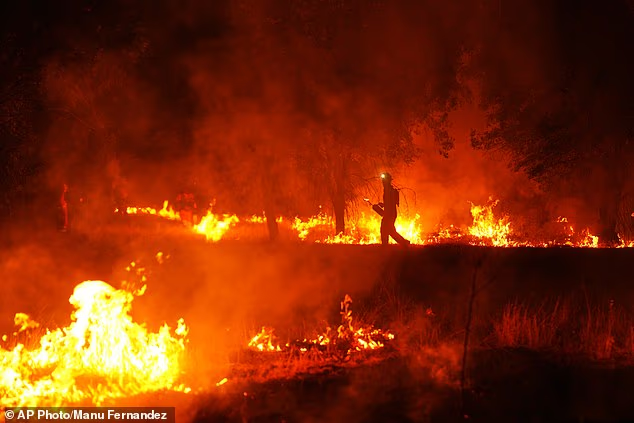
Firefighters use controlled burning to halt a wildfire that continues to spread near Cebreros, Spain, on July 28, 2026
Trees burn during the wildfires in Artana, Spain
Fire crews and emergency vehicles operate along the Fethiye-Antalya highway close to the fire
Firefighters respond to a forest fire both from the air and land in Turkiye’s Seydikemer district
Footage shared on social media shows bright orange flames rising above the mountains as dark clouds of smoke engulf the Greek island Paros
According to Greek news outlet Proto Thema, emergency crews have been battling the blaze non-stop since Tuesday afternoon
Firefighters respond to a forest fire in Turkey
A firefighting vehicle operates as smoke rises from a fire burning inside a military base, amid drought conditions following a heatwave and water shortages across much of France
The EU centre coordinates the deployment of aircraft and firefighters to countries that request emergency support, drawing on resources pooled by European countries and rented by the EU. It has sent seven planes and four helicopters to France, and six planes and three ground forest firefighting teams to Spain.
Not all planes in the EU fleet are currently occupied, and some are pre-stationed in eastern and central Europe as the risk there rises, Ms Zuber said.
More of Europe’s tourism destinations have been hit by wildfires today, as nine villages were evacuated on the Greek holiday island of Paros.
Footage shared on social media shows bright orange flames rising above the mountains as dark clouds of smoke engulf the island.
Nine villages have been evacuated due to the growing inferno. Local media has reported that residents are fleeing to the beaches on the instructions of emergency services, while two firefighters died in Crete after becoming trapped in their vehicles.
According to Greek news outlet Proto Thema, emergency crews have been battling the blaze non-stop since Tuesday afternoon.
State TV ERT said the men had been trapped by the fire in their fire engine in the foothills of a mountain near the western city of Rethymno.
The fire department in a statement said the men had died ‘during an operation to contain a rural forest fire in the Krya Vrysi area of Rethymno’.
Local municipal official Sifis Vavourakis told ERT the fire front was over nine miles long.
‘The fire is out of control,’ he said.
Some 110 firefighters with 27 fire engines and four aircraft had been dispatched to deal with the fire, the fire department said earlier.
But the winds had complicated efforts to fight the fire from the air, local mayor Yiannis Tatarakis told ERT, adding that six villages had been evacuated so far.
‘The wind keeps changing direction, it’s very easy to get trapped,’ Mr Tatarakis said.
1949: A photo of the gigantic fire of the forest of Landes de Gascogne which killed 82 people taken on August 22, 1949
2026: An aerial view depicting a residential area engulfed in flames during a wildfire in the forest of Lege-Cap-Ferret, southwestern France on July 23, 2026
The blaze comes as Europe is battling some of the worst wildfires in living memory across multiple popular holiday destinations including France, Spain and Turkey.
The response team in Paros includes 66 firefighters, specialised forest firefighting units from Athens, five helicopters, and two water-bombing planes.
They will soon be reinforced by 20 additional firefighters travelling from the mainland town of Rafina.
One resident who fled to the neighbouring island of Antiparos told Swiss outlet Blick: ‘This is turning into a real catastrophe! The fire spread further south with the wind in just three hours.’
Early on Wednesday, residents in Trypiti, Glyfa, Pyrgaki and Aspro Chorio were ordered to evacuate towards Dryos, after an earlier alert told people in Ageria to flee to Aliki beach.
The orders followed Tuesday’s evacuations from Agios Charalambos, Kambi, Bougados, Aneratza and Kamari as the blaze continued to spread.
Deputy Mayor Haris Giourtzidis said authorities did not yet have ‘a clear picture of the extent of the damage’, adding: ‘So far, we know that two barns have burned down.’
He said strong, persistent winds were hampering firefighting efforts and revealed emergency crews had been forced to remove some residents from their homes after they refused to leave their animals behind.
Local media said the wildfire had split into two fronts advancing towards Faragas Beach and Tripiti, with Agkairia among the worst-hit areas.
Fire service spokesman Yiannis Artopoios said the blaze was slowly being brought under control by 86 firefighters but warned: ‘The battle continues so that the fire does not escape.’
Elsewhere on the island of Crete, two firefighters, aged 28 and 60, died after becoming trapped in their vehicle as they battled flames in the Sachtouria area, in Nea Krya Vrysi, Rethymno, Greek news outlet OEMA reported.
Fire crews and emergency vehicles operate along the Fethiye-Antalya highway as thick smoke from a forest fire reduces visibility in the Seydikemer district of Mugla, Turkey
Firefighters respond to a forest fire both from the air and land in the Seydikemer district of Mugla, Turkey on July 29
Firefighters work as flames and smoke rise during a wildfire, amid drought conditions following a heatwave and water shortages across much of France
Residents smother embers with dirt to prevent reignition after a wildfire was brought under control near La Adrada, 95 kilometres west of Madrid, on July 28, 2026
Trees burn during the wildfires in Artana, Spain
Smoke rising from right next to the settlements is covering the sky as firefighters and Turkish General Directorate of Forestry teams continue their efforts to extinguish the fire
According to initial reports, the pair lost their orientation as they tried to navigate thick smoke.
The fire in Crete’s Rethymno area has been burning uncontrollably since early afternoon on Wednesday, forcing six villages to evacuate.
Some 156 firefighters are understood to be operating in the area.
A wildfire also broke out in Moroni, Heraklion, in Crete, with a team of 58 firefighters working to extinguish it.
In mainland Greece, a blaze also tore through the seaside village of Ageranos in Laconia, sparking an evacuation order.
The fires in Greece come as Europe is battling some of the worst wildfires in living memory across multiple popular holiday destinations as temperatures hit up to 47C (117F).
Around 4,000 holidaymakers were evacuated yesterday from a popular French beach resort.
Officials ordered campsites, holiday villages, tourist residences and leisure parks to be cleared in the surfing hotspot of Lacanau, around 35 miles west of Bordeaux.
1949: A photo taken on August 22, 1949, of a gigantic fire in the forest of Landes de Gascogne which killed 82 people
2026: Residents on their bicycles looking at smoke rising behind a residential area during a wildfire near Lege-Cap-Ferret, southwestern France taken on July 23, 2026
Firefighters in France and Spain were battling to contain the blazes before the arrival of a fourth heatwave of the summer brings scorching temperatures.
Flames have torn through vast swathes of forest in both countries, incinerating properties and forcing the evacuation of tens of thousands of people.
In a sign of progress, Spain’s interior ministry said it ended evacuation orders for 13 municipalities on Tuesday afternoon, without providing details of how many people were covered.
Locals in Bordeaux are suffering the economic fallout of the devastating fires, with one tour guide telling the Telegraph:
‘For one of our most popular walking tours, we’d normally have 20 to 30 people at this time of year. This morning we had six. I’ve had 10 people cancel next week.’
‘This city relies heavily on tourists – we get about 6.5 million tourists per year – and this is going to really severely impact us. This is the busiest time of year. We are looking at a severe financial hit.’
Roland Lescure, France’s finance minister, said on Monday: ‘This is also an economic thunderbolt, hitting a region that did not need it.’
Conditions are set to worsen as a fresh heatwave hits western Europe this week, with temperatures climbing again in France from Tuesday and Spain from Wednesday, according to meteorologists.
French firefighters were ‘on the offensive’, commander Eric Pitault insisted, standing beside a 50-metre-wide, 25-kilometre-long firebreak cut with the help of civilian volunteers on the Cap Ferret peninsula.
Over the past six days, the largest French wildfire since 1949 has raged west of Bordeaux, forcing more than 220,000 people to flee and destroying 240 homes.
The prefect’s office said that, while there were flare-ups overnight, these were under control and the burnt area had not increased.
An aerial view of emergency vehicles near a wildfire in Lege-Cap-Ferret in the Gironde department
A firefighting helicopter makes a water drop as a wildfire burns next to the village of Plomari on the island of Lesbos, Greece
Firefighters use controlled burning to halt a wildfire that continues to spread near Cebreros, Spain, on July 28, 2026
Nine villages have been evacuated due to the growing inferno in Turkey
Outside Spain’s Aldea del Fresno, on the edge of the vast fires burning west of Madrid, evacuated locals queued up in their cars in the hope of returning to properties and pets.
They were among 60,000 people forced to flee by fires that have consumed 190,000 acres, an area almost the size of New York City.
For now, though, the Guardia Civil gendarmerie was blocking their return, blaming the risk of smoke inhalation.
Galia Borisova, a 55-year-old domestic helper, wanted to reach her animals in nearby Picadas but was having to wait.
‘They say there’s so much smoke that you can’t breathe, even with a mask. And I believe it, because you could see it from here.’


























































You must be logged in to post a comment Login