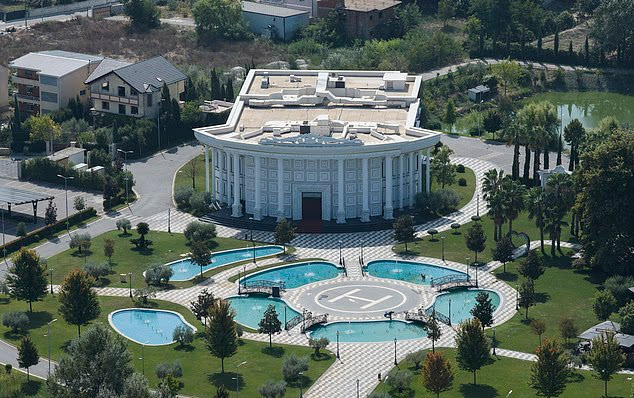
With its pillared frontage, helipad, lake views and huge sun terrace, it’s little wonder that Albania’s Ajman Park has become a hit with tourists.
The modern leisure complex just 20 miles to the west of the country’s capital Tirana offers the finest in family-friendly accommodation, with children’s play areas, outdoor hot tubs and a choice of restaurants – there’s an Italian, a steakhouse and one offering sushi.
On social media sites, British visitors lavish praise on the five-star resort, with one mother from Bristol who stayed there with her family describing it as ‘stunning’.
Such guests are among more than a million UK tourists expected to visit Albania this year as the Balkan state, not so long ago an international pariah under hardline communist rule, revels in its newfound status as one of Europe’s most fashionable destinations.
And yet there is one vital detail about Ajman Park its British visitors are almost certainly unaware of. According to prosecutors, the site was in part bankrolled by millions of pounds made by an international Albanian cocaine mafia operating in the UK.
And it is far from the only resort financed by drugs being sold in Britain. A Daily Mail investigation has discovered that for years, drug barons and people-smuggling kingpins have funnelled billions back from their illegal businesses to launder it in their home country’s booming construction and tourism sectors.
It turns out this dirty money has been used to build many of the sun-kissed resorts along the Aegean and Ionian coasts that have been buzzing all summer with UK holidaymakers.
Albania’s five-star Ajman Park is hugely popular with British tourists, but prosecutors say the site is partly bankrolled by millions of pounds made by an Albanian cocaine mafia in the UK
The resort’s owner, Julian Balla, is now on the run, as he is wanted for his alleged connections to cocaine trafficking networks, suspected drug smuggling and money laundering
Much of the gleaming new high-rise skyline in Tirana – itself a popular city break destination – has also been constructed with the illicit gains made from drug sales in Britain.
The sheer scale of the Albanian drug lords’ operations here is terrifying. More than 450 Albanian-run cannabis factories have been found in the UK in the past four years, in what is now the cornerstone of a trade worth £2.6billion annually.
When I visited Albania this week, officials there told me proudly that in recent years they have seized 2,500 properties from suspected criminals, including several high-end tourist resorts.
But this is just a fraction of the assets being funded by crooked money. One economist calculates up to £1.3billion of criminal cash a year is now being pumped into the Albanian economy, adding that construction is the main ‘washing machine’.
The work of prosecutors targeting the drug lords is hampered, they say, by the Albanian government turning a blind eye to the phenomenon because of the huge investment the criminals deliver.
One analyst describes it as ‘state-sponsored money laundering’. That said, the authorities have finally cracked down on the Ajman Park resort in Shijak, which advertises itself with the slogan: ‘Chill out in paradise.’
Its owner, Julian Balla, is on the run, wanted by Albanian prosecutors for his alleged connections to one of the world’s most powerful cocaine trafficking networks and for suspected drug smuggling and money laundering.
Officials seized the resort along with a string of other properties last year as part of their ongoing probe into the global smuggling operation which, they say, was masterminded by Albanian brothers Franc and Hajdar Copja from a house in Tottenham, north London. Along with a convicted murderer called Ervis Cela, they are accused of using a network of 30 henchmen to smuggle billions of pounds worth of cocaine from South America to Europe.
Much of it was trafficked into the UK, the most lucrative market for a crime empire so powerful its decisions dictate cocaine prices across Europe.
Hajdar Copja, pictured in Dubai, is believed to have masterminded a global drug smuggling operation, along with his brother Franc, from a house in north London
In 2024, the two Copja brothers were charged by Albanian’s Special Court Against Corruption and Organised Crime (SPAK) with seven murders and two attempted murders, as well as drug trafficking and money laundering. Franc, the younger brother, is accused of offering £4.3million for a hit on the leader of a rival smuggling ring as part of a violent gang war after a 50kg cocaine shipment went missing on its way to Britain.
Prosecutors allege the drug barons were making so much money that their social media messages show them bickering over whether to hide their booty under olive trees in Albania or convert it into gold bullion. They instead chose property, with Franc funnelling at least £6.4million into a string of high-end Albanian construction projects, it is claimed.
These include four £1.5million villas in a luxury development called Mandarine Drive in a wealthy Tirana suburb, a coastal apartment in west Albania and Solis Farm, an agrotourism resort near the capital which included a hotel, guesthouse, holiday villas, bar and restaurant.
Anti-corruption campaigners also allege the gang was heavily involved in recent tourist developments in Ksamil, an Ionian Sea resort dubbed the ‘Maldives of Europe’ – although these were not included in the prosecutor’s seizure. Intercepted messages allegedly show Franc telling an accomplice he was happy to provide cash ‘at any time and for whatever sum’ after he was asked if he could invest almost £2million in a new Tirana apartment block.
Franc Copja was jailed for life in Belgium earlier this year after being convicted of a separate murder there. His brother, last heard of in Dubai, remains at large.
As for Ervis Cela, who was already on the run for murder and kidnapping in Italy, he is in custody in Albania awaiting trial.
The extraordinary tale of how UK-based Albanians sparked a property boom in their home country dates back to the late 1990s, when the first wave of migrants arrived in Britain and started sending back money to build large family houses.
As I witnessed this week, Tirana and other cities are littered with oversized villas dating from this period, often unoccupied and only half built because their owners still live abroad.
But the construction business really took off a decade ago when Albanian gangs began to dominate the cocaine and cannabis industries across western Europe – especially Britain. With so much money to launder, crime bosses began to invest on a huge scale.
Cash was seized from the the two Copja brothers, who were charged by an Albanian court with seven murders, two attempted murders, drug trafficking and money laundering
Cocaine trafficked by the Copja brothers… Albanian gangs began to dominate the cocaine and cannabis industries across western Europe – especially Britain – about a decade ago
‘Estimates are that hundreds of millions of pounds are leaving the UK and ending up in Albania, where it then gets semi-legitimised either into the banking system or to pay for construction work,’ Steve Brocklesby, an intelligence manager with the National Crime Agency (NCA), said in 2022.
While the majority of this activity is carried out by Albanian organised crime groups, there were also ‘indications’ that the Italian mafia were taking advantage of the lax checks.
‘The risks have been low, if not zero,’ says Neritan Sejamini, an Albanian political analyst. ‘It was easy to come to Albania, apply for a construction permit, construct the building, sell it off and enjoy the proceeds.
‘And, unfortunately, the Albanian economy is becoming dependent on it. A lot of tax comes from it, so there is no incentive from the government to limit or cut down on these illegal activities.’
Mr Sejamini said it was telling that none of the government agencies whose job it was to check for potential laundering had ‘raised the red flag’ when approving construction projects.
Indeed, as other Albanian anti- corruption campaigners stressed to the Daily Mail, the alleged Copja crime gang’s assets were discovered only after French investigators cracked their secret messaging system.
Likewise, many other suspected money laundering cases pursued in Albania get under way only after criminals are arrested in other countries and their details passed to the authorities in Tirana.
The racket has skewed the country’s entire economy. In recent years, the Albanian lek has risen sharply against the euro and pound, despite the country’s low productivity and persistent trade deficit – factors which should lead to the currency’s value plunging.
The construction boom also contradicts the usual rules of supply and demand as the surge in the building of luxury apartments continued even as the country’s population growth stalled.
Despite some successes tackling organised crime and state corruption, the Anglo-Albanian cash flow shows no sign of stopping.
TikTok videos seen by the Daily Mail reveal suspected Albanian crooks operating in Britain flaunting wads of £20 notes as they prepare to send it back to their home country. One included an Albanian folk song with the lyrics: ‘Money doesn’t talk but controls the system. When you have a big problem, money solves it’.
So how do they get UK-based criminals to channel their ill-gotten gains back home?
Risena Xhaja, the head of Albanian Seized and Confiscated Assets Management agency, is optimistic that British and Albanian authorities will keep working together to fight corruption
Some employ couriers to smuggle physical cash. In 2018, Albanian brothers Jak and Gjelosh Kolicaj were convicted of smuggling £7million out of the UK using a network of couriers who carried wads of banknotes wrapped in brown packaging concealed in a suitcase that was then placed in a second outer suitcase.
From their Peterborough base they organised 80 trips over two years to countries including Belgium and Greece for onward transportation to Albania.
As the illicit takings grew too large to physically transport, many began using Hawala, an informal money transfer system involving an international network of brokers who operate on trust to circumvent the traditional traceable banking system.
More recently, the NCA suspect gangs are using cryptocurrency to send money seamlessly between borders undetected.
The Copja brothers used a mix of these methods, with prosecutors seizing cryptocurrency worth £7.3million as well as more than £1million in cash which was allegedly spirited out of the UK and back to Albania with their own network of couriers.
It’s a bleak picture. But some are fighting back. Risena Xhaja, the head of Albanian Seized and Confiscated Assets Management agency, this week showed the Daily Mail a specially produced glossy catalogue outlining those 2,500 properties and assets worth £24million that prosecutors have seized in the past decade because they were paid for with suspected crime money.
The haul includes a string of expensive hotels, villas, seaside developments and coastal apartments across the country. Some 300 of the seized or confiscated properties have been rented out, while others have been sold at auction, said Ms Xhaja.
One hotel was given to Albania’s ministry of defence for officers to use for their holidays and training conferences. And a property in Tirana has now been turned into a public gallery.
There have been other successes, too. Emiljan Shega was jailed for ten years for cocaine trafficking in north London in 2013 as part of a gang which made tens of millions from the crime.
Almost a decade later, an Albanian court seized assets worth around £2.5million that he owned in his home country, which included a villa, three apartments and large swathes of land.
So significant is the issue that last month the UK and Albanian governments hailed a ‘historic’ agreement to share the proceeds of criminal cash seized from gangs operating between the countries.
The UK government said the agreement sent a ‘clear message to criminals that British and Albanian authorities will pursue the proceeds of organised crime and work across borders’.
Ms Xhaja was similarly upbeat, describing the development as a ‘game-changer’.
Yet while there is no doubting her determination or the hard work of her team, other experts were more downbeat.
Mr Sejamini says: ‘This might make the criminals hesitate, which is a good thing, but will this really solve the problem? No.’
He added that for that to ever happen, ‘you need the entire government to act and to do what the government is supposed to do – to fight crime, including money laundering’.
When the Daily Mail visited the Ajman Park last week, the place was bustling with a mix of hotel guests and locals enjoying cocktails in its bars and al fresco dining on its terrace.
One of the cheerful staff said they often welcomed British holidaymakers who enjoyed the hotel’s ‘incredible’ rooms.
But, just like those guests from the UK, this worker had no idea who owned the resort or how it had been financed.
After all, the Ajman Park resort’s landscaped gardens and gushing fountains are a world away from the grimy, crime-ridden streets of north London.






































You must be logged in to post a comment Login