


Connect with us
DAPA Banner
DAPA Coin
DAPA
COIN PAYMENT ASSET
PRIVACY · BLOCKDAG · HOMOMORPHIC ENCRYPTION · RUST
ElGamal Encrypted MINE DAPA
🚫 GENESIS SOLD OUT
DAPAPAY COMING

NewsBeat

French Open 2026 results: Adolfo Daniel Vallejo criticised for questioning ‘courage’ of female umpire

Published

on

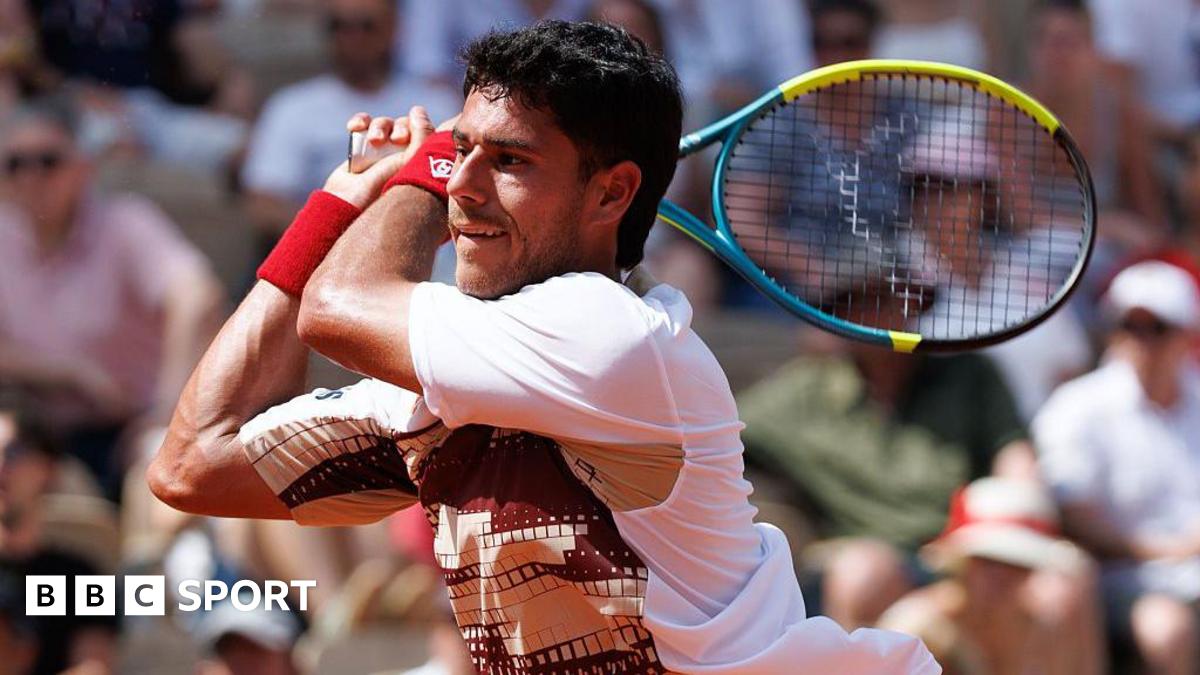
Adolfo Daniel Vallejo, wearing a white patterned t-shirt, plays a backhand with his yellow, blue and black racquet held in two hands over his right shoulder

Vallejo also said he was unhappy with how much time Kouame was given in between points.

Players are only allowed to take up to 25 seconds between points, but umpires can use their discretion as to when to start the shot clock while the crowd settles down.

“I think this sort of matches should be umpired by a man,” Vallejo told Clay magazine, external in an interview listened to and verified by BBC Sport.

“It’s very difficult for a woman to do it because the crowd is very annoying and you need to have a lot of courage to go against the crowd.

Advertisement

“I knew it [the crowd] was going to be like that. It didn’t harm me, it only strengthened him.”

Asked whether having a male umpire would have made a difference, Vallejo added: “Yes, yes, absolutely. The crowd was really disrespectful, but I understand it because they are supporting their home player.”

Vallejo has since taken to social media to defend his comments, stating on X that they have been “taken out of context” and he was referring to Carvalho specifically, rather than all female umpires.

The French Open added: “The tournament strongly condemns all sexist remarks, regardless of who makes them, and offers its support to the match umpire and, more broadly, to all the tournament’s umpiring officials.”

Advertisement

The Grand Slam rulebook states that players “shall at all times conduct themselves in a sportsmanlike manner and give due regard to the authority of officials and the rights of opponents, spectators and others”.

Source link

Continue Reading
Click to comment

You must be logged in to post a comment Login

Leave a Reply

NewsBeat

Why Are Boys Unhappy? The Toxic Subcultures And Lost Playtime Fuelling Childhood Loneliness

Published

on

Why Are Boys Unhappy? The Toxic Subcultures And Lost Playtime Fuelling Childhood Loneliness

It’s well established that people are more stressed, anxious and lonely now than generations ago. While these problems are often examined in adults, they are also more prevalent among teens and kids.

There’s no one reason why society, and specifically kids, are struggling more in today’s world, although screens, digital culture and other modern stressors certainly don’t help. This is true for all young people; however, there are a few issues really affecting boys right now.

Young boys are particularly susceptible to the “manosphere,” which is a toxic culture that leaves them feeling isolated.

The “manosphere” ― which describes the many online communities that preach a culture of toxic masculinity and misogyny ― is a growing problem in society. And young boys are highly susceptible to the harms, said Carine Diverlus, a psychotherapist and founder of Pieces to Peace Psychotherapy in Toronto.

Advertisement

Many men who subscribe to these views believe there’s “prejudice” against men in current society. It also normalises the idea that men are “naturally dominant,” according to the Canadian Museum of Human Rights, and normalises violence toward women and girls.

For those who engage with problematic podcasts, message boards or anti-feminist videos promoting these views, those beliefs “ultimately shape a lot of their own engagements with their surrounding world, but it also creates such a harmful relationship between themselves and self,” Diverlus said.

“They’re being taught to believe that men are superior, that men deserve all these things … but at the root of these beliefs are a lot of insecurities,” she added.

There is also a lot of shame that comes with these toxic beliefs and expectations, because they push boys “to show up in a particular way. There are a lot of actual high standards that come with that, as to what it looks like for them to ‘be a man’ that is either unattainable or unrealistic or just ridiculous,” Diverlus explained.

Advertisement

This contributes to the difficult, heavy emotions young boys carry. Yet, there is nowhere for those emotions to go, because young boys aren’t stereotypically (and certainly not in the manosphere) given permission to feel those emotions, she said.

Boys ― and especially Black boys ― are not allowed by society to have and experience emotions, according to Diverlus. Boys who feel unable to show their emotions may shut down, retreat to their bedroom or even start to yell, she noted.

“There is an encouragement of separation between self and emotion, and the reality is that when you are separating yourself from your emotions, you are separated from self entirely,” Diverlus said. “If you aren’t allowed to be fully yourself, if you aren’t allowed to be fully in your body, and to fully experience life, it ultimately will lead to dissatisfaction, unfulfilment and this general lack of happiness.”

This is confusing for young boys, and it’s also lonely.

Advertisement

“It is such an isolating experience where you don’t feel a sense of safety to go to anyone to talk about what you’re going through,” Diverlus said.

Galina Zhigalova via Getty Images

Children are more lonely and more isolated now because of a breakdown of community and unfair societal pressures.

There has also been a breakdown of community throughout society.

There’s a striking lack of community among everyone, prompting experts to raise alarms about a loneliness epidemic. This crisis is even more heightened in kids and is causing issues for young people, including boys.

Advertisement

“When I was growing up, I lived in a community and felt a connection to my community, to other kids in the community. Families were more connected,” said Kenneth Barish, a clinical professor of psychology at Weill Cornell Medicine in New York. “We’ve become much less connected to a community and kids need communities, kids need support not just from parents and extended families, but from mentors, coaches and teachers,”

There are a number of reasons why we’re less connected now. Parents work more, and they likely work nontraditional hours thanks to our always-on culture. There’s also more stress and economic inequality in society, Barish said, which allows people less time to devote to kids.

When opportunities for relationships break down, that’s “a tremendous source of distress for kids,” Barish said. Adults in a community ― whether it be parents, coaches, aunts or uncles ― often offer encouragement to kids throughout their lives. Without that, their mental health suffers.

“They’re much likely to become discouraged, withdrawn and then at risk for all kinds of mental health problems,” Barish said.

Advertisement

Kids spend less time playing, which can lead to unhappiness as well.

Another area of research that suggests what’s leading to kids’ unhappiness is “less opportunity for play,” according to Barish.

“Play is actually not just fun, although fun is good, fun is healthy,” Barish said. Data shows that kids overall spend less time playing as the focus has shifted from fun and play to academic success ― even in the early grades.

“Schools have decreased the amount of play time and increased the amount of academic time, and that actually is counterproductive because kids need play for their social development,” Barish said. “Play is helpful for their social maturity and for their ability to learn social skills, to learn accommodation to others and to be creative.”

Advertisement

“A decrease in the amount of time that kids are allowed to play may be another contributing factor to why kids are unhappy now,” he added. “Kids who play a lot are happier.”

Here’s what you can do to help.

To help young boys (or any young child) thrive, adults can take steps.

“There’s several really important recommendations,” Barish said. “One is actually just to spend more time listening. This is what we all need, otherwise we get stuck in bad feelings.”

Advertisement

This can cause anxiety and discouragement to take over, he added. But if an adult talks through these emotions with a child, it can help these feelings pass and even give kids tools to work through tough feelings.

Allow them to be soft and to be open with you, Diverlus suggested. You should also share what it looks like to express emotions in a healthy way.

It’s also important to enthusiastically engage with them about their strengths and interests, according to Barish. “That’s the best way to develop our relationship, to begin conversations, and to provide kids with support,” he said.

Another way to increase their happiness and deepen relationships is by playing with your child or grandchild.

Advertisement

“I’m a believer in parents and grandparents playing with kids. I think that’s even better because then they get the benefit not just of play, but of playing with us, and it strengthens our relationship,” Barish explained.

Letting young boys know that you’re proud of them is also important.

“Not just for their accomplishments, not for scoring a goal or getting an ‘A,’ but for their effort and their kindness to others,” Barish noted.

Speaking of kindness, it’s also important to help foster goodness by getting involved as a family in helping others, he said. “Helping others is really good for all of us at every age, even young kids, because it gives them a different sense of what they have to offer.”

Advertisement

Childhood is a time of change as kids grow into adulthood. “There’s so much of a shaping of their future in the world that happens. And I’m sure there’s so many ways that … each and every one of us have interacted with young boys that maybe hasn’t been the healthiest. Maybe it’d be the pressure that we put on them … or it’s the way that we’re trying to get them to feed into being strong,” Diverlus said. “All these tropes carry so much more weight and impact than we actually realise in the moment.”

Living with toxic masculinity is harmful to everyone, not just young boys, Diverlus stressed.

“Toxic masculinity impacts and harms us all… we all end up just being so much more jaded and unhappy as a result of that,” she said.

Advertisement

Source link

Continue Reading

NewsBeat

‘Beautiful’ film that everyone should watch will leave you ‘ugly crying’

Published

on

Daily Mirror

Those who have watched the film revealed they were left crying throughout

Brendan Fraser stars in the “beautifully made” film that made viewers “question how we see life”.

Advertisement

Rental Family, which is now available to stream on Disney+ and stars Shogun actor Takehiro Hira, follows an American actor who is struggling to find purpose after moving to Japan.

Brendan stars as Phillip Vanderploeg who joins an agency in Tokyo called Rental Family, which provides actors to play stand-in family members.

From funeral attendants to stepfathers, Phillip is hired for a number of roles but he slowly begins to form a genuine bond with some of the people he is hired by.

Phillip must decide if he wants to continue working for the agency or return to acting jobs.

Advertisement

Get Disney+ for £5.99

This article contains affiliate links, we will receive a commission on any sales we generate from it. Learn more
Content Image

£5.99

Disney+

Get Disney+ here

A Disney+ subscribtion now starts at £5.99 per month and provides access to hit series like Rivals, Only Murders in the Building and The Bear, plus countless titles from Marvel, Star Wars, Pixar and more.

Advertisement

Posting about the film on Reddit, one viewer shared: “I’ve just watched it today. I am an older person, however this did kick me in the feels. Wonderfully shot, beautifully made. Make the time to see it.

“It’s a slow burner however it did make me think about life and how we see it.

“It made me feel like something is missing in my own life. Maybe for the good or not, i don’t know. Just take out some time and watch.”

Replying, another viewer penned: “I didn’t expect to ugly cry during this one, but I did. I thought it was supposed to be a sweet heartwarming comedy.”

“Loved the film. Great acting all round. Such a heartfelt, funny and touching film. Absolutely loved the cinematography, and the score was sublime,” someone else added.

A third continued: “Just watched Rental Family today. It is an underrated film in my opinion. I was impressed by the storytelling, themes, and character development, and all of that in under 2 hours. Wow!”

The film, which debuted in 2025, has a rating of 88% on Rotten Tomatoes.

Advertisement

Rental Family is available to stream on Disney+

Source link

Continue Reading

NewsBeat

Paraguayan tennis player facing significant fine for ‘sexist remarks’ about female French Open umpire

Published

on

Paraguayan tennis player facing significant fine for ‘sexist remarks’ about female French Open umpire

Paraguayan tennis player Adolfo Daniel Vallejo is facing a “significant sanction” from French Open organisers after suggesting his second-round match should not have been umpired by a woman.

Following his five-set defeat, Vallejo was quoted by Clay magazine as saying: “This sort of match needs to be umpired by a man, it’s very difficult for a woman to do it.”

Tournament organisers swiftly condemned the remarks on Friday, issuing a strong statement that deemed Vallejo’s comments “unacceptable”.

The French Tennis Federation and Roland Garros organisers asserted: “The competence of an umpire is not determined by their gender but by their professionalism and ability to officiate at the highest level. The outcome of a sporting event, whether positive or negative, can never justify or excuse such remarks.”

Advertisement

They confirmed a “significant sanction” in the form of a fine would be imposed, adding that the tournament “strongly condemns all sexist remarks, regardless of who makes them, and offers its support to the match umpire and, more broadly, to all the tournament’s umpiring officials.”

Vallejo made his complaint after losing to Moise Kouame on Thursday
Vallejo made his complaint after losing to Moise Kouame on Thursday (Reuters)

The controversy erupted after Vallejo’s gruelling five-set loss to French teenager Moise Kouame, a match umpired by experienced official Ana Carvalho. The contest, which stretched to four hours and 56 minutes, saw Kouame, 17, triumph 6-3 7-5 3-6 2-6 7-6 (8) amidst a raucous home crowd on Court Suzanne Lenglen.

Vallejo expressed dissatisfaction with Kouame’s pace of play and argued that Brazilian umpire Carvalho lacked the authority to manage the boisterous crowd.

He reiterated his view, stating: “It has to be refereed by a man, because it’s a very demanding crowd and you need a lot of strength to go against the crowd.”

While players are allotted 25 seconds between points, with a visible clock, umpires retain discretion on when to initiate the countdown, particularly when crowd noise is a factor.

Advertisement

He acknowledged the crowd’s behaviour, saying: “The crowd was very out of line, but I understand they are supporting their compatriot.”

Vallejo added: “It’s quite an intense crowd and that’s why I was prepared. I already knew it would be like that and, to be honest, it didn’t harm me, but rather strengthened him.”

He also accused his opponent of time-wasting: “I think he took up a lot of time on many occasions, lying on the floor or stalling. And it’s not normal for the crowd to be shouting for a full minute without any play. In a match where the physical aspect matters so much, if you give a player a lot of time, he’s obviously going to take advantage of it.”

Later, Vallejo took to X (formerly Twitter) to claim his words had been “taken out of context”.

Advertisement
Vallejo was critical of female umpire Ana Carvalho
Vallejo was critical of female umpire Ana Carvalho (Reuters)

He clarified: “I never spoke about women in general, I spoke about the referee specifically, who didn’t handle the crowd at any point during the match.”

He also added: “That said, I also didn’t say that I lost because of her. I congratulated the opponent and it’s normal for the crowd to cheer for the home player.”

Clay magazine, the publication that reported the initial quotes, defended its story, responding: “It’s true that you didn’t say you lost because of her, and we didn’t write that either. Our text explains everything with precision and the appropriate context.”

Source link

Advertisement
Continue Reading

NewsBeat

Cannibal killer who boasted about ‘eating victim with pasta’ refused parole

Published

on

Belfast Live

David Harker, 51, bragged about murdering mother-of-four Julie Paterson and eating her remains with cheese and a bowl of pasta

A killer has been refused parole after he bragged that he had eaten parts of his victim with a plate of pasta David Harker, now 51, killed mother-of-four Julie Paterson, 32, in Darlington in 1998 with just some of her remains have ever been found.

He is serving a life sentence after admitting manslaughter on the grounds of diminished responsibility. It emerged Harker had told friends and psychiatrists that he had fried part of her thigh and eaten it with pasta and cheese.

Advertisement

He has now been refused parole for the ninth time.

He has been eligible for parole since 2013 and this month a ninth hearing was held to determine whether he should be freed or sent to an open prison.

The Parole Board said it was still not considered safe to allow him to be released or to be transferred, based on the continuing need to protect the public.

Harker was 24 when he was sentenced in 1999.

Advertisement

Psychiatrists agreed he had a severe psychopathic disorder when he killed Ms Paterson, meaning he was not guilty of murder.

The Parole Board said the law required Harker’s case to be assessed regularly.

A report into his recent behaviour found that his behaviour in custody had “significantly improved”, with no disciplinary findings since 2015.

Previous decisions have been made using documents but the latest, ninth, heard oral evidence.

Advertisement

Harker did not attend or make representations.

The panel considered a dossier containing 356 pages of reports, including submissions on behalf of the Secretary of State arguing against release.

It heard from the person responsible for managing Harker in jail, two probation officers who would be responsible for managing him in the community, a psychologist and someone who worked with him on a programme in prison.

While the person who worked with him on the programme was not allowed to recommend a course of action, the others said Harker did not pass the test for release.

Advertisement

In its conclusion, a Parole Board summary of the decision said: “The panel carefully analysed all the evidence and formed its own independent assessment of risk.

“It decided not to direct the release of David Harker, nor to recommend to the Secretary of State that David Harker should be transferred to open conditions.”

Source link

Advertisement
Continue Reading

NewsBeat

The Funniest Posts From Parents This Week (May 23-29)

Published

on

The Funniest Posts From Parents This Week (May 23-29)

Kids may say the darndest things, but parentspost about them in the funniest ways.

Every week, we round up the most hilarious quips from parents across social media platforms like X, Threads and Bluesky to spread the joy. Scroll down to read the latest batch.

Source link

Advertisement
Continue Reading

NewsBeat

Euromillions and Thunderball winning numbers for Friday, May 29 – live

Published

on

Wales Online

To win the full estimated £111 million jackpot — or a share of it if there are multiple winners — players must match all seven numbers, which include the five main numbers and the two Lucky Stars. However, the game also offers tiered prizes, so even if you don’t hit the jackpot, you could still walk away with a smaller win.

Source link

Continue Reading

NewsBeat

I Was 6 When My Father Decided We’d Sail Around The World. I Would Be Trapped On That Boat For Nearly A Decade.

Published

on

I Was 6 When My Father Decided We'd Sail Around The World. I Would Be Trapped On That Boat For Nearly A Decade.

It has taken me decades to be ready to tell this story. Until I reached the safety of adulthood and created my own family, I wasn’t able to confront my parents’ story about my past. In their telling, I was “privileged.” After all, I grew up on a beautiful boat called Wavewalker, sailing around the world.

Of course I knew their story wasn’t true. Although I had grown up on Wavewalker from the age of 7 for almost a decade, I was trapped there — unable to go to school or have friends. While my brother was allowed to help out on deck, I was expected to cook and clean down below for hours each day.

My normal life in England ended when I was 6 years old and my father announced that we were going to sail around the world. He wanted to recreate Captain Cook’s third voyage, which would take three years. This was a long time – but we would be back, he promised, before I was 10. That meant that even though I was leaving my best friend Sarah, my beloved water spaniel Rusty, and my dollhouse behind, they would all be waiting for me when we returned.

Except that wasn’t what happened. We set sail from England a year after that announcement, and it was a decade before I returned alone at the age of 17. Most of the time in between I lived on Wavewalker and was unable to go to school. We often ran out of fresh food – and sometimes almost ran out of water – on longer voyages. When that happened, we relied on canned and dried food, and my father allowed us each a cup of water a day for drinking and washing.

Advertisement

Photo Courtesy Of Suzanne Heywood

The author on Wavewalker.

One of the challenges of my childhood, I grew to understand, was that my parents’ narrative looked true – we seemed to be living a privileged life by being able to sail to gorgeous places like Vanuatu and Fiji in the South Pacific. But the reality was very different.

For a start, I learned early on our voyage how dangerous the ocean could be. A few months after we left England, we were hit by an enormous wave when my father attempted to cross the Southern Indian Ocean accompanied only by two novice crew members, my mother (who didn’t like sailing) and his two small children. I fractured my skull and broke my nose in that accident and had to endure multiple head operations without anaesthesia on the small atoll that we eventually found in the middle of the ocean.

But my life on Wavewalker wasn’t just physically dangerous. Living on a boat for a decade meant that I could rarely have friendships, I had little or no access to medical care and I couldn’t attend school.

Advertisement

As I turned into a teenager, I had no private space. Instead I had to share the one working toilet we had on board with my family and up to eight or nine crew, and to share a cabin with adult crew members.

As the years went on, it became clear that my parents had no intention of fulfilling their promise to return home. I had no way of leaving the boat – I had no passport or money. But more than that, I had nowhere to go.

We’d set sail when I was a small child, and after that I never saw any of my relatives again. Apart from my parents, I had no other adults in my life apart from the crew members who came and went. The only people I saw in authority were the customs and immigration officials who boarded our boat when we arrived in each new country, and they never expressed any interest in the welfare of the two children they found there.

While Wavewalker represented freedom for my parents – they could pull up the anchor and sail away whenever they wanted – it was a prison for me.

Advertisement

I eventually realised that the only way I would ever escape Wavewalker was if I found a way to educate myself. I tried to convince my parents to let me go to school, and six years after setting sail, they finally agreed to allow me to enrol in an Australian correspondence school. I was 13 years old.

While it was clear to me that my only possible escape was through education, studying by correspondence on a boat was very difficult. By this time my father had turned our boat into a sort of “floating hotel” to pay for our endless voyage, and my parents wanted me to work rather than spending my days with my nose in my books.

There were also more practical issues. I had no postal address and I had no space in which to study apart from the one small table in our main cabin. Sometimes I would hide myself inside a sail at the front of the boat to study, knowing no one would come looking for me there. I had to fight my father for paper, which was an expensive commodity in the South Pacific. Whenever we reached a major port, I sent off the lessons I’d completed and asked the school to send them back to the post office at our next port of call, but if my father decided to change course, my lessons went astray.

I found the correspondence lessons very challenging, partially because I had missed a lot of education and because it was very difficult to learn remotely without being able to talk to a teacher. I knew, however, that I had no choice – it was my only way out.

Advertisement
The author studying on Wavewalker.

Photo Courtesy Of Suzanne Heywood

The author studying on Wavewalker.

After three years of studying by correspondence while at sea, when I was 16 and my brother was 15, my parents decided to put my brother into a school in New Zealand. (As my father once explained it to me, my education was less important since I would never have to support a family.)

When my parents sailed away, I was left behind to look after my brother, doing the shopping, cooking and cleaning while he went to school each day and I tried to keep studying by correspondence. For nine months, we lived alone in a small hut beside a lake in a country in which I only knew one adult (who lived several hours away). My father left a small amount of money in a bank account that I could only access by forging his signature.

I kept working through my correspondence lessons, posting them off each week. I also wrote to every university I’d ever heard of, asking them if they would let me apply to be a student. Most wrote back saying that they would not consider me.

The local universities wouldn’t consider me because I was an English citizen, and the English ones wouldn’t consider me because they thought my qualifications were too hard to assess. But eventually Oxford University wrote back and ― after I sent them two essays – offered to interview me if I could find some way to get myself back to England. So I used money I’d earned picking kiwis, together with a small contribution from my father, to buy a one-way plane ticket, betting everything on that meeting.

Advertisement

Amazingly, Oxford gave me a place, and I went to university the following year. By that time, however, my relationship with my parents was tenuous. I really struggled that first year at university – not only because I had almost no money and survived mainly on cans of tomatoes and dried pasta, but also because I found it hard to fit in socially after so many years of isolation.

The good news is that after that tough first year, I started to make friends, and with access at last to libraries and laboratories, I thrived academically. After finishing my degree, I went on to do a Ph.D. at Cambridge University and then joined the UK government, working in the Treasury. It was there that I met my wonderful husband, Jeremy. When I became a parent myself – Jeremy and I had three lovely children – I was determined to treat my children very differently. I make it clear to them that my love will always be unconditional, and that I will always be there for them if they need me.

The author's book about her time on the boat.
The author’s book about her time on the boat.

When my parents eventually returned to the UK, I tried several times to talk to them about the past, but they always reacted defensively, stating that it had “all worked out fine in the end.”

I knew I would probably lose the remaining relationship I had with them when I told the true story about my childhood. However, I never doubted that I would write about my time on Wavewalker. When my children reached the same age I was when I was struggling with my loneliness and lack of access to education, I at last saw my childhood through a mother’s eyes. I knew that I no longer had an obligation to maintain my parents’ narrative: My childhood was certainly unusual, but it was never privileged.

Author’s Note: This essay is an account of my childhood as I experienced it, and based on extensive diaries and other documents from the time. Others who were present may have experienced it differently. But this is my story.

Advertisement

This piece was previously published on HuffPost. We’re sharing it again as part of HuffPost Personal’s “Best Of” series.

Do you have a compelling personal story you’d like to see published on HuffPost? Find out what we’re looking for here and send us a pitch.

Source link

Advertisement
Continue Reading

NewsBeat

Richard Osman baffled by wrong Pointless claim made on X

Published

on

Richard Osman baffled by wrong Pointless claim made on X

Osman presented both Pointless and the celebrity version of the show with Alexander Armstrong and has corrected claims made by TV Zone.

He quoted one of its posts, which said that Pointless Celebrities had stopped broadcasting, calling it “new” information.

Osman was quick to react to the post, sharing his confusion and putting the claims right, saying: “No idea where this news has come from today, we stopped making this show in 2022!”

Advertisement

Replying to Richard, one person explained: “They dragged out the airing of the episodes so much that they were still showing new ones as recently as August 2025!

“I’m still not 100% sure they’ve shown them all!”

To which he jokingly replied: “It’s nice to see myself in my early thirties though.”

Advertisement

One person suggested: “It probably came off the back of the news Pinkpantheress wanting to appear on the regular Pointless but being told no.”

Pop star Pinkpantheress, whose real name is Victoria Walker, said at a concert in Manchester that she got through to Pointless’ final application stage but was told she couldn’t take part in the show, reports The Independent.

She couldn’t progress to filming as the show realised who she was.

The 25-year-old told the crowd: “It’s my favourite trivia show, and I wanted to be on the show.”


The biggest ever British game show jackpot winners


She went on: “And I made it to before they put you on TV at the last stage.

Advertisement

“I was in Manchester, I was ready to go on TV to play Pointless.

“Then someone comes in, and he goes ‘wait, hold on – we know who you are.’”

Pinkpantheress says she couldn’t do the show “because I’m too famous” even though she vowed to donate any money she won to charity.


Recommended reading:

Advertisement

Richard Osman on the future of Celebrity Pointless

Someone else asked Richard what the future holds for the BBC gameshow: “Is it likely/possible to return?

“Or is there a definitely no more?”

He said: “Definitely no more from me, but who knows!”

What’s your favourite quiz show? Let us know in the comments.

Advertisement

Source link

Continue Reading

NewsBeat

Cain’s gesture in Emmerdale for honorary Dingle Kammy will leave you teary-eyed | Soaps

Published

on

Cain's gesture in Emmerdale for honorary Dingle Kammy will leave you teary-eyed | Soaps
The face of a happy man! (Picture: ITV/Metro)

Emmerdale’s Cain Dingle (Jeff Hordley) is a lot of things, but on the odd occasion…he can actually be quite thoughtful.

This week, Belle Dingle (Eden Taylor-Draper) feared she had fallen for another man’s manipulative ways when Aaron Dingle (Danny Miller) told her that he believes Kammy Hadiq (Shebz Miah) is the Emmerdale Farm firestarter.

Kammy looked like the culprit because Aaron and Robert Sugden (Ryan Hawley) caught him in a field with a petrol can and lighter in hand. He revealed to the couple that he was planning on torching his car, but due to the fact Kammy didn’t reveal everything about his situation, it looked like the claim about his vehicle was just a cover up.

In reality, Kammy wanted to burn his beloved Kamilla for an insurance claim. He told best friend Vinny Dingle (Bradley Johnson) that he wanted to pretend that the firestarter had burnt his car so he could get some money.

Advertisement

This led to Kammy revealing to Vinny that he’s currently homeless and has been sleeping in one of the barns on Robert’s farm. Belle arrived a few moments later, but left with a broken heart as Kammy couldn’t bring himself to tell her about the life he’s been living.

To view this video please enable JavaScript, and consider upgrading to a web
browser that
supports HTML5
video

Advertisement
Kammy in the pub looking suspicious in Emmerdale
We finally learnt more about Kammy’s life this week (Picture: ITV)

He had a moving conversation with her yesterday though, and it came after Vinny told Aaron and Belle the truth about the young man. Kammy explained to Belle that his whole world fell apart when his father died. He said that he couldn’t handle being at home and witnessing his devastated mum attempt to process her grief, so he passed the time by stealing cars with his sister.

Kammy’s sister got into an accident at one point but he took the fall for her. He was very nearly handed a prison sentence, but the court recognised the troubled teens were trying to distract themselves from a family tragedy.

Still, because of Kammy’s choices, he left the home and his community. He berated himself for causing his mum so much pain, and believed everything that happened to him after was well deserved.

Kammy expected Belle to view him as someone ‘sad and alone’, but she was desperate to support him. That evening, Kammy sat at the dinner table with the rest of the Dingles and was told that he’d be looked after by them for as long as he needs.

Robert and Aaron approach Kammy in the middle of a field in Emmerdale
The beloved character had been sleeping in one of the barns on Emmerdale Farm (Picture: ITV)

This was very sweet, and Kammy was touched, but Cain realised today that there was actually a bit of a problem having another person live at Wishing Well.

At the moment, Belle, Cain, Moira Dingle (Natalie J Robb), Kyle (Huey Quinn), Isaac (Bobby Dunsmuir), Sam Dingle (James Hooton) and Lydia Dingle (Karen Blick) all reside there, which meant adding Kammy to the mix made an already packed house even more cramped.

Advertisement

Don’t miss a Soaps scoop! Add us as a Preferred Source

As a loyal Metro Soaps reader, we want to make sure you never miss our articles when searching for stories. We have all the latest soaps news, spoilers, videos, and interviews, with a vibrant community of highly engaged readers.

Click the button below and tick Metro.co.uk to ensure you see stories from us first in Google Search.

Add us as a Preferred Source

Soaps authors collage Fact box image only Picture: Metro
Now you can ensure you never miss a story from the Soaps team
Advertisement

After being summoned to the scrapyard in today’s episode, Kammy was over the moon when Cain presented him with a caravan to live in, right by Wishing Well so he can still enjoy Lydia’s homecooked meals.

The caravan (if his car is called Kamilla, this definitely needs a name) is a bit run down, and Kammy definitely needs to add his flair to it, but it’s a space he can call his own.

Most importantly, though, it’s a home.

Advertisement

Source link

Advertisement
Continue Reading

NewsBeat

Mum of Archie Battersbee jailed after forcing driving off road believing he ‘bottled family member’

Published

on

Daily Record

Hollie Dance was found guilty of causing grievous bodily harm with intent, while her son Thomas Summers was convicted of related charges

The mother of Archie Battersbee has been jailed after a road revenge incident against the ‘wrong’ man. Hollie Dance and her son Thomas Summers forced a man off the road believing he had ‘bottled’ a member of their family.

Dance, 50, was behind the wheel of a BMW in October 2022 as she pursued the victim’s Peugeot from Southend to Basildon in Essex, eventually forcing him off the road. DailyStar reports Dance is the mother of Archie Battersbee, who tragically passed away at the age of 12 in August 2022 following a High Court battle.

Advertisement

Her mitigation emphasised the “harrowing months” she had endured prior to her criminal behaviour. Prosecutor Richard Scott informed Basildon Crown Court that the other driver was “run off the road by Hollie Dance, forcing him into a tree” and ejecting him from his vehicle.

Her son Summers, 26, who was operating a rented Toyota, then “rammed into (the man) and sent him into a bush”, Mr Scott added. The prosecutor stated that the man sustained injuries including a fractured and dislocated shoulder and a foot fracture.

Mr Scott explained that the backdrop to the incident was that the defendants, both from Southend, “believed the complainant in this case had been involved in an incident in which another member of their family had been hurt”.

He revealed that the family member was Dance’s daughter, Summers’ sister.

In a victim impact statement summarised by the prosecutor, the man said he was “aware there were rumours I had bottled someone prior to the collision”. “I can confirm this is not true, this is something I would not have done,” the man declared.

Both defendants were convicted following an earlier trial of causing grievous bodily harm (GBH) with intent. Dance admitted dangerous driving and was convicted of possessing a prohibited weapon – a gas canister.

Summers admitted causing serious injury by dangerous driving and was convicted of affray. Archie Battersbee died after his life support was withdrawn following failed attempts to overturn a High Court ruling that doctors could lawfully do so.

Advertisement

An inquest later determined the boy, who was discovered unconscious with a ligature over his head at home in Southend, died accidentally in a “prank or experiment” that went wrong and had not intended to harm himself. Bibi Ihuomah, for Dance, said an expert described the defendant as “a woman whose life had been profoundly damaged by a terrible event”.

She continued: “She had been through five harrowing months. In the sixth month, which was August, her son’s life support was withdrawn. The night before the offences she had been assessed regarding her mental health status.”

Archie’s funeral took place on September 13, 2022, and Ms Ihuomah said “weeks after the burial of her son these offences were committed”. Mr Scott said Dance had previous convictions including for actual bodily harm (ABH) in 1996 and drink-driving in 2017.

Advertisement

Emily Lauchlan, for Summers, said it was an “impromptu pursuit without forward thinking or planning”. The judge, recorder Peter Clark, addressed the defendants, stating that the loss of Archie was “desperately sad” and that afterwards “somebody assaulted and injured your daughter and your sister”.

He emphasised that there are “correct ways to respond to unlawful behaviour”. “Your response was completely unlawful, you sought revenge,” he admonished them.

He further noted that “all the evidence suggests you sought revenge against a person wrongly identified as the perpetrator”.

He sentenced Dance to four years in prison and imposed a driving ban of 43 months. Summers received a five-year prison sentence and a four-year driving ban.

Advertisement

As she was led to the cells on Friday, Dance blew a kiss to the public gallery, while Summers made a peace sign when he was led down separately afterwards.

Source link

Continue Reading

Trending

Copyright © 2025