

For many musicians, there’s no indicator they’ve made it quite as big as winning a Grammy.
However, there are a select few A-listers who have proved that you can still have make a huge impact in the music industry without ever taking home one of those coveted gold gramophones.
From multi-nominated rappers to legendary singers and groups who managed to slip through the awards show’s net, here are 19 huge artists that have made a massive impact in the music world, but still have a Grammy-shaped gap on their mantelpiece…
Diana Ross
Advertisement
Jim Dyson via Getty Images
Despite more than 50 years in the entertainment industry, Diana Ross never won any of the previous 13 Grammys that she has been nominated for.
However, her contribution to the music world is so inarguable that the Recording Academy eventually granted her a Lifetime Achievement award in 2012, while the Supremes received the same honour in 2023.
Ms Ross was most recently nominated for a competitive Grammy in 2024, but lost out to Michael Bublé on the night.
Advertisement
Bob Marley
Michael Ochs Archives via Getty Images
He may be remembered the world over as a trailblazer in the world of reggae music, but Bob Marley was never even nominated for a Grammy in his lifetime, let alone awarded one.
The genre-specific Best Reggae Album award was introduced at the Grammys in 1985, four years after Bob Marley’s death. His son, fellow musician Ziggy Marley, is the artist who has won in this category the most times.
Katy Perry
Advertisement
Since I Kissed A Girl was released in 2008, Katy Perry has been nominated for a total of 13 Grammys, including a coveted nod in the Album Of The Year category for Teenage Dream.
As of yet, she’s yet to win one, though, with her last nomination coming in 2015 off the back of her Prism album.
Nicki Minaj
Leon Bennett via Getty Images
Nicki Minaj is slightly behind her former collaborator Katy Perry on 10 nominations without a win, last receiving a nomination in 2016 for her album The Pinkprint.
Three years later, she criticised the Grammys once again, claiming she’d missed out on a nomination because her song Super Freaky Girl was being considered in the pop categories, rather than rap, which she’d submitted it as.
Snoop Dogg
imageSPACE/MediaPunch/IPx
Snoop Dogg is officially the Glenn Close of the Grammys, as he’s the artist with the most nominations and zero wins (joint with singer-songwriter Brian McKnight).
The rapper has 17 Grammy nominations to his name, and was last nominated in 2016, for his contribution to Kendrick Lamar’s album To Pimp A Butterfly.
Advertisement
Queen
Pete Still via Getty Images
In Freddie Mercury’s lifetime, Queen received a total of four Grammy nominations for their hits Bohemian Rhapsody and Another One Bites The Dust, though none of these translated into a win.
The band was eventually awarded the Lifetime Achievement Award in 2018, the same year their album A Night At The Opera was inducted into the Grammys Hall Of Fame.
Nine UK number one singles. Hundreds of millions of records sold. Not one but two jukebox musicals that solely feature their music. And yet, zero Grammy wins.
In fact, it took until 2021 for them to even be nominated, when their comeback song I Still Have Faith In You was recognised in the Record Of The Year category.
Follow-up album Voyage later picked up four nominations in 2023, including Album Of The Year, though sadly none of these translated into a win, either.
Advertisement
The Academy did also kind of make up for their past oversights by inducting Dancing Queen into their Hall Of Fame in 2015, though.
Jimi Hendrix
Michael Ochs Archives via Getty Images
Sadly, the legendary singer and guitarist is another musician who the Recording Academy only recognised after his death (unless you count his sole nomination for his guitar of The Star-Spangled Banner).
After being awarded Lifetime Achievement in 1992, he’s since won some posthumous Grammys and had his work inducted into the Hall Of Fame on more than one occasion.
Advertisement
Björk
Santiago Felipe via Getty Images
Known for her unique and avant-garde approach to music, Björk has a hefty 16 Grammy nominations under her belt, placing her high up on the list of musicians who’ve received the most recognition without an actual win.
Her most recent nomination came in 2023, when her album Fossora lost out in the Best Alternative category to Wet Leg’s self-titled debut.
Pet Shop Boys
Advertisement
Andrea Friedrich via Getty Images
Undoubtedly one of the most celebrated pop acts Britain has ever produced, with 15 albums to their name and a Brit Award for Outstanding Contribution, Pet Shop Boys have still somehow never won a Grammy.
They have been nominated on six occasions, though, most recently in 2010 for their Xenomania-produced Yes album.
Lana Del Rey
Andrew Chin via Getty Images
Spread out over a decade, Lana Del Rey has a total of 11 Grammy nominations.
Advertisement
Five of these fell in 2024, and while it wasn’t to be for Lana that night, she did end up getting dragged up on stage by Taylor Swift after her album Midnights – on which the Video Games singers lent her vocals to the fan-favourite Snow On The Beach – was awarded the night’s top prize.
BTS
Kevin Mazur via Getty Images
As one of the biggest and most recognisable K-pop groups on the planet, BTS have fans all over the world and have now charted on both sides of the Atlantic.
They were also the first Korean pop act to be recognised at the Grammys, where they’ve now been nominated five times (including three in 2023), albeit without a win as of yet.
Advertisement
Sia
Hell Gate Media/Shutterstock
She’s known as much for her own music as she is for her songwriting credits for artists including Beyoncé and Rihanna.
But despite nine nominations, Sia is yet to win a Grammy for any of her musical offerings.
Tupac Shakur
Advertisement
Raymond Boyd via Getty Images
In his lifetime, Tupac earned just two Grammy nominations, both for his album Me Against The World, but lost out on the night to Coolio and Naughty By Nature.
Following his death in 1996, Tupac racked up a further four posthumous nominations, though none of these led to a win, either.
Guns N’ Roses
Gary Miller via Getty Images
Guns N’ Roses have sold a whopping 100 million records worldwide, and in 2012 were inducted into the Rock And Roll Hall Of Fame.
Advertisement
Between 1990 and 2019, the rock legends also racked up four Grammy nominations, but never managed a win.
The Beach Boys
Dan MacMedan via Getty Images
Despite their undeniable impact on pop music, the Recording Academy never gave The Beach Boys a competitive Grammy win.
They do have a lifetime achievement award, though, and their iconic Pet Sounds album also has a place in the Grammys Hall Of Fame.
Advertisement
Arctic Monkeys
During their time in the spotlight, Arctic Monkeys have scooped an impressive seven Brit Awards, though they’ve not yet managed to win a Grammy.
They have been nominated nine times in total, though, most recently in 2024 for their album The Car.
Post Malone
Dave Simpson via Getty Images
Rapper and singer Post Malone has an impressive 18 Grammy nominations, including two Album Of The Year nods.
Advertisement
In 2025, he went into the night with a hefty eight nominations for his album F-1 Trillion and collaborations with Taylor Swift and Beyoncé, though he once again wound up coming home empty-handed.
Robbie Williams
Andreas Rentz via Getty Images
It’s been well-documented that Robbie Williams’ mammoth success on his home turf has never quite translated across the Atlantic, and despite having the most Brit Awards and UK number one albums of anyone in history, he’s never managed to win a Grammy.
Interestingly, he has been nominated for two in the past, but neither were actually for his music.
Advertisement
Robbie’s first nomination was for the music video for 1 Giant Leap’s My Culture, on which he was a featured artist. Meanwhile, his second was in the Best Music Film category for his live show at the Royal Albert Hall.
Lulu has made claims about her ex-husband Maurice Gibb’s supposed ‘secret child’ (Picture: Rex)
Lulu has revealed she recently learned her late ex-husband Maurice Gibb may have fathered a child with another woman while they were still married – something that son has now contradicted.
The singer made the claim during an appearance on Louis Theroux’s podcast, where she reflected on her relationship with the Bee Gees star and the unexpected revelations that have emerged years after his death about possible secrets he was keeping.
Lulu, who was married to Gibb for six years before their split in 1973, said she had only recently been shown evidence suggesting he had a son following a one-night encounter.
‘I think he’s got a son. It might have happened when we were married. I just found out,’ she said, adding that DNA testing appeared to confirm the claim.
Advertisement
However, Nick Endacott-Gibb, 57, insists he was conceived around two years before Lulu and Maurice first got together.
Lulu opened up about the ‘secret child’ rumours on Louis Theroux’s podcast (Picture: @louistheroux)
He told the Mirror: ‘I was born in April 1968, conceived in August 1967. Lulu and Maurice weren’t married until 1969, after what has been described for decades as a “whirlwind” romance.
‘Were you together with him, Lulu? Two years does not a whirlwind make. I’m as curious as she is about whether Maurice was with her at the time I was conceived. It was the summer of love, after all!’
Nick was adopted by a couple, Peggy who was a secretary and David who was a chartered quantity surveyor, at 18 months old from a children’s home.
Lulu explained on the podcast that she had not focused on when the child may have been conceived, suggesting it was not something she felt compelled to investigate further.
Advertisement
She said that she chose ‘not to focus’ on when the child was conceived (Picture: Hulton-Deutsch Collection/CORBIS/Corbis via Getty Images)
Gibb, who died in 2003, is known to have had two children with his second wife Yvonne Spenceley, but questions around a possible third child have circulated for years.
In 2019, musician Endacott-Gibb publicly claimed he was Gibb’s biological son after a DNA test showed a match with Gibb’s son, Adam.
Despite this, he said at the time that some family members continued to dispute the findings.
Nick spent years searching for his biological parents before discovering a connection to band studio manager Patti Nolder, who had worked closely with the Bee Gees. Further testing, including DNA results from a genealogy website, appeared to confirm the link.
Reflecting on the situation, Lulu spoke about how her outlook on life has changed, admitting she once viewed things too rigidly.
Advertisement
The singer talked about her romantic history (Picture: Tim P. Whitby/Getty Images for Disney)
‘I think I used to take myself way too seriously,’ she said, adding that experience had taught her that life is rarely straightforward and often filled with grey areas.
The conversation also turned to her life after her marriage ended. Following their divorce, Lulu began a relationship with celebrity hairstylist John Frieda, which was later complicated by a brief romance with David Bowie.
‘I had a brief relationship with him, we had a fling,’ she said, acknowledging the situation created tension at the time.
The pair were married in 1969 (Picture: Getty Images)
Despite their separation, Lulu and Gibb later shared a reunion on stage in 2002, when she invited him to perform on her television special.
She said it was a meaningful moment that offered both of them a sense of closure and a chance to reconnect publicly.
‘It seemed to close the circle,’ she said, adding that it allowed Gibb to be recognised in his own right.
Advertisement
The full interview is available now on The Louis Theroux Podcast.
Got a story?
If you’ve got a celebrity story, video or pictures get in touch with the Metro.co.uk entertainment team by emailing us celebtips@metro.co.uk, calling 020 3615 2145 or by visiting our Submit Stuff page – we’d love to hear from you.
TOKYO (AP) — Global shares dipped Monday across the board, as oil prices continued to climb after U.S. President Donald Trump’s latest comments dashed hopes for an early end to the war in Iran.
France’s CAC 40 lost 1.5% in early trading to 7,548.83, while Germany’s DAX dove 2.0% to 21,944.26. Britain’s FTSE 100 fell 1.7% to 9,754.80. U.S. shares were set to drift lower with Dow futures down 0.5% at 45,659.00. S&P 500 futures fell 0.7% to 6,515.25.
In Asia, Japan’s benchmark Nikkei 225 dropped 3.5% to finish at 51,515.49. In Taiwan, the Taiex shed 2.5% to 32,722.50. Australia’s S&P/ASX 200 fell 0.7% to 8,365.90. South Korea’s Kospi dove 6.5% to 5,405.75. Hong Kong’s Hang Seng slipped 3.5% to 24,382.47, while the Shanghai Composite declined 3.6% to 3,813.28.

Trump over the weekend warned the U.S. will “obliterate” Iran’s power plants if it doesn’t fully open the Strait of Hormuz within 48 hours, prompting Tehran to say it would respond to any such strike with attacks on U.S. and Israeli energy and infrastructure assets in the region.
Advertisement
“Trump’s ultimatum and Iran’s retaliatory warnings point to a widening conflict that keeps energy disruption and market volatility elevated with no clear off-ramp in sight,” said Ng Jing Wen, analyst at Mizuho Bank in Singapore.
Higher oil prices, which also shook stock markets on Friday, dashed hopes for a possible upcoming cut to interest rates by the Federal Reserve, analysts said. Before the war, traders were betting that the Fed would cut rates at least twice this year. Central banks in Europe, Japan and the United Kingdom also recently held their interest rates steady.
But analysts observed that the markets were starting to react less to each of Trump’s remarks, perhaps deciding the narrative for markets was being set elsewhere, not Washington, such as what Iran might do but how global economic growth could be affected by soaring energy prices. Some Asian nations, like Japan, are vulnerable to higher energy prices.
In energy trading, benchmark U.S. crude added $1.62 to $99.85 a barrel. Brent crude, the international standard, gained $1.42 to $113.61 a barrel. The price of Brent crude has zigzagged lately from about $70 per barrel before the war began to as high as $119.50.
Advertisement
In currency trading, the U.S. dollar rose to 159.53 Japanese yen from 159.22 yen. The euro cost $1.1526, down from $1.1571.
___
AP Business Writers Chan Ho-him in Hong Kong, and Stan Choe in New York contributed to this report.
Manchester City beat Arsenal in the Carabao Cup final and will now hope to chase down Mikel Arteta’s side in the Premier League
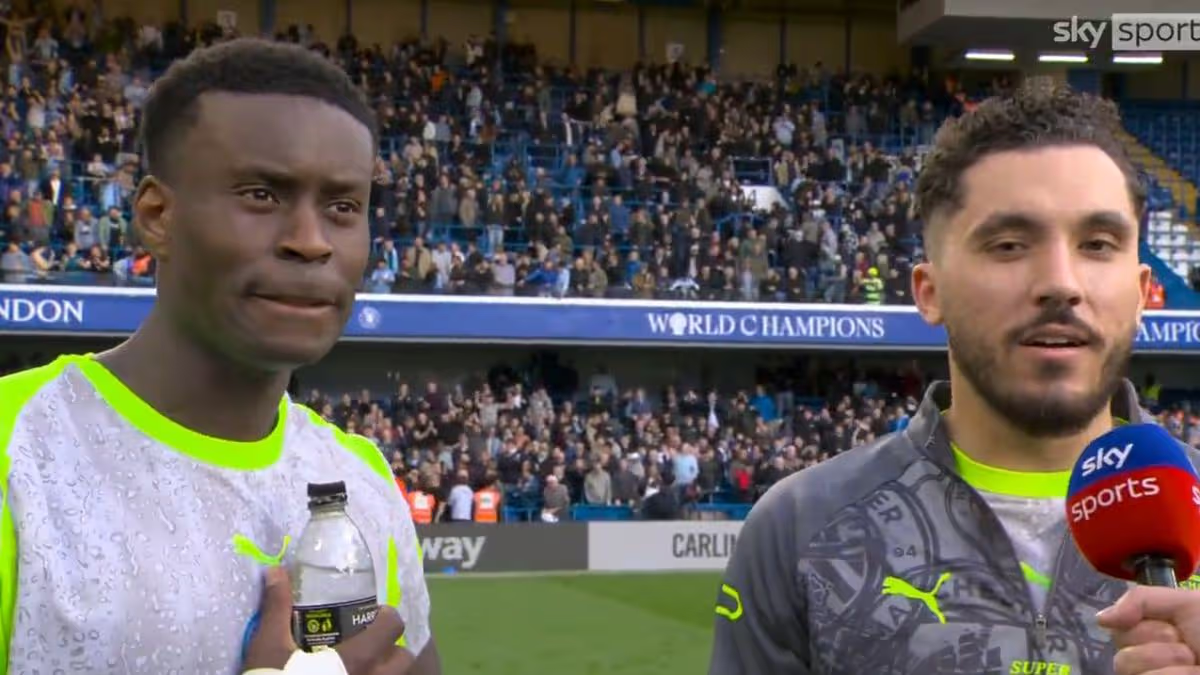
Rodri believes Manchester City’s Carabao Cup final win over Arsenal can have an impact on the Premier League title race after the Blues secured a 2-0 Wembley win.
Advertisement
Nico O’Reilly scored twice in the second half as City earned the first domestic trophy of the campaign. The Blues will hope to follow it up with two more given they are still in the FA Cup and are Arsenal’s only rivals for the Premier League title.
The Gunners have a healthy nine-point advantage at the top of the table but still have to travel to the Etihad while the Blues have a game in hand. And Rodri feels the cup final victory can now play a part in the run-in.
Get MEN Premium now for just £1 HERE – or get involved in our City WhatsApp group by clicking HERE. You can also join our City Facebook page by clicking HERE and don’t miss out on our brilliant selection of newsletters HERE.
“It’s a game not only for this title but to show that we can beat them,” said Rodri, speaking to the Spanish media at Wembley. “There is still a lot to do and it’s clear we didn’t want to go out of the Champions League.
Advertisement
“But we went out and now we have to take the positives, we have more time to prepare for the games. So that’s something to take into account – but we also have to celebrate this.”
City were second best in the first half but dominated after the break to run out ultimately comfortable winners.
Asked about the half-time message, Rodri said: “I think it was a calming talk – we were doing things well and we didn’t have any problems – we were doing well in terms of pressure – it was more a matter of personality wanting to go for the game, not letting them take control.
“I felt like they dropped a bit physically, we detected it and we wanted to go for them. You can tell when you have players who are good in the area and Nico O’Reilly has again shown his potential.”
“We knew it was a very important game,” he added. “Not only because of the title but also because we had to face the best team in the league.
“Now we need to rest go back to the next round of internationals and come back with the optimism that we still have two more competitions to fight for.”
A van burst into flames in the centre of a Cambridgeshire town. Firefighters were called to the fire this morning (March 23) around 5am.
Advertisement
Crews arrived to find a van on fire on High Street in March. The crew extinguished the blaze and returned to their station by 6am.
A spokesperson for Cambridgeshire Fire and Rescue Service said: “At 4.58am on Monday (23) a crew from March was called to a fire on High Street in March.
“Firefighters arrived to find a van on fire. Wearing breathing apparatus they extinguished the fire using hose reels and returned to their station by 6am.”
The spokesperson confirmed that the caused of the fire was accidental.
The controller, who appeared to be working ground and directing aircraft, then instructed an incoming flight to go around the runway.
The nose of the jet was mangled (Picture: Reuters)
There was no immediate confirmation of deaths or injuries (Picture: Reuters)
He tells the Air Canada flight to ‘hold position’, adding: ‘I know you can’t move. The vehicles are responding to you now.’
Another voice says ‘man, that wasn’t good to watch’, before the controller replies: ‘I know, I was here. I tried to reach out to ’em…
‘We were dealing with an emergency earlier and I messed up.’
Advertisement
The other worker replied: ‘No man, you did the best you could.’
Around 72 passengers and four crew members were on board Flight 8646, which was travelling from Montreal to LaGuardia.
It was going down the runway at 131mph, according to flight-tracker website, FlightRadar24.
UPDATE: Analysis of tower audio and map of the airport indicates the aircraft was showing a speed of 114kts or 131mph.JAZZ646 (yellow line) was cleared to land on Runway 4. Truck 1 & Company (green line) requested to cross RW 4 and was authorized to cross by the tower at… https://t.co/ZObElHh2s6pic.twitter.com/TQ053wyJzv
All of the UK’s bank holidays have been confirmed by the Government for the rest of 2026. Between the different nations, dates for bank holidays can vary so it’s important to check you know when they’re taking place, depending on where you live.
Advertisement
Easter weekend is when the next batch of bank holidays will take place and it includes Good Friday, April 3, and Easter Monday, April 6, for England, Wales and Northern Ireland. However, only Good Friday is recognised as a bank holiday in Scotland – not Easter Monday, Chronicle Live reports.
Recently officials set out the remaining bank holiday dates for this year via X, the social media platform previously called Twitter. Several posts specify that UK-wide bank holidays will take place on Good Friday, as previously noted, along with Mondays May 4 and 25.
Get MEN Premium now for just £1 HERE – or get involved in our WhatsApp group by clicking HERE. And don’t miss out on our brilliant selection of newsletters HERE.
All UK nations will also observe bank holidays on Christmas Day, December 25, and Monday, December 28 (as a substitute Boxing Day). Meanwhile, Monday, July 13, represents the Battle of the Boyne bank holiday for Northern Ireland, while in Scotland, Monday, August 3, marks the Summer bank holiday. The rest of the UK – England, Wales and Northern Ireland – will observe this year’s Summer bank holiday on Monday, August 25.
Advertisement
On Monday, November 30, Scotland alone will commemorate the St Andrew’s Day bank holiday. And, as revealed last month, Scotland will enjoy an additional bank holiday this year.
Buckingham Palace said in February: “To mark the achievement of Scotland’s men’s football team competing at the Fifa World Cup for the first time in 28 years, we consider it desirable that Monday, the fifteenth day of June in the year 2026 should be a bank holiday in Scotland.
“Now, therefore, we, in pursuance of section 1(3) of the Banking and Financial Dealings Act 1971, do hereby appoint Monday, the fifteenth day of June in the year 2026 to be a bank holiday in Scotland.”
Complete list of UK bank holidays for 2026
England and Wales
Thursday, January 1 – New Year’s Day
Friday, April 3 – Good Friday
Monday, April 6 – Easter Monday
Monday, May 4 – Early May bank holiday
Monday, May 25 – Spring bank holiday
Monday, August 31- Summer bank holiday
Friday, December 25 – Christmas Day
Monday, December 28 – Boxing Day (substitute day)
Scotland
Friday, April 3 – Good Friday
Monday, May 4 – Early May bank holiday
Monday, May 25 – Spring bank holiday
Monday, June 15 – World Cup bank holiday
Monday, August 3 – Summer bank holiday
Monday, November 30 – St Andrew’s Day
Friday, December 25 – Christmas Day
Monday, December 28 – Boxing Day (substitute day)
Northern Ireland
Tuesday, March 17 – St Patrick’s Day
Friday, April 3 – Good Friday
Monday, April 6 – Easter Monday
Monday, May 4 – Early May bank holiday
Monday, May 25 – Spring bank holiday
Monday, July 13 – Battle of the Boyne (substitute day)
Two people, 18-year-old Juliette Kenny, and an unnamed University of Kent student, have died following the start of the meningitis outbreak. Thousand of people have been vaccinated against the disease.
09:26, 23 Mar 2026Updated 09:26, 23 Mar 2026
The number of cases of meningitis linked to an outbreak in Kent has dropped as thousands of young people in the area are vaccinated against the disease. Confirmed cases have fallen from 23 to 20, the UK Health Security Agency (UKHSA) said in an update on Sunday morning, after they were downgraded following further testing.
Meanwhile, suspected cases under investigation have also fallen from 11 to nine, meaning the total number of cases is 29, down from 34 on Saturday. Two people, 18-year-old Juliette Kenny, and an unnamed University of Kent student, have died following the start of the outbreak.
But now a doctor has explained why a national lockdown in an effort to halt the spread of the meningitis is not on the cards. Dr Ahmed, who has almost half a million followers on TikTok, where he describes himself as “healthcare Gordon Ramsay”, said he recognised people are concerned about the outbreak, but issued a note of caution.
Advertisement
“Ok, untwist your panties, put them back in the drawer, and listen,” he said. “Yes, the meningitis outbreak now involves 29 people, and two of them have died, and a nine-month-old child is struggling for their life in ICU. It is very scary.
“But at the same time we have seen one of the fastest national healthcare responses from the government [in] the last decade, with over 6,000 courses of antibiotics and over 25,000 courses of vaccines given out to people who are at risk.”
He added meningitis spreads “very differently” from a virus such as Covid-19, and said a national lockdown is “very unlikely” for two reasons.
“Number one, meningitis needs very close contact and sharing utensils and vapes, things that would normally have body fluids on them, in order to spread from person to person,” he said. “It does not just spread over long distances through the air.
Advertisement
“And number two, this kind of outbreak is not entirely unexpected. The UK has three to 400 cases of meningitis B in a year that break out in small outbreaks like this. What is unprecedented about this outbreak is that the outbreak can be traced to literally one single location, and the fact that it’s meningitis B, something that we don’t routinely vaccinate our young teenagers for.”
Calling on people to “keep calm”, he concluded: “So yes, while it’s very scary that it can just start symptoms within two days and then kill someone within another couple of days, it just doesn’t have the characteristics that will allow for a national outbreak and a lockdown.”
NHS Kent and Medway said more than 9,078 meningitis B vaccines had been handed out as of Saturday evening while 12,595 antibiotics had been administered.
Content cannot be displayed without consent
What is meningitis?
The NHS describes meningitis as “an infection of the protective membranes that surround the brain and spinal cord”. It says the condition can affect anyone, but is most common in babies, young children, teenagers, and young adults.
Advertisement
The organisation warns meningitis can be very serious if not treated quickly, and can cause sepsis, which can be fatal. It can also result in permanent damage to the brain or nerves.
It is usually caused by a bacterial or viral infection – bacterial meningitis is rarer, but more serious, and it is this type of the disease which the two people in Kent died from. Infections can be spread by sneezing, coughing, or kissing, and is usually transmitted by people carrying the virus or bacteria in their nose or throat, but who are not ill themselves.
What are the symptoms of meningitis?
The NHS says symptoms of meningitis can develop quickly and in any order. Someone with meningitis may not develop all these symptoms. They can include:
a high temperature (fever)
being sick
a headache
a rash that does not fade when a glass is rolled over it
The beach forms part of a picturesque walk along the coast
A posh seaside town under two hours from Cambridge has untouched sands waiting to be discovered. Although Cambridge has much on offer with its fine architecture and breadth of history, there are no sandy beaches in sight.
Advertisement
Luckily, beaches are not far away. One with beautiful untouched sands is at Burnham Overy Staithe. Around two hours from Cambridge, this is a secluded beach on the north Norfolk coast.
A path to the beach stretches over around a mile, making it the perfect place to take a leisurely stroll or quick stop on the way to somewhere else. The well-kept sands are a beauty to see.
For anyone wanting a beach stop that isn’t overcrowded, this beach is also the perfect place for that. Once people have seen the beach, a visit to the picturesque town of Burnham Overy Staithe is also worth the trip.
Advertisement
Previously, this town has been named as one of the “poshest” in the UK by The Telegraph. It’s close to Burnham Market and Sandringham, and it’s also a major sailing hub.
While visiting the town, people can see the Burnham Overy Staithe windmill, which dates back to 1816. There are plenty of cute places to eat and drink, such as the community pub known as The Boathouse.
This is described as a “popular spot for lunch and coffee”. There are also plenty of places to walk in the town and beach, as the beach forms part of the North Norfolk coast circular walk.
On the National Trust website, it said: “Wander through Burnham Overy Staithe near Brancaster, and enjoy beautiful sights of the North Norfolk coast and its wildlife. This circular route follows part of the Norfolk Coast Path and passes through Holkham National Nature Reserve.
Advertisement
“There’s the opportunity to visit Burnham Overy Town, St. Clement church with its Norman tower, and catch sight of the Tower Windmill along the way.” With the weather getting warmer, this posh town and beautiful beach may be worth a visit.
Living under the threat of bombardment is terrifying. Barely an hour passes in Tehran without the sound of an explosion. Nowhere feels safe.
We moved quickly and didn’t stay in one place long. Police stations and checkpoints were being targeted, it seemed. We passed through those as quickly as we could. At night we watched explosions light up the sky, air defence fire opening up in reply.
That is what Iranians are coping with day by day, night by night.
We were only the second international news team allowed into Iran since the start of the war, for a week joining a few others already based there.
Advertisement
It was difficult to get into the country and to reach Tehran, and once there, it was hard to operate and dangerous.
Image: People at a funeral for security chief Larijani and the crew of a sunken navy ship
We took the risk so we could ask two questions that can’t be answered outside the country: How is Israel and America’s air war on Iran affecting its people? And what does its government, battered but not beaten, plan to do next?
At the sites of one airstrike after another, the answer to the first question was tragically clear.
Advertisement
Innocent civilians are bearing the brunt of the Israeli-American campaign, and increasingly so.
Like the pensioner whose daughter was at home in their block of flats when it was hit by missiles. They blew the block apart, and the one opposite, as well as whatever their attackers were targeting. Her body was found in the rubble three days later, he told us through furious tears.
The term precision targeting loses much of its meaning up close. In this case, a centre belonging to the Basij paramilitary volunteer force seemed to have been destroyed – but a lot else besides, an entire city block to be precise.
Advertisement
Advertisement
Inside Iran’s children’s wards
In a hospital, we were confronted with heart-wrenching tragedy. Four-year-old Anita lay dying in intensive care. She has severe head injuries after her home was caught in an airstrike. Her mother Zeebar cried over her comatose child, telling her: “We are waiting for you, we are waiting for you.” Doctors say Anita is not likely to wake up.
Downstairs, Fatima stood over her grown son, who had received a chunk of shrapnel in his arm, sent flying three blocks, he said, from another airstrike as he had left for work.
“This war must stop,” she told us. “It is innocent civilians being hurt.”
Advertisement
Image: Iranian mother Zeebar holds the hand of four-year-old Anita, in a coma after US-Israeli strikes
Regardless of what is being targeted, and however precise, the bombs being dropped on a densely populated city will cause civilian casualties.
In January, in Tehran and across the country, people were being shot at by their own security forces when weeks of protests were suppressed.
Thousands were killed, shot dead by the security forces, say activists and human rights groups.
Whenever I mentioned this to government supporters or officials, they blamed foreign agents for stoking the unrest.
Thousands attend Iran funerals
Advertisement
The tension we felt in the city goes back to that crackdown too. We were able to operate freely in the places where we were given permission to film, but few people were prepared to go on camera. Off-camera though, people were more open.
One man talked with contempt for the “extreme” nature of the authorities and hoped it would change after the war.
Which brings us to the second question we had come here to ask. What of the government and what it does next? We were not there long, and only in one city, but for now at least, Iran’s leadership appears confidently in control.
Dominic Waghorn’s final thoughts after a week reporting in Iran
Advertisement
Suppressing unrest is, of course, easier in a time of war.
But the air campaign may be helping the government too. Many Iranians see it as an attack on them and their country as much as the state. When you are living in mortal fear of your family and home being obliterated from the skies, it is hard not to take it personally.
Israel’s attack on Iran’s major South Pars gas field, for instance, was condemned by one Iranian we spoke to. Why attack that, he asked. For many, an attack on the gas field is an attack on everyone in Iran, regardless of their political affiliation.
The government has fervent supporters too, lots of them. They were out in force in the street for the funeral of Ali Larijani, a top government figure buried with others. Tens of thousands attended.
Advertisement
As we stood among them, the limitations of Israel and America’s ambitions became more glaring.
If you assassinate the leaders of people whose religion embraces martyrdom, this is what to expect.
Advertisement
Iran has a long tradition of honouring the virtues of resistance and no surrender. Iranians are reared on stories of foreign treachery. Their government is drawing on all that to reinforce its support.
Iran seems to have been waiting for this war for years. Its leadership is hydra-headed, programmed to replace itself. It has so far proven surprisingly capable of responding to attacks with speed and strategy despite its enemies’ claims it has been decapitated.
We left with a sense they are bracing themselves now for a long war. For the ordinary people, that means weeks, if not months, more terrifying uncertainty and the risk of death and injury. For their leaders, it means projecting defiance, digging in and outlasting the enemy.
The classic BBC documentary Driving School that made Maureen Rees from Cardiff a household name can still be enjoyed
Long before the phrase ‘reality TV’ was popularised by early 2000s shows like Big Brother, Popstars and Survivor, there was a television docusoap that captivated the nation – BBC’s Driving School.
Advertisement
Driving School paved the way for the fascination with programmes documenting real-life situations, even turning one of its participants into a star.
Debuting on the BBC in 1997, Driving School was a fly-on-the-wall documentary following a group of learner drivers around Bristol and South Wales. Despite being produced on a shoestring budget, it was aired during primetime and gave rise to one of the first reality TV celebrities, Welsh icon Maureen Rees.
The series was conceived and directed by British film and documentary maker Francesca Joseph, with narration provided by Quentin Willson, who would later host the similar programme, Britain’s Worst Driver.
A quarter of a century after its premiere, all six episodes were made accessible on BBC iPlayer and viewers can still enjoy the episodes, reports the Mirror.
On IMDb, reviewers have lauded Driving School as “hilarious” and a “milestone” in television. One reviewer noted: “It’s largely forgotten now but this series marked a change in TV documentaries.
“It was conceived as a simple documentary about the trials and tribulations of teaching people to drive but as the footage came in it became apparent that the stars of the show were the learners not the instructors. Maureen Reese (sic) rapidly became the pupil that everyone tuned in to see. Each week we wanted to see what danger she would encounter.”
Advertisement
They continued: “A small milestone in the story of TV.”
Another commented: “Doesn’t anybody remember this documentary? It was hilarious! In fact, most of it doesn’t even stick in my mind but I remember Maureen Rees as the mad welsh woman always arguing with her husband and nearly decapitating everyone else on the road. Plus, she failed her driving test about 8 times! It really was a good watch.”
The popularity of Driving School resulted in a four-part celebrity edition which was broadcast in 2003 to support Comic Relief. Presented by Mel Giedroyc, famous faces taking part included Pop Idol runner-up Gareth Gates, television legend Paul O’Grady, EastEnders actress Natalie Cassidy and Big Brother star Jade Goody. They discovered live during the Red Nose Day appeal whether they had been successful. None of them had.
Meanwhile, Maureen from Cardiff, now 84, went on to enjoy a television career and even released a pop single. She presented the short-lived Really Useful Show, in which she learned car maintenance and appeared as herself in the sitcom Barbara, as well as travelling to the US to be interviewed on The Tonight Show with Jay Leno. In 2001, she appeared as a chapel woman in the coming-of-age film Very Annie Mary, which was set in Wales.
In 2004, she participated in the Channel 5 series Back to Reality, a programme featuring former reality TV stars. She made it to the final day, finishing as runner-up to Princess Diana’s former lover James Hewitt.
Maureen released a single, a cover of Madness’ Driving in My Car, which reached number 49 in the UK Singles Chart, with the video featuring her driving Betsy, her powder-blue 1990 Lada Riva estate.
Driving School is available to stream on BBC iPlayer
You must be logged in to post a comment Login