

In case you missed it, Rachel Cusk’s new novel Life of M has been the centre of heated online debate. Dubbed a “biogossip” (biography based on gossip) allegedly inspired by the actress Natalie Portman, the novel investigates fame, power and truth with a particular emphasis on storytelling.
Much of the discussion of the book revolves around the similarities between Portman’s real life rather than how Cusk explores her chosen themes. In a recent article for The Guardian, journalist Elle Hunt provides a handy list of must-know information for those wishing to read the novel but may be unsure of all the details. The biogossip argument is certainly plausible. For instance, references to Léon: The Professional (1994) and Black Swan (2010) are easy enough to pick up if you are aware of Portman’s filmography. At the conclusion, Hunt asks whether more gossip in literature could solve the crisis of people reading less than ever.
It is interesting to consider whether easy-to-spot references to public figures are the key to drawing new readers in. However, asking for more gossip may be addressing the symptoms rather than the cause and ignores the fact that gossip has always existed in literature, and to a far greater extent than you might think.
Since the birth of the modern novel, scandalous discourse has permeated stories in complex and exciting ways. The genre of the biogossip has existed since the 1600s, with French writer Madeleine de Scudéry credited with writing the first roman à clef (French for “novel with a key”). Stories within this genre satirise current affairs, placing real figures behind thinly veiled character disguises.
Faber
These books were a way of discussing controversial topics and sharing insider knowledge while avoiding charges of libel. Take de Scudéry’s novel Artamène ou le Grand Cyrus (co-written with her brother Georges) discusses major figures associated with The Fronde (1648 to 1653), a series of uprisings against the regency government of Queen Anne of Austria and her chief minister, Cardinal Mazarin. Using ancient Persia as a veil for 17th-century French court dynamics, de Scudéry contributed her tuppence-worth via the ten volume novel.
But liking gossip and being a good gossiper goes much further when it comes to reading.
Consider the last time you had a really good gossip session with a close friend, going over an incident in excruciating detail. It feels like a simple thing to engage with when, in reality, complex social processes are occurring simultaneously.
Gossip relies on individuals holding knowledge about a social network, and the quality of the conversation is dependent on the extent to which participants engage with the information being evaluated. It is expected that you offer an opinion, which not only contributes to the communal knowledge pot but is also a demonstration of a your morals, perceptions and assumptions. We are not always conscious of this happening, but we usually walk away from a conversation with a better understanding of other people and ourselves – how we react to certain behaviours, actions and motivations.
The same process can be applied to literature. Regardless of genre or era, novels naturally rely on characters interacting with their fictional contexts, including social networks. The intimacies and power dynamics navigated through a novel can be decoded by using the same skills we exercise when we gossip.
Every conversation a reader is privy to in a novel is essential to the practice, as it is the author providing breadcrumbs that lead to deeper character insights. Their reactions and responses inform our understanding of what the novel is trying to do. By engaging with the text in the same way we gossip, it unlocks a channel through which classics and other supposedly inaccessible texts can be understood.
Wikimedia
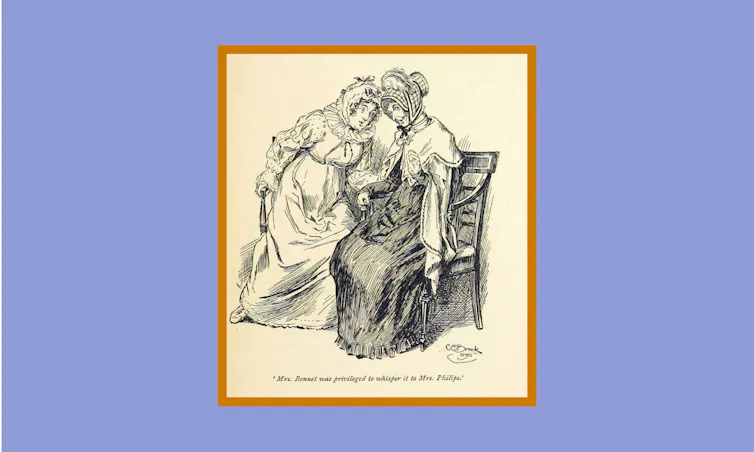
Take, for example, the first page of Pride and Prejudice. Austen deploys gossip to illustrate the Bennett parents’ attitude to marriage: Mrs Bennett has heard from Mrs Long that Netherfield is to be occupied by a young eligble man, which only excites the local mothers. Mr Bennett remains unmoved, he’s even disparaging of the prospect of one of his girls marrying the handsome, single, rich landowner. Mrs Bennett’s desperation to get her girls married versus her husband’s lax attitude hints at the forthcoming conflicts of the novel. Eagle-eyed readers can notice this and unlock how Austen is satirising marriage culture from the opening lines.
À lire aussi :
Jane Austen’s world ran on gossip – and she revelled in it
The same can be applied to Shakespeare plays. Much Ado About Nothing is in essence a series of carefully constructed gossip that relies on the subject of conversation to be within earshot and so generating the plot and moments of character development.
The play’s subplot involves Don Pedro, Ursula and Hero playing matchmakers for Benedick and Beatrice. Don Pedro’s gang carefully arrange a conversation in which Benedick overhears them gossiping about Beatrice’s unrelenting affection for him. Likewise, Ursula and Hero ensure Beatrice is present for their gossip about Benedick’s affections for her. The result? They confess their love for each other and the subplot is resolved – all thanks to the power of gossip.
So, what does that mean for readers? It is generally understood that fictional stories are excellent ways to wrestle with what it means to be human and all the messy parts that go with it. By reading as a gossip, we specifically practice the identification of behavioural signs and patterns and can apply the knowledge to future scenarios, both fictional and non-fictional.
In the process of gossip, we become better at reading social situations because we have an insight into the potential subtexts of any given conversation. It also makes reading more enjoyable and helps illuminate the similarities between someone from the 18th century and us in the present. It unveils the persistence of humanity’s problems, from awkward interactions to first loves, and helps us realise that we are not alone in our experiences.
I invite you to pick up a book and keep an eye out for any gossip – you might just find out something new.
This article features references to books that have been included for editorial reasons, and may contain links to bookshop.org. If you click on one of the links and go on to buy something, The Conversation UK may earn a commission.


































































You must be logged in to post a comment Login