Connect with us
DAPA Banner
DAPA Coin
DAPA
COIN PAYMENT ASSET
PRIVACY · BLOCKDAG · HOMOMORPHIC ENCRYPTION · RUST
ElGamal Encrypted MINE DAPA
🚫 GENESIS SOLD OUT
DAPAPAY COMING

NewsBeat

How the Great Strike tore through Durham like a tornado

Published

on

How the Great Strike tore through Durham like a tornado

“EVERY second shop in Newgate Street, the main street in Bishop Auckland, shuttered up and the shopkeeper ruined,” wrote the town’s prospective MP Hugh Dalton in his diary 100 years ago.

This was not the result of an out-of-town shopping centre. This was because of the General Strike which broke out a century ago this weekend and brought Britain to a standstill.

READ MORE: PICKETS IN PRIESTGATE AND FURY IN FERRYHILL: DAY-BY-DAY HOW THE GREAT STRIKE UNFOLDED IN THE NORTH-EAST

In Bishop Auckland, Dalton, leading member of the Labour Party, found “white-faced women who starved themselves to feed their children” and “men sitting silent in clubs too poor to buy either a drink or a smoke”.

Advertisement

Later, in December 1926, he made a single entry: “Miners hopelessly defeated”.

Digging for coal at Murton during the 1926 strike

Coal lay at the start and finish of the General Strike.

More than one million miners made coal the largest industry in Britain, and in 357 towns and villages of County Durham, it shaped the social geography.

Coal mining was the dirtiest, most dangerous (more than a thousand deaths annually) and dehumanising occupation in the country (80 per cent of coal was hewn by hand-pick). It gave rise to class conflict and the most appalling industrial relations.

Advertisement

A County Durham soup kitchen during the 1926 strike.

But after the First World War, there was a falling demand for coal, and the strike originated in an attempt by mine-owners to pass the problems of a declining industry down to their workers. Rather than amalgamate struggling pits, the owners tried to cut wages and increase hours.

The situation was aggravated by Chancellor Winston Churchill restoring Britain’s currency to the Gold Standard in 1925 in an attempt to regain the country’s financial prestige. This meant Britain’s currency was over-valued at a time when other countries were devaluing – therefore, cheap foreign coal came into Britain while British coal for export became 10 per cent dearer – and Durham coal was an exported commodity.

Miners resisted the owners’ changes – “not a penny off the pay, not a second on the day” – and appealed to the Trades Union Congress, which represented eight million workers, for support.

When lengthy negotiations failed as miners refused to accept inferior terms, they were “locked out” of their collieries on April 30. They reacted by going on strike on May 1.

Advertisement

Miner solidarity was total and was almost equalled by the 1.75 million workers called out by the TUC in support.

Yet on May 12, the strike – a “nine days wonder” – was over as the TUC capitulated.

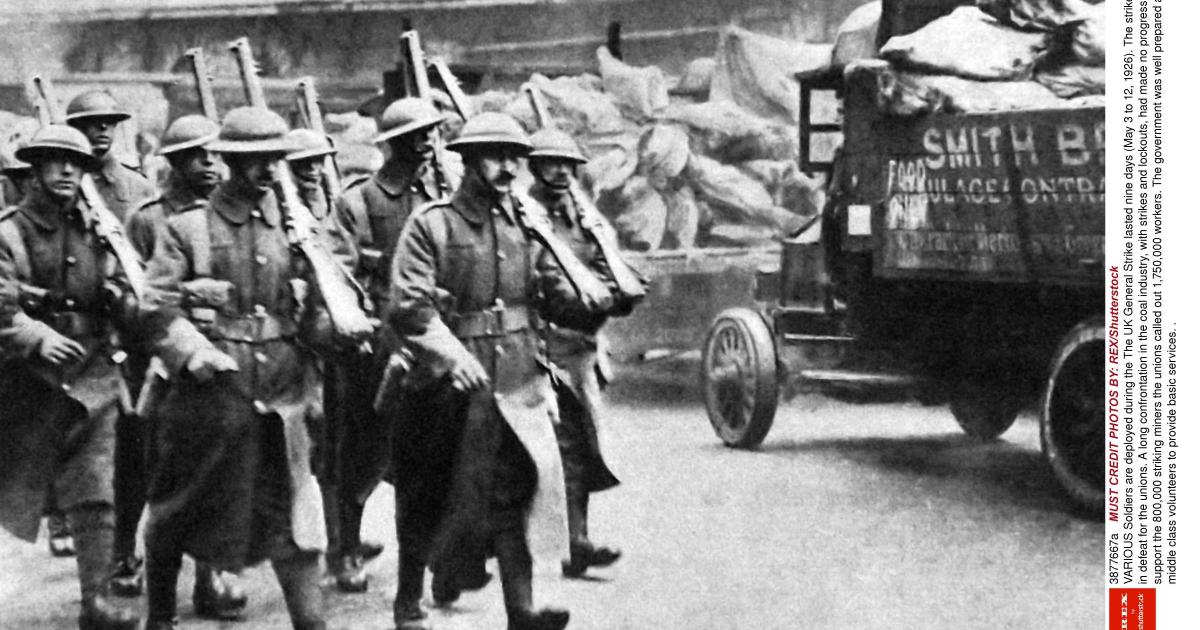
The troops are called in to deal with the strikers. Photo by Universal History Archive/REX/Shutterstock The troops are called in to deal with the strikers. Photo by Universal History Archive/REX/Shutterstock

Most miners continued to strike for six months until starvation and isolation – Dalton’s diary highlighting the appalling conditions on the ground in the coalfield – forced them to accept the owners’ harsh terms, and the lock-out ended.

Responsibility for this dire state of affairs can be shared between the four participants.

Advertisement

The TUC was anxious to protect its members’ wages but its leaders were divided and timid. They hoped not to paralyse the country but to pressure the government into forcing concessions from the owners. Afraid of “reds”, moderates like Ernest Bevin sought a Trumpian “exit ramp” from early days.

Righting a bus that was turned over in Glasgow by strikersRighting a bus that was turned over in Glasgow by strikers

The men’s leaders, like the Miners’ Federation of Great Britain (MFGB) secretary and gifted orator Arthur Cook, trusted neither the TUC nor a Conservative government. He stubbornly held to the rhetorical “not a penny off the pay, not a second on the day” long after May 12, until union funds of £4m were exhausted.

Colliery owners, at a time of right-wing government, adopted an intransigent stance. They remained deaf to calls for colliery improvement and felt they only had to wait the strike out. Even Tory hawk Lord Birkenhead called them the “stupidest men in England” and Prime Minister Stanley Baldwin found them “stupid and discourteous”.

During the 1926 Great Strike, unemployed miners formed fashionable jazz bands to wile away the hours. This is the No Place Nobblers, from near StanleyDuring the 1926 Great Strike, unemployed miners formed fashionable jazz bands to wile away the hours. This is the No Place Nobblers, from near Stanley

Baldwin shrewdly grasped that by trying to coerce him, the TUC had converted an industrial dispute into a political one. He was thus able to portray himself as a “man of peace” and to brand the strike as a threat to the constitution.

Advertisement

By contrast, Churchill denounced striking workers as “the enemy” trying to “hold up the nation”, words that could have been a rehearsal for the way the 1984 miners’ strike was presented by another Conservative government.

History suggests that, against these forces, the strike was doomed from the beginning.

Planning by the TUC was eleventh hour, improvised and fragmented. There were more than 500 Councils of Action acting virtually autonomously, such as the proactive and radical centre of Chopwell (“Little Moscow”), in Gateshead.

FIGHTING FOR COAL: Striking miners digging for coal at South Hetton during the 1926 strike

By contrast, government planning was timely and comprehensive. Coal and food were stockpiled and an emergency structure divided Britain into 10 districts. Each was under a Civil Commissioner empowered to recruit half-a-million (chiefly middle class) “patriotic volunteers” and to use the armed forces to ensure that food was smoothly delivered.

Advertisement

Warships also acted as an intimidating presence by turning their guns towards ports.

Leadership was exercised effectively by Baldwin and based on a clear strategy of protecting parliamentary democracy, while the supine TUC shrank from turning off the lights and fires and bringing industry to a halt.

Local leaders were more impressive. In Chopwell, Will Lawther – later the Labour MP for Barnard Castle – led the blocking of roads from Newcastle to Consett in order to undermine “volunteer” action, and he was imprisoned after the police baton-charged his supporters outside the Gateshead court.

The Flying Scotsman derailed near Cramlington when strikers removed a rail from the East Coast Main LineThe Flying Scotsman derailed near Cramlington when strikers removed a rail from the East Coast Main Line

In propaganda terms, Churchill orchestrated the government case in a nationally circulated newspaper called “The British Gazette”.

Advertisement

By contrast, the TUC deprived itself of favourable coverage by calling out the printers to strike! Their “British Worker” newspaper was hand-printed and circulation in Durham was limited to 16,000. In Blaydon, workers produced a publication called “The Northern Light” which was cyclostyled on equipment which was moved from house to house to avoid arrest.

The technically independent BBC focused on the political issue too and even blocked a broadcast of the Archbishop of Canterbury’s peace initiative. Its chairman was Darlington coal lord Jack Pease, Baron Gainford.

Road transport was at the centre of most of the trouble, but in general food and coal supplies were maintained. On Newcastle quayside, a submarine and two destroyers were moored beside a food-ship and convoys to Consett had police escorts.

It cost the United Bus Company £600 to repair damage to vehicles in Bishop Auckland.

Advertisement

Volunteers numbering 25,000, including university students, were available in the North East to drive private cars and lorries, and a further 12,000 acted as special constables. Of a national figure of 1,760 arrests for disorder, 396 were in the North East District.

Thankfully, no one was killed in the UK.

In the last analysis, the power of the state prevailed. The TUC had no stomach for the fight and the government spent £433m on winning it.

In working class Durham, there was little for strikers to do as support was solid and blacklegs practically unknown.

Advertisement

It was a hot summer and men at first enjoyed the natural warmth and light, and relief from toil.

But some families were turned out of their tied housing by the mine owners, and by July, with no benefits system for able men, food was running short. Perhaps in mining villages, some men could hunt and fish or “acquire” vegetables, but in towns there was more scavenging, notably of coal from heaps and railway lines, but also men had the possibility of casual work.

There was no paid work available for women and they can be seen to have been the real victims of the strike.

By November, only five per cent of Durham miners had returned to work, but by the end of that month, the privations their families and communities were suffering, forced the majority to accept severe, locally-dictated terms.

Advertisement

Nationally, the triumph of the owners meant there was no reorganisation and so nationalisation, universally popular with miners, did not come about until 1947.

In 1927, Baldwin introduced an Act of Parliament that outlawed sympathetic strikes. This, though, was seen by some as unnecessarily vindicative and contributed to his ousting in 1929, although it was not repealed until 1946.

The miners remained stoical and stubborn but recognised that a better future lay in supporting Labour politics rather than in industrial action. They were rewarded as early as 1929 with the formation of the second Labour government, with Will Lawther defeating the sitting Conservative MP Cuthbert Headlam in Barnard Castle.

Some miners and their supporters were victimized in 1926 but the strike was also a warning to employers that conciliation and collective bargaining were less risky than confrontation. And with non-militant men like Bevin leading the unions away from direct action, the result was relative industrial peace until the 1970s.

Advertisement

Sadly, 60 years after the General Strike, the lessons of under-preparation and taking on a strong government were not learned by a future miners’ leader who shared a first name with his role model Arthur Cook.

Glynn Wales at the Tommy statue in Seaham

  • Glynn Wales, of Bishop Auckland, began his career as a history teacher in 1969 at Ferryhill Grammar School, and he rose to become head of Ferryhill Comprehensive until he retired in 1997 to join Durham university and train the next generation of history teachers

Source link

Continue Reading
Click to comment

You must be logged in to post a comment Login

Leave a Reply

NewsBeat

The Fortune viewers say the same thing minutes into Channel 5 show

Published

on

Wales Online

Eleanor Tomlinson and Callum Woodhouse star in the tense new psychological drama

The Fortune viewers were unimpressed as the new psychological drama started on Channel 5.

The series follows waitress Amanda Blakefield, played by Poldark’s Eleanor Tomlinson, whose life is turned upside down when a solicitor turns up at her work to tell her she is due to inherit a massive estate from a man she doesn’t know.

She continues to avoid the solicitor but visits the man’s widow Fiona (Rebecca Front) and son Anthony, played by All Creatures Great and Small star Callum Woodhouse, who are furious and make it clear they plan to fight it.

Advertisement

Meanwhile, Amanda’s husband Jimmy (Harry Potter star Matthew Lewis) appears to be caught up in a mystery of his own as he keeps receiving mysterious phone calls.

As it got underway on Tuesday night (June 2), many viewers posted messages on X admitting they were not convinced, with some questioning the plot.

“Wouldn’t they phone her and ask her into their office instead of just barging into her workplace?” wondered one viewer.

Advertisement

Another commented on the platform, which was formerly Twitter: “How to sort out an unexpected inheritance: (a) consult a solicitor, and get it sorted out; or: (b) throw away the solicitor’s letter and barge in uninvited to a grieving family.”

Someone else called the show “a dud” and another viewer admitted: “Oh I really want to like this but so far I’m struggling.”

“This is absolute s***e,” insisted another viewer, as one posted: “Mrs Poldark the only thing saving this so far…”

“Channel 5 either do b****y brilliant dramas or shockingly bad am/dram… #thefortune is tipping ever so slowly to the latter… ludicrous,” said somebody else, as one viewer complained about the “exaggerated sighs” and “pauses”.

Advertisement

Meanwhile, a review in The Telegraph gave it just one out of five stars, calling it “rubbish”.

However, others thought the series – which was filmed across Hartlepool, Northumberland, Newcastle and north Yorkshire last year – had promise.

“So far looking good,” said one viewer. Another noted the stellar line-up, which also includes Denis Lawson, Stephen Tompkinson, Paula Wilcox, Danielle Walters and Nina Wadia.

Advertisement

“It’s got a really good cast too,” they posted. “Well known faves.”

The Fortune is airing on Channel 5.

Source link

Advertisement
Continue Reading

NewsBeat

England vs India: Alice Capsey leaves Charlotte Edwards with huge selection call by securing win

Published

on

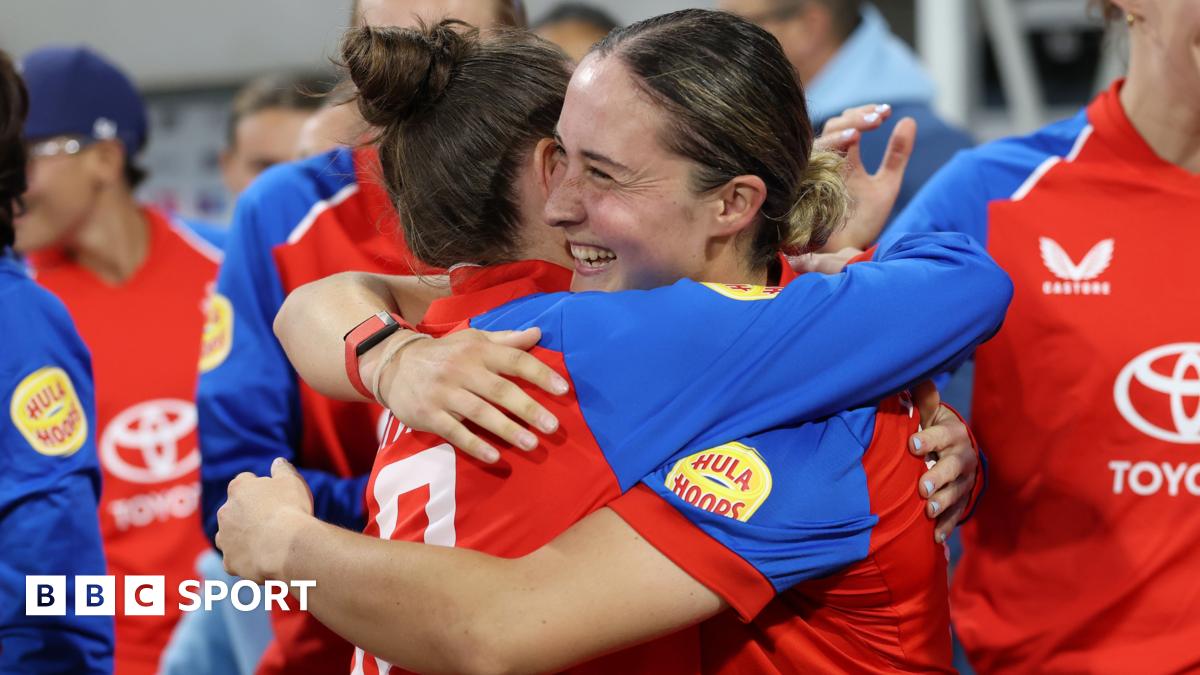
Cricketers play on the grass dressed in yellow and blue kits. A scoreboard shows England 94 for 2. Spectators are sat along the perimiter of the pitch. In the background is a church spire, and other brick buildings against the grey sky.

Coach Charlotte Edwards will be delighted with the momentum England have gained and the quality of their cricket but now faces her biggest decision since being appointed as coach before the start of last summer.

Capsey hit a match-winning 74 not out against New Zealand last month but when Wyatt-Hodge was available for Saturday’s match in Bristol she was pushed down from opener to number four – a sign that Dunkley and Wyatt-Hodge were still the preferred opening partnership.

How long can that remain the case?

Dunkley, who has opened in all of England’s T20s under Edwards, made a start again, reaching double figures for the fifth time in a row, before hitting straight to deep mid-wicket. Her highest score this summer is 26.

Advertisement

Wyatt-Hodge has made 29 and five since returning after the birth of her first child but has the advantage of holding the experience of 179 internationals.

While Knight played a series of sweeps and reverses, Capsey, who looks fitter and more composed in 2026, targeted the straight boundaries with power.

She hit one glorious carving drive over extra cover for six early on and in the 15th over kicked for home by hitting spinner Sree Charani for a four and two thumping sixes.

Knight reached her fifty in 31 deliveries – the quickest she has reached that landmark for England in any format. She was unrecognisable from the batter who started the summer with five innings at less than a run a ball.

Advertisement

The next question is whether England can translate this performance into one under pressure on the world stage, something they have failed to do in recent years.

Source link

Continue Reading

NewsBeat

Celtic: Club could face choice of Martin O’Neill or Robbie Keane

Published

on

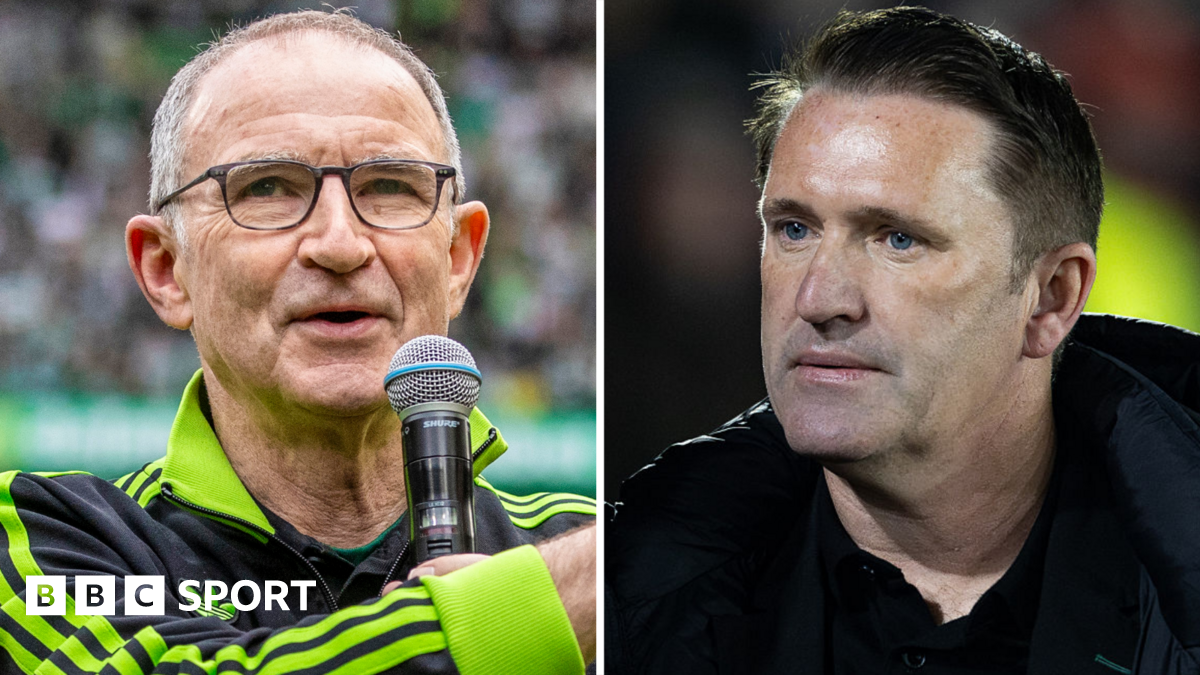
Martin O'Neill and Robbie Keane

However, while Ferencvaros failed to punch their weight domestically, they overperformed in the Europa League after falling to Qarabag in the Champions League play-off round.

Keane guided his side to 12th place in the league phase, four points and nine places above Celtic despite having one of the smallest budgets. Their only defeat was against eventual semi-finalists Nottingham Forest.

On their way to the last 16, they defeated Rangers, Genk, RB Salzburg, and Ludogorets, while drawing away at Fenerbahce too.

They conquered Ludogorets again over two legs in the play-off round, before falling to Braga of Portugal 4-2 on aggregate despite a 2-0 win at home.

Advertisement

Ferencvaros often played 3-5-2, and Keane has often described his football as attacking and once said he threatened to drop his centre-backs if they passed to each other too often rather than opting to play the ball forward.

“I don’t like my centre-backs keeping the ball for the sake of keeping the ball,” the former Tottenham, Liverpool, and Leeds striker said.

Former Celtic captain Scott Brown and youth coach Jonny Hayes are mooted as potential assistants to Keane, as well as former Aberdeen manager Stephen Glass, who has been with him in Hungary.

Could he be the man to replace O’Neill? Or could he even work with his former international manager at Celtic?

Advertisement

Source link

Continue Reading

NewsBeat

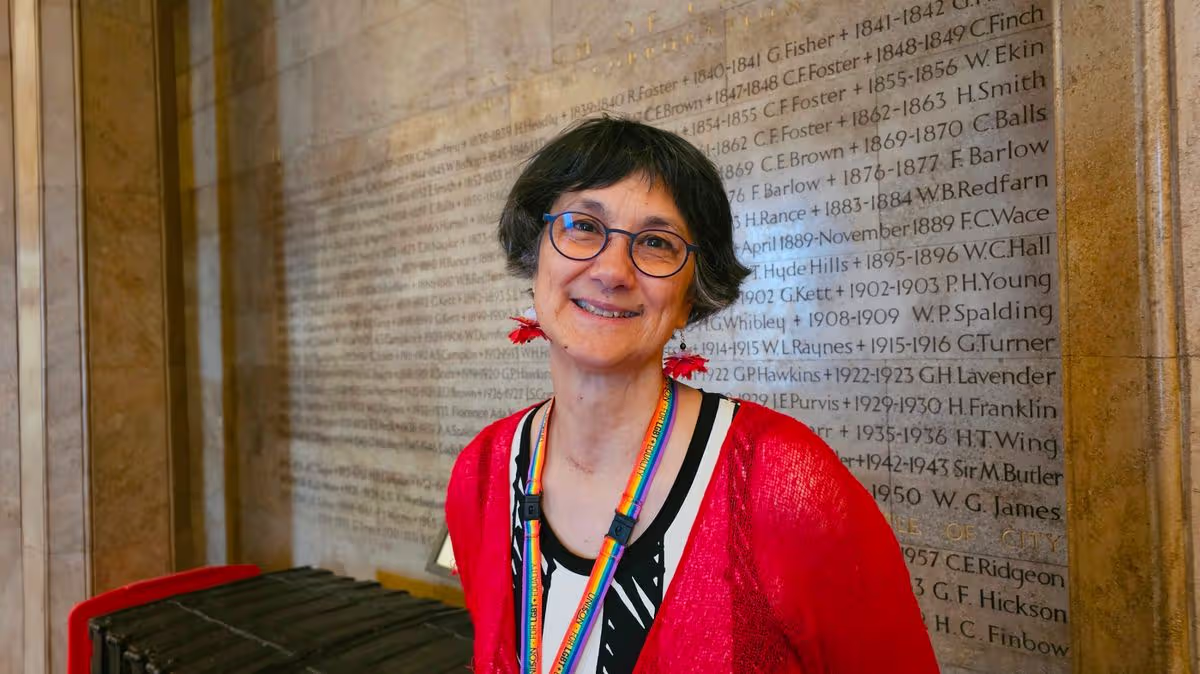
New Mayors hold top positions on Northern Ireland councils for the coming year

Published

on

Belfast Live

There are some new faces at the helm of our 11 local authorities

This week marks the selection of 11 new mayors and council chairs across our local authorities.

Advertisement

The largely ceremonial role of mayor rotates on a yearly cycle and is shared among the major parties in the chamber. It includes chairing Council meetings, attending civic and ceremonial events, welcoming visitors, and supporting initiatives that promote community wellbeing and local pride.

The Local Government (Northern Ireland) Act states that councils’ annual general meetings must take place in June during which new mayor and deputy mayors are nominated. It comes ahead of council elections across Northern Ireland next year.

While most council areas welcomed new mayors on Monday, selections will take place throughout this week.

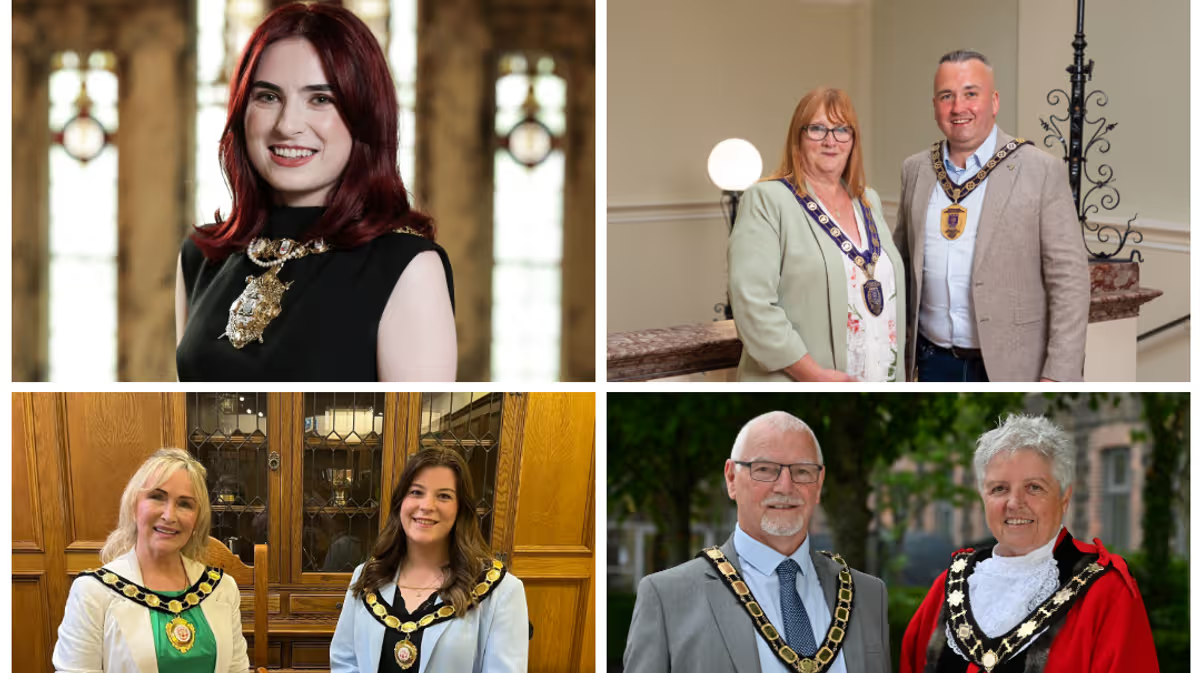
Here’s our run down of the new faces selected so far to hold the top positions on Northern Ireland councils for the coming year.

Advertisement

Belfast City Council

The new Irish-speaking Lord Mayor of Belfast has said diversity will be at the heart of her message over the coming year.

Installed at the full council meeting on Monday evening, is Sinn Féin Councillor Róis-Máire Donnelly, a 30-year-old operations manager in the community sector.

A native of Ballymurphy in West Belfast, Róis-Máire has been a councillor for three and a half years, representing the Black Mountain District Electoral Area. In her coming term she says she wants to focus on young people, the cost of living crisis, the Irish language, and the epidemic of violence against women and girls.

Advertisement

Róis-Máire Donnelly replaced DUP Councillor Tracy Kelly in the mayoral role. Alliance Ormiston Councillor Hedley Abernethy was appointed Deputy Lord Mayor of Belfast.

Derry City and Strabane District Council

Sinn Fein’s Cllr Grace Uí Niallais accepted the Mayoral chain for Derry City and Strabane District Council on Monday evening from her predecessor Cllr Ruairí McHugh at the Council’s AGM in the Guildhall. The new Mayor will be supported in her role by the SDLP Deputy Mayor Councillor Catherine McDaid.

Advertisement

Formally accepting the chain of office, Mayor Uí Niallais said pledged to be “a Mayor for All” and prioritise action on Violence Against Women and Girls as she outlined her priorities for the year ahead during her inaugural address at the Guildhall.

Antrim and Newtownabbey

Councillor Henry Cushinan has been appointed as the first Sinn Fein Mayor of Antrim and Newtownabbey, with the DUP’s Councillor Alison Bennington appointed as Deputy Mayor for the incoming year.

Councillor Cushinan was also the first elected Sinn Fein Councillor in legacy Antrim Borough Council in 1985 and was re-elected to Antrim and Newtownabbey Borough Council in 2015 and 2019.

Advertisement

The new Deputy Mayor, Councillor Alison Bennington represents the Glengormley Urban District Electoral Area (DEA) and has served as a Councillor from 2019.

Armagh City, Banbridge and Craigavon Borough Council

Sinn Féin Councillor Mary O’Dowd has been formally installed as the new Lord Mayor of Armagh City, Banbridge and Craigavon.

Elected to represent the Lurgan District Electoral Area in May 2023, Councillor O’Dowd described her appointment as “an incredible honour”. In her inaugural address, she set out her ambition to lead an inclusive and successful council that puts every citizen at its heart and champions fairness, opportunity, and progress for all.

Advertisement

DUP Councillor Lavelle McIlwrath has been appointed Deputy Lord Mayor for the incoming year. Elected to represent the Portadown District Electoral Area in 2019, Councillor McIlwrath previously served on Armagh City and District Council, having been co-opted in December 2013, a role he held until June 2015.

Causeway Coast and Glens Borough Council

Causeway Coast and Glens Council made history this week with female Mayor and Deputy Mayor appointments.

Advertisement

The DUP’s Dawn Huggins is taking on the role of mayor while UUP Alderman Sandra Hunter, who represents the Causeway DEA, will serve as deputy.

In her opening Mayoral address, Councillor Huggins said: “To be entrusted with this role by my colleagues in this chamber is both a privilege and a responsibility that I accept with humility and determination.”

The Bann DEA representative takes over the chain of office from Councillor Oliver McMullan.

Fermanagh and Omagh District Council

Two Sinn Féin councillors have been appointed Chair and Vice Chair of Fermanagh and Omagh District Council with Councillor Debbie Coyle nominated as Council Chair and Councillor Stephen McCann as Vice Chair.

The new Chair has pledged to champion equality, support local communities and raise awareness of domestic abuse through her chosen charity, Fermanagh and Omagh Women’s Aid.

The Enniskillen councillor becomes only the fourth woman to serve as Chair since Fermanagh and Omagh District Council was established in 2015.

Mid and East Antrim Borough Council

Alderman Thomas Gordon has been named as the new Mayor of Mid and East Antrim, while Councillor Bethany Carson-Ferris (UUP), who represents Carrick Castle area has been appointed Deputy Mayor.

Alderman Thomas Gordon (DUP), who represents Bannside, takes up the role of Mayor from Councillor Jackson Minford who served as the Borough’s First Citizen during 2025/26.

Speaking following the appointment, the new Mayor said it was a great honour to assume the role: “Over the next year, I want to use this role to celebrate the people and places that make our Borough special, support initiatives that bring communities together, as well as champion the opportunities we have across industry, tourism and the environment.”

Mid Ulster District Council

Dungannon Councillor Deirdre Varsani (Sinn Féin) has been named as the new Chair of Mid Ulster with Cookstown Councillor Eva Cahoon (DUP) named as Deputy Chair.

Originally from Armagh, Cllr Varsani also spent 13 years working in London and has been a resident of Dungannon for the past 26 years. She is a former teacher and vice-principal who has a long-standing interest in heritage, history, culture, sport and the Irish language.

Newry, Mourne and Down District Council

Councillor Glyn Hanna (DUP) has been appointed Chairperson in Newry, Mourne and Down, with Councillor Doire Finn (SDLP) elected as Deputy Chairperson.

Advertisement

In his inaugural speech as Chairperson, Cllr Hanna said it was an honour to take up the role and he was “proud and humbled” to serve as the first Unionist Chairperson of Newry, Mourne and Down District Council since its creation in 2015.

Other councils

Ulster Unionist Craig Blaney is expected to be the next Mayor of Ards and North Down Borough Council. The Bangor Central councillor will officially take up his chain of office on Wednesday, June 3, at the council’s annual meeting.

His deputy will be a DUP councillor although the party has yet to announce who that will be.

Mr Blaney was deputy mayor from 2022 to 2023 and said the opportunity to be Mayor is ‘something very special indeed’. As a local businessman, Mr Blaney said he was keen to ‘shine a light’ on local business, entrepreneurship and town centre regeneration.

Advertisement

Meanwhile Lisburn and Castlereagh City Council will select their new Mayor and Deputy Mayor on Friday.

For all the latest news, visit the Belfast Live homepage here and sign up to our daily newsletter here.

Source link

Advertisement
Continue Reading

NewsBeat

Health experts share how much weight training a week can slash early death risk

Published

on

Health experts share how much weight training a week can slash early death risk

Regularly engaging in 90 minutes to two hours of weight training each week could significantly reduce the risk of premature death, experts have revealed.

A new study indicates that individuals who consistently undertake resistance training can lower their chance of an early demise from any cause by 13 per cent. This benefit extends further for specific conditions, with a 19 per cent reduced risk of early death from heart disease and stroke.

Moreover, those who incorporate weightlifting, resistance bands, or bodyweight exercises into their routine also benefit from a 27 per cent lower risk of dying from neurological disease.

This reduction holds true even when other physical activities, such as aerobic exercise, are taken into account.

Advertisement

The researchers behind the findings underscore the importance of a balanced exercise regimen, advocating for the combination of aerobic activities like cycling, jogging, and swimming with strength-based training.

However, they noted that exceeding two hours of strength training per week does not appear to offer additional health advantages.

Ultimately, the study found that the lowest risks of early mortality were observed in people who engaged in a decent amount of both aerobic and strength training, or maintained very high levels of aerobic activity.

People who undertake resistance training regularly and keep it up for the long term lower the chance of early death from any cause by 13 per cent – and by 19 per cent when it comes to conditions such as heart disease and stroke, according to a study
People who undertake resistance training regularly and keep it up for the long term lower the chance of early death from any cause by 13 per cent – and by 19 per cent when it comes to conditions such as heart disease and stroke, according to a study (Alamy/PA)

Current NHS guidelines say adults should aim to do strength activities that work all the major muscle groups (legs, hips, back, abdomen, chest, shoulders and arms) on at least two days per week.

They should also do at least 150 minutes of moderate intensity activity a week or 75 minutes of vigorous intensity activity a week.

Advertisement

Examples of moderate activity include very brisk walking (4mph or faster), cycling at 10mph-12mph, or badminton.

Vigorous activity includes hiking, jogging at 6mph or faster, fast cycling, basketball or tennis.

The new study, published in the British Journal of Sports Medicine, included 147,374 people (31,540 men and 115,834 women) followed for up to 30 years.

People were quizzed every two years on the amount of time they spent on strength training and aerobic exercise.

Advertisement
Current NHS guidelines say adults should aim to do strength activities that work all the major muscle groups (legs, hips, back, abdomen, chest, shoulders and arms) on at least two days per week
Current NHS guidelines say adults should aim to do strength activities that work all the major muscle groups (legs, hips, back, abdomen, chest, shoulders and arms) on at least two days per week (Alamy/PA)

Aerobic exercise in the study included brisk walking, running, jogging, swimming, cycling, tennis and squash, while strength training included exercises using weights or body weight, such as dumbbell work, squats and lunges.

The lowest risks were observed among those people with both high aerobic activity and strength training levels, with risks dropping by up to 58% among the most active.

Tom Burton, strategic lead for health and wellbeing policy at Sport England, said: “Strength-based physical activity is a powerful tool, particularly in support of healthy ageing – helping prevent or delay poor health, keeping us mobile and independent and easing pressures on overstretched health and care services.

“Sport England research has found that active lifestyles prevent 3.3 million cases of chronic illness a year, as well as saving £8 billion a year for healthcare services.

“Our mission is to make physical activity accessible to all – it’s the key to healthier, wealthier and happier communities.”

Advertisement

Source link

Continue Reading

NewsBeat

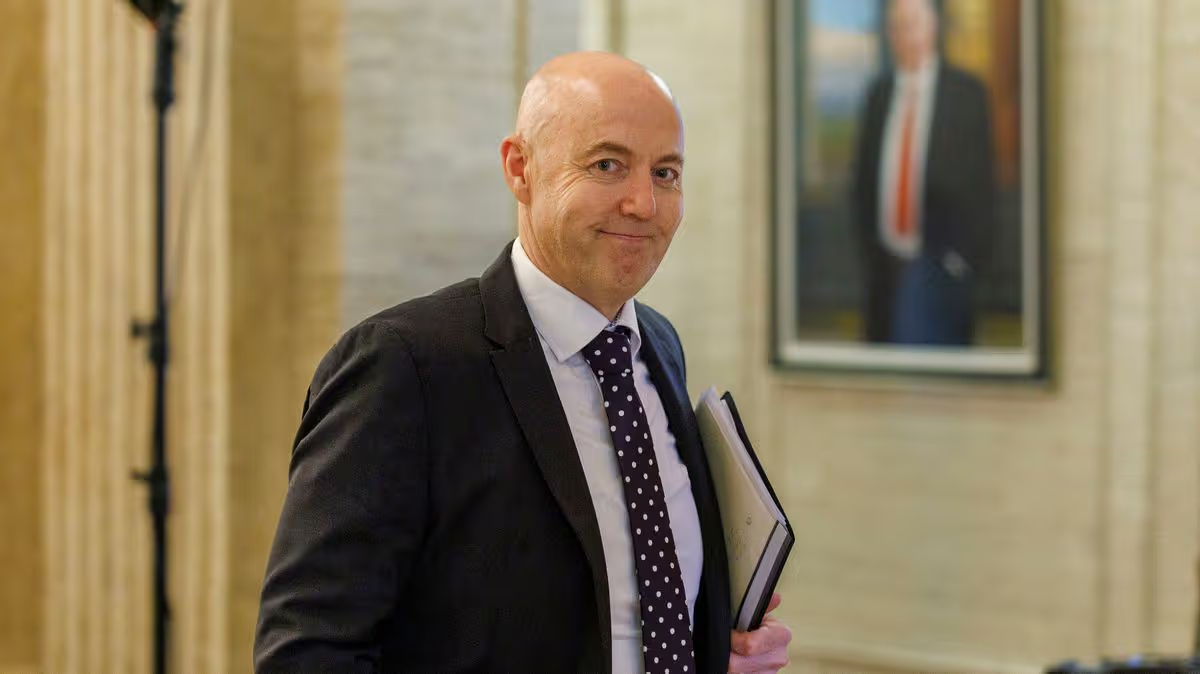
Jon Burrows ‘deeply disappointed’ by Doug Beattie’s resignation letter

Published

on

Belfast Live

The former PSNI officer also said he “completely” rejected allegations in the letter that an “insidious campaign of rumour and gossip” had been directed at Mr Beattie.

The UUP leader has said he is “deeply disappointed” by comments made by Doug Beattie, who resigned from the party on Sunday.

The Upper Bann MLA, who once led the UUP, cited a “toxic atmosphere” under its current leadership as the reason for his departure.

Advertisement

In a scathing resignation letter directed at party leader Jon Burrows, the ex-Army captain said: “Your leadership style became dismissive and overly centralised, empowering individuals to actively undermine elected representatives.

“In the absence of any coherent policy direction from the leadership, a toxic atmosphere has been allowed to flourish within the party.”

Speaking on BBC Radio Ulster’s Evening Extra on Tuesday, Mr Burrows said he had “a lot of respect” for Mr Beattie, “both as a gallant soldier and also as a long-standing member and politician in this party”.

However, referring to the resignation letter he said: “I’m deeply disappointed by the comments Doug made, I regret that he made them, and I don’t recognise his characterisation of me whatsoever.”

Advertisement

Asked about disciplinary proceedings which Mr Beattie described as “vindictive and a deliberate attempt to drive” him from the party, Mr Burrows said: “I deal with what is in front of me, and I have high standards, A leader sets high standards in terms of integrity.

“It is my responsibility to set high ethical standards,” he added.

The former PSNI officer also said he “completely” rejected allegations in the letter that an “insidious campaign of rumour and gossip” had been directed at Mr Beattie.

For all the latest news, visit the Belfast Live homepage here and sign up to our daily newsletter here.

Source link

Continue Reading

NewsBeat

Take 2: White House correspondents’ dinner is rescheduled for July

Published

on

Take 2: White House correspondents' dinner is rescheduled for July

NEW YORK (AP) — And now, Take Two: The White House Correspondents’ Association dinner has been rescheduled — with President Donald Trump apparently in attendance.

The dinner, cut short in April by a gunman who prosecutors say was trying to assassinate Trump, will now take place on July 24. It will be a more intimate gathering with “significantly enhanced safety measures and new access procedures,” said Weijia Jiang, president of the White House Correspondents’ Association.

Jiang did not say where the dinner would be held. But Trump, on his Truth Social platform, revealed it would be at the Waldorf Astoria Hotel on Pennsylvania Avenue — former site of the Trump International Hotel.

The president said he’d been invited to return and speak, and had accepted the invitation. He called the rescheduling “a sign of Strength and Fortitude.”

Advertisement

“This announcement is a very good thing in that we cannot allow Lunatics to change our way of life, or even its scheduling,” Trump wrote.

He added he hadn’t decided on whether to give his originally intended speech, in which he was widely expected to attack the press. “I don’t know whether or not I will give the same rather nasty statements, at least as it concerns certain people, but we will soon find out,” he wrote. “In any event, it will be a ‘HOT’ ticket!”

Rescheduling decision took time

Jiang, in her announcement, noted that “rescheduling was not automatic,” and had involved much consideration and input from board members.

She emphasized the dinner’s stated purpose: “a celebration of a free press and the vital role of journalism in our democracy for over a century.”

Advertisement

“We will not allow an act of violence to have the last word, especially during a year when we are reflecting on the 250th anniversary of America and everything we stand for,” Jiang said.

It was not clear how large the rescheduled dinner would be, or whether it would be a full-scale dinner at all. Jiang made reference to a “more intimate gathering” than the original event, attended by close to 3,000 people at the Washington Hilton, but did not give details, saying they’d be shared directly with attendees.

Her remarks were in line with recent speculation that a rescheduled event would have to be pared down, a nod to financial as well as security concerns.

Concern expressed for wounded officer

Jiang also made note of the Secret Service officer who was shot in April and has been recovering. “Our thoughts remain with the officer who was injured and with everyone who experienced that evening,” she said. “We are indebted to the US Secret Service, law enforcement and the hotel staff whose swift response protected our guests and our staff.”

Advertisement

Though Jiang always insisted the dinner should be rescheduled, not everyone felt the same way.

Some critics said they felt it would be a good idea to scuttle the whole event permanently — not only for security reasons, but for what they saw as an unseemly enterprise of journalists hobnobbing in formal wear with the subjects of their reporting.

“It undermines the public faith in how the press does its work, and it makes it look like we are pals with the people we cover,” Kelly McBride, an ethics expert at the Poynter Institute, a journalism think tank, said in May.

Advertisement

Source link

Continue Reading

NewsBeat

Cambridge City Council elects Labour leader after earlier deadlock

Published

on

Cambridgeshire Live

Opposition leaders said they ‘were not going to hold the city council ransom’

Labour’s Katie Thornburrow has been elected as leader of Cambridge City Council after last month’s meeting ended in deadlock. The first meeting of the full council since the local elections had to be adjourned after opposition parties voted against her appointment twice despite hours of deliberation.

Advertisement

The meeting was adjourned until June 1 but this time Cllr Thornburrow was successfully voted leader. The Green Party put forward Cllr Sefira Davison, deputy leader of the group, as leader, but she was defeated by 16 votes to 12 – with 12 more councillors abstaining.

Cllr Thornburrow thanked everyone who took part in negotiations and welcomed all the newly elected council members.

She said: “Not only have you lowered the average age of councillors in the chamber but you’ve brought a range of experience, insight and expertise, and you deserve thanks for stepping forward for election. I know putting myself forward was a hard decision but it’s one I’ve never regretted.”

Cllr Thornburrow said they would be introducing regular meetings between the leaders of Labour, Liberal Democrat and Green groups and starting a cross-party finance working group “that will make budget-setting more collaborative and open”.

Advertisement

She said the “new ways of working” reflect how she personally wants to lead and have also come from the “constructive, extensive conversations” had with opposition leaders.

Cllr Davison congratulated her and said it would be “great comfort for residents” that there would be not just “scrutiny from all sides – but hopefully that scrutiny will be in a collaborative framework for the good of the city.”

Cllr Tim Bick, leader of the Liberal Democrat group, said that a “three-party administration” was their priority but this had “failed because Labour didn’t support it”.

He said: “Our interpretation of the election result was a clear desire for change and we didn’t feel Labour carrying on as before was appropriate.”

Advertisement

Cllr Bick said that other options including a coalition between the Greens and Liberal Democrats were also considered, but said they felt there was “uncertainty” surrounding the Greens “collective views on the major issues affecting our city”.

He said they didn’t want a Labour administration but without a “credible alternative”, there was “sadly no other show in town” and they “were not going to hold the city council ransom”.

In return for the Liberal Democrat group abstaining from the vote, Labour agreed to support a number of their proposals. These include measures to control the spread of HMOs, reopen public toilets and improve street cleaning and public realm enforcement.

They will also bring forward a report on a potential citywide Public Spaces Protection Order to enhance police powers in relation to anti-social driving. Labour have also agreed to prepare a report responding to Equalities Act guidance surrounding public toilet access to protect the rights of the trans community. The rights of both opposition parties will also be extended with guaranteed speaking rights at cabinet.

Advertisement

In a press release issued by the Greens following the meeting, Cllr Davison said: “We heard from the Lib Dems today that Labour being in power wasn’t what they wanted, but it’s what they chose.

“We’ve spent weeks offering fair, reasonable compromises, including a proportionate split of cabinet posts and balanced leadership arrangements, and they told us they wouldn’t accept any offer that didn’t give them immediate leadership of the council.”

She said they would look forward to holding the administration to account and making sure they deliver “the best results for the city”.

Source link

Advertisement
Continue Reading

NewsBeat

Police release CCTV image of witness after body recovered from river

Published

on

Cambridgeshire Live

The body of Conor Kinlan was recovered from a Cambridgeshire river in January

Police have released a CCTV image of a witness they would like to speak to in connection with the death of a man who entered a Cambridgeshire river in January. Conor Kinlan was found in the River Nene in Peterborough on January 24 of this year.

Conor’s death is being treated as a murder and three men, who have been charged with murder, are due to stand trial next month. Police would now like to speak to a man captured on CCTV in connection with Conor’s death.

In the CCTV image, the man is seen wearing blue-green trousers, a black jacket, a red and white cap and riding a light green mountain bike. Detective Chief Inspector Richard Stott, from the Bedfordshire, Cambridgeshire and Hertfordshire Major Crime Unit, said: “We’d like to speak to this man who we believe can help our enquiries.

Advertisement

“We recognise the images aren’t of the best quality but hope the man himself may see this and come forward, or someone might recognise the distinctive clothing.” Anyone with information should call police on 101 or online and quote Operation Adeo.

Do you want more of the latest Cambridgeshire news as it comes in from across the county? Sign up to our dedicated newsletter to make sure you never miss a big story from Cambridge or anywhere else in the county. You can also sign up to our dedicated Traffic and Crime newsletters for the latest updates on the topics you are most interested in .

Source link

Advertisement
Continue Reading

NewsBeat

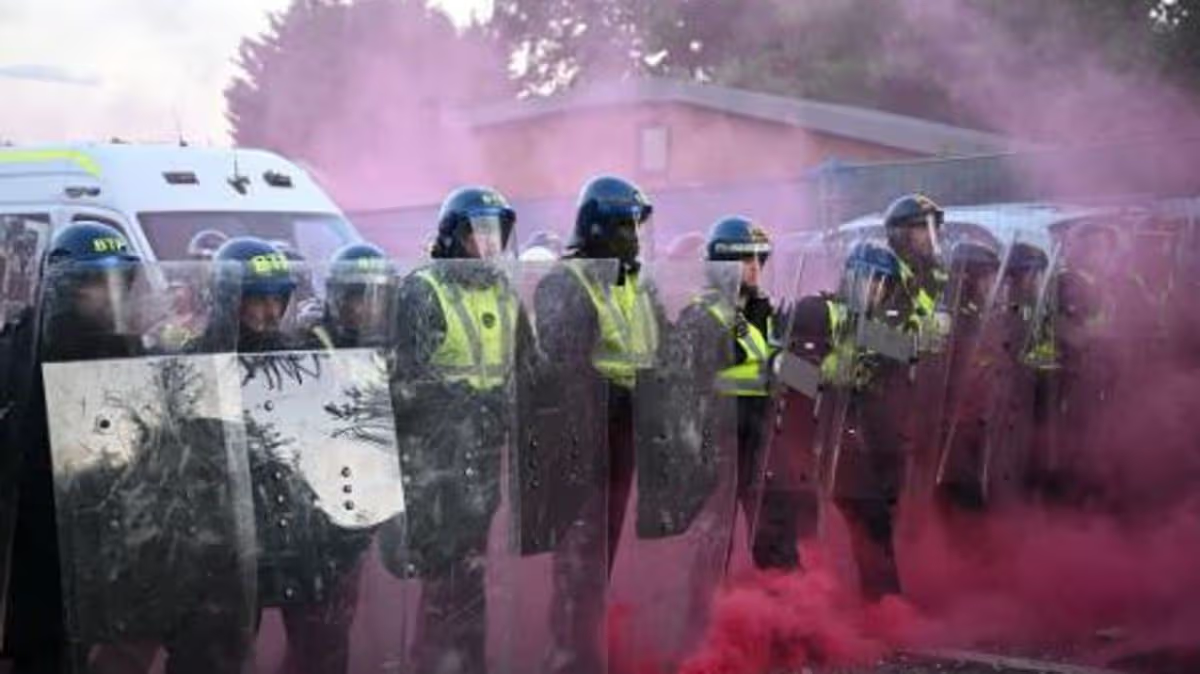
Protesters clash with riot police in Southampton near where Henry Nowak was murdered

Published

on

Manchester Evening News
Protesters clash with riot police in Southampton near where Henry Nowak was murdered – Manchester Evening News

reach logo

At Reach and across our entities we and our partners use information collected through cookies and other identifiers from your device to improve experience on our site, analyse how it is used and to show personalised advertising. You can opt out of the sale or sharing of your data, at any time clicking the “Do Not Sell or Share my Data” button at the bottom of the webpage. Please note that your preferences are browser specific. Use of our website and any of our services represents your acceptance of the use of cookies and consent to the practices described in our Privacy Notice and Terms and Conditions.

Source link

Advertisement
Continue Reading

Trending

Copyright © 2025