

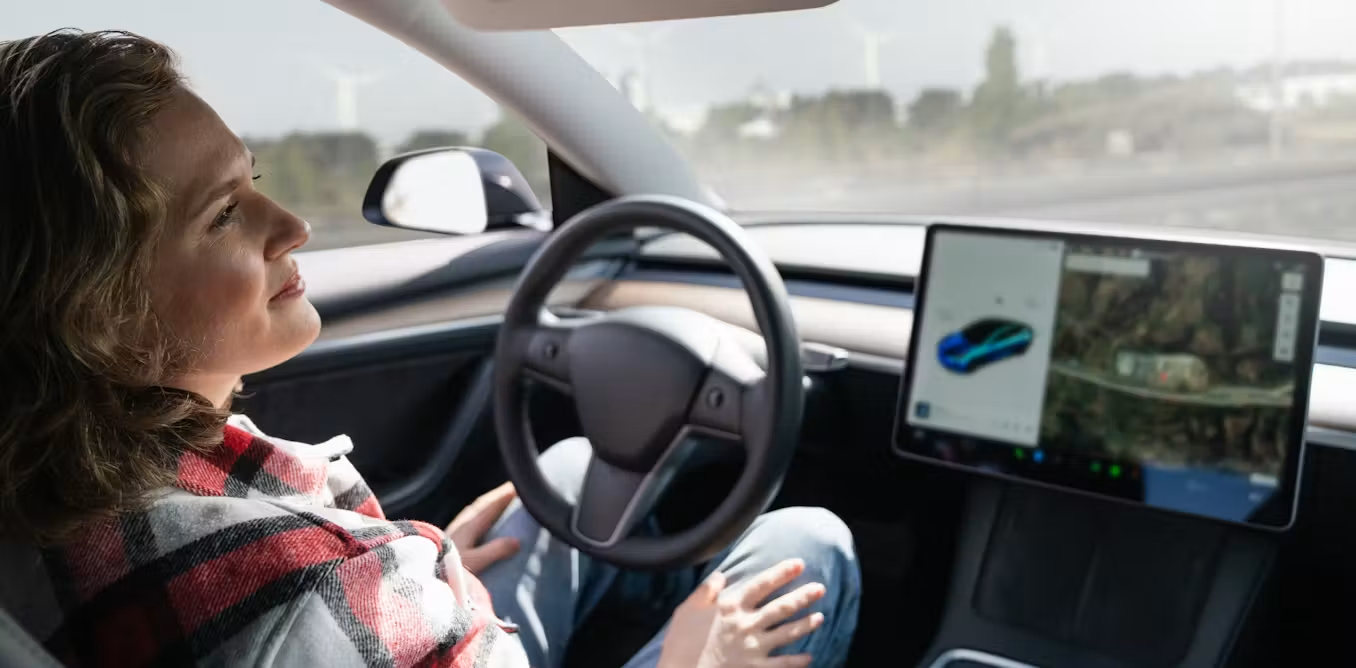
Imagine getting into a London taxi. Someone is sitting in the driver’s seat, but the car is driving itself. If the autonomous system gets into difficulty, they must recognise what is happening, decide whether to intervene and, within seconds, potentially take control.
This is no longer hypothetical. Uber and the British autonomous driving company, Wayve, have been granted licences to operate self-driving taxis in London with human safety drivers seated inside, with more than 100,000 people having joined a waiting list for the service. Uber launched its service, with 15 autonomous vehicles, on September 3.
Much of the debate thus far has focused on whether robotaxis will eventually replace human drivers. But there is another important question: what happens to human skill when our job changes from doing something to watching a machine do it?
Driving involves reading the road, anticipating others’ behaviour, judging risk and
responding to unexpected situations. Autonomous vehicles transfer much of this
work to software, but humans don’t necessarily become unskilled; their expertise
changes.
They become less of an operator and more of a critical supervisor. There
is, however, a problem with this arrangement, one that was identified long before
today’s enthusiasm for AI.
In 1983, Lisanne Bainbridge published an influential paper, Ironies of Automation, noting that automation tends to leave humans with the tasks machines find most difficult, namely, monitoring complex systems and dealing with unusual situations.
The irony is that automating routine work can leave people with fewer opportunities
to practise the skills they need when something goes wrong. Applied to robotaxis, this paradox is striking: the better the autonomous system becomes at driving, the less its human supervisor needs to drive.
However, the less that person drives, the fewer opportunities they have to practise the skills they may suddenly need when the system encounters something it cannot handle.
Meaningful oversight
There are signs of a similar problem elsewhere. For example, a 2025 study of clinicians using AI-assisted colonoscopy found that after routinely working with AI, their ability to detect precancerous growths when working without the technology declined, falling from 28.4% before regular exposure to AI to 22.4% afterwards.
This does not mean that AI makes doctors worse, nor that autonomous vehicles will
inevitably make people poor drivers. The significant distinction is between the
performance of the human-machine system and the capabilities retained by the
human within it.
Caito / Shutterstock
A system can improve while the human supervisor becomes less practised. We hear about keeping a “human in the loop” in medicine, education, law and workplaces increasingly reliant on machine-generated analysis. However, having a human present is not the same thing as having meaningful human oversight.
For that, the person needs enough expertise to recognise when the machine is wrong,
enough confidence to challenge, and enough authority to intervene.
A temporary job?
Robotaxis already operate in the US, China and the Middle East, sometimes without
a supervisor. This raises an uncomfortable question about London’s safety drivers:
do they represent a new kind of skilled occupation (expertise in supervising
autonomous systems) or are they temporary workers, required until the technology is
considered reliable enough to work alone?
There may, in other words, be two kinds of displacement happening. Eventually, the
taxi driver may be displaced by the machine, but before that happens, driving itself becomes displaced by supervising. And that transformation is likely to reach far beyond transport.
The government had anticipated commercial trials beginning this year, but regulatory and technical hurdles have delayed the rollout. Transport for London has not published the guidance operators will need and no vehicles have thus far completed the approval process required for fully driverless passenger services.
The delay has been welcomed by some campaigners who have raised concerns
ranging from employment and road safety, to privacy and the environmental costs
associated with data intensive technologies. However, the postponement should not
be read as evidence that autonomous vehicles have failed or that they are inherently unsafe.
Indeed, it highlights something more fascinating – that technological capability, regulation and social preparedness do not necessarily develop at the same speed.
Before fully autonomous vehicles can become ordinary features of London’s streets,
regulators must confront questions that are partly technical but also ethical; such as, who supervises an autonomous system? Who is responsible when something goes
wrong?
And at what point are we prepared to decide that the human supervisor is no
longer needed? London’s delayed experiment is therefore testing a relationship with technology that is becoming increasingly familiar: machines performing while humans watch, judge and remain responsible.
As such, the challenge is no longer about keeping a “human in the loop”, but ensuring that when we do, humans retain the skills, judgment and agency that make their presence meaningful.





























































You must be logged in to post a comment Login