


A retired British couple have been named as victims of a wildfire in southern Spain that killed 13 people, as wildfires continue to blaze across Europe, prompting hundreds of evacuations.
Christine and Michael Chard, who have been described as ‘lovely, lovely people’, were killed when a devastating blaze spread through the Almeria region.
A local councillor from the Spanish municipality, Francesca Murray Howe, said Mrs Chard was ‘charming’ and ‘beautiful’ while her husband was ‘very sarcastic’.
In a tribute to the retired couple, Ms Howe said: ‘She was a beautiful woman, truly beautiful. She had incredible red hair, long and wavy; simply beautiful. And a great sense of humour, very funny. Charming, warm, a wonderful human being.’
The local politican added that Mr Chard was a ‘man of few words’.
The Chards, originally from southeast England, were married in Bedar after moving to the area some years ago. According to social media, this summer would have marked their ninth wedding anniversary.
A friend of the couple wrote in a social media tribute: ‘Words can’t express our feelings at the loss of our dearest friends. Condolences to all your family. RIP and we hope there is a nice dry martini for you Chris.’
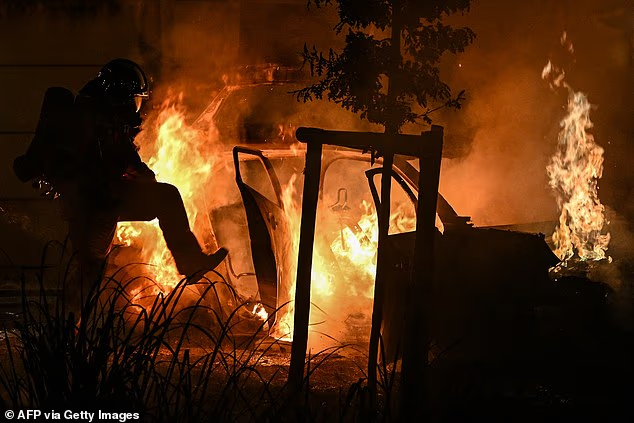
A firefighter sprays water on burning cars during a fire in front of a camping site in Villeneuve-les-Beziers, Southern France

The military fighting a wildfire in La Mierla area, near Guadalajara, about 100 kilometers north of Madrid
Another wrote: ‘Rest in peace, Christine and Michael. I was heartbroken to hear this news. Christine, you were always so kind to me, and I looked forward to our catch ups whenever our visits coincided with you being here. I treasure the friendship, the laughs, the cheeky drinks, the twinkle in your eye.’
It comes after 93-year-old Briton Audrey Ethel Curry died in hospital two days after she was injured in the fires.
Among the seven Britons to have been identified by relatives or the Spanish authorities as victims are Pete and Fran Gillam and Annette Kilgore, 69, while her husband Malcolm Timbrell, 70, survived the blaze.
Kent-born Ian Jarvis has also been identified as a victim by British media.
The wildfire began on July 9 and raged for almost a week, becoming one of the deadliest in Spain’s history.
Elsewhere, hundreds of people have been forced to flee their homes as major wildfires continue to rage across southern Europe.
Spain is battling multiple blazes while popular holiday destinations in France remain on high alert ahead of another intense heatwave expected to push temperatures close to 45C.
Fire crews in Spain are continuing to tackle a major wildfire north of Madrid that has burned around 13,000 hectares (32,000 acres) and prompted the evacuation of about 700 residents.
Prime Minister Pedro Sánchez said his government was closely monitoring the situation and praised emergency crews for their relentless efforts to contain the blaze and protect nearby communities.
Around 300 firefighters, backed by 26 water-bombing aircraft, have been deployed to the fire, which ignited on Thursday in the province of Guadalajara during a spell of extreme heat.
Regional officials have described the blaze as particularly difficult to contain because of the rugged, forested terrain surrounding the Sierra Norte Natural Park, an area home to endangered wildlife including wolves, golden eagles and rare butterfly species.
Elsewhere in Spain, firefighters have gained ground on a separate wildfire near Zaragoza in the north-eastern region of Aragon, where around 1,000 residents were evacuated after flames swept through the countryside.
Authorities say the blaze has burned approximately 14,400 hectares after improved weather conditions slowed its advance.
No deaths or injuries have been reported, while emergency officials are assessing when evacuated residents can safely return home.
Spain’s State Meteorological Agency (Aemet) has warned the country is about to enter its third heatwave of the summer, with temperatures forecast to climb steadily before peaking later this week.
Some parts of southeastern Spain could approach or even exceed 45C, dramatically increasing the risk of new wildfires as vegetation dries out further.
The warnings come after Spain suffered one of its deadliest wildfires in recent years earlier this month, when 13 people were killed in a blaze in Almería that destroyed around 7,000 hectares.
In neighbouring France, thousands of people have already been forced to evacuate as a series of fast-moving wildfires swept through the country’s Mediterranean regions following last month’s record-breaking heatwave.
One of the largest fires erupted near Trévillach in the foothills of the French Pyrenees close to the Spanish border, scorching more than 4,600 hectares and forcing more than 10,000 people to leave over a dozen villages.

A major wildfire that has been raging for two days in northeast Spain has reduced more than 12,000 hectares of land to ash
French Interior Minister Laurent Nunez warned that worsening weather conditions and powerful winds threatened to reignite the fire’s spread, while residents described flames racing towards homes in a matter of minutes.
‘It came within 300 metres of the houses. We were stunned by how quickly it spread,’ one resident told local media.
The wildfire also disrupted the Tour de France, with organisers urging spectators to avoid the final section of one stage so emergency vehicles could move freely through the affected area.
Race officials dramatically reduced the convoy accompanying riders, saying the exceptional circumstances required extraordinary safety measures.
Earlier in the month, firefighters battled several major blazes across southern France, including around Marseille and the Aude region near the Spanish border.
More than 1,200 hectares were burned in a single day as strong winds hampered firefighting operations despite the efforts of hundreds of firefighters.
Another wildfire near the Riviera resort town of Fréjus forced more than 2,000 holidaymakers to evacuate six campsites as flames approached popular tourist areas.
‘The fire spread extremely quickly in the context of this heatwave and extreme drought,’ local prefect Simon Babre told BFM TV.
The blaze had scorched about 180 hectares (445 acres) by Sunday evening, the prefect’s office said.
Television images showed large flames advancing behind hillside villas typical of the French Riviera, while thick black smoke billowed above pine and cypress trees.
Authorities said there were no fatalities, although smoke blanketed parts of Marseille and drifting ash disrupted flights arriving at the city’s airport.
European authorities have warned that prolonged periods of exceptional heat, combined with extremely dry vegetation and low humidity, are creating ideal conditions for large and fast-moving wildfires across the continent.
Scientists say human-driven climate change is increasing the frequency, intensity and duration of heatwaves, leaving forests and grasslands more vulnerable to ignition and allowing fires to spread more rapidly.
Forecasters have also warned that dry thunderstorms could develop over mountainous areas later this week, bringing lightning strikes but little rainfall, conditions that could spark fresh wildfires just as southern Europe braces for another spell of extreme heat.
Germany’s recent cool spell may be short-lived, with another heatwave possible soon.
Meteorologists say high pressure is expected to rebuild over central Europe, allowing hot air currently over Spain and France to move back into Germany.
Temperatures could exceed 30C across much of the country by next weekend, although the exact timing remains uncertain due to a potential boundary between warm and cool air masses.
The previous heatwave was historic, with Germany reaching a record 41.7C at the end of June and experiencing around 12 consecutive days of heat warnings, making it one of the longest such periods since the German Weather Service (DWD) introduced its heat warning system in 2005.






















































You must be logged in to post a comment Login