

Connect with us
DAPA Banner
DAPA Coin
DAPA
COIN PAYMENT ASSET
PRIVACY · BLOCKDAG · HOMOMORPHIC ENCRYPTION · RUST
ElGamal Encrypted MINE DAPA
🚫 GENESIS SOLD OUT
DAPAPAY COMING

NewsBeat

I tried an AI skincare routine – and it completely changed my skin

Published

on

I tried an AI skincare routine - and it completely changed my skin
Can AI help determine what skincare is best for me? (Picture: Metro/Noli/Getty)

Metro journalists select and curate the products that feature on our site. If you make a purchase via links on this page we will earn commission – learn more

There’s no denying the beauty industry is oversaturated, with too many products and confusing messaging about what your skin actually needs. 

Viral trends come and go, and only add to the overwhelm, but aren’t always best suited to you and your needs. As a beauty journalist, I know this feeling all too well – I have oily skin with hormonal acne and mild rosacea, and despite my years in the industry, I’m often left feeling frustrated with the excessive amount of products that promise to ‘fix’ me. 

If that’s something you’ve also experienced, Noli could be the solution to simplifying things. It’s an AI-driven platform, backed by L’Oreal, that uses dermatologist diagnostics to take the guesswork out of beauty shopping.

Advertisement

The setup is simple; complete the questionnaire to discover your profile – or what Noli calls its BeautyDNA – and it will analyse your skin type, concerns, budget preference, and more, to recommend the products best suited to your needs. 

So I did exactly that, and have plenty of thoughts. My personal needs are to clear up blemishes, tackle dehydration and smooth uneven tone and texture. I told Noli I have no preference on fragrance, want my skin to feel soothed, and I’m happy to spend a little more on products if they’ll work. 

Here’s exactly what Noli said I needed, and my verdict on the four-product skincare routine it built for me. 

White tube of La Roche-Posay Effaclar H Iso-Biome Cleansing Cream

La Roche-Posay Effaclar H Iso-Biome Cleansing Cream

Noli advised using this as my first skincare step, as it’s gentle enough to cleanse my skin without being too harsh or removing too much oil, which can only lead to increased oil production.

Advertisement

It’s specifically formulated to soothe discomfort from harsh acne treatments, which can be very drying, and is well-tolerated with Isotretinoin (a prescription acne treatment). 

The formula is packed with niaciamide, mannose and glycerin, which, combined, hydrate and reduce the appearance of pores and inflammation. 

I love how rich and creamy it feels when lathered with warm water, and I found it surprisingly effective at removing my makeup too.

It rinses off easily, is fragrance-free, and leaves my skin feeling immediately softer and smoother.

Advertisement

So far, so good.

Buy Now for £16.50

Green bottle with black lid of SkinCeuticals Phyto Corrective

SkinCeuticals Phyto Corrective

Next up was a targeted serum, and Noli’s top pick for me was this SkinCeuticals Phyto Corrective. Gel.

It’s a blend of hyaluronic acid, cucumber, thyme and mulberry that contains lactic acid, a gentle exfoliant, that unclogs pores, reduces blemishes and hydrates without adding oil. 

It’s incredibly lightweight, with a watery-thin texture that absorbs in seconds, which I love.

Advertisement

There’s nothing I hate more than spending ages rubbing a sticky solution on my skin. 

It has a slight medicinal scent, but it disappears very quickly, and I found that when I had bouts of period-induced breakouts, it calmed my skin and left it feeling soothed and comfortable, even when I had painful cysts on my chin.

It’s expensive, but a worthwhile investment.

Buy now for £83

Green pot of IT Cosmetics Confidence in a Gel Cream

IT Cosmetics Confidence in a Gel Cream

Next is an oil-free moisturiser that can tackle blemishes, hydrate and balance oil production. 

Advertisement

Noli’s pick was this from IT Cosmetics – a refreshing, cooling gel cream that contains a mix of niacinamide and lactic acid, both proven ingredients for reducing inflammation, regulating excess oil and unclogging pores.

Everything I need, basically. 

I love the texture of this; it’s like a drink of water for my skin, without the stickiness or greasy residue I often experience from thicker, richer traditional creams.

I use it day and night, and it creates a smooth, even base for my makeup and SPF to be applied on top.

Advertisement

Buy Now for £47

Yellow bottle of Kiehl’s Better Screen™ UV Serum Sunscreen

Kiehl’s Better Screen™ UV Serum Sunscreen

I know all too well the importance of SPF, and having been sunburnt as a reckless teenager, I’m well aware of how damaging a lack of sun protection can be.

Noli recommended this new sunscreen from Kiehl’s, which provides SPF 50 and a silky-soft texture that leaves a glowy finish. 

It’s a non-comedogenic, meaning it won’t block your pores, which inevitably leads to breakouts, and doesn’t leave a white cast behind that could leave my skin looking ghostly.

I love the radiant finish, which isn’t dewy, but just enough to make my skin look healthier with one use.

Advertisement

Buy Now for £42

Follow Metro across our social channels, on Facebook, Twitter and Instagram

Share your views in the comments below

Advertisement

Source link

Advertisement
Continue Reading
Click to comment

You must be logged in to post a comment Login

Leave a Reply

NewsBeat

Portfolio Diet: Food Plan And Heart Benefits

Published

on

Portfolio Diet: Food Plan And Heart Benefits

In a recent video, surgeon, author, and medical myth debunker Dr Karan Rajan said that the portfolio diet could “reduce your [low-density lipoprotein] LDL cholesterol as much as a statin”.

Statins are medications designed to lower a person’s LDL, or “bad”, cholesterol levels, thus reducing their risk of heart disease and stroke.

A 2003 study found that the portfolio reduced LDL cholesterol by almost 29%. In other words, it seemed about as good as low-dose statins (those which reduce LDL cholesterol by 30% or less) at lowering “bad” cholesterol.

The British Heart Foundation cautioned that statins may carry unique benefits and better-proven outcomes outside of just lowering LDL cholesterol. If you’ve been prescribed statins, keep taking them as long as your doctor advises.

Advertisement

But if you’re trying to keep your LDL levels healthy in general, some research suggests the portfolio diet can reduce “bad” cholesterol by as much as 30%.

What is the portfolio diet?

The diet, which was invented in the early 2000s by Dr. David J.A. Jenkin, is designed to combine several LDL cholesterol-reducing foods into a single plan.

Speaking to Harvard Health, dietitian Andrea Glen – who was involved in 2023 research that showed sticking strictly to the Portfolio diet was linked to a 14% lower risk of heart disease – said: “A lot of different foods can lower LDL cholesterol, but only by a little bit – about 5% to 10%.

Advertisement

“The idea behind the portfolio diet was to combine many of these foods together to get a larger reduction.”

How can I follow a portfolio diet?

The portfolio diet focuses on four main components:

  1. Plant protein, especially soy protein, found in tofu, edamame beans, lentils, and tempeh.
    Consuming these has been linked to a 4-6% LDL cholesterol reduction, and the portfolio diet asks you to aim for least 35g a day.
  2. Plant sterols, like those found in minimally processed olive, sunflower, and rapeseed oils and fortified products e.g. some margarines, milks, and yoghurts which say they help to lower cholesterol.
    A 2014 review of studies found that eating up to 3.3g a day of plant sterols a day lowered participants’ LDL cholesterol levels by 6-12% after four weeks, though consuming more did not lead to better results. The portfolio diet suggests 2g of plant sterols a day, which the British Heart Foundation says you probably won’t get from oils, fruits, veg, and grain alone: reach fof fortified foods for the most effective does.
  3. Tree nuts, like almonds, Brazil nuts, hazelnuts, cashews, macadamia nuts, walnuts, and pistachios.
    These could help to reduce LDL cholesterol by anywhere from 3-19%. The portfolio diet asks you to eat a handful, or 42g, of tree nuts a day.
  4. Soluble fiber, which you can get from fruits, vegetables, whole grains, and legumes (e.g. black beans, oats, Brussels sprouts, barely, sweet potatoes, carrots, avocado, and soft fruit, like apples and pears).
    Getting enough soluble fibre has been linked to 5-11 lower LDL cholesterol level points. The portfolio diet recommends 18g a day.

Taking psyllium husk can help if you’re struggling to reach your soluble fibre goals, while (as we mentioned) plant sterol-fortified yoghurts, spreads, and milk products are probably the best way to help you meet that target.

Advertisement

Source link

Continue Reading

NewsBeat

Could women’s anger turn Makerfield voters against Reform UK?

Published

on

Could women’s anger turn Makerfield voters against Reform UK?

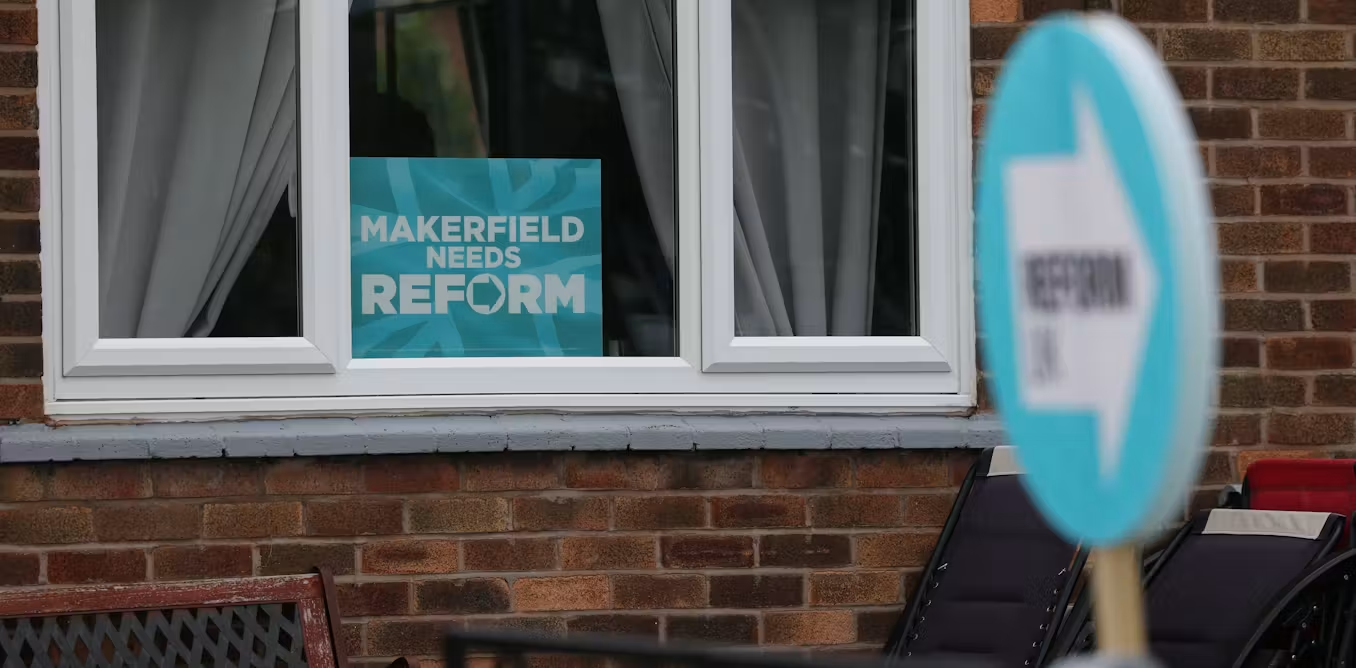
With the Makerfield byelection approaching, polling suggests that Andy Burnham has a lead over Reform UK’s candidate Robert Kenyon. That lead, it appears, is stronger among women than men. Among women, Burnham’s lead stretches to 17 points, while among men is just two points.

One factor behind this may be the social media campaign being run by Reform. Analysis suggests that the party’s posts are targeted at (and seen more often by) men. And among voters aged 25 to 65, Kenyon’s campaign adverts have been seen far more often by men.

This is not surprising – research shows that men consume more political news and media than women, partially due to a “child penalty”, which can reduce the amount of news that mothers consume. As such, Reform’s campaign may be cutting through to more men.

However, the women of Makerfield do seem to have noticed one key claim about Kenyon – and it’s not something they view favourably. His old social media posts included a number of sexually explicit comments, as well as sexist language. This included a post in which he described women who had an abortion as “cowardly”.

Advertisement

On a special edition of the BBC’s Question Time programme recorded in Makerfield, one female audience member stated: “I’d rather have a career politician than a plumber who’s a sexist.”

Previous research shows that holding sexist attitudes and voting for a rightwing party in the UK are associated. This is relevant to understanding not just women’s choices when it comes to the byelection, but also men’s. Men who do not hold sexist attitudes will also be unlikely to lend their support to Reform.

But it’s important not to give too much weight to Reform’s choice of candidate or social media campaign as the causes of the gender differences seen in this recent polling. It is well understood that women are now less likely to vote for rightwing parties than men. This is especially the case when it comes to populist or far-right parties.

Women are more likely to vote for leftwing parties than men, a pattern that played out in the UK’s 2024 general election. The polling in Makerfield is consistent with this trend.

Advertisement

Yet the women of Makerfield, the choice of candidates by both parties, and Kenyon’s controversial comments are likely to play an important role in support for Labour at the byelection. Labour and Burnham, currently mayor of Greater Manchester, must consolidate the left vote in the constituency, and make sure their voters turn out on the day. Reform’s choice of Kenyon as its candidate may just help them to do this.

A candidate who has displayed controversial attitudes about women and issues around gender may make women who favour a third party, such as the Green party, more likely to prioritise keeping Reform out. They may see a vote for Labour as the best way to do this.

How might anger affect the vote?

One problem for Labour nationally is that the left vote has fragmented even further since 2024, with support increasing for the Green party. Support for the Greens among younger, educated women is now particularly strong.

While the Greens won only 4% of the vote in Makerfield at the last general election, if this were to increase it could be a real issue for Labour. This is not because the Greens are a threat to win the constituency, but because they could take support away from Burnham.

Advertisement

In the last byelection in Greater Manchester – Gorton and Denton – there were competing claims from Labour and the Greens about who was best placed to keep Reform out. Then, Reform had fielded a different candidate with controversial attitudes to gender issues. This may have contributed to a Green win, with late-deciding women potentially playing a role in the result.

In Makerfield, unlike in Gorton and Denton, it is much more obvious that women should consolidate behind Labour if they want to keep out a controversial Reform candidate. This may help Labour and bring back women who have voted (or have considered voting) Green.

On top of this, Reform’s decision to stick with a candidate with attitudes that seemed to make women in the Question Time audience visibly angry may motivate women to turn out and vote.

This could also spill over into households. It’s well established that when one person in a household votes, others in that household are more likely to do so. This goes alongside any influence Labour-voting women might have on the voting choices of those around them.

Advertisement

Of course, this influence could also work against Labour. My own research has shown that, in the UK, people who discussed politics with a Labour or a Liberal Democrat supporter were less likely to go on to vote Remain. And those who discussed politics with a Ukip backer were more likely to vote Leave.

The contest in Makerfield may be decided in part by how well Labour can persuade leftwing voters, who are disproportionately women, to vote for Burnham to keep out a controversial Reform candidate. Then the question will be whether these women can also mobilise those around them to do the same.


Source link

Advertisement
Continue Reading

NewsBeat

Keir Starmer to ban under-16s from social media apps

Published

on

Keir Starmer to ban under-16s from social media apps

Prime Minister Sir Keir Starmer is expected to announce the proposed ban at a Downing Street press conference scheduled for 8am.

The move comes in response to overwhelming support during a government consultation, which found that 91% of parents backed raising the minimum age for social media access to 16.

The proposed UK ban would apply to platforms such as TikTok, Instagram, Threads, Facebook, X, YouTube, Snapchat, and Reddit.

Advertisement

Children under 16 to be banned from social media apps

Sir Keir said: “This is a choice about whose side we’re on: families across the country, or a status quo that isn’t working.

“People rightly expect action, and this Government will always stand up for parents and put children first.

“As a dad, I know every parent wants their child to grow up safe and happy.

“That’s why we will call time on a system that’s failing our kids and take bold action to give every child the best possible start in life.”

Advertisement

It is expected that the ban will go further than similar measures in Australia by also banning under-16s from accessing romantic or sexual AI chatbots and limiting their ability to chat with strangers on gaming platforms, according to The Sunday Times.

Other measures under consideration include daily time limits for under-18s to prevent late-night scrolling.

The consultation on the proposals closed on May 26 and drew about 116,000 responses, making it the second-largest in history.

More than 83% of parents who responded said the risks of social media outweigh the benefits for children.

Among younger respondents, 62% said restricting high-risk features would improve their safety online.

Advertisement

However, 72% expressed concerns about feeling left out if such restrictions were introduced.

Sir Keir’s announcement follows his recent ultimatum to Apple and Google, giving them three months to make it technologically impossible for children to take, share or view nude images on their smartphones.

Not everyone agrees with the proposals.

The U.S. embassy in London, responding to the consultation, warned the UK against a blanket ban, favouring more targeted requirements instead.

Advertisement

They raised concerns that strict age verification could place disproportionate compliance burdens on American tech companies.

Domestic critics have also voiced their concerns.

The Molly Rose Foundation, established after the death of 14-year-old Molly Russell, argued that a simple age ban will not address the underlying product safety risks.

Andy Burrows, the foundation’s chief executive, said: “A majority of children will continue to use high-risk sites that will have no incentive to implement robust protections.

Advertisement

“This is not what online safety experts believe will work and is necessary.

“Keir Starmer has chosen to abdicate responsibility for tackling harmful algorithms and his legacy will be setting back children’s safety by years.”

However, Conservative figures who campaigned for tougher online protections for children welcomed the new direction.

Lord Nash, a former education minister, said: “The Government now has an opportunity to draw a line in the sand and end tech companies’ uncontrolled experiment with children’s safety.

Advertisement

“They must deliver in full on their pledge to raise the age limit to 16 for harmful platforms and features, with robust age verification to ensure it is properly enforced.

“Only by doing this can they begin to end the catastrophic harm being done to a generation.

“Let’s give our children their childhood back.”

Labour MP Feryal Clark, co-chairwoman of the All-Party Parliamentary Group for digital creators, said: “High-quality, creator-led educational video content is a critical public resource and is not the same thing as social media.

Advertisement

“For example, many young people use it to revise for GCSEs, to learn a language or a musical instrument.

“Any legislative intervention must capably address this distinction.”

Do you agree with a social media ban for under-16s? Let us know your thoughts in the comments.

Advertisement

Source link

Continue Reading

NewsBeat

Ryanair investigated over cost to parents to sit next to child

Published

on

Ryanair investigated over cost to parents to sit next to child

The Competition and Markets Authority (CMA) said it was looking into whether the airline’s policy, which the watchdog said typically led to a fee of £8 each way, was “unfair” under consumer law.

It said Ryanair’s terms and conditions state a parent must sit with their child if aged between two years and 11.

This is done through what the airline calls a “mandatory family seat” that the parent must pay a fee for.

Advertisement

Ryanair called the investigation “bogus” and insisted its family seating policy “fully complies with all relevant laws”.

The airline said that it does not charge any fee for children to sit beside their parent or accompanying adult.

However, parents and guardians must pay a booking fee to be seated next to them, The Guardian reports.

Why is Ryanair being investigated?

The CMA is looking at whether the airline’s “approach to seat reservations may mean parents are being charged for the airline to meet its child safety and disability‑related obligations as set out under aviation rules – and will investigate to determine whether or not this practice is in line with consumer law”.

The watchdog said it understood that Ryanair was the only major airline flying from the UK to impose such a charge, BBC News reports.

Advertisement

It said other airlines offered to seat children next to a parent or guardian without a fee, or allocate seats together automatically during booking for free.

The CMA added that its investigation had just started, and it had “reached no conclusions about whether Ryanair has broken the law”.

Ryanair said adults travelling with children pay one reserved seat fee, “but can select reserved seats beside them for up to four children on the same booking FREE OF CHARGE”.

In a statement, the airline said: “This means that parents travelling with children pay for only one (adult) reserved seat but pay nothing for the four other reserved seats for their children travelling with them.

Advertisement

“This bogus CMA investigation is a failed effort by the Starmer Govt to pretend it cares about consumers when it has failed to abolish APD [Air Passenger Duty] which would immediately deliver lower fares for all consumers and growth for the UK aviation, tourism and wider economy.

“Ryanair looks forward to disproving these false CMA claims during this bogus investigation.”


Recommended reading:

Advertisement

Consumer rights body Which? welcomed the investigation.

Rory Boland, travel editor at Which?, said: “Which? has repeatedly highlighted Ryanair’s harsh approach to separating families and making parents pay a fee to sit next to children as young as three, so it’s good to see the regulator investigating the airline’s behaviour.”

He added: “Ryanair doesn’t have to wait for the outcome of the CMA’s investigation, it could stop charging these unreasonable fees today and we would encourage them to do that.”

What’s your opinion on the Ryanair seating charge? Let us know in the comments.

Advertisement

Source link

Continue Reading

NewsBeat

How to write a compelling climate haiku

Published

on

How to write a compelling climate haiku

A haiku looks like the easiest poem to write. Three short lines, a few syllables, finished before your tea goes cold. That apparent simplicity is exactly why this format works so well for writing about the climate crisis, and why it is where I send researchers who tell me they cannot write poetry.

Before you write one, it helps to unlearn the rule you were taught at school.

Most of us were told a haiku has three lines of five, seven and five syllables. In English, that is a myth. Japanese counts a unit called the mora (in haiku circles, the on), which behaves differently from a syllable. “Tokyo” is two syllables to my northern English ear and four morae in Japanese. Anyone who insists on a strict 17-syllable count is being a pedant. Aim for 17 syllables or fewer, then stop counting and start noticing.

A haiku includes four things. The poem must be about nature. If it turns out to be about human nature, you have written a senryū, which is a fine thing, just a different one.

Advertisement

Every haiku carries a kigo, a single seasonal reference: a flower, a fruit, an animal, a festival that fixes the poem in one season.

A haiku is written in the present tense, a snapshot, roughly a live photo of the world, or about as long as it takes me to fall off my chair. And, at its best, it has a kireji, a cutting word that pivots the poem. English has no cutting words, so we make the turn with punctuation, or with a plain contrast between one image and another.

Why the haiku suits the climate crisis

That final ingredient, the turn, is the reason the haiku is so well suited to climate. A haiku builds a scene and then breaks it. Things are one way, and then they are another. Climate change has exactly that shape, which means the form itself can carry the science.

Here is one of mine, written about the American pika, a small mountain mammal that has died out across a 165km² stretch of California’s northern Sierra Nevada as temperatures have risen and snowpack has fallen.

Advertisement

Balanced on a rock

orange sneezeweed in your mouth;

you drop in the heat.

Look at how little it has to do. Orange sneezeweed is the kigo, a wildflower the pika gathers and dries in the sun. The tense is present, so we are with the animal as it feeds. The semicolon is the cutting point. Before it, a creature is alive and busy. After it, the creature is gone, undone by heat it cannot escape. The poem never mentions degrees or decades. The form delivers the loss for you.

The same trick works in either direction. You could write the turn the other way, from a damaged world to a recovering one, for a poem about the ozone layer healing, or a river coming back to life.

Advertisement


À lire aussi :
Haiku has captured the essence of seasons for centuries – new poems contain a trace of climate change


The climate crisis has a communications problem. How do we tell stories that move people – not just to fear the future, but to imagine and build a better one? This article is part of Climate Storytelling, a series exploring how arts and science can join forces to spark understanding, hope and action.


Why bother, when you could write a paper?

Because a poem reaches people a paper never will, and reaches a different part of them. British poet Percy Bysshe Shelley called poetry “a mirror which makes beautiful that which is distorted”.

Advertisement

A haiku holds that mirror up to a warming world and asks the reader to look again at something they had stopped seeing. Science does not hold the only licence on knowledge, and a researcher who can move a reader as well as inform one is a more powerful communicator for it.

There is a deeper reason too. The kigo assumes the seasons stay where we left them. As the climate shifts, they do not. Researchers who have analysed decades of English-language haiku have found the seasonal markers themselves starting to slip, blossom arriving early, snow arriving late. The form that was built to fix a season is now quietly recording its disruption.

How to write a winning climate poem: A masterclass with Sam Illingworth, professor at Edinburgh Napier University.

Now write one

Pick a piece of research, yours or someone else’s. Find the living thing at the heart of it. Give it a season, put it in the present, and find the moment everything turns. You will probably have a draft inside five minutes, which is about how long it takes the researchers in my workshops.

Advertisement

If you are an academic in the UK or Ireland, The Conversation’s Climate Poetry Award is open until September 1 2026: a climate poem of three to 40 lines, plus 250 words on the research behind it. Write the haiku first. Then see what else poetry is willing to do for your science.

Source link

Advertisement
Continue Reading

NewsBeat

Millionaire arrested in hunt for ‘Putney pusher’ who shoved jogger into path of bus | News UK

Published

on

Millionaire arrested in hunt for 'Putney pusher' who shoved jogger into path of bus | News UK

To view this video please enable JavaScript, and consider upgrading to a web
browser that
supports HTML5
video

A banker and former British Army officer has been arrested nine years after allegedly throwing a woman under a bus in Putney.

Advertisement

In May 2017, the ‘Putney Pusher’ pushed the woman on Putney Bridge, and his identity has remained unknown ever since.

The driver of the bus managed to swerve out of the way and avoid hitting the 33-year-old woman, but shocking CCTV footage sparked a years-long manhunt to find the suspect.

The ‘millionaire’ suspect reportedly has ties to several European royal families and works as a director at a private bank after serving with the British Army.

Now, the Metropolitan Police have said a 44-year-old man has been arrested and taken into custody on suspicion of attempted grievous bodily harm.

Advertisement
CCTV captured the jogger in question after the horrific scene (Picture: Met Police)

They added: ‘The arrest relates to an incident on 5 May 2017, where a woman was pushed into the path of a bus on Putney Bridge in Putney.’

After issuing a widespread plea for any leads, police were forced to close the case, despite two arrests and the questioning of 50 suspects.

The bus driver, Oliver Salbris, was labelled a hero for his quick actions in swerving to avoid the woman.

Timeline of the Putney Pusher

May 5, 2017

Advertisement

7:40am

A jogger wearing grey pushes a woman onto the road on Putney Bridge. A double-decker bus on the road managed to swerve at the last minute, saving her life.

7:55am

The jogger comes back, ignoring the victim as she attempts to confront him about the attack. He disappeared and has not been seen since.

Advertisement

June 2018

After a massive manhunt, the Metropolitan Police closed their investigation, with no suspects ever charged.

April 2024

A play about the Putney Pusher gets conversation going around the case again. The play, called Once Upon a Bridge, was performed at the OSO Arts Centre in Barnes, south west London.

Advertisement

June 15, 2026

A suspect is arrested and charged with attempted grievous bodily harm.

Advertisement

He told the Sunday Times in 2017he thought he was going to hit her: ‘If I hadn’t swerved, I would have smashed her head.

‘It was reflex. The consequences would have been terrible for her – and for me,’ he said.

He said the jogger ‘looked like he was doing it on purpose’.

Latest London news

To get the latest news from the capital, visit Metro’s London news hub.

Advertisement

‘He needs to be caught and to explain himself. He needs to be prosecuted,’ Mr Salbris added.

Get in touch with our news team by emailing us at webnews@metro.co.uk.

Advertisement

For more stories like this, check our news page.

Source link

Advertisement
Continue Reading

NewsBeat

Summer Glasgow Airport strikes called off after workers back pay deals

Published

on

Daily Record

The action would have had an impact on anyone else flying out to the World Cup, as well as Scottish school summer holidays and next month’s Commonwealth Games.

Potential strike action by workers at two companies operating at Glasgow Airport has been called off after pay deals were agreed. Nearly 400 Unite members working for ICTS and Menzies Aviation voted to down tools following the rejection of “unacceptable” pay offers.

Advertisement

However, after discussion between the union and employers, both companies have come back with improved offers which workers are happy with. The action would have impacted further World Cup flights as well as summer holidays with Scottish schools finishing up this month, and the Commonwealth Games which kick off at the end of July.

It follows the news last week that workers employed by Aberdeen Airport had agreed a pay deal to avert a potential strike there. However, an unresolved dispute between remains between Unite members and Edinburgh Airport which could lead to industrial action if no deal is agreed.

Security firm ICTS, which operates the security search areas and employs around 230 people at Glasgow Airport, has agreed a two-year pay deal. A five per cent increase in basic pay and shift allowances, backdated to January 1, will be implemented for 2026 and includes a one-off bank holiday.

In 2027, workers will receive in increase of one per cent plus the RPI inflation rate alongside a boost to terms and conditions. Dispatchers, allocators, airside agents and controllers employed by Menzies Aviation will receive a 4.4 per cent increase backdated to January as well as a pay increase in July of between five and 11.1 per cent.

Advertisement

Unite general secretary Sharon Graham said: “Hundreds of frontline workers at Glasgow Airport have secured vastly improved pay deals. This is a direct result of the workers refusing to accept their employers’ pitiful pay offers and to fight for better pay which they successfully secured after the threat of strike action.”

Carrie Donoghue, Unite industrial officer, said: “Unite is pleased to have delivered two pay deals covering Menzies Aviation and ICTS workers based at Glasgow Airport. The resolution of these disputes removes the threat of strike action at Glasgow Airport and ensures that no disruption happens during the extremely busy summer period.”

Get Daily Record Premium for just £1 per month in exclusive offer to celebrate the world cup. Click HERE.

Source link

Advertisement
Continue Reading

NewsBeat

VO2 Max: Overlooked Health Marker Is Linked To Better Longevity

Published

on

VO2 Max: Overlooked Health Marker Is Linked To Better Longevity

When you go for a health checkup, there are probably some health markers you’re used to getting checked, like heart rate, blood pressure and cholesterol levels.

There’s another one you might not have heard of, and it plays a role in longevity, heart health, brain health and emotional well-being.

The marker we’re talking about is VO2 max, or volume oxygen max, which plays a role in your aerobic exercise capabilities.

Paying attention to your VO2 max and getting it in the best shape possible is important for those aforementioned health reasons, but also because women, in particular, lose about 10% of their VO2 max per decade after age 30.

Advertisement

If that isn’t convincing enough for you to take a look into your VO2 max and fitness routine, consider this April 2026 study finding: people with below-average aerobic fitness had a greater risk of increased anxiety compared to those with above-average fitness.

So what exactly is VO2 max, and why don’t more people know about it? How can it be measured, what’s the range to aim for and how does it benefit so many aspects of health? Various specialists answer those questions for you below.

What is VO2 max?

Essentially, VO2 max is a fitness measure in which “V” stands for “volume” and “O2” stands for “oxygen”.

Advertisement

“More specifically, it is a measure of how much oxygen your body uses at maximum effort,” said Dr. Cheng-Han Chen, a board-certified interventional cardiologist and medical director of the Structural Heart Program at MemorialCare Saddleback Medical Center in Laguna Hills, California. “A higher VO2 max indicates that your body can more efficiently process oxygen to perform a task and is associated with better cardiovascular health.”

Ellen Latham, a physiologist, knew the value and kept it in mind when developing Orangetheory workouts. “When I created Orangetheory, this was a big part of the foundation,” she said. “I wanted a workout that would truly improve how the body functions, and VO2 max plays a major role in that.”

Why you should pay attention to it

If the existence of VO2 max is news to you, you’re not alone. A fairly complicated test often done in a laboratory setting, it’s harder to track than, say, your heart rate. It’s definitely doable, though – especially as of late.

Advertisement

“VO2 max is often overlooked because it sounds complicated, but it does not have to be,” Latham said. “If you are following a structured, well-designed workout, especially one that incorporates intervals at higher intensities, you are already improving it … Your heart rate may level off, but your VO2 max continues to climb.”

The benefits are far-reaching and worth it, too.

“It has traditionally been discussed in the context of elite athletes; however, a higher VO2 max indicates a more robust cardiovascular and metabolic system, with significant implications for health outcomes that extend well beyond the gym,” said Dr. Michael Doney, a former ER physician and the executive medical director at Biograph, a clinic that runs VO2 max tests.

On that note, let’s talk about the benefits for the heart. “Paying attention to and monitoring your VO2 max might be beneficial for those who [want] to track their cardiovascular fitness over time, especially those who are starting an exercise regimen,” Chen said. “Having a higher VO2 max is associated with a lower risk of cardiovascular disease.”

Advertisement

That ties into longevity, which is another reason to pay attention.

“VO2 max is among the most well-validated predictors of healthspan and cardiovascular disease risk available,” Doney said. “We often focus on passive markers, like cholesterol or blood pressure, but cardiorespiratory fitness is an independent risk factor for mortality and may be more predictive of longevity than many traditional risk factors, like body mass or insulin resistance.”

Latham shared similar sentiments. “VO2 max is one of the strongest indicators of how long and how well you’re going to live,” she said. “We tend to focus on things we can see, like weight or appearance, but those don’t tell you how healthy your body really is.”

She’s also seen improvements in heart strength, endurance, energy levels and mental well-being.

Advertisement

A psychiatrist backs up the mental and emotional benefits. “A higher VO2 max creates a brain that is more resilient, more adaptable and less vulnerable to stress, depression and cognitive decline,” said Dr. Joshua Lichtman, medical director and psychiatrist at Neuro Wellness Spa. “From a psychiatric standpoint, VO2 max is very important for brain health and brain functioning.”

More specifically, he shared that a higher VO2 max is associated with improved learning and memory, better mental clarity, faster processing speed and less cognitive fatigue or “brain fog.”

He attributed this to cerebral blood flow, metabolic efficiency and brain-derived neurotrophic factor (BDNF), which plays a central role in neuroplasticity. “In practical terms, these patients don’t just feel better — they handle life better,” he said.

How to measure VO2 max

Advertisement

As mentioned, measuring this marker (at least officially and most effectively) isn’t quick; it requires lab testing and a graded exercise test with a treadmill or cycle ergometer. So, consider a workaround if you don’t have any major health concerns.

“There are easier ways to estimate VO2 max using online calculators, which can take your heart rate response to a minute of walking and come up with an estimated VO2 max,” Chen suggested.

Some fitness watches can tell you, too. For example, you can check with an Apple Watch Series 3 or later through the Health app, and select Garmin watches have you covered.

What’s an ideal VO2 max?

Advertisement

When focusing on a health marker, you probably want to know what number or range to aim for. However, since every person’s body is different, you won’t get a set numerical answer here.

“Rather than setting a specific goal, it is more important to see the VO2 max value improve over time, indicating improvement in your physical fitness,” Chen said.

Progress, not perfection.

Doney also believed there’s no single, universal target, but added a suggestion. “The most critical threshold to cross is moving out of the bottom 20% (the lowest quartile) for your demographic,” he said. “This is where ‘all-cause mortality’ risk is disproportionately elevated.”

Advertisement

You can improve your VO2 max with moderate-to-vigorous aerobic activity, which could entail brisk walking, cycling, swimming, a running plan or other exercises that increase your heart rate.

“What matters is improving your own baseline and maintaining it as you age,” Latham said. “If you are consistently challenging your body and improving over time, you are on the right track.”

Source link

Advertisement
Continue Reading

NewsBeat

Ebola cases in eastern Congo climb to 782 and deaths reach 181

Published

on

Ebola cases in eastern Congo climb to 782 and deaths reach 181

KINSHASA, Congo (AP) — The number of confirmed Ebola cases in Congo has increased to 782, with 181 deaths, the Congolese Ministry of Health said in a statement on social platform X on Sunday evening.

However, the number of cases in Congo is believed to be higher because the outbreak was confirmed on May 15, weeks after it is suspected to have begun, and the contact tracing coverage rate is at 56%, a sharp decrease from last week.

The latest Ebola outbreak is caused by the rare Bundibugyo virus, which has no approved vaccine or treatment, unlike the “Zaire virus,” which was responsible for most of Congo’s past 16 outbreaks of the disease.

Fifty-six people have recovered, and the current fatality rate of the outbreak is 23%, the Ministry said.

Advertisement

The outbreak is concentrated in Congo’s eastern province of Ituri, which accounts for more than 90% of the cases. Cases have also been recorded in the North Kivu and South Kivu provinces, and have spread across the border to Uganda.

Nearly a million people have been displaced by conflict in Ituri, according to the U.N. humanitarian office, making contact tracing difficult as people flee attacks or move frequently in the vast province with dense forests, poor roads and remote villages that can take days to reach.

Tracing is also difficult among the thousands of artisanal miners who regularly move between remote sites in the mineral-rich region.

Attacks on health workers from angry residents, skepticism among some locals, and armed conflict in hot spots continue to challenge efforts to stop the outbreak.

Advertisement

Last month, U.S. officials said Washington intends to send Americans exposed to Ebola while abroad to a new facility in Kenya rather than flying them back home. They said the center would be located at Laikipia Air Base with a capacity of 50 quarantine beds. The move led to protests over the plans to build an Ebola quarantine center, which was later halted by the courts.


Source link

Advertisement
Continue Reading

NewsBeat

King’s Birthday Honours – Dr Martin Raby made an OBE

Published

on

King's Birthday Honours - Dr Martin Raby made an OBE

The honour was made as a testimony of Dr Raby’s services to higher education.

With a 155-year heritage in creative education, The Northern School of Art is the only specialist arts and design school in the North East.

The prestigious honour recognises Dr Raby’s leadership during a period of significant progress which has seen the school become one of the UK’s leading specialist providers of creative education.

Dr Martin Raby, Principal of the Northern School of Art, honoured with the OBE in recognition of his work in higher education (Image: The Northern School of Art)

During his 18-years as principal, the school secured degree awarding powers in 2024, enabling it to award its own qualifications for the first time in its history.

Advertisement

The school has also achieved the rare distinction of securing three successive Ofsted outstanding ratings for its Middlesbrough-based further education provision.

Students at The Northern School of Art celebrate ‘outstanding’ Ofsted recognition in February 2025 (Image: The Northern School of Art)

It has twice received an overall Teaching Excellence Framework (TEF) Gold award, the highest rating awarded to a university or college by the Office for Students (OfS) in England, for its higher education provision in Hartlepool.

The Northern School of Art’s Hartlepool campus (Image: The Northern School of Art)

Dr Raby has also overseen the transformation of the school’s estate during the past decade, working closely with partners including Middlesbrough Council, Hartlepool Borough Council and Tees Valley Combined Authority.

Together they have delivered a purpose-built further education campus in Middlesbrough, substantial new teaching facilities in Hartlepool and the establishment of the Northern Film and TV Studios.

Advertisement

Backed by support from North East Screen, the commercial studios are playing an increasingly important role in attracting television and film production to the region.

It has created opportunities for students, alumni and crew returning to the North East.

Production activity is set to grow further through planned enhancements to the studios and the development of a production village, a collaborative project involving the school, Hartlepool Borough Council, Tees Valley Combined Authority and North East Screen.

Throughout his career, Dr Raby has championed social mobility through education, helping thousands of students from diverse backgrounds to access further and higher education, leading them to pursue careers in the creative industries.

Advertisement

Many of those successful students are the first in their families to progress into higher education or employment in the sector.

His contribution extends beyond the institution through support for regional regeneration, economic development and skills growth across Tees Valley and Hartlepool.

Through employer partnerships, civic leadership and a commitment to creative excellence, he has helped school to become a nationally recognised institution and an important anchor organisation supporting the future prosperity of the region.

Dr Raby, now OBE, said: “I’m delighted to receive this honour, which reflects the remarkable achievements of The Northern School of Art and the dedication of everyone associated with it.

Advertisement

“Whilst our key partners have been magnificent in the support that they have provided as we have transformed the school, what is truly special is the exceptional efforts of my colleagues, who are incredibly dedicated to supporting our students.

Read next … more culture and arts stories from The Northern Echo, by clicking here

“The real transformation is what our students can achieve by studying with us, growing as creative practitioners thanks to the quiet dedication of our staff teams, whether they are FE students, going on to undergraduate study, or our graduates, progressing to impressive careers in the creative industries.

“I could not wish for a better group of colleagues, and it is an honour to lead them, supported by talented governors, as the school continues on its trajectory of growth and development.”

Advertisement

The new OBE recipient pledged: “There is much more to come.”

Source link

Advertisement
Continue Reading

Trending

Copyright © 2025