Connect with us
DAPA Banner
DAPA Coin
DAPA
COIN PAYMENT ASSET
PRIVACY · BLOCKDAG · HOMOMORPHIC ENCRYPTION · RUST
ElGamal Encrypted MINE DAPA
🚫 GENESIS SOLD OUT
DAPAPAY COMING

NewsBeat

I went undercover on the Tube to test how safe women really are. Within hours, men followed me, touched me and ignored my pleas to stop. It was bone-chilling, writes MIMI YATES

Published

on

Mimi Yates travelled across London’s transport network at all hours of the day and night, secretly filming what happened to her and documenting how it felt to move around the capital as a young woman on her own

It’s around 2am on the Piccadilly Line and the Tube carriage is empty – apart from me and a man twice my age. His eyes never leave me during the 40-minute journey.

Potbellied and with a menacing grin, he moves suddenly from the seat opposite, plonking himself down next to me. He’s desperate to get my attention, talking at me over the deafening noise of the train.

Unnerved, I get off before my stop. But he follows me and on to another near-empty train – this time the Jubilee Line towards Stratford. Again and again he tries to engage me in chat, staring at me and licking his lips.

I finally manage to lose him somewhere between the platform and the escalators at North Greenwich station.

Advertisement

Half an hour later, I’m on the platform at Green Park when another man starts trying to attract my attention, calling out to me. He’s well dressed in a Barbour-style jacket with fashionable glasses. He beckons me to sit down next to him while we wait for the train.

‘Beauty needs a seat, now. Come sit down,’ he says. I tentatively take up a place with two seats between us. He tells me he has a daughter who is my age.

He keeps asking me where I live, and after failing to get an answer starts to threaten me. ‘I will find the pub or restaurant next door to you. I’m going to come to look for you and I will find you.’

He doesn’t give up, repeatedly demanding my phone number. I tell him politely ‘no’ 20 times – I counted.

Advertisement

Mimi Yates travelled across London’s transport network at all hours of the day and night, secretly filming what happened to her and documenting how it felt to move around the capital as a young woman on her own

I board the train I’ve been waiting for. Laughing, he follows me into the same carriage, sitting down opposite me as he persists asking for my number. It’s around 3am now and the carriage is busy but that doesn’t deter him.

‘You have to give me your number, you have to. I am asking for yours. You have to meet up with me.’

Advertisement

Then he reaches over and strokes my thigh. ‘Please don’t touch me,’ I hear myself say.

A girl and her partner see what’s happening but say and do nothing.

By the time I get home, it’s almost 5am. I am badly shaken and film my reaction on my phone. ‘My heart is still beating quite fast. I just don’t think I expected it to be that bad.’

This wasn’t a normal night out. I had been working undercover for the Daily Mail’s investigative series, Underground UK.

Advertisement

Over two months earlier this year, I travelled across London’s transport network at all hours of the day and night, secretly filming what happened to me and documenting how it felt to move around the capital as a young woman on her own.

What I experienced has changed the way I view the city I love.

I was verbally sexually harassed around eight times and physically assaulted once on four journeys in the course of my undercover investigation, at night and during the day

I was verbally sexually harassed around eight times and physically assaulted once on four journeys in the course of my undercover investigation, at night and during the day

In March this year, a London Assembly report described ‘unacceptable’ levels of violence against women and girls across the capital’s public transport network.

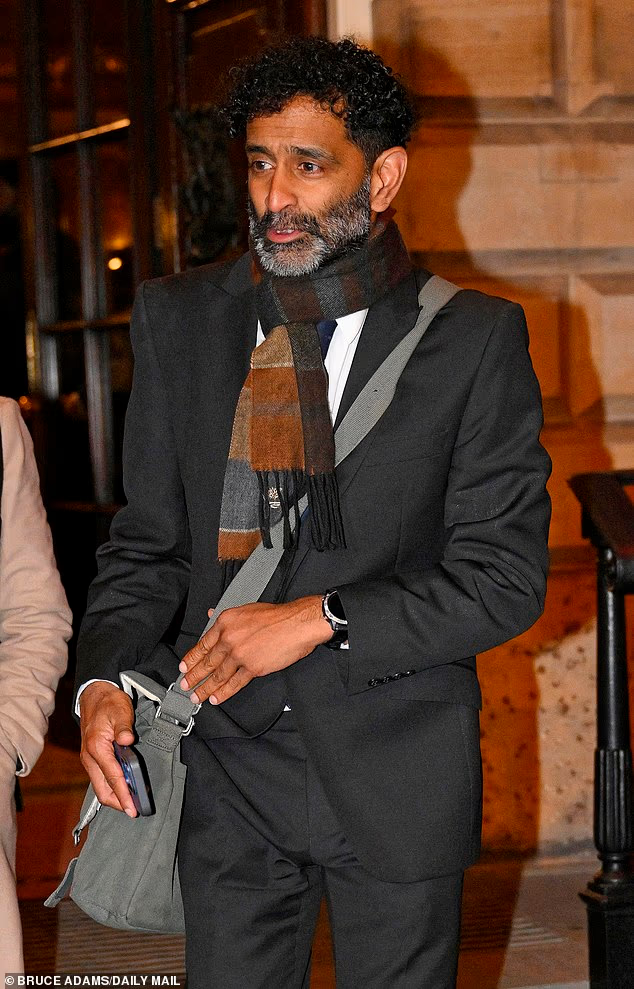
In 2025, 4,593 sex-based offences against women and girls were recorded yet only a tiny proportion, around 3 per cent, led to a charge or summons. Some 58 per cent of cases identified no suspect at all, despite an extensive network of CCTV and ticketing data that can help trace journeys. Recent cases show why. In May, Salman Yousaf, 46, was jailed for eight sexual assaults and one count of outraging public decency on the Night Tube.

Advertisement

He targeted lone women who’d fallen asleep on the Central and Jubilee Lines, but police only connected him to the attacks when he was already in prison for another crime.

In March, Craig Anderson, 38, was jailed after sexually assaulting four women and stalking another across the railway network. Prosecutors described him as a man who ‘did not take no for an answer’.

I travelled before work, after work, at weekends and on Night Tube routes on seven lines – the Victoria, Piccadilly, District, Circle, Central, Jubilee and the DLR (Docklands Light Railway).

For my safety, a producer accompanied me, close enough that I could signal if I needed help, but far enough away that any man who approached me wouldn’t know I was being monitored.

Advertisement

And I dressed carefully: a buttoned-up checkered shirt, long baggy trousers and a denim jacket, concealing the wires connecting to a hidden camera and sound recording equipment. I wasn’t laying myself out as bait.

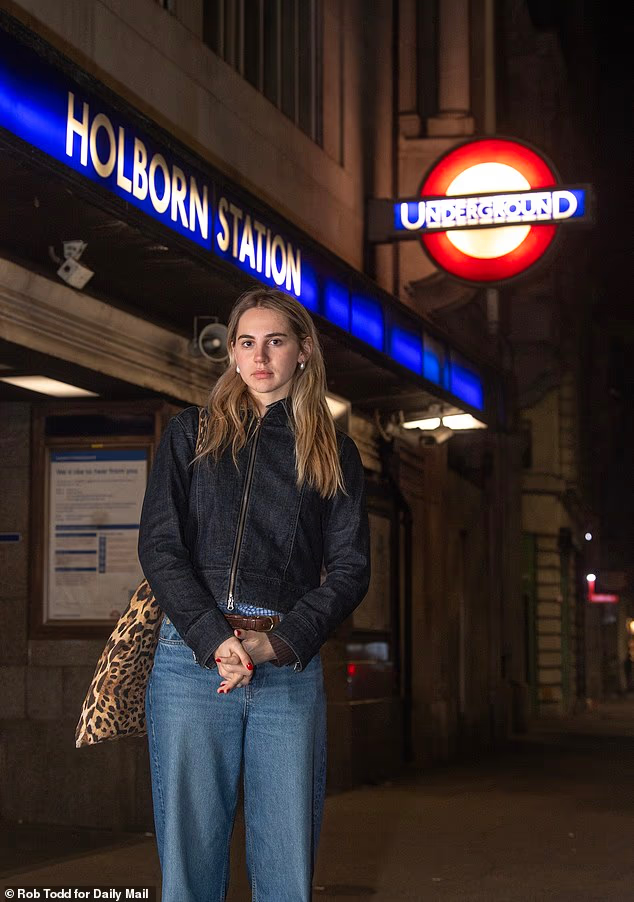
I began my first journey at Holborn Tube Station in central London at 1.30am on April 25. Less than 15 minutes into the journey, on an eastbound District Line train, I noticed a group of young men staring in my direction.

I did what women so often do in these situations: looked away, kept my face blank, pretended to be absorbed in my phone. When I got off at Dagenham East, they got off too. They walked ahead of me, deliberately slowly and kept turning back as if to check I was still there. I walked out of the station, hoping they’d disappear, but they lingered.

It was only when I turned back and headed down to the platform again did they finally drift away.

Advertisement

Things got worse later – when I encountered that man in trendy spectacles at Green Park who assaulted me. The audio I recorded is muffled in places but I can hear, and I remember, my intense anxiety as he became ever more angry and insistent.

As one unpleasant interaction ended, another began. It was relentless. Within a minute of me standing up to get away from the man in the glasses, I noticed another group of men. One stocky man with sunken eyes came over and asked for my number. I said ‘no’ nine times. He stood so close to me I could smell the rank odour of the pub he’d been in as his hand ran down the pole near my leg. ‘What are you scared of?’ he asked, rolling his eyes.

There was a girl slumped against the wall of the carriage, clearly intoxicated. At one point he gestured towards her and said: ‘Look at her.’ All I could think was, what might happen to her if nobody was there.

In March this year, a London Assembly report described ‘unacceptable’ levels of violence against women and girls across the capital’s public transport network

In March this year, a London Assembly report described ‘unacceptable’ levels of violence against women and girls across the capital’s public transport network

Advertisement

With each incident I felt the burden was on me to stay calm, polite enough not to escalate the situation, firm enough not to encourage it and alert enough to work out whether I needed help.

Advertisement

By the time I got home I was exhausted, drained yet still in fight or flight mode.

I was verbally sexually harassed around eight times and physically assaulted once on four journeys in the course of my undercover investigation, at night and during the day.

Esme Rice, 31, didn’t have a hidden camera when she was aggressively sexually assaulted on the Tube recently – but her recollection is crystal clear.

On June 6, at around 11pm, Esme was travelling home on the Elizabeth Line after dinner with friends when two men orchestrated a sexual assault – blocking her exit to the doors as she got off and groping her. ‘They were not remorseful,’ she said. ‘They were happy with themselves that they’d just sexually assaulted me.’

Advertisement

At Stratford, where she exited the train, Esme says she told a member of staff.

There was no police presence at the station, a major Tube and rail interchange, and she was advised to text British Transport Police (BTP) on 61016.

She sent the message within two minutes. Fifteen minutes later, she received an automated response saying her report was ‘urgent’. It took 13 hours for BTP to call her back.

Frustrated, she posted about her experience on TikTok. Hundreds of women flooded her account sharing similar experiences. ‘I stayed up for hours waiting for the phone call,’ she told me. ‘I received nothing. I’ve just been sexually assaulted. How can they not be getting back to me?’

Advertisement

It wasn’t her first experience of policing failures.

In 2024, Esme says that a man masturbated over her on the Jubilee Line during rush hour. She screamed at him in the carriage but no passengers intervened.

The case was closed two weeks later because no positive identification could be made, despite the police having CCTV, according to Esme, and photos she’d taken of the man. Now she avoids travelling on the Tube when she can, scans the faces of passengers around her, always wondering whether she might see any of the men who assaulted her again.

Across the Transport for London (TfL) network, posters urge passengers to call out sexual harassment and encourage women to report incidents and text BTP under the famous, ‘see it, say it, sorted’ slogan.

Advertisement

But does it ever really get ‘sorted’? When I reported the physical assault I experienced to 61016, I was told it was ‘great’ I had photo evidence because the CCTV ‘would have expired about a week ago’. In fact, during a follow-up phone call, the officer told me the line I was on ‘doesn’t really have CCTV on it, anyway’.

A recent BBC investigation found this is far from unusual, and that many sex offenders are escaping justice due to serious issues with CCTV on public transport. Hundreds of women who have been assaulted are then told by police that they could not find their attackers because there was no available footage.

In more than 250 of 560 reports where officers requested CCTV, the incident had not been recorded, there was a system fault, the footage was unusable or it had already been overwritten.

Of course, not all men who use the Tube behave like this. But for many women, all it takes is one to determine if they can ever feel safe again

Of course, not all men who use the Tube behave like this. But for many women, all it takes is one to determine if they can ever feel safe again

Advertisement

British Transport Police investigate offences, but CCTV is maintained by TfL and rail operators, which also set their own retention periods. There is no legal requirement for working CCTV on passenger trains, meaning potential evidence doesn’t exist or can be deleted before police request it.

On the Tube specifically, there are three major lines with little to no CCTV camera coverage in carriages. TfL says these lines have some of the oldest trains on the network, so are ‘unable to support on-train CCTV’ that would meet requirements needed for prosecution by the police.

For women, the gap between official advice and the reality of what happens after they have reported an incident is risible.

‘There is a big lack of trust in the reporting process,’ says Susan Leadbetter, a transport design expert at WSP, a global engineering and professional services consultancy. She has spent years researching how public spaces and transport can be made safer for women.

Advertisement

‘A lot of the women that I spoke to who had been assaulted or harassed – 20 per cent said that they would never report it again because of how it was handled.’

When she first began collating women’s experiences for a university undergraduate dissertation, she was shocked by what she discovered. ‘Women were telling me how they’d been groped, ejaculated on while on the Tube, followed home, stared at,’ she told me. ‘It was just so harrowing.’

The very design of the Tube, according to Leadbetter, is part of what makes harassment on public transport feel so frightening. 

‘You’re enclosed within that space,’ she said. ‘There’s no staff. There’s not much phone signal or data on some of the lines as well. So if something did happen, there’s a bit of nervousness around: how do I actually report it?’

Advertisement

There is, of course, a limit to how much London’s Underground can be physically transformed. The Tube is the oldest underground railway in the world, its narrow platforms and ageing trains built long before anyone was thinking about women’s safety, phone signal or CCTV coverage.

But there are things TfL could do. London graduate Camille Brown, 22, has made headlines with her petition calling for women-only carriages on the Tube, with a YouGov poll from last year finding a majority in favour.

‘I remember girls arriving at school in tears after incidents on the Tube. It was from about Year 7 [age 11-12] onwards,’ she says, adding that as a schoolgirl and student negative experiences on the Underground felt grimly routine.

Camille looked at the systems used in Tokyo, Mumbai and Mexico City. She suggests a designated carriage, at one end of the train close to the driver, where women who feel vulnerable could choose to travel.

Advertisement

Susan Leadbetter is not convinced. She says we need to work on what we can fix now: visible staff, working cameras, reliable signals and better-lit stations – and designing new routes with that in mind.

‘The Elizabeth line is great. The platforms are really wide, the lighting is really bright and you don’t feel tight and constrained on the platforms.’

She is careful not to suggest that design alone can solve violence against women. ‘You can’t out-design bad behaviour.’

The bigger problem, she explains, is that women are being made to feel unsafe because of people’s – largely men’s – behaviour. ‘These incidents do start at a low level.

Advertisement

‘They do evolve and grow into more severe instances because they get away with these smaller instances of harassment and violence… repeat perpetrators could be doing this to so many other people on the network.’

For all the young women I spoke to, the case of Sarah Everard looms large. The 33-year-old marketing executive was abducted from a street in Clapham, south London, in March 2021 as she walked home.

Mimi Yates is approached by a man on the Victoria Line tube at Tottenham Hale very early in the morning

Mimi Yates is approached by a man on the Victoria Line tube at Tottenham Hale very early in the morning

Her murder, by serving Metropolitan Police officer Wayne Couzens, forced a national reckoning about women’s safety. Couzens had previously been linked to incidents of indecent exposure before he abducted, raped and murdered her.

Advertisement

Things are changing, albeit slowly. On June 9, BTP secured the first sentence in England and Wales under new sex-based harassment legislation on the railways.

David Stroud, 44, pleaded guilty after grabbing a young woman’s hair and trying to kiss her on an overground train, describing it as ‘banter’. For campaigners, it was a landmark moment: an acknowledgement that behaviour that is too often dismissed can, in fact, be criminal.

Stroud was sentenced to a 12-month community order and 150 hours of unpaid work.

For Esme Rice it isn’t enough. ‘Women have been systematically let down… it just feels like I don’t have a voice through the authorities.’

Advertisement

I tell Esme what had happened to me during my investigation and I ask her whether she sees those experiences as sexual harassment.

‘I’ve had people say, ‘oh he just grabbed your bum, it’s hardly rape’. It doesn’t matter, Mimi. Unwanted touching, unwanted interactions… no is, no. It’s that simple.’

Esme is right. As for me, I do move differently about the city I grew up in now. I scan faces on platforms, look twice at men behind me on busy platforms and wonder whether I would recognise the ones who followed me, touched me or would not leave me alone during my investigation.

Of course, not all men who use the Tube behave like this. But for many women, all it takes is one to determine if they can ever feel safe again.

Advertisement

A spokesman for Transport for London told the Daily Mail: ‘We are working closely with the police to make the transport network a hostile place for offenders.

‘The behaviour that Mimi experienced on our network is appalling and totally unacceptable. We encourage anyone who experiences or witnesses this kind of behaviour to report it to the police or a member of staff. We are also committed to improving CCTV coverage, image quality and data retention across the network.’

British Transport Police said: ‘We urge anyone who experiences or witnesses an offence on the railway to immediately report it to 61016 so our officers can make urgent enquiries. That number receives over a quarter of a million texts every year – and this figure continues to rise as confidence grows among passengers in reporting historically underreported crimes, such as sexual offending.’

And in response to Mimi’s assault, it said: ‘On 29 June we received a report of a sexual assault that happened two months prior, in the early hours of 26 April.

Advertisement

‘This report was immediately triaged by staff in our force Contact Centre, before being passed to police officers in London who contacted the victim directly by phone within 90 minutes of the report.’

Source link

Continue Reading
Click to comment

You must be logged in to post a comment Login

Leave a Reply

NewsBeat

Concern for rough sleepers next to Foss Fairy Trail in York

Published

on

Concern for rough sleepers next to Foss Fairy Trail in York

Tracy Ostle, chair of the Foss Fairy Trail, a free trail for families along the banks of the River Foss across from Huntington Road, said she reported at least two people sleeping rough in a tent on the path to the council’s Navigators on May 19.

However, she said no one replied to her email – and the tent remained next to the river on Monday (June 29).

Tracy Ostle maintaining the Foss Fairy Trail (Image: Dylan Connell)

City of York Council said its teams visited the site several times over the last two months.

A team also attended on Monday to clear the site and found that the rough sleepers were no longer staying in the tent, the council said.

Advertisement

The council’s assistant director of housing, Katherine Proctor, said the local authority’s Housing Navigators work with rough sleepers in York “but our offer of help is not always accepted”.

She said the council teams “always act on all reports” about rough sleepers, and offer help ranging from helping someone returning home or into a hostel and support where necessary.

But Ms Ostle questioned the support that the rough sleepers at the Foss Fairy Trail had received, adding that the lack of communication from the council had left her concerned for their welfare.

Ms Ostle also said delays in officers attending the trail meant she had to spend two hours cleaning the site.

Advertisement

Items left by rough sleepers on the Foss Fairy Trail in York (Image: Supplied)

She said two mattresses and mess – including human waste – had been left at the site, describing it as a “mini-Glastonbury”.

The chair of the trail, who maintains the site alongside her full-time job, said the mess had resulted in people avoiding the area.

But Ms Ostle said she was ultimately concerned for the welfare of the rough sleepers, adding: “It’s just shocking.”

Mattresses left by rough sleepers on the Foss Fairy Trail in York (Image: Supplied)

She felt the rough sleepers would have been seen sooner by the Salvation Army, which previously supported York’s rough sleepers’ early intervention programme through the charity’s £95,000-a-year contract with City of York Council.

Advertisement

Ms Ostle added that Charlie Malarkey, who ran the Salvation Army’s York Early Intervention and Prevention Team before the council moved the service in house in 2023, had been to check on the rough sleepers on the Foss Fairy Trail – even though it is no longer his job.

She claimed the Salvation Army would have ensured the rough sleepers were supported quicker.


Recommended reading:


Recalling previous cases with rough sleepers on the Foss Fairy Trail while the Salvation Army carried out the service, Ms Ostle said: “I’d email Charlie Malarkey and he’d be down there first thing – 4am/5am.

Advertisement

“He knew what had to be done and would do whatever he could to find them somewhere. They would be gone the next day.”

Major Andrew Vertigan, from the York Salvation Army, said: “Salvation Army continues to work with rough sleepers across the city, as a voluntary provider of social care but no longer receives funding to do so from City of York Council.”

Mr Vertigan said he has been “surprised by the number of requests and inquiries his team receives”, adding: “We seek to respond and support as best we can with limited resources.”

‘We always act on all reports,’ says council boss

Ms Proctor said City of York Council’s Housing Navigators “work with everyone sleeping rough in the city, including those in the centre and the outlying areas, but our offer of help is not always accepted”. “We offer and give help discreetly, while honouring our duty to protect individuals’ privacy.

Advertisement

“This could range from helping someone to return home or, where appropriate, into a hostel and support. Depending on a person’s circumstances, we cannot always offer a place at a hostel. When in our hostels, everyone must follow a clear set of rules to keep residents and staff safe. If this is breached, we will take action.

“All support is tailored to each person’s needs. It is provided sensitively to maintain a dialogue and encourage the offer of help to be taken up. We work with people to discuss options at times that best suit them.

“When a rough sleeper location is vacated and waste is left behind, our Neighbourhood Enforcement Officers will investigate and clean the site. Any waste left in public spaces should be reported via (www.york.gov.uk/ReportFlyTipping, email ycc@york.gov.uk and will be removed as soon as possible.

“We welcome alerts about people sleeping outdoors and we always act on all reports. This includes help to manage during periods of extreme heat or cold.”

Advertisement

Source link

Continue Reading

NewsBeat

Daredevils who scaled Empire State Building facing MULTIPLE charges after flying protest banner and sky-high proposal at 1,454 feet

Published

on

Daredevils who scaled Empire State Building facing MULTIPLE charges after flying protest banner and sky-high proposal at 1,454 feet

Two masked daredevils who climbed to the top of the Empire State Building with a protest banner – before one dropped to a knee for a dramatic proposal – are now facing multiple charges. 

Angela Nikolau, 33, and Vanya Beerkus, 32, were taken into custody following their sky-high stunt on Wednesday afternoon.

The Russian couple were hit with a slew of charges including burglary, reckless endangerment, criminal mischief, criminal trespass, violation of a local law, criminal tampering, disorderly conduct, and possession of burglar’s tools, ABC News reported.

The thrill seekers were escorted out of an New York Police Department precinct in Midtown on Wednesday night. 

Advertisement

Beerkus was seen with a stoic expression, dressed in black and handcuffed, as two police officers walked him out of the building and into a white van. 

Nikolau followed behind with a smirk, also clad in black, as two officers guided her to the same white vehicle. 

The 33-year-old had a cheeky grin on her face as she sat seen sitting inside the white van.

Nikolau and Beerkus are being transported to Manhattan Criminal Court where they will face a judge for arraignment. 

Advertisement

A pair of masked daredevils were spotted climbing to the very top of the Empire State Building in New York City on Wednesday

Ivan Beerkus is transported in handcuffs in New York. He was taken into police custody after unfurling a pro-peace banner on top of the Empire State Building

Ivan Beerkus is transported in handcuffs in New York. He was taken into police custody after unfurling a pro-peace banner on top of the Empire State Building

Angela Nikolau is transported in New York after she climbed to the top of the massive building before getting engaged to Beerkus

Angela Nikolau is transported in New York after she climbed to the top of the massive building before getting engaged to Beerkus

Advertisement

The pair scaled the spire of the New York City landmark, which reaches a staggering 1,454 feet. 

As they clung on, the daredevils flew a banner which read: ‘When the power of love beats the love of power the world knows peace.’

The message appeared to be a modified quote from British politician William Gladstone, and is often misattributed to the rock star Jimi Hendrix

After flying the banner at around noon, the climbers began to descend just after 12.30pm, before reaching a lower platform where Beerkus dropped down to one knee and proposed.

Advertisement

Nikolau appeared to say ‘yes’ to the astonishing proposal, as a helicopter circling the building captured the couple embracing and they removed their masks to share a kiss.

The influencer posted a video of herself atop the Empire State Building at around midday.

The stunt couple, who are known for climbing skyscrapers, starred in the 2024 Netflix documentary Skywalkers: A Love Story.

Nikolau has posted herself scaling tall buildings and performing hair-raising acts while donning a black cat-face covering.

Advertisement
Ivan Beerkus and Angela Nikolau attend Netflix's Skywalkers: A Love Story Tribeca Film Festival Premiere

Ivan Beerkus and Angela Nikolau attend Netflix’s Skywalkers: A Love Story Tribeca Film Festival Premiere

A daredevil influencer, Angela Nikolau, posts videos of herself scaling tall buildings while donning a black cat-face covering. She is often filming with musician Vanya Beerkus

A daredevil influencer, Angela Nikolau, posts videos of herself scaling tall buildings while donning a black cat-face covering. She is often filming with musician Vanya Beerkus 

After they began their descent at around 12.30pm, Beerkus proposed to Nikolau on a lower deck of the spire, and she appeared to say yes as the pair embraced and shared a kiss

Nikolau posted a series of photos of the pair atop the Empire State Building, including a snap of the proposal and her flashy diamond ring

Nikolau posted a series of photos of the pair atop the Empire State Building, including a snap of the proposal and her flashy diamond ring

Advertisement
Tourists and onlookers gazed up in astonishment at the scene unfolding above them, as the Empire State Building's observation deck was quickly cleared

Tourists and onlookers gazed up in astonishment at the scene unfolding above them, as the Empire State Building’s observation deck was quickly cleared

Nikolau shared a video of herself on top of the Empire State Building at around midday

Nikolau shared a video of herself on top of the Empire State Building at around midday

The New York City Police Department was at the scene and the couple were arrested at around 1pm

The New York City Police Department was at the scene and the couple were arrested at around 1pm

Join the discussion

Advertisement

Should daredevil stunts on famous landmarks be celebrated or harshly punished for risking public safety?

She is often videoed and pictured atop the terrifyingly tall buildings with musician Beerkus.

Nikolau posted a series of photos of the couple shortly after the stunt, including a snap of the proposal and of her flashy new diamond ring.

The New York City Police Department was at the scene and the pair were taken into custody at around 1pm.

Advertisement

Tourists and onlookers gazed up in astonishment at what was unfolding above them as the Empire State Building’s observation deck was quickly cleared.

Witness Julie Morris told CBS: ‘We were right at the top. I could see two people open the gates – the mesh gates – and they went up to the top.

‘I just assumed they were allowed up there.’

On the street below the iconic building, police had taped off the area and closed the street.

Advertisement

This is a breaking news story. 

Source link

Continue Reading

NewsBeat

Gwyneth Paltrow’s son Moses, 20, makes his modeling debut… just weeks after big sister Apple, 22, lands first film role

Published

on

Gwyneth Paltrow's son Moses Martin made his modeling debut on Tuesday by posing for the 'Escape to the Countryside' campaign from British luxury brand, Burberry, captured by lensman Chris Rhodes

Moses Martin is entering the family business. 

The 20-year-old son of Gwyneth Paltrow and Chris Martin appears set on pursuing a public life in the entertainment industry, making his modeling debut on Tuesday.

Martin, who is a junior at Brown University, showed off his good looks in the new ‘Escape to the Countryside’ campaign from British luxury brand, Burberry, captured by lensman Chris Rhodes.

In one shot, the nepo baby toted the $2,095 ‘Check Backpack’ featuring the iconic plaid print from the fashion house established in 1856 by Thomas Burberry.

Advertisement

In another image, the youngster appeared to be ready for tennis in a $395 ‘Cotton Polo Shirt’ in denim blue while seated behind the $2,650 ‘Check Holdall’ bag.

Martin is following in the footsteps of his big sister, Apple, who has modeled for brands like Chloé, Self-Portrait and GapStudio.

The 22-year-old Vanderbilt University grad is set to make her big-screen acting debut in Nancy Meyers’ 2027 semi-autobiographical movie about filmmakers for Warner Bros. alongside Penélope Cruz, Kieran Culkin, Jude Law and Owen Wilson.

Advertisement

Gwyneth Paltrow’s son Moses Martin made his modeling debut on Tuesday by posing for the ‘Escape to the Countryside’ campaign from British luxury brand, Burberry, captured by lensman Chris Rhodes

In one shot, the 20-year-old nepo baby toted the $2,095 'Check Backpack' featuring the iconic plaid print from the fashion house established in 1856 by Thomas Burberry

In one shot, the 20-year-old nepo baby toted the $2,095 ‘Check Backpack’ featuring the iconic plaid print from the fashion house established in 1856 by Thomas Burberry

Apple was previously criticized for her off-pitch singing with LA duo Jade Street at Cannery Hall in Nashville on October 17. 

The Daily Mail has reached out to Paltrow’s publicist for comment about her son’s move into modeling, but didn’t immediately hear back. 

Advertisement

In April, Paltrow gushed that that her boy was ‘the definition of a gentleman – kind, intelligent, thoughtful and soulful. It’s beyond words how incredible you are.’

The 53-year-old Oscar winner is also a bona fide nepo baby – having had a leg up in the industry thanks to her actress mother Blythe Danner, showrunner father Bruce Paltrow and filmmaker godfather Steven Spielberg.

Martin was sporting the $595 'Check Collar Cotton Polo Shirt' over the $595 'Long-Sleeve Cotton Top' with blue jeans

Martin was sporting the $595 ‘Check Collar Cotton Polo Shirt’ over the $595 ‘Long-Sleeve Cotton Top’ with blue jeans

In another shot, the Brown University junior appeared to be ready for tennis in a $395 'Cotton Polo Shirt' in denim blue while seated behind the $2,650 'Check Holdall' bag

In another shot, the Brown University junior appeared to be ready for tennis in a $395 ‘Cotton Polo Shirt’ in denim blue while seated behind the $2,650 ‘Check Holdall’ bag

Advertisement

Paltrow ‘consciously uncoupled’ from the 49-year-old British rocker in 2013 following a decade of marriage, and married 9-1-1 co-creator Brad Falchuk in 2018. 

Last month, the half-Jewish empty nester received substantial backlash for starring in a commercial for 51 Park, a luxury real estate development in Israel, amid the humanitarian crisis in Gaza.

And in May, Paltrow raised eyebrows when she laid off around 20 employees at her lifestyle company Goop in favor of adopting automated, AI-driven workflows.

The Manhattan-born musician's gig in front of the camera came after his older sister Apple Martin modeled for brands like Chloé (pictured), Self-Portrait and GapStudio

The Manhattan-born musician’s gig in front of the camera came after his older sister Apple Martin modeled for brands like Chloé (pictured), Self-Portrait and GapStudio

Advertisement
The 22-year-old Vanderbilt University grad is set to make her big-screen acting debut in Nancy Meyers' 2027 semi-autobiographical movie about filmmakers for Warner Bros. (pictured last Saturday)

The 22-year-old Vanderbilt University grad is set to make her big-screen acting debut in Nancy Meyers’ 2027 semi-autobiographical movie about filmmakers for Warner Bros. (pictured last Saturday)

In April, Paltrow gushed that Martin was 'the definition of a gentleman - kind, intelligent, thoughtful and soulful. It's beyond words how incredible you are'

In April, Paltrow gushed that Martin was ‘the definition of a gentleman – kind, intelligent, thoughtful and soulful. It’s beyond words how incredible you are’ 

Paltrow 'consciously uncoupled' from Coldplay frontman Chris Martin (R) in 2013 following a decade of marriage, and married 9-1-1 co-creator Brad Falchuk in 2018

Paltrow ‘consciously uncoupled’ from Coldplay frontman Chris Martin (R) in 2013 following a decade of marriage, and married 9-1-1 co-creator Brad Falchuk in 2018

The Influenced actress will next executive produce and star in producer Stacey Sher and playwright Heidi Schreck’s adaptation of Belle Burden’s new bestseller Strangers: A Memoir of Marriage, which will stream on Netflix.

Advertisement

Source link

Continue Reading

NewsBeat

The Bowes Museum jobs up for grabs right now – how to apply

Published

on

The Bowes Museum jobs up for grabs right now - how to apply

The Bowes Museum in Barnard Castle is recruiting across its visitor experience and catering teams, with new opportunities for welcome staff and café workers as the museum goes through a period of change, investment and transformation.

Do you have what it takes to join the team?

Welcome Team Assistant (zero hours)

Zero-hours Welcome Team Assistant roles are available on a permanent basis, paid at £12.71 per hour.

Advertisement

The posts sit at the heart of the visitor experience, with successful candidates becoming part of the team that greets visitors, supports ticketing and retail, and helps deliver the museum’s wider offer.

The listing says: “The visitor is central to our offer at The Bowes Museum, to succeed in this role you will be enthusiastic, motivated, able to work on your own initiative and collaborate with others.

“You will be comfortable working with others in a customer-facing sales environment, delivering the highest standards of customer service and care. You will be an effective communicator and demonstrate flexibility in this varied role.”

Some weekend and Bank Holiday working will be required, as well as some evening work for events and exhibition previews.

Advertisement

The closing date is ongoing, with interviews arranged over the phone.

The Silver Swan at Bowes Museum (Image: SARAH CALDECOTT)

Catering Assistant

The museum is also recruiting a zero-hours Catering Assistant on a permanent contract, paid at £12.71 per hour.

Working as part of the catering team, the successful candidate will support a thoughtful, high-quality food and drink offer that provides an exceptional visitor experience.

Advertisement

The listing says: “Food is an important part of how visitors experience The Bowes Museum and its historic setting.

“We are looking for a Catering Assistant to join our Catering Team, supporting the delivery of a thoughtful, high-quality food and drink offer that provides an exceptional visitor experience at the museum.”

To succeed in the role, applicants will need to be enthusiastic, self-motivated and passionate about delivering excellent visitor experiences.

The museum is seeking someone confident, friendly and approachable, with a genuine interest in engaging with people.

Advertisement

The closing date is ongoing, with interviews arranged over the phone.

More information on these roles and details of how to apply can be found at thebowesmuseum.org.uk/jobs-and-volunteering/.

Source link

Advertisement
Continue Reading

NewsBeat

Megalodon’s legendary life revealed by fossil rediscovery

Published

on

Megalodon’s legendary life revealed by fossil rediscovery

Museums are supposed to be havens for the collective cultural and scientific heritage of the planet, but specimens sometimes go missing.

Happily, they can also be rediscovered, as a new study shows, with the vertebrae of the legendary predatory shark known to the world under its old name of Megalodon (now properly Otodus megalodon) turning up on a museum shelf decades after they were seemingly lost.

The new paper takes another look at the size and growth of this giant shark that lived between 15 and 3.5 million years ago. The study confirms previous estimates that these animals might have been longer than 24 metres. To put that in context, even the most unnaturally exaggerated sharks in the Jaws franchise topped out at 10.5 metres. These were seriously big fish.

The work is based on an analysis of several 11-million-year-old vertebrae from one animal, found in Denmark. Apart from the jaws and teeth, shark skeletons are mostly cartilage, so vertebrae are rare and important. Compared to a tooth, they give a much better indication of the size of the owner and here these are the largest known of any O megalodon (23cm in diameter).

Advertisement
One of the study researchers, Mette Elstrup, holding a 10.8-million-year-old vertebral fossil specimen of Otodus megalodon, and a reconstructed O. megalodon jaw model in the background.
Museum of Southern Jutland, Denmark, Author provided (no reuse)

These important specimens were thought to have been destroyed in a move from the Geological Museum of Copenhagen (now part of the Natural History Museum of Denmark) to the Museum of Southern Jutland in 1989. The scientific records of them were limited to old photos and descriptions. A couple of these vertebrae have now turned up, having apparently sat on a shelf unrecognised for decades. This allowed for the new study, which also estimated that a newborn O megalodon might be 3.6 metres long and live for nearly a century.

How can museums and palaeontologists lose valuable fossils?

All manner of unlikely and unfortunate actions can lead to the loss of fossils from museums.

Most obviously this can happen during times of conflict. The second world war saw the loss of dinosaur fossils on both sides of the conflict. The original specimens of the sail-backed dinosaur Spinosaurus were destroyed in Munich by an allied bombing raid in 1944. Earlier, a number of specimens, including parts of the early dinosaur Thecodontosaurus, were destroyed in Bristol after an Axis raid in 1940.

Huge dinosaur skeleton suspended from ceiling.
Skeletal mount of the Spinosaurus at the Fukui Prefectural Dinosaur Museum.
Palaeotaku, CC BY-NC

These were not even the first losses from enemy action in international wars. In 1916, the Canadian ship SS Mount Temple was sunk by a German ship. Although it was mostly carrying wheat, it also had a cargo of dinosaur fossils from Alberta that were being moved to the UK. The cargo lists are vague so we don’t even know what dinosaurs were on board.

Indirect action could be problematic too. In 1941, the Chinese attempted to move as many as 40 specimens of “Peking man” (Homo erectus), the first of our relatives to have human-like proportions, to the US to try to save valuable early hominid fossils from the invading Japanese forces. They never arrived, and might have been lost at sea after the ship they were on was sunk. Although it’s possible they never even made it on board the vessel.

Advertisement

Things can also be simply lost or fall apart. An apparent giant sauropod dinosaur similar to Diplodocus was named by the US palaeontolgist Ed Cope in 1877 as Amphicoelias fragillimus. He described it from a single, incomplete, fragile, but giant, vertebra.

Cope gave differing measurements of the vertebra at various times, making it unclear quite how large it actually was. When he died, his collection was sold to the American Museum of Natural History, but they were never able to find this specimen. Given how fragile it was, it may simply have disintegrated on the shelf and been overlooked or thrown away.

Museums are not immune to losses either. If you have an enormous number of specimens (the Natural History Museum in London has an estimated 80 million objects in its collection), it is inevitable that one or two may simply get lost.

I’ve been an eyewitness to lost specimens turning up in a museum when a colleague spotted a dinosaur skull and pterosaur skeleton sitting on the wrong shelf like misplaced library books. Then there’s the more nefarious activities – I’ve heard of researchers deliberately moving specimens to make them hard to find so other researchers cannot examine them, and occasionally things are stolen from collections.

Advertisement

On top of this, natural disasters and accidents can wipe out history. The Fukushima earthquake and tsunami of 2011 in Japan caused major damage to the nearby Iwaki museum with damage to some of the fossils in their collections. And in 2018, one wing of the Nation Museum of Brazil in Rio de Janeiro burned down with the loss of many fossil specimens that were on display.

For all the examples raised here, museums are inherently safe places for specimens. There are millions and millions of fossils that have been held in institutions around the world for decades and even centuries. It is inevitable that accidents will happen, and that bad actors will cause occasional losses. Fortunately, at least on occasion these do reappear and give us some exciting new research opportunities.

Source link

Advertisement
Continue Reading

NewsBeat

England route to World Cup 2026 final as Harry Kane heroics keep hopes alive

Published

on

England route to World Cup 2026 final as Harry Kane heroics keep hopes alive

England had trailed since the seventh minute thanks to Brian Cipenga’s strike which beat Jordan Pickford all too easily at his front post after a defensive mix-up.

Source link

Advertisement
Continue Reading

NewsBeat

Paul Sneddon dead aged 70 as comedy world heartbroken at loss of Scots legend

Published

on

Daily Record

Paul Sneddon has played a huge part in the Edinburgh comedy scene.

Tributes have poured in following the death of much-loved Scots comedian Paul Sneddon, 70.

Advertisement

The Edinburgh performer, best known for his comedy characters Vladimir McTavish and Bob Doolally, has been remembered as a “kind”, “generous” and hugely talented figure who was at the heart of Scotland’s comedy scene for decades.

The Stand Comedy Club in Edinburgh announced the devastating news on Wednesday, describing Paul as a “vital part” of the venue since it first opened.

In a heartfelt tribute shared on social media, the club said: “It’s with the heaviest of hearts that we announce the passing of Paul Sneddon, known to so many as Vladimir McTavish and Bob Doolally.

“Paul has been a vital part of The Stand since we began and a much treasured and loved part of the comedy scene for many years. He was as known for his kindness, encouragement and generosity as he was for his immense talent.

Advertisement

“He made every green room brighter, every line-up funnier and the world a nicer place to live in. We are broken at the loss of our dear friend.”

The club said its thoughts were with Paul’s wife Christine, daughters Julia and Rosie, and his many friends and fans.

Paul had been due to perform his latest Edinburgh Fringe show, 2026 and the S**t Hits the Fan for Vladimir McTavish , in August.

Fans and fellow comedians quickly paid tribute online, with one writing: “This is dreadful news. What an absolutely lovely, hilariously funny, kind man.

“He made my life about a billion times more fun by hosting the comedy course with John, which got me into stand-up. He radiated such enormous warmth and encouragement. A huge miss.”

Another said: “So sad to hear this awful news. Paul was such a lovely guy as well as being a wonderful performer and comedian. He will be sorely missed.”

A third added: “That is such sad and shocking news, won’t be the same without him. My thoughts are with his family and friends.”

Comedy night Laugh It Off at The Railway also paid tribute, saying: “Devastated to hear the news today that Paul Sneddon AKA Vladimir McTavish / Bob Doolally has very sadly passed away.

Advertisement

“Paul was a great comedian, a great guy and a keen supporter of Laugh It Off. He’s given me nothing but positive encouragement as a fledgling stand-up. I was speaking to him only a couple of days ago about gigs at the Fringe. He’ll be greatly missed.”

Get more Daily Record exclusives by signing up for free to Google’s preferred sources. Click HERE.

Source link

Advertisement
Continue Reading

NewsBeat

How people in the UK are marking America’s 250th independent anniversary

Published

on

A woman with shoulder-length blonde hair talks into a microphone

Liquor is just one thing that helped fuel revolutionary America 250 years ago. People joining the UK events say they’ve enjoyed learning about the extent of the cultural crossover – not just because the US’s big birthday is a milestone that resonates globally, but because it’s also taught them things about their own part of the world.

Back in the City of London, participants on Mark Grant’s tour say the deep-dive into American history has also had the effect of showing them a side of their city they never knew.

“It took me to a few alleys I’d never been to,” says Peter Tidmarsh, a local. “I’m just amazed.”

Not for nothing has Grant been a contestant 13 times on the BBC’s Mastermind game show, thanks in part to his prolific knowledge of the UK capital. Blue plaques, historic pubs, and even the site of an church that was moved brick-by-brick to Missouri – all these sites feature on his tour.

Advertisement

For Grant, the Square Mile is its own character in the American story, and it offers an illuminating window into how a young US might have looked at a turning point in history. “The cities [in the UK and the US] would have been the same, and so this is kind of the foundation of it all,” he reckons.

An Australian by birth, Grant acknowledges that he’s neutral on the question of which side was responsible for the infamous 18th Century breakup. Britons on the tour, meanwhile, insist they’re not taking sides either – they’ve just come along to learn something.

“Well, there’s some regret,” jokes Tim Parry from Essex. “But I think I think we got over it.”

“I think 250 years is long enough,” adds Tidmarsh.

Advertisement

Source link

Continue Reading

NewsBeat

Cambridgeshire cathedral roof ‘deteriorating’ as it needs major repairs

Published

on

Cambridgeshire Live

The cathedral roof needs replacement roof tiles amongst the repairs

Urgent repairs needed at Peterborough Cathedral

Funding is being sought for “vital” roof repairs at a Cambridgeshire cathedral to prevent “massive problems in the future”. Peterborough Cathedral has been a centrepiece in the city for over 900 years.

Since the building is so cold, parts of it have started to deteriorate and become affected by the weather. Cathedral staff have identified problems, with water from rain seeping into parts of the roof.

As a result, the cathedral is applying for a fund from Historic England for £230,000. If granted, this will be used to replace roof tiles, replace gutters, and re-lead some parts of the roof.

Jack Pishorn, COO of Peterborough Cathedral, said the roof repairs are “vital”. He added: “We’ve identified a pot of £230,000 from Historic England to do some vital repairs – it’s all very unglamorous stuff.

Advertisement

“It’s to stop water from entering the building and stop things deteriorating.” Jack added that it was “no secret” that the cathedral was running at a deficit, after only last year it launched an appeal to raise £300,000 to keep open seven days a week.

Jack added: “The big focus for my team is to look at how we can generate income and control our expenditure to ensure we can have a sustainable future. But of course, while you’re working in a deficit, you stop spending money on repairs or maintenance.

Advertisement

“That’s something that’s happened over many, many years. So, of course, we have to find that money because the problem is going to get progressively worse year after year.”

The Very Revd Chris Dalliston, Dean of Peterborough Cathedral, said that without the repairs being done in a “timely fashion” they will build up to “massive problems”. The Dean added: “This space is for everyone. We want to maintain it as a great asset for the city spiritually and culturally.”

The cathedral has submitted an expression of interest for the Places of Worship Renewal Fund with Historic England. The Places of Worship Renewal Fund is a new £92 million national programme.

It helps listed places of worship across England to carry out urgent repairs and remain safe and open. It replaces the previous VAT relief scheme with capital grants.

Advertisement

Source link

Continue Reading

NewsBeat

World Cup 2026: Senegal’s remarkable exit after comeback and controversy

Published

on

Belgium captain Youri Tielemans is fouled by Lamine Camara

One minute, Senegal were cruising into the last 16 of the World Cup.

The next, they were left wondering how another dream had slipped through their grasp.

Manager Pape Thiaw’s side led 2018 semi-finalists Belgium 2-0 with only four minutes left of normal time, after goals from Habib Diarra and Ismaila Sarr.

But after outplaying their opponents, they somehow “found a way to lose the game”, as ex-Republic of Ireland skipper Roy Keane put it on ITV.

Advertisement

Romelu Lukaku’s 86th-minute goal sparked hope for Belgium and three minutes later, captain Youri Tielemans headed in an equaliser from Leandro Trossard’s cross – the pair were earlier seen having a heated argument – to force extra time.

Then came the controversial penalty, awarded for Lamine Camara’s challenge on Tielemans following a video assistant referee (VAR) review, and converted by the skipper himself 125 minutes in.

It condemned Senegal to further agony, having already endured the pain of being stripped of their Africa Cup of Nations (Afcon) title earlier this year.

“Football is just crazy. I couldn’t call any of this game,” former England striker Dion Dublin told BBC Radio 5 Live.

Advertisement

Late drama, controversy, history and heartbreak – this last-32 tie had everything and here, BBC Sport attempts to make sense of it all.

Source link

Continue Reading

Trending

Copyright © 2025