

Connect with us

NewsBeat

ICE takes issue with AP reporting on body-worn camera footage policy

Published

on

ICE's hiring spree draws fresh scrutiny after Maine shooting

WASHINGTON (AP) — The acting director of U.S. Immigration and Customs Enforcement took issue Saturday with reporting by The Associated Press on a policy to publicly release body-worn camera footage only when the agency determines it is in its “best interests.”

David J. Venturella said ICE policy “clarifies that it’s not appropriate to release footage when doing so could compromise investigations or privacy. This approach mirrors other federal law enforcement agencies’ policies and is fully consistent with the Freedom of Information Act and the Privacy Act.”

ICE policy calls for the release of footage in the immediate aftermath of a serious injury or death in custody, ideally within 72 hours, if in the “best interests of the agency.” It was adopted in February 2025, after President Donald Trump took office.

“If there are specific and compelling circumstances justifying an objection to public release that cannot be resolved by redaction or other means, when determined by the ICE Director or his or her designee, ICE may withhold or indefinitely delay the release,” the policy states.

Advertisement

Venturella said in a statement that ICE was “committed to transparency and accountability” and was “on track to equip every officer and agent in the field with body-worn cameras by the end of August.” He said the AP conflated “the expedited release of footage following a serious bodily injury or death in custody with ICE’s broader authority to release body-worn camera footage.”

The AP quoted Christopher Schneider, a sociology professor at Brandon University in Canada, who said that selective releases are routine in some law enforcement agencies but usually not so clearly contemplated in policy. “In some ways, ICE is saying the quiet part out loud,” he said.

The AP said policies vary among other law enforcement agencies and cited examples of major police departments that routinely release footage.

The story noted that ICE’s sister agency, Customs and Border Protection, has not released footage of the fatal shooting of Alex Pretti in Minneapolis in January. CBP Commissioner Rodney Scott told lawmakers that it was part of an investigation and would be made public “when it’s appropriate.”

Advertisement

ICE has been under heightened scrutiny since the fatal shooting in July of a 25-year-old motorist in Maine by an ICE officer with a history of violent behavior. Days earlier, another ICE officer shot and killed a Houston homebuilder driving to work. Neither shooting was recorded with body cameras.

Source link

Advertisement
Continue Reading
Click to comment

You must be logged in to post a comment Login

Leave a Reply

NewsBeat

DiJonai Carrington ejected for flagrant 2 foul on Sophie Cunningham

Published

on

DiJonai Carrington ejected for flagrant 2 foul on Sophie Cunningham

CHICAGO (AP) — DiJonai Carrington of the Chicago Sky was ejected Saturday after being called for a Flagrant 2 foul on Sophie Cunningham of the Indiana Fever. Minutes later, Carrington posted on social media the words “WHITE PRIVILEGE” and tagged the Fever.

Cunningham, who is white, was shooting a fast-break layup in the first quarter when Carrington, who is Black, came from behind and hit her in the head and neck, knocking her to the court as the shot went in.

Cunningham got up immediately, charged toward Carrington and pushed her as she was held back by a teammate.

The play was reviewed and upgraded to a Flagrant 2 after the referee said there was windup, impact and follow-through on the foul.

Advertisement

In the third quarter, Fever star Caitlin Clark was assessed a technical foul after she made contact with a referee when she was forced out of bounds. The technical was Clark’s eighth of the season, triggering a one-game suspension for Indiana’s next game.

Cunningham has frequently come to Clark’s defense after physical play by opponents and has become one of the higher-profile players in the league this season. In an ESPN article published last month, she voiced support for barring transgender girls and women from girls’ and women’s sports, which led to small protests and rallies outside Fever games in Seattle and Portland.

In a memo to teams on Friday, WNBA Commissioner Cathy Engelbert said the league would have ongoing discussions about the issue of transgender participation in women’s basketball.

___

Advertisement

AP WNBA: https://apnews.com/hub/wnba-basketball

Source link

Advertisement
Continue Reading

NewsBeat

Unsolved murder of drug dealer who tried to run from criminal underworld

Published

on

Daily Record

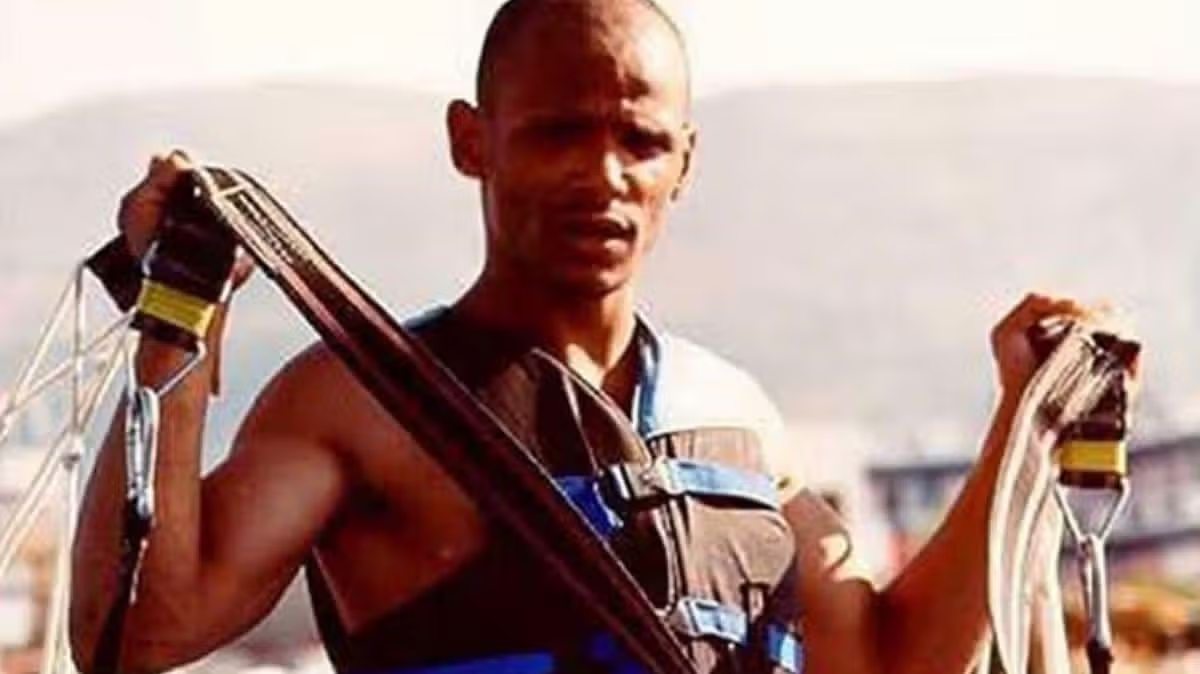
Danny Regan was found dead inside the high-security home he ran to in 2002

A drug dealer who fled his hometown in a desperate bid to escape the dark hole he had fallen into was killed inside his high-security home.

Danny Regan told his mum that he did not think he would live to see his 30th birthday – an ominous premonition which proved correct, as he was shot dead aged 26.

Advertisement

Nearly 24 years later, his murder remains unsolved. Danny, 26, had moved to Haydock from Leeds just 12 months before he was killed on December 12, 2002. The dad-of-two lay dead for days before his body was finally discovered, three days after it is believed two men broke into his house and shot him in the chest with either a pump action or semi-automatic shotgun, reports the Liverpool Echo.

The hitmen escaped in a silver or grey Rover, which was later found burned out on Cooper Lane.

Two men aged 22 and 25, from Leeds, were arrested in connection with the incident. An e-fit of the suspect was also later released by police. But nobody was ever charged with Danny’s murder, and his killers have so far evaded justice.

On the second anniversary of her son’s death in December 2004, Danny’s mum Pat Regan told the Yorkshire Evening Post: “I miss Danny so much more this year than last year, because last year it felt like he would still come home.

“Every day I thought I would walk in, and find the trail of cornflakes he used to leave on the kitchen table, which would mean he’d been here. It’s still so hard to face the idea that my son is never coming home.

“My son was no angel and became involved in drugs and with dealers. I would not want anyone to go through it.

“Danny knew the dangers he was facing and I was always waiting for a knock at the door. He came home in a coffin and his designer gear came home in big brown envelopes.

Advertisement

“He wanted to escape the world he lived in and knew the dangers he was facing. I was always waiting for a knock at the door and eventually it came.”

Danny, who had ties to Leeds’ criminal underworld, had been living in a fortified property on Station Road, surrounded by security cameras and a 6ft-high spiked fence.

It was later discovered the house was owned by an on-the-run drugs baron, Mark Lilley. The 6ft tall, 20-stone bodybuilder was sentenced in his absence to 23 years in prison in April 2000 – but had disappeared mid-trial after skipping bail, and was believed to be hiding in Spain or Holland.

He was one of the UK’s most wanted criminals before he was finally apprehended in the Costa Del Sol and extradited in August 2013.

Advertisement

In the wake of her son’s death, Pat became a fierce voice in the fight against gun crime. She set up a Mothers Against Violence group in her hometown of Leeds, and also campaigned for Mothers Against Guns (MAG) and Mothers Against Murder and Aggression (Mama).

The mum-of-six said in 2004: “When I first met other mothers who had felt what I did, | was speechless, and felt numb at finding others who could understand what my family has been through.

“It made me determined to try to stop this violence, which is why I set up the Leeds branch of Mothers Against Violence. l know it’s too late to save Danny and persuade him to give up the lifestyle which led to his death. But it’s not too late to save others, and if the work I do can make another young man think twice, then perhaps Danny’s life won’t have been lost in vain.”

Advertisement

Her tireless fight for justice ended in tragedy four years later, when she was stabbed to death by her grandson, Danny’s nephew, Rakeim Regan, 21.

READ MORE: Christian convert accused of Scot’s suitcase murder ‘turned his back on religion’ before her death

READ MORE: Police remain at Scots beauty spot where 11-year-old girl found dead for third day

Rakeim, who had paranoid schizophrenia, had experienced a severe decline in his mental health before the attack, and believed his grandmother was “conspiring with police to get him”. He admitted manslaughter and was detained indefinitely in a secure psychiatric hospital in 2008.

Advertisement

In a final appeal for Danny’s killer to be exposed, made one year before her own death, Pat said: “I know that Danny’s lifestyle may have led to his death and some of the things he did were wrong. But he wasn’t an evil person and didn’t deserve to die like this.”

Ensure our latest stories always appear at the top of your Google Search by making us a Preferred Source. Click here to activate or add us as your Preferred Source in your Google search settings.
Source link

Advertisement
Continue Reading

NewsBeat

Can leaders ever reform prisons without playing politics? Four things Andy Burnham could do

Published

on

Can leaders ever reform prisons without playing politics? Four things Andy Burnham could do

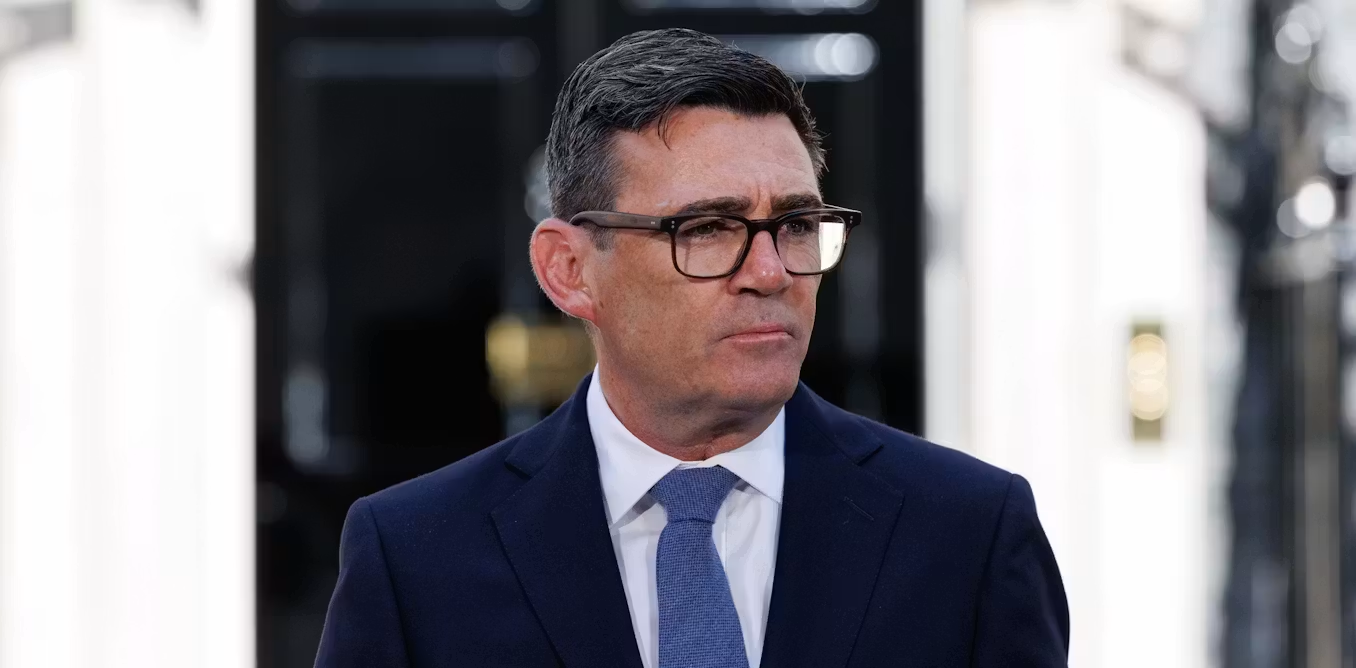
The UK’s prime minister, Andy Burnham, is facing his first major test with the public over the upcoming early release of thousands of prisoners. These plans are part of the Sentencing Act 2026, passed by Keir Starmer’s government in response to an independent review of sentencing.

The review recommended a model whereby eligible prisoners could be released at the one-third point of their custodial term, if they engaged constructively with the prison regime. (If not, they could stay in custody until the halfway point or longer.)

But the proposals as enacted under the Sentencing Act simply mean many prisoners will automatically be released earlier. The new law also reduces the use of short sentences, which have contributed to recent increases in the UK prison population.

This was a response born of crisis, designed to stop the operational collapse of a prison estate running close to absolute capacity. Nonetheless, it can be defended on public protection grounds.

Advertisement

Reoffending rates are highest among people serving short sentences. Diverting them into community supervision rather than inflicting a short, disruptive spell inside is likely to help bring these rates down.

Reoffending rates are markedly lower among those serving longer sentences, so releasing them earlier – particularly when those releases are planned and supervised – is unlikely to make much difference to public safety.

The rollout of this law change has placed Burnham in an unenviable position. Unless the prison population is reduced, police cells will back up and courts won’t be able to remand dangerous defendants, because there is nowhere to hold them. But this clashes with the emotional force of what criminologists call “penal populism” – the pursuit of penal policy for its electoral appeal, rather than its effectiveness.

Burnham is understandably reluctant to risk an early-released prisoner committing a serious offence in the opening months of his premiership. Faced with that bind, he has largely deferred to populist pressure.

Advertisement

Penal populism explains a political context in which the need to appear tough on crime overrides expert consensus and operational reality.


À lire aussi :
Will ending short prison sentences fix prison overcrowding? What an expert thinks


When survivors of serious crimes began receiving letters from the probation service informing them that “their” offenders were being considered for release, public anger built quickly.

This anger has coalesced around emblematic cases such as the killers of PC Andrew Harper (two of whom will now become eligible for release at the halfway point of their manslaughter sentences). Political opponents led by the Conservative leader, Kemi Badenoch, have weaponised the outcry effectively.

Advertisement

Placed in this invidious position, Burnham paused the scheme and announced exclusions for rape, serious child sexual offences and grooming – though, controversially, not for domestic abuse. This pause calmed the immediate storm – but at the cost of a smaller reduction in the prison population, leaving the underlying capacity crisis unresolved.

The problem with ‘tough on crime’

All of this gives rise to difficult questions about what leaders need to do if they want to win votes using crime – or avoid losing votes as a result of crime.

The evidence that punitiveness wins elections is weaker than one might think. Although concern has been increasing recently, crime is only fifth on the list of issues that decide votes. Research consistently finds that support for punitiveness softens once people are given the specifics of real cases, rather than abstract categories of “offender”.

Despite many people thinking England and Wales’s criminal justice system is getting more lenient, sentencing has in fact become harsher in recent years. Much of the growth of the prison population is down to increased sentence lengths, rather than more crime.

Advertisement
The early release scheme aims to remedy overcrowding in England and Wales’ struggling prisons.
Andy Rain/EPA-EFE

What actually shapes leaders’ responses to issues of crime and justice is not that toughness wins, but that leniency-gone-wrong loses. A single serious offence by an early-released prisoner is a political catastrophe, while the thousands of quiet, successful releases are invisible. Leaders are not, therefore, responding to a clear public appetite for harshness, but acting in anticipation of what might happen if things go wrong.

Ultimately, bringing release dates forward is politically dangerous because it can be reframed as “letting criminals out early”, and is easily portrayed as a policy which undermines the imposition of retribution as intended by a judge.

Four solutions

So, what should Burnham do? The political storm around the early release scheme is an opportunity to pursue reforms that are harder to politicise. Four such reforms stand out to me:

1. Reform use of prison recall

Advertisement

Recalls are the biggest lever: in early 2026, for the first time on record, more people were recalled to prison than released – 13,193 in a single quarter. Only 22% involved a further charge; the rest were for technical breaches such as missing probation appointments. Burnham should make recall proportionate, reserving it for genuine risk rather than administrative non-compliance.

2. Address Imprisonment for Public Protection sentences

The legacy of the indeterminate sentence of Imprisonment for Public Protection still holds, despite being abolished in 2012. Around 946 people have never been released, 99.6% of them past their tariff, with a further 1,476 inside on recall. Legislative change could lead to the safe release of this cohort.

3. Reduce use of remand

Advertisement

The remand population – those held in prison while awaiting trial or sentencing – makes up close to a fifth of all prisoners (and is up to 16,000 in 2026, from 9,000 in 2019). These numbers could be safely reduced through tagging, enforced time limits and bail accommodation.

4. Community sentences for women

Most women in custody – less than 5% of the prison population – are serving short sentences for non-violent offences. Replacing these with community provision would cut prison numbers and avoid the wider harm of imprisoning primary carers.


À lire aussi :
How to stop released prisoners reoffending: what the evidence says

Advertisement

Meaningful reform in these four areas would help ease capacity issues. Importantly, these alternatives share a feature that the early release scheme lacks. All rest on a claim of procedural legitimacy (technical breach, expired tariff, unconvicted status, non-violent offending) that is far more defensible in public argument, and therefore more durable against a populist attack.

We know that the more time people spend in prison, the more harm they suffer. Even Conservative governments have accepted that prison can be “an expensive way of making bad people worse”.

However, the early release policy has been caught by the familiar tough-on-crime script. In the process, it appears to have damaged the very confidence in the justice system it was supposed to sustain.

The lesson is not that reform is impossible. But when it is introduced under crisis conditions and applied retrospectively to people the public can already name, it is uniquely exposed to political attack.

Advertisement

Changing the point of release may yet have a future. But doing it in the glare of a moral panic, as a response to an operational crisis, almost certainly does not.

Source link

Advertisement
Continue Reading

NewsBeat

how satire became political power as youth protest forced change

Published

on

how satire became political power as youth protest forced change

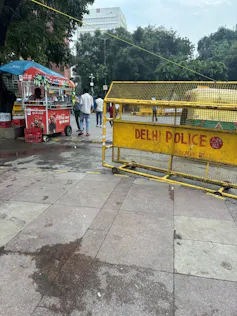
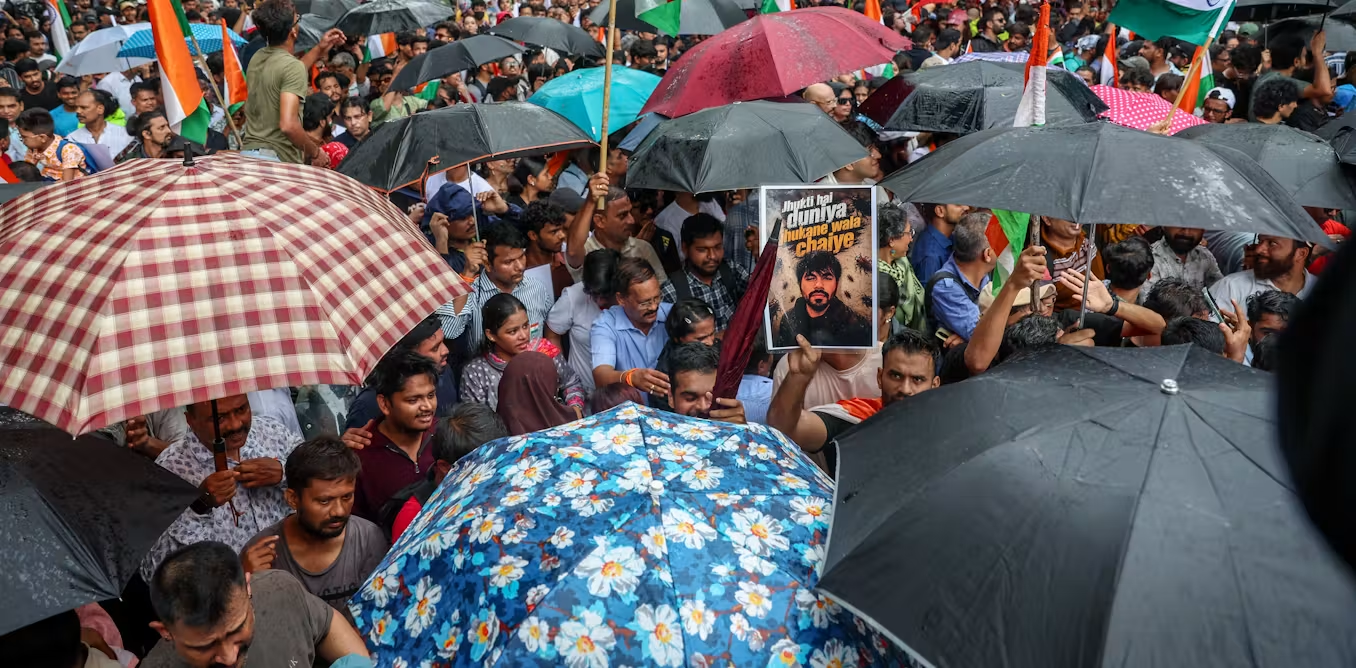
As I strolled around the Jantar Mantar astronomical observatory in Delhi on July 28, the atmosphere was finally calm. Jantar Mantar had been the focus of the recent “cockroach” protests, in which tens of thousands took to the streets to push for education reforms in India.

While police and riot control vans remained, life was returning to normality. Street vendors and small businesses were bustling again. I joined people drinking tea and heard a range of opinions. The resignation of the education minister, Dharmendra Pradhan, a few days earlier seemed to satisfy the protesters’ calls for accountability in India.

But there were still competing narratives as to what happened in those few short weeks of protest. To me, after talking with many people on the streets of Delhi, it feels as if six words changed the political atmosphere in India completely: “What if all cockroaches come together?”

These words were posted online on May 16 by 30-year-old Abhijeet Dipke, an Indian political communication strategist studying at Boston University in the US. He was responding to a comment from India’s chief justice, Surya Kant, made from the bench during a legal case.

Advertisement

While criticising attacks on the judiciary on social media, Kant said: “There are youngsters like cockroaches … they don’t get any employment, they don’t have any place in profession. Some of them become media, some of them become social media, some of them become RTI activists, some of them become other activists, and they start attacking everyone.”

Kant later clarified he had been referring to fake degree holders. But the remark was widely interpreted as a slur against jobless young people at a time of high youth unemployment in India.

In response, Dipke created a website, Cockroach Janta Party (CJP), as satire – but within a fortnight, 22 million people were following his posts. He returned to India on June 6 and was immediately swarmed by the press at Delhi airport. Holding up a copy of the autobiography of the late B.R Ambedkar, who chaired the drafting committee for India’s constitution, he demanded the resignation of India’s education minister.

Advertisement

This was a direct call for accountability after the government had abruptly cancelled India’s medical entrance exam, which had been sat by 2.28 million students, on May 12. The National Testing Agency explained that a paper very like the one sat by the students had been leaked and circulated online.

At least 21 students are subsequently reported to have taken their lives in response to the exam’s cancellation.

Sonam Wangchuk, an educationalist and climate activist, joined the protest and commenced a hunger strike, along with some other students. On July 18, the 20th day of his fast and having lost 10kg, Wangchuk was forcibly removed from the protest site to a hospital. This was met with further outrage.

Sansad Marg or Parliament Street in New Delhi. Photo taken by author, July 28.
Susan Ann Samuel

On July 20, the cockroach protesters took to the streets en masse, with Jantar Mantar, site of the astronomical observatory established in 1724, becoming the focus of activism for educational reform.

Advertisement

The ensuing march to India’s parliament building in New Delhi drew more than 50,000 protestors. Despite the peaceful nature of the protest, it was met with tear gas, police batons, pellet guns and excessive force against the young protesters.

The movement had three demands: the resignation of the education minister, compensation for the families of students who had taken their lives over the medical entrance exam’s cancellation, and the dropping of all charges against protesters – along with an apology for the police crackdown.

Pradhan resigned. The government agreed to meet the other two demands, and on July 25 the protest was called off.

The power of satire

The CJP bills itself as “the voice of the lazy and unemployed”. Yet the massive response suggests otherwise.

Advertisement

The movement called out to disenchanted youth – a generation that has grown up amid disruption, economic crisis, pandemic and wars. The satirical tone of the new party’s communication strategy proved an effective way to convey its serious message.

Political satire, which uses memes rather than merely rhetoric, can create what scholars call a “medium of value”. The young people in India have found a new identity through this.

A single reaction to a derogatory remark spurred collective resistance. The movement’s wider manifesto included calls for judicial reform, electoral integrity, increased representation for women, and the break-up of media monopolies.

A derted square in New Delhi with police signs
Jantar Mantar, the observatory where protesters gathered, taken by author on July 28.
Susan Ann Samuel

India’s prime minister, Narendra Modi, reacted quickly, publishing video messages to the young people of India. He established an expert taskforce to examine the issues, and announced fast-track courts. On July 29, India’s parliament passed a Bill establishing stricter penalties for anyone found to be leaking exam papers.

On August 3, the Supreme Court announced that Delhi and other state governments would be allowed to withdraw “first information reports” – complaints against protesters – except in especially serious cases. It also said it would frame a new protocol governing the use of pellet guns.

Advertisement

What’s different about this protest?

The cockroach protest surfaced after more than a year in which young people had already shaken governments on three continents. Since 2022, Gen Z-led protests erupted across Sri Lanka, Nepal, Bangladesh, Madagascar, Morocco, Kenya, Indonesia, Peru, Mexico, the Philippines and beyond.

The triggers were local: economic mismanagement in Sri Lanka, a social media ban in Nepal, an unfair quota system for employment in Bangladesh, chronic water and power cuts in Madagascar, new taxes in Kenya, misallocated public spending in Morocco.

But the message was shared: the need for economic social and cultural rights, freedom from corruption and inequality, and dissent against a governing class that appeared to have stopped listening.

In Sri Lanka, Bangladesh, Nepal and Madagascar, governments fell as a result of the protests.

Advertisement

How does India’s cockroach protest compare? Where in many cases, the Gen Z protesters called for their government to resign, India’s cockroaches did not seek regime change. They peacefully marched for accountability within the system. And their demands were – largely – met through the machinery of Indian democracy.

Calling this simply a Gen Z movement misses the point. Young people and students were joined by their parents, grandparents, and even toddlers and children. Where the global wave was defined by the age of its participants, India’s was defined by an intergenerational solidarity gathered around a single grievance.

The global Gen Z uprising asked who should hold power. The cockroach protesters in India asked something more specific – and arguably harder: whether India’s governing institutions can still be trusted to uphold the constitution. For Indians, this meant something deep — guarding the soul of their country.

Advertisement

Source link

Continue Reading

NewsBeat

Why escorted tours are making a comeback and they're nothing like the coach holidays your grandparents enjoyed

Published

on

Why escorted tours are making a comeback and they're nothing like the coach holidays your grandparents enjoyed

Escorted tours have long been associated with packed coaches and rigid itineraries, but a new generation of luxury cultural holidays is changing perceptions with small groups, exclusive access and experiences that independent travellers often can’t arrange themselves.

Source link

Continue Reading

NewsBeat

Andy Burnham cost of living update as PM reveals important August plan

Published

on

Wales Online

The Prime Minister is in ‘listening mode’, according to Downing Street

Downing Street has announced a big update on Andy Burnham. The PM will kick off a national tour this week to ask the public how the Government can improve their lives. Officials said the Prime Minister would be in “listening mode” as he spends much of the rest of August travelling the country to discuss the cost of living.

Advertisement

Having promised to give the public “breathing space”, he is expected to unveil a series of measures intended to help with bills, following on from cuts to energy costs and a £2 cap on bus fares announced in his first week in Downing Street.

Mr Burnham will also focus on improving high streets and officials said he would use the summer tour to inform his 10-year plan for the country. A spokesperson for the Prime Minister said he would be “getting out of Westminster and meeting people where they are”.

They added: “He thinks Westminster has got used to telling people that everyday hassles – like hidden pricing and consumers being ripped off – must be accepted as part of life. He doesn’t think that’s right. That’s why he’s going to start rolling out a series of pro-consumer cost-of-living measures to give people some room to breathe.”

With the fallout of the Iran war keeping inflation higher than expected, the cost of living remains a major concern among the public. A poll published by Ipsos at the end of July found 30% of people listed the economy as a major concern while 22% listed inflation or prices specifically.

Advertisement

But opposition figures have accused Mr Burnham of “tinkering” with his announcements. Reform UK’s economic spokesman Robert Jenrick said the Prime Minister should “scrap green levies and taxes on energy bills”, and rule out tax rises in October’s budget.

He added: “It’s high time the Labour Party cut the ballooning benefits bill so we can relieve pressure on the hardworking majority that hold our country together.”

Source link

Advertisement
Continue Reading

NewsBeat

Man rushed to hospital with stab wounds after ‘attempted murder’ on Glasgow road

Published

on

Daily Record

The man was found injured after being attacked in an apparent murder bid on Thursday night.

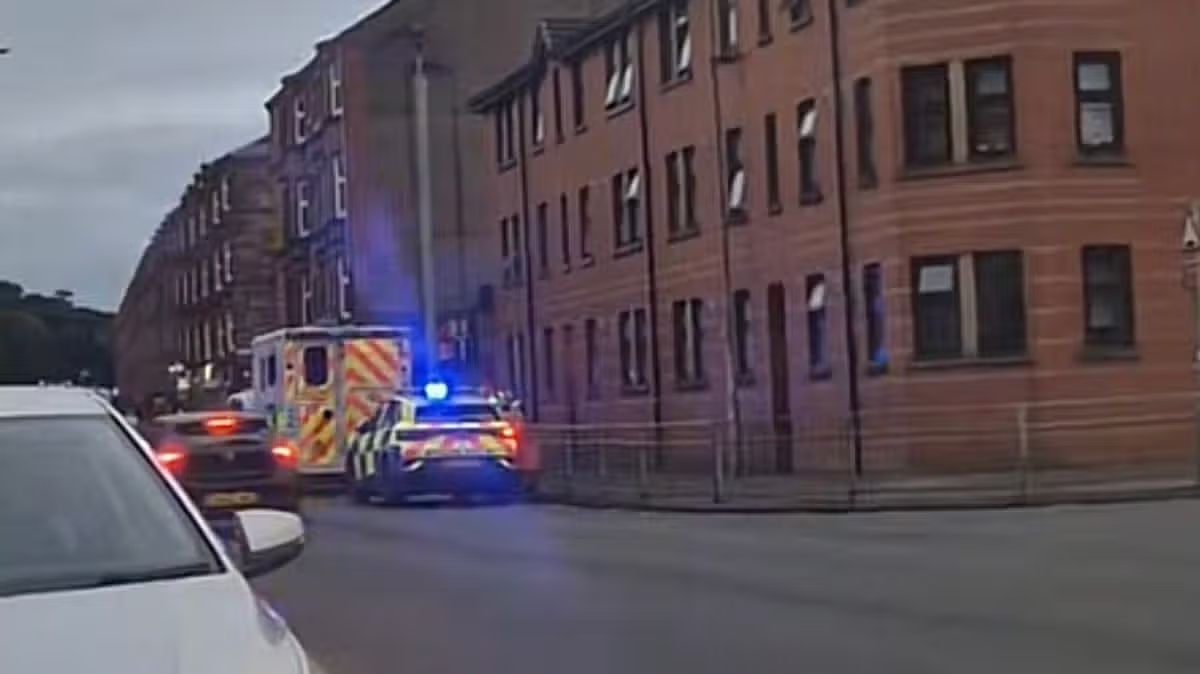
A man has been rushed to hospital following an alleged attempted murder in Glasgow. The alarm was raised around 10.40pm on Tollcross Road, near to its junction with Crail Street, in the east end of the city on Thursday, August 6.

Advertisement

Emergency services, including Police Scotland and Scottish Ambulance Service, raced to the scene after receiving reports of a man being seriously assaulted.

He was taken by ambulance to Glasgow Royal Infirmary where he is being treated for stab injuries. His condition is described as serious but stable.

Footage taken from the scene shows at least three blue-lit police vans and an ambulance parked on the busy road.

An attempted murder investigation has been launched. Police Scotland are asking anyone with any information on the attack – including potential witnesses – or those with dash-cam footage to get in touch. Detective Inspector Graham Clarke said: “Enquiries are ongoing into this attempted murder and we are appealing to the public for any information.

Advertisement

“This is a busy area and we are urging anyone who witnessed this attack, or anyone with information which could assist our enquiries to contact us. “We would also appeal to anyone with dash-cam or personal footage to get in touch in case it holds anything relevant.”

Information can be passed to Police Scotland through 101, quoting incident number 3565 of 6 August. Alternatively, Crimestoppers can be contacted on 0800 555 111, where anonymity can be maintained.

Get more Daily Record exclusives by signing up for free to Google’s preferred sources. Click HERE.

Source link

Advertisement
Continue Reading

NewsBeat

Royal Navy warns of 25% surge in Russian naval activity near UK

Published

on

Royal Navy warns of 25% surge in Russian naval activity near UK

The Royal Navy has warned of a significant increase in Russian naval activity near UK waters, having spent 21 days in July monitoring Moscow’s vessels.

Naval operations to track Russian ships surged by 25 per cent in July compared to last year, with warships repeatedly traversing the Dover Strait and North Sea.

Offshore patrol vessels HMS Tyne, HMS Mersey and HMS Severn were deployed throughout the month to monitor Russian frigates Neustrashimy and Admiral Grigorovich, which are tasked with escorting so-called “shadow fleet” tankers.

Russia uses its ageing shadow fleet to evade international sanctions on its oil exports and help fund its war in Ukraine.

Advertisement
HMS Tyne was also tasked with monitoring the Neustrashimy
HMS Tyne was also tasked with monitoring the Neustrashimy (MoD/PA)

HMS Tyne was also tasked with monitoring the Neustrashimy as it carried out a live firing exercise outside British and French waters on July 20.

Another ship, the frigate HMS Somerset, has been involved in monitoring Russian activity in the North Atlantic as part of a four-month Nato deployment searching for submarines, alongside helicopters from the Navy’s Fleet Air Arm.

Somerset’s commanding officer, Commander Matt Millyard, said: “This deployment demonstrates exactly what the Royal Navy exists to do, protect the UK and our allies from wherever our interests are threatened.

“I am immensely proud of every single member of the ship’s company for what we have achieved over the past four months.

It is fantastic to bring the ship home after a highly successful deployment and reunite with our families.”

Advertisement

The increase in Russian naval activity follows the seizure of the tanker Smyrtos by Royal Marines in June, the first time British troops have directly boarded a shadow fleet vessel.

The Ministry of Defence (MoD) said the diversion of Russian ships to escort shadow fleet vessels meant Russia was “using up valuable operational capacity to constantly guard cargo”.

Last month, the MoD said in its annual report that Royal Navy vessels had been “activated” 116 times in the year to March 2026, shadowing 61 Russian warships and 28 merchant vessels around the UK’s waters.

This reflected a 30 per cent increase in Russian naval activity over the previous two years, and included operations to deter the spy ship Yantar that was spotted near undersea cables off Scotland in November 2025.

Advertisement

Source link

Continue Reading

NewsBeat

An ‘explosive diarrhoea’ parasite is sweeping the world… and now it has reached the UK and Europe: Here’s how you can avoid the grim bug that grips hold of your guts for weeks and starts with a bubbling, balloon-like feeling

Published

on

Some sufferers have described having to use the toilet up to 20 times a day, while others told of a bubbling, or balloon-like feeling in the stomach

It’s the explosive diarrhoea bug that’s struck down tens of thousands of Americans this summer. Cyclosporiasis, a parasitic infection that spreads via contaminated food or water, has hit more than 22,000 people across 45 states.

Linked to an iceberg lettuce farm in Mexico, it swept quickly through the US, killing two and leaving hundreds hospitalised over the past few weeks alone.

And health chiefs now warn the debilitating infection – which causes weeks of violent diarrhoea, abdominal cramps and vomiting – has reached the UK.

At least 67 Britons have fallen ill with cyclosporiasis since May. Officials are urging all travellers to take precautions when visiting or returning from North, Central and South America.

Advertisement

It may sound terrifying but experts say that, armed with the correct information, the parasite, called cyclospora, needn’t be a cause for concern.

‘It’s not something you want to get,’ says Dr Paul Hunter, microbiologist and professor of medicine at the University of East Anglia, ‘but there are clear ways to reduce your risk, on holiday or at home.’

What exactly is the cyclospora parasite?

Cyclospora is a single-cell organism, meaning, in layman’s terms, it is microscopically tiny.

It is a parasite that lives and multiplies in the small intestine, burrowing into cells that line the gut wall. The frequent, watery diarrhoea associated with the bug is the body’s attempt to expel them.

Advertisement

Some sufferers have described having to use the toilet up to 20 times a day, while others told of a bubbling, or balloon-like feeling in the stomach

Symptoms typically go on for a couple of weeks but can last up to a month, says Dr Lindsey Ann Edwards, senior lecturer in microbiology at King’s College London.

She adds: ‘The main sign is very watery diarrhoea over a prolonged period. While other bugs may clear up after a few days, cyclosporiasis continues.’

Advertisement

Some sufferers have described having to use the toilet up to 20 times a day, while others told of a bubbling, or balloon-like feeling in the stomach.

The parasite can also cause abdominal pain and nausea, but rarely vomiting.

Can I catch it from an infected person?

Cyclosporiasis differs from more common bugs in how it is spread. ‘The parasite can’t be passed on between humans, unlike many other diarrhoea-causing infections,’ says Professor Hunter.

In fact, people become infected with cyclospora only when they consume food or water that contains the parasite.

Advertisement

‘If you were just at dinner with, or even lived with, an infected person, you likely wouldn’t get it,’ says Professor Hunter.

Instead, outbreaks, such as the one in the US, occur when infected faecal matter comes into contact with crops, usually due to contaminated water supplies used to wash or grow produce.

Prof Hunter adds: ‘It’s raw vegetables and fruit – crops you won’t typically cook – that tend to spread cyclospora, as boiling can kill the parasite.

‘Salad leaves in particular are full of nooks and crannies and have a lot of surface area for the parasite to lay eggs on. And you don’t cook them – making them a perfect vehicle for cyclospora.’

Advertisement
Raspberries and blackberries have been behind a number of outbreaks for the same reason as salad leaves now are ¿ they¿re hard to clean well and full of little troughs and pits

Raspberries and blackberries have been behind a number of outbreaks for the same reason as salad leaves now are – they’re hard to clean well and full of little troughs and pits

Is it only salad I need to be worried about?

The US outbreak has been linked to Taylor’s Farm, a farm in Mexico that supplies bags of shredded lettuce to fast-food giant Taco Bell as well as grocery stores.

But previous outbreaks have been caused by a range of other fresh vegetables and fruit, including, most commonly, raspberries. ‘Anything that you eat without peeling or cooking could carry the parasite,’ says Professor Hunter.

Raspberries and blackberries have been behind a number of outbreaks for the same reason as salad leaves now are – they’re hard to clean well and full of little troughs and pits.

Advertisement

‘Vegetables with a waxy skin, like cucumbers, or that you typically peel – like oranges or carrots – are less likely to cause infections.’

How come it is now spreading to the UK?

Cyclospora is most prevalent in tropical regions such as South and Central America, Southeast Asia or the Middle East, as the parasite’s eggs can usually only survive in warm, humid conditions.

These regions typically also have poorer water treatment and sanitation infrastructure, making crop contamination more likely.

But while rare, there have been cyclospora outbreaks in the UK and Europe. Imported produce can bring in the infection, although most commonly people pick it up abroad, says Dr Edwards.

Advertisement

‘The parasite tends to incubate for around ten days, so people can go on a week-long holiday but then develop symptoms two or three days after getting back.

‘In the current outbreak, it seems most people have picked it up travelling to Mexico and the US.’

Will washing fruit and veg get rid of it?

‘It’s always a good idea to wash fresh fruit and vegetables,’ says Professor Hunter. ‘But with cyclospora, washing produce – while removing maybe 80 per cent of the parasites – won’t stop you getting sick, as the eggs, once laid, are difficult to dislodge.

‘Cooking is really the only way to kill off the bug.

Advertisement

‘I’ve always cautioned against eating uncooked vegetables – especially salads – when abroad.’

People with healthy immune systems can also usually get over the infection without treatment, but their symptoms can last up to a month and may relapse

People with healthy immune systems can also usually get over the infection without treatment, but their symptoms can last up to a month and may relapse

What’s the best way to treat an infection?

Once diagnosed via a stool sample, cyclosporiasis infections can be easily treated with antibiotics.

Trimethoprim-sulfamethoxazole, commonly sold as Bactrim, Septra or Cotrim, is taken twice daily for seven to ten days.

Advertisement

People with healthy immune systems can also usually get over the infection without treatment, but their symptoms can last up to a month and may relapse.

Hydration is key, says Dr Edwards, because of how much fluid is expelled. Sufferers should drink a lot of water, broths and take electrolytes and antibiotics.

Should I be worried about getting it?

Not unless you are planning an imminent trip to the US or Mexico.

If you are, at mealtimes or in restaurants, stick to cooked vegetables or ones that are peeled.

Advertisement

Those with a weakened immune system, as well as the elderly and children, should also be careful, adds Dr Edwards.

‘It’s not usually deadly – and given the number of infections in the US, two deaths makes sense statistically,’ she says.

‘But if you have underlying health conditions, it can make it much more difficult for your body to get rid of the parasite. Constant diarrhoea can cause severe dehydration, which can be deadly.’

Anyone returning from abroad who develops symptoms should seek help from their GP.

Advertisement

Source link

Continue Reading

NewsBeat

Wales breaking news plus weather and traffic updates (Saturday, August 8)

Published

on

Wales Online

Flights have resumed at Bristol Airport after a chaotic Friday night and Saturday morning which saw passengers stranded and diverted as operations grounded to a halt.

The airport suspended all flights on Friday evening due to a runway defect. All flights were suspended until 8am on Saturday, sparking major disruption for passengers.

The airport said early on Saturday morning: “Due to a defect on the runway, we have temporarily suspended operations as a precaution, in order to inspect and repair the section affected.

Advertisement

“We apologise for any inconvenience. Safety is always our number one priority.”

In an updated statement issued at 8am on Saturday, the airport said: We’re very sorry to customers affected and any impact this has had to their summer holiday. We continue to work closely with all airlines affected.

“The safety of passengers and staff is of paramount importance, which is why we made the decision to temporarily suspend flights as a precaution and to allow for the runway repair to be carried out.”

You can follow all the latest here.

Advertisement

Scroll down for more updates:

Source link

Continue Reading

Trending

Copyright © 2025