Connect with us

NewsBeat

‘I’m a doctor and I eat this breakfast every day as it helps lose weight’

Published

on

Wales Online

BBC Breakfast expert slammed cereal – and said he tells patients to do something completely different

A doctor has revealed what he consumes for breakfast ‘all the time’ – and how it assists him in losing weight. Dr Rangan Chatterjee, best known for his television programme Doctor in the House and for being the resident doctor on BBC Breakfast and as a regular contributor to BBC Radio, stated people should begin consuming what they eat for dinner much earlier.

Advertisement

Speaking on the Doctor’s Kitchen podcast previously, Dr Chatterjee explained the crucial factor was incorporating some protein as it keeps hunger at bay for longer. He challenged why people have been conditioned into consuming things like ultra-processed cereal for the first meal of the day.

He said: “Who says that these are breakfast foods? And when you really dive into where this all came from and the marketing involved, it’s actually some cereal companies, right? We used to go to India for 6 weeks every other summer. I can still remember my cousins before they went to school, they’d have these big plates. There was like meats, vegetable curries, there was dal, rice, it was like a proper meal.

“And then I noticed after about 10 years you’re going back and like there’s all these adverts from the cereal companies.”

Podcast host Dr Rupi Aujla replied: “There’s that beautiful set of photos where they looked at what kids eat for breakfast around the world. It was done about 10 years ago. I come back to that all the time. What you see in the UK and the US are just these refined sugary cereals, and you definitely see that in certain other countries like Latin America and particularly in Brazil. But then you look at like Asia and it’s just like a hali, you know, like Sri Lanka was like a hali with some. Some I mean that’s the kind of stuff that I would eat for for dinner.”

Advertisement

Dr Chatterjee added: “Yeah, and one of the things I’ve often said to patients to help them with this is eat dinner for breakfast.” Dr Aujla replied: “Yeah, I do that all the time. Yeah, I mean it’s a very simple way because we’ve got this idea of what a breakfast food is, but actually it wasn’t always.”

Content cannot be displayed without consent

Dr Aujla explained: “Protein at breakfast is a great strategy to ensure that you’re not overconsuming and improve weight maintenance.”

Refraining from snacking is the secret to maintaining a healthy weight, Dr Chatterjee explained, adding: “I genuinely do not bring food into my house that I don’t want to be consuming. Sweets, chocolates, cakes, I don’t keep them at home. Because there will be an evening when I’m feeling tired and a bit stressed and I will start opening the cupboards and look for something a little bit sweet and all I can see at the moment are whole nuts and olives, and sometimes I’m like, ah, I’m not sure I feel like that at the moment. No it’s not really what I wanted. Yeah. So, again, in terms of what is practical for many people and my biases, the patients I’ve seen over the years. I think not using your willpower in your house is a great tool.

“And also, I think a lot of these principles depend where you’re at on your journey. Right, if you’re used to having loads of ultra processed foods, and that’s, you know, making up 70% of your diet, as it is for many people. Actually, to reset, maybe for a few months you don’t want that stuff anywhere near you, so it can, it can help you reset your taste buds, not be tempted.

Advertisement

“Yeah, think about it another way, and we don’t like to think about food in this way, but let’s say you were an alcoholic, right, and you were struggling with your alcohol consumption. And you recognise that and you start to get help. I think most of us would probably accept that whilst you’re trying to recover from that possibly not the best idea to have loads of beer and wine and booze kicking around in your fridge and in your house.”


Source link

Continue Reading
Click to comment

You must be logged in to post a comment Login

Leave a Reply

NewsBeat

Comedian Dave Elliott backs mental health campaign highlighting ‘power of a chat’ for tradespeople

Published

on

Belfast Live

A study revealed that almost half (48%) of tradespeople spend at least four hours of a typical working day alone

Northern Irish comedian Dave Elliott has said he is “humbled” to be the face of a new mental health campaign focusing on the power of connection for tradespeople.

Advertisement

New research from MacBlair, one of Northern Ireland’s leading builders’ merchants, has revealed that 92% of tradespeople in Northern Ireland say a quick chat with someone during the day has a positive impact on their wellbeing.

The findings come as almost half (48%) of tradespeople spend at least four hours of a typical working day alone, highlighting the important role everyday conversations can play in helping people stay connected.

In light of these figures, MacBlair has launched its ‘How’s the Head?’ campaign, focusing on the value of everyday connections, recognising that while working independently is a valued part of life in the trades, day-to-day interactions with others can play an important role in supporting overall wellbeing.

Speaking to Belfast Live, Dave said he was both surprised yet not shocked to see the figures in relation to tradespeople across Northern Ireland.

Advertisement

“I think that you probably would assume straight away that the trades are always craic 24/7, you know – but at the same time, when you think about it, there are a lot of people that are by themselves when working on jobs,” he explained.

“And when you are isolated, whether while working by yourselt or being alone in general, you can often let issues stew and lead people to struggle a bit.

“I think making people more aware of what’s going on in the industry and maybe a bit less ignorant, because that’s how I would have described myself – I think I was probably ignorant of the stats until I heard them.”

94% of participants agreed that staying in touch with friends and family is important for their overall wellbeing, while 64% say interactions with other people during the working day are very or extremely important.

Advertisement

Working independently is a key part of life in the trades, and the research shows that many tradespeople value the flexibility it brings.

Almost a quarter (24%) say the best thing about working independently is being able to work at their own pace, while 20% value the flexibility it provides and 16% enjoy being their own boss.

The research also highlights the reality that many spend long periods working alone. When asked about the challenges of working alone, 46% cited getting the balance right between work and personal life, followed by the pressure to get jobs completed on time (42%) and managing multiple responsibilities (40%).

Advertisement

As part of this year’s How’s the Head? campaign, MacBlair is encouraging tradespeople to take five minutes for a Builder’s Brew.

Whether it’s checking in with a mate, making a call on the drive between jobs or taking time for a chat over a cup of tea, small everyday conversations can make a real difference.

Dave, who is also an ambassador for Action Mental Health, said that it is “humbling” to be able to use his influence to be a champion for positive mental health in Northern Ireland and is delighted to be backing McBlair’s activation to encourage more tradespeople to open up if help is needed.

Dave continued: “I think everybody has issues with their mental health, but many don’t know how to deal with it – it might just be talking to somebody about it or rationalising what it is you’re going through.

Advertisement

“If I can help with that, that’s the biggest win I can get. It’s a real pleasure to be able to bring any positivity to it because it is such an important matter and I do think it’s an area that has been let down, certainly at a political level.

“Whatever I can do to try and help it, I’ll keep doing that for sure.”

Alan Wright, Managing Director at MacBlair, said that he hopes the campaign can help fight the stigma about reaching out when it comes to your mental health.

He said: “‘How’s the Head?’ is about helping to make wellbeing part of the everyday conversation and creating a culture where people feel comfortable speaking openly when they need support.

Advertisement

“It is encouraging that 70% of tradespeople believe the industry is becoming more open about mental health and wellbeing. The stats show that there is still more to do, but that shift shows real progress.”

Dave said he hopes what people take away from the campaign is that it is ok not to be feeling your best and if you are struggling, there are plenty of people who are there to listen.

“A phone call between jobs, a bit of banter on site or checking in with a mate can completely change the mood of the day. Looking after your mental health does not always have to feel like a massive undertaking.”

If you or someone you know needs additional support, help is available from organisations such as Action Mental Health or mindingyourhead.info, where you can find information, advice and support around mental health and wellbeing.

Advertisement

For more information and figures from the MacBlair ‘How’s the Head?’ campaign, see here

For all the latest news, visit the Belfast Live homepage here and sign up to our daily newsletter here.

Source link

Advertisement
Continue Reading

NewsBeat

Worker among 3 killed in shooting at Idaho fast-food restaurant, owner says

Published

on

Worker among 3 killed in shooting at Idaho fast-food restaurant, owner says

TWIN FALLS, Idaho (AP) — An employee was among three people killed in a shooting at an In-N-Out Burger restaurant in southern Idaho, the fast-food chain’s owner said.

“My heart is broken, my chest is heavy, my eyes burn from the tears I’ve shed. We lost one of our beautiful Associates tonight,” In-N-Out owner Lynsi Snyder said in a statement released early Sunday on social media. “In-N-Out will be mourning with the families and praying for them as they tread through a very painful season.”

The FBI on Sunday encouraged the public to submit images and videos related to the shooting Saturday in Twin Falls that left seven other people wounded, some critically.

The In-N-Out had opened just about a week earlier, on July 24, as part of the California-based company’s recent expansion to Idaho.

Advertisement

Authorities are notifying victims’ relatives

Snyder did not identify the worker. Officials were still trying to notify relatives of victims and so were not yet releasing the names, ages or other details about the people hurt in the shooting, Twin Falls spokesperson Josh Palmer said Saturday.

Police who responded to the shooting found the body of the suspected gunman in an area near the restaurant, Palmer said. He did not know if the suspect was included in the fatality count. Some of the people injured were in critical condition, Palmer said.

Police were still trying to determine the shooter’s identity and motive, Twin Falls Police Chief Matthew Hicks said in a news conference earlier Saturday.

“We believe the threat to the community is over,” Hicks said. “It was a very chaotic scene.”

Advertisement

Another police briefing was planned for Sunday afternoon.

Palmer said investigators were interviewing witnesses to the shooting. The restaurant is in a busy shopping plaza, and hundreds of people were in the area when it happened around 2 p.m.

Witnesses describe chaotic scene

Lane Koehn, 34, said he was at a stoplight near the In-N-Out when he saw a person with an AR-style rifle emerge from the drive-thru. A man with a pistol started firing at the shooter.

He then saw someone in an In-N-Out uniform drag a person, also wearing a uniform, bleeding from a gunshot wound to her chest across the parking lot. The employee, Koehn and the man with the pistol stayed until paramedics arrived for her.

Advertisement

“She was pretty bad off, but I don’t know. I hope she made it,” Koehn said.

Koehn said he was told by police to evacuate because the shooting was still active.

Advertisement

He said the shooter fired at least three or four rounds and it was not clear whether or not anyone in particular was targeted.

Video taken by a driver from across the street captured a shooter, who appeared to be dressed in black, walking up to a white car carrying a long rifle, opening the driver-side door and popping the trunk. The person then walked to the trunk and reached inside. At that point the driver who shot the video left quickly, fearing that the man might be getting more weapons.

Twin Falls resident Haley Dodaro, 43, and her mother went to In-N-Out for lunch Saturday afternoon. While waiting in the drive-thru line, they saw people running across the road and workers bolting out of the restaurant. At first, Dodaro thought there might have been a fire, but then a man directing traffic in a reflective vest said there was a shooter.

“So that’s when we knew there was a shooting. People were running out crying and screaming. It was very scary,” Dodaro said in a text message to The Associated Press.

Advertisement

Employee told people to get down

Nayeli Rodriguez, 40, of Burley, was inside waiting for food with her daughters when she heard shots from the kitchen. An employee said it was a shooting and told people to get down. Rodriguez said an older man tried to protect her and her daughters, and they were among the last to run outside.

“We were trying to get as far as we could and some angels let us in their car,” Rodriguez said, also via text message. “I left my car there in the parking lot.”

Police said multiple people were taken to St. Luke’s Magic Valley Medical Center. Hospital spokesperson Taylor Marschner said in a statement that it was “working closely with law enforcement and emergency responders as they manage the situation.”

Twin Falls, a city of about 56,000 people, is about 130 miles (205 kilometers) southeast of Boise and about 75 miles (120 kilometers) north of the Nevada border.

Advertisement

Source link

Advertisement
Continue Reading

NewsBeat

Why the questions about Reform UK and its wealthy donors won’t go away

Published

on

Why the questions about Reform UK and its wealthy donors won’t go away

There have been more claims about Reform UK and its finances. In fact, it has become so complicated that it’s easy to forget party leader Nigel Farage has a byelection battle on his hands.

A £5 million undeclared gift from billionaire Christopher Harborne was the catalyst for Farage’s resignation as MP for Clacton – which sparked the byelection. Many observers thought his resignation was a bid to pre-empt a ruling from the parliamentary standards commissioner.

Farage has denied this, but has now suggested to journalists that he should perhaps have “filled in a piece of paper” in connection with the money.


À lire aussi :
Five questions over Nigel Farage’s £5 million donation

Advertisement

Separate to this, police are reportedly investigating £500,000 given to the party by the mother of convicted fraudster and long-time Farage associate George Cottrell in the lead-up to the 2024 election. They are also said to be investigating £500,000 in donations from Britain Means Business – a company owned by Reform MP Richard Tice – made following a £1 million payment to the company from Fiona Cottrell.

It has now been reported that Cottrell made transfers totalling more than US$2 million (£1.49 million) to his mother just days before she donated to both Reform and Britain Means Business.

The police investigations relate to a potential breach of electoral law – the offence of attempting to evade the restrictions on donations under the Political Parties, Elections and Referendums Act 2000.

The specific sections of the act concern permissibility, or who is allowed to give money to political parties. Fiona Cottrell, Tice and Britain Means Business are “permissible donors”. But according to reports, it is unclear if Montenegro-based Cottrell is eligible to donate to a UK political party.

Advertisement

The only time that someone has been convicted of similar offences since the act was passed was in the case of Gary Platt and Conservative MP David Mackintosh. Platt had attempted to hide the provenance of £10,000 donated to Mackintosh’s constituency association, and was given a suspended seven-week jail term. Four other men were also convicted, but Mackintosh was not.

So previously, when police have investigated donations under these sections of the act, it has related to perceived attempts to hide the provenance of a donation. One reason that someone might do this is if the money came from an impermissible donor – but someone needn’t necessarily be an impermissible donor to have committed an offence.

Also folded into the parliamentary investigations are “in-kind” benefits received from Cottrell ranging from security and housing, through to staffing (and advice) for Farage’s social media campaigns.

These were given before Farage became an MP, but within the one-year “declarable period” (like the Harborne gift). Farage has said that these benefits were “totally undeclarable” because he was an influencer as opposed to being in frontline politics.

Advertisement

But in May 2024 Farage described himself as Reform’s “honorary president”. So this casts doubt on the claim. And why these benefits were not registered, when £9,253.60 from Cottrell for travel, security and accommodation to attend a conference in Belgium within the same period, was.

The crux of the Cottrell case is the question of “use”. If, as has been reported, some of these in-kind benefits went towards social media messaging that promoted Reform, it feels like quite tough sledding to claim they had little to do with party politics.

Cottrell (left) was by Farage’s side when he was hit by a milkshake in Clacton in 2024.
James Manning/PA Images/Alamy

Lawyers for George Cottrell have said he “categorically disputes” the allegations about financial help for Farage. Fiona Cottrell is understood not to have commented on the claims.

Advertisement

What it means for Reform

An important thing to note is that the legal onus rests almost entirely on the donor. The party in receipt of the donation simply needs to show that it has conducted a permissibility check on them.

In the case of Reform, some of its biggest donors (like Tice) are effectively woven into the party apparatus. This makes it much harder for the party to be seen to be one step removed from the money.

The question of the £5 million from Harborne remains one for the commissioner. That work is now paused pending the outcome of the byelection. But if Farage wins in Clacton, the commissioner will be making a judgment on three main things: the motive of the giver, what the gift was used for, and whether Farage had any doubt as to whether the money should have been registered.

Of these three, much less attention has been paid to the judgment on Farage’s doubts about the need to register it. But the MPs’ code of conduct is clear: “if there is any doubt, the benefit should be registered.”

Advertisement

This may yet become one of the hinge points. While it is hard to prove whether someone had doubt about something, Farage’s own statements suggest he did. Talking to the Triggernometry podcast, Farage said he had asked a “top international lawyer”, who advised him not to declare it. This could be seen to indicate at least some doubt.

Another question is why Farage asked a lawyer in the first place. There are parliamentary authorities whose job it is to know whether something is declarable.

These stories remain dangerous for Reform. Headlines about a Bitcoin tycoon giving £5 million to Reform while its policy looks kindly on cryptocurrency cut through with the public. Just before the Makerfield byelection, polling showed that when voters saw messaging about the £5 million and this was linked to Reform’s policies on cryptocurrency its vote share dipped by 4%.

Farage might think that failures to fill in bits of paper are trivial. But he must get this right because his personal ratings do him no favours. In the latest YouGov polling he nets out with 65% of people having an unfavourable opinion of him, compared to 25% having a favourable opinion.

Advertisement

Politicians are rarely popular, but this -40 for Farage compares badly with Andy Burnham’s -4 (and is quite close to Keir Starmer’s -45). For the new prime minister, this will almost certainly come down, but Conservative leader Kemi Badenoch is also ahead of Farage on -15.

So, while Farage might win over the voters of Clacton, this is not a good measure of the country. To address the Burnham bounce, Farage needs to meet British voters where they are when it comes to standards in public life. Even if that means filling out pieces of paper now and again.

Source link

Advertisement
Continue Reading

NewsBeat

Slash HUNDREDS off the cost of your summer holiday spending with one of these cards

Published

on

Big banks such as Lloyds, TSB and Halifax charge as much as 2.99 per cent on card transactions abroad ¿ but there¿s a range of banks that don¿t charge any such fees

You’ve checked your passport is valid, bought travel insurance and packed your beachwear. But changing pounds for cash in the currency of your destination has fallen down your to-do list. The good news is you need not pay over the odds in foreign transaction fees, or a huge commission on currency exchange at the airport.

Big banks such as Lloyds, TSB and Halifax charge as much as 2.99 per cent on card transactions abroad, which works out at nearly £30 on every £1,000 spent. But there’s a range of banks that don’t charge any such fees and it takes minutes to open an account with them.

This doesn’t have to affect your existing bank accounts, although you may be offered a juicy bonus if you switch your current account to a new provider. In some cases you can use the new digital card within minutes of setting it up via the bank’s smartphone app.

Here are the best cards for holiday spending, who they suit – and what to watch out for when making payments abroad.

Advertisement

Best bank overall for travellers

First Direct has zero fees on overseas spending and cash withdrawals using its debit card, and the £250 interest-free overdraft it offers is useful in an emergency.

The bank also gives those prepared to switch their current account a £175 bonus. But a switch takes seven working days and it may take more than a month to get the bonus.

You’ll get instant access to your current account when approved and a virtual card to use straight away. First Direct says that 99 per cent of customers receive their physical card within six days.

The bank is well-rated for customer service. In the latest survey of banking customers produced for the Competition and Markets Authority, 74 per cent said they would recommend First Direct to friends and family – placing the bank fourth for overall quality.

Advertisement

Rachel Springall, a finance expert at rate scrutineer Moneyfacts, says First Direct’s customer service is ‘high standard, with 24/7 phone support, so that should give customers peace of mind if they run into any problems’.

Big banks such as Lloyds, TSB and Halifax charge as much as 2.99 per cent on card transactions abroad – but there’s a range of banks that don’t charge any such fees

Best pre-paid card for exchange rate

When using your usual debit or credit card abroad, you normally get Mastercard or Visa’s exchange rate depending on your bank’s preferred payment network.

Advertisement

These are set once a day at a fraction above the rates stated by the European Central Bank.

The rates offered by the two card providers tend to be similar. For example on July 28, Mastercard would have converted £1,000 to €1,170.55, while Visa would have converted the sum to €1,173.53, not factoring in any bank fees. This is a difference of €2.98.

But you can also use something called the interbank rate – the live rate at which banks exchange currencies. As this is a real-time rate, this can sometimes work out better than the rates set by Visa and Mastercard.

Investment platform Trading 212 offers a pre-paid card that uses the interbank exchange rate. You’d need to spend thousands to notice any savings but the main benefits of Trading 212’s card lie elsewhere. There’s no foreign transaction fee in using the card abroad and you can withdraw up to £400 a month in cash for free.

Advertisement

You can also earn 3.8 per cent interest on your cash. It costs £4.95 to have a physical card delivered. The virtual card is free and can be used immediately once you open an account.

The number one rule with exchange rates is to avoid using airport services to switch currency at the last minute.

And when faced with the choice of paying in pounds or the local currency at an ATM on your trip, experts say choose the local currency. This swerves an expensive mark-up from a foreign bank.

The best credit card for travel

Credit card providers charge as much as 2.99 per cent on foreign transactions. Some levy an even higher fee on cash withdrawals, such as 3.99 per cent with a Tesco credit card – on top of a 2.75 per cent foreign exchange fee.

Advertisement

If you need to take out £500 in the local currency, using this card to do so would cost you £33.70.

You can find credit cards that don’t charge either of these fees.

One top pick is the Lloyds Ultra Credit Card. There are no foreign transaction or cash withdrawal fees, plus you can earn a good 1 per cent cashback on all card purchases in the first year.

The interest rate is a relatively low 14.9 per cent on purchases but this is a representative rate that not everyone receives. You should get your card in five to seven working days and Lloyds says you should see your card details in the app in ‘just a few days’ – from there you can use it digitally by adding it to Apple or Google Pay.

Advertisement

A couple of pointers with credit cards. When it comes to cash withdrawals, unlike the grace period that you have to clear your balance on purchases, interest is charged from the moment you have the money in your hands.

When applying for a credit card, you should check eligibility first. It won’t affect your credit history.

Holidaymakers also benefit from additional protection if they buy with a credit card. Any goods or services not received which are valued between £100 and £30,000 are covered under section 75 of the Consumer Credit Act.

With the Lloyds Ultra Credit Card, there are no foreign transaction or cash withdrawal fees

With the Lloyds Ultra Credit Card, there are no foreign transaction or cash withdrawal fees

Advertisement

Best app-based bank for travel

Digital challenger banks such as Chase, Monzo and Starling have become popular with travellers because they don’t charge foreign transaction fees.

They’re app-based so it takes a matter of minutes to open an account on your phone and you can usually start using your card straight away by adding it to your digital wallet. However, there are usually restrictions on how much cash you can withdraw.

Starling offers more flexibility on taking out money. You can withdraw up to £300 and make up to six withdrawals a day. Chase lets you withdraw £500 a day but has a £1,500 monthly limit when abroad. You can withdraw £400 fee-free every 30 days in the UK and Europe with Monzo’s standard account. There’s no restriction if Monzo is your main bank.

Kate Steere, from comparison website Finder, says: ‘If you’re after a slick app with genuinely useful budgeting tools like Spaces for saving for your holiday and Settle Up for splitting expenses, Starling is the one to go for.’

Advertisement

When withdrawing cash, try to keep costs low by finding ATMs operated by local banks. You’ll often be charged a flat fee but this can be lower at these branches.

Source link

Continue Reading

NewsBeat

Why Norfolk is the new Cornwall for the grown-up smart set: It’s more civilised, authentic – and you’re much less likely to bump into a drunken teenager!

Published

on

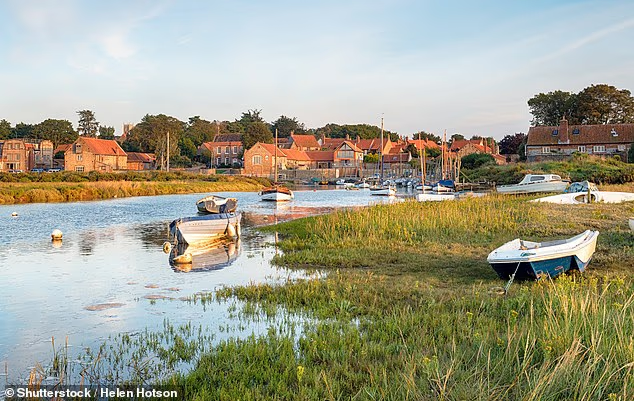
The village of Blakeney in Norfolk, which Sybilla compares to the London borough of Richmond

As children we would look forward to the long stretch of summer spent in Harlyn Bay in North Cornwall where we spent hours swimming and rockpooling.

We would drive down from our home in Bisley in the Cotswolds, the same village as Jilly Cooper.

And we weren’t the only ones. Cornwall was practically Cotswolds-on-Sea in those days with the whole Gloucestershire set making their way down, many of whom may have inspired some of my good friend Jilly’s characters.

Friends would come and stay and we would occasionally go to the Trevose Golf Club disco but most of the time we were knee-deep in sand and dogs – it was all very Famous Five. The adults would chat in the sand dunes with flasks of tea and watch their offspring frolic on the beach, and POSSIBLY got up to some shenanigans themselves.

Advertisement

Back then Harlyn Bay was referred to as ‘The Other Side’, with Polzeath and Rock being the places to be. When we got a bit older we would beg my poor mother to drive us 40 minutes (there was no ferry at night) round to The Mariner’s Pub in Rock where a bunch of blonde and shiny teens would drink until Mummy and Daddy came to collect them.

Eventually my mother gave up driving to ‘The Other Side’ and started looking into holiday rentals there instead to save her the midnight hassle. We swapped one sandy holiday cottage for another and had a whale of a time, going back year after year.

The village of Blakeney in Norfolk, which Sybilla compares to the London borough of Richmond

Advertisement
Cornwall was practically Cotswolds-on-Sea back in those days with the whole Gloucestershire set making their way down, writes Sybilla Hart

Cornwall was practically Cotswolds-on-Sea back in those days with the whole Gloucestershire set making their way down, writes Sybilla Hart

When I started having children, however, I knew it wouldn’t be long before we had to ditch this part of Posh Cornwall – I used to joke that you can’t mix infant bottles with beer bottles. It had become more and more of a party destination, which was not something I needed when I was more invested in Sudocrem than Sambuca.

We tried the south of Cornwall but got a bit put off by the adders on Kynance Cove and the jagged drops around The Lizard which looked like a recipe for broken legs (and the rest).

Plus everyone was in tears by the time we got to Bristol – Cornwall was just too far from Essex so in the end we had to ditch it.

Advertisement

So when I read that Polzeath is the epicentre of a real-life version of the cocktail Sex on the Beach, I felt more than a little relieved at my choice of Norfolk as a holiday destination. For Norfolk is the new Cornwall, at least among the grown-up smart set. It’s far more civilised and authentic than its southern counterpart, which has become raucous, downmarket and a bit last season.

Now that I am responsible for no fewer than three teenagers it is a blessing that we are not in Polzeath which I hear is transformed into a drunken playground by night for two weeks in July – with residents having to appoint a ‘beach ranger’ to patrol them.

Here in north Norfolk you are more likely to bump into a seal on the beach than a drunken teenager and most of the people who holiday in Cley-next-the-Sea are young families or retired people.

My children have made some friends over the years and occasionally sit in someone’s boat at night while sharing a can of Tesco Pear Cider but that is about the extent of it.

Advertisement

Norfolk, as I have come to realise, is just as smart as Cornwall but miles less populated. There’s no battling the crowds to find a tiny sliver of free sand to lie your towel down on, as you have to in Polzeath these days. The posh villages in Norfolk vary hugely and I find the best way to describe them is by comparison to London boroughs.

For example, Blakeney is like Richmond, well-heeled, beautiful with fantastic walks. Burnham Market is Norfolk’s version of Belgravia and has all the shops and smart restaurants.

Burnham Market in Norfolk is appreciated for its shops and smart restaurants ¿ in a similar way to Belgravia in London

Burnham Market in Norfolk is appreciated for its shops and smart restaurants – in a similar way to Belgravia in London

The Gunton Arms, found four miles from the beaches of Norfolk coast, is an award-winning traditional pub and restaurant

The Gunton Arms, found four miles from the beaches of Norfolk coast, is an award-winning traditional pub and restaurant

Advertisement

Brancaster is Fulham, full of families and labradors walking on the beach. Burnham Overy Staithe is Chelsea-on-Sea and full of blonde teenagers wearing the same clothes messing about on boats.

Cromer is more like Hackney, Holt is Barnes and finally, Hunstanton with its famous tennis tournament is best described as Norfolk’s answer to Clapham.

The restaurants in Norfolk are a case of Rick Stein eat your heart out with The Gunton Arms near Cromer scoring high as well as The Moorings in Blakeney, and we’re spoilt for choice when it comes to nice cafes selling flat whites.

There are hidden beaches to be found at low tide with only a tern for company; mudflats that look like works of art; windmills peppering the horizon and you can almost imagine former Norfolk resident Admiral Nelson striding out of the waves towards a centuries-old watering hole.

Advertisement

On the beaches you will find pebbles instead of beer bottles, shells instead of discarded vapes.

And the only creatures I’ve seen copulating on Norfolk beaches are the birds.

Source link

Advertisement
Continue Reading

NewsBeat

I’m a beauty editor and I always got bitten on holiday until I found this secret thing that mosquitos hate – and it smells divine too!

Published

on

This summer sees a raft of body sprays and fragrances with natural bug-deterring benefits hitting the market. But do natural insect repellents really work?

Mosquitoes and midges can ruin even the chicest of getaways, triggering a raft of holiday woes – namely the itchy, sore, unsightly, insect bites that can be enough to make the most body-confident want to cover up.

Keeping bugs at bay used to mean spritzing on insect repellent formulas laced with DEET, a chemical-formula that, while it does the job, melts your nail polish and smells dire too.

Until now. Luxury French fragrance house Diptyque has gone viral on social media because fans of its limited-edition Citronnelle & Geranium Summer Body Spray say it not only keeps bugs away but also smells divine. Which you’d hope, given it has a £52 price tag.

It’s all down to the added essential oils such as lemon eucalyptus and lemongrass, which are said to have inset-repelling properties.

Advertisement

Diptyque isn’t the only one; this summer sees a raft of body sprays and fragrances with natural bug-deterring benefits hitting the market. But do natural insect repellents really work?

‘Plant-based repellents with extracts like citronella, eucalyptus, lavender and verbena contain naturally occurring compounds which can disrupt the scent cues mosquitoes, midges and other biting insects use to identify us humans as targets, making it harder for them to locate us,’ explains GP and aesthetics doctor Ahmed El Muntasar.

This summer sees a raft of body sprays and fragrances with natural bug-deterring benefits hitting the market. But do natural insect repellents really work?

Advertisement

Chemical formulas made with DEET also work in the same way. So how do natural formulas – which, let’s face it, smell infinitely better – compare? ‘Many natural repellents evaporate more quickly than chemical formulas, so they need to be reapplied more frequently – every couple of hours,’ says Dr El Muntasar.

The type of protection you choose should also be determined by your destination.

‘If you’re travelling where mosquito-borne illnesses such as malaria, dengue, chikungunya or Zika are a concern I’d recommend choosing a repellent with proven longer-lasting protection,’ he says, ‘However, for general everyday use in the UK natural repellents can be a reasonable option.’

Here, I test the latest luxe natural bug sprays to see which are worth the investment…

Advertisement

Diptyque Citronnelle & Geranium Summer Body Spray (£52 for 100ml, johnlewis.co.uk)

This bougie body spray went viral for a reason. If you’re not keen on the medicinal scent of citronella (the telltale essential oil in many mozzie-repelling products) this fragrance relies on lemongrass and lemon eucalyptus, which studies show is one of the most effective natural repellents. The scent is a summery blend of lemongrass, geranium, neroli, lemon eucalyptus and orange blossom, so wearing it feels more like a sophisticated cologne than a bug repellent.

I stowed this in my hand luggage for a weekend away and didn’t feel the need to pack a separate perfume – which goes some way to mitigating the price.

Advertisement

The scent lasts only a couple of hours so it needed topping up regularly, but after spritzing it on my arms and legs I had no bites.

Neals Yard Remedies Citronella Formula Body Spray (£15 for 100ml, nealsyardremedies.com)

A family barbecue was the ultimate test for this citrussy body spray and it was a hit – not only did it look chic on the table, it smelled gorgeous and no one complained about midge bites.

Advertisement

Yes, it does smell slightly medicinal (the main fragrance note is definitely citronella) but it’s quickly tempered by other insect-repelling essential oils like lavender and eucalyptus, plus skin-soothing witch hazel, so it errs on the side of sophistication.

Avon Skin So Soft Original Dry Oil Spray (£6 for 150ml, avon.uk.com)

This lightly-hydrating body oil spray has such rave reviews online about its insect-repelling abilities it’s becoming a cult classic. Apparently, it’s the added citronellol and limone that staves off the bugs.

Advertisement

I liked the soft, almost baby-powdery fragrance that didn’t interfere with my usual perfume and how it left a subtle, glowy sheen on my limbs, too.

My daughter – the person in our family mosquitoes seem to love most – still gets the odd bite using this, but nowhere near as many as she does without it. The only drawback is the oil-based formula might not appeal to everyone. But for £6 it’s a no-brainer.

Le Labo Eucalyptus 20 Eau de Parfum (£172 for 50ml, libertylondon.com)

Advertisement

If you really can’t bear bug sprays, devotees of this chic, woody and eucalyptus-driven fragrance say it also helps deter insects. It’s not for the faint-hearted – an intense, aromatic eau de parfum that lasts a long time on the skin (I could still detect a whiff next morning).

After liberally spraying this, I wasn’t bothered by any bugs on an evening walk by a river. The price takes some justifying, but given this is fine fragrance rather than insect repellent you’re covering both bases with one bottle.

Source link

Advertisement
Continue Reading

NewsBeat

Cheap cleaning hack to get stains out of white clothing

Published

on

Cheap cleaning hack to get stains out of white clothing

However, bright white clothes are very easy to stain, whether that is through spilling things like food or drink or getting make-up stains on them.

Sometimes stains can be incredibly hard to get out of white clothes even if you have washed them a few times.

A clothing expert has revealed a way to remove stains to make white clothes look perfect again that will only cost you a few pounds.

The hack is cheap and easy to do. (Image: Getty)

How can I get stains out of white clothes?

Caroline Jackson, who is the Creative Director at Monsoon, has shared a cheap hack that can be used to get rid of tough stains.

Advertisement

If you want to avoid expensive cleaning products and chemicals, this hack might be worth testing out.

The hack is simple to do so won’t take too much time out of your day to complete.

Caroline said: “Baking soda, mixed with lemon juice, white vinegar, dish soap and cold water is what is going to successfully refresh your clothes without trying different brands and sprays that will end up costing a fortune.

“Rinse the stain with cold water, then simply add the combined mixture on the stain, grab a toothbrush and brush the stain away.

Advertisement

“This should help lift marks on the suitable fabric but I always recommend testing first, because lemon juice and vinegar can affect some fibres and finishes.

“It’s important to note that leaving lemon too long on fabrics can cause discolouration, so ensure you keep a close eye when treating any stains using this method.”

It is likely that you will already have a few of these things at home already.

However, if you need to buy anything, you can get the items from Aldi with the baking soda costing 65p, lemon juice costing 69p, distilled vinegar costing 35p, and washing up liquid costing 62p.

Advertisement

Common mistakes when removing stains from white clothing

Caroline also brought up some common mistakes people often make when trying to get rid of stains.

She said people can often use too much stain remover, which can leave a residue behind, or using too much heat, which can cause more harm than good to the item of clothing.

You should check the garment labels to see what fabric it is made from, as different fabrics will respond differently to treatments.

Will you be trying this hack in the future to remove stains? Let us know in the comments.

Advertisement

Source link

Continue Reading

NewsBeat

Cambridgeshire locals share housebuilding and water leak concerns as drought declared

Published

on

Cambridgeshire Live

East Anglia has been officially declared in drought by the Environment Agency, as Cambridgeshire residents debate housebuilding, water leaks and climate change

Readers of Cambridgeshire Live have responded to the news that drought has been declared in the county, with many highlighting housing development, water leaks, and climate change as factors of concern.

The Environment Agency said on Wednesday (July 29) that the region was in drought. Seven areas across the nation, including East Anglia, are in drought.

Advertisement

They are East Anglia; Hertfordshire and London; Thames Valley; Hampshire and the Isle of Wight; Devon and Cornwall; the West Midlands; and Wessex. This follows exceptionally low rainfall and elevated temperatures.

The fourth heatwave of the year reached its peak on Wednesday, with temperatures reaching up to 35C, as specialists warned wildfires could be “exceptionally severe”. The UK Health Security Agency (UKHSA) has issued an amber heat-health alert for the East Midlands, the East, South East and London.

Helen Wakeham, director of water at the Environment Agency and chair of the National Drought Group, said: “The hot and dry weather means we are currently using water faster than nature can replenish it.”

One of our readers, Bobbinbootsie, comments: “New houses are still being built, though. Nothing stops that!”

Advertisement

Skipper says: “Infrastructure needs to improve before any more building. It won’t, though – the great god PROFIT rules OK. Anglian Water have had 10 years to improve things since their last hosepipe ban, but have done nothing.”

Rogersinflatablepants writes: “The scientists warned this would happen. Dry hot summers are becoming increasingly more common, and it’s been entirely attributed to man. Don’t believe the deniers’ lies and misinformation.”

Whynot2 adds: “So the water pipelines AW have and are constructing are nothing, that’s a lot of money spent on nothing. People complain about water leaks and with justification but when you think about the length of water mains and secondary pipes they have perhaps the leakage problem isn’t all that bad and if you add the brown water side of it that they have to maintain it’s all time and cost. How many times have AW objected to new developments due to supply problems, and yet the developers have won?”

2ndincommand says: “And houses are still being built in their thousands in the area. Madness.”

Advertisement

On our Facebook page, Andrew H comments: “I’m sure there are lots of people who recall the ‘summer of 76’. Drought, hosepipe bans, poor crops. The water companies said it would take years for the reservoirs to recover. Then came the August Bank Holiday, it rained, & rained, & didn’t stop raining for two months & by Christmas all the reservoirs were full!”

Rachel B believes: “I think the consumers would have more sympathy for Anglia Water if: Anglia Water stopped pumping untreated sewage into the rivers and sea! If Anglia Water fixed reported water leaks in a timely fashion. I know of one main water leak which has been pouring water over the road for approximately 2 weeks!!! (All AW have done so far is put up temporary traffic lights and a few signs – water is still pouring across the road)

“Stopped putting prices up, without improving the service – For example: I live in an area with historically low water pressure, the only thing that has gone up is the price increase! Apart from the new large pipe linking the north to the East Anglia region, has AW invested / improved the local water infrastructure? Not that I can recall.”

Paul B asks: “Why is it our fault? All bloody winter, we had floods and steady rainfall, but Anglian Water did nothing to deal with it. They aren’t interested in stopping the millions of leaks across the region. When was the last reservoir built ?.The population keeps rising, but nothing is done with the infrastructure to deal with it. Just keep pumping millions out to their shareholders.”

Advertisement

Peter J says: “Didn’t think after taking all that extra money from all the new property developments over the years that it might be prudent to build a few reservoirs, or did they hope none of the new houses would want to actually use water?”

Are Anglian Water doing enough throughout the year, regarding our water supplies? Comment below or HERE to have your say.

Source link

Advertisement
Continue Reading

NewsBeat

Burnham pledges to be ‘relentless’ in tackling small boat crossings

Published

on

Burnham pledges to be ‘relentless’ in tackling small boat crossings

Prime Minister Andy Burnham speaking to the media during a visit to HM Coastguard Maritime Rescue Coordination Centre, in Dover, Kent. Since the start of 2025, the number of National Crime Agency officers tackling organised immigration crime has more than doubled from 376 to almost 800. Picture date: Sunday August 2, 2026.

PA Wire

Source link

Continue Reading

NewsBeat

Small businesses face ‘real compliance burden’ when employment law changes next year – how could YOU be affected?

Published

on

Hard-hit small business owners could face a compliance burden in the new year under the Employment Rights Act

Advertisement

Small businesses could be burdened even further by an employment law change set to come into effect on January 1 next year. 

The Employment Rights Act will mean that, from next year, employees will be able to claim ordinary unfair dismissal after six months rather than two years, which is the current law. 

In practical terms, this means small business owners will have less time to decide whether new workers are suitable before they are entitled to a lot more rights. 

Although the law has been praised as it will offer employees greater protection, it will also make it harder for small business owners to change staff and put them under pressure to make a decision about whether an employee is to be permanent.  

Advertisement

With small businesses under pressure already from policies introduced under Rachel Reeves‘ chancellorship, and unemployment rates at 4.9 per cent, experts worry that the sweeping changes set to be introduced will put the labour market under further pressure. 

Under the new law, the existing cap on the maximum amount of compensation that a fired worker can receive for successful unfair dismissal claims will also be removed. 

This could have a costly effect on small businesses, who have suffered already under changes enacted under Sir Keir Starmer’s leadership. 

Then-Chancellor Rachel Reeves introduced an increase in Employer National Insurance contribution rates from 13.8 to 15 per cent, while the earnings threshold at which employers start paying dropped sharply from £9,100 to £5,000. 

Advertisement

Hard-hit small business owners could face a compliance burden in the new year under the Employment Rights Act 

Rachel Reeves' policies, including increasing employer contributions to national insurance, already put many businesses under strain

Rachel Reeves’ policies, including increasing employer contributions to national insurance, already put many businesses under strain 

This policy – alongside an increase in the national living wage for teenagers and young people – made small businesses less driven to employ young people or more staff due to higher labour costs. 

Advertisement

Small businesses also faced higher business rates, with high street and larger commercial properties valued over £500,000 facing higher costs, de-incentivising small business growth. 

And the one request from the small business and hospitality sector – a reduction in VAT – was refused, denying companies some relief. 

This latest law change by Labour will put an extra burden on compliance for already hard-hit small businesses. 

Employers will now also have to provide a written reason for dismissal if requested by the employee.  

Advertisement

Katie Nightingale, Director of People Consulting at Grant Thornton UK, said: ‘Businesses are already squeezed in a slow economy so will naturally have concerns about investing in training for managers to be set up for the new bill. 

‘This is where the government needs to step up and support. It should provide SMEs with straightforward, accessible templates for compliant recruitment, probation and performance-management procedures. 

‘It should also use the Growth and Skills Levy to fund short, practical courses that build line-manager capability without imposing a prohibitive cost or time commitment.

‘Poor recruitment and performance management are expensive long before a case reaches a tribunal. Mis-hires, employees ‘checking out’, and avoidable staff turnover all damage productivity.

Advertisement

‘Grant Thornton UK helps businesses build hiring and performance practices that work in the real world, not just on paper. This isn’t about ticking a box.

‘Clear expectations, capable managers and honest conversations will help businesses ensure they have the right people working for them and achieve successful outcomes for employees.

‘For SMEs, it’s time to act before it’s too late.’ 

How businesses can prepare  

Three pieces of advice from Grant Thornton UK:

Advertisement
  1. DO review recruitment processes – Recruitment must be robust and standardised, with clear guidance helping hiring managers make consistent and defensible decisions. Objectives should be measurable, reasonable and agreed from an employee’s first day, rather than hastily introduced when a problem emerges several months later. 
  2. DON’T assume your managers know the policy – Asking somebody to confirm that they have read a new policy is no substitute for teaching them how to conduct an honest performance conversation properly. 
  3. DON’T leave performance conversations until the last minute – Managers must hold regular, structured development conversations and record what has been discussed. Waiting until an employee approaches the six-month mark before raising concerns is simply too late. Employers need evidence that expectations were clear, support was provided and issues were addressed fairly. 

Advertisement

Source link

Continue Reading

Trending

Copyright © 2025