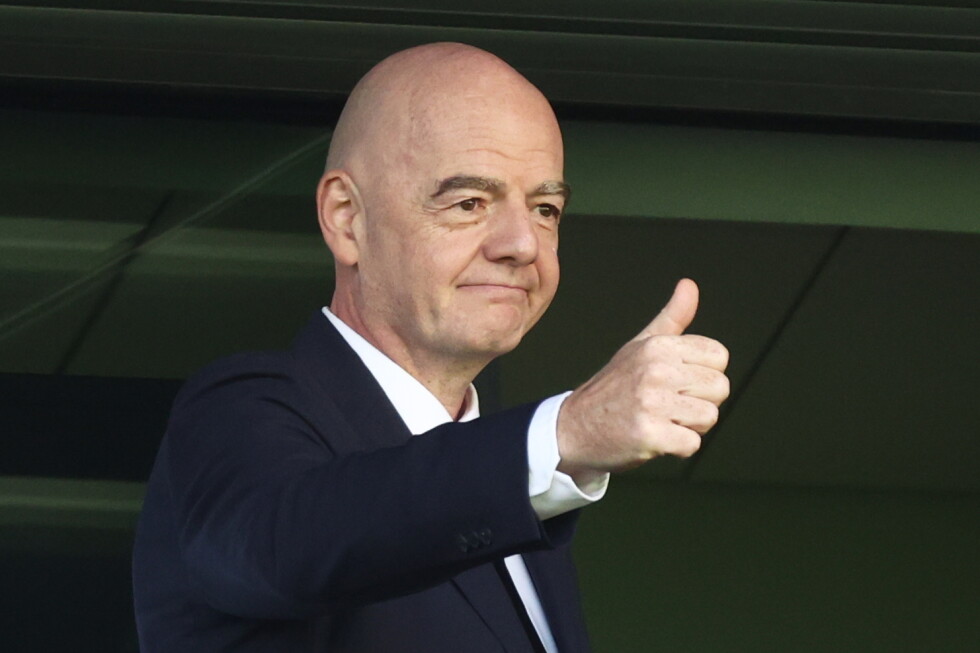
Despite widespread calls for him to step down, FIFA said Infantino will seek next year to win a fourth and final term in office through 2031.
“The FIFA President announced in April that he will stand for re-election in 2027. Of course, nothing has changed. Mr. Infantino will be standing for re-election,” a FIFA spokesperson said.
Advertisement
UEFA, European soccer’s governing body, has led the calls for Infantino to go, saying it had lost confidence in him and previously threatening to boycott FIFA tournaments, including the World Cup. A number of national associations, such the English FA, have withdrawn support for Infantino’s re-election.
On Saturday Infantino refused to comment about his future when arriving for the opening of the Under-20 Women’s World Cup in Poland.
“There will be a lot to say, but there will be a right place and a right time to say this. It’s not today, it’s not here, but here and today, we are enjoying football,” he told Sky News.
FIFA apologized for errors made over its controversial plan to sell profits in the World Cup through a commercial subsidiary and committed to “ensure they do not happen again.”
Advertisement
But that hasn’t been enough to ease the pressure on Infantino’s position.
Nov. 18 is the deadline for candidates to enter the next presidential contest, exactly four months ahead of the vote.
The BBC has confirmed the full line-up for Celebrity Traitors Series 2, with 21 famous faces set to return to the Scottish Highlands castle this autumn
21:08, 06 Sep 2026Updated 21:16, 06 Sep 2026
Celebrity Traitors will make its return to the BBC this autumn with a new group of participants. The celebrity version sees 21 well-known personalities compete in the ultimate game of deception, betrayal and lies, filmed in the magnificent surroundings of a Scottish Highland castle.
Performers, comics, artists and broadcasters will compete against one another in pursuit of victory.
The famous contestants hail from various fields and will be designated either a Traitor or a Faithful by presenter Claudia Winkelman. The second series of the programme follows an exceptionally successful debut last year.
Advertisement
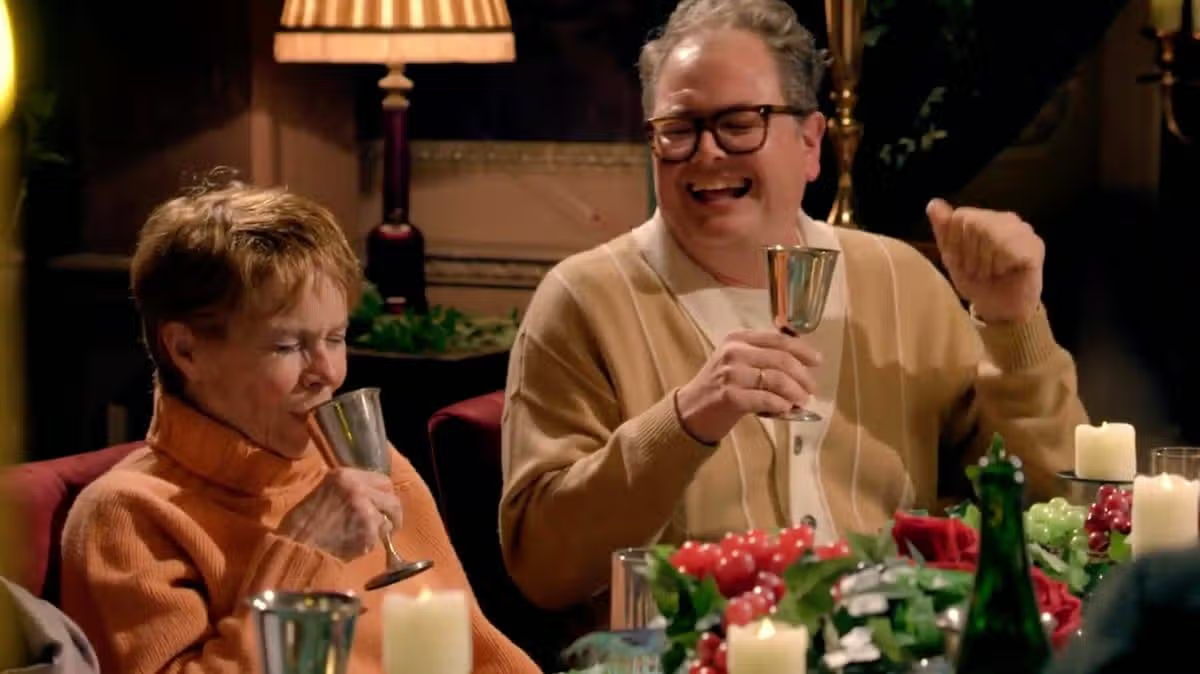
From Celia Imrie discovering an unexpectedly amusing method to relieve tension during one of the show’s supposedly eerie challenges, to the delightful pandemonium created by Alan Carr – an individual entirely unacquainted with the notion of a “poker face” – Celebrity Traitors proved to be amongst last year’s television standouts.
15.4m viewers watched Alan Carr collapse in tears as he emerged victorious against Nick Mohammed and David Olusoga in a nail-biting final episode, reports the Liverpool Echo. For the latest TV and showbiz gossip sign up to our newsletter
This year, 21 famous faces will arrive at the Scottish castle as the series makes its comeback to BBC One and iPlayer this autumn. The victorious celebrity will claim a cash prize of up to £100,000 for a charity of their choosing.
Advertisement
When does Celebrity Traitors 2026 start?
The Celebrity Traitors official premiere date has yet to be confirmed by the BBC but in 2025 series one debuted on Wednesday, October 8.
The new series will comprise ten hour-long episodes. The BBC recently unveiled a teaser trailer, featuring Claudia Winkelman standing inside a church before floral lettering that spelled out “RIP VIP”.
She addressed the fresh roster of contestants: “A moment of silence for the celebrities gathered today. Thoughts and prayers.”
However, TV presenter and podcaster, Richard Osman seemed to confirm it might begin earlier this year. The Guardian reports that during a live edition of The Rest Is Entertainment podcast at London’s Southbank Centre on Saturday, the 55-year-old said the new series of the BBC reality gameshow would begin on September 23.
Advertisement
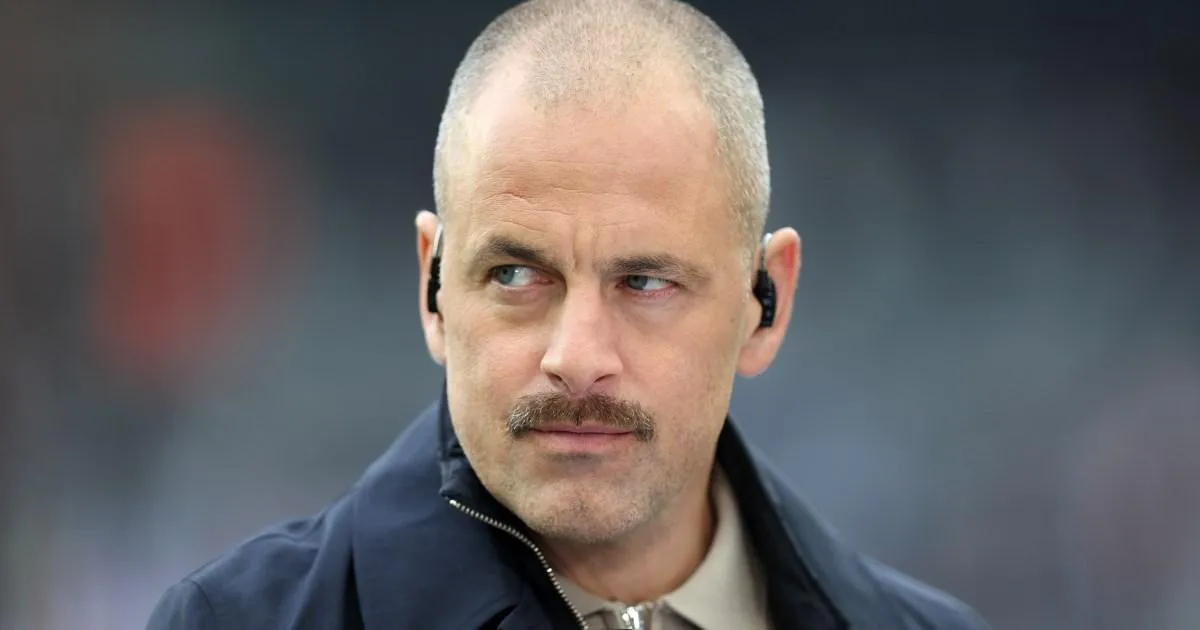
Osman and co-host, journalist Marina Hyde, were joined by former Celebrity Traitors finalist Joe Marler, who when speaking about the advice he would give new contestants, said: “What is it, September 23, the next series?”
Osman responded: “By the way, to point out, it’s absolutely embargoed that it starts on September 23 … let’s talk about what we call the events of September 23 this year … the cat’s out of the bag isn’t it? Not to repeat it.”
If you’ve listened to the podcast and are familiar with Joe Marler’s impish nature, you could take the conversation as very tongue-in-cheek.
Havertz helped Arsenal maintain their perfect start to the new season by scoring the equaliser in a 2-1 win at the Emirates Stadium.
Chelsea summer signing and ex-Arsenal transfer target Morgan Rogers gave the visitors the lead inside two minutes but Havertz equalised midway through the first half.
In-form Martin Odegaard put Arsenal ahead just after half-time and the captain’s goal proved to be the winner as Chelsea failed to score an equaliser of their own.
Advertisement
Exclusive Premier League previews
Get ahead of the start of the season with our weekly football newsletter. Sign up now for free.
The result means only Arsenal and Manchester City have taken a maximum nine points from their first three games, while Chelsea stay fourth with six.
But Havertz is now Arsenal’s first-choice striker – ahead of £64m signing Viktor Gyokeres – and produced another influential performance in Sunday’s win over Chelsea.
Chelsea sold Kai Havertz to Arsenal in 2023 (Picture: Getty)
‘I think if you’ve got Kai Havertz at your club you’re watching him every day, week in, week out,’ Cole said on Premier League Productions.
‘Coaches and managers come and go, but the Directors of Football? Look at the amount of money on centre-forwards the club has spent since they him go out the door.
Ask Metro
Advertisement
Use AI to go deeper into the stories you care about – powered by Metro and trusted publications.
‘It’s just not good enough; I think it’s got to stop happening. It happened with Kevin De Bruyne [leaving]; it happened with Kai Havertz.
Arsenal beat London rivals Chelsea (Picture: Getty)
‘Those kind of deals never happened at Manchester United with Sir Alex Ferguson, or with Arsene Wenger at Arsenal.
‘When did you hear of them letting go of a player who went on to become world class at one of your rivals?’
Advertisement
Odegaard heaped praise on Havertz, who also played a role in Arsenal’s winner, after the 2-1 win over Chelsea.
‘He’s a really smart player,’ the Arsenal skipper said. ‘He moves so well and takes a lot of attention from the defenders and it was a brilliant goal.’
Gunners boss Mikel Arteta, meanwhile, said of Havertz: ‘He looks happy. He looks settled, happy, and some great things have happened in his personal life as well.
‘He feels fit, he’s training every day and has this routine right now. He’s scoring goals, but not only that – he’s also doing amazing work for the team.’
Speaking after Arsenal beat his former club Chelsea, Havertz said: ‘It’s always nice to win at home against a London rival. It was a tough game but over the 90 minutes, we deserved to win that game.
‘They have strong players. They have an amazing squad but so do we. We knew it was going to be tough and it’s going to be a tight game.
‘They scored early, so it’s not easy for us but we believed in ourselves and changed the game around.’
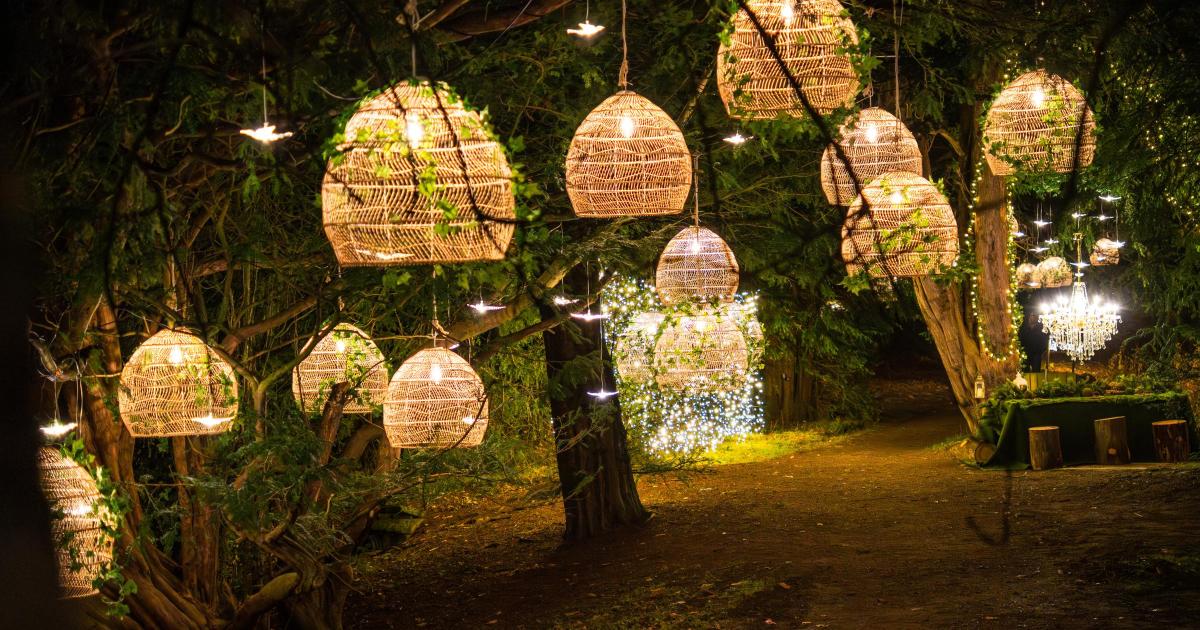
Swinton Park Hotel, near Ripon, will host the Luminescence winter light trail for a second year, transforming its 200-acre grounds into a glowing night-time experience.
The immersive event features illuminated displays, elemental landscapes, and magical realms designed to captivate visitors of all ages.
Felicity Cunliffe-Lister, the co-owner of Swinton Estate and the architect behind the Luminesce Trail, said: “We welcomed over 8000 guests last year during our first season and this year promises even more than before for guests staying on the Estate or visiting for the day. This brings the dark winters evenings to life – we’re really looking forward to it.”
RECOMMENDED READING:
Advertisement
This is the second year for the event. (Image: Pic supplied)
The trail will run from October 31, 2026, to February 21, 2027, and will be open every Saturday and Sunday, as well as daily during the Christmas and February school holidays.
Additional dates in December will also be available to meet demand.
Luminescence has expanded this year to include 11 new attractions, and the lakeside firepit seating area has doubled in size.
The first such event was last year. (Image: Pic supplied)
Visitors can explore scenes such as the Birdcage Walk, featuring 100 illuminated birdcages accompanied by birdsong, and A Night at the Oscars, complete with chandeliers and a touch of Hollywood glamour.
Advertisement
The experience is designed for families and includes playful, interactive elements such as a glowing wishing tree and an installation called the End of the Rainbow.
Guests can toast marshmallows by the fire and enjoy hot chocolate, with mulled wine available for adults.
Swinton Park Hotel is offering extended experiences, including cream tea, lunch, dinner, or drinks either in the castle or at The Terrace in the Swinton Country Club.
There will be a mile long trail of light installations. (Image: Pic supplied)
Tickets are priced at £19 for adults and £11 for children during peak periods, with off-peak tickets costing £17 for adults and £7.50 for children.
Advertisement
Admission is free for children under five.
Dogs are welcome on the trail but must be kept on leads.
Swinton Estate has partnered with Access the Dales to offer two tramper wheelchairs for disabled visitors.
These need to be booked in advance, via their website, to ensure availability alongside an accessible ticket to the trail, and are provided free of charge.
Advertisement
Something to look forward to on the darker nights. (Image: Pic supplied)
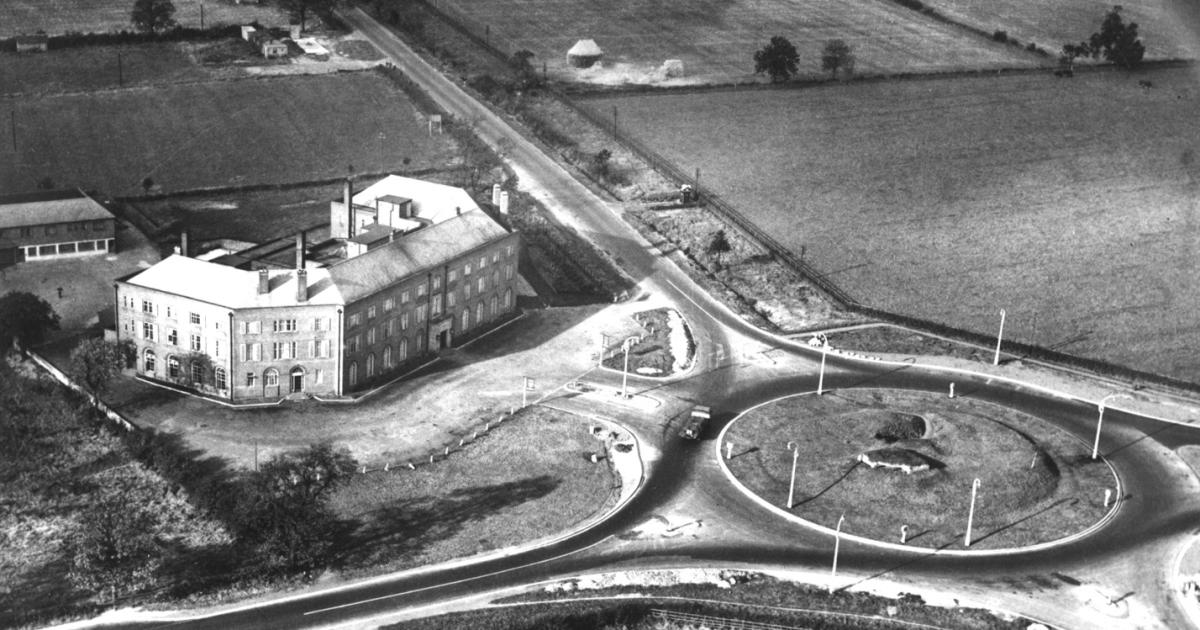
The remarkable discoveries were made during work to upgrade the A1 between Leeming Bar and Barton, which eventually transformed the road into the A1(M).
As construction work progressed, teams of archaeologists were given an opportunity to investigate land surrounding the route between North Yorkshire and County Durham.
What they found at Scotch Corner changed understanding of the Roman occupation of northern England.
Archaeologists discovered the remains of a major settlement which Historic England says pre-dated Roman settlements at York and Carlisle by around ten years.
Advertisement
The settlement was also enormous by the standards of Roman northern England.
It stretched for around 1.4km from north to south – roughly equivalent to placing 13 football pitches end-to-end.
Evidence suggests it was occupied for a relatively short period, perhaps only 20 to 30 years, before activity shifted further south towards Catterick.
NEW TREASURES: A Samian cup and decorated bowl found at the Scotch Corner Roman site during the roadworks. Picture courtesy of Northern Archaeological Associates
But during that time, the people living at Scotch Corner appear to have had access to remarkable wealth and goods arriving from across the Roman world.
Advertisement
Among the most extraordinary finds was a small figure of a toga-clad actor carved from amber.
The object is believed to have been made in Italy during the first century AD and Historic England said nothing like it had previously been found in Britain.
A similar example had been discovered at Pompeii.
Its presence in North Yorkshire suggested the settlement’s inhabitants had connections stretching hundreds of miles across the Roman Empire.
Advertisement
It was far from the only unusual discovery.
Roadworks on the A1(M) at Scotch Corner
Archaeologists also found evidence of workshops where gold, silver and copper coins were being produced.
Historic England described the workshops as the most northerly example of coin production then known anywhere in Europe.
Brooches, gaming counters and other high-status objects were among the thousands of finds recovered during archaeological work associated with the road scheme.
Advertisement
The discoveries indicated Scotch Corner was not simply a collection of homes beside an ancient road.
Instead, it appears to have been an important industrial and trading settlement sitting at a strategically significant junction.
An old road sign for Scotch Corner
That should perhaps sound familiar to modern motorists.
Scotch Corner remains one of the North’s most important crossroads today.
Advertisement
The A1(M) carries drivers north towards County Durham, Newcastle and Scotland or south towards Yorkshire, while the A66 heads west across the Pennines towards Cumbria and the M6.
Nearly 2,000 years ago, major routes were already converging in the same area.
Dere Street, one of the principal Roman roads running north through Britain, passed nearby, while another route headed west towards Bowes, Brough and eventually Carlisle.
The modern road scheme which uncovered the remains was the £380m upgrade of the A1 between Leeming and Barton.
Advertisement
Excavations began in 2014, with around 60 archaeologists involved in investigating sites along the route.
FIRST PUB: The Three Tuns at Scotch Corner, complete with stone mounting steps, which was demolished in 1939 so that the Roman road could be widened
The wider project uncovered thousands of objects from several periods of history, including well-preserved Roman shoes and keys around Catterick.
Archaeological evidence around Catterick has long shown it developed into an important Roman centre known as Cataractonium, with a fort guarding the River Swale crossing and a substantial civilian settlement alongside Dere Street.
But the discoveries at Scotch Corner suggested an important centre had existed further north even earlier.
Advertisement
Historic England said its existence meant Roman expansion into northern England may have happened around a decade earlier than previously believed.
The settlement appears eventually to have declined as Roman activity moved northwards and Catterick grew into a major administrative and economic centre.
Dr Jonathan Shipley, who worked on the archaeological programme, later said the discoveries showed that Scotch Corner had been the site of a much older junction long before the modern road network appeared.
Evidence from the area also included activity dating to the Iron Age and indications of interaction between local communities and the arriving Roman world.
Advertisement
Today there is little from the motorway itself to suggest just how much history was discovered beneath and alongside it.
Drivers still approach Scotch Corner to decide whether to continue north or turn west.
But archaeological work has shown people were travelling, trading and meeting at almost the same strategic location around two millennia before the A1(M) existed.
The three-month-old was on a family camping trip when tragedy struck
Christopher Mallett and Adam Care
18:07, 06 Sep 2026Updated 18:30, 06 Sep 2026
A baby who died in woodland yesterday was a three-month-old on a camping trip with her family, police have confirmed.
Yesterday at 8.45am emergency services rushed to Strawberry Lane, Great Wyrley, in Staffordshire, after receiving reports of a child in cardiac arrest. The girl was pronounced dead by paramedics a short time later.
Advertisement
Detectives say their investigation into the “unexplained” death is in the early stages but that it was an “isolated incident”.
Detective Inspector Katie Gregory said: “While the investigation remains at an early stage, this is an isolated incident and we understand that the child’s family was camping in the area. The death is being treated as unexplained at this time.”
A fishing lake in the Wyrley and Essington Branch Canal Local Nature Reserve was cordoned off by police.
Drone images from the scene show at least four tents and camping chairs positioned close to fishing platforms.
Cheslyn Hay district councillor Robert Duncan said: “I know how deeply upsetting news like this is for our community.
“It’s important that we allow the emergency services the space they need to complete their work with dignity and care.
Advertisement
“As soon as the full and confirmed details are formally shared with me, I will provide a further update to residents.
“Until then, please avoid speculation and allow the family and responders the privacy and respect they deserve.”
Ensure our latest stories always appear at the top of your Google Search by making us a Preferred Source. Click here to activate or add us as your Preferred Source in your Google search settings.
Coun Sonia Simm said teachers and staff were having to spend time that should be spent in the classroom changing nappies and teaching youngsters to use the toilet.
Earlier this year, The Guardian reported that around one in four children across the country who started reception in 2025 were not toilet trained following a survey of school staff by charity Kindred Squared.
The survey also showed that 28 per cent of children were unable to eat and drink independently and a quarter were struggling with other basic life skills.
Advertisement
Speaking at Thursday’s meeting of Northumberland County Council’s Family and Children’s Services scrutiny committee, Ashington councillor Sonia Simm said parents needed to step up.
She said: “I find in a number of schools that children are going into early years and they’re not toilet trained, they’re in nappies. We have children who are six or seven struggling to go – parents need to be taking accountability for their children.
“When my oldest child went to school, children weren’t allowed in until they knew how. They weren’t allowed in if they didn’t know how.
“There’s too much blame on Covid saying Covid delayed things. Covid didn’t stop parents teaching children to use the toilet.
Advertisement
“A lot of school teachers’ time is taken up toilet training and changing nappies. That’s not what they’re there for.
“Parents need to be more accountable.”
The Government has set a target of 75 per cent of children starting school to be “school ready” by 2028. As part of this, councils are required to develop their own “best start” local plans to show how they will meet this target.
Northumberland was a trailblazer for the Family Hub system – successors to the Sure Start Centres that provide support for families and children from conception up until the young person is 18, or 25 if they have additional needs.
Advertisement
The hubs are intended to act as the front door for families, bringing together universal, targeted and specialist services in a “single, accessible model” that help to “identify needs earlier and provide coordinated support before challenges escalate”.
Responding to Coun Simm’s comments, cabinet member for children’s services Coun Guy Renner-Thompson said: “Teachers shouldn’t have to be social workers or surrogate parents, but there are parents that need help to make sure teachers don’t have to pick up the slack later on.
“We want children to spend their time in the classroom learning. The whole ethos of the family hubs is to be a broader umbrella so include NHS, include social care and start at conception all the way through to the age of 18.
“I have a one-year-old and we’re about to have another baby. We go to the family hub in Alnwick and it’s wonderful to see the services in action.
Advertisement
“That’s the whole ethos of the family hub – to make sure those scenarios that Sonia has brought up don’t happen.”
Director of Education, SEND and Skills David Street added: “The vast majority of children in Northumberland are able to go to the toilet.”
Emergency services were called to Possilpark after the alarm was raised at around 5pm on Sunday, September 6.
18:12, 06 Sep 2026Updated 20:31, 06 Sep 2026
Huge fire breaks out at flats in Glasgow’s Possilpark
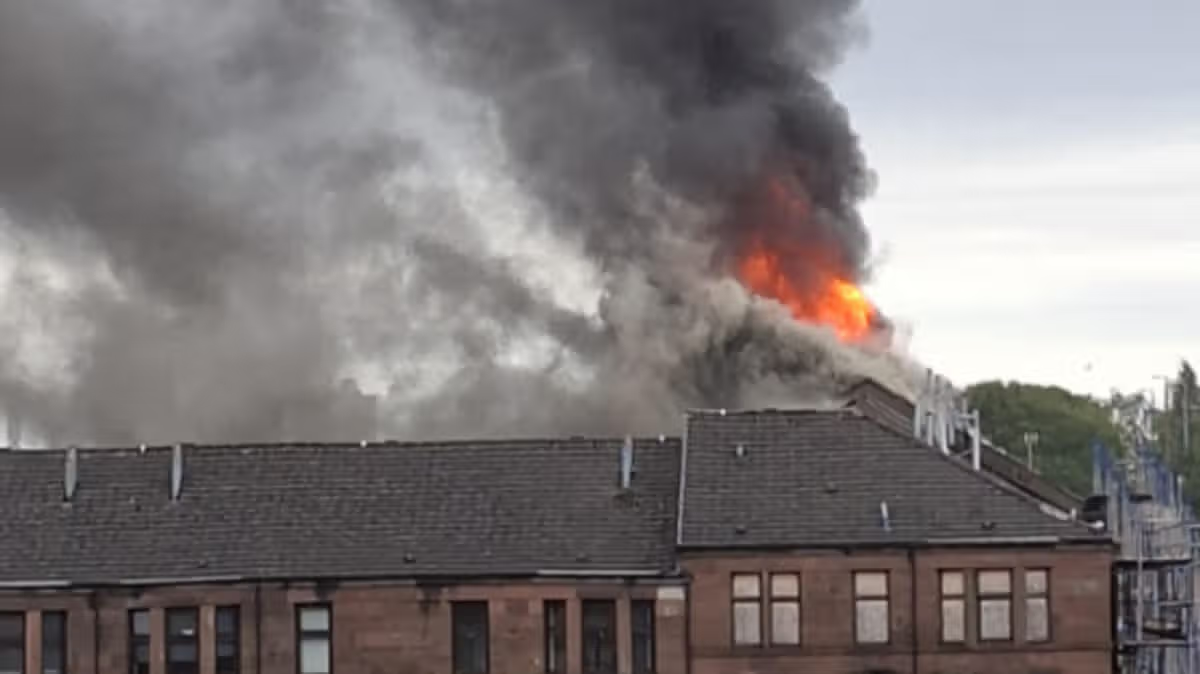
A huge fire has broken out at a tenement block of flats in Glasgow.
Emergency services were called to the Stonyhurst Street area in Possilpark, at Barloch Street, after the alarm was raised shortly before 5pm on Sunday, September 6. Footage taken from the scene showed flames ripping through the roof of a property on the street.
Advertisement
A plume of black smoke could be seen billowing up into the sky as firefighters raced to the scene to battle the inferno. It’s understood the flats affected were being renovated and are currently empty.
Locals have told how the fire appeared to be serious as flames quickly spread. One resident said: “The flats on Stonyhurst Street which were being refurbished are on fire. The fire looks serious as flames are soaring through the roof.”
MSP Paul Sweeney blamed misinformation about the development of the flats, and said rumours the flats were to be used for asylum seekers, refugees or asylum seekers were untrue. He branded the situation ‘depressing’.
In a post on social media he said: “This is completely outrageous. After 20 years of these tenements sitting derelict, finally after much work by myself and other elected representatives, we secured nearly £3million is government investment to bring these tenements back and rennovate them so they can be used by the community in a city with a housing emergency.
Advertisement
“This block here will be used for housing those on the NG homes housing waiting list which is massively oversubscribed.
“It was never going to illegal immigrants, refugees, asylum seekers – it was never intended for that purpose at all.
“So anyone claiming that was spreading lies and misinformation to generate clicks on social media, to whip up the community, wind people up, and this is the upshot of that.”
He added: “I think it’s absolutely disgraceful. And I hope that people will stop and take stock of what’s happening here before this gets even further out of control.”
Advertisement
A Scottish Fire and Rescue Service spokesperson said: “We were alerted at 4.48pm on Sunday, September 6, to reports of a dwelling fire on Barloch Street, Glasgow.
“Operations Control mobilised six appliances and specialist resources to the scene, where firefighters are working to extinguish a fire affecting the fourth floor of a tenement building. Crews remain in attendance.”
Advertisement
Police Scotland have been contacted by the Record for comment.
Get more Daily Record exclusives by signing up for free to Google’s preferred sources. Click HERE.
A father who has spent 20 years in prison serving an indefinite sentence over stealing a mobile phone is to be released – but his family say his life has been ‘stolen’ from him.
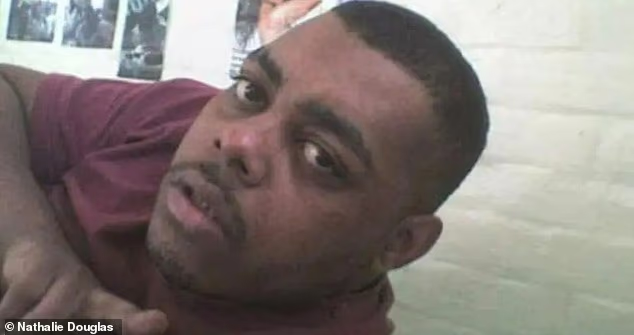
Leroy Douglas, 45, was one of five prisoners whose cases were examined by the UN, which found that keeping them in jail amounted to arbitrary detention under international law.
Despite completing the minimum term of two and a half years set by the court in 2005, Leroy remains behind bars under the controversial Imprisonment for Public Protection (IPP) system.
His release next month comes amid growing pressure to scrap IPP sentences, with Prime Minister Andy Burnham vowing to end them before the current Parliament concludes.
Advertisement
For Leroy’s family, however, the developments have come after two decades of waiting – with the father missing out on multiple life events, including the passing of his teenage daughter.
‘It’s like they’ve just locked him up and thrown the key away, and just forgotten about him,’ his sister Nathalie Douglas told the Daily Mail.
‘His life has been stolen from him, just for stealing a mobile phone.’
She continued: ‘He has been in for so long. It’s just been horrible not having my brother, and growing up together, isn’t it? And my mum not having her son there. All my family missed him.
Advertisement
Leroy Douglas (pictured) has spent 20 years in prison serving an indefinite sentence over stealing a Nokia mobile phone
‘I know it was wrong for him to steal, but taking a Nokia phone? He never used any violence.
‘But, I know that’s not an excuse. I know this, but he just took a Nokia phone and 20 years for a phone – that’s barbaric. That’s crazy.’
Advertisement
Leroy spent time in HMP Stocken in Stretton, Rutland, and now waits in HMP Erlestoke, in Wiltshire, before he is to be transferred to a hostel in October – which is hours away from his family.
Among the many milestones he has missed in prison was the devastating passing of one of his daughters, who died at the age of 19.
‘He has two daughters. One passed away when she was 19,’ Nathalie said. ‘My brother hasn’t been able to even grieve for her.’
Leroy was convicted for crimes including shoplifting as a teenager and young man. He was then sentenced for stealing a mobile phone from his cousin’s boyfriend, while addicted to drugs.
Advertisement
Instead of a fixed term two and a half year custody sentence, Leroy was sentenced under the IPP system – introduced in 2005 for offenders considered dangerous but whose crimes were not serious enough to warrant a life sentence.
Although prisoners were given a minimum length of time, completing it did not automatically result in release.
They could remain in prison indefinitely until the Parole Board was satisfied that it was safe for them to return to the community. This process includes a review at least once every two years.
Leroy’s sister Nathalie (pictured) has said the UK’s justice system has ‘locked [her brother] up and just thrown away the key’
Advertisement
The system was abolished for new cases in 2012, but not retrospectively, leaving thousands of prisoners subject to sentences which could continue long after their minimum tariffs had expired – as with Leroy.
‘Even though he’s coming home. He’s not coming home, really, is he? Because he’s still in the system, you know,’ Nathalie said.
‘He did commit petty theft, but that’s not worthy of 20 years behind bars.
‘He stole from cars, like smashing windows, but nothing like violent. He hasn’t got one violent bone in his body.
Advertisement
‘He’s been cheeky with officers in prison but his behaviour has been good. He hasn’t had any fights.’
Leroy’s release is prefaced with a series of conditions, including abiding by a curfew, being monitored with a GPS tag and being tested for drugs.
His case has gained renewed attention because of the wider political debate over the future of IPP prisoners and the Government’s controversial early prison release scheme.
Leroy is pictured with his sister Nathalie as children
But Leroy’s family have condemned the timing of the scheme, with the aim to combat prison overcrowding, which plans to release prisoners early while their loved one has remained behind bars for decades.
Notably, ministers are finding extra cell spaces by releasing inmates serving IPPs. This move has been criticised over the argument many IPP prisoners have been assessed as too dangerous to release.
‘They’re releasing people early now,’ Nathalie said. ‘And yes, my brother should have been one of the first ones, I think, to be released.’
Advertisement
She believes Leroy could have been released years ago.
‘He’s fit for release. He was fit for release a long time ago, so I don’t understand why they’ve kept him in so long,’ Nathalie said.
‘It make me feel very angry because for 20 whole years, he’s been locked up in jail when he should have been out a very long time ago for stealing a mobile phone.’
The UN ruling has piled fresh pressure on the Government and provided a major boost to the families’ long-running fight for justice.
Advertisement
In a damning opinion, the UN Working Group on Arbitrary Detention concluded the prisoners had been detained arbitrarily and urged Britain to take immediate steps to remedy their situation.
For Nathalie, the finding was a watershed moment, publicly validating what her family had insisted for years.
Asked about the UN’s conclusion, she recalled her reaction: ‘Oh, terrible!’
The ruling, she said, finally put an international stamp on concerns the family had been voicing for years.
Advertisement
‘You know, and it made us feel like we are like fighting a losing battle because they’re always gonna win, isn’t it? What can we do?
‘But we knew it was wrong anyway, but what could we do? I’m glad that it is finally out in the public and they’ve admitted that it is wrong.’
The issue is no longer confined to individual cases. The Government has now committed itself to ending the use of IPP sentences and addressing their continuing consequences.
Campaigners have welcomed the announcement, although they have stressed that legislation alone will not undo the damage caused by years spent in prison or on indefinite licences.
Advertisement
More than 2,000 people remain affected by the legacy of the system, including prisoners still in custody and those released but subject to IPP licences – strict probation rules.
For Leroy, the immediate consequence of the developments is that he will finally be able to leave prison after two decades.
Nathalie said her mother was desperate to have her son home after years of being separated from him.
‘My mum is fine, but she just can’t wait to have him home,’ she said.
Advertisement
‘Obviously, it’s been horrendous, you know, not being able to like see her then every day. It’s been terrible for her.’
Leroy is set to move into a hostel for former prisoners next month, where he could remain for up to two years while he adjusts to life outside prison.
‘He haven’t stepped foot outside for 20 years, so I can imagine like he’s feeling a bit overwhelmed himself,’ Nathalie said.
She said the family would simply be there for him and take things slowly. ‘Just go with the flow and just see what happens,’ she said.
Advertisement
The question now facing the Government is what happens to prisoners like Leroy who have already spent years beyond their minimum tariffs.
Mr Burnham has said that people who have served their time should be considered for release rather than remaining in prison simply because of the legacy of an abolished sentencing system.
He has pledged to bring forward legislation to end the injustice of IPPs before the end of Parliament.
For Leroy’s family, however, the political debate is secondary to the fact that after 20 years, he is finally coming home.
Advertisement
Reflecting on what she believes her brother would have done should he not be behind bars, Nathalie said: ‘He would have settled down with children, and maybe have set up his own business.
‘His life has really been ruined. It’s been stolen away.’
After years of uncertainty, his family finally know that the prison sentence is coming to an end.
Lord Chancellor and Justice Secretary Alex Norris said: ‘There are individuals who have served many years beyond their original tariff and we need to look carefully at how they can progress safely through the system.
Advertisement
‘We are already increasing the frequency of Parole Board reviews and looking at what additional support is needed to help suitable prisoners prepare for release.
‘We’re going to take a cross-party approach to this issue, these are complex cases, involving important public protection and victim considerations.’
Do you have a story? Email isabella.machin@dailymail.co.uk
It was around seven o’clock in the evening when we arrived at a church in the city of Hama, Syria, to attend the wedding of a friend. As guests gradually filled the courtyard, music began to echo through the building. One by one, the bride, groom, and their relatives entered the church accompanied by songs, applause and cheers.
After the religious ceremony concluded, groups of young men and women began performing Ewiha, a traditional wedding chant in Syria and the Levant. Their voices rose and fell in a rhythmic dialogue as verses praising the bride and groom were answered by equally poetic responses from across the room.
Each verse concluded with a joyful zalghouta – the high-pitched ululation that has accompanied celebrations across the Arab world for generations.
Inside the church in Hama for the wedding. Osman Bahadir Dincer
At first glance, there was nothing extraordinary about the wedding. Yet after more than a decade of war, the celebration felt like something more than a family gathering. It offered a powerful reminder that cultural traditions, social bonds, and everyday celebrations continue to endure, and that Syrians are trying to rebuild ordinary lives amid an uncertain transition.
Advertisement
But we were not in Syria to attend a wedding. As peace and conflict researchers, the three of us have long worked on questions of displacement, refugee return and post-conflict recovery; combining research on Syria with broader comparative perspective.
For this particular field trip, two of us, Bahadir and Zeynep, had spent the previous week travelling across Damascus, Rural Damascus, Aleppo and Raqqa observing firsthand how Syrians are navigating the country’s transition.
The journey, from June 1 to June 7, 2026, was part of a broader research programme that has involved more than 200 interviews over the past two years with Syrian returnees, internally displaced people, local officials, humanitarian workers and civil society representatives. These conversations, together with our wider research, have informed a series of peer-reviewed publications and policy reports on refugee return and reconstruction.
The Insights section is committed to high-quality longform journalism. Our editors work with academics from many different backgrounds who are tackling a wide range of societal and scientific challenges.
Advertisement
For years, researchers had studied Syria from afar, unable to conduct fieldwork across government-controlled areas during the Assad era. Although we made several short visits to Damascus after the regime’s collapse, this was our first opportunity to travel across the country and observe firsthand how people were rebuilding their lives – and how Syria’s transition was unfolding beyond the headlines.
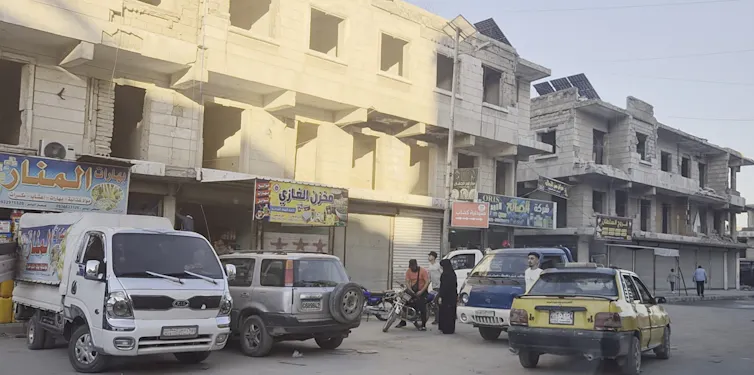
We encountered destroyed neighbourhoods standing alongside reopened shops. Abandoned industrial sites and damaged infrastructure coexisted with busy cafes and crowded restaurants. Communities continued to struggle with unemployment, rising prices and unreliable electricity while many people nevertheless spoke cautiously of hope and new beginnings.
The contrast captured something important about Syria today: hope and hardship coexist. So do recovery and destruction.
Advertisement
Between recovery and ruin
The scale of the challenge remains immense. More than 90% of Syrians live below the poverty line, and nearly 16.5 million people in Syria need humanitarian aid, alongside 2.5 million returnees.
Almost a quarter of the country’s housing stock has been damaged or destroyed, and reconstruction costs are estimated by the World Bank to exceed US$200 billion (around £150bn). Yet international support remains far below what is needed: as of mid-2025, the UN’s humanitarian response plan had received only a small fraction (14 %) of its required funding.
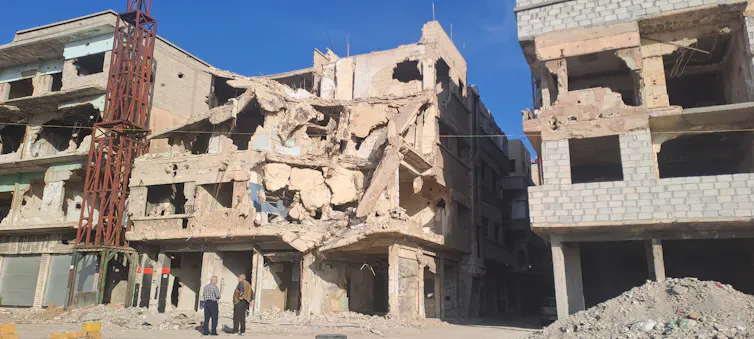
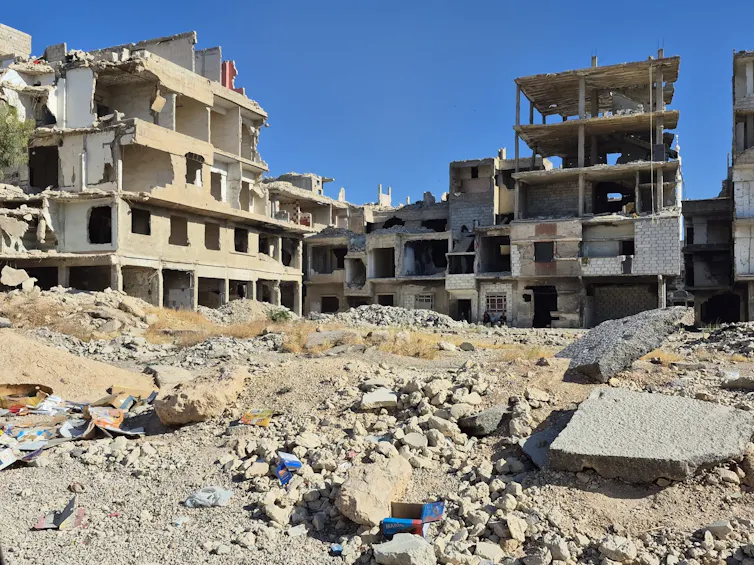
Two men talk in a devastated part of Yarmouk. Osman Bahadir Dincer
Food insecurity affects millions of people, while years of conflict have severely weakened the country’s productive capacity.
These figures help explain the scale of Syria’s crisis, but they reveal little about how it is experienced in everyday life. That became much clearer during our journey: in conversations over tea, on long drives between cities, while walking through damaged neighbourhoods, and in discussions with residents, civil society representatives, local officials and business owners. Across these encounters, one impression emerged again and again.
Many Syrians welcomed the political changes, but few believed that political change alone would improve their lives. Economic concerns dominated almost every conversation.
Advertisement
Basic infrastructure remains under severe strain, with large parts of the country’s electricity, water and sanitation networks still non-functional. More than two million children remain out of school, while a shortage of teachers continues to undermine the education system.
Yet the challenges facing Syria are not distributed evenly.
What struck us most was how fragmented people’s experiences of the war had become. The contrast between affluent neighbourhoods such as Abu Rummaneh and heavily damaged areas like Jobar in Damascus could hardly be greater. The availability of basic services and living standards vary dramatically across regions, cities and even neighbourhoods. In Abu Rummaneh, restaurants are full, cafés are crowded and daily life appears relatively stable. Nevertheless, as one local resident told us:
“We sit on the ashes, and everything remains extremely fragile.”
Elsewhere in Damascus, entire districts still bear the scars of war. We were struck by how many residents had not visited Jobar since the fall of the Assad regime, despite living only a few kilometres away.
Advertisement
For many, the district remained a place known through photographs rather than personal experience. We were equally surprised to find that many humanitarian workers, NGO staff and policy professionals based in Damascus rarely ventured beyond the city’s central neighbourhoods. In many ways, Jobar felt as distant to them as it did to visitors from abroad.
These uneven realities are further complicated by the ongoing return of displaced Syrians. During a brief break between meetings, the Syria country director of one of the largest humanitarian organisations operating across the country welcomed us into her office.
As we cooled down with glasses of water and cups of coffee, after walking through the summer heat of Damascus, our conversation turned to the growing pressures facing Syria’s cities. “Returns to cities lead to rising prices, higher utility costs, more expensive housing and additional pressure on already scarce services”, she explained. For many returnees, settling in the capital is currently more feasible than returning to their original communities.
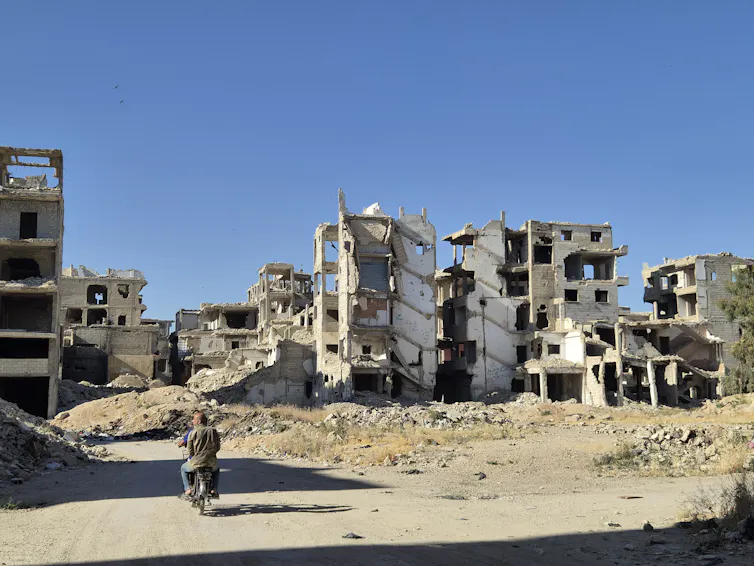
Travelling through Jobar, Damascus. Osman Bahadir Dincer
The individual stories reveal what return looks like in practice. For example, Ahmad, our local research assistant, returned from Turkey to Damascus immediately after the fall of the Assad regime, even though his hometown is Raqqa. Unable to find suitable employment there, he now works as a sports trainer at a youth centre in Damascus. Despite earning an income, he cannot afford to rent an apartment and instead lives in a room within the sports complex.
We heard a similar story from a taxi driver in Damascus who had returned from Turkey five years earlier after years of displacement. Originally from Idlib, he picked us up outside our hotel and, as we crawled through Damascus traffic, told us that despite holding a university degree, driving his ageing taxi was the only steady work he had been able to find.
Advertisement
“This taxi is my only reliable source of income,” he said, tapping the dashboard. “It constantly needs repairs, but without it, I wouldn’t be able to support myself.”
By the time he dropped us off in Bab Touma, our short journey had become another reminder that returning home is only the first step toward rebuilding a life.
On the road across Syria
Our journey towards Rural Damascus, Aleppo, Raqqa and Hama began at 7:30 on a warm Damascus morning, when Ahmed – our driver, research assistant and guide for the days ahead – picked us up from our hotel. Although the city was only beginning to wake up, the summer heat was already building. Before continuing towards rural Damascus, we asked Ahmed to take a short detour through Jobar and Yarmouk.
Jobar, once one of the fiercest frontlines between government forces and rebel factions from 2013 to 2018, remains perhaps the most heavily damaged district of the capital. Entire blocks have been reduced to rubble.
Advertisement
As we walked through the shattered streets, Mohammed, a young activist who had recently returned to Syria and now worked in a local government office, reflected on what the neighbourhood had endured.
“Even though Jobar has always been part of Damascus, it was forgotten during the war and remained forgotten afterwards,” he told us. Gesturing towards the collapsed buildings around us, he continued:
“Since the fall of the regime, most of what you see has been done by people who have returned. They are clearing the rubble, repairing what they can and trying to rebuild their lives. But many Damascenes still haven’t set foot here. Jobar cannot truly recover unless the rest of Damascus comes back too – not only to rebuild it, but to see it, remember it and make it part of the city again.”
Yarmouk, once the largest Palestinian refugee camp in Syria, presents a similarly sobering picture. While a small number of homes have been partially repaired, much of the neighbourhood remains scarred by destruction.
As we walked through the area, we noticed an elderly couple sitting quietly on plastic chairs outside one of the few inhabited houses, surrounded by rubble and the remnants of damaged buildings. They appeared to be watching the street – or what remained of it.
Advertisement
Two Yarmouk residents sitting on chairs maid ruins. Zeynep Sahin-Mencütek
The scene captured the contradictions of post-war Syria: life has returned, but often under conditions that would be difficult to imagine from a distance. For many residents, rebuilding has meant learning to live alongside the ruins rather than beyond them.
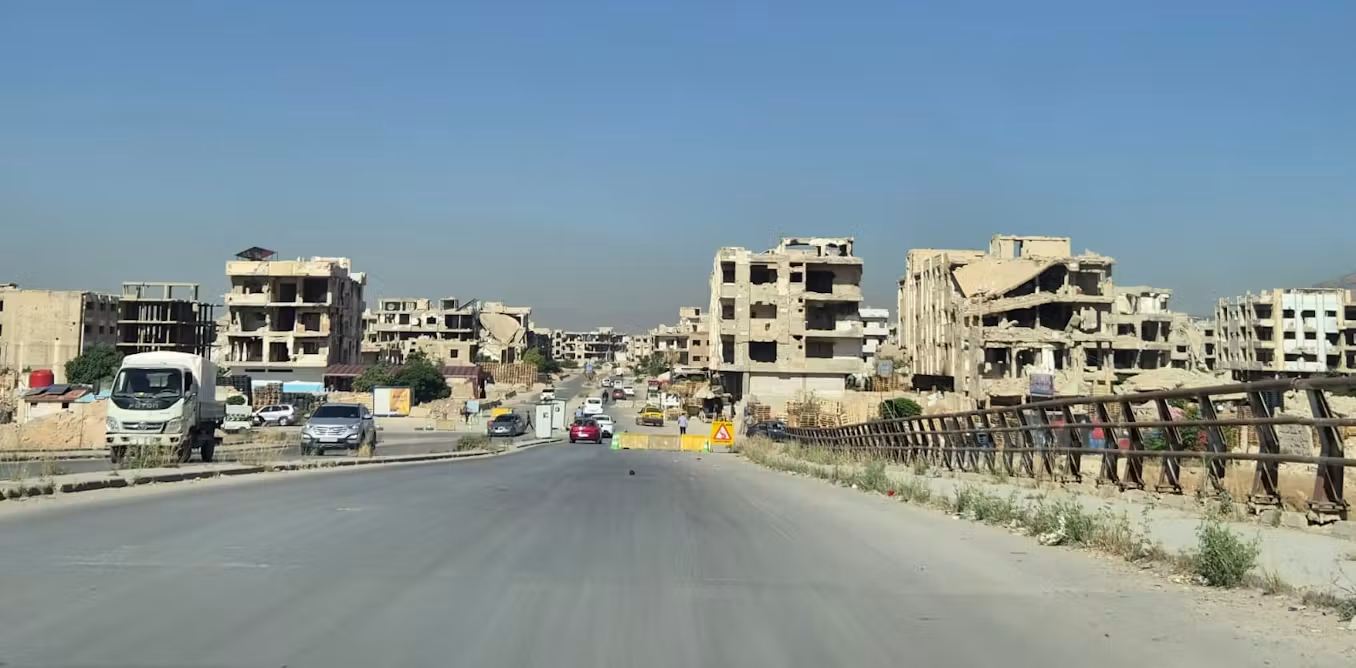
Travelling further into Eastern Ghouta and Harasta offers another stark reminder of the scale of destruction that still shapes much of the country.
Entering Ghouta. Osman Bahadir Dincer
Yet what is striking is not only the destruction, but the coexistence of destruction and recovery.
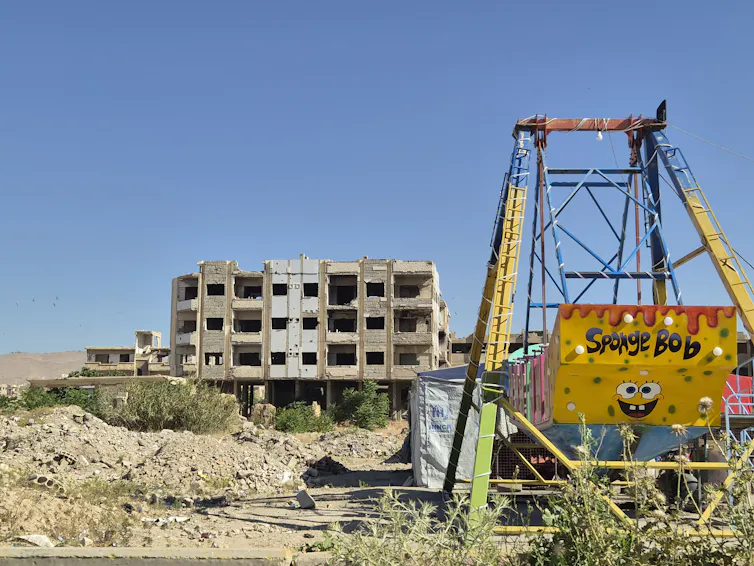
Beside a ruined apartment block, a small shop may have reopened to sell bread or construction materials. On streets where fighting once took place, children play or collect scrap to sell, while a father, mother and children ride together on a single motorcycle. Life is returning, often much faster than reconstruction. Small shops and derelict children’s playgrounds can be seen amid the war-damaged buildings.
A derelict playground. Osman Bahadir Dincer
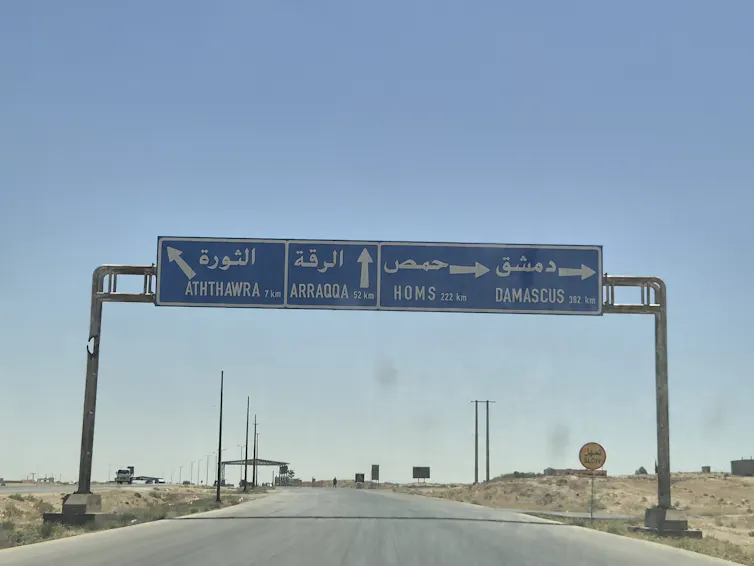
After this brief but sobering visit to Rural Damascus, we set off for Aleppo. The journey itself proved almost as revealing as the cities themselves. Along the M5 highway, abandoned buildings, depopulated settlements and damaged industrial facilities stand as reminders of the conflict’s enduring legacy.
Yet signs of recovery appeared just as frequently: roadside fruit vendors selling seasonal produce, families stopping at newly reopened shops and a steady stream of traffic where ageing vehicles now shared the road with new cars. Ahmed smiled as he pointed to several recently imported SUVs passing us. “Before 2025,” he said, “you almost never saw new cars on Syrian roads. They’ve only started appearing recently.”
Near Hama, we stopped at a large roadside supermarket. Workers stocked shelves while families shopped for groceries. Ahmed insisted that we try a local milk-based dessert, a small gesture of hospitality that would be repeated throughout our journey. Such moments served as reminders that alongside destruction and hardship, everyday life and customs continue.
Advertisement
Aleppo: a broken city
The last time we had travelled through Aleppo countryside was in 2013. More than a decade later, we found ourselves approaching the city with a mixture of curiosity, anticipation and unease. We did not know what awaited us.
For years, Aleppo had existed for us through news reports, and the testimonies of those who had fled. The prospect of finally seeing, with our own eyes, a city that had occupied so much of our research and conversations over the years was both exciting and deeply humbling.
The city that greeted us reflected both its long history and the profound transformations brought about by the conflict. After checking into our hotel in the Aziziyeh district, we wasted little time before heading straight to the Old City. For years, we had heard about the devastation that had befallen Aleppo’s historic heart.
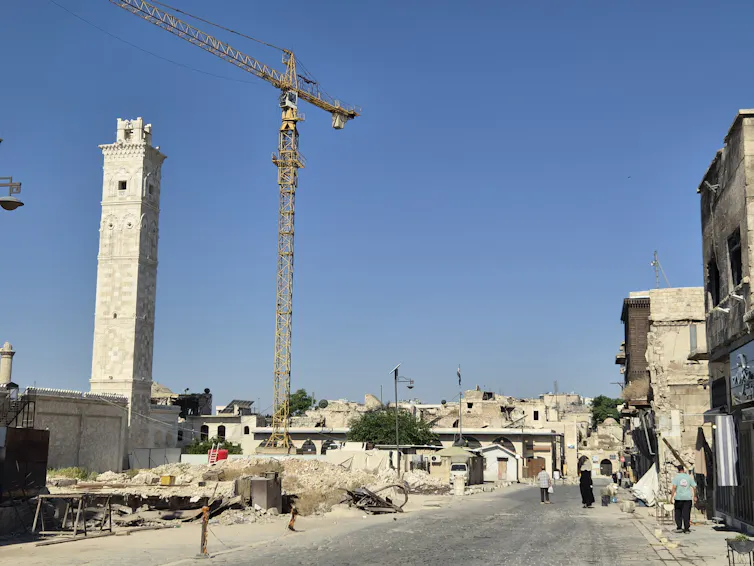
Walking through its narrow streets, it was difficult not to imagine the vibrant markets, workshops and cafés that had once animated these neighbourhoods. Although restoration has brought parts of the old souq and several historic landmarks back to life, large sections of the Old City remain scarred by war, making it impossible to ignore the scale of what Aleppo has lost.
Advertisement
A part of the Old City in Aleppo. Osman Bahadir Dincer
Together with Amr, an Aleppo native who guided us through the city, we spent hours walking through some of the hardest-hit districts, including parts of the Old City, Shaar, Hanano, Karm al-Jabal and Qadi Askar.
The scenes were overwhelming. Destroyed apartment blocks, mountains of rubble and damaged infrastructure remain an integral part of the urban landscape. Walking through the crowded streets with Amr, he pointed to a recently cleared road. “Many of the people returning to Syria are coming back to Aleppo,” he told us. “Many of these streets were blocked by rubble. People cleared them themselves. Otherwise, they couldn’t even get to their homes.”
We also visited Sheikh Maqsoud and Ashrafiyah following the political and military changes that took place earlier this year. Aleppo felt neither fully recovered nor frozen in the past.
As evening fell, the streets filled with families, cafés buzzed with conversation, and restaurants were packed with people enjoying the cooler hours after the summer heat. All this was in stark contrast with the destruction we had witnessed only hours earlier.
The buzz of Eastern Aleppo. Osman Bahadir Dincer
Raqqa and the weight of multiple conflicts
Early the next morning, after a simple breakfast of falafel and tea, we began the long drive east towards Raqqa with Ahmed.
Now in his late-thirties, Ahmed had grown up in Raqqa as one of 11 siblings before moving to Damascus for university. Like many Syrians of his generation, the war had disrupted much of what might otherwise have been an ordinary life. Years of displacement, uncertainty and constant upheaval had postponed plans that many of his peers elsewhere might have taken for granted – including getting married, something he now hoped to do in the near future.
Advertisement
Ahmed had not travelled this route, from Aleppo to Raqqa, for more than 15 years. Throughout the conflict, the route had been effectively closed to ordinary civilians as frontlines shifted and different armed groups controlled different stretches of the highway. As we drove further east, the journey became as much about his personal memories as about Syria’s recent history.
Every so often, he slowed the car to take a photograph. When we asked what had caught his attention, his answer was rarely political. “It just reminds me of my childhood,” he said with a smile. A weathered wall by the roadside, an abandoned building, or a familiar landmark would suddenly unlock another memory from a life interrupted by war.
As we passed an abandoned cement factory on the outskirts of Aleppo, he eased off the accelerator and looked towards the empty building: “Whenever we saw that factory, we knew we had arrived in Aleppo”, he recalled. After a brief pause, he looked at the complex and quietly added “now it is no longer working.”
A little later, he slowed down again, this time pointing towards an old roadside wall. Smiling, he said: “My brothers and I used to play games here whenever we travelled to Aleppo.” It was a simple memory, yet one that revealed how Syria’s roads hold far more than the traces of war.
Advertisement
The road from Aleppo to Raqqa. Osman Bahadir Dincer
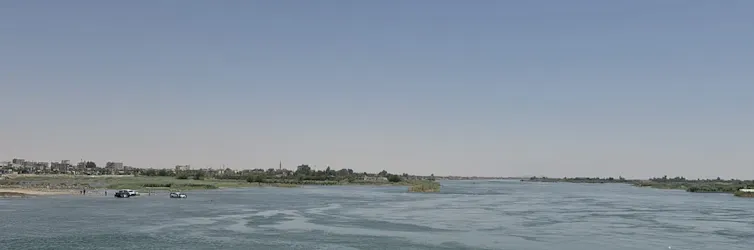
As we approached Raqqa, the scenery began to change. The dry, dusty landscape gave way to greener fields nourished by the waters of the Euphrates. After hours on a highway that alternated between smooth stretches and cratered sections – forcing Ahmed to brake, accelerate and swerve repeatedly to avoid potholes – the sight of the river valley was refreshing.
Crossing the Euphrates over bridges hastily repaired, we entered what Syrians often refer to simply as east of the river – a vast region encompassing Raqqa, Deir al-Zor and Hasaka.
Only a few months earlier, reaching Raqqa had been significantly more complicated. Until recently, the city was controlled by the Syrian Democratic Forces (SDF), a Kurdish-led coalition that governed much of north-eastern Syria separately from the authorities in Damascus. Now, following the SDF’s withdrawal from the city in early January, we were able to enter Raqqa freely.
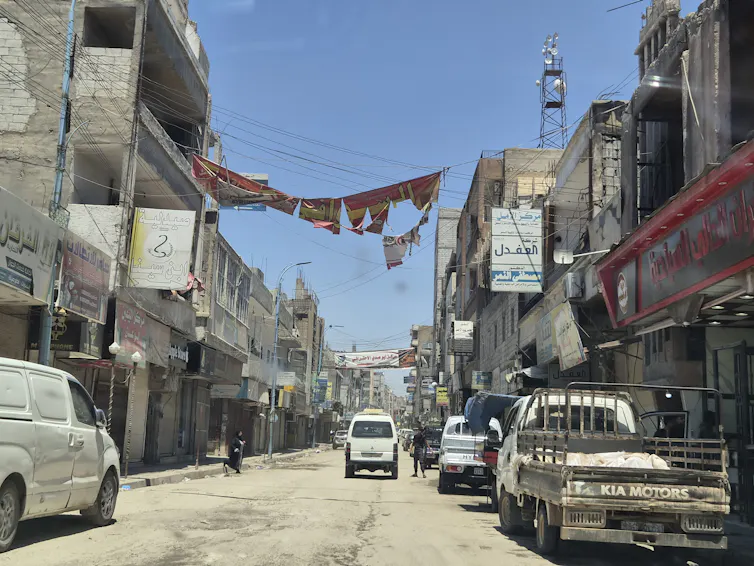
Raqqa feels different from Damascus or Aleppo. It is not necessarily the most physically destroyed city, but it may be one of the most exhausted. Long before the war, Raqqa was among Syria’s least developed and a neglected province. It later became a centre of anti-regime mobilisation, endured years of conflict, served as the de facto capital of Islamic State (IS) and subsequently came under SDF administration.
The cumulative weight of these experiences is visible everywhere. Not only the people seem tired; the roads, buildings and public spaces carry a similar sense of exhaustion. Even the remains of the summer palace associated with Harun al-Rashid, the eighth-century Abbasid caliph, who ruled one of the most powerful empires of the medieval Middle East, appear worn by history.
Advertisement
Raqqa City. Osman Bahadir Dincer
Our visit to Raqqa coincided with Friday prayer, so we briefly went our separate ways. Bahadir joined our local host at one of Raqqa’s largest mosques, while Zeynep spent the time with a local family in their home.
The mosque was packed. One detail stood out immediately: the large number of visibly disabled worshippers, a quiet reminder of the human costs of years of war. Yet what left an even stronger impression came at the end of the sermon. The imam announced that donations would be collected after prayers for communities affected by recent flooding in Deir ez-Zor. Similar collections, he explained, were taking place in mosques across the country. The moment may seem unremarkable elsewhere, but in a country fragmented for years by conflict, competing authorities and shifting frontlines, the idea that communities across Syria were contributing to a common cause felt significant.
Meanwhile, Zeynep was sitting in the guest room of a modest apartment on the third floor of a six-story building, listening to the stories of two sisters who had returned to Raqqa.
Among two brothers and eight sisters, almost every major migration trajectory was represented. One sister, a middle-aged schoolteacher, had spent four years in Turkey before returning to reclaim her teaching position in Raqqa. Another had sought refuge in Jordan, she returned only a few months earlier, while her husband and son remained behind, hoping to join her later. Other siblings and relatives were scattered across Turkey, Germany and different parts of Syria. Yet despite the distance separating them, the family remained closely connected, constantly exchanging news, coordinating plans and talking about when they might be together again.
Looking around the room, one of the sisters smiled sadly. “Before the war,” she said, “this room was always full. There was hardly any space because our whole family gathered here. Now it’s just the two of us. The others have scattered like leaves in the wind. But, God willing, our mother will return soon. Then perhaps our brother, and one day our children and grandchildren too.”
Advertisement
For many Syrian families, displacement has become a long-term condition that generates complex patterns of mobility, transnational connection, return, separation, and reunion, continuing to shape everyday life long after the guns have fallen silent.
Once the visit to the mosque was over, we reunited to the sisters’ apartment, where Arabic coffee and homemade cake were waiting for us. After one last conversation and our farewells, we set off for Hama, where we had been invited to a wedding, before continuing to Damascus later that evening.
The road from Raqqa back toward western Syria revealed both change and continuity. Burnt-out military vehicles still lined parts of the route, while former checkpoints stood abandoned, reduced to empty plots of land and crumbling structures. Yet another feature caught our attention: long queues of ageing trucks moving slowly along the highway, a reminder that commerce and mobility are gradually returning.
Long queues of ageing trucks. Osman Bahadir Dincer
These signs of renewed movement, however, should not be mistaken for a broader economic recovery. Along much of the route, we saw little evidence that major industrial facilities, food-processing plants, or energy infrastructure were being restored at the scale required to revive local economies. This was particularly striking given the importance of agriculture and energy for Syria’s future recovery.
By midday, the heat had become almost unbearable, and we pulled over at a small roadside shop to buy water. The makeshift building stood alone beside the highway, surrounded by an otherwise empty landscape. Inside, most of the large room was bare. In one corner, a few tables displayed biscuits and wafers, while an old refrigerator held a handful of cold drinks.
Advertisement
A young shopkeeper, probably in his early twenties, came over to greet us. He first asked in Arabic where we were from. When we replied that we lived in Germany but were originally from Turkey, he immediately switched to fluent Turkish. Having recently returned after several years there, he was eager to share how much had changed since coming home. “Five months ago,” he said as he handed us bottles of water, “I would have been stopped at ten checkpoints to get here. Sometimes I would wait for hours. Economically, life may have been easier then. But we had no freedom of movement. Now I can travel without anyone stopping me.”
In fact, despite being foreigners, we experienced something of that change ourselves. Travelling with a Syrian colleague, and perhaps also because one of us was a woman, we passed checkpoint after checkpoint without ever being asked to stop. Each time, Ahmed simply slowed the car, exchanged a brief greeting with the soldiers and continued on our way.
One of the changes people mentioned most often was the simple ability to travel freely. Whether moving between cities or crossing from one neighbourhood to another, no longer being stopped, questioned, or delayed represented a profound shift after years in which movement had been shaped by checkpoints, frontlines and competing authorities. As one Syrian after another told us, “the road has become a road again.”
Freedom amid ruins
Many Syrians describe the post-Assad period as a “liberation”. Across different regions and social backgrounds, people repeatedly spoke about the end of fear, the ability to express opinions more openly and the possibility of imagining a different future. While political views remain diverse and uncertainties abound, there is nevertheless a widespread sense that a new chapter has begun.
Advertisement
What struck us was that people rarely explained this through abstract political language. Instead, they pointed to small changes in everyday life. In Damascus and Aleppo, many drew our attention to functioning traffic lights and police officers managing busy intersections. “Look around you,” they would say. “The traffic lights are working again. The police are back on the streets. These are small things, but they make people feel that life is becoming normal again.”
Around Raqqa, following the withdrawal of the SDF from parts of the region, residents expressed a similar sentiment. “For the first time in years,” one resident told us, “we feel free.” For many, this was not primarily a political statement but a reflection of how they experienced everyday life.
Hope was visible not only in what people told us, but also in what they were doing. In Aleppo, we visited a community centre where we met Esma, Mustafa and several other staff members working to support women, children and returning families through educational and rehabilitation programmes.
The building itself reflected Syria’s changing realities. Once the Baath Party’s youth centre, where generations of young Syrians were exposed to state ideology, it has recently been transformed into a place for learning, vocational training and community support.
Advertisement
Esma, who returned from Turkey despite holding Turkish citizenship, now teaches Turkish/Arabic at the centre. Mustafa, who returned from Germany, serves as its director, coordinating its educational and rehabilitation programmes. As we walked through the building together, moving from one classroom to another, we asked Esma why she had chosen to return despite having opportunities to remain abroad. Her answer came without hesitation: “My country is trying to stand up again. People here need us. If not now, then when we will contribute?” Standing beside her, Mustafa nodded quietly, a smile spreading across his face as she spoke. He did not add anything; he didn’t need to. His expression said he fully agreed.
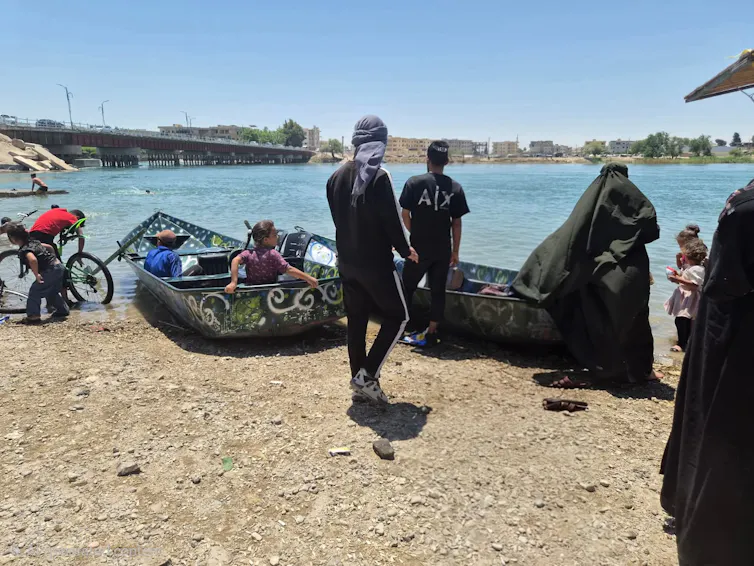
We encountered similar positive scenes in Raqqa. Along the banks of the Euphrates, families gathered for picnics while young boys plunged into the fast-moving current without hesitation. Nearby, young men ferried visitors along the river in small boats fitted with rows of plastic chairs, offering short sightseeing trips. Vendors moved between the groups selling tea and coffee, while others washed their cars along the riverbank. Much of this everyday activity unfolded beneath the partially repaired bridge connecting the eastern and western sides of the city.
At first glance, it looked like an ordinary summer afternoon by the river. Yet there was something profoundly symbolic about people reclaiming a space that had once been synonymous with war.
Everyday life along the river. Osman Bahadir Dincer
Reconstruction projects in Syria often carry a significance that extends far beyond their practical purpose.
Driving back from Hama to Damascus late one evening, we found ourselves unexpectedly caught in a celebration. Earlier that day, President Ahmed al-Sharaa had officially reopened the Rastan Bridge, a strategic crossing that had remained closed for years. Only a few days earlier, we ourselves had been forced to bypass the bridge and drive through Rastan because the crossing was still inaccessible.
Advertisement
Now the atmosphere was entirely different. Families strolled together, young men waved Syrian flags, children ran between the crowds and motorcycles carrying two or three passengers moved slowly back and forth as people stopped to take photographs and celebrate on the bridge.
Yet the optimism we encountered during our travels was almost always accompanied by reminders of the challenges that remain. Across much of the country, the physical, economic and social consequences of war continue to shape everyday life.
Economic difficulties are only one dimension of the challenges Syrians continue to face. Another lies beneath the ground itself. As we were leaving Raqqa, Ahmed pointed towards the open fields stretching alongside the road. They looked calm and ready for cultivation, yet he shook his head. “Hardly a week passes without reports of new casualties,” he said quietly. “People still lose their lives because of mines.”
His remark immediately brought us back to a meeting a few days earlier at the United Nations Development Programme office in Aleppo. Standing in front of a large wall map of the city, one UNDP official traced neighbourhood after neighbourhood with his finger as he explained the scale of destruction and contamination. Large areas of farmland, villages and former frontlines, he told us, remain littered with landmines and unexploded ordnance, preventing people from farming, rebuilding, or even returning safely.
Advertisement
We heard the same concern echoed by government officials. During a meeting in Damascus, one ministry representative described mine clearance as one of the country’s most urgent priorities. “We need to clear the mines,” she told us. “They are everywhere in Syria.”
Returning to Syria is difficult
Our journey across Syria reinforced a finding that has emerged repeatedly from our research on refugee return: crossing the border is only the beginning. Experiences from Bosnia and Herzegovina, Kosovo, Iraq and other post-conflict settings show that return often remains partial, temporary, or circular when employment opportunities, public services, social trust and functioning institutions are absent.
Across these cases, return has proven to be a long-term process of reintegration. As one adviser involved in Syria’s return and recovery policies, told us: “We aim to bring 80 percent of Syrian refugees from Germany, as the German Chancellor requested. However, this requires the creation of 200,000 jobs and housing beforehand. Refugee returns should be conducted in a dignified manner to ensure they go back to safe areas, both psychologically and politically. For example, returning refugees should have access to a roof and non-mined environments.”
The dry, dusty landscape gave way to Raqqa’s greener fields nourished by the Euphrates. Osman Bahadir Dincer
The real question is no longer whether Syrians want to return, but whether the conditions exist for them to remain. With widespread housing shortages, limited employment, fragile public services and millions of people still relying on remittances from relatives abroad, many returnees risk exchanging one form of uncertainty for another. Without meaningful reconstruction and economic recovery, return is unlikely to mark the end of displacement – it may simply become another stage of it.
Across Europe, discussions about Syria increasingly focus on whether the conditions for refugee return are finally emerging. Yet our journey across the country suggests that these debates often overlook Syria’s current realities. Even government officials acknowledged that rebuilding homes, restoring infrastructure, reviving the economy and supporting displaced communities are already stretching the country’s limited resources.
Advertisement
Under these circumstances, a rapid increase in refugee returns could place additional pressure on communities that are themselves still struggling to recover. As one resident in Damascus put it “returnees will drown Syria” – not because their return is unwelcome, but because the country’s economy and institutions are simply yet not able to absorb large numbers of people.
Our journey ended shortly after 1am, when Ahmed dropped us off at our hotel in Damascus. In just a few hours, we would be boarding our flight back to Germany. Yet as we said our goodbyes, our thoughts returned once again to the wedding in Hama.
For a few hours, conversations shifted away from war, displacement, politics and economic hardship. Families gathered, children played, music filled the courtyard and guests celebrated the beginning of a new chapter in the lives of the bride and groom. It was not that people had forgotten Syria’s challenges.
Everyone present was fully aware of them. Rather, it was the determination to celebrate despite them.
To hear about new Insights articles, join the hundreds of thousands of people who value The Conversation’s evidence-based news. Subscribe to our newsletter.
The Repair Shop star Dom Chinea is to make a guest appearance in one of the BBC’s longest-running soaps as part of a milestone episode and has called the opportunity a “pinch-me moment”
The TV star, 40, will make soon be heard on The Archers for a 75th anniversary episode of the BBC radio soap, and listeners will be able to tune into all the action as he arrives in the programme’s fictional village of Ambridge.
Ahead of the guest appearance, said: “This was quite the pinch me moment being part of The Archers – it’s such an iconic show.
“Having only worked on factual TV series, I found it fascinating to be involved in the recording of a scripted drama, it’s the first time I’ve ever played a cameo scripted role. I’m not going to lie I was a little out of my comfort zone and I hope I did The Repair Shop team proud.”
Advertisement
The show will see one of its characters, Leonard Berry, ask Chinea to help fix Robert Snell’s broken toaster without realising he is famous for fixing things.
Chinea will then meet Tony Archer, who shows him a toy tractor that used to belong to his son, John, who died at the age of 22, and Chinea agrees to help Tony fix it.
During discussions about the episode, editor of The Archers Jeremy Howe also suggested that there was a production item that was in need of some real-life Repair Shop attention, in a doorbell board.
The item, which is a sound board of 12 various doorbells used in the long-running drama only has two bells still functioning, and Spot FX producer Vanessa Nuttall and Louiza Patikas, who plays Helen Archer, took the board to The Repair Shop barn.
Advertisement
Howe said: “As huge fans of The Repair Shop, we thought we would give them an unusual challenge from the huge array of oddball props we use to make our Ambridge sound effects.
“Without giving too much away, I think The Repair Shop geniuses – Mark (Stuckey, electrical expert) especially – rose to the challenge and some. We are delighted with our good-as-new gizmo.”
A Repair Shop episode featuring the doorbell board will be shown next year, while the episode of The Archers featuring Chinea will air on Sunday at 7pm.
Advertisement
The Archers was first broadcast in 1951, some nine years before Coronation Street hit screens on ITV and more than three decades before the BBC launched their own television soap in the form of EastEnders. Others to have made guest appearances over the years include Queen Camilla, Dame Judi Dench and Sir Terry Wogan.









![Leroy's sister Nathalie (pictured) has said the UK's justice system has 'locked [her brother] up and just thrown away the key'](https://i.dailymail.com/1s/2026/09/01/20/110983343-15978861-Leroy_s_sister_Nathalie_pictured_has_said_the_UK_s_justice_syste-a-9_1788289988779.jpg)








































You must be logged in to post a comment Login