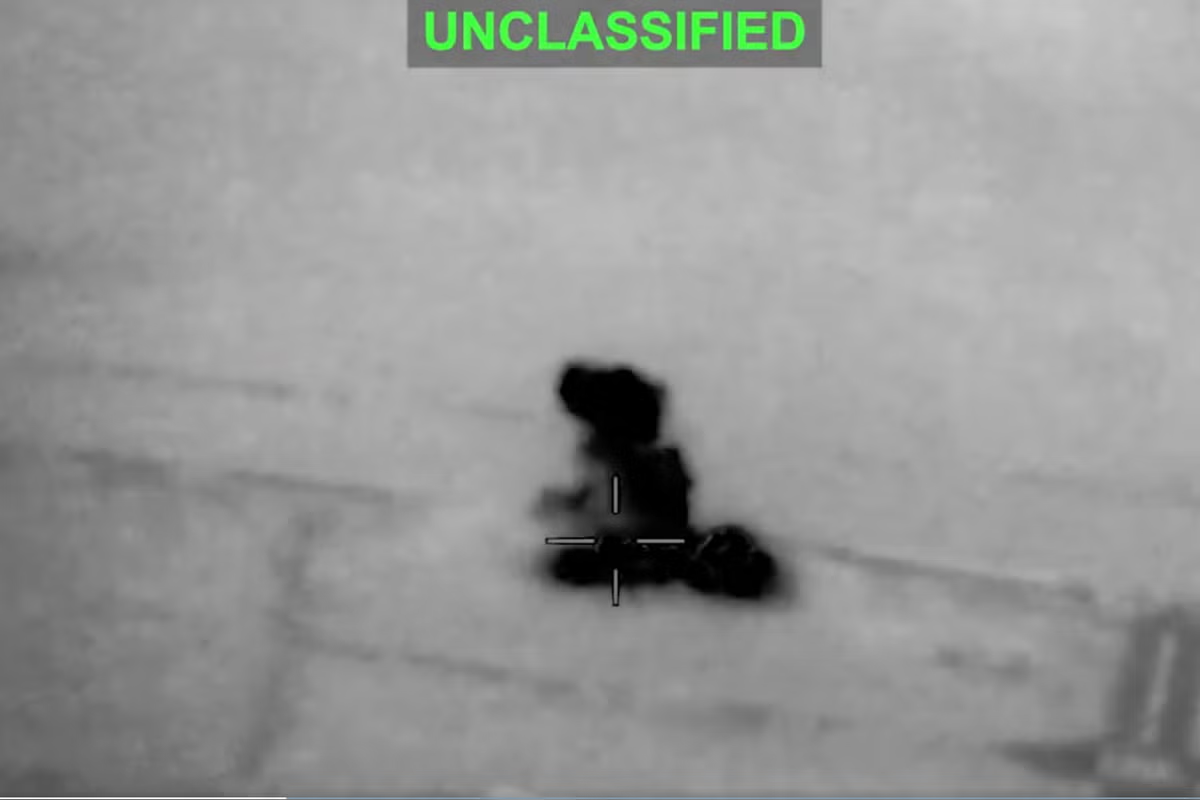



Video: Israel destroys Hezbollah underground infrastructure in southern Lebanon
Israel destroys Hezbollah underground infrastructure in southern Lebanon
Namita Singh29 June 2026 04:52
Iran and US agree to halt attacks and renew talks, US official says
Iran and the United States agreed to halt recent hostilities in the Gulf and renew talks regarding their dispute over the Strait of Hormuz, a US official said on Sunday, raising hopes of saving an interim peace deal that was under pressure from days of tit-for-tat strikes.
Advertisement
“Technical talks are slated to continue on all areas of the Mou. Both sides will stand down for now and vessels can move freely,” the official said, referring to the 14-point memorandum of understanding that was agreed on 17 June under which the strait would be re-opened for traffic.
A cargo ship is pictured off coast of the Khor Fakkan Container Terminal, the only natural deep-sea port in the region and one of the major container ports in Sharjah Emirate, along the Gulf of Oman on 28 June 2026 (AFP/Getty)
Axios, which first reported the cessation of hostilities, citing a senior US official, said talks would resume on Tuesday in Qatar.
A return to diplomacy would follow several days of strikes and counterstrikes since an Iranian projectile hit a cargo vessel in the Strait of Hormuz on Thursday, with both the US and Iran accusing the other of breaking an interim ceasefire that was agreed to on 17 June.
Iran launched missiles and drones at US military sites in Kuwait and Bahrain early on Sunday, shortly after president Donald Trump threatened that the Islamic Republic would cease to exist if it did not honor the agreement to end the war.
Advertisement
Namita Singh29 June 2026 04:26
Israel moves to formally recognise Armenian WWI deaths as genocide
Israel’s cabinet unanimously approved a proposal on Sunday to designate violence against Armenians by the Ottoman Empire during First World War as genocide.
The step, which still needs approval in parliament, reflects deteriorating ties between Israel and Turkey. Turkey has fiercely lobbied to prevent countries from officially recognising the mass deaths of Armenians around 1915 as a genocide, even as Armenians have pushed for it.
Advertisement
Historians estimate that up to 1.5 million Armenians were killed by Ottoman Turks around the time of World War I, an event widely viewed by scholars as the first genocide of the 20th century. Turkey denies that the deaths constituted genocide, saying the toll has been inflated and that those killed were victims of civil war and unrest.
For years, Israel never officially broached the subject for fear of angering Turkey, but that relationship has soured over the past two decades, especially as the most recent wars in Gaza, Lebanon and Iran have dragged on.
“Despite the extensive and unambiguous historical documentation, the Armenian Genocide remains to this day the subject of an institutionalised campaign of denial and minimisation, including a manipulative rewriting of history, mainly by the Turkish government,” said Israeli foreign minister Gideon Saar, who brought the decision to the government.
Turkey called Israel’s move a “politically motivated” step meant to distract from the country’s own actions against Palestinians.
Advertisement
Namita Singh29 June 2026 04:15
RECAP: Interim ceasefire under strain as US and Iran exchange fire over Strait of Hormuz
The interim peace deal between the US and Iran is under strain after both sides traded blows as tensions escalate over shipping routes in the Strait of Hormuz.
The US bombarded Iranian military sites for the second day in row on Sunday in response to drone attacks on cargo ships in the region.
Advertisement
26 June: Singapore-flagged Ever Lovely cargo ship was hit by a drone in the Strait of Hormuz. Trump called the incident a “foolish violation” of the ceasefire agreement before the US hit back, striking targets in Iran’s Sirik region.
27 June: A Panama-flagged MT Kiku cargo ship was also struck in the Strait. Donald Trump took to Truth Social on Saturday evening to warn that Iran would “no longer exist” if Tehran kept breaking the ceasefire. US Central Command confirmed it had launched fresh strikes on Iranian military sites “in direct response to continued Iranian aggression against commercial shipping”.
28 June: Iran on Sunday said its naval and aerospace forces carried out a joint missile and drone operation targeting US military sites in Kuwait and Bahrain, and warned further violations would receive a “crushing response”. Gulf allies condemned the attacks in the region, but Iran’s foreign minister warned that any challenge to Iranian oversight of the strait will “increase tensions”.
Amy-Clare Martin29 June 2026 04:00
What has Iran’s foreign minister said?
Iran’s foreign minister Abbas Araghchi has said bringing maritime traffic back to pre-war levels in the Strait of Hormuz lies solely with Tehran, and warned that any challenge over the strait will “increase tensions”.
The comments were made in a meeting with his Iraqi counterpart in Baghdad on Sunday, as the pair discussed the latest attacks as well as the all-important issue of the strait, according to Reuters.
Araghchi also reiterated his previous position that the memorandum of understanding signed with the US mandates that Israel withdraw from Lebanon and end its strikes there.
Advertisement
Iranian Foreign Minister Abbas Araghchi speaks during a joint press conference with his Iraqi counterpart (AFP/Getty)
Amy-Clare Martin29 June 2026 03:00
By numbers: Impact of Iran-US war on fuel prices at the pump
The four month conflict has sent fuel prices rocketing as countries reliant on Brent crude faced shortages of fuel.
In the UK, diesel prices shot up to £1.92, an increase of nearly 50 pence compared to pre-war, while unleaded petrol rose by 27 pence to around £1.59. These were the highest prices since highest since the late 2022, after Russia’s full-scale invasion of Ukraine sent unleaded prices up to £1.91 and diesel up to £1.99.
Advertisement
Amy-Clare Martin29 June 2026 02:00
Trump promises farmers they will get to sell crops to ‘lovely country of Iran’ after war
President Donald Trump has promised American farmers they will soon be able to sell their crops to the “lovely country of Iran” now that he has signed a memorandum of understanding to end his war.
Amy-Clare Martin29 June 2026 01:00
Advertisement
In detail: How Iran-US war hit global oil prices
The blockade of the Strait of Hormuz has had a direct impact on global oil prices. With Brent crude – the global benchmark – rocketing to a peak of $114 per barrel in early May, a seismic shift was felt across the world.
Prices have largely recovered since a temporary truce came into place between Washington and Tehran, with prices now sitting at around $77 per barrel – $6 higher than the day before the war, but nearly $19 higher than a year-low of $59 in early January.
Advertisement
Amy-Clare Martin29 June 2026 00:00
ICYMI: Iran hit out at ‘unfair’ and ‘unsportsmanlike treatment’ as they exit World Cup
Iran’s football team fired a parting shot at what they called the “unfair and unsportsmanlike” treatment they have received as they left the World Cup.
Saturday’s 1-1 draw with Egypt, in which Iran had a goal disallowed after a lengthy VAR check, was not enough for them to reach the knockout stages, ending a fraught tournament amid their nation’s conflict with the US.
Advertisement
The team had been due to be based in Arizona but switched to Tijuana, Mexico, and have faced a number of travel restrictions for their matches in the United States.
In a statement as they headed home, the Iranian federation (FFIRI) thanked the media for covering their situation.
“Thank you for your professionalism, your support and for covering not only our team’s sporting journey but also the unfair and unsportsmanlike treatment our delegation experienced during our stay,” the statement said.
Iran drew 1-1 with Egypt in Seattle (Getty)
Amy-Clare Martin28 June 2026 23:00
Advertisement
Full story: Iran attacks Bahrain and Kuwait following US strikes
Iran‘s Revolutionary Guard launched drone and missile attacks on Sunday targeting Bahrain and Kuwait in response to U.S. airstrikes that hit the Islamic Republic, and threatened a “complete halt” to negotiations to end the war if Washington continues its attacks.
AmaWaterways has unveiled the designs for its second mega river cruise ship, which will include karaoke areas and an onboard pickleball court.
The new vessel AmaRudi will join sister ship AmaMagna on the Danube in spring 2027. Both are Europe’s largest river cruise ships.
AmaRudi is also the first ship in the fleet to be named after a man, honouring co-founder Rudi Schreiner, who was born and raised near Austria’s Danube river.
Measuring 443 feet long, AmaRudi will have capacity for 196 guests and 70 crew.
Advertisement
Passengers can eat at multiple dining venues from the Journey’s Restaurant and The Chef’s Table restaurant to al fresco dining experiences and the intimate Rudi’s Wine Bar.
AmaRudi will also offer a built-in Deck Club barbecue on the sun deck and public spaces inspired by the destinations along the river. There will even be a snooker table on board.
An onboard wellness area will feature massage treatment rooms, hair and nail services, a gym and a pickleball court, while a new entertainment options will include a cinema, karaoke, billiards and a jukebox.
Guests can play snooker or pickleball among a range of activities aboard AmaRudi (AmaWaterways)
Schreiner said: “AmaMagna changed what travellers believed was possible on a river cruise ship.
”We knew there would be a right time to revisit that concept, and with river cruising continuing to grow, that time is now. More travellers are making the transition from ocean cruising to rivers, and many are looking for a sense of space and choice.
Advertisement
“AmaMagna was one of the most rewarding projects of my career, so having this new ship carry my name makes it especially meaningful. I see it as part of the legacy we have built together over more than two decades of river cruising.”
AmaRudi is scheduled to begin sailing the Danube in spring 2027.
Alongside new homes, the development will feature a dedicated play area space for children
Work has begun on a new development to build 87 new homes in Cambridgeshire. The Tunkers Lane development in Bury will see a mix of homes built as affordable housing.
Advertisement
The homes will range from one and two-bedroom bungalows and one-bedroom maisonettes, to two, three, and four-bedroom houses. There will be 36 properties available for shared ownership, 32 allocated for affordable rent, 10 rent to buy homes, and nine available for social rent.
Housing provider Stonewater has implemented energy-saving measures to the homes. These include air source heat pumps, solar PV panels, and electric car charging stations for some plots.
The development will provide opportunities for apprentices to work on the site and develop their skills, helping to fill the skills shortage in the industry.
A piece of public art will be designed for the estate as well as a dedicated play area for children, and an edible garden. Fruit trees and bushes will be incorporated into the scheme for customers to enjoy, to promote sustainability and healthy eating, according to Stonewater.
Advertisement
An event to mark the beginning of construction took place towards the end of May. The scheme is expected to be completed in the 2027 to 2028 financial year.
Nicola Hillier, head of development (East) at Stonewater, said: “These homes will offer a range of options for local people to secure an affordable home in the village they have existing connections with, contributing to the local economy and broader society.”
The Tunkers Lane scheme is being built in partnership with Huntingdonshire District Council, Burmor Construction, Bury Parish Council, and Calfordseaden.
Advertisement
Patrick Burke, Director at Burmor Construction, said: “We look forward to working closely with Stonewater and our project partners as construction progresses and to seeing this new neighbourhood take shape over the months ahead.”
“There is a distinct art to finding calm in the heart of a bustling capital, and this hote has mastered it”
Mark Casserly
20:24, 28 Jun 2026
There is a distinct art to finding calm in the heart of a bustling capital, and The Morgan Hotel has mastered it. Situated in the centre of Dublin’s most energetic district in Temple Bar, it serves as an elegant contrast to the humdrum of city life.
Whether you are spending your days exploring the nearby cultural gems like the Irish Film Institute or simply soaking in the atmosphere, the hotel provides a luxurious anchor for your trip.
The guest experience is built around thoughtful luxury. Inside my Deluxe King room, the decor—highlighted by striking pink armchairs—felt both contemporary and inviting. From the luxury feather pillows to the monsoon rain shower, everything felt designed for comfort. The ‘SuitePad’ is a particularly welcome modern touch, streamlining the way guests interact with the hotel’s staff, something I hadn’t encountered before at any hotel I’ve stayed in.
Advertisement
The main highlight, however, was dining at the 10 Fleet Street Restaurant. The team here isn’t just serving food; they’re passionate ambassadors for their menu. I started with the burrata bruschetta. This consisted of burrata cream, heirloom tomatoes, shallots, garlic, parmesan, oregano, fresh basil, olive powder and balsamic glaze. All the items complemented the bruschetta so well that I was truly surprised by how delicious it tasted.
For my main course I had the cornfed chicken supreme. This came with sautéed French beans, shitake mushrooms, butternut squash puree, mashed potato, pancetta and white wine herb and mushroom sauce. The chicken was so succulent and tender, and it worked really well with the sauce it was covered in.
I finished on a high note with the “Morgan Mess,” a light, strawberry-forward take on the classic dessert, it was beautiful, light and refreshing.
The restaurant’s mixologist and servers have a wealth of knowledge about the cocktails and food they serve, and their passion for what they do was evident from the moment I met them.
Cocktail lovers, take note: The Morgan’s bar also lives up to the hype. I particularly enjoyed the ‘Morgan Bubbles’—a refreshing mix of Prosecco, mango puree, elderflower, and lime—and the ‘Watermelon Sugar High,’ a complex Cuban-inspired delight shaking Havana 3-year white rum with watermelon, cucumber, lime, pineapple, and an egg-white wash.
The following morning, I had a full Irish breakfast where each element tasted fantastic. This is one to definitely not sleep on if you visit The Morgan, a perfect start to a day of exploring the capital.
If you’re planning to explore Dublin, it’s hard to beat the convenience of The Morgan. It puts you right in the centre of the city while providing a stylish, quiet retreat to recharge after a long day of sightseeing. Add in the high-end dining, plush rooms, and a well-equipped health club, and you have every reason to make this your go-to spot for your next visit.
Prince Harry is said to be rethinking his decision to bring Meghan and his children to the UK next month after his request for police protection was denied.
It is understood that the royal has concerns for his family’s safety after learning on Friday that no taxpayer-funded security would be provided.
They had accepted an invitation to stay in a royal residence during their first visit to the UK since Queen Elizabeth II’s Platinum Jubilee celebrations in 2022.
A source close to the Duke and Duchess of Sussex accused the Home Office and the committee responsible for assessing their security of “wilfully creating conditions that are making it nearly impossible” for them to safely travel in the UK, The Telegraph reported.
Advertisement
The trip would mark the family’s first time in the UK in four years (Instagram/@meghan)
Harry is said to be trying to find a way for the trip to go ahead, as he is “desperate” for his seven-year-old son, Archie, and five-year-old daughter, Lilibet, to see their grandfather King Charles. It is believed that a final decision on the trip and the involvement of Prince Harry’s wife and children will be made in the coming days.
Harry had been waiting for a review by the Royal and VIP Executive Committee (Ravec) on his security requirements, but found out last week that no review had been taken and all assessments had been “paused”, the source told the newspaper.
“The precarious security situation and endless speculation about where the family will stay is making the planning and logistics for the private security team increasingly difficult,” they added.
His level of protection was downgraded in 2020 when he stepped back from royal duties, and he has not been given any police protection since, unless engaging in official royal occasions.
Prince Harry is in an ongoing legal battle with the Home Office over his security arrangements (AFP/Getty)
Their visit was set to mark the one-year countdown to Harry’s Invictus Games, which is being hosted in Birmingham next July, and the Duchess of Sussex was expected to join her husband on several public engagements.
It would also be the first time the duke has seen his father in nine months after the two had tea at Clarence House in September.
His family was expected to stay on both royal estate and private accommodation.
A government spokesman said: “The UK government’s protective security system is rigorous and proportionate.
“It is our long-standing policy not to provide detailed information on those arrangements, as doing so could compromise their integrity and affect individuals’ security.”
Advertisement
The Duke and Duchess of Sussex have been approached for comment.
Facilities such as public toilets and waste disposal points – particularly the lack of them – are a big issue in parts of Skye.
Home to just over 10,000 people, it has few urban areas and is largely an island of dramatic mountains, rugged coastlines, and crofts.
Photographer Danielle Stewart travels all over the Highlands in her campervan in her free time and for work.
Skye is one her regular destinations.
Advertisement
“It’s freedom – you can wake up in beautiful places. That’s the best thing for sure,” she said on the benefits of owning a campervan.
She added: “Over last winter I went to Spain and Portugal for three months and that was great – it’s a very different van life in Europe though, because they have facilities.”
Last week Northern Ireland equalled its warmest June day on record
After last week’s heatwave, this week sees a return to temperatures around average for this time of year in Northern Ireland.
Advertisement
On Thursday, June 25, Northern Ireland provisionally equalled its warmest June day on record with 30.8 C recorded at Castlederg, putting it level with the peak figure on June 30, 1976.
Overnight on Thursday into Friday, Northern Ireland also provisionally broke its highest minimum nighttime temperature, with 19.1 C reached at Murlough. The Met Office said at the conclusion of the heatwave, the verification process begins for any new national records.
The equipment and site will undergo a rigorous validation process before a decision is made on officially inducting any new figures into the meteorological record books.
Here is how the weather in Northern Ireland is looking for the week ahead.
Advertisement
Monday
Mainly dry with variable amounts of cloud and a few bright spells. The odd light shower in northwest. Outbreaks of rain spreading northeast in the evening. Maximum temperature 20 C.
Tuesday
Scattered slow moving showers, occasionally heavy. Early rain should clear leaving sunny spells and showers, with a chance of some thunder. Maximum temperature 19 C.
Wednesday
Turning increasingly windy and cloudy on Wednesday, with showery rain arriving by the evening. Maximum temperature 18 C.
Thursday
A few showers at first on Thursday, otherwise dry with variable cloud and sunny spells. Maximum temperature 19 C.
Advertisement
Friday
Drizzle and a moderate breeze. Maximum temperature 20 C.
You don’t want to be the office pinger (Picture: Getty Images/iStockphoto)
You’re sat at your desk fielding multiple messages on Slack, requesting the latest report here and tweaks to the presentation there.
Then you get a message from Mark who wants to ask you a quick question. The only thing is, Mark is sat right opposite you.
He could simply take a few steps over to your desk and ask you, face-to-face, it would be much quicker. But, no.
Mark is the office ‘pinger’. It’s a term Metro has coined to describe the employees who are in the office with you, but choose not to talk to you in person, and communicate everything via message instead.
Advertisement
But this isn’t an isolated incident. Despite the push for a return to working in the office, with 41% of people now not working from home at all, water cooler chitchat has yet to make a proper comeback.
In fact, a fifth of those employed say they go an entire workday without speaking face-to-face with a colleague.
The study of 2,000 UK workers, commissioned by workplace training platform Kahoot, determined half of workers use emails or messaging services to communicate with colleagues who are in the same room as them.
Some employees are going entire days without talking to a single colleague in person (Picture: Getty Images)
It’s left 40% of those with office jobs feeling disconnected at work, despite sitting shoulder-to-shoulder with their fellow workers. After all, what’s the point of being in an office if you can’t have a fun little gossip?
‘For too many workplaces, employees are constantly in touch, but never actually connecting,’ leadership and workplace coach, Emma Georgiou, tells Metro. ‘Workers are communicating across too many channels, using email, Teams and WhatsApp – and clients and colleagues can access them in any way at any time.’
Advertisement
Jim Moore, employee relations expert at HR consultants Hamilton Nash, has seen a big culture shift over the years in the way workers communicate in the office, with pingers on the rise.
‘Younger generations who grew up in the world of the internet and instant messaging are making up an increasingly large part of the workplace,’ he tells Metro. ‘Boomers and Generation X, on the other hand, are more used to phone calls and in-person communication.
‘It’s also a matter of perceived convenience, as sending messages lets people respond at their own pace, while a ringing phone basically screams “Stop what you’re doing and pay attention to me”. Similarly, in my experience, Gen Z don’t welcome being interrupted by someone walking up with a question.’
He believes that the shift to remote working during Covid, which resulted in the hybrid work model many of us have today ,contributed to this communication problem.
Advertisement
‘It becomes easier to work in isolation and send an instant message if you need anything,’ he adds.
The productivity price
If you thought that not leaving your desk to wander over to a colleague meant you could get more done, you’re likely mistaken.
Emma agrees that people seem to think messaging makes things quicker, but that it’s a misconception. ‘It’s actually slowing things down overall,’ she explains.
‘A five-minute conversation becomes a long email chain of back-and-forth, all the while other chains of messages compete for your attention.
Advertisement
A quick conversation is much more productive than a long message chain (Picture: Getty Images/Maskot)
‘This reduces productivity and causes stress for employees. Constant notifications leave employee’s attention fragmented, and I think organisations can start to mistake responsiveness for effectiveness.’
Jim agrees that a quick face-to-face chat is far quicker overall, even if you’re a little shy.
It’s on the bosses
While it may be easy to dismiss pingers as anti-social or lazy colleagues, Emma explains this behaviour has as much to do with office culture as it does the employees.
‘Simply telling employees to socialise more is not going to work,’ she says. ‘Companies need to be clearer on when it’s best to message, and when a conversation is more effective.
‘Leaders have a key role to play, as the way they communicate sets the tone. If they make a small shift towards having more in-person conversations, it will quickly ripple through their teams.’
Advertisement
Do you have a story you’d like to share? Get in touch by emailing MetroLifestyleTeam@metro.co.uk
The former Greater Manchester Mayor is also reportedly considering creating a “Number 10 in the North” if he became Prime Minister.
The plans would form part of wider proposals to devolve more powers away from Westminster.
With people being so sure on what is to come for Mr Burnham, we’ve been asking Boltonians in town what they make of everything.
Danielle Harris, from Breightmet, said: “I think it will be a good idea. It lets everybody know about him and lets people realise how much of a good mayor he was.
Advertisement
“He’s excellent.”
(Image: Newsquest)
Reports suggest Mr Burnham could set out further plans for devolution in the coming days if he pursues a bid for the Labour leadership.
No British Prime Minister has systematically run part of the government from outside London, while Mr Burnham has long championed greater powers for regions outside Westminster.
Corey Grimes, from Farnworth, said: “I think personally we need someone that’s out of Conservatives, and out of Labour.
Advertisement
Corey Grimes, from Farnworth. (Image: NQ)
“We need to stop this ping pong game back and forth with them arguing the same fight, calling each other names.
“You don’t hear youth centres for the young ones, it’s more of a priority to keep the young ones busy, so they’re not doing drugs, they’re not getting into anti-social behaviour so they’re not idle-minded.
“It could be good, it could be bad, but you never know the true motive.”
During his time as mayor, Greater Manchester secured a series of devolution agreements covering areas including transport, housing, skills and health.
Eddie Goodram, from Queensgate. (Image: NQ)
Eddie Goodram, from Queensgate, said: “I think if he does get in, he’ll make a good PM. Bolton and Greater Manchester have lost by losing him as mayor.
“I was surprised by [Sir Kier Starmer] resigning, just threw his towel in. It’s going to take time to change.
“If people expect things to change overnight, they’re dreaming. We’ll see how it is in a couple of years time.”
Advertisement
Gracie Maudsley, from Little Lever. (Image: NQ)
Gracie Maudsley, from Little Lever, added: “I think he’s a really great guy, done a lot for the north, especially with me being 17 and our past, and it gets a lot of benefits of being that age.
“I think there will be a lot more nationalisation of public transport and higher spending on public services.
“I’m glad to be honest. [Starmer] did a lot of U-turns and he didn’t have much authority to him. It is a lot better we have Andy Burnham coming in.”
The Bar Council, which describes itself as the voice of the barrister profession in England and Wales, has called for the minimum age of criminal responsibility to be raised from 10 to 14
Demands have been made to increase the minimum age of criminal responsibility from 10 to 14.
Advertisement
The Bar Council, which represents the barrister profession in England and Wales, has been examining whether the existing age of criminal responsibility is still fit for purpose.
Both the Law Commission and England’s children’s commissioner have thrown their weight behind the Bar Council’s recommendation. Under current rules, children as young as 10 can be arrested and charged with a criminal offence.
Young people aged between 10 and 17 are handled by youth courts and placed in secure centres for juveniles rather than adult prisons. The Bar Council report, released on Sunday, stated that the age of 10 “remains low by contemporary global standards”.
The Government, in a youth justice paper published in May, said it would “carefully consider” the review and its recommendations. The Bar Council noted that 14 is the lowest age recommended by the United Nations Convention on the Rights of the Child (UNCRC) for children to be held criminally responsible, and is the most widely used age threshold across the globe.
Scotland raised its minimum age of criminal responsibility to 12 back in 2019. While recent efforts were under way in Northern Ireland to lift its threshold from 10, the proposed change appeared likely to be blocked via an Assembly veto mechanism, reports Chronicle Live.
Campaigners pushing for reform have previously suggested that the 1993 murder of two year old James Bulger in Liverpool by 10-year-olds Jon Venables and Robert Thompson has created hesitancy around raising the age of criminal responsibility.
Bar Council chairwoman Kirsty Brimelow recognised that any discussion about the age of criminal responsibility “brings back the memory of the James Bulger case”, but noted that while the case was “terrible and grave” it remained “exceptionally rare”.
Advertisement
“Current age of 10 years is far too low” The Bar Council report reveals that of the 1,590 children aged between 10 and 14 convicted of offences in the year to March 2025, only 22 received immediate custodial sentences, and contends that such a minimal figure “makes it clear that any argument for criminalisation of this cohort cannot realistically be supported by an appeal to the need for criminal process in order to protect the public, even for the short duration of a custodial sentence”. Regarding the current situation, Ms Brimelow stated: “As well as setting children on a separate track, which funnels them towards further crime and prison, this approach also produces inconsistencies within UK law.
“This report does not diminish the need for intervention and protection of the public. Rather, it asks whether criminalisation at such an early age is the most effective, proportionate or just response. It returns a definitive negative answer.”
The report indicates that the evidence “overwhelmingly supports” the finding that criminalising young children “undermines public safety and has adverse outcomes for the child by increasing future offending and perpetuating and punishing underlying vulnerabilities and disadvantage”. The report determines that age 14 “provides a clear and developmentally informed threshold below which children are not rendered criminally culpable”.
Advertisement
What do you think about raising the age of criminal responsibility? Let us know your thoughts in the poll below.
Do you agree with raising the age of criminal responsibility from 10 to 14?
Poll
The report notes that interventions for children under 14 can still take place “without being criminalised”, including child protection, education, welfare, mental health and family support. Raising the age “allows greater scope for diversion and rehabilitation, better serving prevention of a younger child becoming the older child who commits serious crime and, by doing so, protects those who would be the victims of the future”, it concludes.
Advertisement
Ms Brimelow said: “A ‘tough on crime’ approach to the treatment of children which focuses only on punishment as a method of shaping children’s behaviour is very rarely an effective strategy. Mechanisms that reduce the number of children brought into the criminal justice system, through diversion as well as raising the minimum age of criminal responsibility, are less likely to result in an increase in crime amongst this cohort.
“Bringing children into the criminal justice system is more likely to result in further offending. Diversionary programmes are more beneficial to the individual child and to the public in terms of reducing future crime and attendant resources.
“It is also cost-effective financially as well as societally. Increasing the minimum age of criminal responsibility is essential as it can tackle reoffending and prevent future victims of harm.”
Advertisement
Mark Evans, President of the Law Society of England and Wales, stated: “We support raising the age of criminal responsibility to 14 years; the current age of 10 years is far too low. This would be an important step towards aligning the system with evidence on child development and ensuring more effective responses to children who do wrong. We call on the government to accept this proposal as part of its youth justice reforms.”
England’s Children’s Commissioner, Dame Rachel de Souza, commented: “I believe no child at the age of ten should be sentenced for a crime; instead, they need a robust and well-enforced alternative – but one which doesn’t push them into the criminal justice system. I hope the Government seriously considers the recommendations of the Bar Council.”
A Ministry of Justice spokesperson responded: “The current age of criminal responsibility is 10 and no decision has been made on changing it. Any decision we make will always be guided by expert evidence and have the public and victims’ best interests at its heart.”
You must be logged in to post a comment Login