

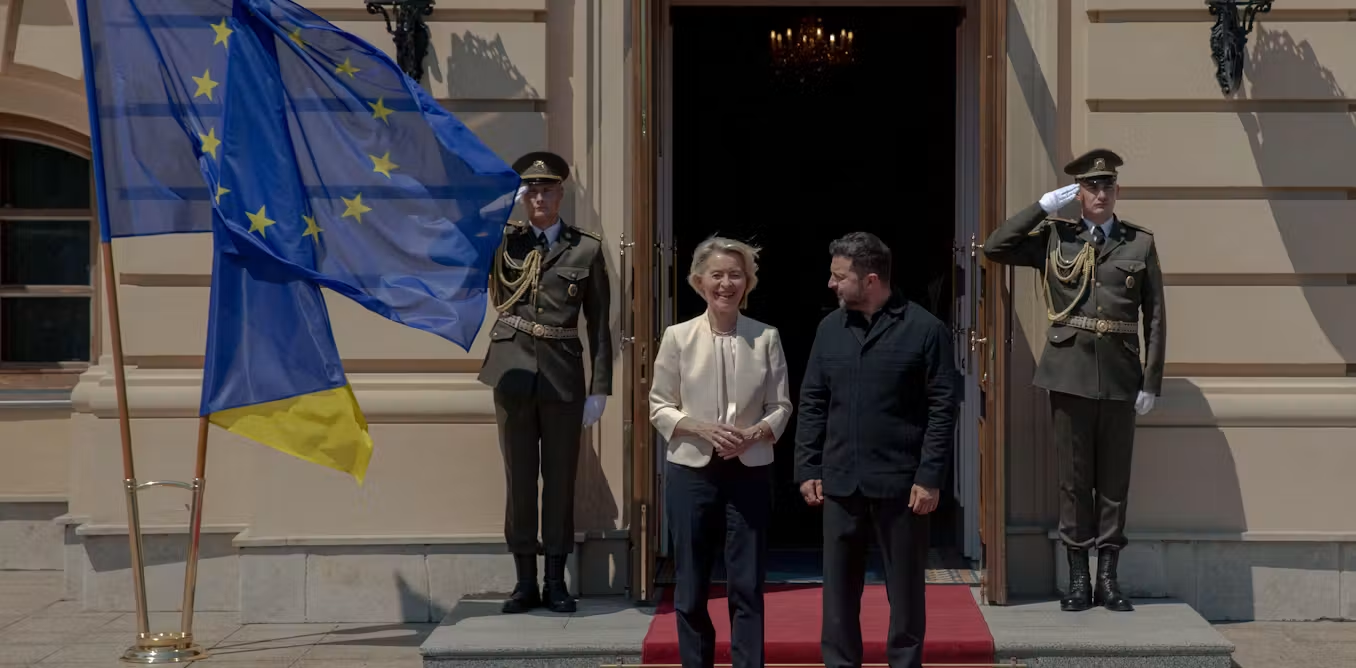
Volodymyr Zelensky is fighting a war on several fronts. Russia is ramping up its missile attacks with almost nightly bombardment of Ukrainian cities. A blockade of Ukraine’s Black Sea ports is choking its grain exports with a devastating effect on its agricultural economy.
Now, just this week, the Ukrainian president has had to sack a senior aide over allegations of money laundering. It’s a particularly bitter blow for a man who ran for office as an anti-graft candidate. If that weren’t enough, Mikhailo Federov, the popular defence minister he sacked just weeks ago, has demanded Zelensky call an election, citing “a systemic crisis of governance,” that has failed to get to grips with endemic corruption.
Clearly Zelensky’s first priority is defence against Russia’s missile attacks. But Ukraine lacks the air defences to cope – overnight on August 19, Russia reportedly hit Kyiv with dozens of ballistic, cruise and hypersonic missiles and more than 150 drones, killing 15 and wounding scores of people.
The Ukrainian president’s appeals to his European allies are increasingly desperate as winter approaches and Russia targets Ukraine’s power infrastructure. But there is mounting evidence that many of these countries are beginning to suffer from war fatigue, according to Benjamin Martill and Adam Holesch, who have researched sentiment to the war across EU members states.
Politically this fatigue is felt at this stage more among parties on the far right and far left, such as the Alternative für Deutschland in Germany and Podemos in Spain. But it’s a sentiment shared by many ordinary people across the dial, who see the conflict as something imposed on them by political elites that is costing them money.
À lire aussi :
European ‘war fatigue’ may be growing – but Ukraine’s recent momentum could buy time
While not as devastating as missiles, the massive swarms of drones Ukraine is now launching against targets deep inside Russia – more than 800 last weekend into the Moscow region according to some reports – are clearly rattling Vladimir Putin. The Kremlin issued a warning to the UK after British-made drones were used in recent attacks that “the deeper its involvement in the conflict… the higher the price it will pay”.
The UK and some of Ukraine’s other European allies are boosting their partnership with Ukraine in the production and deployment of drones. As Arun Dawson of the department of war studies at King’s College London observes, there are obvious pluses for both sides of this partnership. Ukraine clearly benefits from a surge of drone production while the UK and other countries in similar partnerships with Kyiv see their technology tested in real battlefield conditions against a capable enemy.
Given that Britain sees drones as a big part of its defence plans, that alone is a big deal, Dawson concludes.
À lire aussi :
UK-Ukraine drone partnership risks Putin’s wrath but will boost long-term security
As the military use of drones increases, so does the development of counter measures to defend against them – on the battlefield and beyond. Anna Jackman of the University of Reading researches the impact of drones and walks us through the various counter-drone systems.
À lire aussi :
How drones are taken down – from nets and metal cages to jammers
Putin has problems of his own
Elections are not normally something that would usually cause Vladimir Putin any loss of sleep. But next month’s elections to the State Duma, Russia’s national parliament, will be the first since Putin launched his invasion of Ukraine in February 2022. So he’ll want to present a smooth campaign and an overwhelming victory for his United Russia party as proof that the war is going well. But as we have seen in recent months, it isn’t – and Putin’s approval ratings and the attitudes of ordinary Russians towards the war are becoming increasingly negative as well.
EPA/Alexander Zemlianichenko/pool
Jenny Mathers of Aberystwyth University believes that United Russia, which has 70% of seats in the Duma, has little to fear in next month’s poll. So the decision to ban Russia’s one proper opposition party, Yabloko, from running candidates is curious. As is Putin’s pre-election “listening” tour, which has taken the notoriously travel-averse Russian president to a range of cities where suddenly petrol seems to be in plentiful supply and at reduced prices.
Perhaps, Mathers concludes, “Putin and his allies are not nearly as confident in their ability to maintain their grip on power as they would like the rest of the world to think”.
À lire aussi :
Banning the opposition, going on a listening tour: Putin’s worried about the coming election
Harsh new reality for South Korea
No doubt Putin is buoyed by the thought of the 50,000 fresh North Korean troops that Kim Jong-un is sending to join his troops on the frontlines. But, as you’d imagine, they are not so keen on the idea in Seoul. South Korea is still officially at war with the north, and the prospect of thousands of North Korean soldiers gaining combat experience in modern conditions is not a happy one.
South Korea is a key ally of the US in East Asia – and the two countries are engaged in their annual Ulchi Freedom Shield exercises, which Seoul considers a vital element in its defensive preparations. So America’s decision to cut the exercises short (they end on August 21, six days earlier than scheduled) while Donald Trump pursues a fourth summit with Kim, is a major concern.
Virginie Grzelczyk of Aston University warns that Seoul must recalibrate its defence plans in a world where North Korea is a more formidable adversary and it can’t necessarily depend on the US to guarantee its security.
À lire aussi :
North Korea grows stronger as South Korea reckons with fading US support
Why Gaza peace deals fail
Yet another peace plan for Gaza appears to have unravelled in recent weeks. But even as the US president’s Board of Peace published the 15-point “roadmap”, it was clear that it was always likely to fail. In the event, despite an assurance from Hamas that it would disarm if Israel withdrew its troops, it appears to have foundered after Israel said it would not withdraw its troops until Hamas had disarmed.
As analysts say, it was always going to be a matter of “sequencing”: who would make the first leap of faith, where trust is non-existent.
Adam Farquhar is part of a team at the University of Edinburgh that analyses peace agreements and he points to a fatal flaw that the deals to end the conflict in Gaza have all lacked: a clear mechanism for who ensures compliance.
À lire aussi :
Why Gaza peace deals keep unravelling





















































You must be logged in to post a comment Login